
Swing Shutter Window Market Share, Size & Demand by 2034
Coverage: By Type (Stainless Steel, Wooden, Aluminum, PVC, Others); Application (Residence, Office Building, Hotel, Plant, Others) , and Geography (North America, Europe, Asia Pacific, and South and Central America)
- Status : Data Released
- Report Code : TIPRE00020779
- Category : Manufacturing and Construction
- No. of Pages : 150
- Available Report Formats :


- Last update date : November 02, 2026


2025 Market Size
US$ 4.29 Bn
Base year value
2034 Forecast
US$ 7.13 Bn
Projected by 2034
CAGR 2026-2034
5.79 %
Growth rate
Addressable Market
US$ 51.70 Bn
(2026-2034)
The Swing Shutter Window Market was valued at US$ 4.29 Billion in 2025 and is projected to reach US$ 7.13 Billion by 2034, registering a CAGR of 5.79% during 2026–2034. The market covers swing-operated shutter window systems manufactured from stainless steel, wood, aluminum, and PVC, with demand spanning residences, office buildings, hotels, and plants. Product selection is increasingly influenced by durability, architectural appearance, thermal performance, maintenance requirements, weather resistance, and compatibility with contemporary building envelopes.
North America represents a substantial regional opportunity, supported by residential renovation, replacement of aging window systems, and continued demand for durable exterior shading solutions. The Swing Shutter Window Market size in the region is supported by renovation activity, premium residential construction, and commercial projects where security, appearance, and weather protection are important purchasing considerations. The regional market is modeled to expand at approximately ~5% CAGR through 2034 as manufacturers emphasize material durability, customized finishes, and installation efficiency.
Swing Shutter Window Market Assessment and Insights
Regional Outlook
- North America: ~26% of the global Swing Shutter Window Market share in 2025 | ~5% CAGR through 2034. Market position: North America maintains a major regional position, supported by residential replacement, renovation, exterior protection requirements, and demand for low-maintenance shutter systems across detached housing and commercial buildings.
- US: ~78% of North American market revenue in 2025 | ~5% CAGR through 2034. Market position: The US represents the principal North American market, supported by residential remodeling, architectural customization, and commercial applications requiring durable, visually coordinated exterior window and shading systems.
- Europe: ~24% of the global market in 2025 | ~5% CAGR through 2034. Market position: Europe has a mature architectural market, with Italy, Germany, France, the UK, and Spain providing established demand through renovation, heritage properties, energy-conscious construction, and premium residential applications.
- Asia Pacific: ~34% of the global market in 2025 | ~6% CAGR through 2034. Market position: Asia Pacific is the largest regional market and the fastest-growing region, supported by urban housing construction, commercial development, rising disposable incomes, and expanding adoption of modern aluminum and PVC window systems.
Segment Outlook
- Aluminum: ~43% Share in 2025 | ~6% CAGR through 2034. Market position: Aluminum leads the type landscape because it combines structural strength, weather resistance, comparatively low maintenance, design flexibility, and suitability for contemporary building facades and larger openings.
- Residence: ~62% Share in 2025 | ~6% CAGR through 2034. Market position: Residential projects represent the largest application opportunity because shutters combine privacy, daylight management, security, weather protection, and architectural styling, making them relevant to both new construction and replacement activity.
Competitive Coverage
Al Zawrak L.L.C, B2BMit, Bieber Windows, GORLINI, MOLARO, Quemme SpA, REHAU, Rotomaster International, SIDEL SRL, Trocal
Methodology
The Insight Partners follows Data Collection & Secondary Research, Primary Research, Data Analysis, and Data Triangulation & Final Review to validate market estimates and insights.
Source: The Insight Partners' analysis based on proprietary research, government publications, company annual reports, investor presentations, industry databases, and expert interviews.
In the case of the Swing Shutter Window Market, a change in direction can be seen as the focus moves from conventional wooden exterior protection products to a wider range of products made from aluminum, PVC, and stainless steel. It appears that companies are looking to integrate classic shutters with better finishes, corrosion resistance, and hardware improvements into their production process. Additionally, the process is becoming more personalized, meaning that manufacturers are able to make shutters for various openings, façades, weather conditions, and refurbishment needs. At the same time, wood is still relevant in historical, high-end, and traditional architecture.
From now till 2034, the development of the market will depend on residential buildings under construction in cities, renovation projects, architectural updates, and the use of advanced building envelopes. New demand will arise in such regions as the Asia Pacific and some Middle Eastern countries where construction of new houses, hotels, and other buildings opens up possibilities for innovative shutter designs. Moreover, money is being invested into production flexibility, digitized configuration, better finishes, and pre-fabrication of the components. At the same time, the goal of energy efficiency may also contribute to exterior shading systems.
Swing Shutter Window Market Report Scope
| Report Attribute | Details |
|---|---|
| Market size in 2025 | US$ 4.29 Billion |
| Market Size by 2034 | US$ 7.13 Billion |
| Global CAGR (2026 - 2034) | 5.79% |
| Historical Data | 2021-2024 |
| Forecast period | 2026-2034 |
Swing Shutter Window Market Analysis
Swing Shutter Window Market growth is directly dependent on the construction of buildings, building renovations, and replacement. There are numerous parties involved in the production and distribution process, including materials producers, profile producers, shutter manufacturers, hardware manufacturers, surface treatment organizations, fabricators, wholesalers, installers, and building contractors. The demand is driven both by new buildings and replacement projects; replacement projects require more efforts in relation to fitting into architectural design and dimensions. Manufacturers who offer systems that are customized will be able to produce a variety of products.
Supply conditions vary significantly depending on materials used. The aluminum and PVC-based systems have advantages due to standardized production, uniform finish, and fabricating processes. At the same time, wooden shutters need quality materials, precision machining, finishing, and installation. Stainless steel can also be applied in those cases when high corrosion resistance and strength are required. The manufacturers differentiate based on material combinations, finishes, hardware, customization, and installation services. Local fabricating services still remain important since windows' sizes and other factors are quite different from country to country.
The Swing Shutter Window Market competitive environment features both shutter-specialized suppliers as well as window and facade systems suppliers with a broader range of goods. REHAU is featured among polymer window and shutter related solutions manufacturers, whereas MOLARO offers wood, wood-aluminum, PVC and shading products. GORLINI, Bieber Windows, Quemme SpA and SIDEL SRL stand out as specialists and/or regional providers. The Al Zawrak L.L.C and B2BMit companies extend market coverage through distribution and supply of shutter-related products, whereas Rotomaster International and Trocal offer wider product variety.
Market investment priorities now include automation of the production process, surface durability, product customization and efficient installation. Established manufacturing processes of some companies will enable them to utilize standardized parts while still being able to customize the size and finish of the product. Thus, strategic positions of the company depend on the product range, geographic reach, material specialization, lead times, relationships with installers and ability to meet residential and commercial standards. Companies offering both classical shutter design and performance of the modern materials can enter renovation market as well as new construction market.
● REPORT CUSTOMIZATION
Tailor This Report To Align With Your Specific Business Requirements
This report can be customized to align precisely with your business objectives, scope, and target markets. Customization options include tailored segmentation, geography, competitive analysis, and strategic insights to support informed decision-making.
Customize This Report →WHAT YOU CAN ADJUST
- ● Segmentations
- ● Geography
- ● Competitive Analysis
- ● Language Preferences
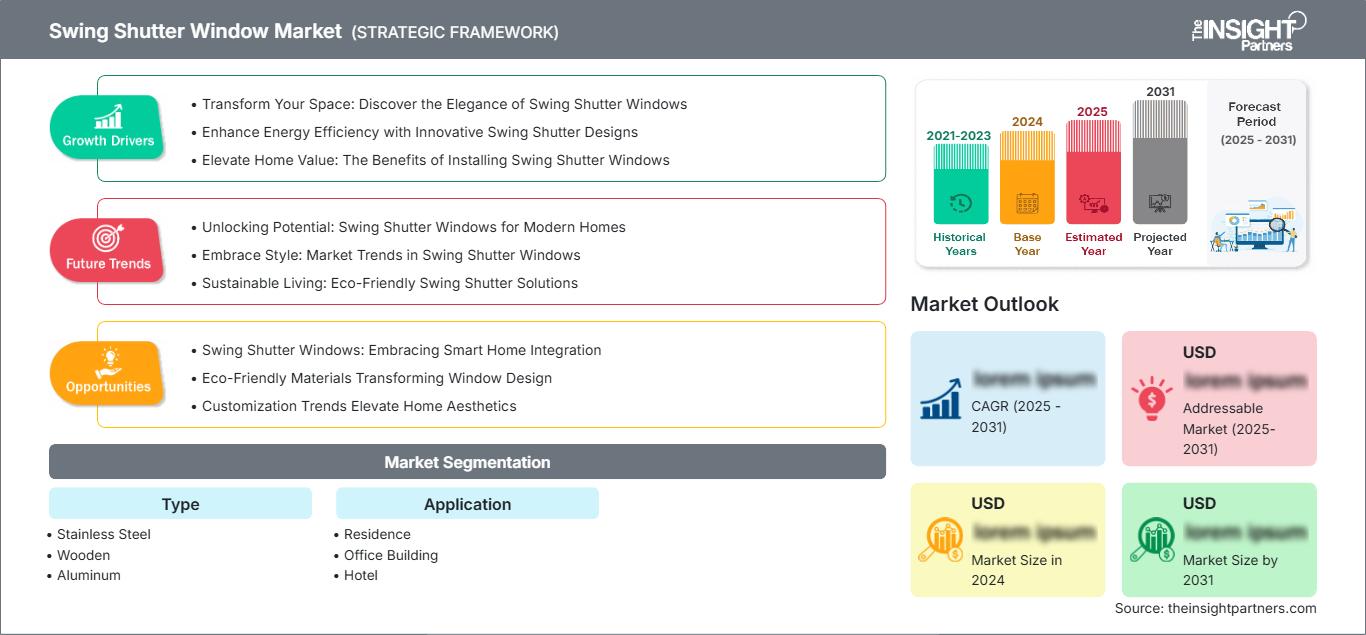
Swing Shutter Window Market: Strategic Insights
Regional Insights
North America Swing Shutter Window Market
North America accounted for an estimated ~26% of the global Swing Shutter Window Market in 2025 and is modeled to expand at ~5% CAGR through 2034. The area gains from an already installed stock of homes, constant renovation needs, and consumer interest in exterior products that blend beauty and toughness. The replacement applications provide a need for products that allow customization to fit the existing openings and not necessitate full facades redesign.
The US constitutes the key regional demand market, with contributions from Canada and Mexico via residential building, renovations, hospitality, and commercial building. Aluminum and PVC products are especially important where buyers value low maintenance and uniformity in finishing. High-end wood shutters continue to play a part in architectural renovations and design-based housing. Customized sizing, installation services, weather protection coating, and compatibility with existing window products will help regional players gain an edge.
U.S. Swing Shutter Window Market
The US represented approximately ~78% of North American Swing Shutter Window Market revenue in 2025 and is modeled to grow at ~5% CAGR through 2034. Demand is driven by residential remodeling, replacement of older window units, construction of new housing and hotels/office renovation. Buyers have become more inclined to consider issues of durability, maintenance, architectural look, privacy, and weatherproofing in conjunction with shutters, rather than seeing shutters merely as ornamental products.
Competitors consist of specialists, window systems producers, fabricators and distributors that sell through regional building markets. PVC and aluminum will be pertinent to standardized and low-maintenance installations; wood is still an important material for premium residences and historic renovation jobs. Commercial usage opens up prospects for custom-made solutions in hospitality and office segments. The presence of both replacement and new construction provides manufacturers with several avenues to increase customer reach independent of the specific building type.
Europe Swing Shutter Window Market
Europe represented approximately ~24% of the global Swing Shutter Window Market in 2025 and is projected to expand at ~5% CAGR through 2034. Italy is the leader in Europe, based on shutter manufacturing experience, external shading architecture, renovation, and window/facade specialist ecosystem. Germany adds energy-conscious building renovation and state-of-the-art window systems manufacturing, while France and Spain have demand for products in residential construction, renovation, and hospitality sectors.
A unique selling proposition for the UK is that renovation, compatibility with architecture, and aesthetics are important factors in making the purchase decision. Italy uses traditional wooden shutters alongside aluminium and other modern types, giving the supplier an option to cater to historical and modern buildings. Germany focuses on performance, system integration, and precision manufacturing. France has demand in residential construction and renovation, whereas Spain is driven by climatic necessity of solar protection and privacy. In all countries, there is an advantage of the replacement market due to existing building renovation needs for improved performance.
European manufacturers are now making more of a tendency to incorporate traditional designs with advanced paint finishes, hardware, and design. Wooden shutters are still strategic when there is a need to preserve the architectural style of buildings, while aluminum and PVC cater to those requiring durability and reduced maintenance. The market continues to be diverse with respect to both material used and applications and not because of an overwhelming product preference across all regions within Europe.
APAC Swing Shutter Window Market
APAC accounted for approximately ~34% of the global Swing Shutter Window Market in 2025 and is expected to expand at ~6% CAGR through 2034, making it the fastest-growing regional market. China is the leading country in Asia Pacific because of its large construction ecosystem, manufacturing base, urban development, and broad availability of aluminum and polymer-based building products. Japan and South Korea contribute through technologically advanced building products and renovation.
India and Australia offer further demand in residential, hospitality, commercial, and replacement applications. New installations are facilitated by industrialization and urbanization, whereas building efficiency programs drive increased emphasis on facades and solar management. Local manufacture, enhanced distribution channels, and product customization are among the factors that will help increase accessibility. The high volume of construction coupled with emerging demand for premium products presents manufacturers with opportunities in both standard and architectural shutters.
Middle East & Africa Swing Shutter Window Market
The Middle East & Africa Swing Shutter Window Market is modeled to expand at ~6% CAGR through 2034. Saudi Arabia is the leading country in the Middle East & Africa regional opportunity, supported by large-scale infrastructure development, residential projects, hospitality investment, and commercial construction. The UAE also provides significant demand through high-value residential, hotel, and commercial developments where facade appearance and solar management are important.
South Africa represents an established market within the region, while Rest of MEA provides opportunities associated with urbanization, residential development, and selective commercial projects. High solar exposure creates a functional role for exterior shading, while construction activity determines installation volumes. Suppliers with corrosion-resistant materials, durable finishes, and products capable of withstanding demanding climatic conditions can address the region's requirements. Aluminum systems are particularly relevant where low maintenance and weather resistance are important purchasing factors.
Segmentation Analysis
Type
Type is a central competitive dimension in the Swing Shutter Window Market because material selection determines durability, appearance, maintenance, fabrication requirements, and price positioning. The type segment is modeled to expand at ~6% CAGR through 2034. Aluminum benefits from structural performance and design flexibility, while PVC addresses cost-conscious and low-maintenance demand. Wooden systems remain important for architectural character, and stainless steel serves applications requiring higher corrosion and mechanical resistance.
- Stainless Steel: Stainless steel shutters serve projects requiring strong corrosion resistance, structural durability, and long service performance. Their strategic relevance is greater in demanding environments where moisture, exposure, hygiene, or intensive use makes material resilience more important than the lowest acquisition cost.
- Wooden: Wooden shutters retain strong appeal in traditional architecture, heritage renovation, premium residences, and design-led projects. Their market position is supported by natural appearance and customization, while advanced coatings and engineered construction help reduce maintenance concerns associated with conventional wood products.
- Aluminum: Aluminum shutters are widely suited to contemporary architecture because they combine low weight, strength, corrosion resistance, finish flexibility, and relatively low maintenance. They can support customized profiles and colors, making them relevant across residential, hospitality, and commercial facade applications.
- PVC: PVC shutters appeal to customers seeking economical, lightweight, and low-maintenance solutions. Their resistance to moisture and ability to support consistent finishes make them suitable for residential applications, particularly where buyers prioritize straightforward maintenance and predictable lifecycle performance.
Application
Application demand is influenced by construction volumes, renovation intensity, building design, security requirements, and the importance assigned to exterior appearance. The application segment is modeled to grow at ~6% CAGR through 2034. Residential projects remain the principal demand base, while offices, hotels, and plants create opportunities for specialized configurations and higher-performance specifications.
- Residence: Residential buildings represent the broadest application base because shutters support privacy, daylight management, security, weather protection, and facade appearance. Replacement and renovation activity further expands demand because homeowners can upgrade exterior systems without completely replacing the surrounding building structure.
- Office Building: Office buildings use shutters where facade appearance, solar control, privacy, and occupant comfort influence design specifications. Renovation projects can create opportunities for modernized systems that integrate with contemporary glazing, facade treatments, and building-management objectives.
- Hotel: Hotels require visually consistent products capable of supporting architectural themes while providing privacy, light management, and weather protection. Boutique and premium hospitality projects can favor customized wood or aluminum solutions, whereas standardized properties may prioritize repeatable dimensions and efficient installation.
- Plant: Plants and industrial facilities require durable shutter systems that can withstand demanding operating environments. Material selection is influenced by exposure, maintenance access, security, and operational requirements, making stainless steel and robust aluminum configurations relevant for selected industrial installations.
Opportunity Snapshot
| Application | Revenue Contribution | Trend Tag | Adoption Stage |
|---|---|---|---|
| Residence | High | Renovation Demand | Mature |
| Office Building | Medium | Facade Modernization | Scaling |
| Hotel | Medium | Premium Shading | Scaling |
| Plant | Low | Durable Enclosures | Emerging |
Swing Shutter Window Market Growth Drivers and Impact Analysis
Expansion of Residential Renovation and Replacement Activity
Residential renovation is a fundamental demand driver because shutter systems can be replaced or upgraded without requiring complete rebuilding of the surrounding property. Older buildings often have products with deteriorated finishes, outdated hardware, weaker weather resistance, or limited design flexibility. Replacement demand therefore creates opportunities for aluminum, PVC, and treated wooden systems with improved durability and contemporary finishes. In mature housing markets, refurbishment provides manufacturers with recurring demand even when new construction moderates. In developing markets, rising household incomes and urban housing development can shift demand toward products with better aesthetics and lifecycle performance. This mechanism broadens the customer base from new-build developers to homeowners, renovation contractors, architects, and window specialists, supporting more diversified sales channels and reducing dependence on new construction alone.
Preference for Durable and Low-Maintenance Exterior Systems
Material performance increasingly affects shutter purchasing decisions as building owners seek products that maintain appearance and functionality under changing weather conditions. Aluminum and PVC can reduce maintenance requirements compared with conventional untreated wood, while stainless steel offers additional corrosion resistance in demanding environments. This shift encourages manufacturers to improve coatings, hardware, surface finishes, and material combinations rather than competing only on initial product price. For architects and developers, durable systems can simplify lifecycle planning and improve consistency across multiple building elevations. The impact is particularly relevant in coastal, high-sun, humid, or heavily polluted locations where degradation can increase maintenance costs. Suppliers able to demonstrate consistent material performance, finish durability, and installation reliability can therefore strengthen their position across both replacement and new-construction projects.
Architectural Demand for Customized Facade Solutions
Contemporary architecture increasingly values customized openings, coordinated facade finishes, and differentiated building identities. This supports shutter manufacturers that can provide multiple colors, dimensions, materials, profiles, and hardware configurations without creating excessive production complexity. Customization is particularly relevant to hotels, premium residences, restoration projects, and commercial buildings where exterior appearance contributes to property positioning. Digital configuration and improved fabrication technologies can help manufacturers manage smaller production batches while maintaining repeatability. The resulting opportunity extends beyond the shutter itself to associated hardware, frames, installation services, and window-system integration. As architects specify increasingly coordinated building envelopes, suppliers with broader customization capabilities can capture higher-value projects and establish closer relationships with designers, contractors, and facade specialists.
Swing Shutter Window Market Future Trends
Greater Integration of Shutters With High-Performance Window Systems
The Swing Shutter Window Market trends are increasingly connected with the wider evolution of energy-efficient window and facade systems. Future product development is likely to place greater emphasis on coordinated shutters, glazing, frames, seals, and hardware rather than treating each component independently. Manufacturers can use this approach to improve installation compatibility and address thermal, acoustic, solar-control, security, and aesthetic requirements within a unified building envelope. This trend should support system suppliers capable of providing engineered combinations and standardized interfaces. It can also increase the importance of technical documentation, installation training, and specification support because architects and contractors need confidence that multiple components will function together. The resulting competitive landscape is likely to favor companies combining material expertise with broader window and facade-system capabilities.
Digital Configuration and More Flexible Product Customization
Digital product configuration is expected to become more important as customers seek customized shutter dimensions, finishes, materials, and hardware while maintaining short project timelines. Online configurators, digital measurement workflows, computer-aided production, and integrated quotation systems can reduce communication errors between manufacturers, distributors, installers, and customers. These capabilities are particularly useful for renovation projects where every opening may have different dimensions. Digital workflows can also support more efficient production planning by linking customer specifications directly with manufacturing processes. Over time, the combination of customization and standardized manufacturing could allow suppliers to serve premium architectural requirements without proportionately increasing production complexity. Companies investing in digital sales and production infrastructure may therefore improve responsiveness while expanding the range of configurations available through established distribution channels.
Swing Shutter Window Market Opportunities
Expansion of Premium Renovation and Heritage-Compatible Products
Premium renovation offers an attractive opportunity because building owners increasingly seek to preserve architectural character while improving functional performance. Manufacturers can address this requirement through wooden shutters with improved coatings, aluminum products replicating traditional profiles, and hybrid systems combining heritage appearance with modern durability. The opportunity extends across historic residences, boutique hotels, heritage commercial properties, and renovation projects where visual compatibility is important. Suppliers can differentiate through custom dimensions, color matching, specialized hardware, and restoration-oriented installation services. Strong relationships with architects, conservation specialists, and renovation contractors can improve specification opportunities. The Swing Shutter Window Market Forecasts can therefore be interpreted through a growing addressable opportunity for suppliers capable of balancing traditional aesthetics with contemporary performance, rather than relying exclusively on standardized new-build products.
Localized Manufacturing for High-Growth Construction Markets
Expansion into high-growth construction markets can create opportunities for suppliers to establish localized fabrication, distribution, and installation capabilities. Asia Pacific provides particularly relevant conditions because construction scale, urbanization, and manufacturing infrastructure can support localized production while reducing transportation and lead-time constraints. Similar strategies can be applied selectively in the Middle East, where climatic exposure and project-specific requirements favor suppliers with local technical support and durable material solutions. Localization can also enable manufacturers to adapt profiles, coatings, hardware, and installation practices to regional requirements. Partnerships with window fabricators, distributors, contractors, and property developers can accelerate market access. Companies that combine standardized core components with region-specific customization can potentially improve cost control while addressing different architectural and climatic requirements.
Recent Developments
- September 2026: REHAU Window Solutions introduced the NUVERA hung/slider window system in North America, using glass-fiber reinforced profiles and a simplified fabrication architecture for residential and light-construction applications. The launch demonstrates continued development toward slimmer profiles, larger glazing areas, and flexible window configurations, supporting the broader movement toward higher-performance building-envelope systems.
- January 2025: WAREMA announced new Xeenos flush-mounted actuators designed to connect external venetian blinds, roller shutters, awnings, and lighting through the Matter connectivity standard. The development highlights the increasing integration of exterior shading with connected-home infrastructure and gives shutter manufacturers an additional route for differentiating products through control and automation capabilities.
- June 2025: Molaro joined the PR FESR FVG 2021–2027 initiative supporting the forest-wood supply chain in internal areas of Friuli Venezia Giulia. The company stated that its investment project primarily concerns machinery, equipment, and software that can be integrated into its existing production setup, illustrating continued investment in manufacturing capabilities relevant to wood-based window and shutter products.
Frequently Asked Questions

- Comprehensive Market Sizing and Forecast Analysis
- Detailed Segmentation Analysis
- In-Depth Market Dynamics Assessment
- Regional and Country-Level Insights
- Competitive Landscape and Company Benchmarking
- Strategic Business Intelligence
Recent Reports
Testimonials

The Insight Partners provided valuable market intelligence that supported our global go-to-market strategy. Their team was professional, responsive, and attentive to our feedback, providing thoughtful analysis and helpful methodological clarifications throughout the project.
Junmo Kim Chief Financial Officer (CFO), Enertech Co., Ltd.
The Insight Partners' SCADA System Market report is comprehensive, with valuable insights on current trends and future forecasts. The team was highly professional, responsive, and supportive throughout. We are very satisfied and highly recommend their services.
RAN KEDEM Partner, Reali Technologies LTDs
I requested a report on a very specific software market and the team produced the report in a few days. The information was very relevant and well presented. I then requested some changes and additions to the report. The team was again very responsive and I got the final report in less than a week.
JEAN-HERVE JENN Chairman, Future Analytica
We worked with The Insight Partners for an important market study and forecast. They gave us clear insights into opportunities and risks, which helped shape our plans. Their research was easy to use and based on solid data. It helped us make smart, confident decisions. We highly recommend them.
PIYUSH NAGPAL Sr. Vice President, High Beam Global
The Insight Partners delivered insightful, well-structured market research with strong domain expertise. Their team was professional and responsive throughout. The user-friendly website made accessing industry reports seamless. We highly recommend them for reliable, high-quality research services
YUKIHIKO ADACHI CEO, Deep Blue, LLC.
This is the first time I have purchased a market report from The Insight Partners.While I was unsure at first, I visited their web site and felt more comfortable to take the risk and purchase a market report.I am completely satisfied with the quality of the report and customer service. I had several questions and comments with the initial report, but after a couple of dialogs over email with their analyst I believe I have a report that I can use as input to our strategic planning process.Thank you so much for taking the extra time and making this a positive experience.I will definitely recommend your service to others and you will be my first call when we need further market data.
JOHN SUZUKI President and Chief Executive Officer, Board Director, BK Technologies
I wish to appreciate your support and the professionalism you displayed in the course of attending to my request for information regarding to infectious disease IVD market in Nigeria. I appreciate your patience, your guidance, and the fact that you were willing to offer a discount, which eventually made it possible for us to close a deal. I look forward to engaging The Insight Partners in the future, all thanks to the impression you have created in me as a result of this first encounter.
DR CHIJIOKE ONYIA MANAGING DIRECTOR, PineCrest Healthcare Ltd.Reason to Buy
- Informed Decision-Making
- Understanding Market Dynamics
- Competitive Analysis
- Identifying Emerging Markets
- Customer Insights
- Market Forecasts
- Risk Mitigation
- Boosting Operational Efficiency
- Strategic Planning
- Investment Justification
- Tracking Industry Innovations
- Aligning with Regulatory Trends





 Get Free Sample for