
Swiss Turn System Market Growth, Trends & Forecast by 2034
Coverage: By Type (0-10mm, 11-20mm, 21-30mm, 31-35mm, Above 36 mm); Application (Healthcare, Aerospace and Defense, Electronics, Others) , and Geography (North America, Europe, Asia Pacific, and South and Central America)
- Status : Data Released
- Report Code : TIPRE00026922
- Category : Manufacturing and Construction
- No. of Pages : 150
- Available Report Formats :


- Last update date : October 13, 2026


2025 Market Size
US$ 623.4 Mn
Base year value
2034 Forecast
US$ 966.8 Mn
Projected by 2034
CAGR 2026-2034
5.0 %
Growth rate
Addressable Market
US$ 7,217.66 Mn
(2026-2034)
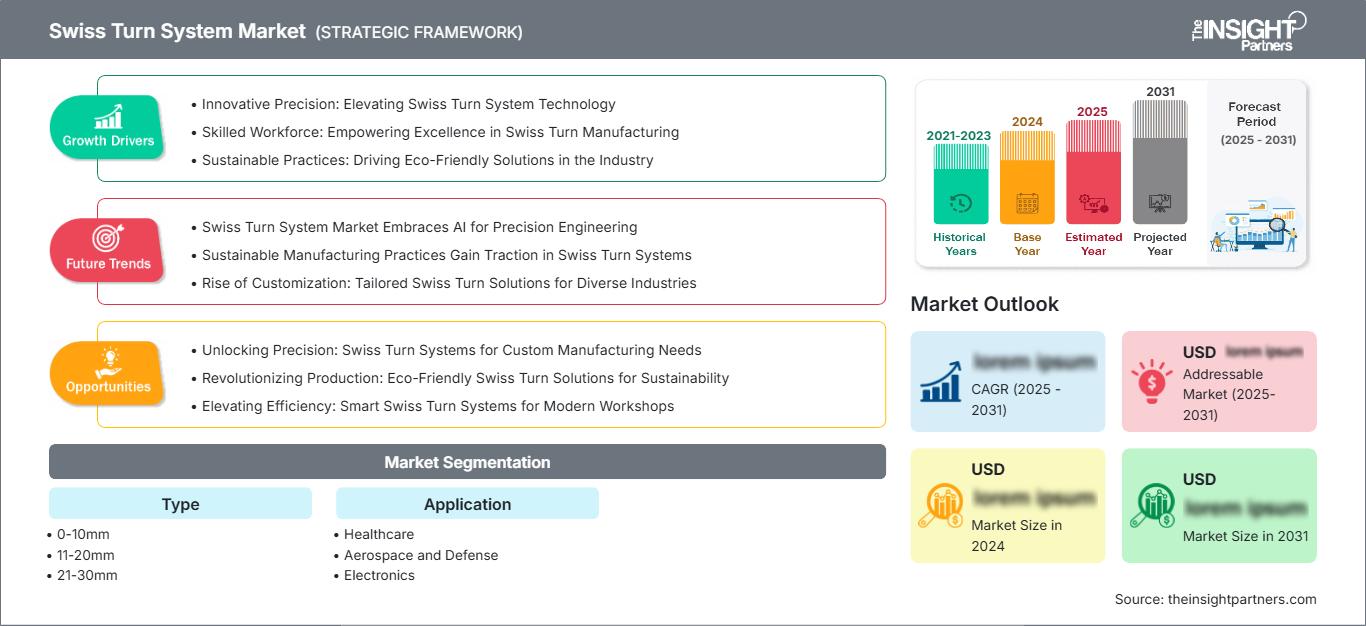
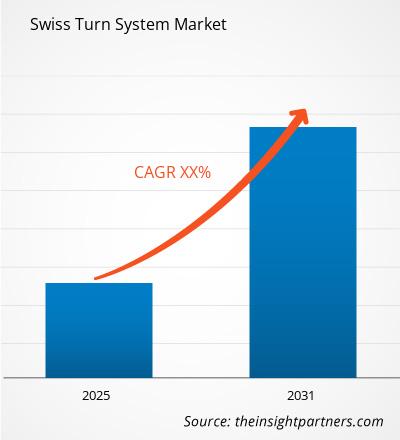
The Swiss Turn System Market size is estimated at US$ 623.4 Million in 2025 and is projected to reach US$ 966.8 Million by 2034, registering a CAGR of 5.00% from 2026 to 2034. The market covers Swiss-type precision turning systems used for small-diameter, high-accuracy component production, with demand concentrated across healthcare, aerospace and defense, and electronics applications. The market is shaped by automation, multi-axis machining, tighter component tolerances, shorter production cycles, and increasing requirements for repeatable machining of complex parts.
North America represents an established demand center, supported by precision manufacturing, medical-device production, aerospace programs, and replacement of conventional machining equipment with automated systems. The region is expected to record a ~4% CAGR through 2034. Increasing use of digitally connected machine tools, reshoring of selected precision-component production, and demand for unattended machining are strengthening equipment investment.
Swiss Turn System Market Assessment and Insights
Regional Outlook
- North America: ~22% of the global Swiss Turn System Market share in 2025 | ~4% CAGR through 2034. Market position: North America remains a major precision-machining market, supported by medical-device manufacturing, aerospace component production, automation investments, and demand for shorter production cycles and domestically sourced high-tolerance components.
- US: ~82% of North American market revenue in 2025 | ~4% CAGR through 2034. Market position: The US represents the principal North American demand center, supported by established medical, aerospace, defense, electronics, and precision-engineering clusters. Investment increasingly emphasizes automated machining, productivity, and repeatability.
- Europe: ~21% of the global market in 2025 | ~4% CAGR through 2034. Market position: Europe has a mature precision-machining ecosystem, with Switzerland, Germany, Italy, France, and the UK supporting demand. Germany represents the leading country in Europe through its machinery, automotive, aerospace, medical, and industrial-component base.
- Asia Pacific: ~53% of the global market in 2025 | ~6% CAGR through 2034. Market position: Asia Pacific is the largest and fastest-growing regional market, supported by Japan's machine-tool expertise and expanding manufacturing capacity in China, South Korea, India, and Southeast Asia.
Segment Outlook
- Type: ~30% Share in 2025 | ~5% CAGR through 2034. Market position: Small-diameter configurations represent an important portion of demand because Swiss turning is particularly suited to slender, intricate components requiring close dimensional control, automated feeding, high spindle speeds, and efficient repeat production.
- Application: ~39% Share in 2025 | ~5% CAGR through 2034. Market position: Application demand is anchored by healthcare, aerospace and defense, and electronics, where component complexity, tolerance requirements, traceability, and repeatability increase the value of Swiss-type machining systems.
Competitive Coverage
Kremin Inc., KSI Swiss, Nakamura-Tome Co., Ltd., Hyundai WIA Corporation, Bolton Group, Inc., JARNG YEONG ENTERPRISE CO., LTD., EMCO GmbH, Kent Industrial USA, Fair Friend Group, Citizen Machinery Co., Ltd., Tsugami Corporation
Methodology
The Insight Partners follows Data Collection & Secondary Research, Primary Research, Data Analysis, and Data Triangulation & Final Review to validate market estimates and insights.
Source: The Insight Partners' analysis based on proprietary research, government publications, company annual reports, investor presentations, industry databases, and expert interviews.
The process of precision turning has moved from automatic lathes to CNC-controlled Swiss-type lathe machines that have the ability to perform the processes of turning, drilling, milling, threading, and back working. Modern machines now incorporate a number of other features such as multi-spindle, driven tool, Y-axis or B-axis operation, automated bar feeding, thermal compensation, and computerized program generation. This helps in minimizing secondary operations and achieving consistency in machining complicated parts. An example is Citizen Machinery, which refers to its Cincom range of products as sliding headstock CNC automatic lathes suitable for precise machining, whereas the latest introductions by Star Micronics demonstrate the ongoing development of Swiss-type machines in the categories of 20 mm and 32 mm machining.
Moving into the future, investments will most likely be focused on flexible automation, interconnected manufacturing, and machines that can handle complicated parts without multiple setups. The Asian manufacturing centers are increasing their precision production capability, whereas the European and North American manufacturers are investing in productivity, labor efficiency, and machining of high-value parts. The digitalization of machining technology is also changing the purchase criterion, as software, machine monitoring, machine automation, tools, and service considerations are becoming equally important.
Swiss Turn System Market Report Scope
| Report Attribute | Details |
|---|---|
| Market size in 2025 | US$ 623.4 Million |
| Market Size by 2034 | US$ 966.8 Million |
| Global CAGR (2026 - 2034) | 5.0% |
| Historical Data | 2021-2024 |
| Forecast period | 2026-2034 |
Swiss Turn System Market Analysis
Market Growth Outlook is dependent on the trend towards high precision and high productivity machining. Demand for this system arises due to the need of producing components that require small or slender parts with tolerance and reduced manual handling. Value Chain participants include machine tool producers, control system suppliers, tooling, bar stock producers, automation firms, distributors, integrators, and maintenance firms. Machine capability is now being judged on productivity of the entire process not just spindle capability.
The Swiss Turn System Market forecast shows that supply drivers arise from a fairly specialized manufacturing base globally. Companies from Japan, Europe, South Korea, Taiwan, and USA take part in the production of machine tools, control systems, tooling, automation, and distribution. Product differentiation is now arising from multi-axis capability, tool capacity, cycle time reduction, chip handling, energy efficiency, programming, and integration with automated material handling. The existing product range of Citizen proves this point in terms of its sliding headstock systems and related fixed headstock machines.
Competitors include machine-tool experts and diversified manufacturers such as Nakamura-Tome, Hyundai WIA, EMCO, and Fair Friend Group that provide machines for general turning and machining operations, whereas specialists like KSI Swiss and JARNG YEONG ENTERPRISE provide specialized solutions for precise turning applications. Competition among Citizen Machinery and Tsugami relies on comprehensive lines of Swiss-type machines, whereas Star Micronics develops further its product line. As an example, Star's 2025 SP-32 machine allows machining of workpieces up to 32 mm and is aimed at manufacturing components for IT infrastructure, automotive, hydraulic, pneumatic, and general machinery industries.
Thus, the investment will go to machines with precision capabilities and independence in production process. It is required to find machines that allow automated manufacturing, fast changeover, and process control and do not require much setup. Application engineering plays an important role in strategic positioning since medical, aerospace, and electronics components can differ dramatically in terms of tooling approach, materials used, tolerances, and volumes of manufacturing.
● REPORT CUSTOMIZATION
Tailor This Report To Align With Your Specific Business Requirements
This report can be customized to align precisely with your business objectives, scope, and target markets. Customization options include tailored segmentation, geography, competitive analysis, and strategic insights to support informed decision-making.
Customize This Report →WHAT YOU CAN ADJUST
- ● Segmentations
- ● Geography
- ● Competitive Analysis
- ● Language Preferences
Swiss Turn System Market: Strategic Insights
Regional Insights
North America Swiss Turn System Market
North America accounted for approximately ~22% of the global Swiss Turn System Market in 2025 and is expected to expand at a ~4% CAGR through 2034. Demand is driven by the US precision manufacturing market base, namely medical devices, aerospace, defense, electronics, and industrial components. Manufacturing is more and more adopting Swiss machinery for cases where small, intricate parts have to be machined and need repeatability and low secondary work.
In terms of the investment climate of the region, there are considerations of labor supply, certain manufacturing processes being reshored, and increased machine usage. Manufacturing activities in Canada and Mexico play an important role in the overall regional eco-system, while US manufacturers, distributors, and machine tool integrators ensure that machinery can be supplied and serviced. North American customers usually focus a lot on automation, process reliability, machine availability, and integration with the production management system.
U.S. Swiss Turn System Market
The US represented approximately ~82% of North American Swiss Turn System Market revenue in 2025 and is expected to grow at a ~4% CAGR through 2034. The country's demand base is anchored by medical-device manufacturing, aerospace and defense production, electronics, and specialized industrial machinery. These applications require precision-machined shafts, connectors, pins, fasteners, surgical components, and other intricate parts.
American ecosystem comprises machine tool distributors, contract manufacturers, components makers, automation integrators, and tooling specialists. Purchasing is more and more based on an assessment of the whole production process, such as bar feeding, tool handling, measurement, chip handling, and lights-out manufacturing. Medical machining pays a lot of attention to repeatability and process reliability, while machining of difficult materials and complicated geometries is essential for aerospace and defense industries. Both of these factors provide justification for further growth of Swiss-type machines.
Europe Swiss Turn System Market
Europe represented approximately ~21% of the global Swiss Turn System Market in 2025 and is projected to expand at a ~4% CAGR through 2034. Germany is the leading country in Europe, supported by its extensive machine-tool, automotive, industrial machinery, medical, and precision-engineering ecosystem. Switzerland also remains strategically important because of its historical precision-machining and watchmaking capabilities.
Germany's demand is supported by advanced manufacturing and a large supplier network, while Italy has a significant base of machinery and precision-component producers. France contributes through aerospace, defense, medical, and industrial manufacturing, and the UK has demand linked to aerospace, medical technology, electronics, and specialist engineering. Spain contributes through automotive and industrial production. Across these markets, Industry 4.0 adoption is increasing the importance of connected machine tools, automated material handling, digital monitoring, and integrated production cells.
European manufacturers also place strong emphasis on machine efficiency, environmental performance, and flexible production. Swiss-type equipment is particularly relevant where manufacturers must produce complex parts in relatively high-mix environments without sacrificing dimensional consistency. The region's mature industrial ecosystem therefore supports replacement demand as well as investment in higher-productivity systems.
APAC Swiss Turn System Market
Asia Pacific held approximately ~53% of the global Swiss Turn System Market in 2025 and is expected to record a ~6% CAGR through 2034, making it the fastest-growing region. Japan is the leading country in Asia Pacific, supported by its machine-tool manufacturing base, precision-engineering capabilities, and established ecosystem of CNC, tooling, automation, and component suppliers.
China is expanding production capacity across electronics, industrial machinery, automotive, and precision components, while South Korea benefits from electronics, automotive, and industrial manufacturing. India is developing its precision-manufacturing capabilities as industrial localization and advanced manufacturing investments increase. Australia represents a smaller but specialized demand center. The region's growth is supported by manufacturing expansion, automation adoption, export-oriented production, and continued investment in higher-accuracy equipment.
Middle East & Africa Swiss Turn System Market
Middle East and Africa represents a smaller portion of global demand, with growth expected at a ~4% CAGR through 2034. Saudi Arabia and the UAE are important regional investment centers because industrial diversification programs are encouraging advanced manufacturing, engineering services, and localized production. South Africa provides an established machining and industrial base serving mining, automotive, engineering, and defense-related applications.
Demand across the region remains concentrated in specialized industrial applications rather than broad-based Swiss machining deployment. Saudi Arabia's manufacturing diversification initiatives and the UAE's industrial development programs can support future adoption where precision-component production is localized. South Africa's installed machining ecosystem provides a service and manufacturing foundation. Equipment suppliers are therefore likely to prioritize distributor partnerships, application support, training, and maintenance capabilities alongside direct machine sales.
Segmentation Analysis
Type
The Type segment is expected to register a ~5% CAGR from 2026 to 2034. Demand varies substantially according to component diameter, material, tolerance, production volume, and machining complexity. Smaller configurations remain closely associated with medical, electronics, instrumentation, and miniature precision components, whereas larger systems address increasingly complex industrial and aerospace parts. The broader direction is toward machines that combine diameter flexibility with multi-axis machining, automation, and reduced setup requirements.
- 0-10mm: 0-10mm systems serve miniature components requiring tight dimensional control and high-speed machining. Their strategic importance is strongest in medical, electronics, instrumentation, and specialized precision applications where small component geometry makes Swiss-type guidance particularly valuable.
- 11-20mm: 11-20mm systems address a broad range of precision components and provide a balance between miniature-part capability and production flexibility. Demand benefits from medical, electronics, automotive, and industrial applications requiring repeatable high-volume machining.
- 21-30mm: 21-30mm machines extend Swiss machining toward larger components while retaining the process advantages of guided turning. They are relevant for industrial, aerospace, hydraulic, pneumatic, and automotive component manufacturers seeking fewer secondary operations.
- 31-35mm: 31-35mm systems support larger precision parts and complex multi-operation machining. Their strategic relevance is increasing as manufacturers seek to transfer more operations into a single automated platform and reduce work-in-process between turning and secondary machining.
- Above 36 mm: Above 36 mm configurations address applications requiring larger bar capacity and greater machining envelope. Adoption is more specialized and depends on component geometry, material, production volume, and the economic advantage of combining turning with milling and drilling.
Application
The Application segment is projected to record a ~5% CAGR through 2034. Healthcare, aerospace and defense, and electronics each require precision components but differ in production economics and qualification requirements. Healthcare emphasizes repeatability and process consistency, aerospace and defense emphasize complex geometries and difficult materials, while electronics emphasizes miniaturization and high-volume precision. These differences support continued demand for application-specific machine configurations.
- Healthcare: Healthcare applications require precision components for instruments, implants, connectors, and other medical-device assemblies. Demand is supported by strict manufacturing consistency, complex miniature geometries, material requirements, and increasing automation in regulated production environments.
- Aerospace and Defense: Aerospace and Defense applications require tight-tolerance components, lightweight materials, specialized alloys, and repeatable machining. Swiss systems are strategically relevant when manufacturers seek complex parts with fewer setups and improved process consistency.
- Electronics: Electronics applications emphasize miniaturization, dimensional accuracy, high production volumes, and repeatability. Swiss turning is relevant for connectors, pins, housings, shafts, and other small precision components used in increasingly compact electronic systems.
Opportunity Snapshot
| Application | Revenue Contribution | Trend Tag | Adoption Stage |
|---|---|---|---|
| Healthcare | High | Medical Precision | Mature |
| Aerospace and Defense | Medium | Complex Components | Scaling |
| Electronics | Medium | Miniaturized Parts | Scaling |
Swiss Turn System Market Growth Drivers and Impact Analysis
Automation and Labor Productivity
Manufacturers are increasingly seeking machining platforms that can sustain high utilization while reducing dependence on manual intervention. Swiss-type systems naturally support automation because bar stock can be continuously supplied and complex operations can be performed within a single machining cycle. Automated bar feeders, tool monitoring, robotic handling, and digital production monitoring further increase machine autonomy. The market impact is a shift in equipment purchasing from standalone turning capability toward integrated production cells. For contract manufacturers, higher unattended utilization can improve capacity without requiring proportional increases in labor. For OEM component suppliers, automation can support repeatability across large production batches. Suppliers that combine machining hardware with software, material handling, and process-support capabilities can therefore address a broader share of the customer's productivity requirement.
Rising Precision Requirements in Medical Manufacturing
Healthcare manufacturing is creating sustained demand for equipment capable of producing intricate components with consistent dimensional performance. Medical devices frequently include small shafts, pins, connectors, screws, instruments, and other components where tolerance control and repeatability influence downstream assembly. Swiss-type machines are suited to these requirements because the guided-workpiece architecture stabilizes machining of slender components. Increasing device complexity also favors multi-axis equipment capable of completing multiple operations in fewer setups. The market impact extends beyond machine purchases to tooling, inspection, process validation, and service requirements. Machine suppliers that provide application engineering for medical materials and geometries can strengthen customer retention because qualification and process stability are important considerations in regulated manufacturing environments.
Complex Materials and Multi-Operation Machining
Aerospace, defense, medical, and high-performance electronics components increasingly involve difficult-to-machine materials or geometries that raise the cost of conventional multi-step processing. Swiss-type platforms with driven tools, multiple axes, and advanced control functions can consolidate turning, drilling, threading, milling, and back-working operations. This reduces intermediate handling and can improve positional consistency between features. The market impact is particularly relevant for high-value components where scrap, rework, and setup time materially affect production economics. As machining strategies become more sophisticated, buyers are also evaluating spindle performance, tool capacity, chip management, thermal behavior, and programming support. Equipment suppliers therefore face increasing pressure to demonstrate measurable process improvements rather than relying solely on machine specifications.
Swiss Turn System Market Future Trends
Integrated Digital Machining and Predictive Production
The Swiss Turn System Market trends show that future systems are expected to incorporate deeper connectivity between machine controls, production-management platforms, inspection systems, and maintenance workflows. Real-time monitoring of spindle conditions, tool wear, thermal behavior, energy consumption, and production cycles can help manufacturers identify process deviations before they create significant quality or downtime issues. For Swiss-type machining, digital monitoring is particularly relevant because complex multi-tool operations can make process diagnosis more difficult when several cutting operations occur within a single cycle. Suppliers are likely to differentiate through software ecosystems that simplify machine setup, production tracking, remote support, and process optimization. This trend could also increase recurring software and service opportunities alongside conventional equipment sales.
Expansion of Flexible Multi-Axis Platforms
The next phase of product development is likely to emphasize flexibility rather than simply increasing spindle speed or machine size. Manufacturers increasingly need one platform to handle multiple component geometries and production batches while minimizing changeover time. Multi-axis configurations, additional tooling positions, programmable guide-bush arrangements, and automated setup functions can improve this flexibility. Star Micronics' 2025 product introductions illustrate how suppliers are extending Swiss-type platforms across different machining diameters and industry requirements. The implication is a gradual convergence between Swiss turning and broader mill-turn capabilities, particularly for manufacturers seeking to complete more operations without transferring components between machines.
Swiss Turn System Market Opportunities
Application-Specific Machining Solutions
A significant commercial opportunity exists in developing application-specific packages rather than selling Swiss machines as generic capital equipment. Medical manufacturers may require specialized tooling, process monitoring, automation, and documentation, while aerospace customers may prioritize difficult-material machining and complex multi-axis operations. Electronics producers may instead emphasize cycle time, miniaturization, and high-volume automation. Suppliers can respond through packaged machine configurations, application-engineering services, tooling partnerships, and validated process templates. This approach can also shorten customer commissioning periods and strengthen differentiation in markets where core machine specifications increasingly converge. Regional service centers and local application teams can further improve adoption by reducing implementation risk for manufacturers entering Swiss-type machining for the first time.
Automation and Service Ecosystems in Emerging Manufacturing Hubs
Emerging manufacturing centers provide opportunities for suppliers that can combine machine sales with training, automation integration, maintenance, and process engineering. India, China, South Korea, Southeast Asia, and selected Middle Eastern markets are expanding advanced manufacturing capabilities, but purchasing decisions can be constrained by shortages of specialized machining expertise. Suppliers can address this gap through application laboratories, distributor training, remote diagnostics, operator education, and integrated automation packages. The opportunity is broader than machine-unit sales because lifecycle services can generate recurring revenue and improve equipment utilization. Partnerships with local contract manufacturers and component producers can also help machine-tool suppliers demonstrate applications and build references in markets where Swiss machining remains less established than conventional CNC turning.
Recent Developments
- September 2025: Star Micronics Co., Ltd. introduced the SP-32 Swiss-type automatic lathe, extending the SP Series to machining diameters of up to 32 mm. The company stated that the machine is designed for diverse component requirements, including IT infrastructure equipment, automotive components, hydraulic and pneumatic equipment, and general machinery. The product adds capacity while retaining the series' tooling and software-oriented configuration.
- April 2025: Star Micronics Co., Ltd. launched the SR-20RIV Type E Swiss-type automatic lathe with a maximum machining diameter of 20 mm. The company positioned the model for a broad range of industries, including medical equipment, while building on the established SR-20RIV platform. Star reported cumulative sales exceeding 2,400 machines for the two earlier SR-20RIV types.
- January 2026: Citizen Machinery Co., Ltd. listed the BND51SY as a January 2026 product release in its CNC automatic lathe catalog portfolio. The company continues to offer Cincom sliding-headstock and Miyano fixed-headstock platforms, reflecting a strategy centered on precision machining, automation, and broader production workflow support. Its 2025 product guide and subsequent catalog updates demonstrate continued portfolio development across machining capacities.
Frequently Asked Questions

- Comprehensive Market Sizing and Forecast Analysis
- Detailed Segmentation Analysis
- In-Depth Market Dynamics Assessment
- Regional and Country-Level Insights
- Competitive Landscape and Company Benchmarking
- Strategic Business Intelligence
Recent Reports
Testimonials

The Insight Partners provided valuable market intelligence that supported our global go-to-market strategy. Their team was professional, responsive, and attentive to our feedback, providing thoughtful analysis and helpful methodological clarifications throughout the project.
Junmo Kim Chief Financial Officer (CFO), Enertech Co., Ltd.
The Insight Partners' SCADA System Market report is comprehensive, with valuable insights on current trends and future forecasts. The team was highly professional, responsive, and supportive throughout. We are very satisfied and highly recommend their services.
RAN KEDEM Partner, Reali Technologies LTDs
I requested a report on a very specific software market and the team produced the report in a few days. The information was very relevant and well presented. I then requested some changes and additions to the report. The team was again very responsive and I got the final report in less than a week.
JEAN-HERVE JENN Chairman, Future Analytica
We worked with The Insight Partners for an important market study and forecast. They gave us clear insights into opportunities and risks, which helped shape our plans. Their research was easy to use and based on solid data. It helped us make smart, confident decisions. We highly recommend them.
PIYUSH NAGPAL Sr. Vice President, High Beam Global
The Insight Partners delivered insightful, well-structured market research with strong domain expertise. Their team was professional and responsive throughout. The user-friendly website made accessing industry reports seamless. We highly recommend them for reliable, high-quality research services
YUKIHIKO ADACHI CEO, Deep Blue, LLC.
This is the first time I have purchased a market report from The Insight Partners.While I was unsure at first, I visited their web site and felt more comfortable to take the risk and purchase a market report.I am completely satisfied with the quality of the report and customer service. I had several questions and comments with the initial report, but after a couple of dialogs over email with their analyst I believe I have a report that I can use as input to our strategic planning process.Thank you so much for taking the extra time and making this a positive experience.I will definitely recommend your service to others and you will be my first call when we need further market data.
JOHN SUZUKI President and Chief Executive Officer, Board Director, BK Technologies
I wish to appreciate your support and the professionalism you displayed in the course of attending to my request for information regarding to infectious disease IVD market in Nigeria. I appreciate your patience, your guidance, and the fact that you were willing to offer a discount, which eventually made it possible for us to close a deal. I look forward to engaging The Insight Partners in the future, all thanks to the impression you have created in me as a result of this first encounter.
DR CHIJIOKE ONYIA MANAGING DIRECTOR, PineCrest Healthcare Ltd.Reason to Buy
- Informed Decision-Making
- Understanding Market Dynamics
- Competitive Analysis
- Identifying Emerging Markets
- Customer Insights
- Market Forecasts
- Risk Mitigation
- Boosting Operational Efficiency
- Strategic Planning
- Investment Justification
- Tracking Industry Innovations
- Aligning with Regulatory Trends





 Get Free Sample for