
Thermal Spray Market Size, Trends & Growth by 2034
Coverage: by Product Type (Coatings, Material, Thermal Spray Equipment); Thermal Spray Coatings and Finishes (Combustion, Electric Energy); End User (Aerospace, Industrial Gas Turbines, Automotive, Electronics, Oil and Gas, Medical Devices, Energy and Power, Other End-user Industries) , and Geography (North America, Europe, Asia Pacific, and South and Central America)
- Status : Data Released
- Report Code : TIPRE00012684
- Category : Manufacturing and Construction
- No. of Pages : 150
- Available Report Formats :


- Last update date : July 13, 2026


2025 Market Size
US$ 11.93 Bn
Base year value
2034 Forecast
US$ 20.36 Bn
Projected by 2034
CAGR 2026-2034
6.12 %
Growth rate
Addressable Market
US$ 146.21 Bn
(2026-2034)
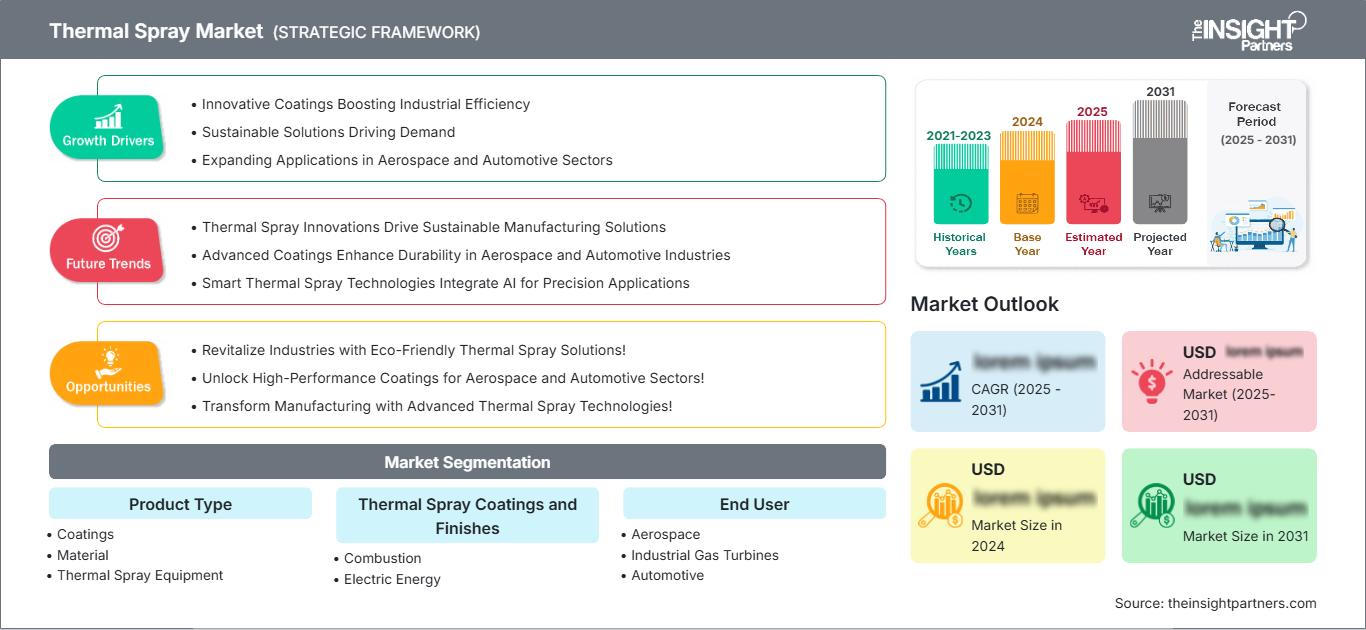
The Thermal Spray market size was valued at US$ 11.93 Billion in 2025 and is projected to reach US$ 20.36 Billion by 2034, growing at a CAGR of 6.12% from 2026 to 2034. Demand is supported by high-performance surface engineering needs across aerospace, industrial gas turbines, automotive, electronics, oil and gas, medical devices, energy and power, and other end-user industries where durability and heat resistance are critical.
North America continues to be an important hub for adoption, with the thermal spray market estimated to account for 27-30% of the market in 2025 and register a CAGR of 5.7-6.3% until 2034. The market size for thermal spray in North America is bolstered by aerospace engine refurbishing, defense maintenance, medical implant coating, and gas turbine efficiency initiatives.
Thermal Spray Market Assessment and Insights
- North America accounted for 27–30% share in 2025 and is expected to grow at a 5.7–6.3% CAGR between 2026–2034, supported by aerospace MRO, defense overhaul, and high-value turbine component refurbishment.
- US represented 78–82% of North America in 2025 and is projected to expand at a 5.8–6.4% CAGR between 2026–2034, led by aviation, energy, and medical device applications.
- Europe held 23–26% share in 2025 and is forecast to grow at a 5.4–6.0% CAGR between 2026–2034, with Germany, the UK, France, Italy, and Spain leading demand.
- Asia Pacific captured 31–34% share in 2025 and is projected to advance at a 6.7–7.4% CAGR between 2026–2034, driven by China, Japan, South Korea, India, and Australia.
- Largest Segment Coatings held 55–59% of the Thermal Spray market share in 2025 and is expected to grow at a 5.8–6.4% CAGR between 2026–2034 due to repeat maintenance and OEM use.
- High Growth Segment Medical devices held 7–9% market share in 2025 and is projected to grow at a 7.0–7.8% CAGR between 2026–2034 as implant coating adoption expands.
- Key companies analyzed in detail: 3M Company, A&A Coatings, Bodycote plc, Chromalloy Gas Turbine LLC, Fisher Barton Group, H.C. Starck Tungsten GmbH, Höganäs AB, Kennametal Inc., Linde plc, Oerlikon Metco.
Source: The Insight Partners' analysis based on proprietary research, government publications, company annual reports, investor presentations, industry databases, and expert interviews.
Thermal Spray technology has evolved into a controlled process for surface engineering rather than merely depositing metals to repair damaged parts. Various thermal spray techniques, such as plasma spray, HVOF, flame spray, electric arc, and cold spray, are being combined with robotics, closed-loop powder feed systems, and digital record keeping. The production environment is moving towards certification cells for coatings, which involve traceability of feedstocks, repeatable microstructures, and faster qualification.
Capital investments will be made based on component life cycle extension economics, not solely on the production of new systems. The rising number of manufacturing centers in the Asia Pacific and the Middle East is driving the installation of thermal spraying equipment near aircraft, power, energy, and precision manufacturing facilities. Regulatory pressure on hard chrome replacement, efficiency goals in turbines, and medical device biocompatibility requirements will continue expanding the Thermal Spray Market size by providing measurable tailwinds for qualified suppliers.
Thermal Spray Market Report Scope
| Report Attribute | Details |
|---|---|
| Market size in 2025 | US$ 11.93 Billion |
| Market Size by 2034 | US$ 20.36 Billion |
| Global CAGR (2026 - 2034) | 6.12% |
| Historical Data | 2021-2024 |
| Forecast period | 2026-2034 |
Thermal Spray Market Analysis
Demand drivers are linked with those that come into contact with heat, corrosion, abrasion, cavitation, and frequent mechanical stress. The growth of the thermal spray market is aided by the recovery in aviation air traffic, maintenance cycles for gas turbines, and industrial players' desire to reduce replacement costs. The International Air Transport Association stated that air traffic would continue to grow until 2025.
The value chain consists of raw materials and wire supply, equipment, process gases, masks, coatings, inspection, and post-coating finishing. Supply conditions provide an advantage to those who can qualify materials and processes according to aerospace, medical, and power generation industry requirements. H.C. Starck Tungsten GmbH, Höganäs AB, Kennametal Inc., Linde plc, and 3M Company continue to play significant roles in this regard.
Competitive positioning is shaped by qualification depth, installed base, repair turnaround, and process automation. Thermal Spray Market analysis indicates a balanced field where Oerlikon Metco provides equipment and materials, Bodycote plc scales certified coating services, Chromalloy Gas Turbine LLC focuses on turbine repair, and A&A Coatings serves specialist industrial applications. Fisher Barton Group adds application depth in wear-intensive components.
Current investment trends are shifting toward automated kiosks, inspection integration, IIoT platforms, and service facilities across regions. The clients want those suppliers who mitigate the qualification risks, ensure process repeatability, and offer a multi-process coatings portfolio. The future lies in differentiating from the rest not just by providing a particular spraying technology, but by having an effective manufacturing system with materials science, fixtures, robots, finishing, and NDE.
● REPORT CUSTOMIZATION
Tailor This Report To Align With Your Specific Business Requirements
This report can be customized to align precisely with your business objectives, scope, and target markets. Customization options include tailored segmentation, geography, competitive analysis, and strategic insights to support informed decision-making.
Customize This Report →WHAT YOU CAN ADJUST
- ● Segmentations
- ● Geography
- ● Competitive Analysis
- ● Language Preferences
Thermal Spray Market: Strategic Insights
Regional Insights
North America Thermal Spray
North America generated 27–30% share in 2025 and is projected to expand at a 5.7–6.3% CAGR through 2034. The regional Thermal Spray Market share is anchored by aircraft engine overhaul, landing gear refurbishment, industrial gas turbine maintenance, and orthopedic implant manufacturing. Service companies operate near OEMs, tiers, and defense depots, thereby reducing qualification periods and accelerating component turnaround.
Structural demand comes from the North American focus on extending asset lifespans and regulations governing coating replacement. Restrictions on hard chromium coatings, the economics of turbine blade repairs, and requirements for surface finishes in medical devices are driving the adoption of HVOF, plasma spraying, and cold spray technologies. Lack of skilled labor is also driving automation.
U.S. Thermal Spray Market
The U.S. accounts for 78-82% of North America in 2025 and is forecast to grow at a 5.8-6.4% CAGR during 2026-2034. The demand for coatings in this region is dominated by commercial aerospace, military sustainment, power turbines, oil and gas components, semiconductor processing tools, and orthopedic implants. Qualification requirements for domestic use include approvals such as NADCAP, ISO, and the customer.
The presence of companies in the market is widespread, including Oerlikon Metco, Bodycote plc, Chromalloy Gas Turbine LLC, Linde plc, 3M Company, Kennametal Inc., Fisher Barton Group, and A&A Coatings, which provide materials, gases, machinery, and shop services. Trends in applications include thermal barrier coatings for engines, carbide coatings for abrasion protection, titanium porosity for implants, and conductive coatings for electronics.
Europe Thermal Spray Market
Europe held 23–26% share in 2025 and is projected to grow at a 5.4–6.0% CAGR during 2026–2034. Germany remains the leading country because of turbine, automotive, industrial machinery, and precision manufacturing depth. The UK benefits from aerospace MRO and defense programs, while France shows steady coating demand from aviation, energy, and medical devices.
Demand from Italy and Spain is boosted by power generation applications, oil and gas machinery, and repair services to the industry. The regulatory attitude towards hazardous plating alternatives in Europe encourages the use of HVOF and plasma spray as substitutes for hard chrome coating. The regional manufacturers are developing automated spray booths and low-emission spraying procedures.
APAC Thermal Spray Market
The APAC region held the highest market share, 31%-34%, in 2025, and its CAGR was predicted to reach 6.7-7.4%. It represents the fastest-growing region. Demand is driven by China due to the process of aviation localization, electronics, power equipment, and heavy industry. Contributions from Japan and South Korea include turbine production, electronics, semiconductors, and automobile production.
India is investing in expanding capacity in the aerospace, rail transport, energy, and medical device sectors, while Australia is investing in mining, defense maintenance, and energy grid coating applications. The focus on domestic production, power grid stability, and export-grade component coating is increasing the need for skilled coating solutions. Localization of powder, gas, and inspection capabilities will enhance the position of Thermal Spray Market share across the region.
Middle East & Africa Thermal Spray Market
Middle East & Africa is forecast to grow at a 5.9–6.6% CAGR through 2034. Saudi Arabia is the leading country, supported by energy, petrochemical, aviation, and industrial localization programs. The UAE adds aircraft maintenance, turbine services, and precision manufacturing, while South Africa contributes mining, power, and repair applications.
The rest of the MEA demand is attributed to oilfield machinery, desalination plants, power generation facilities, and infrastructure redevelopment. Anti-corrosive, anti-erosion, and thermal coatings extend maintenance intervals by enabling equipment to operate in difficult conditions. Local service certification is required for regional opportunities.
Segmentation Analysis
Product Type
Product Type is projected to grow at a 5.9–6.6% CAGR from 2026 to 2034. Thermal Spray scope across this segment covers recurring coating demand, feedstock replacement, and capital equipment upgrades. Coatings dominate because customers repeatedly restore high-value parts, while materials and equipment benefit as manufacturers automate production and broaden certified process windows.
- Coatings represent the largest revenue contributor because aerospace, turbine, medical, and industrial customers use coatings repeatedly for protection, dimensional restoration, and performance enhancement.
- Material demand follows powder, wire, ceramic, carbide, and metal alloy consumption, with traceability and particle consistency becoming strategic for regulated applications.
- Thermal Spray Equipment is gaining importance as automated booths, robotic manipulators, and digital controllers improve repeatability, safety, and productivity in qualified production environments.
Thermal Spray Coatings and Finishes
Thermal Spray Coatings and Finishes is expected to expand at a 5.7–6.3% CAGR during 2026–2034. Process selection depends on coating density, porosity, bond strength, substrate sensitivity, and finishing requirements. Combustion methods remain cost-effective for broad industrial protection, while electric energy processes support high-performance ceramics, thermal barriers, and precision coatings.
- Combustion processes serve cost-sensitive wear and corrosion applications, including flame spray and HVOF, where coating adhesion and field-service flexibility matter.
- Electric Energy processes support plasma and arc spray applications requiring high-temperature materials, ceramic thermal barriers, dense metallization, and controlled microstructures.
End User
End User is forecast to grow at a 6.1–6.8% CAGR from 2026 to 2034. Aerospace remains the largest application base, while medical devices show the highest thermal spray market growth profile. The segment benefits from lifecycle cost pressure, durability expectations, energy efficiency targets, and the need to qualify coatings for harsh, regulated, or high-precision operating environments.
- Aerospace leads adoption through engine thermal barriers, abradable seals, landing gear restoration, and MRO demand where certified coating performance directly affects uptime and safety.
- Industrial Gas Turbines use coatings on blades, vanes, combustors, and seals to resist oxidation, erosion, and thermal fatigue in high-efficiency power generation.
- Automotive demand is linked to wear-resistant engine parts, lightweight components, brake systems, and emerging electric vehicle uses requiring surface protection and conductivity.
- Electronics applications include metallization, heat management, dielectric layers, and semiconductor equipment components where dimensional control and material purity are critical.
- Oil and Gas relies on corrosion and erosion protection for valves, pumps, drilling tools, compressors, and subsea components exposed to abrasive operating conditions.
- Medical Devices represent a high-growth application segment in the thermal spray market as orthopedic implants use porous titanium and hydroxyapatite coatings to improve fixation and biocompatibility.
- Energy and Power demand comes from turbines, boilers, renewable equipment, and grid assets where coatings extend service life and reduce maintenance intervals.
Opportunity Snapshot
| Segment Name | Revenue Contribution | Trend Tag | Adoption Stage |
| Aerospace | High | Engine MRO | Mature |
| Industrial Gas Turbines | High | Barrier Coats | Mature |
| Automotive | Medium | EV Surfaces | Scaling |
| Electronics | Medium | Heat Control | Scaling |
| Oil and Gas | Medium | Erosion Shield | Mature |
| Medical Devices | Medium | Implant Fixation | Scaling |
| Energy and Power | High | Turbine Life | Mature |
Thermal Spray Market Growth Drivers and Impact Analysis
Aerospace MRO and Engine Efficiency Requirements
Aviation operators are extending component life while meeting higher engine temperature and fuel efficiency targets. Thermal barrier coatings on turbine blades, abradable seal coatings, and wear-resistant landing gear surfaces reduce replacement frequency and support safe overhaul intervals. The impact is strongest where certified repair saves high-value parts from scrappage. As airline utilization rises, coating suppliers with aerospace approvals, process records, and rapid turnaround capacity continue supporting Thermal Spray Market growth through pricing resilience and repeat business.
Replacement of Hazardous Hard Chrome Processes
Environmental and worker-safety pressure on hexavalent chromium is accelerating substitution with HVOF carbide and other engineered coatings. The shift affects aerospace hydraulics, industrial rolls, oilfield tools, and machinery components that require hardness, wear resistance, and corrosion protection. Thermal Spray Market impact appears through coating line conversions, new qualification programs, and rising demand for powders, process gases, and finishing expertise. Suppliers that prove equivalent performance can capture long-cycle regulated applications.
Gas Turbine Refurbishment and Power Reliability
Power producers rely on turbine availability during peak demand, grid balancing, and industrial energy operations. Coatings protect blades, vanes, combustors, shafts, and compressor parts from oxidation, hot corrosion, and particle erosion. Instead of replacing capital-intensive hardware, operators refurbish components during planned outages. This creates recurring demand for qualified repair shops and materials. The market impact is higher coating intensity per overhaul, especially where efficiency upgrades push operating temperatures upward.
Thermal Spray Market Future Trends
Digital Spray Cells and Closed-Loop Quality
Thermal Spray Market trends are moving toward sensor-rich booths that capture powder flow, robot path, gas parameters, temperature, and coating history in one production record. Future systems will increasingly use predictive controls to reduce scrap, shorten qualification, and support remote diagnostics. The shift is strategically important because regulated customers want evidence, not only inspection results. Suppliers that convert process knowledge into digital repeatability will improve margins, audit readiness, and multi-site consistency.
Cold Spray Expansion into Sensitive Substrates
Cold spray is expected to move from specialized repair into broader production where low thermal input protects aluminum, magnesium, copper, composites, and heat-sensitive assemblies. The process can restore geometry, add conductivity, or build functional surfaces without melting feedstock. Its future role is strongest in electric mobility, defense sustainment, electronics, and localized repair. Adoption will depend on powder cost, nozzle design, qualification data, and integration with machining and inspection workflows.
Thermal Spray Market Opportunities
Localized Certified Coating Hubs in Emerging Regions
The Thermal Spray Market forecast points to attractive investment in certified regional coating hubs near aerospace, power, oil and gas, and precision manufacturing clusters. Locally based capacity can reduce overseas transportation, outage periods, and customs delays for repair parts. It would be advisable to focus on locations with multi-process capabilities, metallurgical labs, finishing, and documentation. The potential is highest in regions that encourage industrialization and local production by OEMs.
Medical Implant Coating Qualification Partnerships
Orthopedic and dental implant manufacturers require materials that promote adherence, biocompatibility, and resistance to sterilization and wear throughout the implant's life cycle. Suppliers of coating solutions have an opportunity to get involved early in the product development process, qualify porous titanium and hydroxyapatite products, and demonstrate consistent process control. The chance is not limited to coating production but also includes masking, finishing, batch production, and regulatory support.
Recent Developments
- January 2026: Bodycote, the world’s leading provider of advanced heat treatment and specialist thermal processing services, today announced the acquisition of Spectrum Thermal Processing, a respected heat treatment provider based in Cranston, Rhode Island. The acquisition expands Bodycote’s North American footprint, enhances regional capacity in critical process categories, and reinforces the company’s ability to support aerospace, defense, space and industrial customers across the Northeast.
- August 2025: Chromalloy Gas Turbine LLC — commissioned its expanded Belac Coatings Center of Excellence in Oldsmar, Florida, adding an EB-PVD thermal barrier coating system for FAA-approved high-pressure turbine blades and vanes. The facility totals 95,000 square feet across two sites and supports hot-section component production.
- July 2025: Oerlikon Metco — launched Surface Two, an IIoT-enabled thermal spray platform designed for larger parts, automation readiness, and multi-process flexibility across aerospace, power generation, automotive, medical, and semiconductor applications. The system supports parts up to 2,000 mm diameter and handling options up to 5,000 kg.
Frequently Asked Questions

- Comprehensive Market Sizing and Forecast Analysis
- Detailed Segmentation Analysis
- In-Depth Market Dynamics Assessment
- Regional and Country-Level Insights
- Competitive Landscape and Company Benchmarking
- Strategic Business Intelligence
Recent Reports
Testimonials

The Insight Partners provided valuable market intelligence that supported our global go-to-market strategy. Their team was professional, responsive, and attentive to our feedback, providing thoughtful analysis and helpful methodological clarifications throughout the project.
Junmo Kim Chief Financial Officer (CFO), Enertech Co., Ltd.
The Insight Partners' SCADA System Market report is comprehensive, with valuable insights on current trends and future forecasts. The team was highly professional, responsive, and supportive throughout. We are very satisfied and highly recommend their services.
RAN KEDEM Partner, Reali Technologies LTDs
I requested a report on a very specific software market and the team produced the report in a few days. The information was very relevant and well presented. I then requested some changes and additions to the report. The team was again very responsive and I got the final report in less than a week.
JEAN-HERVE JENN Chairman, Future Analytica
We worked with The Insight Partners for an important market study and forecast. They gave us clear insights into opportunities and risks, which helped shape our plans. Their research was easy to use and based on solid data. It helped us make smart, confident decisions. We highly recommend them.
PIYUSH NAGPAL Sr. Vice President, High Beam Global
The Insight Partners delivered insightful, well-structured market research with strong domain expertise. Their team was professional and responsive throughout. The user-friendly website made accessing industry reports seamless. We highly recommend them for reliable, high-quality research services
YUKIHIKO ADACHI CEO, Deep Blue, LLC.
This is the first time I have purchased a market report from The Insight Partners.While I was unsure at first, I visited their web site and felt more comfortable to take the risk and purchase a market report.I am completely satisfied with the quality of the report and customer service. I had several questions and comments with the initial report, but after a couple of dialogs over email with their analyst I believe I have a report that I can use as input to our strategic planning process.Thank you so much for taking the extra time and making this a positive experience.I will definitely recommend your service to others and you will be my first call when we need further market data.
JOHN SUZUKI President and Chief Executive Officer, Board Director, BK Technologies
I wish to appreciate your support and the professionalism you displayed in the course of attending to my request for information regarding to infectious disease IVD market in Nigeria. I appreciate your patience, your guidance, and the fact that you were willing to offer a discount, which eventually made it possible for us to close a deal. I look forward to engaging The Insight Partners in the future, all thanks to the impression you have created in me as a result of this first encounter.
DR CHIJIOKE ONYIA MANAGING DIRECTOR, PineCrest Healthcare Ltd.Reason to Buy
- Informed Decision-Making
- Understanding Market Dynamics
- Competitive Analysis
- Identifying Emerging Markets
- Customer Insights
- Market Forecasts
- Risk Mitigation
- Boosting Operational Efficiency
- Strategic Planning
- Investment Justification
- Tracking Industry Innovations
- Aligning with Regulatory Trends





 Get Free Sample for