
Thermo Ventilators Market Growth, Trends, and Oppotunities 2034
Coverage: by Type (Ceiling Mounted, Window Mounted, Wall Mounted); Application (Residential, Commercial) , and Geography (North America, Europe, Asia Pacific, and South and Central America)
- Status : Data Released
- Report Code : TIPRE00007851
- Category : Manufacturing and Construction
- No. of Pages : 150
- Available Report Formats :


- Last update date : July 16, 2026


2025 Market Size
US$ 3.53 Bn
Base year value
2034 Forecast
US$ 6.13 Bn
Projected by 2034
CAGR 2026-2034
7.82 %
Growth rate
Addressable Market
US$ 47.17 Bn
(2026-2034)
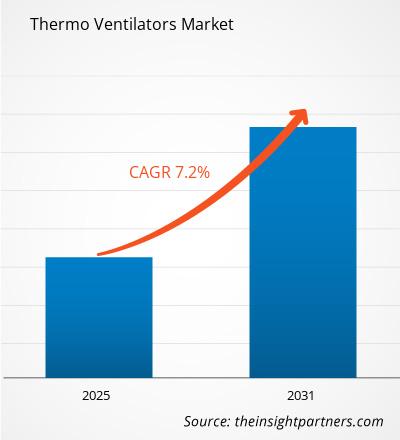
The Thermo Ventilators market is projected to grow from US$ 3.53 Billion in 2025 to US$ 6.13 Billion by 2034, recording a CAGR of 7.82% during 2026–2034. The market covers ceiling mounted, window mounted, and wall mounted products used across residential and commercial applications. Growth reflects rising demand for controlled air exchange, temperature stabilization, and healthier indoor environments in buildings.
Across North America, Thermo Ventilators market size is expected to expand at a 7.4–7.9% CAGR during 2026–2034, supported by tighter building energy codes and rising residential retrofit spending. Demand is strongest where airtight construction, wildfire smoke exposure, and high-efficiency HVAC upgrades increase the need for balanced ventilation with thermal recovery. Commercial adoption is also improving as schools, offices, and healthcare facilities prioritize indoor air quality management.
Thermo Ventilators Market Assessment and Insights
- North America accounted for 31–33% share in 2025 and is growing at a CAGR of 7.4–7.9% between 2026–2034, led by code-driven ventilation upgrades, residential remodeling, and smart HVAC integration.
- US represented 72–76% of North America in 2025 and is growing at a CAGR of 7.2–7.7% between 2026–2034, supported by builder specification and IAQ awareness.
- Europe held 27–29% share in 2025 and is growing at a CAGR of 6.9–7.4% between 2026–2034, with Germany, the UK, France, Italy, and Spain leading demand.
- Asia Pacific captured 28–30% share in 2025 and is growing at a CAGR of 8.4–8.9% between 2026–2034, led by China, Japan, South Korea, India, and Australia.
- Largest Segment Ceiling mounted products held 43–46% market share in 2025 and are growing at a CAGR of 7.5–8.0% between 2026–2034 due to commercial and multifamily use.
- High Growth Segment Wall mounted products held 30–33% of the Thermo Ventilators market share in 2025 and are growing at a CAGR of 8.3–8.8% between 2026–2034 through retrofit-led adoption.
- Key companies analyzed in detail: Aereco S.A., Honeywell International Inc., Lennox International Inc., Mitsubishi Electric Corporation, Panasonic Holdings Corporation, Sauter Controls GmbH, Siemens AG, Swegon Group AB, Vaisala Oyj, Whirlpool Corporation.
Source: The Insight Partners' analysis based on proprietary research, government publications, company annual reports, investor presentations, industry databases, and expert interviews.
Technology development has moved Thermo Ventilators from simple exhaust devices toward demand-controlled, sensor-enabled, heat recovery systems. Manufacturers now combine electronically commutated motors, humidity sensors, variable airflow logic, and low-noise housings to reduce energy loss while maintaining ventilation rates. Production dynamics are also shifting, as component sourcing increasingly depends on fan motors, control boards, compact heat exchangers, and building automation interfaces. This evolution aligns with airtight construction practices and regulatory pressure for lower operational energy.
Looking ahead, emerging urban housing markets, public building refurbishment, and net-zero construction targets will expand the Thermo Ventilators Market size, shaping long-term demand. Investment is expected to move toward modular products, connected controls, and application-specific units for apartments, schools, clinics, and hospitality properties. Regulatory tailwinds from energy performance directives, ventilation standards, and occupational health requirements should support specification-led procurement, particularly where humidity control and air quality monitoring are increasingly treated as building performance metrics.
Thermo Ventilators Market Report Scope
| Report Attribute | Details |
|---|---|
| Market size in 2025 | US$ 3.53 Billion |
| Market Size by 2034 | US$ 6.13 Billion |
| Global CAGR (2026 - 2034) | 7.82% |
| Historical Data | 2021-2024 |
| Forecast period | 2026-2034 |
Thermo Ventilators Market Analysis
The Thermo Ventilators Market analysis reveals that demand is driven by the nexus between energy efficiency, air quality, and resilience. Airtight structures minimize uncontrolled air leaks but also require more mechanical air exchanges. Consumers are looking for quiet and compact units that regulate moisture levels and smells, whereas commercial customers look for consistency in air change and savings on energy throughout their lifecycles. The value chain includes suppliers of motors, sensors, heat exchangers, HVAC distributors, installers, and building automation systems.
Market supply conditions are relatively well-balanced but are influenced by the cost of electronics, housing made from metals, and high-efficiency motors. The industry is becoming increasingly services-oriented as installers tune the airflow, integrate products into control systems, and provide documentation. Thus, the companies with good training programs, extensive application databases, and aftersales services benefit from this trend. Thermo Ventilators evolve from commodities in ventilation to performance building elements.
Competitive positioning is influenced by product breadth and distribution channel coverage. According to Thermo Ventilators market report, Honeywell International Inc., Siemens AG, Mitsubishi Electric Corporation, and Panasonic Holdings Corporation derive competitive advantage from their controls, HVAC, and building technology portfolio, whereas Aereco S.A., Swegon Group AB, Vaisala Oyj, and Sauter Controls GmbH gain competitive advantage through demand control, sensing, and automation expertise. Lennox International Inc. and Whirlpool Corporation contribute to residential and light commercial access.
Investments are directed towards connectivity of controls, quieter products, reduced installation footprint, and efficient heat recovery. Competitive differentiation is not based on the ability of a vendor to provide high airflow capacity but rather on energy performance, commissioning, and compatibility with HVAC systems. Vendor's ability to combine hardware with certification and diagnostic services provides an additional advantage.
● REPORT CUSTOMIZATION
Tailor This Report To Align With Your Specific Business Requirements
This report can be customized to align precisely with your business objectives, scope, and target markets. Customization options include tailored segmentation, geography, competitive analysis, and strategic insights to support informed decision-making.
Customize This Report →WHAT YOU CAN ADJUST
- ● Segmentations
- ● Geography
- ● Competitive Analysis
- ● Language Preferences
Thermo Ventilators Market: Strategic Insights

Regional Insights
North America Thermo Ventilators Market
North America accounted for 31–33% of global revenue in 2025 and is forecast to grow at a 7.4–7.9% CAGR through 2034. The region benefits from stronger ventilation provisions in residential and commercial codes, increasing use of energy recovery ventilators, and retrofit activity in homes built before tighter envelope standards. The regional Thermo Ventilators Market share is sustained by higher equipment value per installation.
Demand is heavily weighted toward the United States and Canada, where the combination of wildfire smoke events, energy loss from cold environments, and exposure to indoor pollutants have made ventilation a key focus for both safety and energy efficiency considerations. Ventilation control systems are being installed in commercial projects within the educational, healthcare, and office markets, as well as by home builders.
U.S. Thermo Ventilators Market
The US accounted for 72–76% of North America demand in 2025 and is forecast to expand at a 7.2–7.7% CAGR from 2026 to 2034. The demand for ceiling-mounted and wall-mounted units can be driven by large single-family constructions, renovation of multifamily housing, and modernization of commercial structures.
The company coverage is extensive, including Honeywell International Inc., Lennox International Inc., Panasonic Holdings Corporation, Mitsubishi Electric Corporation, Siemens AG, and Whirlpool Corporation, which provide adjacent channels for HVAC, controls, and appliances. The applications in question include total air quality systems in homes, ventilation systems in schools, and demand-controlled systems in offices.
Europe Thermo Ventilators Market
The market share for Europe in 2025 was 27–29%, and it will expand at a CAGR of 6.9–7.4% through 2034. Germany is the key country due to its deep renovation potential, high energy prices, and established presence in heat recovery technology. The UK is also developing well thanks to its efforts to improve social housing, moisture management, and demand-controlled ventilation retrofits.
Aereco S.A. and Aldes' demand-control experience make France the leader among countries; the opportunities for expansion in Italy and Spain come from apartment refurbishment and hospitality building upgrades. Nordic and Central European consumers value high-efficiency heat recovery, noise reduction, and automatic airflow. Specifications will continue driving the market in Europe.
APAC Thermo Ventilators Market
APAC held a share of 28–30% in 2025 and would witness an 8.4–8.9% CAGR in 2026–2034. The leading country in APAC is China due to apartment construction, urban air quality regulations, and availability of HVAC equipment locally. Japan and South Korea provide valuable demand for small, silent, and energy-efficient ventilation systems.
India and Australia have higher growth rates from a lower base, driven by increased use of controlled ventilation in premium residences, offices, hospitals, and retail complexes. Policies such as the green buildings programs, urban development, and energy efficiency labels would help drive the Thermo Ventilators Market growth in the region.
Middle East & Africa Thermo Ventilators Market
Middle East & Africa is forecast to grow at a 6.6–7.1% CAGR during 2026–2034. Saudi Arabia is the leading country, supported by hospitality, healthcare, and mixed-use infrastructure projects. The UAE continues to specify energy-efficient HVAC solutions in premium buildings, while South Africa provides demand in commercial retrofits and institutional facilities.
Hot climates make thermal efficiency critical because uncontrolled fresh air intake raises cooling loads. Rest of MEA demand is project-led, linked to airports, schools, clinics, and hotels. Buyers increasingly seek systems that balance fresh air requirements with lower energy consumption, particularly in buildings operating under high cooling intensity and dust-prone outdoor conditions.
Segmentation Analysis
Type
The Type segment is projected to record a 7.6–8.1% CAGR during 2026–2034. Thermo Ventilators Market scope across product formats is shaped by installation constraints, airflow requirements, and the split between new construction and retrofit demand. Ceiling mounted systems dominate because they integrate cleanly with ducted layouts, while wall mounted units are gaining from apartment retrofits and localized ventilation needs.
- Ceiling Mounted products serve commercial rooms, multifamily corridors, and new residential projects where concealed installation, duct routing, and centralized airflow balancing support higher specification rates.
- Window Mounted products remain relevant in cost-sensitive homes and small commercial spaces, especially where structural changes are limited and users need relatively simple installation.
- Wall Mounted products are strategically important for retrofits, apartments, and rooms without duct access, offering compact placement, targeted air exchange, and faster installation cycles.
Application
The Application segment is expected to grow at a 7.4–7.9% CAGR during 2026–2034. Residential demand is supported by healthier-home positioning, humidity control, and energy-efficient renovations, while commercial users focus on ventilation compliance, occupant comfort, and operating-cost reduction. The segment is increasingly influenced by building owners seeking measurable IAQ performance rather than basic exhaust capacity.
- Residential adoption is strongest in airtight homes, apartments, and renovation projects where humidity, odors, allergens, and temperature stability influence product selection and replacement decisions.
- Commercial demand comes from offices, schools, healthcare, hospitality, and retail facilities where predictable airflow, controls integration, and documented compliance strengthen procurement decisions.
Opportunity Snapshot
| Segment Name | Revenue Contribution | Trend Tag | Adoption Stage |
| Residential | High | Healthy Homes | Scaling |
| Commercial | Medium | Smart Buildings | Scaling |
Thermo Ventilators Market Growth Drivers and Impact Analysis
Tighter Energy Codes and Airtight Construction
Building envelopes are becoming tighter to reduce heating and cooling losses, but that shift increases reliance on controlled mechanical ventilation. Thermo Ventilators address this tradeoff by supplying fresh air while limiting thermal penalty through heat recovery, variable airflow, and sensor-based operation. The impact is visible in residential codes, commercial retrofits, and public facilities where compliance documentation is now part of procurement. As developers prioritize energy ratings and occupant comfort, demand shifts toward products that can be commissioned accurately, operate quietly, and integrate with controls. This driver strengthens premium equipment adoption and reduces the attractiveness of low-cost exhaust-only systems in new construction and deep renovation projects.
Indoor Air Quality Awareness Across Occupied Buildings
Greater awareness of indoor pollutants, humidity, allergens, and airborne contaminants is reshaping ventilation purchasing. The WHO has emphasized healthy indoor environments as part of broader respiratory health protection, while schools, offices, clinics, and homes increasingly require measurable air exchange rather than intermittent exhaust. Thermo Ventilators benefit because they combine air renewal with thermal comfort, making continuous ventilation more acceptable in both hot and cold climates. The Thermo Ventilators market impact is stronger specification by architects, facility managers, and housing associations. Products with filtration compatibility, humidity response, and continuous low-noise operation gain preference because they support year-round use without creating avoidable energy waste or occupant complaints.
Integration with Smart HVAC and Building Automation
Smart building investment is increasing demand for ventilation products that can communicate with thermostats, sensors, energy dashboards, and building management systems. Thermo Ventilators are no longer evaluated only on airflow, as buyers increasingly consider connectivity, diagnostics, and automated response to humidity or occupancy. This driver helps established controls companies and HVAC brands position ventilation as part of a broader comfort platform. The commercial impact is especially important in offices, healthcare facilities, and hospitality properties that need consistent operating data. In residential settings, smart integration improves user acceptance because systems can run quietly in the background while adjusting to cooking, bathing, sleeping, and seasonal conditions.
Thermo Ventilators Market Future Trends
AI-Assisted Airflow Optimization
Thermo Ventilators Market trends will increasingly center on predictive airflow control that uses humidity, occupancy, temperature, and outdoor air quality signals. Instead of operating on fixed schedules, future systems will adjust ventilation intensity room by room or zone by zone. This approach can lower wasted energy while improving comfort during peak pollution, cooking, or high-occupancy periods. Manufacturers are expected to embed learning algorithms in controllers, while building automation partners will use ventilation data for maintenance planning. The result will be more adaptive products that shift market competition toward software intelligence, commissioning accuracy, and verified performance under real operating conditions.
Compact Heat Recovery for Retrofit Buildings
Retrofit-friendly heat recovery will become one of the defining Thermo Ventilators Market trends as governments and property owners focus on existing buildings rather than only new construction. Future Thermo Ventilators will use smaller cores, simplified ducting, and lower-profile wall or ceiling housings to reduce installation time in apartments, schools, and small offices. This trend is important because many older buildings cannot accept full duct networks without major disruption. Suppliers that solve space, noise, and condensate management constraints will unlock a wider replacement market. Standardized installation kits and digital commissioning tools are likely to become as important as airflow capacity in retrofit procurement decisions.
Thermo Ventilators Market Opportunities
Residential Retrofit Packages for Energy Renovation
The Thermo Ventilators Market forecast points to a strong opportunity in residential retrofit packages that combine ventilation, humidity control, and basic smart monitoring. Housing stock in North America and Europe includes many airtight renovation projects where insulation and window upgrades create moisture and pollutant risks unless ventilation is improved. Suppliers can target contractors with bundled kits, design guidance, and simplified commissioning. The opportunity is actionable because retrofits require practical installation formats, not only premium technology. Companies that build partnerships with renovation firms, energy auditors, and housing associations can capture recurring demand while supporting healthier homes and documented energy efficiency outcomes.
Commercial Compliance and Service-Based Ventilation Models
Commercial buildings offer an opportunity for service-linked ventilation because owners need compliance evidence, energy control, and operating reliability. Vendors may expand from selling products to providing services such as commissioning, monitoring, filter-replacement schedule development, and performance reporting for office buildings, educational institutions, clinics, and hospitality properties. Such an approach helps generate repeat business, increases the market share of service-oriented vendors in the Thermo Ventilators Market, and minimizes risk for buyers by tying equipment performance to results. The most appropriate type of Thermo Ventilators for this opportunity is one with sensors and remote diagnostic capabilities. Facility managers will most likely appreciate solutions that show airflow performance and detect malfunctions.
Recent Developments
- February 2026: Aereco S.A. — Aereco UK announced “The new face of MEV,” highlighting updated mechanical extract ventilation positioning for residential applications. The move reinforces the company’s focus on demand-controlled air exchange, retrofit compatibility, and housing-sector ventilation education, supporting greater awareness of efficient mechanical ventilation in homes and apartments.
- February 2025: Panasonic Holdings Corporation — Panasonic showcased the OASYS whole-home air quality management solution and BalancedHome ERV series at IBS 2025. The company emphasized efficiency, comfort, and compliance for builders, including a stated reduction in heating and air-conditioning energy consumption of up to 53% compared with traditional HVAC systems.
Frequently Asked Questions

- Comprehensive Market Sizing and Forecast Analysis
- Detailed Segmentation Analysis
- In-Depth Market Dynamics Assessment
- Regional and Country-Level Insights
- Competitive Landscape and Company Benchmarking
- Strategic Business Intelligence
Recent Reports
Testimonials

The Insight Partners' SCADA System Market report is comprehensive, with valuable insights on current trends and future forecasts. The team was highly professional, responsive, and supportive throughout. We are very satisfied and highly recommend their services.
RAN KEDEM Partner, Reali Technologies LTDs
I requested a report on a very specific software market and the team produced the report in a few days. The information was very relevant and well presented. I then requested some changes and additions to the report. The team was again very responsive and I got the final report in less than a week.
JEAN-HERVE JENN Chairman, Future Analytica
We worked with The Insight Partners for an important market study and forecast. They gave us clear insights into opportunities and risks, which helped shape our plans. Their research was easy to use and based on solid data. It helped us make smart, confident decisions. We highly recommend them.
PIYUSH NAGPAL Sr. Vice President, High Beam Global
The Insight Partners delivered insightful, well-structured market research with strong domain expertise. Their team was professional and responsive throughout. The user-friendly website made accessing industry reports seamless. We highly recommend them for reliable, high-quality research services
YUKIHIKO ADACHI CEO, Deep Blue, LLC.
This is the first time I have purchased a market report from The Insight Partners.While I was unsure at first, I visited their web site and felt more comfortable to take the risk and purchase a market report.I am completely satisfied with the quality of the report and customer service. I had several questions and comments with the initial report, but after a couple of dialogs over email with their analyst I believe I have a report that I can use as input to our strategic planning process.Thank you so much for taking the extra time and making this a positive experience.I will definitely recommend your service to others and you will be my first call when we need further market data.
JOHN SUZUKI President and Chief Executive Officer, Board Director, BK Technologies
I wish to appreciate your support and the professionalism you displayed in the course of attending to my request for information regarding to infectious disease IVD market in Nigeria. I appreciate your patience, your guidance, and the fact that you were willing to offer a discount, which eventually made it possible for us to close a deal. I look forward to engaging The Insight Partners in the future, all thanks to the impression you have created in me as a result of this first encounter.
DR CHIJIOKE ONYIA MANAGING DIRECTOR, PineCrest Healthcare Ltd.Reason to Buy
- Informed Decision-Making
- Understanding Market Dynamics
- Competitive Analysis
- Identifying Emerging Markets
- Customer Insights
- Market Forecasts
- Risk Mitigation
- Boosting Operational Efficiency
- Strategic Planning
- Investment Justification
- Tracking Industry Innovations
- Aligning with Regulatory Trends





 Get Free Sample for