
Thermochromic Pigments Market Share, Growth & Demand by 2034
Coverage: By Product Type (Reversible Pigments, Irreversible Pigments); Application Type (Paints and Coatings, Printing Inks, Plastic Products, Textiles, Consumer Goods, and Others), and Geography (North America, Europe, Asia Pacific, and South and Central America)
- Status : Data Released
- Report Code : TIPRE00014378
- Category : Chemicals and Materials
- No. of Pages : 150
- Available Report Formats :


- Last update date : June 22, 2026


2025 Market Size
US$ 1.35 Bn
Base year value
2034 Forecast
US$ 2.76 Bn
Projected by 2034
CAGR 2026-2034
8.2 %
Growth rate
Addressable Market
US$ 18.39 Bn
(2026-2034)
The global thermochromic pigments market size is projected to reach US$ 2.76 billion by 2034 from US$ 1.35 billion in 2025. The market is anticipated to register a CAGR of 8.2% during the forecast period 2026–2034.
Key market dynamics include a heightening global focus on smart and responsive packaging solutions, rising consumer demand for interactive and aesthetic consumer goods, and a significant shift toward smart textiles and functional fabrics. Additionally, the market is expected to benefit from the growing popularity of temperature-indicating medical devices, expansion in industrial automotive coatings for thermal mapping, and the increasing inclusion of thermochromic inks in high-security anti-counterfeiting print segments.
Thermochromic Pigments Market Analysis
The thermochromic pigments market analysis shows a shift toward high-value functional coatings and smart substrates as industries prioritize real-time temperature monitoring and visual differentiation. The market is bifurcated into commercial-grade reversible leuco dye systems for packaging and highly precise liquid crystal variants for specialized aerospace and medical applications. Strategic opportunities are emerging in intelligent structural materials and building envelopes, where vanadium-oxide-based smart windows and heat-reflective roof coatings offer a clear energy-saving competitive advantage. The analysis also notes that market expansion depends on microencapsulation stability to resist UV degradation and thermal processing efficiency during plastic extrusion. Competitive differentiation now stands out depending on technical formulation capabilities that highlight long-term stability, non-toxic, eco-friendly materials, and customizable temperature threshold switches. This approach helps top-tier chemical manufacturers charge higher prices in a market requiring precise engineering compliance.
Thermochromic Pigments Market Overview
Smart materials have evolved from niche novelties to mainstream industrial and lifestyle solutions. The market includes functional reversible inks, irreversible temperature indicators for cold-chain logistics, and dynamic architectural coatings. Both global specialty chemical corporations and advanced material startups compete in this market, optimizing organic dye structures and microencapsulation matrices. Growing demand for active, temperature-sensitive food and beverage labels among quality-conscious distribution chains in North America and Europe has increased the popularity of thermochromic packaging as a portable quality assurance solution. North America leads in revenue due to its strict pharmaceutical tracking regulations and established manufacturing infrastructure, while Asia-Pacific is advancing in high-volume production innovation and textile adoption. The US market is the most developed, driven by technology-focused consumer goods brands and the broad availability of functional packaging materials. Competition among pigment producers is fueling greater formulation stability and the inclusion of advanced polymers that resist color fading and chemical weathering.
Market Assessment and Insights
- Global market for Thermochromic Pigments was valued at US$ 1.35 Billion in 2025
- Annual market size is expected to reach US$ 2.76 Billion by 2034
- Total addressable market (TAM) during 2026-2034 is projected to reach approximately US$ 18.39 Billion
- Market is anticipated to register a CAGR of 8.2% during the forecast period
- The United States represents a key market, supported by Growing Demand in Consumer Goods and Packaging, Advancements in Industrial Applications, Technological Innovations and Expanding Applications, as well as evolving industry dynamics
- Market analysis covers North America, Europe, Asia-Pacific, South and Central America, Middle East and Africa, with growth evaluated across the forecast period
- Market opportunities such as Growing Demand in Consumer Goods and Packaging, Expansion in the Automotive and Coatings Industry, Technological Innovations and New Applications are expected to influence market dynamics and addressable market
- Report profiles industry participants, including Chromatic Technologies Inc, E. I. DuPont de Nemours and Company, Hali Pigment co ltd, Hammer Packaging, LCR Hallcrest LLC, OliKrom, RPM International Inc, SFXC, Smarol Industry Co Ltd, The 3M Company, while analyzing competitive strategies and innovation developments
-
Source: The Insight Partners' analysis based on proprietary research, government publications, company annual reports, investor presentations, industry databases, and expert interviews.
● REPORT CUSTOMIZATION
Tailor This Report To Align With Your Specific Business Requirements
This report can be customized to align precisely with your business objectives, scope, and target markets. Customization options include tailored segmentation, geography, competitive analysis, and strategic insights to support informed decision-making.
Customize This Report →WHAT YOU CAN ADJUST
- ● Segmentations
- ● Geography
- ● Competitive Analysis
- ● Language Preferences
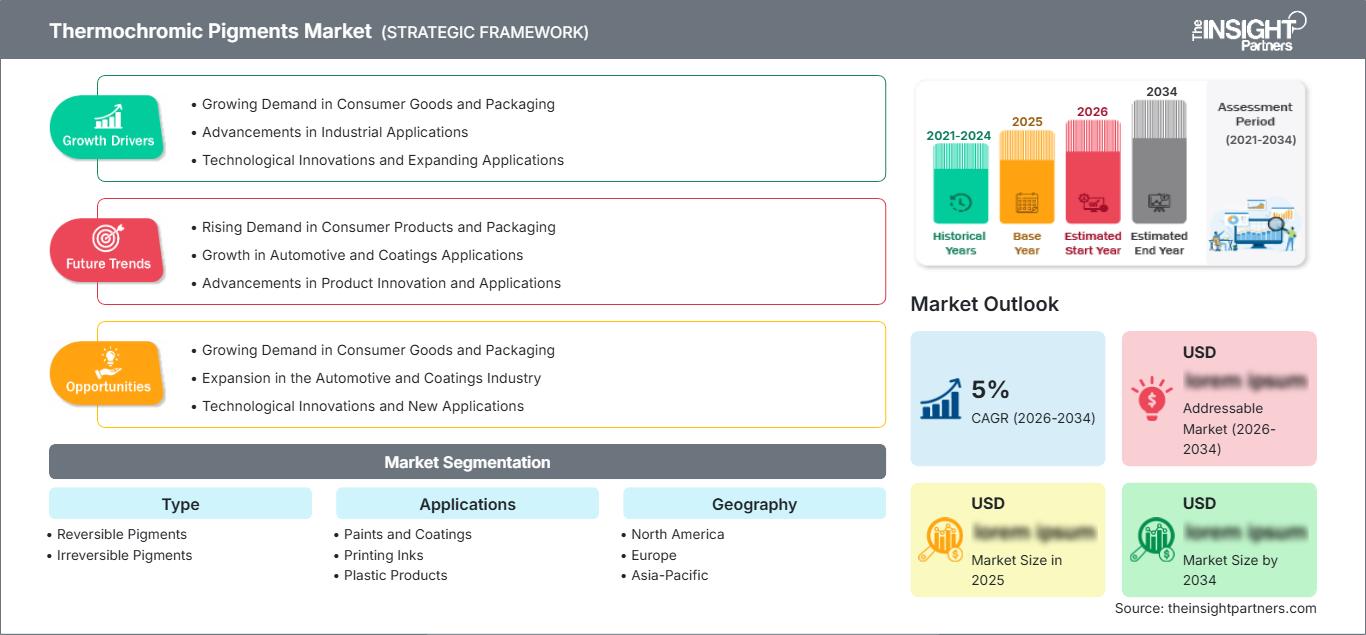
Thermochromic Pigments Market: Strategic Insights
-
Get Top Key Market Trends of this report.This FREE sample will include data analysis, ranging from market trends to estimates and forecasts.
Thermochromic Pigments Market Drivers and Opportunities
Market Drivers:
- Growing Demand for Smart and Interactive Packaging: The expansion of the global food, beverage, and pharmaceutical sectors has accelerated the adoption of temperature-indicating labels. Reversible and irreversible thermochromic inks provide immediate visual confirmation of product freshness or cold-chain breaches, enhancing logistics safety.
- Rising Integration in Smart Textiles and Fashion: The mainstreaming of activewear and smart clothing has sustained high demand for thermochromic fabric treatments. As consumers trade up to functional, interactive aesthetic designs, heat-sensitive apparel continues to achieve stable volume gains.
- Expansion of High-Security Printing and Anti-Counterfeiting: Advanced security inks for currency, exam answer sheets, and luxury product labeling have become critical barrier mechanisms. Online and cross-border commercial expansions utilize these unique thermal properties to prevent counterfeiting and fraud.
Market Opportunities:
- Expansion into Energy-Efficient Architecture and Net-Zero Glazing: Beyond consumer products, thermochromic formulations offer significant opportunities in smart windows and building envelope coatings that modulate solar heat gain automatically, lowering HVAC cooling demands.
- Growth in Automotive and Industrial Thermal Mapping: Forming strategic partnerships between pigment manufacturers and automotive tier-1 suppliers can facilitate access to high-margin safety applications, such as hot-surface warning coatings on engines and industrial machinery components.
- Diversification into Sustainable and Non-Toxic Formulations: There is a growing opportunity for chemical producers to target eco-conscious manufacturers by engineering bio-based, formaldehyde-free microencapsulated pigments, avoiding regulatory restrictions in strict markets.
Thermochromic Pigments Market Report Segmentation Analysis
The Thermochromic Pigments Market share is analyzed across various segments to provide a clearer understanding of its structure, growth potential, and emerging trends. Below is the standard segmentation approach used in most industry reports:
By Product Type:
- Reversible Pigments: The highest contributor to the market by volume, allowing continuous shifting back and forth through the color spectrum as temperatures change. It is heavily utilized in dynamic consumer goods, promotional novelties, textiles, and functional screen inks.
- Irreversible Pigments: A critical segment focused on safety and compliance, providing permanent color changes once a specific heat threshold is crossed to serve as clear evidence of temperature abuse or overheating.
By Application Type:
- Paints and Coatings: A major application sector used for industrial equipment safety indicators, aerospace thermal testing, protective layers, and architectural heat-regulating coatings.
- Printing Inks: The primary volume driver for the market, benefiting from the rapid expansion of flexible food packaging, temperature-sensitive logistics labels, and secure documents.
- Plastic Products: Includes a broad range of injection-molded products, household kitchenware, toys, and baby safety accessories that shift colors to indicate excessive heat.
- Textiles: Focuses on specialized fashion apparel, activewear, thermal military camouflage, and functional smart fabrics that respond to body temperature variations.
- Consumer Goods: Encompasses innovative novelty items, promotional drinkware, heat-reactive cosmetics, and interactive electronic casings.
By Geography:
- North America
- Europe
- Asia Pacific
- South & Central America
- Middle East & Africa
Thermochromic Pigments Market Report Scope
| Report Attribute | Details |
|---|---|
| Market size in 2025 | US$ 1.35 Billion |
| Market Size by 2034 | US$ 2.76 Billion |
| Global CAGR (2026 - 2034) | 8.2% |
| Historical Data | 2021-2024 |
| Forecast period | 2026-2034 |
| Segments Covered |
By Product Type
|
| Regions and Countries Covered |
North America
|
| Market leaders and key company profiles |
|
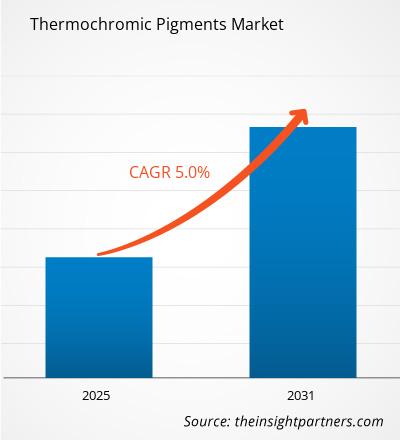
Thermochromic Pigments Market Players Density: Understanding Its Impact on Business Dynamics
The Thermochromic Pigments Market is growing rapidly, driven by increasing end-user demand due to factors such as evolving consumer preferences, technological advancements, and greater awareness of the product's benefits. As demand rises, businesses are expanding their offerings, innovating to meet consumer needs, and capitalizing on emerging trends, which further fuels market growth.
Thermochromic Pigments Market Share Analysis by Geography
Asia-Pacific is expected to grow fastest in the coming years. Emerging markets in South & Central America, the Middle East, and Africa also have many untapped opportunities for advanced material developers and smart packaging manufacturers to expand.
The thermochromic pigments market is undergoing a significant transformation, moving from consumer novelty gimmicks to global high-value functional components. Growth is driven by the rising stringency of cold-chain monitoring, a surge in smart manufacturing demand, and the expansion of energy-efficient construction materials. Below is a summary of market share and trends by region:
1. North America
- Market Share: Holds the largest revenue share globally, driven by highly developed industrial sectors and premium chemical supply lines.
- Key Drivers:
- Stringent pharmaceutical and food-safety regulations requiring automated cold-chain tracking validation
- Mainstreaming of smart packaging components across high-end consumer retail networks
- High adoption of advanced functional coatings in domestic automotive and aerospace assembly plants
- Trends: Scaling of advanced industrial paint formulations and the successful adoption of non-toxic, formaldehyde-free pigment lines to appeal to eco-conscious corporate regulatory frameworks.
2. Europe
- Market Share: Represents a highly mature market, anchored by advanced chemical manufacturing infrastructure and rigorous sustainability policies in Germany, France, and the UK.
- Key Drivers:
- High domestic integration of specialty pigments for functional and protective industrial coatings
- Established regulatory mandates for chemical safety and environmental tracking metrics
- Robust research initiatives and government funding supporting net-zero smart-building materials
- Trends: A strategic shift toward prioritizing pigment distribution for high-margin smart window glazing and automotive applications over low-margin novelty items.
3. Asia-Pacific
- Market Share: The fastest-growing region globally, with China and India acting as primary industrial hubs for high-volume pigment synthesis and downstream application.
- Key Drivers:
- Massive manufacturing base in China dominating the production of raw commercial-grade thermochromic agents
- Expanding regional printing ink, flexible packaging, and large-scale consumer textile sectors
- Rapid urbanization and rising middle-class disposable incomes driving preference for interactive electronics and consumer goods
- Trends: Heavy reliance on B2B manufacturing contracts for smart apparel and temperature-indicating packaging labels, alongside growing local development of anti-counterfeiting security inks.
4. South and Central America
- Market Share: Emerging market with a growing manufacturing footprint in countries like Brazil and Chile.
- Key Drivers:
- Increasing awareness of active packaging benefits for preserving export-oriented goods
- Modernization of domestic textile print mills to introduce premium, high-value functional sportswear
- Rising interest in anti-counterfeiting labeling to secure regional supply chains against fraudulent products
- Trends: Growth of localized boutique ink blends and the introductory application of thermochromic warning elements onto industrial production lines to improve worker safety.
5. Middle East and Africa
- Market Share: Developing market with specialized industrial demand, transitioning toward formalized technological integration.
- Key Drivers:
- Extreme climate conditions driving high utility for heat-reflective and temperature-monitoring outdoor coatings
- Structural investments in Smart Cities to maximize energy savings via innovative building insulation materials
- Strategic implementation of supply chain monitoring systems to track critical imported electronics and medical goods
- Trends: Growth in infrastructural usage of thermal mapping coatings on desert equipment alongside a steady focus on localized commercial label printing.
High Market Density and Competition
Competition is intensifying due to the presence of established global chemical and specialty material leaders. Prominent industry innovators, alongside specialized regional producers and niche microencapsulation experts, contribute to a diverse and rapidly expanding market landscape.
This competitive environment pushes vendors to differentiate through:
- Premiumization and functional performance branding: Positioning thermochromic pigments as superior performance metrics over standard dyes by emphasizing UV stability, long shelf-life, and precise activation temperatures.
- Product line diversification: Expanding solutions beyond standard slurry forms to offer advanced microencapsulated powder concentrates, masterbatches for plastics, and specialized water-based screen inks.
- Vertical supply integration: Managing the entire synthesis chain, from core organic molecule compilation to advanced microencapsulation, ensuring transparency, toxicity compliance, and strict color-consistency standards.
Opportunities and Strategic Moves
- Partner with high-end flexible packaging firms and e-commerce labels to tap into the surging demand for active temperature monitoring in Asia-Pacific and North American distribution markets.
- Incorporate sustainable raw materials and formaldehyde-free chemical certifications to appeal to safety-oriented consumer demographics and demanding global environmental regulatory standards.
Major Companies operating in the Thermochromic Pigments Market are:
- Chromatic Technologies Inc
- E. I. DuPont de Nemours and Company
- Hali Pigment Co. Ltd
- Hammer Packaging
- LCR Hallcrest LLC
- OliKrom
- RPM International Inc
- SFXC
- Smarol Industry Co Ltd
- The 3M Company
Disclaimer: The companies listed above are not ranked in any particular order.
Thermochromic Pigments Market News and Recent Developments
- In February 2026, Sun Chemical Corporation established a new manufacturing facility in the Midwest to boost its operational footprint and optimize production workflows. This strategic expansion is designed to enhance supply chain efficiency and address the rising demand for thermochromic pigments across diverse industrial sectors, strengthening the company's market position.
- In May 2024, DuPont announced the launch of its PN 1000 ink series at drupa 2024. The new product series is a set of low-viscosity water-based pigment inkjet inks for commercial printing, formulated with proprietary DuPont technology and compatible with industry-standard drying technologies.
Thermochromic Pigments Market Report Coverage and Deliverables
The Thermochromic Pigments Market Size and Forecast (2021–2034) report provides a detailed analysis of the market covering below areas:
- Thermochromic Pigments Market size and forecast at global, regional, and country levels for all the key market segments covered under the scope
- Thermochromic Pigments Market trends, as well as market dynamics such as drivers, restraints, and key opportunities
- Detailed PEST and SWOT analysis
- Thermochromic Pigments Market analysis covering key market trends, global and regional framework, major players, regulations, and recent market developments
- Industry landscape and competition analysis covering market concentration, heat map analysis, prominent players, and recent developments in the Thermochromic Pigments Market.
- Detailed company profiles
Frequently Asked Questions

- Comprehensive Market Sizing and Forecast Analysis
- Detailed Segmentation Analysis
- In-Depth Market Dynamics Assessment
- Regional and Country-Level Insights
- Competitive Landscape and Company Benchmarking
- Strategic Business Intelligence
Recent Reports
Testimonials

The Insight Partners' SCADA System Market report is comprehensive, with valuable insights on current trends and future forecasts. The team was highly professional, responsive, and supportive throughout. We are very satisfied and highly recommend their services.
RAN KEDEM Partner, Reali Technologies LTDs
I requested a report on a very specific software market and the team produced the report in a few days. The information was very relevant and well presented. I then requested some changes and additions to the report. The team was again very responsive and I got the final report in less than a week.
JEAN-HERVE JENN Chairman, Future Analytica
We worked with The Insight Partners for an important market study and forecast. They gave us clear insights into opportunities and risks, which helped shape our plans. Their research was easy to use and based on solid data. It helped us make smart, confident decisions. We highly recommend them.
PIYUSH NAGPAL Sr. Vice President, High Beam Global
The Insight Partners delivered insightful, well-structured market research with strong domain expertise. Their team was professional and responsive throughout. The user-friendly website made accessing industry reports seamless. We highly recommend them for reliable, high-quality research services
YUKIHIKO ADACHI CEO, Deep Blue, LLC.
This is the first time I have purchased a market report from The Insight Partners.While I was unsure at first, I visited their web site and felt more comfortable to take the risk and purchase a market report.I am completely satisfied with the quality of the report and customer service. I had several questions and comments with the initial report, but after a couple of dialogs over email with their analyst I believe I have a report that I can use as input to our strategic planning process.Thank you so much for taking the extra time and making this a positive experience.I will definitely recommend your service to others and you will be my first call when we need further market data.
JOHN SUZUKI President and Chief Executive Officer, Board Director, BK Technologies
I wish to appreciate your support and the professionalism you displayed in the course of attending to my request for information regarding to infectious disease IVD market in Nigeria. I appreciate your patience, your guidance, and the fact that you were willing to offer a discount, which eventually made it possible for us to close a deal. I look forward to engaging The Insight Partners in the future, all thanks to the impression you have created in me as a result of this first encounter.
DR CHIJIOKE ONYIA MANAGING DIRECTOR, PineCrest Healthcare Ltd.Reason to Buy
- Informed Decision-Making
- Understanding Market Dynamics
- Competitive Analysis
- Identifying Emerging Markets
- Customer Insights
- Market Forecasts
- Risk Mitigation
- Boosting Operational Efficiency
- Strategic Planning
- Investment Justification
- Tracking Industry Innovations
- Aligning with Regulatory Trends





 Get Free Sample for