
Tire Curing Press Market Growth, Trends & Demand by 2034
Coverage: by Type (Mechanical Tire Curing, Hydraulic Tire Curing, Hybrid Tire Curing, Others); Application (Radical Tire, Ordinary Tire) , and Geography (North America, Europe, Asia Pacific, and South and Central America)
- Status : Data Released
- Report Code : TIPRE00010332
- Category : Manufacturing and Construction
- No. of Pages : 150
- Available Report Formats :


- Last update date : August 06, 2026


2025 Market Size
US$ 1.48 Bn
Base year value
2034 Forecast
US$ 1.87 Bn
Projected by 2034
CAGR 2026-2034
2.64 %
Growth rate
Addressable Market
US$ 15.21 Bn
(2026-2034)
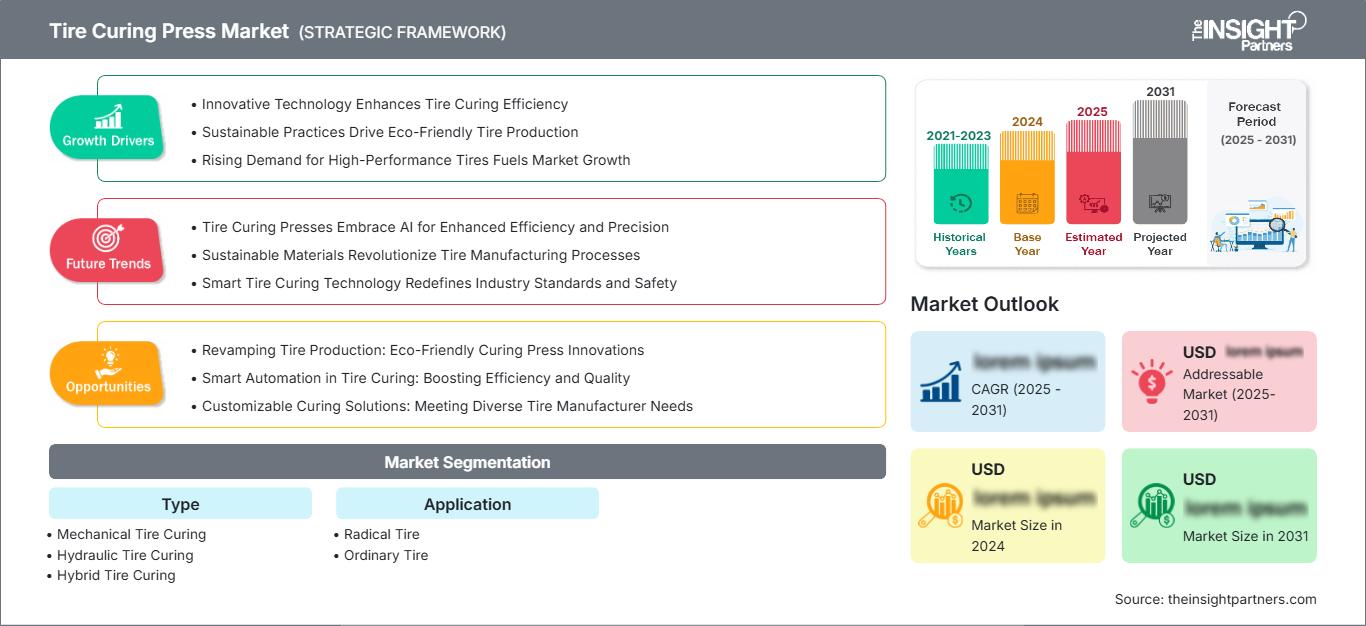
The Global Tire Curing Press Market was valued at US$ 1.48 Billion in 2025 and is projected to reach US$ 1.87 Billion by 2034, growing at a CAGR of 2.64% during 2026–2034. Demand remains linked to tire plant modernization, radial tire capacity additions, and precision vulcanization requirements across passenger, commercial, and specialty tire production lines.
Within North America, Tire Curing Press Market size is expected to advance at a steady 2.1–2.5% CAGR as producers upgrade aging curing fleets and automate quality-critical tire lines. Structural support comes from replacement tire demand, premium radial production, and plant-level investment in digital monitoring, hydraulic precision, and energy-efficient curing systems for light truck and commercial applications.
Tire Curing Press Market Assessment and Insights
- North America accounted for 18–20% share in 2025 and is growing at a CAGR between 2.1–2.5% during 2026–2034, supported by automated tire plants and high-value replacement tire production.
- US represented 78–82% of North America in 2025 and is growing at a CAGR between 2.2–2.6% during 2026–2034 on radial tire upgrades.
- Europe held 20–22% share in 2025 and is growing at a CAGR between 2.0–2.4% during 2026–2034, led by Germany, France, Italy, Spain, and the UK.
- Asia Pacific captured 43–46% share in 2025 and is growing at a CAGR between 2.8–3.2% during 2026–2034, led by China, Japan, South Korea, and India.
- Largest Segment Hydraulic Tire Curing held 44–47% market share in 2025, with a CAGR range of 2.6–3.0% during 2026–2034.
- High Growth Segment Hybrid Tire Curing held 14–17% market share in 2025, with a CAGR range of 3.2–3.7% during 2026–2034.
- Key companies analyzed in detail: Greatoo Intelligent Equipment Inc., Harburg-Freudenberger Maschinenbau GmbH, HERBERT Maschinenbau GmbH and Co. KG, Larsen and Toubro Limited, McNeil and NRM Inc., Mitsubishi Heavy Industries Machinery Systems, Ltd., Rogers Industrial Products Inc., Uzer Makina Sanayi ve Ticaret A.S., Kobe Steel, Ltd., MESNAC Co., Ltd.
Source: The Insight Partners' analysis based on proprietary research, government publications, company annual reports, investor presentations, industry databases, and expert interviews.
With respect to curing machines, the market is shifting from mechanically intensive press systems to hydraulically assisted systems with digital monitoring, which ensure better mold control, consistent cycles, and maintenance. Tire manufacturers are balancing capacity additions with upgrades since the curing machine is among the processes that are energy-intensive during the manufacturing of tires. The development of radial tires, electric vehicle tires, and plant automation will affect the equipment specifications and supplier considerations.
For the forecast period, investments in capacity additions in Asia-Pacific, capacity additions in North America, and energy-efficient upgrades in Europe will be the key investment areas. The market will be aided by tire labeling regulations, low rolling resistance regulations, and the need for process traceability. Suppliers having modular presses, retrofit capabilities, and a localized services network will have a good opportunity.
Tire Curing Press Market Report Scope
| Report Attribute | Details |
|---|---|
| Market size in 2025 | US$ 1.48 Billion |
| Market Size by 2034 | US$ 1.87 Billion |
| Global CAGR (2026 - 2034) | 2.64% |
| Historical Data | 2021-2024 |
| Forecast period | 2026-2034 |
Tire Curing Press Market Analysis
Market Drivers for Tire Curing Press Market growth is due to the need to improve tire manufacturing plant efficiency, radial tire production needs, and the need for machines that are precise in controlling pressure, temperature, and time cycles. There is a need for investment in equipment as vehicle production increases, and replacement tires increase. There are also EV tires being manufactured.
The value chain for the market has activities such as steel construction, hydraulic systems, heating assemblies, control software, molds, bladders, and field servicing. Supply dynamics are still defined by long lead times for equipment, service proximity, and integration into automated processes in the tire manufacturing plants. Existing tire manufacturers seek suppliers who can provide globally but also modify equipment designs according to utilities, labor practices, and plant capacity constraints.
Market Analysis of Tire Curing Press reveals a fragmented yet highly technical market where global engineering organizations face competition from regional machinery companies. Harburg-Freudenberger Maschinenbau GmbH concentrates on its Curemaster and electric curing technology, whereas Mitsubishi Heavy Industries Machinery Systems, Ltd., Larsen and Toubro Limited, and Kobe Steel, Ltd. capitalize on their experience in heavy machinery, manufacturing prowess and global customer base.
Greatoo Intelligent Equipment Inc., MESNAC Co., Ltd., Uzer Makina Sanayi ve Ticaret A.S., HERBERT Maschinenbau GmbH and Co. KG, McNeil and NRM Inc., and Rogers Industrial Products Inc. compete by way of application-specific expertise, service capability based on installed base and regional tie-ups with tire manufacturers. Strategic positioning increasingly revolves around retrofit economics, predictive maintenance, control technologies and performance track record in radial as well as conventional tire manufacturing.
● REPORT CUSTOMIZATION
Tailor This Report To Align With Your Specific Business Requirements
This report can be customized to align precisely with your business objectives, scope, and target markets. Customization options include tailored segmentation, geography, competitive analysis, and strategic insights to support informed decision-making.
Customize This Report →WHAT YOU CAN ADJUST
- ● Segmentations
- ● Geography
- ● Competitive Analysis
- ● Language Preferences
Tire Curing Press Market: Strategic Insights
Regional Insights
North America Tire Curing Press Market
North America accounted for approximately 18–20% of the market revenue in 2025 and is projected to register a 2.1–2.5% CAGR during the forecast period. The region's market position is supported by its well-established tire manufacturing base, steady replacement tire demand, and strong adoption of automation technologies. Investments are increasingly focused on hydraulic system modernization, hybrid press retrofits, energy-efficiency improvements, and digital monitoring solutions that enhance productivity and process control in radial passenger and light truck tire production lines.
Market demand is further supported by ongoing reshoring initiatives, stringent safety and quality standards, and continuous efforts by manufacturers to improve operational efficiency. As curing remains a critical bottleneck in tire production, minimizing downtime is a priority for plant operators. Consequently, equipment suppliers with local service networks and technical support capabilities across the United States and Canada gain a competitive advantage, enabling faster maintenance response times and helping manufacturers maintain uninterrupted production across mixing, tire building, curing, and inspection processes.
U.S. Tire Curing Press Market
The United States accounted for approximately 78–82% of the North American market revenue in 2025 and is expected to expand at a 2.2–2.6% CAGR over the forecast period. The country remains the primary market within the region due to its extensive installed tire manufacturing capacity, stable replacement tire demand, and continued production of premium radial tires for passenger vehicles, light trucks, and commercial fleets. Demand for tire curing presses is strongest in passenger car, light truck, and commercial tire manufacturing lines, where productivity, consistency, and quality requirements are particularly high.
The market is supported by the presence of both global equipment manufacturers and specialized service providers offering automation upgrades, retrofit solutions, spare parts, and plant modernization services. Tire producers increasingly prioritize equipment reliability, predictive maintenance capabilities, software-based diagnostics, and compatibility with existing molds and production systems to maximize operational efficiency. Since curing is one of the most critical stages of tire manufacturing, bottlenecks or unplanned downtime can impact production yield, tire uniformity, delivery schedules, and overall plant throughput, making advanced and dependable curing press technology a key investment area.
Europe Tire Curing Press Market
Europe held 20–22% of the Tire Curing Press Market share in 2025 and is forecast to grow at a 2.0–2.4% CAGR, with Germany as the leading country. Germany benefits from advanced machinery ecosystems, tire R and D, and automation standards that favor precise hydraulic and hybrid platforms. UK demand is linked to replacement tires, specialty production, and equipment refurbishment.
France, Italy, and Spain support regional demand through passenger tire, commercial tire, and industrial tire manufacturing bases. Energy efficiency and tire labeling regulations influence procurement decisions, pushing suppliers to demonstrate lower heat loss, stable curing cycles, improved traceability, and after-sales responsiveness.
APAC Tire Curing Press Market
Asia Pacific accounted for approximately 43–46% of the Tire Curing Press Market share in 2025 and is expected to record a 2.8–3.2% CAGR during the forecast period, making it the largest and fastest-growing regional market. Growth is led by China, while Japan, South Korea, India, and Australia contribute significantly through strong vehicle production, expanding tire manufacturing capacity, and export-oriented operations. The region's large-scale tire industry, combined with rising demand from passenger vehicles, commercial vehicles, and industrial applications, continues to drive investment in both new curing press installations and production line upgrades.
Regional demand is supported by industrial development policies, localization strategies, and the proximity of equipment suppliers to major tire manufacturing hubs, enabling faster service and lower procurement costs. Tire manufacturers across Asia Pacific are increasing radial tire production capacity and replacing aging mechanical presses with more efficient hydraulic and automated systems. As a result, the region remains the primary volume and expansion engine of the global market, supported by ongoing capacity additions, modernization projects, and a highly competitive manufacturing ecosystem.
Middle East & Africa Tire Curing Press Market
The Middle East & Africa (MEA) Tire Curing Press Market is projected to grow at a 2.4–2.8% CAGR over the forecast period, with Saudi Arabia representing the largest country-level market. Demand across Saudi Arabia, the UAE, South Africa, and the rest of MEA is closely linked to infrastructure development, logistics expansion, mining activities, and construction projects that require durable commercial and off-road tires. These sectors support steady demand for tire manufacturing equipment, particularly in facilities serving regional transportation and industrial markets.
Growth is encouraged by reliable energy availability in key Gulf countries, ongoing industrial diversification initiatives, and investments in transportation and logistics infrastructure. While large-scale tire manufacturing capacity remains limited compared to Asia Pacific and Europe, selected countries are pursuing localized production and industrial development projects. As a result, equipment procurement tends to be project-driven, with buyers prioritizing durable curing presses, strong after-sales support, and configurations optimized for commercial vehicle and standard tire production. Suppliers offering local service capabilities and maintenance support are generally better positioned to secure contracts and long-term customer relationships in the region.
Segmentation Analysis
Type
By type, the hybrid tire curing segment is forecast to grow at a 2.5–2.9% CAGR during 2026–2034. Tire Curing Press Market scope within type is shaped by the transition from legacy mechanical systems toward hydraulic and hybrid platforms that improve control, reduce maintenance variation, and support energy-aware production. Buyers evaluate press type against tire mix, plant layout, mold change frequency, and automation strategy.
- Mechanical Tire Curing remains relevant for plants prioritizing proven designs, lower acquisition cost, and broad tire-size familiarity, especially where maintenance teams are experienced with toggle-based equipment.
- Hydraulic Tire Curing holds the largest position due to precise clamping, smoother operation, and suitability for radial tire quality requirements across passenger and commercial tire production.
- Hybrid Tire Curing is strategically important for modernization programs because it combines mechanical robustness with hydraulic precision and supports efficiency improvements without complete process redesign.
Application
By application, the radical tire segment is expected to grow at a 2.4–2.8% CAGR during 2026–2034. Radical Tire applications dominate equipment specifications because high-speed, fuel-efficient, and EV-ready tires require uniform vulcanization, consistent mold pressure, and tight process repeatability. Ordinary Tire production remains important in cost-sensitive markets, industrial uses, and replacement channels where durability and operational simplicity drive investment decisions.
- Radical Tire applications lead demand because radial construction requires consistent curing precision, defect reduction, and compatibility with premium passenger, truck, bus, and EV tire programs.
- Ordinary Tire applications maintain a stable role in regional plants, industrial tires, and price-sensitive production where press durability, ease of maintenance, and throughput remain decisive.
Opportunity Snapshot
| Application | Revenue Contribution | Trend Tag | Adoption Stage |
| Radial Tire | High | EV Radial | Scaling |
| Ordinary Tire | Medium | Durable Output | Mature |
Tire Curing Press Market Growth Drivers and Impact Analysis
Radial Tire Capacity Expansion
The manufacturing of radial tires necessitates curing machines that have the capability to maintain consistency in temperature, pressure, and alignment of the molds during repetitive operations. The effect on producers who manufacture passenger, truck, and bus tires as they increase their radial tire manufacturing capacity is a transition to procurement of hydraulic and hybrid machines, which ensure process repeatability. In reality, the effect of this driver results in increased use of such machines for new production lines as well as the substitution of existing mechanical machines where applicable.
Automation and Predictive Maintenance Adoption
Tire factories are integrating press controls with plant execution systems to reduce unplanned downtime and improve cycle-level traceability. Smart sensors, hydraulic diagnostics, and condition monitoring help maintenance teams identify thermal drift, pressure instability, and component wear before output quality is affected. The Tire Curing Press Market benefits because automation upgrades justify capital spending even in mature plants. Suppliers that provide retrofit kits, remote service, and standardized control architectures can capture orders from manufacturers seeking better uptime without major facility redesign or workforce expansion.
Energy Efficiency and Process Cost Reduction
The curing process is energy-intensive as it involves heating and pressurizing the tire to vulcanize it. In the evaluation of new presses, factors such as utility usage, heat transfer, maintenance and cycle consistency come into play. Some of the areas that may result in lower variability include electric heating, better insulation, hydraulic optimization and hybrid designs. Commercial benefit is more apparent in those geographic locations where power charges are higher or carbon footprint reporting is mandatory.
Tire Curing Press Market Future Trends
Electrified and Low-Emission Curing Architectures
Tire Curing Press Market trends indicate a shift towards electrically cured systems and environmentally friendly thermal technologies that minimize reliance on steam-based manufacturing facilities. Electric heaters provide better temperature control, quicker reaction times, and energy savings when there is complementarity between utilities and processes. The adoption process will take time since the factories need to establish the quality of the product and the viability of using their molds, as well as maintenance. There will be early adopters among premium radial tires and even pilot EV tire lines.
AI-Assisted Cure Cycle Optimization
Future press systems will adopt more artificial intelligence-enabled systems to control the curing process within established process windows. Based on the analysis of cycle time, bladder state, mold temperature, and product quality, tire manufacturers can enhance consistency, reduce scrap rate, and minimize human involvement in the process. This development does not mean replacing engineers’ expertise, but it will certainly contribute to the creation of a closed-loop system. The suppliers who have both control and application expertise will be in a position to assist their customers in converting data into actions.
Tire Curing Press Market Opportunities
Retrofit Programs for Mature Tire Plants
Retrofit programs offer a practical route for manufacturers that need better performance but cannot halt production for complete line replacement. Opportunities include control upgrades, hydraulic modernization, post-cure handling improvements, and energy-saving heating modules. Tire Curing Press Market Forecasts indicate that retrofit-led spending will remain important in North America and Europe, where installed bases are large and capital approval favors measurable payback. Suppliers can win by providing modular packages, short installation windows, operator training, and performance documentation that links upgrades to uptime and quality outcomes.
Localized Manufacturing Partnerships in Asia Pacific
The size of the Asia Pacific offers chances for manufacturers of press equipment that combine world engineering with local manufacturing and servicing. Cooperation with producers of tires, with automation companies, and with local producers of components will allow to shorten the delivery time and provide good life-cycle support. Good opportunities exist in China, India and export centers of Southeast Asia where manufacturers of tires are increasing their capacity for radial tires and modernizing conventional tire production lines.
Recent Developments
- June 2025: Harburg-Freudenberger Maschinenbau GmbH — HF Group held its Global Sales Meeting in Hamburg, aligning mixing and curing sales teams under a joint customer focus agenda. The update is relevant to curing press buyers because it signals stronger coordination around automation, service, and cross-technology tire manufacturing solutions.
- April 2024: Harburg-Freudenberger Maschinenbau GmbH — HF announced that HF Mixing Group and HF TireTech Group would operate under the HF Group umbrella with one joint management team. The organizational move supports integrated tire production solutions, including curing technologies, service coordination, and customer support across global tire manufacturing operations.
Frequently Asked Questions

- Comprehensive Market Sizing and Forecast Analysis
- Detailed Segmentation Analysis
- In-Depth Market Dynamics Assessment
- Regional and Country-Level Insights
- Competitive Landscape and Company Benchmarking
- Strategic Business Intelligence
Recent Reports
Testimonials

The Insight Partners provided valuable market intelligence that supported our global go-to-market strategy. Their team was professional, responsive, and attentive to our feedback, providing thoughtful analysis and helpful methodological clarifications throughout the project.
Junmo Kim Chief Financial Officer (CFO), Enertech Co., Ltd.
The Insight Partners' SCADA System Market report is comprehensive, with valuable insights on current trends and future forecasts. The team was highly professional, responsive, and supportive throughout. We are very satisfied and highly recommend their services.
RAN KEDEM Partner, Reali Technologies LTDs
I requested a report on a very specific software market and the team produced the report in a few days. The information was very relevant and well presented. I then requested some changes and additions to the report. The team was again very responsive and I got the final report in less than a week.
JEAN-HERVE JENN Chairman, Future Analytica
We worked with The Insight Partners for an important market study and forecast. They gave us clear insights into opportunities and risks, which helped shape our plans. Their research was easy to use and based on solid data. It helped us make smart, confident decisions. We highly recommend them.
PIYUSH NAGPAL Sr. Vice President, High Beam Global
The Insight Partners delivered insightful, well-structured market research with strong domain expertise. Their team was professional and responsive throughout. The user-friendly website made accessing industry reports seamless. We highly recommend them for reliable, high-quality research services
YUKIHIKO ADACHI CEO, Deep Blue, LLC.
This is the first time I have purchased a market report from The Insight Partners.While I was unsure at first, I visited their web site and felt more comfortable to take the risk and purchase a market report.I am completely satisfied with the quality of the report and customer service. I had several questions and comments with the initial report, but after a couple of dialogs over email with their analyst I believe I have a report that I can use as input to our strategic planning process.Thank you so much for taking the extra time and making this a positive experience.I will definitely recommend your service to others and you will be my first call when we need further market data.
JOHN SUZUKI President and Chief Executive Officer, Board Director, BK Technologies
I wish to appreciate your support and the professionalism you displayed in the course of attending to my request for information regarding to infectious disease IVD market in Nigeria. I appreciate your patience, your guidance, and the fact that you were willing to offer a discount, which eventually made it possible for us to close a deal. I look forward to engaging The Insight Partners in the future, all thanks to the impression you have created in me as a result of this first encounter.
DR CHIJIOKE ONYIA MANAGING DIRECTOR, PineCrest Healthcare Ltd.Reason to Buy
- Informed Decision-Making
- Understanding Market Dynamics
- Competitive Analysis
- Identifying Emerging Markets
- Customer Insights
- Market Forecasts
- Risk Mitigation
- Boosting Operational Efficiency
- Strategic Planning
- Investment Justification
- Tracking Industry Innovations
- Aligning with Regulatory Trends





 Get Free Sample for