
Tire Machinery Market Size, Share & Forecast by 2034
Coverage: By Product (Extrusion, Cutting); Application (Motorcycles, Passenger Cars, Light Trucks, Trucks and Buses, Agriculture/ OTR, Aircraft, Others) , and Geography (North America, Europe, Asia Pacific, and South and Central America)
- Status : Data Released
- Report Code : TIPRE00008257
- Category : Manufacturing and Construction
- No. of Pages : 150
- Available Report Formats :


- Last update date : August 06, 2026


2025 Market Size
US$ 2.61 Bn
Base year value
2034 Forecast
US$ 4.03 Bn
Projected by 2034
CAGR 2026-2034
4.95 %
Growth rate
Addressable Market
US$ 30.14 Bn
(2026-2034)
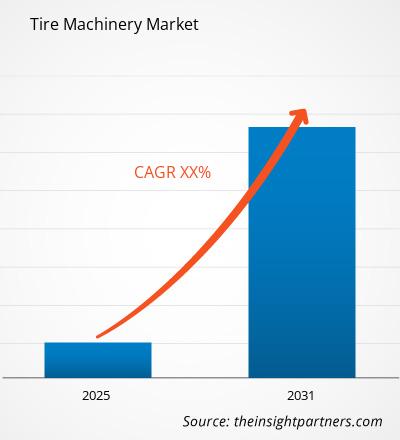
The Global Tire Machinery Market is projected to grow from US$ 2.61 Billion in 2025 to US$ 4.03 Billion by 2034, registering a CAGR of 4.95% during 2026–2034. The market covers machinery used across tire production workflows, including extrusion and cutting systems for motorcycles, passenger cars, light trucks, trucks and buses, agriculture/OTR, and aircraft applications.
North America remains a technology-led demand center, with the Tire Machinery Market size supported by capacity modernization and the reshoring of strategic tire production. The region is estimated to expand at a 4.6–5.0% CAGR during 2026–2034, helped by automation upgrades, EV tire requirements, and stricter quality expectations in commercial vehicle, aircraft, and premium passenger car tire manufacturing.
Tire Machinery Market Assessment and Insights
- North America accounted for 24–27% share in 2025 and is growing at a CAGR of 4.6–5.0% during 2026–2034, led by factory automation, replacement tire demand, and premium vehicle output.
- US represented 78–82% of North America in 2025 and is growing at a CAGR of 4.7–5.1% during 2026–2034 as tire plants invest in robotics.
- Europe held 20–23% share in 2025 and is growing at a CAGR of 4.2–4.7% during 2026–2034, with Germany, France, Italy, Spain, and the UK leading technology upgrades.
- Asia Pacific captured 41–45% share in 2025 and is growing at a CAGR of 5.2–5.7% during 2026–2034, supported by China, India, Japan, and South Korea capacity investments.
- Largest Segment Extrusion held 58–62% market share in 2025 and is growing at a CAGR of 4.7–5.1% during 2026–2034 due to compound precision needs.
- High Growth Segment Cutting held 38–42% market share in 2025 and is growing at a CAGR of 5.1–5.6% during 2026–2034 as flexible SKU production rises.
- Key companies analyzed in detail: Harburg-Freudenberger Maschinenbau GmbH, Larsen & Toubro Limited, Mitsubishi Heavy Industries, Ltd., VMI Group, MESNAC Co., Ltd., Kobe Steel, Ltd., TKH Group NV, Shenyang Blue Silver Industry Automatic Equipment Co., Ltd., SAFE-Run Machinery (Suzhou) Co., Ltd., and Davis-Standard, LLC.
Source: The Insight Partners' analysis based on proprietary research, government publications, company annual reports, investor presentations, industry databases, and expert interviews.
Production strategies are moving from isolated mechanical lines toward digitally coordinated plants that connect mixing, extrusion, component preparation, building, curing, inspection, and intralogistics. The Tire Machinery Market benefits from tire producers seeking lower scrap, tighter gauge control, faster compound changeovers, and higher uptime. Machinery vendors are responding with modular platforms, automated material handling, servo-driven controls, vision inspection, and remote service models that help plants manage wider tire portfolios without raising labor intensity.
Future demand will depend on the development of new clusters of tire manufacturers, the electrification of fleets, investment in infrastructure, and regulations focused on energy efficiency and traceability of products. The relevance of India, Southeast Asia, Mexico, and the Middle East is increasing due to tire manufacturers' diversification of their production facilities. In addition, traditional plants located in North America, Europe, Japan, and South Korea will focus on investments in automation technologies.
Tire Machinery Market Report Scope
| Report Attribute | Details |
|---|---|
| Market size in 2025 | US$ 2.61 Billion |
| Market Size by 2034 | US$ 4.03 Billion |
| Global CAGR (2026 - 2034) | 4.95% |
| Historical Data | 2021-2024 |
| Forecast period | 2026-2034 |
Tire Machinery Market Analysis
The Tire Machinery Market growth is tied to tire producers balancing replacement demand, EV tire complexity, and higher expectations for durability, rolling resistance, and noise reduction. Extrusion and cutting machines play an important role in this change process due to their impact on compound uniformity, ply precision, tread design control, and subsequent building efficiency.
In the supply chain, the demands are fueled by the localization of the automotive original equipment manufacturer (OEM), commercial truck replacement schedules, aircraft tires’ certification needs, and off-the-road (OTR) tires in the mining and agricultural industries. On the supply side, the dynamics continue to be driven by steel, electronics, servos, controls, software, and integration skills.
The Tire Machinery Market analysis shows a competitive field where European precision engineering, Chinese scale, Indian localization, and Japanese industrial know-how intersect. Harburg-Freudenberger Maschinenbau GmbH, VMI Group, MESNAC Co., Ltd., Kobe Steel, Ltd., and SAFE-Run Machinery (Suzhou) Co., Ltd. compete through automation depth, installed-base services, and lifecycle productivity.
Larsen & Toubro Limited, Mitsubishi Heavy Industries, Ltd., TKH Group NV, Shenyang Blue Silver Industry Automatic Equipment Co., Ltd., and Davis-Standard, LLC add engineering, components, vision, and extrusion capabilities to the ecosystem. Money is moving toward regional assembly, commissioning digitally, and equipment to enable smaller lot sizes.
● REPORT CUSTOMIZATION
Tailor This Report To Align With Your Specific Business Requirements
This report can be customized to align precisely with your business objectives, scope, and target markets. Customization options include tailored segmentation, geography, competitive analysis, and strategic insights to support informed decision-making.
Customize This Report →WHAT YOU CAN ADJUST
- ● Segmentations
- ● Geography
- ● Competitive Analysis
- ● Language Preferences
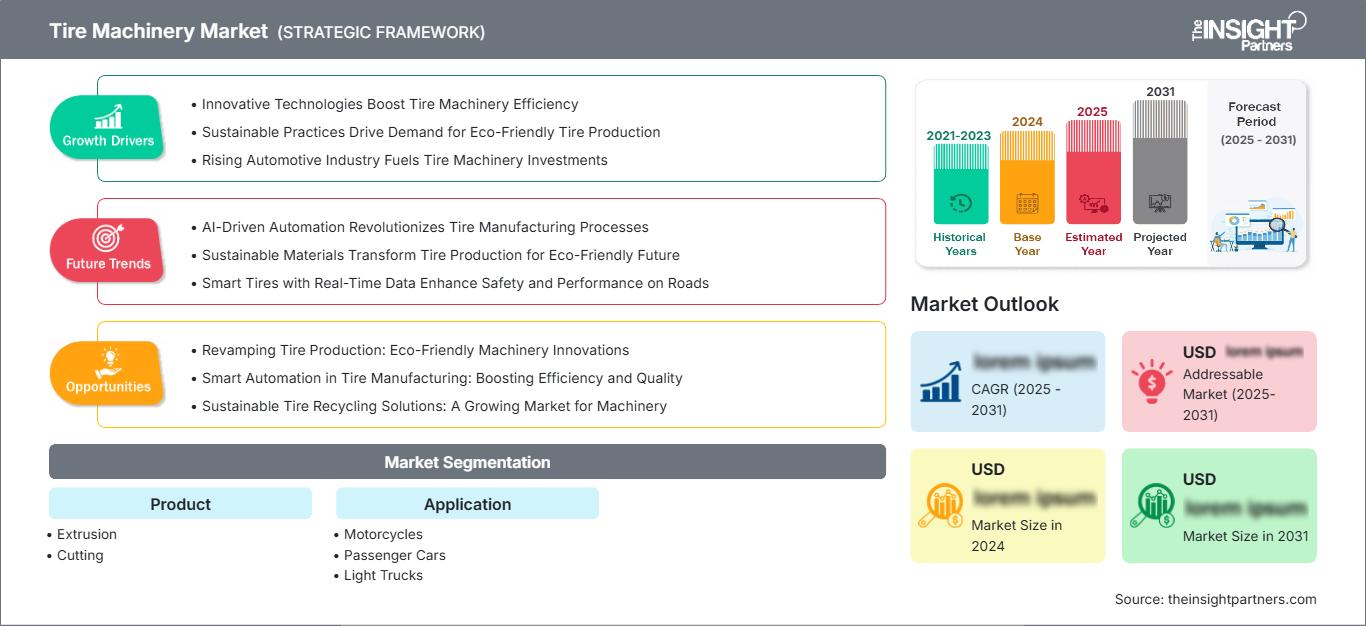
Tire Machinery Market: Strategic Insights
Regional Insights
North America Tire Machinery Market
North America held 24–27% Tire Machinery Market share in 2025 and is projected to grow at a 4.6–5.0% CAGR during 2026–2034. Demand is concentrated in modernization rather than in greenfield expansion alone, as tire producers upgrade extrusion control, automated cutting, robotic handling, and inspection systems to support premium tires, EV platforms, and commercial fleets.
Regional investments also reflect supply-chain resilience, with manufacturers seeking shorter lead times for replacement tires and specialized production. Machinery purchases are influenced by safety standards, skilled labor constraints, and energy management goals. Vendors with strong service footprints and retrofit capability are positioned to win repeat orders from established plants.
U.S. Tire Machinery Market
The United States represented approximately 78–82% of the North American market in 2025 and is projected to grow at a 4.7–5.1% CAGR during 2026–2034. Demand is supported by production across passenger car, light truck, truck and bus, and aircraft tire segments, where manufacturers require highly consistent curing performance, product traceability, and precise process control to meet quality, safety, and certification standards. Increasing emphasis on automation and operational efficiency is also encouraging investment in advanced tire production equipment and process optimization solutions.
Market dynamics revolve around the existence of solid technical sales infrastructure, engineering capabilities, and after-market service providers rather than purely domestic equipment manufacturing. Davis-Standard, LLC is one of the companies with capabilities in tire processing and extrusion systems, whereas foreign companies like VMI Group and Harburg-Freudenberger Maschinenbau GmbH (HF Group) help tire factories in the United States through automation, maintenance, digital monitoring, and productivity improvement systems. Customers value equipment reliability, predictive diagnostics, and after-market service more these days to avoid any downtime.
Europe Tire Machinery Market
Europe accounted for approximately 20–23% of the Tire Curing Press Market share in 2025 and is projected to expand at a 4.2–4.7% CAGR during 2026–2034. Germany leads regional demand due to its advanced engineering capabilities, strong industrial supply chain, and significant presence in premium tire manufacturing. Tire specialty manufacturing and experience in motorsports are provided by the UK. France, Italy, and Spain are further developing replacement tire and commercial vehicle tire facilities. Growth of the demand is driven by the concentration of European manufacturers on providing the highest product quality, efficiency, and modernization of technology in existing tire factories.
European market expansion becomes more affected by the regulations regarding energy efficiency, application of automation, and sustainability issues related to the manufacturing industry. Tire manufacturers spend money on curing machinery and retrofits, allowing for better material usage, less process variation, saving energy, and applying recycled and bio-rubber compounds. Since the majority of production capacity in Europe consists of the existing factories, the supplier companies that have skills in regulatory issues, process control, and factory modernization have good opportunities.
APAC Tire Machinery Market
Asia Pacific accounted for approximately 41–45% of the Tire Manufacturing Equipment Market share in 2025 and is expected to register a 5.2–5.7% CAGR during 2026–2034, making it the largest and most dynamic regional market. China remains the dominant country due to its extensive tire production base, growing localization of manufacturing equipment, and ongoing investments in smart factories and automated production systems. While Japan and South Korea contribute to growing demand due to their advantages in precision engineering and machinery, India is aggressively building up capacity for tire production to cater to domestic consumption and exports.
Australian demand contribution comes from its agricultural, OTR, and mining tires sector, where replacement services and support are still an important aspect. Favorable industrial policies, development of infrastructural programs, and supply chain development for electric vehicles in the region have led to investments in modern tire production facilities, hence, driving demand for new extruding, cutting, inspection, materials handling, and automation equipment, which improve efficiency and productivity. Investments in greenfield facilities and upgrading existing production capacities will help drive equipment purchases in the region over the forecast period. Consequently, the Asia Pacific remains the major driver for the global market.
Middle East & Africa Tire Machinery Market
Middle East & Africa (MEA) is projected to grow at a 5.0–5.5% CAGR during 2026–2034, with Saudi Arabia leading regional market expansion. The demand for tire manufacturing machinery and equipment is driven by the development of logistics corridors, large-scale construction works, industrial diversification programs, and the increasing requirement for replacement tires that are used in the fleets of commercial vehicles, construction equipment, mining equipment, and vehicles in the energy sector. These trends are leading to increased investment in productivity and modernization of selected tire manufacturing and processing enterprises.
The United Arab Emirates serves as a regional center for the distribution of equipment, technical service provision, and after-sales support, and South Africa continues to be an important market because of the presence of its mining industry, agriculture industry, and truck tire industry. In other MEA countries, demand for equipment and machinery is largely project-based and relies on imports and highly specialized technical skills. The buyers of machinery are increasingly focused on equipment reliability, operator training, automation, and maintenance support to increase productivity and performance of tire production enterprises.
Segmentation Analysis
Product
By product, cutting segment is expected to expand at a 4.8–5.2% CAGR during 2026–2034. Tire Machinery Market scope across product lines is defined by precision compound processing, dimensional accuracy, and integration with tire building workflows. Buyers increasingly evaluate extrusion and cutting systems on uptime, changeover speed, automation readiness, and compatibility with sustainable compound formulations.
- Extrusion remains the largest product area because tread, sidewall, inner liner, and component profiles require accurate temperature control, stable output, and repeatable geometry for high-volume tire programs.
- Cutting is gaining strategic importance as producers manage broader SKU mixes, shorter batches, and tighter ply preparation requirements across passenger, commercial, OTR, and aircraft tire manufacturing.
Application
By application, the passenger cars segment is expected to expand at a 4.9–5.3% CAGR during 2026–2034. Demand varies by tire complexity, production volume, certification intensity, and replacement cycles. Passenger cars and light trucks support scale, while trucks and buses, agriculture/OTR, and aircraft applications require robust machinery capable of handling heavier materials and stricter quality demands.
- Motorcycles require compact machinery layouts, consistent compound processing, and efficient changeovers as two-wheeler tire producers serve commuter, premium, and performance categories in high-volume Asian markets.
- Passenger Cars represent a major machinery demand base because tire producers must handle EV-specific durability, low-noise designs, high-speed ratings, and frequent SKU refreshes.
- Light Trucks support machinery investment through replacement demand, regional delivery fleets, and tire designs requiring stronger carcasses, reliable tread profiles, and efficient ply cutting.
- Trucks and Buses require durable production equipment for large tire formats, retread-compatible designs, and commercial fleet specifications where downtime and load performance influence purchase decisions.
- Agriculture/ OTR demands machinery capable of processing heavy compounds, reinforced structures, and large dimensions for mining, construction, forestry, and farm equipment tire applications.
- Aircraft remains specialized, with machinery selection driven by certification requirements, precision material handling, high-speed performance, and strict traceability across low-volume, high-value tire production.
Opportunity Snapshot
| Application | Revenue Contribution | Trend Tag | Adoption Stage |
| Motorcycles | Medium | Urban Mobility | Mature |
| Passenger Cars | High | EV Tires | Scaling |
| Light Trucks | High | Fleet Delivery | Scaling |
| Trucks and Buses | High | Load Efficiency | Mature |
| Agriculture/ OTR | Medium | Mining Tires | Scaling |
| Aircraft | Low | Certified Output | Emerging |
Tire Machinery Market Growth Drivers and Impact Analysis
Automation Investments in Tire Plants
Automation is a primary growth driver as tire producers face skilled labor shortages, rising quality expectations, and pressure to reduce scrap. Modern extrusion and cutting lines now integrate servo controls, recipe management, vision inspection, and automated transfer systems. The result is lower process variation, faster changeovers, and better traceability. In the Tire Machinery Market, suppliers that combine mechanical reliability with software-enabled diagnostics can capture retrofit projects as well as new line installations across passenger, truck, OTR, and aircraft tire plants.
EV Tire Complexity and Material Precision
The electric cars will demand the use of tires that have the ability to handle high torque, heavy loads from batteries, noise considerations, and rolling resistance. This has made the role of proper mixing of compounds, extrusion of tread rubber, ply cuttings, and geometrical consideration of components much more critical than before. The machine purchaser is demanding machinery that is capable of producing dimensional accuracy through processing of new rubber compounds and reinforcements.
Regional Capacity Diversification
The tire manufacturing industry is diversifying its manufacturing locations in order to minimize logistics risks, cater to local OEMs, and minimize disruptions in supply. Some of the emerging investment destinations include India, Southeast Asia, Mexico, and the Middle East. Equipment providers have an advantage whenever there are greenfield projects that would need to have fully integrated extrusion, cutting, handling, and control technologies. Brownfield investment destinations are still investing in brownfield projects.
Tire Machinery Market Future Trends
Digital Twin Enabled Production Optimization
Digital twins will become a defining element of Tire Machinery Market trends as tire plants use virtual models to validate recipes, simulate line bottlenecks, and predict maintenance needs before failures occur. This approach can reduce commissioning time and improve operator training for complex lines. Over the forecast period, machinery vendors that embed simulation, sensor data, and remote diagnostics into equipment packages will differentiate themselves from suppliers offering stand-alone mechanical systems.
Sustainable Compound Processing
Compounding of sustainable materials is expected to affect machinery requirements in the testing of recycled carbon black, biodegradable materials, compounds with high silica content, and low-energy cures. Machinery is supposed to accommodate variations in formulae without compromising on the precision and output of profiles. In the future, there will be more demand for machinery that conserves energy, facilitates closed-loop quality control, and supports documentation of material traceability.
Tire Machinery Market Opportunities
Localized Smart Factory Packages
Suppliers can pursue localized smart factory packages that combine machinery, controls, installation, training, and lifecycle service for new tire plants. Tire Machinery Market Forecasts indicate strong potential where manufacturers need rapid commissioning and lower dependence on cross-border technical teams. A bundled model can improve customer confidence by reducing integration risk, especially in India, Southeast Asia, and the Middle East. Vendors that build regional engineering centers and spare-parts networks can convert one-time machinery sales into recurring service revenue.
Retrofit Programs for Brownfield Plants
Brownfield plants producing tires present an immense opportunity, as most manufacturers tend to go for improvements rather than line changeover. Installation of new extrusion heads, control, cutting, safety, and inspection systems could bring about tangible productivity benefits at reduced capital disturbance. The most significant markets here would be North America, Europe, Japan, and developed Asian manufacturing hubs. Vendors able to assess current lines, evaluate the benefit/cost ratio, and implement the process of modernization gradually will benefit immensely.
Recent Developments
- March 2026: MESNAC Co., Ltd. — MESNAC showcased intelligent tire manufacturing systems at Tire Technology Expo 2026, including automated mixing with material traceability, an NPS PCR one-stage tire building machine with a 35-second cycle, and curing press technologies using patented electric heating.
- 2025: VMI Group — VMI announced that it won the Tire Manufacturing Innovation of the Year Award at Tire Technology Expo 2025, reinforcing its positioning in automated tire production systems and innovation-led machinery development for global tire manufacturers.
Frequently Asked Questions

- Comprehensive Market Sizing and Forecast Analysis
- Detailed Segmentation Analysis
- In-Depth Market Dynamics Assessment
- Regional and Country-Level Insights
- Competitive Landscape and Company Benchmarking
- Strategic Business Intelligence
Recent Reports
Testimonials

The Insight Partners' SCADA System Market report is comprehensive, with valuable insights on current trends and future forecasts. The team was highly professional, responsive, and supportive throughout. We are very satisfied and highly recommend their services.
RAN KEDEM Partner, Reali Technologies LTDs
I requested a report on a very specific software market and the team produced the report in a few days. The information was very relevant and well presented. I then requested some changes and additions to the report. The team was again very responsive and I got the final report in less than a week.
JEAN-HERVE JENN Chairman, Future Analytica
We worked with The Insight Partners for an important market study and forecast. They gave us clear insights into opportunities and risks, which helped shape our plans. Their research was easy to use and based on solid data. It helped us make smart, confident decisions. We highly recommend them.
PIYUSH NAGPAL Sr. Vice President, High Beam Global
The Insight Partners delivered insightful, well-structured market research with strong domain expertise. Their team was professional and responsive throughout. The user-friendly website made accessing industry reports seamless. We highly recommend them for reliable, high-quality research services
YUKIHIKO ADACHI CEO, Deep Blue, LLC.
This is the first time I have purchased a market report from The Insight Partners.While I was unsure at first, I visited their web site and felt more comfortable to take the risk and purchase a market report.I am completely satisfied with the quality of the report and customer service. I had several questions and comments with the initial report, but after a couple of dialogs over email with their analyst I believe I have a report that I can use as input to our strategic planning process.Thank you so much for taking the extra time and making this a positive experience.I will definitely recommend your service to others and you will be my first call when we need further market data.
JOHN SUZUKI President and Chief Executive Officer, Board Director, BK Technologies
I wish to appreciate your support and the professionalism you displayed in the course of attending to my request for information regarding to infectious disease IVD market in Nigeria. I appreciate your patience, your guidance, and the fact that you were willing to offer a discount, which eventually made it possible for us to close a deal. I look forward to engaging The Insight Partners in the future, all thanks to the impression you have created in me as a result of this first encounter.
DR CHIJIOKE ONYIA MANAGING DIRECTOR, PineCrest Healthcare Ltd.Reason to Buy
- Informed Decision-Making
- Understanding Market Dynamics
- Competitive Analysis
- Identifying Emerging Markets
- Customer Insights
- Market Forecasts
- Risk Mitigation
- Boosting Operational Efficiency
- Strategic Planning
- Investment Justification
- Tracking Industry Innovations
- Aligning with Regulatory Trends





 Get Free Sample for