Foam Market Trends, Size & Growth by 2034
Foam Market Size and Forecasts (2021 - 2034), Global and Regional Share, Trends, and Growth Opportunity Analysis Report Coverage : by Material Type (Polyurethane, Polystyrene, Polyethylene, Polypropylene, Phenolic, PET); Type (Rigid and Flexible); End-Use Industry (Construction, Packaging, Automotive, Furniture & Bedding, Footwear); and Geography (North America, Europe, Asia Pacific, and South and Central America)
- Status : Data Released
- Report Code : TIPRE00040200
- Category : Chemicals and Materials
- No. of Pages : 150
- Available Report Formats :



Report Coverage
Revenue forecast, Company Analysis, Industry landscape, Growth factors, and Trends

Segment Covered
This text is related
to segments covered.

Regional Scope
North America, Europe, Asia Pacific, Middle East & Africa, South & Central America

Country Scope
This text is related
to country scope.
Frequently Asked Questions
Flexible foam is modeled to account for ~56% of the market in 2025, with a CAGR of ~7% through 2034. Its broad use in furniture, bedding, automotive interiors, and cushioning supports this position. The estimate is intended for analytical comparison and should be interpreted within the supplied segmentation framework.
Construction is modeled to represent ~28% of the market in 2025, with a CAGR of ~7% through 2034. Demand is supported by insulation, building-envelope improvements, renovation, and construction activity. Project economics, building requirements, and installation costs will influence the pace of adoption across different countries and building types.
The Foam Market Report evaluates the global market baseline, regional outlook, material categories, rigid and flexible foam, and the construction, packaging, automotive, furniture and bedding, and footwear industries. It also examines competitive positioning, manufacturing considerations, emerging product trends, and potential investment opportunities through 2034.
The United States is modeled to account for ~75% of North American market revenue in 2025, with a CAGR of ~5% through 2034. Its position reflects a diversified base of construction, packaging, automotive, furniture, and industrial demand. These estimates help frame the relative importance of US demand within the wider North American market.
Asia Pacific is modeled as the fastest-growing region, with a CAGR of ~8% through 2034. Industrial expansion, urban development, and growing downstream manufacturing demand underpin this outlook. Actual growth will depend on investment, local production economics, construction cycles, and the pace at which customers adopt foam materials in specific applications.
The Foam Market was valued at US$ 116.64 Billion in 2025 and is projected to reach US$ 201.08 Billion by 2034. The supplied global CAGR for 2026–2034 is 6.24%. These figures provide the report's baseline for assessing regional demand, material choices, end-use opportunities, and investment priorities.
Asia Pacific is modeled to hold ~39% of global market revenue in 2025, making it the largest region in this assessment. Its position reflects manufacturing capacity, construction activity, packaging consumption, and demand from automotive and consumer goods supply chains. The regional estimate is modeled rather than a directly reported market measurement.
1. Executive Summary
1.1 Analyst Market Outlook
1.2 Market Attractiveness
2. Foam Market Landscape
2.1 Overview
2.2 Value Chain Analysis
2.2.1 Raw Materials/Components
2.2.2 Manufacturing Process/Technology
2.2.3 Distribution Landscape
2.2.4 End–User
2.2.5 Level of Integration
2.3 Supply Chain Analysis
2.3.1 List of Manufacturers/Suppliers
2.3.2 List of Potential Customers (Upto 50)
2.4 Porter's Five Force Analysis
2.5 PEST Analysis
2.6 Import–Export Analysis for Key Countries (As per the nearest HS Code)
2.7 Impact of Artificial Intelligence (AI)
2.8 Product or Technology Roadmap
2.9 Sustainability and ESG Trends
2.10 Patent Analysis
2.11 Regulatory Framework
3. Competitive Landscape
3.1 Company Benchmarking by Key Players
3.2 Market Share Analysis, 2025 – By Key Players
3.3 Market Concentration
4. Foam Market - Key Industry Dynamics
4.1 Market Drivers
4.2 Market Restraints
4.3 Market Opportunities
4.4 Future Trends
4.5 Impact of Drivers and Restraints
5. Foam Market - Global Market Analysis
5.1 Foam Market Market Revenue (US$ Billion), 2021–2034
5.2 Foam Market Market Forecast and Analysis
6. Foam Market Revenue Analysis – Material Type
6.1 Foam Market Market Forecasts and Analysis by Material Type
6.2 Polyurethane
6.2.1 Overview
6.2.2 Polyurethane Market Revenue, 2021–2034 (US$ Billion)
6.3 Polystyrene
6.3.1 Overview
6.3.2 Polystyrene Market Revenue, 2021–2034 (US$ Billion)
6.4 Polyethylene
6.4.1 Overview
6.4.2 Polyethylene Market Revenue, 2021–2034 (US$ Billion)
6.5 Polypropylene
6.5.1 Overview
6.5.2 Polypropylene Market Revenue, 2021–2034 (US$ Billion)
6.6 Phenolic
6.6.1 Overview
6.6.2 Phenolic Market Revenue, 2021–2034 (US$ Billion)
6.7 PET
6.7.1 Overview
6.7.2 PET Market Revenue, 2021–2034 (US$ Billion)
7. Foam Market Revenue Analysis – Type
7.1 Foam Market Market Forecasts and Analysis by Type
7.2 Rigid and Flexible
7.2.1 Overview
7.2.2 Rigid and Flexible Market Revenue, 2021–2034 (US$ Billion)
8. Foam Market Revenue Analysis – End-Use Industry
8.1 Foam Market Market Forecasts and Analysis by End-Use Industry
8.2 Construction
8.2.1 Overview
8.2.2 Construction Market Revenue, 2021–2034 (US$ Billion)
8.3 Packaging
8.3.1 Overview
8.3.2 Packaging Market Revenue, 2021–2034 (US$ Billion)
8.4 Automotive
8.4.1 Overview
8.4.2 Automotive Market Revenue, 2021–2034 (US$ Billion)
8.5 Furniture & Bedding
8.5.1 Overview
8.5.2 Furniture & Bedding Market Revenue, 2021–2034 (US$ Billion)
8.6 Footwear
8.6.1 Overview
8.6.2 Footwear Market Revenue, 2021–2034 (US$ Billion)
9. Foam Market – Geographical Analysis
9.1 Overview
9.2 North America
9.2.1 North America Foam Market Market Overview
9.2.2 North America: Foam Market Market – Revenue, 2021–2034 (US$ Billion)
9.2.3 North America: Foam Market Market Breakdown, by Material Type
9.2.4 North America: Foam Market Market Breakdown, by Type
9.2.5 North America: Foam Market Market Breakdown, by End-Use Industry
9.2.6 North America: Foam Market Market – Revenue and Forecast Analysis – by Country
9.2.6.2 US: Foam Market Market – Revenue and Forecast, 2021–2034 (US$ Billion)
9.2.6.2.1 US: Foam Market Market Breakdown, by Material Type
9.2.6.2.2 US: Foam Market Market Breakdown, by Type
9.2.6.2.3 US: Foam Market Market Breakdown, by End-Use Industry
9.2.6.3 Canada: Foam Market Market – Revenue and Forecast, 2021–2034 (US$ Billion)
9.2.6.3.1 Canada: Foam Market Market Breakdown, by Material Type
9.2.6.3.2 Canada: Foam Market Market Breakdown, by Type
9.2.6.3.3 Canada: Foam Market Market Breakdown, by End-Use Industry
9.2.6.4 Mexico: Foam Market Market – Revenue and Forecast, 2021–2034 (US$ Billion)
9.2.6.4.1 Mexico: Foam Market Market Breakdown, by Material Type
9.2.6.4.2 Mexico: Foam Market Market Breakdown, by Type
9.2.6.4.3 Mexico: Foam Market Market Breakdown, by End-Use Industry
9.3 Europe
9.3.1 Europe Foam Market Market Overview
9.3.2 Europe: Foam Market Market – Revenue, 2021–2034 (US$ Billion)
9.3.3 Europe: Foam Market Market Breakdown, by Material Type
9.3.4 Europe: Foam Market Market Breakdown, by Type
9.3.5 Europe: Foam Market Market Breakdown, by End-Use Industry
9.3.6 Europe: Foam Market Market – Revenue and Forecast Analysis – by Country
9.3.6.2 UK: Foam Market Market – Revenue and Forecast, 2021–2034 (US$ Billion)
9.3.6.2.1 UK: Foam Market Market Breakdown, by Material Type
9.3.6.2.2 UK: Foam Market Market Breakdown, by Type
9.3.6.2.3 UK: Foam Market Market Breakdown, by End-Use Industry
9.3.6.3 Germany: Foam Market Market – Revenue and Forecast, 2021–2034 (US$ Billion)
9.3.6.3.1 Germany: Foam Market Market Breakdown, by Material Type
9.3.6.3.2 Germany: Foam Market Market Breakdown, by Type
9.3.6.3.3 Germany: Foam Market Market Breakdown, by End-Use Industry
9.3.6.4 France: Foam Market Market – Revenue and Forecast, 2021–2034 (US$ Billion)
9.3.6.4.1 France: Foam Market Market Breakdown, by Material Type
9.3.6.4.2 France: Foam Market Market Breakdown, by Type
9.3.6.4.3 France: Foam Market Market Breakdown, by End-Use Industry
9.3.6.5 Russia: Foam Market Market – Revenue and Forecast, 2021–2034 (US$ Billion)
9.3.6.5.1 Russia: Foam Market Market Breakdown, by Material Type
9.3.6.5.2 Russia: Foam Market Market Breakdown, by Type
9.3.6.5.3 Russia: Foam Market Market Breakdown, by End-Use Industry
9.3.6.6 Italy: Foam Market Market – Revenue and Forecast, 2021–2034 (US$ Billion)
9.3.6.6.1 Italy: Foam Market Market Breakdown, by Material Type
9.3.6.6.2 Italy: Foam Market Market Breakdown, by Type
9.3.6.6.3 Italy: Foam Market Market Breakdown, by End-Use Industry
9.3.6.7 Rest of Europe: Foam Market Market – Revenue and Forecast, 2021–2034 (US$ Billion)
9.3.6.7.1 Rest of Europe: Foam Market Market Breakdown, by Material Type
9.3.6.7.2 Rest of Europe: Foam Market Market Breakdown, by Type
9.3.6.7.3 Rest of Europe: Foam Market Market Breakdown, by End-Use Industry
9.4 Asia-Pacific
9.4.1 Asia-Pacific Foam Market Market Overview
9.4.2 Asia-Pacific: Foam Market Market – Revenue, 2021–2034 (US$ Billion)
9.4.3 Asia-Pacific: Foam Market Market Breakdown, by Material Type
9.4.4 Asia-Pacific: Foam Market Market Breakdown, by Type
9.4.5 Asia-Pacific: Foam Market Market Breakdown, by End-Use Industry
9.4.6 Asia-Pacific: Foam Market Market – Revenue and Forecast Analysis – by Country
9.4.6.2 China: Foam Market Market – Revenue and Forecast, 2021–2034 (US$ Billion)
9.4.6.2.1 China: Foam Market Market Breakdown, by Material Type
9.4.6.2.2 China: Foam Market Market Breakdown, by Type
9.4.6.2.3 China: Foam Market Market Breakdown, by End-Use Industry
9.4.6.3 India: Foam Market Market – Revenue and Forecast, 2021–2034 (US$ Billion)
9.4.6.3.1 India: Foam Market Market Breakdown, by Material Type
9.4.6.3.2 India: Foam Market Market Breakdown, by Type
9.4.6.3.3 India: Foam Market Market Breakdown, by End-Use Industry
9.4.6.4 Japan: Foam Market Market – Revenue and Forecast, 2021–2034 (US$ Billion)
9.4.6.4.1 Japan: Foam Market Market Breakdown, by Material Type
9.4.6.4.2 Japan: Foam Market Market Breakdown, by Type
9.4.6.4.3 Japan: Foam Market Market Breakdown, by End-Use Industry
9.4.6.5 Australia: Foam Market Market – Revenue and Forecast, 2021–2034 (US$ Billion)
9.4.6.5.1 Australia: Foam Market Market Breakdown, by Material Type
9.4.6.5.2 Australia: Foam Market Market Breakdown, by Type
9.4.6.5.3 Australia: Foam Market Market Breakdown, by End-Use Industry
9.4.6.6 Rest of Asia-Pacific: Foam Market Market – Revenue and Forecast, 2021–2034 (US$ Billion)
9.4.6.6.1 Rest of Asia-Pacific: Foam Market Market Breakdown, by Material Type
9.4.6.6.2 Rest of Asia-Pacific: Foam Market Market Breakdown, by Type
9.4.6.6.3 Rest of Asia-Pacific: Foam Market Market Breakdown, by End-Use Industry
9.5 South and Central America
9.5.1 South and Central America Foam Market Market Overview
9.5.2 South and Central America: Foam Market Market – Revenue, 2021–2034 (US$ Billion)
9.5.3 South and Central America: Foam Market Market Breakdown, by Material Type
9.5.4 South and Central America: Foam Market Market Breakdown, by Type
9.5.5 South and Central America: Foam Market Market Breakdown, by End-Use Industry
9.5.6 South and Central America: Foam Market Market – Revenue and Forecast Analysis – by Country
9.5.6.2 Brazil: Foam Market Market – Revenue and Forecast, 2021–2034 (US$ Billion)
9.5.6.2.1 Brazil: Foam Market Market Breakdown, by Material Type
9.5.6.2.2 Brazil: Foam Market Market Breakdown, by Type
9.5.6.2.3 Brazil: Foam Market Market Breakdown, by End-Use Industry
9.5.6.3 Argentina: Foam Market Market – Revenue and Forecast, 2021–2034 (US$ Billion)
9.5.6.3.1 Argentina: Foam Market Market Breakdown, by Material Type
9.5.6.3.2 Argentina: Foam Market Market Breakdown, by Type
9.5.6.3.3 Argentina: Foam Market Market Breakdown, by End-Use Industry
9.5.6.4 Rest of South and Central America: Foam Market Market – Revenue and Forecast, 2021–2034 (US$ Billion)
9.5.6.4.1 Rest of South and Central America: Foam Market Market Breakdown, by Material Type
9.5.6.4.2 Rest of South and Central America: Foam Market Market Breakdown, by Type
9.5.6.4.3 Rest of South and Central America: Foam Market Market Breakdown, by End-Use Industry
9.6 Middle East and Africa
9.6.1 Middle East and Africa Foam Market Market Overview
9.6.2 Middle East and Africa: Foam Market Market – Revenue, 2021–2034 (US$ Billion)
9.6.3 Middle East and Africa: Foam Market Market Breakdown, by Material Type
9.6.4 Middle East and Africa: Foam Market Market Breakdown, by Type
9.6.5 Middle East and Africa: Foam Market Market Breakdown, by End-Use Industry
9.6.6 Middle East and Africa: Foam Market Market – Revenue and Forecast Analysis – by Country
9.6.6.2 South Africa: Foam Market Market – Revenue and Forecast, 2021–2034 (US$ Billion)
9.6.6.2.1 South Africa: Foam Market Market Breakdown, by Material Type
9.6.6.2.2 South Africa: Foam Market Market Breakdown, by Type
9.6.6.2.3 South Africa: Foam Market Market Breakdown, by End-Use Industry
9.6.6.3 Saudi Arabia: Foam Market Market – Revenue and Forecast, 2021–2034 (US$ Billion)
9.6.6.3.1 Saudi Arabia: Foam Market Market Breakdown, by Material Type
9.6.6.3.2 Saudi Arabia: Foam Market Market Breakdown, by Type
9.6.6.3.3 Saudi Arabia: Foam Market Market Breakdown, by End-Use Industry
9.6.6.4 UAE: Foam Market Market – Revenue and Forecast, 2021–2034 (US$ Billion)
9.6.6.4.1 UAE: Foam Market Market Breakdown, by Material Type
9.6.6.4.2 UAE: Foam Market Market Breakdown, by Type
9.6.6.4.3 UAE: Foam Market Market Breakdown, by End-Use Industry
9.6.6.5 Rest of Middle East and Africa: Foam Market Market – Revenue and Forecast, 2021–2034 (US$ Billion)
9.6.6.5.1 Rest of Middle East and Africa: Foam Market Market Breakdown, by Material Type
9.6.6.5.2 Rest of Middle East and Africa: Foam Market Market Breakdown, by Type
9.6.6.5.3 Rest of Middle East and Africa: Foam Market Market Breakdown, by End-Use Industry
10. Foam Market Industry Landscape
11. Foam Market – Key Company Profiles
11.1 BASF SE
11.1.1 Key Facts
11.1.2 Business Description
11.1.3 Products and Services
11.1.4 Financial Overview
11.1.5 SWOT Analysis
11.1.6 Key Developments
11.2 Armacell International S.A.
11.2.1 Key Facts
11.2.2 Business Description
11.2.3 Products and Services
11.2.4 Financial Overview
11.2.5 SWOT Analysis
11.2.6 Key Developments
11.3 JSP
11.3.1 Key Facts
11.3.2 Business Description
11.3.3 Products and Services
11.3.4 Financial Overview
11.3.5 SWOT Analysis
11.3.6 Key Developments
11.4 Kaneka Corporation
11.4.1 Key Facts
11.4.2 Business Description
11.4.3 Products and Services
11.4.4 Financial Overview
11.4.5 SWOT Analysis
11.4.6 Key Developments
11.5 Recticel
11.5.1 Key Facts
11.5.2 Business Description
11.5.3 Products and Services
11.5.4 Financial Overview
11.5.5 SWOT Analysis
11.5.6 Key Developments
11.6 Rogers Corporation
11.6.1 Key Facts
11.6.2 Business Description
11.6.3 Products and Services
11.6.4 Financial Overview
11.6.5 SWOT Analysis
11.6.6 Key Developments
11.7 Sealed Air Corporation
11.7.1 Key Facts
11.7.2 Business Description
11.7.3 Products and Services
11.7.4 Financial Overview
11.7.5 SWOT Analysis
11.7.6 Key Developments
11.8 Arkema
11.8.1 Key Facts
11.8.2 Business Description
11.8.3 Products and Services
11.8.4 Financial Overview
11.8.5 SWOT Analysis
11.8.6 Key Developments
11.9 Zotefoams plc
11.9.1 Key Facts
11.9.2 Business Description
11.9.3 Products and Services
11.9.4 Financial Overview
11.9.5 SWOT Analysis
11.9.6 Key Developments
11.10 Covestro AG.
11.10.1 Key Facts
11.10.2 Business Description
11.10.3 Products and Services
11.10.4 Financial Overview
11.10.5 SWOT Analysis
11.10.6 Key Developments
12. List of Additional Companies Analyzed
13. Appendix
13.1 Glossary
13.2 List of Tables
13.3 List of Figures
13.4 Research Methodology and Approach
13.4.1 Secondary Research
13.4.2 Primary Research
13.4.3 Market Estimation Approach
13.4.3.1 Supply Side Analysis
13.4.3.2 Demand Side Analysis
13.4.4 Research Assumptions and Limitations
13.5 Meet Our Analysts
13.6 About The Insight Partners
13.7 Market Intelligence Cloud
Yes! We provide a free sample of the report, which includes Report Scope (Table of Contents), report structure, and selected insights to help you assess the value of the full report. Please click on the "Download Sample" button or contact us to receive your copy.
Absolutely - analyst assistance is part of the package. You can connect with our analyst post-purchase to clarify report insights, methodology or discuss how the findings apply to your business needs.
Once your order is successfully placed, you will receive a confirmation email along with your invoice.
• For published reports: You'll receive access to the report within 4-6 working hours via a secured email sent to your email.
• For upcoming reports: Your order will be recorded as a pre-booking. Our team will share the estimated release date and keep you informed of any updates. As soon as the report is published, it will be delivered to your registered email.
We offer customization options to align the report with your specific objectives. Whether you need deeper insights into a particular region, industry segment, competitor analysis, or data cut, our research team can tailor the report accordingly. Please share your requirements with us, and we'll be happy to provide a customized proposal or scope.
The report is available in either PDF format or as an Excel dataset, depending on the license you choose.
The PDF version provides the full analysis and visuals in a ready-to-read format. The Excel dataset includes all underlying data tables for easy manipulation and further analysis.
Please review the license options at checkout or contact us to confirm which formats are included with your purchase.
Our payment process is fully secure and PCI-DSS compliant.
We use trusted and encrypted payment gateways to ensure that all transactions are protected with industry-standard SSL encryption. Your payment details are never stored on our servers and are handled securely by certified third-party processors.
You can make your purchase with confidence, knowing your personal and financial information is safe with us.
Yes, we do offer special pricing for bulk purchases.
If you're interested in purchasing multiple reports, we're happy to provide a customized bundle offer or volume-based discount tailored to your needs. Please contact our sales team with the list of reports you're considering, and we'll share a personalized quote.
Yes, absolutely.
Our team is available to help you make an informed decision. Whether you have questions about the report's scope, methodology, customization options, or which license suits you best, we're here to assist. Please reach out to us at sales@theinsightpartners.com, and one of our representatives will get in touch promptly.
Yes, a billing invoice will be automatically generated and sent to your registered email upon successful completion of your purchase.
If you need the invoice in a specific format or require additional details (such as company name, GST, or VAT information), feel free to contact us, and we'll be happy to assist.
Yes, certainly.
If you encounter any difficulties accessing or receiving your report, our support team is ready to assist you. Simply reach out to us via email or live chat with your order information, and we'll ensure the issue is resolved quickly so you can access your report without interruption.
The Insight Partners performs research in 4 major stages: Data Collection & Secondary Research, Primary Research, Data Analysis and Data Triangulation & Final Review.
- Data Collection and Secondary Research:
As a market research and consulting firm operating from a decade, we have published many reports and advised several clients across the globe. First step for any study will start with an assessment of currently available data and insights from existing reports. Further, historical and current market information is collected from Investor Presentations, Annual Reports, SEC Filings, etc., and other information related to company’s performance and market positioning are gathered from Paid Databases (Factiva, Hoovers, and Reuters) and various other publications available in public domain.
Several associations trade associates, technical forums, institutes, societies and organizations are accessed to gain technical as well as market related insights through their publications such as research papers, blogs and press releases related to the studies are referred to get cues about the market. Further, white papers, journals, magazines, and other news articles published in the last 3 years are scrutinized and analyzed to understand the current market trends.
- Primary Research:
The primarily interview analysis comprise of data obtained from industry participants interview and answers to survey questions gathered by in-house primary team.
For primary research, interviews are conducted with industry experts/CEOs/Marketing Managers/Sales Managers/VPs/Subject Matter Experts from both demand and supply side to get a 360-degree view of the market. The primary team conducts several interviews based on the complexity of the markets to understand the various market trends and dynamics which makes research more credible and precise.
A typical research interview fulfils the following functions:
- Provides first-hand information on the market size, market trends, growth trends, competitive landscape, and outlook
- Validates and strengthens in-house secondary research findings
- Develops the analysis team’s expertise and market understanding
Primary research involves email interactions and telephone interviews for each market, category, segment, and sub-segment across geographies. The participants who typically take part in such a process include, but are not limited to:
- Industry participants: VPs, business development managers, market intelligence managers and national sales managers
- Outside experts: Valuation experts, research analysts and key opinion leaders specializing in the electronics and semiconductor industry.
Below is the breakup of our primary respondents by company, designation, and region:
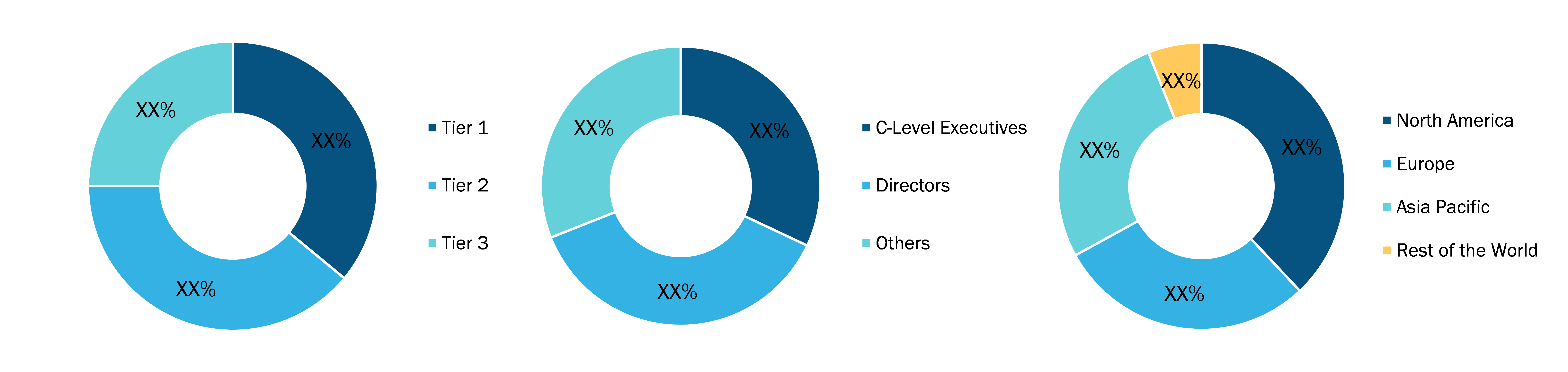
Once we receive the confirmation from primary research sources or primary respondents, we finalize the base year market estimation and forecast the data as per the macroeconomic and microeconomic factors assessed during data collection.
- Data Analysis:
Once data is validated through both secondary as well as primary respondents, we finalize the market estimations by hypothesis formulation and factor analysis at regional and country level.
- 3.1 Macro-Economic Factor Analysis:
We analyse macroeconomic indicators such the gross domestic product (GDP), increase in the demand for goods and services across industries, technological advancement, regional economic growth, governmental policies, the influence of COVID-19, PEST analysis, and other aspects. This analysis aids in setting benchmarks for various nations/regions and approximating market splits. Additionally, the general trend of the aforementioned components aid in determining the market's development possibilities.
- 3.2 Country Level Data:
Various factors that are especially aligned to the country are taken into account to determine the market size for a certain area and country, including the presence of vendors, such as headquarters and offices, the country's GDP, demand patterns, and industry growth. To comprehend the market dynamics for the nation, a number of growth variables, inhibitors, application areas, and current market trends are researched. The aforementioned elements aid in determining the country's overall market's growth potential.
- 3.3 Company Profile:
The “Table of Contents” is formulated by listing and analyzing more than 25 - 30 companies operating in the market ecosystem across geographies. However, we profile only 10 companies as a standard practice in our syndicate reports. These 10 companies comprise leading, emerging, and regional players. Nonetheless, our analysis is not restricted to the 10 listed companies, we also analyze other companies present in the market to develop a holistic view and understand the prevailing trends. The “Company Profiles” section in the report covers key facts, business description, products & services, financial information, SWOT analysis, and key developments. The financial information presented is extracted from the annual reports and official documents of the publicly listed companies. Upon collecting the information for the sections of respective companies, we verify them via various primary sources and then compile the data in respective company profiles. The company level information helps us in deriving the base number as well as in forecasting the market size.
- 3.4 Developing Base Number:
Aggregation of sales statistics (2020-2022) and macro-economic factor, and other secondary and primary research insights are utilized to arrive at base number and related market shares for 2022. The data gaps are identified in this step and relevant market data is analyzed, collected from paid primary interviews or databases. On finalizing the base year market size, forecasts are developed on the basis of macro-economic, industry and market growth factors and company level analysis.
- Data Triangulation and Final Review:
The market findings and base year market size calculations are validated from supply as well as demand side. Demand side validations are based on macro-economic factor analysis and benchmarks for respective regions and countries. In case of supply side validations, revenues of major companies are estimated (in case not available) based on industry benchmark, approximate number of employees, product portfolio, and primary interviews revenues are gathered. Further revenue from target product/service segment is assessed to avoid overshooting of market statistics. In case of heavy deviations between supply and demand side values, all thes steps are repeated to achieve synchronization.
We follow an iterative model, wherein we share our research findings with Subject Matter Experts (SME’s) and Key Opinion Leaders (KOLs) until consensus view of the market is not formulated – this model negates any drastic deviation in the opinions of experts. Only validated and universally acceptable research findings are quoted in our reports.
We have important check points that we use to validate our research findings – which we call – data triangulation, where we validate the information, we generate from secondary sources with primary interviews and then we re-validate with our internal data bases and Subject matter experts. This comprehensive model enables us to deliver high quality, reliable data in shortest possible time.
 Get Free Sample For