
Uranium Mining Market Demand, Trends & Forecast by 2034
Coverage: By Mining Technique (Open-pit Mining, Underground Mining); Application (Medical, Defense, Industrial, Others) , and Geography (North America, Europe, Asia Pacific, and South and Central America)
- Status : Data Released
- Report Code : TIPRE00029660
- Category : Manufacturing and Construction
- No. of Pages : 150
- Available Report Formats :


- Last update date : October 30, 2026


2025 Market Size
US$ 6.01 Bn
Base year value
2034 Forecast
US$ 9.87 Bn
Projected by 2034
CAGR 2026-2034
5.67 %
Growth rate
Addressable Market
US$ 71.99 Bn
(2026-2034)
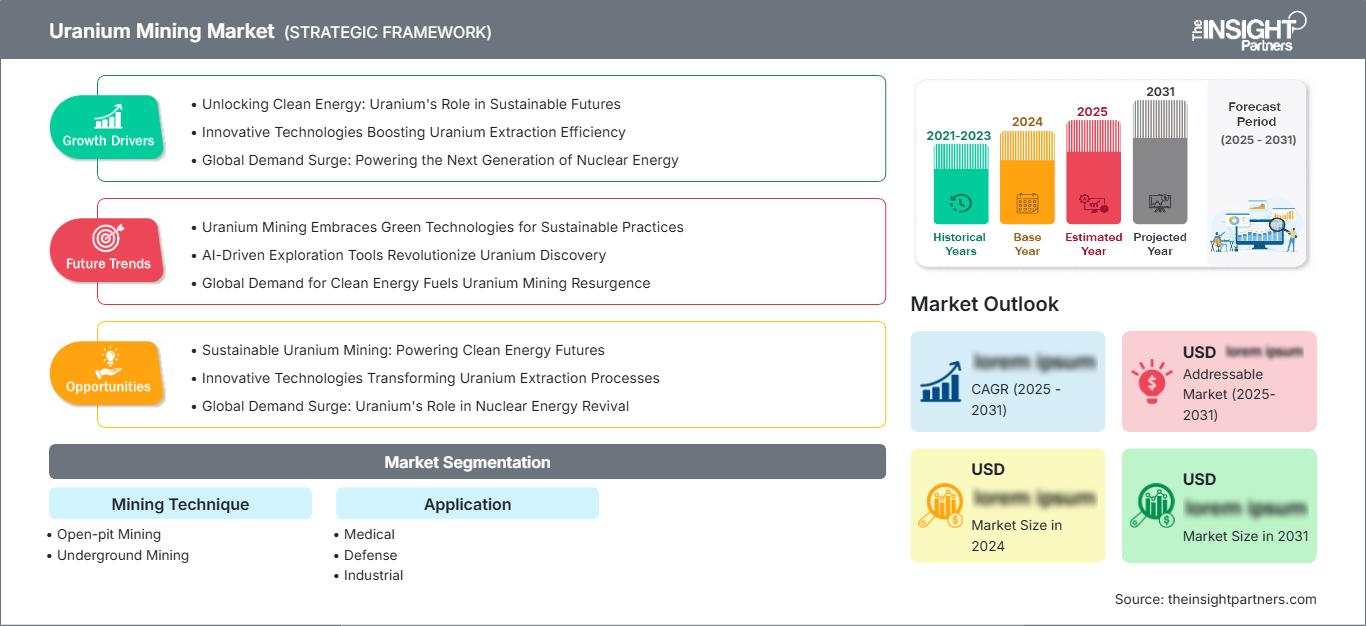
The uranium mining market was valued at US$ 6.01 Billion in 2025 and is projected to reach US$ 9.87 Billion by 2034, registering a CAGR of 5.67% during 2026-2034. The market covers the extraction of uranium-bearing ore through Open-pit Mining and Underground Mining for Medical, Defense, and Industrial applications, with mined uranium subsequently entering the nuclear fuel and other specialized value chains.
North America remains a strategically important producing and consuming region, supported by established uranium resources in Canada, renewed U.S. domestic production, and government efforts to strengthen nuclear fuel security. The Uranium Mining Market Size in North America is estimated to account for ~27% of global value in 2025 and is expected to expand at ~5.0% CAGR through 2034. The U.S. uranium sector has shown a clear operational recovery, with domestic uranium concentrate production reaching its highest level since 2017 in 2025, while Canadian high-grade assets continue to provide an important source of mine supply for utilities seeking diversified procurement.
Uranium Mining Market Assessment and Insights
- North America: The region represents ~27% of global uranium mining market value in 2025 and is projected to grow at ~5.0% CAGR. Canada provides the region's strongest production base through high-grade Saskatchewan operations, while U.S. production and policy support are increasing the strategic value of domestic resources. This combination strengthens regional supply resilience and reduces exposure to concentrated overseas supply chains.
- U.S.: The U.S. accounts for ~15% of North America's uranium mining market in 2025 and is expected to grow at ~6.2% CAGR. Rising domestic uranium concentrate production, federal support for nuclear fuel security, and development of ISR projects are improving the commercial environment. The implication is a gradual expansion of domestic mine-to-mill capacity, although permitting, project economics, and conversion and enrichment bottlenecks remain important constraints.
- Europe: Europe contributes ~8% of the global uranium mining market in 2025 and is expected to grow at ~4.7% CAGR. France, Germany, and the Czech Republic are strategically important because of nuclear generation, fuel-cycle infrastructure, and efforts to diversify away from Russian-linked nuclear fuel supply. The region's principal differentiator is its emphasis on supply-chain sovereignty rather than simply maximizing domestic mining volumes.
- Asia Pacific: Asia Pacific represents ~48% of global uranium mining market value in 2025 and is forecast to expand at ~6.1% CAGR. China, Australia, and India are central to regional dynamics, with China emphasizing domestic uranium resource development, Australia retaining major resource potential, and India pursuing long-term nuclear fuel security. Expanding reactor programs and state-backed resource strategies support sustained demand.
- Largest Segment: Industrial application is the largest main segment and is expected to register approximately ~5.5% CAGR through 2034. Its leading position reflects the broad requirement for uranium as feedstock for commercial nuclear power and associated industrial nuclear activities. Long-term utility contracting and reactor-life-cycle demand provide greater continuity than specialized applications.
- High Growth Segment: Medical application is projected to record approximately ~6.4% CAGR, supported by expanding nuclear medicine infrastructure and demand for radioisotope-related activities. Its growth mechanism differs from conventional power generation because procurement is influenced by isotope availability, reactor and processing infrastructure, and healthcare investment.
- Key companies analyzed in detail: National Atomic Company Kazatomprom JSC, Cameco Corporation, Orano, Uranium One, ARMZ Uranium Holding Co., China National Nuclear Corporation, CGN Mining Company Limited, BHP Group Limited, General Atomics, and Navoi Mining and Metallurgical Company JSC.
Source: The Insight Partners' analysis based on proprietary research, government publications, company annual reports, investor presentations, industry databases, and expert interviews.
The Uranium Mining Market Share has shifted from a predominantly conventional extraction model toward a more technology-diverse structure in which deposit characteristics determine the commercial extraction route. Open-pit and underground mining still play an important role in the extraction of conventional uranium, especially when it is located near the surface or deep underground and needs to be physically extracted. Simultaneously, in situ recovery has gained great importance in key producing countries like Kazakhstan, Uzbekistan, and the US. The relevance of this innovation for the provided market taxonomy can be explained by the fact that the economic viability of uranium mining depends nowadays more on the geological characteristics of the mineral than on a specific type of mining.
The examples of recent operational innovations prove this trend. In 2025, China National Nuclear Corporation launched the National No. 1 Uranium demonstration project in Inner Mongolia, reaching uranium-product output quickly through a combination of in situ leaching along with digital well construction and intelligent process control. While Kazakhstan focused on developing wellfields and processing facilities, Canada kept investing in high-grade underground mines and mill plants.
Buyer requirements have also changed. Utilities increasingly value reliable delivery schedules, diversified geopolitical exposure, and long-term contracting alongside mine cost competitiveness. This favors producers capable of integrating mining with processing, conversion, trading, or broader nuclear fuel services. Consequently, the uranium mining market is increasingly shaped by the reliability of the entire upstream-to-fuel pathway rather than by mine output alone.
Until 2034, new production will likely arise from a wider array of geographical regions, especially those in Central Asia, Mongolia, Africa, North America, and Australia. The Zuuvch-Ovoo project in Mongolia, the mine developments in Kazakhstan, resource development in Uzbekistan, and the reinitiation of ISR operations in the United States are examples of how projects may seek to expand sources for the future. The capital investment will be directed at brownfield developments and technically proven resources, in which case the existing infrastructure may reduce the time needed to develop such projects.
Regulatory policy will remain a major determinant of project sequencing. The Uranium Mining Market Report indicates that governments are increasingly treating uranium as a strategic material linked to energy security, which can accelerate domestic support for exploration, mining, processing, and fuel-cycle infrastructure. The result should be a more regionally diversified uranium mining market, although geopolitical restrictions, permitting delays, skilled-labor shortages, and processing bottlenecks can still prevent announced resources from translating quickly into commercial supply.
Uranium Mining Market Report Scope
| Report Attribute | Details |
|---|---|
| Market size in 2025 | US$ 6.01 Billion |
| Market Size by 2034 | US$ 9.87 Billion |
| Global CAGR (2026 - 2034) | 5.67% |
| Historical Data | 2021-2024 |
| Forecast period | 2026-2034 |
Uranium Mining Market Analysis
The uranium mining market growth outlook is closely tied to the interaction between reactor demand, utility procurement, mine development cycles, and supply security. However, since demand for nuclear power is rising, utilities will have a higher demand for future uranium volumes; mining companies, however, are not able to increase their production capacity right away, as they have to first explore potential resources, perform feasibility studies, obtain permits, develop the infrastructure, prepare the wellfield, construct mines, and bring them online. Consequently, there is always going to be a lag in the market in terms of supply reacting to demand signals.
The uranium value chain starts from exploration and resource development; then moves through extraction, processing/in-situ leaching, concentrating, transport, conversion, enrichment and fuel fabrication. The ISR-focused model used by Kazakhstan and the high-grade underground mines used in Canada showcase the significance of the above capabilities, respectively. The implication for the uranium mining market is that production growth depends not only on geological resources but also on the ability to transform those resources into qualified, transportable uranium concentrate under increasingly stringent environmental and operational requirements.
Supply concentration remains a central competitive issue. Kazatomprom retains a leading position in global primary uranium production, while Cameco, Orano, CGN, Uranium One, Navoi Mining and Metallurgical Company, CNNC, ARMZ, BHP, and General Atomics contribute through geographically diverse operations. Kazakhstan remains particularly important because ISR infrastructure enables efficient extraction from suitable sandstone deposits. Canada differentiates itself through high-grade underground production, Australia through large resource bases and integrated mining operations, and China through accelerated domestic resource development.
Strategies of competition are thus no longer limited to ownership of mines. Cameco has achieved market penetration through ownership of Westinghouse, which gives it access to the nuclear fuel cycle from front-end to back end, while Orano is working on enhancing its mining resources and downstream fuel-cycle capabilities in the West. Kazatomprom is making investments in wells and ancillary facilities to ensure production capability, while CNNC is working on digital technology for the production of domestic uranium, and General Atomics is trying to position ISR as a pathway to resource development in the U.S.
● REPORT CUSTOMIZATION
Tailor This Report To Align With Your Specific Business Requirements
This report can be customized to align precisely with your business objectives, scope, and target markets. Customization options include tailored segmentation, geography, competitive analysis, and strategic insights to support informed decision-making.
Customize This Report →WHAT YOU CAN ADJUST
- ● Segmentations
- ● Geography
- ● Competitive Analysis
- ● Language Preferences
Uranium Mining Market: Strategic Insights
Regional Insights
North America Uranium Mining Market
North America held approximately ~27% of the uranium mining market in 2025 and is projected to expand at ~5.0% CAGR. Canada is the principal production center, supported by the high-grade uranium deposits of northern Saskatchewan and established milling infrastructure. The United States is becoming increasingly relevant because domestic uranium concentrate production has recovered and government policy is emphasizing resilient nuclear fuel supply chains.
Canada's competitive advantage comes from high ore grades, mature technical expertise, established transportation networks, and the presence of large producers such as Cameco and Orano. The U.S. market differs because ISR dominates suitable domestic deposits and development economics are strongly influenced by permitting and fuel-security policy. The regional outlook therefore, combines established Canadian production with incremental U.S. mine restarts and new ISR projects.
U.S. Uranium Mining Market
The U.S. represents approximately ~15% of North America's uranium mining market and is expected to grow at ~6.2% CAGR. Wyoming remains a key ISR operating center, while Texas, Utah, and New Mexico contribute to the broader domestic mining and processing ecosystem. The recent increase in U.S. uranium concentrate production demonstrates that previously underutilized capacity can respond when nuclear fuel security improves the commercial environment.
Government policy is also influencing procurement behavior. Domestic production is being linked more closely with the security of conversion, enrichment, and fuel fabrication, creating an incentive to develop a more complete U.S. fuel-cycle chain. General Atomics is relevant through its ISR operations and development pipeline, while Cameco's broader nuclear portfolio gives it strategic exposure to the U.S. reactor and fuel market.
Europe Uranium Mining Market
Europe accounts for approximately ~8% of the global uranium mining market and is expected to grow at ~4.7% CAGR. France is the region's principal nuclear fuel-cycle hub, combining substantial reactor demand with Orano's mining and processing capabilities. France's strategy emphasizes diversified overseas uranium supply and downstream control rather than relying on a large domestic uranium resource base.
The Czech Republic is becoming strategically relevant through renewed nuclear investment and reactor construction activity, which can strengthen long-term fuel demand. Germany remains an important nuclear policy and industrial reference point, even though its commercial nuclear generation profile differs from France and the Czech Republic. Across Europe, procurement diversification and reduced dependence on Russian-linked fuel services are more important growth mechanisms than expansion of domestic mining.
APAC Uranium Mining Market
APAC represents approximately ~48% of the global uranium mining market and is forecast to grow at ~6.1% CAGR, making it the most important regional market for production and demand. China is a major driver because of its expanding nuclear fleet and state-backed effort to strengthen domestic uranium resources. The National No. 1 Uranium project in Inner Mongolia illustrates the increasing use of automation and advanced ISR technology.
Australia provides a major resource and production base, with BHP's Olympic Dam demonstrating the strategic importance of uranium as a by-product of a large integrated mining operation. India represents an important demand-side market because nuclear expansion and energy-security priorities encourage long-term uranium procurement. Mongolia is also emerging as a significant future supply location following the investment agreement for the Zuuvch-Ovoo project. The regional uranium mining market therefore, combines large reactor demand, resource development, technology localization, and state-backed supply strategies.
Middle East & Africa Uranium Mining Market
The Middle East and Africa region is expected to grow at ~5.8% CAGR, supported mainly by uranium resource development in Africa rather than established Middle Eastern mining. Namibia remains strategically important to the global supply chain, while Tanzania is progressing uranium development through the Mkuju River project. Niger's political and regulatory changes have also highlighted the importance of jurisdictional diversification for uranium producers and utilities.
The region's opportunity is constrained by infrastructure, financing, permitting, water availability, and political risk. Projects with existing resource definition and established technical pathways are therefore better positioned than early-stage assets. Uranium One's African portfolio and Orano's continued African activities illustrate how international producers are balancing resource potential against jurisdictional and infrastructure considerations.
Segmentation Analysis
Mining Technique
Mining techniques are divided into Open-pit Mining and Underground Mining. The uranium mining market scope under this dimension captures conventional extraction, where ore is physically removed from the deposit.
Open-pit Mining is expected to register approximately ~6.1% CAGR through 2034. It remains attractive where mineralization occurs relatively close to the surface and where large-scale material movement can be integrated with centralized processing. Its outlook depends on stripping ratios, environmental controls, rehabilitation requirements, and the ability to maintain economic recovery as deposits mature.
Underground Mining is expected to grow at approximately ~5.4% CAGR. It remains strategically important for deep and high-grade deposits, particularly in Canada and Australia. Underground development requires substantial capital, ventilation, worker-safety systems, ground-control engineering, and specialized ore handling. High ore grades can offset these complexities and support sustained mine economics.
- Open-pit Mining: Suited to shallow deposits and larger accessible ore bodies; demand is influenced by mine scale, stripping economics, environmental permitting, and processing capacity.
- Underground Mining: Suited to deeper or high-grade deposits; competitiveness depends on grade, mine design, ventilation, automation, worker safety, and long-term access to the ore body.
Application
The application comprises Medical, Defense, and Industrial uses. The uranium mining market scope under this dimension reflects the downstream purposes that create demand for mined uranium and associated nuclear materials.
Medical application is expected to record approximately ~6.4% CAGR, the fastest among the supplied application segments. Expansion of nuclear medicine and isotope-related infrastructure supports demand, although the pathway from uranium mining to medical use is indirect and depends on enrichment, irradiation, isotope production, processing, and logistics.
Defense application is expected to grow at approximately ~5.8% CAGR. National security considerations support strategic uranium inventories and secure nuclear fuel-cycle capabilities. Government procurement and supply assurance are particularly important because defense-related nuclear requirements can prioritize availability and jurisdictional control over short-term commercial economics.
Industrial application is expected to expand at approximately ~5.5% CAGR and remains the largest application segment. Commercial nuclear power represents the dominant structural demand mechanism, with reactor operation requiring dependable long-term uranium feedstock. Utility contracting, reactor life extensions, new nuclear construction, and fuel-cycle localization support its outlook.
- Medical: Supports isotope production and nuclear medicine; demand depends on isotope infrastructure, reactor availability, and specialized processing.
- Defense: Driven by strategic material security, government procurement, and national control of sensitive nuclear fuel-cycle capabilities.
- Industrial: Primarily linked to commercial nuclear power and industrial nuclear activities; long-term utility demand provides the strongest recurring demand base.
Opportunity Snapshot
| Application | Revenue Contribution (High/Medium/Low) | Trend Tag | Adoption Stage |
| Industrial | High | Contract Security | Mature |
| Defense | Medium | Supply Sovereignty | Scaling |
| Medical | Low | Isotope Capacity | Scaling |
Uranium Mining Market Growth Drivers and Impact Analysis
Expansion of Nuclear Generation and Reactor Life Extensions
The strongest structural driver is the strengthening of nuclear generation requirements. New reactor construction, life extensions, refurbishment programs, and interest in advanced reactor technologies increase utilities' need for dependable uranium inventories. The mechanism is cumulative: additional reactor capacity raises fuel requirements, utilities seek longer-term supply contracts, producers receive stronger investment signals, and mine developers gain greater visibility over future project economics. This supports the uranium mining market even when spot-market conditions fluctuate.
Strategic Shift Toward Domestic and Diversified Uranium Supply
Energy-security policy is changing the geographic priorities of uranium procurement. Governments and utilities increasingly seek suppliers outside jurisdictions exposed to sanctions, export restrictions, political instability, or transportation disruptions. This is encouraging investment in Canadian, U.S., Australian, Mongolian, and Central Asian resources while supporting domestic processing and fuel-cycle projects. For miners, geographic diversification improves access to strategic customers and can increase the value of projects located in stable regulatory jurisdictions.
Technology-Led Improvement in Uranium Recovery
ISR technology, automation, digital well construction, remote monitoring, and improved ore-processing systems are increasing the range of deposits that can be developed economically. China's recent uranium project demonstrates how digital controls can be embedded into large-scale ISR operations, while U.S. and Central Asian producers continue to use ISR as a principal extraction route. Technology improves recovery control, reduces unnecessary excavation, and can lower surface disturbance, strengthening the commercial case for technically suitable deposits.
Uranium Mining Market Future Trends
Greater Use of Digitized and Selective Extraction Systems
The uranium mining market trends are increasingly centered on digital mine management, sensor-based monitoring, remote operations, and selective recovery. Uranium deposits can vary significantly in grade, permeability, depth, and geological continuity, making real-time process control particularly valuable. Digital well construction and intelligent ISR demonstrated by Chinese projects could influence new developments in other sandstone-hosted deposits. Producers adopting these systems can improve resource utilization while strengthening operational consistency and environmental monitoring.
Supply-Chain Localization Around Strategic Nuclear Fuel
Uranium producers are increasingly being evaluated as part of national nuclear fuel strategies rather than as standalone mining companies. The trend is visible in the development of domestic uranium resources in China and the U.S., European efforts to diversify fuel supplies, and investments connecting mining with downstream conversion, enrichment, and fuel fabrication. This will encourage vertically coordinated procurement and longer-term offtake structures, while producers in politically stable jurisdictions may gain greater strategic importance.
Expansion of Geographically Diversified Greenfield Projects
New uranium projects are moving toward jurisdictions that can provide large resources, supportive policy, and credible development frameworks. Mongolia, Uzbekistan, Tanzania, Australia, Canada, and the United States are gaining attention as producers and developers seek to reduce dependence on concentrated supply sources. The uranium mining market is consequently likely to become more diversified, although infrastructure and permitting will continue to determine which resources can reach commercial production.
Uranium Mining Market Opportunities
Develop ISR-Based Projects in Underdeveloped Resource Regions
ISR offers an opportunity to commercialize suitable sandstone uranium deposits with less surface excavation than conventional mining. The strongest targets are regions with proven geological characteristics, available water-management infrastructure, established regulatory frameworks, and access to uranium processing facilities. Central Asia, the United States, and selected African jurisdictions can benefit from this model. Developers that combine advanced wellfield design with remote monitoring and environmental controls can improve project bankability while addressing community and regulatory concerns.
Build Integrated Supply Platforms Around Strategic Customers
The growing emphasis on nuclear fuel security creates an opportunity for miners to form longer-term commercial relationships with utilities, governments, fuel-cycle companies, and reactor developers. Producers can capture greater strategic value by linking mine development with processing, transportation, trading, conversion, or downstream partnerships. This approach is particularly relevant in North America and Europe, where customers are seeking diversified sources of uranium and greater visibility across the nuclear fuel chain. Companies capable of offering dependable multi-stage supply solutions can strengthen contract visibility and support new mine financing.
Frequently Asked Questions

- Comprehensive Market Sizing and Forecast Analysis
- Detailed Segmentation Analysis
- In-Depth Market Dynamics Assessment
- Regional and Country-Level Insights
- Competitive Landscape and Company Benchmarking
- Strategic Business Intelligence
Recent Reports
Testimonials

The Insight Partners provided valuable market intelligence that supported our global go-to-market strategy. Their team was professional, responsive, and attentive to our feedback, providing thoughtful analysis and helpful methodological clarifications throughout the project.
Junmo Kim Chief Financial Officer (CFO), Enertech Co., Ltd.
The Insight Partners' SCADA System Market report is comprehensive, with valuable insights on current trends and future forecasts. The team was highly professional, responsive, and supportive throughout. We are very satisfied and highly recommend their services.
RAN KEDEM Partner, Reali Technologies LTDs
I requested a report on a very specific software market and the team produced the report in a few days. The information was very relevant and well presented. I then requested some changes and additions to the report. The team was again very responsive and I got the final report in less than a week.
JEAN-HERVE JENN Chairman, Future Analytica
We worked with The Insight Partners for an important market study and forecast. They gave us clear insights into opportunities and risks, which helped shape our plans. Their research was easy to use and based on solid data. It helped us make smart, confident decisions. We highly recommend them.
PIYUSH NAGPAL Sr. Vice President, High Beam Global
The Insight Partners delivered insightful, well-structured market research with strong domain expertise. Their team was professional and responsive throughout. The user-friendly website made accessing industry reports seamless. We highly recommend them for reliable, high-quality research services
YUKIHIKO ADACHI CEO, Deep Blue, LLC.
This is the first time I have purchased a market report from The Insight Partners.While I was unsure at first, I visited their web site and felt more comfortable to take the risk and purchase a market report.I am completely satisfied with the quality of the report and customer service. I had several questions and comments with the initial report, but after a couple of dialogs over email with their analyst I believe I have a report that I can use as input to our strategic planning process.Thank you so much for taking the extra time and making this a positive experience.I will definitely recommend your service to others and you will be my first call when we need further market data.
JOHN SUZUKI President and Chief Executive Officer, Board Director, BK Technologies
I wish to appreciate your support and the professionalism you displayed in the course of attending to my request for information regarding to infectious disease IVD market in Nigeria. I appreciate your patience, your guidance, and the fact that you were willing to offer a discount, which eventually made it possible for us to close a deal. I look forward to engaging The Insight Partners in the future, all thanks to the impression you have created in me as a result of this first encounter.
DR CHIJIOKE ONYIA MANAGING DIRECTOR, PineCrest Healthcare Ltd.Reason to Buy
- Informed Decision-Making
- Understanding Market Dynamics
- Competitive Analysis
- Identifying Emerging Markets
- Customer Insights
- Market Forecasts
- Risk Mitigation
- Boosting Operational Efficiency
- Strategic Planning
- Investment Justification
- Tracking Industry Innovations
- Aligning with Regulatory Trends





 Get Free Sample for