
Utility Boiler Market Growth, Share & Trends by 2034
Coverage: By Technology (Subcritical, Supercritical, Ultra-Supercritical); Fuel Type (Coal, Oil, Gas); Capacity (30-100 MW, 100-250 MW, 250-500 MW, >500 MW) , and Geography (North America, Europe, Asia Pacific, and South and Central America)
- Status : Data Released
- Report Code : TIPRE00027572
- Category : Manufacturing and Construction
- No. of Pages : 150
- Available Report Formats :


- Last update date : September 18, 2026


2025 Market Size
US$ 47.85 Bn
Base year value
2034 Forecast
US$ 80.59 Bn
Projected by 2034
CAGR 2026-2034
5.96 %
Growth rate
Addressable Market
US$ 581.67 Bn
(2026-2034)
The Utility Boiler market was valued at US$ 47.85 billion in 2025 and is expected to reach US$ 80.59 billion by 2034; it is estimated to record a CAGR of 5.96% during 2026-2034.
Utility Boiler Market Assessment and Insights
- North America accounted for an estimated 27–30% share in 2025 and is expected to grow at a CAGR of 5.8–6.4% from 2026–2034, supported by boiler life-extension projects, reliability planning, and fuel-flexible generation capacity.
- U.S. represented roughly 72–76% of North America demand in 2025 and is projected to record a CAGR of 5.7–6.3%, led by plant upgrades and reserve capacity requirements.
- Europe held an estimated 18–21% share in 2025 and is forecast to grow at a CAGR of 4.9–5.6%, with Germany, the UK, France, Italy, and Spain leading modernization and retrofit demand.
- Asia Pacific represented the largest regional base at 39–43% share in 2025 and is expected to grow at a CAGR of 7.2–7.9%, led by China, India, Japan, South Korea, and Australia.
- Largest Segment: is coal by fuel type, with an estimated 46–50% market share in 2025 and a CAGR of 5.6–6.2%, reflecting installed coal-fired capacity and retrofit demand.
- High Growth Segment: is ultra-supercritical technology, with an estimated 25–29% share in 2025 and a CAGR of 7.8–8.6%, supported by efficiency mandates and lower emission intensity.
- Key companies analyzed in detail: Bharat Heavy Electricals Limited, Thermax Limited, Babcock & Wilcox Enterprises, Inc., IHI Corporation, Mitsubishi Power, Ltd., General Electric Company, Larsen & Toubro Limited, Doosan Enerbility Co., Ltd., Siemens Energy AG, and John Wood Group PLC.
Source: The Insight Partners' analysis based on proprietary research, government publications, company annual reports, investor presentations, industry databases, and expert interviews.
Thermal generation has shifted from simple capacity addition toward lifecycle optimization, fuel flexibility, and higher steam-cycle efficiency. Subcritical systems remain widely installed, but supercritical and ultra-supercritical configurations are gaining preference where operators need improved heat rates and lower emissions per unit of electricity. This transition is strengthening demand for advanced pressure parts, combustion systems, digital controls, and service-led upgrades across the utility boiler market.
Investment patterns through 2034 will be shaped by energy security, industrial electrification, and grid resilience. Emerging economies are expected to continue deploying large-capacity units, while mature markets focus on retrofits, emissions controls, and selective replacement. Regulatory pressure will not eliminate demand; instead, it will redirect procurement toward high-efficiency boilers, fuel conversion options, and better integration with flexible power systems.
Utility Boiler Market Report Scope
| Report Attribute | Details |
|---|---|
| Market size in 2025 | US$ 47.85 Billion |
| Market Size by 2034 | US$ 80.59 Billion |
| Global CAGR (2026 - 2034) | 5.96% |
| Historical Data | 2021-2024 |
| Forecast period | 2026-2034 |
Utility Boiler Market Analysis
Utility boiler market growth is closely linked to electricity demand, reserve capacity planning, and the need for dependable baseload or mid-merit generation. Higher loads in data centers, industrial electrications, and increased energy demands from cities are forcing utilities to invest in dispatchable resources. Manufacturers of boilers are meeting this demand by offering enhanced technology in combustion systems, heat transfer systems, and surveillance systems.
The value chain consists of boiler OEs, pressure part makers, burner providers, control system providers, engineering firms, and long-term services. Decision-making for procurement is now based on life cycle costs, outage period, fuel flexibility, and emissions performance. Coal is still relevant in Asia; however, gas-fired boiler applications are emerging in North America, Europe, and certain countries in the Middle East region.
Competitive positioning in the utility boiler market analysis is shaped by installed-base access, technical service capability, and project execution experience. Bharat Heavy Electricals Limited and Larsen & Toubro Limited continue to be important players in the large-scale thermal plants business in India. On the other hand, Mitsubishi Power, Ltd., General Electric Company, Siemens Energy AG, IHI Corporation, and Doosan Enerbility Co., Ltd. engage themselves using modern steam cycle technologies and services.
Babcock & Wilcox Enterprises, Inc., Thermax Limited, and John Wood Group PLC improve the competitiveness of the industry by offering after-sales support, utility-scale engineering, and industrial boiler manufacturing capabilities. Strategic investment today involves upgrading facilities for emissions reductions and digital performance management. Equipment providers who have combined reliable equipment with flexible fuel policies find themselves more competitive in light of utilities' decarbonization strategy.
● REPORT CUSTOMIZATION
Tailor This Report To Align With Your Specific Business Requirements
This report can be customized to align precisely with your business objectives, scope, and target markets. Customization options include tailored segmentation, geography, competitive analysis, and strategic insights to support informed decision-making.
Customize This Report →WHAT YOU CAN ADJUST
- ● Segmentations
- ● Geography
- ● Competitive Analysis
- ● Language Preferences
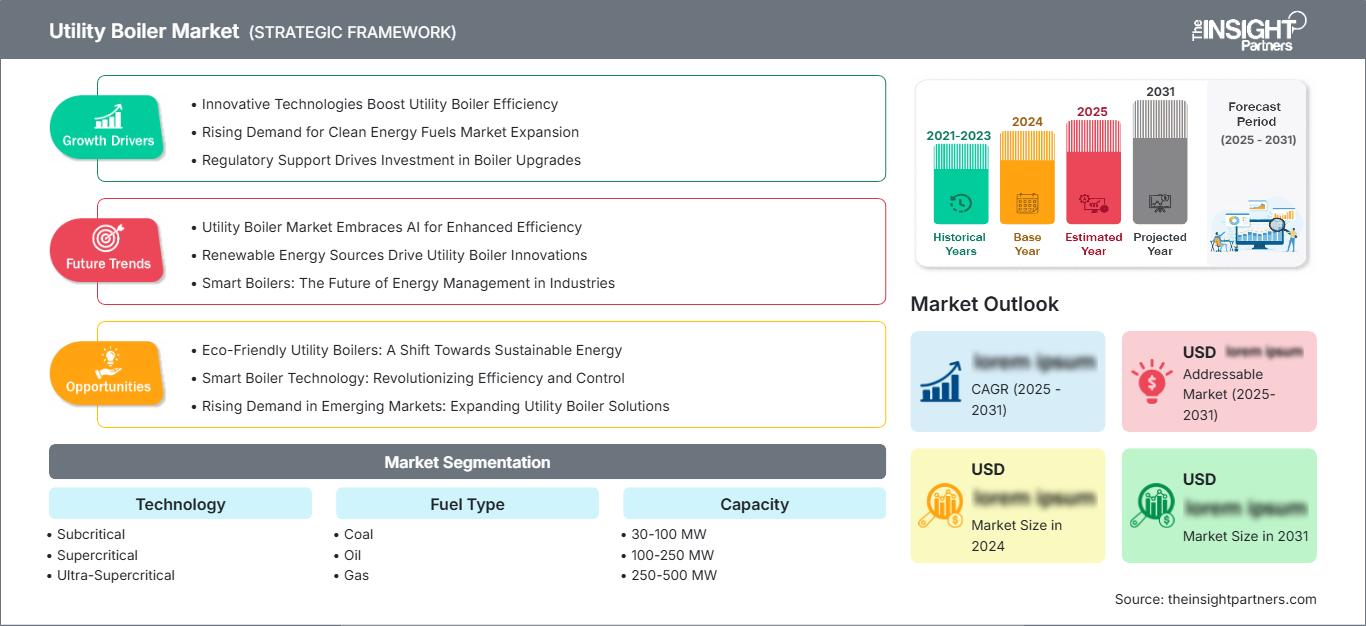
Utility Boiler Market: Strategic Insights
Regional Insights
North America utility boiler market
North America is expected to maintain a 27–30% utility boiler market share in 2025, with demand concentrated in power plant modernization, outage management, and emissions-control upgrades. Operators are extending the operating life of selected thermal assets to support grid reliability as variable renewable capacity expands.
The region is forecast to grow at a CAGR of 5.8–6.4% during 2026–2034. U.S. utilities are prioritizing boiler performance improvements, while Canada supports targeted upgrades for reliable generation and industrial power supply. Demand is less volume-led than Asia Pacific but remains value-intensive due to retrofit complexity.
U.S. utility boiler Market
The U.S. accounted for an estimated 72–76% share of North America demand in 2025 and is projected to expand at a CAGR of 5.7–6.3%, according to the utility boiler market report. The market will be driven by reserve margins, delayed decommissioning of certain thermal facilities, and increasing demand from data centers, manufacturing plants, and the electrification of the infrastructure. Market presence is predominant in engineering services, aftermarket parts, emission systems, and digital monitoring solutions. General Electric Company, Babcock & Wilcox Enterprises, Inc., and Siemens Energy AG provide solutions for increasing the efficiency and reliability of power plant operations, and flexible operations of utilities will be driven by the intermittent nature of renewables.
Europe utility boiler Market
Europe held an estimated 18–21% share in 2025 and is expected to grow at a CAGR of 4.9–5.6%. Germany and the United Kingdom have a lot of retrofit action, whereas France, Italy, and Spain have targeted requirements for efficiency gains, back-up capability, and thermal resource efficiency within a more stringent emissions context.
The market within Europe is based more upon replacement, regulatory compliance, and services intensity than additional coal-fired capacity installations. There is an emphasis upon combustion improvements, emissions reduction, and overall energy transition strategy integration. Boiler manufacturers that can offer retrofit capability, pressure part replacement, and performance analysis stand to gain steady service-based revenues.
APAC utility boiler Market
APAC accounted for an estimated 39–43% share in 2025 and is projected to grow at a CAGR of 7.2–7.9%. China and India remain the leading countries due to electricity demand growth, large thermal fleets, industrial expansion, and ongoing modernization of high-capacity power generation assets.
Japan, South Korea, and Australia contribute through high-efficiency retrofits, aging fleet upgrades, and reliability programs. The region supports utility boiler market trends around ultra-supercritical technology, improved heat rates, and emissions reduction. Coal remains relevant, but procurement increasingly favors efficient designs and better operational control.
Middle East & Africa utility boiler Market
The Middle East & Africa market is expected to grow at a CAGR of 5.4–6.1% during 2026–2034. Both Saudi Arabia and the UAE utilize the industrial strength, energy associated with desalination and the expansion of their infrastructure, whereas South Africa needs reliable upgrades for its aged thermal generation capacities.
Demand is selective but strategically important, especially for those cases where utilities need dependable steam generation and better availability. Gas turbines, services contracts and boiler upgrades are forecasted to define regional demand. The RoMEA demand will be dependent on grid developments, fuel availability and government power infrastructure spending.
Segmentation Analysis
Technology
Technology is expected to grow at a CAGR of 6.6–7.2% during 2026–2034. The utility boiler market scope across technology is shaped by efficiency requirements, emissions control, and power plant operating profiles. Subcritical units dominate installed capacity, while supercritical and ultra-supercritical designs are preferred for new large-scale projects and major replacement programs.
- Subcritical boilers remain widely used in older thermal plants because they are familiar to operators, easier to maintain, and suitable for regions prioritizing cost control and incremental efficiency upgrades.
- Supercritical boilers support higher thermal efficiency and lower fuel consumption, making them attractive for utilities seeking better heat rates without the higher technical complexity of ultra-supercritical systems.
- Ultra-Supercritical boilers are gaining strategic importance in large power projects because they reduce emissions intensity, improve plant economics, and align with regulatory pressure for more efficient thermal generation.
Fuel Type
Fuel Type is projected to record a CAGR of 6.2–6.9% from 2026–2034. Coal remains the largest fuel base, but gas-fired systems are gaining interest in flexible power markets. Oil-based boilers serve niche and backup roles where fuel logistics, industrial demand, or energy security considerations support continued usage.
- Coal remains the largest sub-segment due to its installed base in Asia Pacific and parts of North America, where operators invest in retrofits, efficiency upgrades, and emissions-control technologies.
- Oil boilers serve specific reserve, islanded, and industrial applications where liquid fuel availability, backup needs, or infrastructure constraints make oil-fired steam generation commercially relevant.
- Gas boilers are increasingly favored for lower-carbon generation, faster ramping capability, and compatibility with flexible power systems supporting renewable integration and grid stability.
Capacity
Capacity is estimated to grow at a CAGR of 6.5–7.1% during 2026–2034. Larger units above 500 MW dominate revenue contribution because high-capacity thermal plants require sophisticated boiler systems, advanced materials, and complex engineering. Smaller capacity ranges remain relevant for distributed industrial power and regional utility applications.
- 30-100 MW systems serve smaller utilities, industrial campuses, and captive power needs where compact configuration, manageable capital investment, and localized generation are important procurement factors.
- 100-250 MW units are used in regional grids and industrial power applications where operators need moderate output, stable steam generation, and adaptable fuel configurations.
- 250-500 MW systems balance scale and flexibility, supporting mid-sized power stations, retrofit programs, and markets where grid expansion requires dependable generation without the footprint of very large units.
- >500 MW boilers represent the largest revenue opportunity because utility-scale power stations require high-efficiency steam generation, advanced pressure parts, and long-term service support.
Opportunity Snapshot
| Capacity | Revenue Contribution | Trend Tag | Adoption Stage |
| 30-100 MW | Low | Captive Power | Mature |
| 100-250 MW | Medium | Regional Grids | Scaling |
| 250-500 MW | Medium | Retrofit Demand | Scaling |
| >500 MW | High | Baseload Scale | Mature |
Utility Boiler Market Growth Drivers and Impact Analysis
Rising Need for Reliable Dispatchable Power
Rising electricity consumption due to industrial development, urbanization, air conditioning loads, and data centers has raised the need for reliable generation assets that are reliable. Although there has been an increase in renewable energy capacity, utilities continue to need generation plants that will be able to help maintain the stability of the electricity grid in times when there is high demand and low renewables production. It provides continuous demand for boiler improvement, increased reliability, and maintenance contracts.
Modernization of Aging Thermal Power Infrastructure
There are numerous thermal power plants where there is a need for replacement of pressure parts, improvement of burners, upgrading of the control systems and improving efficiencies. Utilities are focusing on those initiatives which will help in minimizing forced outages, better heat rate performance and extension of the life of the plants without any complete plant replacement. This will benefit the suppliers with their aftermarket business and engineering services.
Adoption of High-Efficiency Boiler Technologies
These types of boilers are being increasingly used as they offer greater steam temperatures, improved efficiency, and less fuel usage per megawatt produced. This is of great significance to power stations that experience fuel cost constraints and limitations on emissions. This change enhances the economics of advanced materials, efficient burners, and monitoring software systems. It further favors manufacturers with engineering expertise, especially for large capacity installations where efficiency matters more than the initial cost of equipment.
Utility Boiler Market Future Trends
Digital Monitoring and Predictive Maintenance
The utility boiler market trends increasingly include sensor-based monitoring, predictive analytics, and remote diagnostics. Operators are using digital tools to identify tube wear, combustion imbalance, slagging, corrosion, and efficiency losses before they cause outage events. This trend shifts supplier value from equipment delivery toward lifecycle performance management. By 2034, digital service packages are expected to become standard in major utility contracts, especially for large boilers where unplanned downtime carries high financial and grid reliability costs.
Fuel Flexibility and Lower-Emission Operation
Future boiler purchases will favor flexibility in fuel types, low-NOx combustion, and suitability to varying electricity generation mixes. Natural gas, coal blends, biomass co-firing, and hydrogen-ready technologies will factor into decision-making depending on local economics and policy objectives. While this development will not entirely supplant traditional boilers, it will redefine the specification criteria towards lower emission intensity, enhanced flexibility, and grid compatibility with high shares of renewables.
Utility Boiler Market Opportunities
Retrofit Programs for Existing Power Plants
Retrofit programs offer a major opportunity because many utilities prefer targeted upgrades over full replacement, according to the utility boiler market forecast. Pressure-part changes, burner improvements, air preheater upgrades, and control-system modernization can improve reliability and efficiency while limiting capital intensity. Suppliers with strong field-service teams and outage execution capability can capture recurring revenue. This opportunity is strongest in North America and Europe for plant life extension, and in the Asia Pacific for performance improvement across large installed fleets.
Large-Capacity Projects in Emerging Power Markets
New emerging nations keep on needing reliable power plant capacity for their growth process, which includes industrialization, urbanization, and expansion of the electricity network. Power plants with large capacity boilers greater than 500 MW represent business opportunities for the suppliers who have the expertise in engineering, project management, and after-sales services. In terms of geographical location, the most promising one is the Asia Pacific region, especially India and Southeast Asia.
Frequently Asked Questions

- Comprehensive Market Sizing and Forecast Analysis
- Detailed Segmentation Analysis
- In-Depth Market Dynamics Assessment
- Regional and Country-Level Insights
- Competitive Landscape and Company Benchmarking
- Strategic Business Intelligence
Recent Reports
Testimonials

The Insight Partners provided valuable market intelligence that supported our global go-to-market strategy. Their team was professional, responsive, and attentive to our feedback, providing thoughtful analysis and helpful methodological clarifications throughout the project.
Junmo Kim Chief Financial Officer (CFO), Enertech Co., Ltd.
The Insight Partners' SCADA System Market report is comprehensive, with valuable insights on current trends and future forecasts. The team was highly professional, responsive, and supportive throughout. We are very satisfied and highly recommend their services.
RAN KEDEM Partner, Reali Technologies LTDs
I requested a report on a very specific software market and the team produced the report in a few days. The information was very relevant and well presented. I then requested some changes and additions to the report. The team was again very responsive and I got the final report in less than a week.
JEAN-HERVE JENN Chairman, Future Analytica
We worked with The Insight Partners for an important market study and forecast. They gave us clear insights into opportunities and risks, which helped shape our plans. Their research was easy to use and based on solid data. It helped us make smart, confident decisions. We highly recommend them.
PIYUSH NAGPAL Sr. Vice President, High Beam Global
The Insight Partners delivered insightful, well-structured market research with strong domain expertise. Their team was professional and responsive throughout. The user-friendly website made accessing industry reports seamless. We highly recommend them for reliable, high-quality research services
YUKIHIKO ADACHI CEO, Deep Blue, LLC.
This is the first time I have purchased a market report from The Insight Partners.While I was unsure at first, I visited their web site and felt more comfortable to take the risk and purchase a market report.I am completely satisfied with the quality of the report and customer service. I had several questions and comments with the initial report, but after a couple of dialogs over email with their analyst I believe I have a report that I can use as input to our strategic planning process.Thank you so much for taking the extra time and making this a positive experience.I will definitely recommend your service to others and you will be my first call when we need further market data.
JOHN SUZUKI President and Chief Executive Officer, Board Director, BK Technologies
I wish to appreciate your support and the professionalism you displayed in the course of attending to my request for information regarding to infectious disease IVD market in Nigeria. I appreciate your patience, your guidance, and the fact that you were willing to offer a discount, which eventually made it possible for us to close a deal. I look forward to engaging The Insight Partners in the future, all thanks to the impression you have created in me as a result of this first encounter.
DR CHIJIOKE ONYIA MANAGING DIRECTOR, PineCrest Healthcare Ltd.Reason to Buy
- Informed Decision-Making
- Understanding Market Dynamics
- Competitive Analysis
- Identifying Emerging Markets
- Customer Insights
- Market Forecasts
- Risk Mitigation
- Boosting Operational Efficiency
- Strategic Planning
- Investment Justification
- Tracking Industry Innovations
- Aligning with Regulatory Trends





 Get Free Sample for