
Vacuum Evaporators Market Share, Trends & Demand Outlook 2034
Coverage: By Type of Technology (Mechanical Vapor Recompression (MVR) Vacuum Evaporators, Heat Pump Vacuum Evaporators and Thermal Vacuum Evaporators), Application (Wastewater Treatment, Product Processing and Others), End-use Industry (Chemical and Petrochemical, Food and Beverage, Pharmaceutical, Electronics and Semiconductor, Energy and Power, Automotive, and Others), and Geography (North America, Europe, Asia Pacific, Middle East and Africa, and South and Central America)
- Status : Published
- Report Code : TIPRE00008133
- Category : Manufacturing and Construction
- No. of Pages : 261
- Available Report Formats :


- Last update date : November 02, 2026


2025 Market Size
US$ 3.67 Bn
Base year value
2034 Forecast
US$ 6.87 Bn
Projected by 2034
CAGR 2026-2034
7.2 %
Growth rate
Addressable Market
US$ 47.52 Bn
(2026-2034)
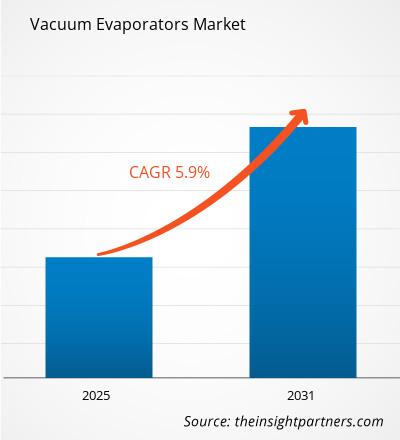
The Vacuum Evaporators Market is expanding as industries seek efficient methods to concentrate process liquids, recover reusable water, and reduce wastewater disposal volumes. The market is valued at US$ 3.67 Billion in 2025 and is projected to reach US$ 6.87 Billion by 2034, registering a CAGR of 7.2% during 2026–2034. Demand is supported by industrial water-reuse requirements, process concentration needs, and the increasing deployment of energy-efficient evaporation technologies across chemical, food, pharmaceutical, electronics, and power applications.
The Vacuum Evaporators Market size outlook reflects a transition from conventional thermal separation toward systems designed around energy recovery, lower-temperature operation, and closed-loop water management. North America is expected to expand at a modelled 6% CAGR through 2034, supported by stringent industrial wastewater requirements, established process industries, replacement of aging treatment assets, and investment in water-recovery infrastructure.
Vacuum Evaporators Market Assessment and Insights
Regional Outlook
- North America: 33.27% of the global market in 2025 | 6.5% CAGR through 2034. Market position: North America holds the largest regional position, supported by mature chemical, pharmaceutical, food, power, and automotive industries. Industrial wastewater compliance, retrofit activity, and demand for water recovery sustain equipment procurement across established manufacturing clusters.
- US: 83.42% of North American market revenue in 2025 | 6.8% CAGR through 2034. Market position: The US is the dominant country in North America, reflecting its broad industrial base and high concentration of pharmaceutical, chemical, food-processing, energy, and advanced manufacturing facilities requiring wastewater concentration and process-liquid recovery.
- Europe: 30.11% of the global market in 2025 | 7.4% CAGR through 2034. Market position: Europe represents a mature market characterized by stringent environmental requirements, sophisticated process engineering, and replacement demand. Germany is the leading country in Europe, followed by strong demand from France, the UK, Italy, and Spain.
- Asia Pacific: 26.41% of the global market in 2025 | 8.6% CAGR through 2034. Market position: Asia Pacific is the fastest-growing region, driven by industrial expansion, water stress, chemical and pharmaceutical manufacturing, electronics production, and increasing investment in industrial wastewater recycling. China is the leading country in Asia Pacific.
Segment Outlook
- Mechanical Vapor Recompression (MVR) Vacuum Evaporators: 53.86% Share in 2025 | 6.8% CAGR through 2034. Market position: MVR leads because vapor compression substantially improves thermal efficiency and reduces dependence on external steam. Its economics are particularly attractive for continuous industrial wastewater concentration and high-throughput process applications.
- Heat Pump Vacuum Evaporators: 28.26% Share in 2025 | 8.5% CAGR through 2034. Market position: Heat pump systems have a strong growth outlook because they operate at comparatively low temperatures and can recover heat efficiently. Their suitability for temperature-sensitive products and compact industrial installations supports wider adoption.
Competitive Coverage
Hebei Leheng Energy Saving Equipment Co., Ltd., Phoenix Scientific Co., Ltd., ENCON Industries, LLC, C&G Depurazione Industriale Srl, Veolia Water Technologies, Alfa Laval AB, GEA Group Aktiengesellschaft, SPX FLOW Inc., Condorchem Envitech Solutions, DE DIETRICH SAS, Bucher Unipektin AG, Zhejiang Taikang Evaporator Co., Ltd.
Methodology
The Insight Partners follows Data Collection & Secondary Research, Primary Research, Data Analysis, and Data Triangulation & Final Review to validate market estimates and insights.
Source: The Insight Partners' analysis based on proprietary research, government publications, company annual reports, investor presentations, industry databases, and expert interviews.
The Vacuum Evaporators Market has transitioned from somewhat energy-intensive evaporation equipment into systems engineering with a focus on heat recovery, process automation, and boiling under vacuum conditions. Recompression mechanical vapor, heat pumps, enhanced heat-exchanger surfaces, and forced circulation have expanded the operating range for challenging process streams. Equipment suppliers are increasingly designing evaporators based on the characteristics of the feed, solid content, viscosity, fouling tendency, degree of concentration needed, and quality of recovered water, rather than just the thermal process itself.
Production trends are changing with the move by industrial facilities from specialized equipment to comprehensive treatment systems. Evaporation may act as the concentration step in wastewater treatment, as a processing step in product manufacturing, or as a recovery step that ties into crystallization and solids processing. In this regard, it benefits those suppliers who can design the entire process system as well as provide the equipment.
The forward-looking prospects for the Vacuum Evaporators Market are becoming more closely tied to new industrial geographies and water resilience investment. The Asia-Pacific region is becoming increasingly important as chemicals, pharmaceuticals, electronics, food, and energy production grow in the region, while water-intensive industrial hubs generate closed-loop wastewater treatment needs. Investments are also increasing.
Vacuum Evaporators Market Report Scope
| Report Attribute | Details |
|---|---|
| Market size in 2025 | US$ 3.67 Billion |
| Market Size by 2034 | US$ 6.87 Billion |
| Global CAGR (2026 - 2034) | 7.2% |
| Historical Data | 2021-2024 |
| Forecast period | 2026-2034 |
Vacuum Evaporators Market Analysis
Vacuum Evaporators Market Growth Dynamics: Industrial establishments look to minimize liquid waste streams by recovering water, solvents, or concentrating a product. The demand arises in locations with wastewater that includes contaminants making conventional processing inadequate or locations with higher disposal expenses. The value chain includes feed analysis, process design, evaporator design and construction, heat exchanger, pump, controls, installation, commissioning, and life cycle support services. Customers consider total cost of ownership more often than just equipment costs when making purchases.
Supply side favors companies with engineering expertise since the design of vacuum evaporators is dependent on feed chemistry, boiling characteristics, solids content, risk of corrosion, and heat input. Multi-Effect Vapor Recycle (MVR) systems rely on efficient vapor compression and heat recovery, whereas heat pump systems depend on effective refrigeration. Thermal systems have relevance when there is availability of external steam or waste heat. Therefore, supplier competitiveness has become dependent on engineering capability, customization, and ability to interface evaporation with other treatment systems.
The competitive landscape of the Vacuum Evaporators Market includes diversified water-technology companies, process-equipment manufacturers, and specialized evaporation suppliers. Veolia Water Technologies, Alfa Laval, GEA, SPX FLOW, and DE DIETRICH provide broad engineering capabilities that can connect evaporation with larger industrial process or water-treatment systems. Specialists such as Condorchem Envitech Solutions, ENCON Industries, Phoenix Scientific, Hebei Leheng, and Zhejiang Taikang compete through focused evaporation configurations and application-specific engineering.
Investment is increasingly directed toward technologies that reduce energy consumption and improve water recovery. Companies with strong installed bases can leverage aftermarket services, modernization projects, and technology upgrades, while specialist suppliers can compete through modular designs and shorter project execution cycles. Strategic positioning therefore depends on balancing equipment efficiency, engineering customization, lifecycle support, and geographic responsiveness rather than relying solely on equipment scale.
● REPORT CUSTOMIZATION
Tailor This Report To Align With Your Specific Business Requirements
This report can be customized to align precisely with your business objectives, scope, and target markets. Customization options include tailored segmentation, geography, competitive analysis, and strategic insights to support informed decision-making.
Customize This Report →WHAT YOU CAN ADJUST
- ● Segmentations
- ● Geography
- ● Competitive Analysis
- ● Language Preferences
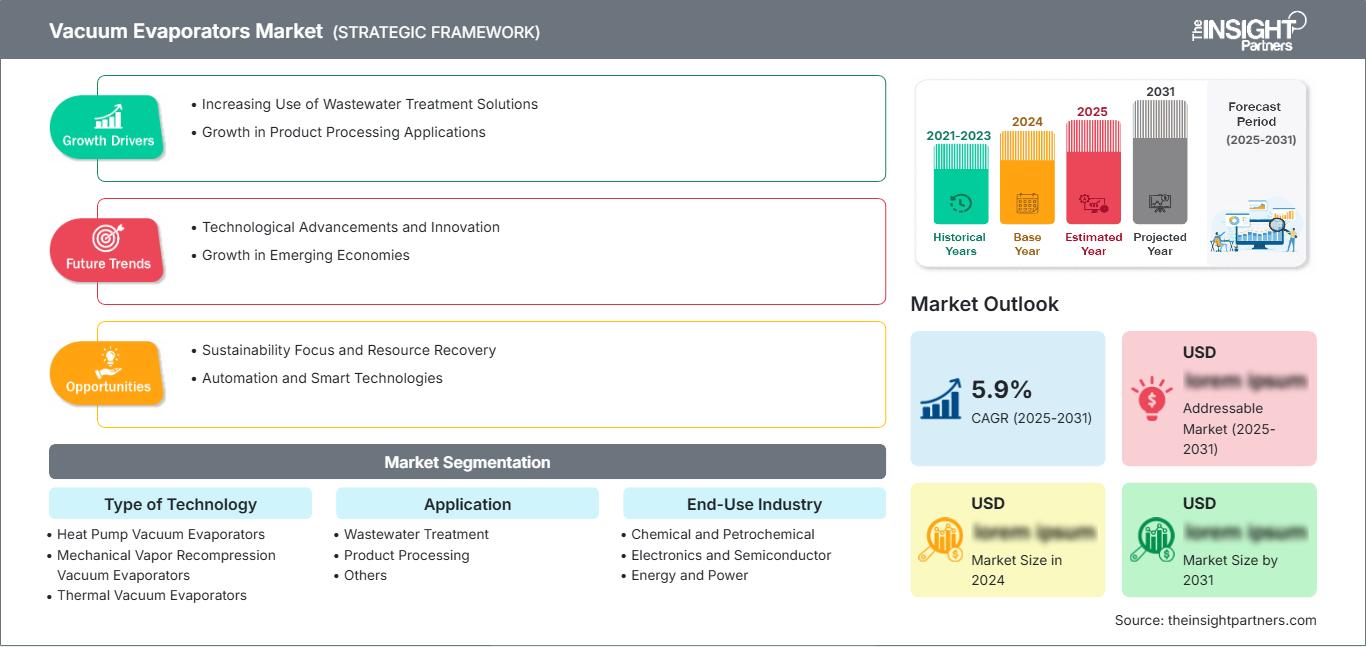
Vacuum Evaporators Market: Strategic Insights
Regional Insights
North America Vacuum Evaporators Market
North America accounted for a modelled 33.27% share of the Vacuum Evaporators Market in 2025 and is expected to expand at 6.5% CAGR through 2034. The region benefits from a mature industrial base encompassing chemicals, pharmaceuticals, food and beverage, energy, automotive, and specialty manufacturing. These sectors generate concentrated process streams where evaporation can reduce disposal volumes and support water reuse. Established environmental compliance practices also encourage operators to upgrade aging treatment infrastructure rather than depend exclusively on conventional wastewater-disposal pathways.
The US represents the principal demand center, supported by extensive manufacturing capacity and strong engineering expertise. Canada contributes through resource processing, food production, chemicals, and industrial water-management applications. Buyers increasingly prioritize systems that can operate reliably with variable feed conditions and minimize steam or electricity requirements. MVR and heat pump configurations are therefore gaining strategic importance where energy costs influence project economics. Replacement projects, industrial expansion, and integrated water-recovery installations should maintain North America's leading position despite its slower growth relative to emerging industrial regions.
U.S. Vacuum Evaporators Market
The US represented 83.42% of North American revenue in 2025 and is projected to grow at 6.8% CAGR through 2034. Its position is supported by extensive pharmaceutical and biotechnology manufacturing, chemical and petrochemical production, food processing, power generation, and automotive activity. Industrial facilities increasingly require reliable methods for concentrating wastewater, recovering process water, and managing difficult streams that cannot be economically addressed through conventional treatment alone.
The country also has a substantial installed base that creates recurring retrofit and replacement opportunities. Suppliers including Veolia Water Technologies, Alfa Laval, GEA Group Aktiengesellschaft, SPX FLOW Inc., and ENCON Industries, LLC participate in different portions of the industrial water and evaporation ecosystem. Pharmaceutical and electronics facilities favor controlled, low-temperature processing where product or water quality is critical, while chemical and energy applications often emphasize throughput, concentration capability, and operating cost. This diversified application structure supports steady demand across both new-build and modernization projects.
Europe Vacuum Evaporators Market
Europe represented 30.11% of the Vacuum Evaporators Market in 2025 and is expected to register 7.4% CAGR through 2034. Germany is the leading country in Europe, supported by its large chemical, pharmaceutical, food, engineering, and manufacturing sectors. France also provides substantial demand through chemicals, food processing, pharmaceuticals, and industrial water management. The UK maintains a specialized demand base linked to pharmaceuticals, food, chemicals, and advanced manufacturing, while Italy and Spain contribute through food production, chemicals, automotive manufacturing, and industrial wastewater applications.
European buyers place strong emphasis on resource efficiency, operating costs, emissions management, and equipment integration. The region's environmental framework encourages industrial operators to reduce pollution and improve resource efficiency, creating favorable conditions for advanced evaporation systems. MVR configurations are particularly relevant where energy optimization is central to investment decisions, while heat pump systems can address lower-temperature process streams.
Replacement of older equipment is another important demand mechanism. Many mature manufacturing facilities require modernization without extensive changes to existing plant layouts. Compact evaporators, automated controls, improved fouling management, and modular skid designs can therefore improve project feasibility. Germany remains the leading country in Europe because of its industrial concentration and engineering ecosystem, while France, the UK, Italy, and Spain provide differentiated opportunities across process industries.
APAC Vacuum Evaporators Market
APAC accounted for 26.41% of the Vacuum Evaporators Market in 2025 and is forecast to grow at 8.6% CAGR through 2034, making it the fastest-growing region. China is the leading country in Asia Pacific, supported by its extensive chemical, pharmaceutical, food, electronics, and manufacturing base. India is another important growth center as industrial water reuse expands across pharmaceutical, chemical, textile, and food-processing clusters.
Japan and South Korea contribute mature technology-intensive demand, particularly from electronics, semiconductor, specialty chemicals, and advanced manufacturing. Australia provides opportunities in resource processing, food production, energy, and water-stressed industrial applications. Across the region, industrialization and water-security requirements are encouraging companies to invest in wastewater concentration and recycling infrastructure. Policy enforcement, industrial-park development, and localization of process-equipment manufacturing further support adoption. The combination of large industrial volumes and comparatively lower technology penetration provides a stronger growth pathway than in mature markets.
Middle East & Africa Vacuum Evaporators Market
The Middle East & Africa market is expected to expand at 5.3% CAGR through 2034. Saudi Arabia represents the leading country in the Middle East & Africa where industrial water-reuse investment, petrochemical production, energy infrastructure, and water-security priorities create a strong addressable market. The UAE also provides demand through advanced water infrastructure, food production, chemicals, and industrial development.
South Africa is an important African market because water scarcity intersects with mining, energy, chemicals, food processing, and industrial wastewater requirements. Across the Rest of MEA, adoption remains more project-driven, with procurement influenced by infrastructure availability, financing, local service capabilities, and the economics of water reuse. Evaporation is particularly relevant where freshwater availability is constrained and industrial operators need to reduce liquid discharge. Opportunities should increasingly favor modular systems, heat-recovery configurations, and suppliers able to provide local commissioning and maintenance.
Segmentation Analysis
Type of Technology
Technology selection is central to the Vacuum Evaporators Market because operating cost, energy efficiency, product sensitivity, and wastewater characteristics vary widely across applications. Mechanical vapor recompression has gained traction where continuous operation and low steam consumption are priorities, while heat-pump and thermal systems remain relevant for specific process conditions and site constraints. Buyers increasingly evaluate evaporation technology as part of an integrated treatment or production system rather than as isolated equipment.
- Mechanical Vapor Recompression (MVR) Vacuum Evaporators: These systems compress generated vapor and reuse its latent heat, making them strategically important for high-volume applications where energy consumption is a major component of lifecycle cost.
- Heat Pump Vacuum Evaporators: Heat pump vacuum evaporators are expected to expand at 8.5% CAGR, supported by demand for low-temperature evaporation, compact installations, and energy-efficient treatment. They are particularly suitable where feed characteristics or product quality limit the use of higher operating temperatures. Their ability to integrate recovered heat improves their relevance for small and medium industrial facilities.
- Thermal Vacuum Evaporators: Thermal vacuum evaporators are projected to grow at 6.3% CAGR. They remain relevant where plants have access to steam, waste heat, or other economical thermal sources. Their established process architecture supports applications requiring robust concentration performance and relatively straightforward integration into existing thermal processing infrastructure.
Application
Applications define the commercial scope of the Vacuum Evaporators Market, with wastewater treatment representing the largest and most compliance-driven use case. Product processing remains important in food, beverage, pharmaceutical, and specialty chemical production, where concentration under vacuum preserves product quality. Other applications include solvent recovery, crystallization support, and specialized industrial separation processes.
- Wastewater Treatment: Demand is concentrated in water-intensive industries where wastewater disposal is costly or restricted. Evaporation can complement membranes, biological treatment, crystallization, and other processes in integrated water-recovery systems.
- Product Processing: Product Processing represents a modelled 31.98% share in 2025 and is expected to grow at 6.3% CAGR. Evaporation is used to concentrate products, improve downstream processing efficiency, and control final product characteristics. Food, pharmaceutical, and specialty chemical manufacturers value-controlled temperature and residence time, making vacuum operation attractive where thermal sensitivity affects product quality.
End-use Industry
End-use demand reflects the breadth of the Vacuum Evaporators Market across process manufacturing, environmental compliance, and advanced technology production. Chemical and petrochemical facilities use evaporation for effluent concentration and product recovery, while food and beverage producers rely on vacuum processing to concentrate sensitive products. Pharmaceutical, electronics and semiconductor, energy and power, automotive, and other industries adopt these systems as wastewater complexity and sustainability requirements increase.
- Chemical and Petrochemical: High-strength process streams and wastewater reduction requirements make evaporation an important concentration and recovery technology across chemical production facilities.
- Food and Beverage: It is projected to expand at 7.8% CAGR. Concentration of extracts, juices, dairy products, and other liquids requires controlled thermal conditions, while wastewater applications create an additional demand pathway. Hygienic construction, cleanability, product recovery, and energy consumption remain central procurement considerations.
- Pharmaceutical: Pharmaceutical applications are expected to grow at 9.7% CAGR. Manufacturing facilities require controlled processing, high-quality recovered water, and reliable management of concentrated streams. Low-temperature vacuum evaporation can help protect temperature-sensitive materials while supporting solvent or water separation.
- Electronics and Semiconductor: Electronics and Semiconductor applications are expected to grow at 8.7% CAGR. Semiconductor and electronics facilities consume substantial quantities of high-purity water and generate specialized wastewater streams. Evaporation can form part of advanced treatment and recovery trains designed to reduce freshwater dependence and concentrate difficult residual streams.
- Energy and Power: Energy and Power applications are expected to grow at 6.6% CAGR. Power facilities use evaporation for wastewater minimization, concentration, and water recovery, particularly where discharge constraints or limited freshwater availability influence plant economics. Heat integration can improve the attractiveness of thermal configurations.
- Automotive: Automotive applications are projected to grow at 6.2% CAGR. Metal finishing, surface treatment, paint operations, and component manufacturing can generate concentrated industrial wastewater. Vacuum evaporation provides a route to reduce disposal volumes and support water reuse within production facilities.
Opportunity Snapshot
| Application | Revenue Contribution | Trend Tag | Adoption Stage |
| Wastewater Treatment | High | Water Reuse | Scaling |
| Product Processing | High | Product Concentration | Mature |
Vacuum Evaporators Market Growth Drivers and Impact Analysis
Stricter Industrial Wastewater Management and Zero-Liquid-Discharge Requirements
Industries are under mounting pressure to reduce discharges and use wastewater as a recoverable resource rather than a burden. Evaporators prove very useful especially when there are hard to treat dissolved solids or high salinity in the effluent that prevents traditional methods from being effective. Evaporation helps concentrate the remaining waste stream and produce a portion of recoverable water for further treatment and reuse in zero liquid discharge applications. It is important not only due to regulations, but also because smaller amounts of wastewater can result in less transportations and treatment needs. Industries like chemicals, pharmaceuticals, electronics, food processing and energy thus more frequently consider using evaporators in their wastewater management strategy.
Industrial Water Scarcity Is Increasing the Economic Value of Water Recovery
Water scarcity is beginning to impact the business case of process equipment investments in industry. If water is too costly, unstable, or allocated under restriction, then there will be an economic advantage to utilizing water recovered from process waste streams, both for the resilience of the manufacturing process and environmental impact. Vacuum evaporation is a good technology to invest in because it allows the separation of water from contaminated streams, and the recovery of that water as condensate back into the industrial process, once polished. The benefit is greatest in water-dependent industries where growth of production capacity is limited by the lack of water supply. Industrial development in Asia Pacific, the Middle East, and North America are examples.
Demand for Energy-Efficient Thermal Separation Is Reshaping Equipment Selection
The consumption of energy has become a major factor in determining the choice of evaporator system purchase due to the fact that heat separation itself could constitute a considerable cost of operation. It makes people pay attention to MVR and heat pump systems that reuse heat instead of permanently consuming thermal energy from outside. Selection of equipment, thus, shifts from a mere capacity comparison to lifecycle evaluation taking into account electricity, steam, heat availability, maintenance, and operating hours. MVR systems are suitable for the continuous throughput processes, whereas heat pump systems are good for the low-temperature processes. Companies that have proved their capability to effectively integrate heat and operate will be more competitive in winning modernization projects.
Vacuum Evaporators Market Future Trends
Digital Process Control Will Become Embedded in Evaporation System Design
Future evaporator systems will most certainly have improved features such as automation, sensors, predictive monitoring, and remote system management. Digital systems are able to adjust to changing feed concentrations, temperatures, viscosity, vapor pressures, and solid content, allowing for consistent performance irrespective of varying water characteristics. Such digital systems are very useful for unattended or semiautonomous systems because they tend to experience more process inconsistencies that lead to fouling, higher energy consumption, and more maintenance needs. Instrumentation data will also help with condition-based maintenance by detecting reduced heat transfer efficiency or unusual compressor functioning in order to prevent system disruptions. In terms of future systems' specifications, it will become more important for suppliers to offer digital systems as standard features instead of optional extras.
Modular and Hybrid Evaporation Systems Will Expand Deployment Flexibility
Modular skid-mounted evaporators and hybrid system configurations are forecast to receive interest from industrial consumers due to the need to install such systems quickly and be able to scale up capacity. Module standardization will cut down engineering time and will make capacity scaling along with production possible. The use of hybrids will allow combining vacuum evaporation with membrane processing, crystallization, biological treatment, and other separation techniques depending on feedstock properties and recovery needs. Such an option becomes especially useful for industrial parks and mid-sized companies which do not need to invest in customized large-scale systems right away. Modular design will make replacement and retrofit projects easier to carry out when space within the plant is limited. In this regard, vendors which will be capable of customizing standardized systems in accordance with site-specific processes will win the competitive edge.
Vacuum Evaporators Market Opportunities
Industrial Water-Reuse Projects in High-Growth Manufacturing Clusters
The potential to offer evaporation systems in industrial clusters in water-scarce and industrializing economies is a very lucrative one for evaporation system suppliers. The need for water by chemical, pharmaceutical, electronic, food, and specialty manufacturing industries is growing as water needs become more critical, coupled with stricter wastewater regulations. Suppliers can access these opportunities through modular evaporation systems characterized by higher recovery rate, small size, and local servicing capabilities. There is more scope for this opportunity in areas where industrial clusters comprise several large-scale water users because central wastewater management infrastructure can accommodate large equipment and repeated services. The cooperation of suppliers with engineering, procurement, and construction companies will further enhance the reachability of markets through integration of evaporation in the entire water reuse solution.
Low-Energy Evaporation for Difficult and High-TDS Industrial Streams
The second opportunity revolves around designing energy-efficient systems for the challenging industrial streams of high-TDS, high-fouling, or other similar nature. This could be considered a highly technical opportunity due to the fact that system selection depends on the feed properties, material compatibility, heat transfer designs, circulation strategies, and solid handling systems post treatment. Both MVR and Heat Pump technologies can add economic advantages in cases where the number of hours is large, and the cost of steam is high externally. Suppliers can capitalize on offering pilot testing services, process guarantees, digital tracking, and life cycle optimization services rather than just selling the system. This allows for creating opportunities in industries like chemical, pharmaceutical, semiconductors, food, and energy where conventional treatment would leave behind a stream of waste that needs concentration.
Recent Developments
- May 2025: Veolia announced an agreement to acquire CDPQ’s remaining 30% stake in Water Technologies and Solutions, giving Veolia full ownership. The company stated that the transaction would strengthen its water-technology positioning and support investment in technologies addressing water scarcity and strategic industrial demand, including semiconductor and pharmaceutical applications.
- April 2024: Alfa Laval Iberia partnered with INERCO Engineering, Technology, and Consulting SA to advance zero liquid discharge (ZLD) projects. The collaboration uses evaporation technology to treat industrial liquid effluents and produce water suitable for reuse, with surplus heat potentially utilized to improve evaporation efficiency. The ZLD solutions are designed to help industries reduce freshwater consumption, manage liquid waste more effectively, and improve operational efficiency.
- May 2024: De Dietrich Process Systems announced the acquisition of the HEINKEL Drying and Separation Group, including the HEINKEL, COMBER, BOLZ-SUMMIX, and JONGIA brands. The acquisition strengthens De Dietrich's industrial presence in Europe and expands its international reach. It also broadens the company's portfolio with solid-liquid separation, drying, and mixing technologies for pharmaceutical, chemical, and food applications.
Frequently Asked Questions

- Comprehensive Market Sizing and Forecast Analysis
- Detailed Segmentation Analysis
- In-Depth Market Dynamics Assessment
- Regional and Country-Level Insights
- Competitive Landscape and Company Benchmarking
- Strategic Business Intelligence
Recent Reports
Testimonials

The Insight Partners provided valuable market intelligence that supported our global go-to-market strategy. Their team was professional, responsive, and attentive to our feedback, providing thoughtful analysis and helpful methodological clarifications throughout the project.
Junmo Kim Chief Financial Officer (CFO), Enertech Co., Ltd.
The Insight Partners' SCADA System Market report is comprehensive, with valuable insights on current trends and future forecasts. The team was highly professional, responsive, and supportive throughout. We are very satisfied and highly recommend their services.
RAN KEDEM Partner, Reali Technologies LTDs
I requested a report on a very specific software market and the team produced the report in a few days. The information was very relevant and well presented. I then requested some changes and additions to the report. The team was again very responsive and I got the final report in less than a week.
JEAN-HERVE JENN Chairman, Future Analytica
We worked with The Insight Partners for an important market study and forecast. They gave us clear insights into opportunities and risks, which helped shape our plans. Their research was easy to use and based on solid data. It helped us make smart, confident decisions. We highly recommend them.
PIYUSH NAGPAL Sr. Vice President, High Beam Global
The Insight Partners delivered insightful, well-structured market research with strong domain expertise. Their team was professional and responsive throughout. The user-friendly website made accessing industry reports seamless. We highly recommend them for reliable, high-quality research services
YUKIHIKO ADACHI CEO, Deep Blue, LLC.
This is the first time I have purchased a market report from The Insight Partners.While I was unsure at first, I visited their web site and felt more comfortable to take the risk and purchase a market report.I am completely satisfied with the quality of the report and customer service. I had several questions and comments with the initial report, but after a couple of dialogs over email with their analyst I believe I have a report that I can use as input to our strategic planning process.Thank you so much for taking the extra time and making this a positive experience.I will definitely recommend your service to others and you will be my first call when we need further market data.
JOHN SUZUKI President and Chief Executive Officer, Board Director, BK Technologies
I wish to appreciate your support and the professionalism you displayed in the course of attending to my request for information regarding to infectious disease IVD market in Nigeria. I appreciate your patience, your guidance, and the fact that you were willing to offer a discount, which eventually made it possible for us to close a deal. I look forward to engaging The Insight Partners in the future, all thanks to the impression you have created in me as a result of this first encounter.
DR CHIJIOKE ONYIA MANAGING DIRECTOR, PineCrest Healthcare Ltd.Reason to Buy
- Informed Decision-Making
- Understanding Market Dynamics
- Competitive Analysis
- Identifying Emerging Markets
- Customer Insights
- Market Forecasts
- Risk Mitigation
- Boosting Operational Efficiency
- Strategic Planning
- Investment Justification
- Tracking Industry Innovations
- Aligning with Regulatory Trends





 Get Free Sample for