
Very Edge AI Chipset Market Growth, Trends & Forecast by 2034
Coverage: By Hardware (Processor, Memory, Network); Technology (Machine Learning, Natural Language Processing, Context-aware Computing, Computer Vision, Predictive Analysis); Function (Training, Inference); End User (Healthcare, Manufacturing, Agriculture, Cybersecurity, Automotive, Retail, Human Resources, Marketing, Law, Government, Fintech) , and Geography (North America, Europe, Asia Pacific, and South and Central America)
- Status : Data Released
- Report Code : TIPRE00026566
- Category : Electronics and Semiconductor
- No. of Pages : 150
- Available Report Formats :


- Last update date : September 17, 2026


2025 Market Size
US$ 7.23 Bn
Base year value
2034 Forecast
US$ 31.43 Bn
Projected by 2034
CAGR 2026-2034
17.74 %
Growth rate
Addressable Market
US$ 160.67 Bn
(2026-2034)
The Edge AI Chipset Market is projected to grow from US$ 7.23 Billion in 2025 to US$ 31.43 Billion by 2034, registering a CAGR of 17.74% during 2026–2034. Growth is being shaped by demand for ultra-low-latency inference, privacy-preserving device intelligence, and energy-efficient AI processing across healthcare, manufacturing, automotive, retail, cybersecurity, agriculture, fintech, and government applications.
North America remains a leading demand center as enterprises shift AI workloads closer to cameras, sensors, robots, vehicles, gateways, and embedded computing systems. The Edge AI Chipset Market size in the region benefits from strong semiconductor R&D, hyperscaler participation, industrial automation, and defense-grade edge analytics. Regional growth is estimated in the 16.8–18.6% CAGR range through 2034.
Very Edge AI Chipset Market Assessment and Insights
- North America: The region represented 36–39% share in 2025 and is expected to grow at a CAGR of 16.8–18.6% between 2026–2034, supported by AI PCs, smart cameras, industrial IoT, autonomous systems, and edge server deployments.
- U.S.: The U.S. accounted for 82–86% of North America revenue in 2025 and is projected to grow at a CAGR of 17.0–18.8%, led by hyperscaler silicon, defense modernization, robotics, and automotive AI.
- Europe: Europe held 20–23% share in 2025 and is expected to grow at a CAGR of 15.2–16.9%, with Germany, the UK, France, Italy, and Spain advancing industrial automation, connected mobility, and privacy-focused edge AI.
- Asia Pacific: Asia Pacific captured 29–33% share in 2025 and is forecast to expand at a CAGR of 18.7–20.6%, driven by China, Japan, South Korea, India, and Australia across electronics manufacturing, smart cities, robotics, and automotive systems.
- Largest Segment: Hardware held 58–62% market share in 2025 and is projected to grow at a CAGR of 16.5–18.0%, reflecting demand for processors, memory, and networking optimized for on-device inference.
- High Growth Segment: Inference represented 63–67% share in 2025 and is expected to grow at a CAGR of 18.8–20.4%, as enterprises prioritize real-time decisions, local privacy, and reduced cloud bandwidth costs.
- Key companies analyzed in detail: Amazon Web Services, Inc.; Microsoft Corporation; Google LLC; International Business Machines Corporation; Qualcomm Technologies, Inc.; Micron Technology, Inc.; Advanced Micro Devices, Inc.; Samsung Electronics Co., Ltd.; Intel Corporation; and NVIDIA Corporation.
Source: The Insight Partners' analysis based on proprietary research, government publications, company annual reports, investor presentations, industry databases, and expert interviews.
The Edge AI Chipset Market growth reflects a transition from cloud-dependent analytics toward device-level intelligence. Earlier deployments focused on basic image processing and signal filtering, while current architectures combine neural processing units, GPUs, ASICs, FPGAs, memory, and connectivity stacks. Production dynamics are shifting toward power-efficient nodes, higher memory bandwidth, security enclaves, and validated software toolchains that reduce time-to-deployment for industrial, healthcare, automotive, and retail systems.
Looking ahead, the Edge AI Chipset Market will be influenced by emerging geographies, public AI infrastructure investments, and regulations encouraging local data processing. Asia Pacific manufacturing scale, North American software ecosystems, and European privacy mandates will shape procurement priorities. Vendors that combine silicon, reference designs, developer tools, and lifecycle support are positioned to capture long-term design wins.
Very Edge AI Chipset Market Report Scope
| Report Attribute | Details |
|---|---|
| Market size in 2025 | US$ 7.23 Billion |
| Market Size by 2034 | US$ 31.43 Billion |
| Global CAGR (2026 - 2034) | 17.74% |
| Historical Data | 2021-2024 |
| Forecast period | 2026-2034 |
Very Edge AI Chipset Market Analysis
Edge AI Chipset Market growth is being driven by the need to process video, sensor, voice, biometric, transaction, and machine data at the point of generation. Enterprises are reducing cloud round-trip times for latency-sensitive applications such as driver assistance, defect inspection, fraud detection, patient monitoring, and access control. Value chain is growing from chip providers to module manufacturers, edge platform providers, device OEMs, systems integrators, and software providers specific to vertical industries.
Supply dynamics benefit those who can strike the right balance between compute density, thermal constraints, costs, and software readiness. Processor providers are innovating on heterogeneous architecture, which combines CPU, GPU, NPU, memory and secure communication. The demand is high where failure tolerance is low, bandwidth is costly, or there is an issue of data sovereignty.
Edge AI Chipset Market analysis indicates a competitive landscape shaped by hyperscalers, semiconductor leaders, memory suppliers, and embedded AI specialists. Amazon Web Services, Microsoft Corporation, Google LLC, and International Business Machines Corporation affect the deployment ecosystem by orchestrating cloud-edge computing, using AI frameworks, and offering enterprise platforms. Qualcomm Technologies, Inc., Intel Corporation, NVIDIA Corporation, Samsung Electronics Co., Ltd., Micron Technology, Inc., and Advanced Micro Devices, Inc. compete in terms of silicon performance, memory design, and embedded AI roadmaps.
Trends in investment are going towards inference-optimized hardware, a convenient software stack, and a verticalized reference design. Strategic positioning is becoming more dependent on energy efficiency per inference, support for models, longevity of the products, and integration into current cloud infrastructures. Collaboration of chip makers, cloud platforms, OEMs, and industrial automation companies is lowering barriers to deployment for customers.
● REPORT CUSTOMIZATION
Tailor This Report To Align With Your Specific Business Requirements
This report can be customized to align precisely with your business objectives, scope, and target markets. Customization options include tailored segmentation, geography, competitive analysis, and strategic insights to support informed decision-making.
Customize This Report →WHAT YOU CAN ADJUST
- ● Segmentations
- ● Geography
- ● Competitive Analysis
- ● Language Preferences
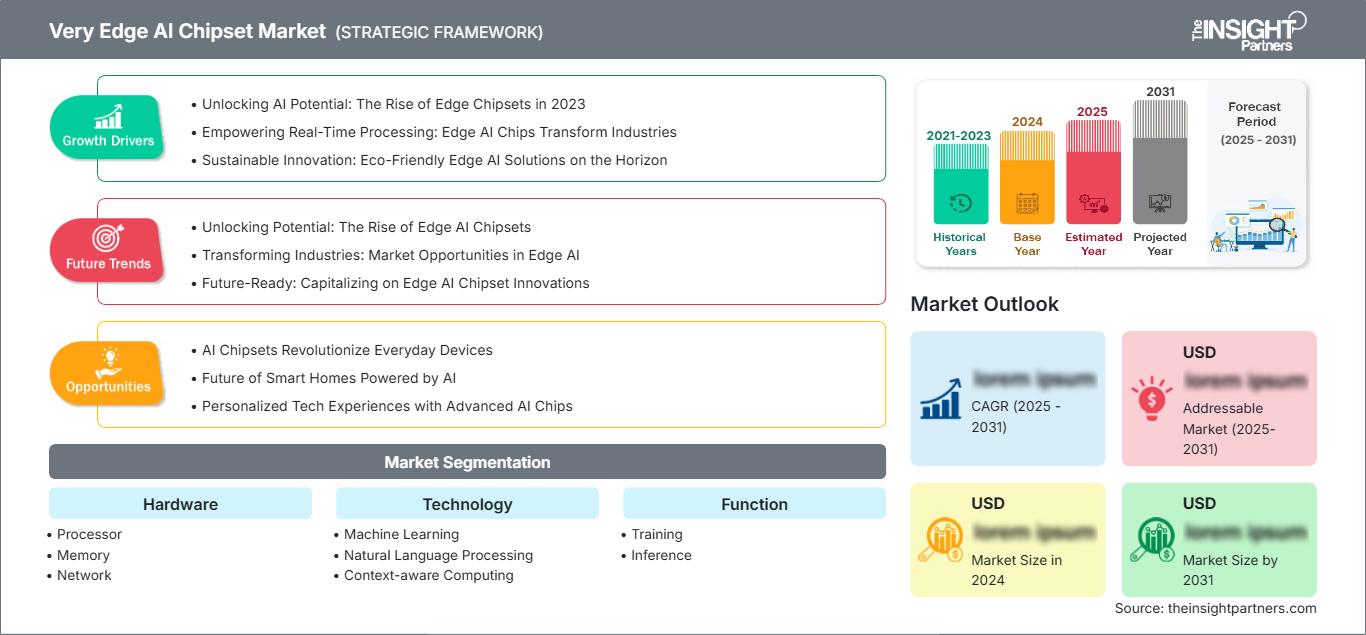
Very Edge AI Chipset Market: Strategic Insights
Regional Insights
North America Edge AI Chipset Market
North America accounted for 36–39% share in 2025, supported by enterprise AI adoption, strong semiconductor R&D, cloud-edge infrastructure, and advanced automation. The Edge AI Chipset Market share in this region is reinforced by smart camera networks, industrial robotics, edge gateways, automotive AI, and defense applications that require low latency and secure localized processing.
The region is projected to grow at a CAGR of 16.8–18.6% during 2026–2034. Demand is expanding as AI workloads shift from centralized servers to distributed devices operating in factories, hospitals, warehouses, retail stores, vehicles, and public infrastructure. Procurement decisions emphasize reliability, software compatibility, cybersecurity, and long-term vendor support.
U.S. Edge AI Chipset Market
The U.S. represented 82–86% of North America's revenue in 2025 and is expected to grow at a CAGR of 17.0–18.8% through 2034. The nation receives advantages through hyperscalers’ investments, semiconductor design capability, military programs, autonomous vehicle piloting, and enterprise modernization projects that require distributed AI inference capability.
Companies are present widely, with Amazon Web Services, Microsoft Corporation, Google LLC, IBM, Qualcomm Technologies, Inc., Intel Corporation, NVIDIA Corporation, and AMD providing cloud-edge software solutions, AI accelerators, embedded solutions, and industrial applications. Use cases range from predictive maintenance, clinical monitoring, logistics automation, fraud detection, intelligent surveillance, and vehicle perception systems.
Europe Edge AI Chipset Market
Europe held 20–23% share in 2025 and is projected to grow at a CAGR of 15.2–16.9%. Germany is at the forefront of regional adoption via its focus on Industry 4.0, automotive electronics, robotics, and machine vision. The United Kingdom prioritizes fintech, cybersecurity, and artificial intelligence in the healthcare sector, whereas France pushes forward with digitization in government and embedded intelligence with respect to aerospace.
Italy and Spain are seeing more adoption in manufacturing, agriculture, retail, and intelligent infrastructure sectors. In the region, regulation favors local processing when privacy, explainability, and data minimization are required. Demand is high for chipsets that enable secure inference, low-latency performance, industrial-grade robustness, and interoperability with automation systems.
APAC Edge AI Chipset Market
APAC accounted for 29–33% share in 2025 and is forecast to grow at a CAGR of 18.7–20.6%. China leads by being at the forefront of electronics manufacturing, smart cities, industrial automation, and artificial intelligence-driven surveillance. Japan and South Korea are supporting in terms of robotics, automotive electronics, and semiconductor fabrication.
India and Australia are ramping up in agriculture, healthcare, logistics, government services, and cybersecurity. APAC region's advantages are in large volumes of devices, good manufacturing clusters, and policies encouraging the development of local AI solutions. Demand for chipsets is limited to machine vision, prediction, power-efficient inference, and connectivity of embedded systems.
Middle East & Africa Edge AI Chipset Market
The Middle East & Africa market is expected to grow at a CAGR of 14.5–16.3% during 2026–2034. The adoption of edge AI is being led by Saudi Arabia and the UAE through smart cities, energy infrastructure, government, logistics, and surveillance, where processing needs to be done locally and in real time.
South Africa, along with other countries in MEA, is seeing edge AI adoption in mining, security, agriculture, telecommunication, and utility sectors. The demand in these areas is driven by ruggedized devices, good connectivity, and analytics that happen locally for the assets in the areas.

Segmentation Analysis
Hardware
Hardware is estimated to grow at a CAGR of 16.5–18.0% during 2026–2034. The Edge AI Chipset Market scope across hardware includes processors, memory, and networking that enable local AI execution under strict power, thermal, and space constraints. Adoption is strongest where real-time decisions, data privacy, and device autonomy are critical.
- Processor: Processors remain the core compute layer, combining CPUs, GPUs, NPUs, ASICs, and FPGAs to execute machine learning workloads across cameras, gateways, vehicles, robots, and medical devices.
- Memory: Memory demand rises as edge models become larger and multimodal, requiring efficient bandwidth, lower power consumption, and robust retention for industrial and embedded AI systems.
- Network: Network components support device-to-device, edge-to-cloud, and gateway connectivity, enabling distributed inference while maintaining security, resilience, and manageable bandwidth consumption.
Technology
Technology is projected to grow at a CAGR of 17.2–18.9% from 2026–2034. Machine learning, natural language processing, context-aware computing, computer vision, and predictive analysis define the workload mix in the Edge AI Chipset Market report. Demand is strongest for chipsets that accelerate multiple AI models while supporting flexible software frameworks and industry-specific deployment patterns.
- Machine Learning: Machine learning supports anomaly detection, automation, personalization, classification, and forecasting across industrial, healthcare, retail, cybersecurity, and automotive applications.
- Natural Language Processing: Natural language processing enables voice interfaces, translation, documentation assistance, call analytics, and human-machine interaction on devices with reduced cloud dependence.
- Context-aware Computing: Context-aware computing combines sensor inputs, location, behavior, and device state to provide adaptive responses in mobility, healthcare, retail, and workplace automation.
- Computer Vision: Computer vision is central to inspection, surveillance, driver assistance, robotics, patient monitoring, smart checkout, and agricultural imaging applications.
- Predictive Analysis: Predictive analysis supports maintenance, risk scoring, fraud prevention, resource optimization, crop monitoring, and proactive operational decision-making.
Function
Function is forecast to grow at a CAGR of 18.1–19.8% during 2026–2034. Inference dominates near-term deployments because organizations need fast, localized decisions from trained models. Training remains more selective at the edge, primarily supporting personalization, federated learning, adaptive industrial systems, and privacy-sensitive environments in the Edge AI Chipset Market forecast.
- Training: Training at the edge is used selectively for personalization, local adaptation, federated learning, and environments where raw data cannot be transferred externally.
- Inference: Inference drives deployment volumes because it enables low-latency decisions in production systems, consumer devices, vehicles, factories, hospitals, stores, farms, and security networks.
End User
End User demand is projected to grow at a CAGR of 17.6–19.5% through 2034. Healthcare, manufacturing, agriculture, cybersecurity, automotive, retail, human resources, marketing, law, government, and fintech use edge AI to reduce response time, preserve privacy, automate decisions, and lower dependency on continuous cloud connectivity.
- Healthcare: Healthcare uses edge AI chipsets for monitoring, imaging support, triage tools, wearable diagnostics, hospital automation, and privacy-preserving patient data processing.
- Manufacturing: Manufacturing adoption centers on defect detection, predictive maintenance, robotics, safety monitoring, visual inspection, and production analytics.
- Agriculture: Agriculture applies edge intelligence in crop imaging, livestock monitoring, irrigation control, yield forecasting, autonomous equipment, and field-level analytics.
- Cybersecurity: Cybersecurity deployments use local inference for anomaly detection, access control, endpoint protection, threat identification, and zero-trust monitoring.
- Automotive: Automotive demand is driven by driver assistance, cabin monitoring, infotainment, predictive maintenance, autonomous features, and vehicle-to-everything intelligence.
- Retail: Retail applies chipsets in smart checkout, inventory visibility, loss prevention, shopper analytics, queue management, and personalized in-store experiences.
- Human Resources: Human resources adoption is emerging in workplace analytics, attendance systems, identity verification, training assistance, and privacy-conscious employee service platforms.
- Marketing: Marketing teams use edge AI for customer engagement, localized personalization, digital signage, audience measurement, and campaign responsiveness.
- Law: Legal environments use edge processing for secure document handling, speech transcription, evidence analytics, access control, and confidential workflow automation.
- Government: Government adoption includes smart infrastructure, border security, public safety, digital services, traffic systems, and privacy-preserving local analytics.
- Fintech: Fintech uses edge AI for fraud detection, biometric authentication, risk assessment, branch automation, transaction monitoring, and secure customer interactions.
Opportunity Snapshot
| End User | Revenue Contribution Trend | Adoption Stage |
|---|---|---|
| Healthcare | High | Patient AI Scaling |
| Manufacturing | High | Factory Vision Mature |
| Agriculture | Medium | Crop Sensing Emerging |
| Cybersecurity | Medium | Endpoint Defense Scaling |
| Automotive | High | Vehicle Perception Scaling |
| Retail | Medium | Smart Checkout Scaling |
| Human Resources | Low | Workplace AI Emerging |
| Marketing | Medium | Local Personalization Emerging |
| Law | Low | Secure Documents Emerging |
| Government | Medium | Smart Services Scaling |
| Fintech | Medium | Fraud Signals Scaling |
Very Edge AI Chipset Market Growth Drivers and Impact Analysis
Shift Toward Real-Time Local Inference
Autonomous movement, surveillance, inspection, robotics, healthcare, and fraud detection cannot rely fully on the cloud. Local inference helps with speed, bandwidth saving, and keeping private data closer to the point of generation. This becomes an incentive for developing chips that are able to run several AI models at once under power constraints. The effect of such is noticeable in purchase requirements, where buyers take into consideration performance per watt, software support, security, and the lifecycle of the device.
Expansion of Connected Devices and Industrial IoT
The growth in connected sensors, cameras, machines, wearables, vehicles, and gateways is resulting in more data being produced beyond the infrastructure that is central to the system. The requirement for organizations to have smart filtering and decision-making on the device itself is necessary to avoid network congestion and latency in response time. The Edge AI Chipsets enable the device itself to become a decision node for predictive maintenance, safety, resource management, and quality assurance.
Rising Privacy, Security, and Data Sovereignty Requirements
There is an effort from privacy laws and corporate risk management policies to process sensitive data locally as much as possible. There can be many kinds of data that may have to be subject to strict management of transport and storage. The Edge AI Chipsets provide a solution for reduced exposure through processing of the inference either on the device itself or within the local environment.
Very Edge AI Chipset Market Future Trends
Multimodal AI Models Moving onto Devices
Edge AI Chipset Market trends point toward devices that can process video, audio, text, sensor signals, and contextual data together. Multimodal capabilities will be dependent on more memory bandwidth, inference engines, heat-efficient architectures, and model compression optimization. The development of smaller models for generation and vision-language tasks will make it possible to use chipsets that support decision-making in vehicles, robotics, medical equipment, retail and industrial products without always accessing the cloud.
Federated and Adaptive Edge Learning
Federated learning and adaptive learning will become increasingly important as businesses look to improve models without having to aggregate raw data. More often than not, devices will update insights on their own and send only certain parameters or aggregations of signals. This strategy will be helpful in privacy-intensive industries, including healthcare, finance, government, and human resources. Chip manufacturers will compete by offering security enclaves, trusted execution, updates, and tooling for federated learning.
Very Edge AI Chipset Market Opportunities
Vertical Reference Designs for Regulated Industries
For vendors looking to gain traction, they should consider providing credible reference designs for industries including healthcare, fintech, governments, automobiles, and industrial automation. These industries require assurance of reliability, security, regulatory compliance, and support during the lifespan of the product before rolling out widespread deployments. This is where opportunities lie in providing integrated packages including chipsets, software development kits, library models, security components, and integration instructions suitable for the operational environment.
Energy-Efficient AI for Remote and Battery-Powered Devices
Cameras powered by batteries, wearables, drones, agricultural sensors, field gateways, and mobile phones all need AI that does not consume much energy. Semiconductor companies can capitalize on this trend by improving AI performance with respect to power consumption, wake-and-sleep cycles, memory access, and heat dissipation. This potential will be greatest in agriculture, logistics, defense, environment, retail, and health care sectors.
Frequently Asked Questions

- Comprehensive Market Sizing and Forecast Analysis
- Detailed Segmentation Analysis
- In-Depth Market Dynamics Assessment
- Regional and Country-Level Insights
- Competitive Landscape and Company Benchmarking
- Strategic Business Intelligence
Recent Reports
Testimonials

The Insight Partners provided valuable market intelligence that supported our global go-to-market strategy. Their team was professional, responsive, and attentive to our feedback, providing thoughtful analysis and helpful methodological clarifications throughout the project.
Junmo Kim Chief Financial Officer (CFO), Enertech Co., Ltd.
The Insight Partners' SCADA System Market report is comprehensive, with valuable insights on current trends and future forecasts. The team was highly professional, responsive, and supportive throughout. We are very satisfied and highly recommend their services.
RAN KEDEM Partner, Reali Technologies LTDs
I requested a report on a very specific software market and the team produced the report in a few days. The information was very relevant and well presented. I then requested some changes and additions to the report. The team was again very responsive and I got the final report in less than a week.
JEAN-HERVE JENN Chairman, Future Analytica
We worked with The Insight Partners for an important market study and forecast. They gave us clear insights into opportunities and risks, which helped shape our plans. Their research was easy to use and based on solid data. It helped us make smart, confident decisions. We highly recommend them.
PIYUSH NAGPAL Sr. Vice President, High Beam Global
The Insight Partners delivered insightful, well-structured market research with strong domain expertise. Their team was professional and responsive throughout. The user-friendly website made accessing industry reports seamless. We highly recommend them for reliable, high-quality research services
YUKIHIKO ADACHI CEO, Deep Blue, LLC.
This is the first time I have purchased a market report from The Insight Partners.While I was unsure at first, I visited their web site and felt more comfortable to take the risk and purchase a market report.I am completely satisfied with the quality of the report and customer service. I had several questions and comments with the initial report, but after a couple of dialogs over email with their analyst I believe I have a report that I can use as input to our strategic planning process.Thank you so much for taking the extra time and making this a positive experience.I will definitely recommend your service to others and you will be my first call when we need further market data.
JOHN SUZUKI President and Chief Executive Officer, Board Director, BK Technologies
I wish to appreciate your support and the professionalism you displayed in the course of attending to my request for information regarding to infectious disease IVD market in Nigeria. I appreciate your patience, your guidance, and the fact that you were willing to offer a discount, which eventually made it possible for us to close a deal. I look forward to engaging The Insight Partners in the future, all thanks to the impression you have created in me as a result of this first encounter.
DR CHIJIOKE ONYIA MANAGING DIRECTOR, PineCrest Healthcare Ltd.Reason to Buy
- Informed Decision-Making
- Understanding Market Dynamics
- Competitive Analysis
- Identifying Emerging Markets
- Customer Insights
- Market Forecasts
- Risk Mitigation
- Boosting Operational Efficiency
- Strategic Planning
- Investment Justification
- Tracking Industry Innovations
- Aligning with Regulatory Trends





 Get Free Sample for