
Vibration Level Switch Market Demand, Share & Growth by 2034
Coverage: by Technology (Vibrating Fork and Vibrating Rod); Application (Liquids and Solids); Industry (Oil & Gas, Chemicals, Water & Wastewater, Food & Beverages, Pharmaceuticals, Power Generation, Metals & Mining, and Others); , and Geography (North America, Europe, Asia Pacific, and South and Central America)
- Status : Data Released
- Report Code : TIPMC00002536
- Category : Manufacturing and Construction
- No. of Pages : 150
- Available Report Formats :


- Last update date : September 17, 2026


2025 Market Size
US$ 926.4 Mn
Base year value
2034 Forecast
US$ 1,608.74 Mn
Projected by 2034
CAGR 2026-2034
6.32 %
Growth rate
Addressable Market
US$ 11,469.35 Mn
(2026-2034)
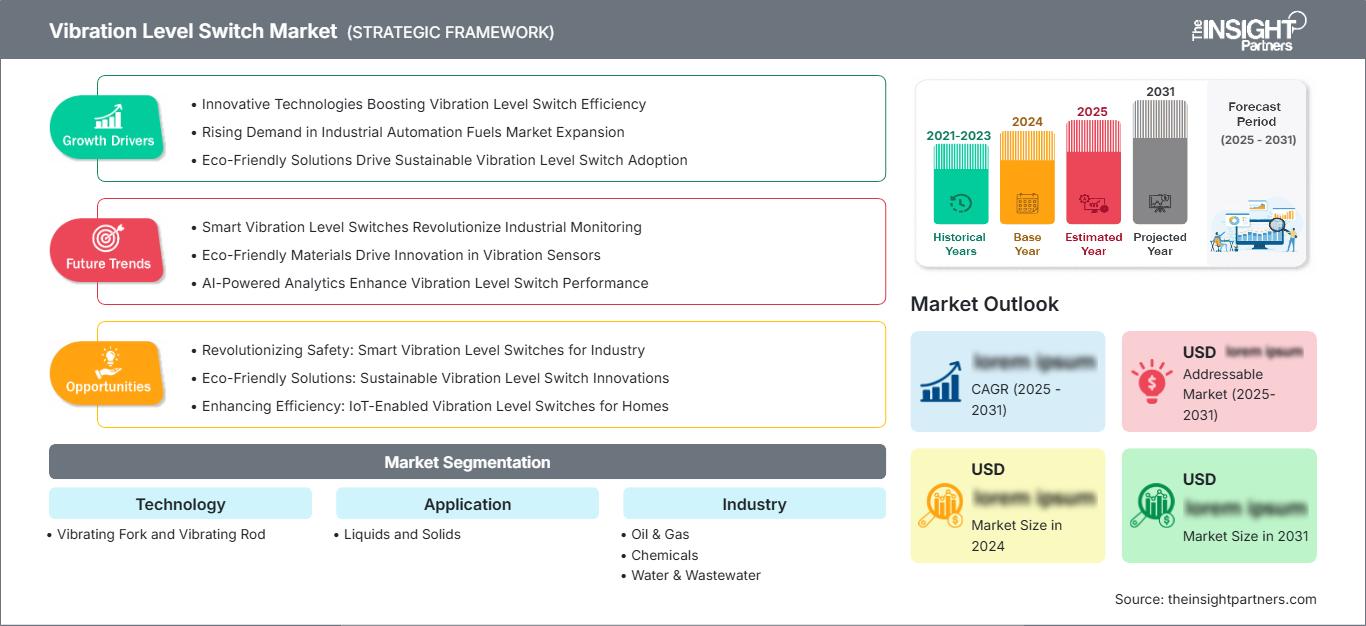
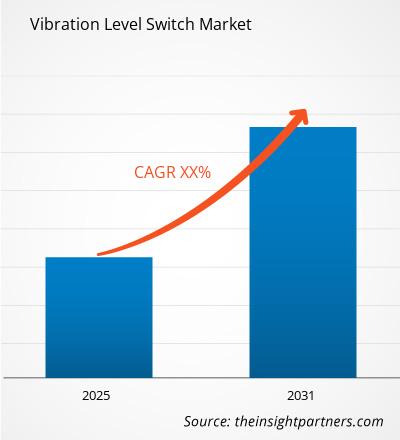
The vibration level switch market was valued at US$ 926.4 Million in 2025 and is projected to reach US$ 1,608.74 Million by 2034, expanding at a CAGR of 6.32% during 2026–2034. Demand is supported by the need for dependable point-level detection across process industries, particularly where overfill prevention, dry-run protection, and reliable material detection are operational priorities in demanding production environments.
North America is expected to register an estimated CAGR of 5.8–6.4% during 2026–2034. Replacement of aging process instrumentation, continued automation across oil and gas and chemicals, and investment in water infrastructure are supporting the vibration level switch market size, while safety-oriented instrumentation requirements strengthen adoption in critical installations.
Vibration Level Switch Market Assessment and Insights
- North America: North America is projected to represent 28–32% share in 2025 and grow at a CAGR of 5.8–6.4% during 2026–2034, supported by process automation, replacement demand, and safety-focused instrumentation across established industries.
- US: The US is estimated to account for 67–72% of North America's 2025 value and expand at a CAGR of 5.9–6.5% during 2026–2034, led by industrial modernization and water infrastructure.
- Europe: Europe is expected to hold 24–28% share in 2025 and grow at a CAGR of 5.5–6.1% during 2026–2034, with Germany, the UK, France, Italy, and Spain benefiting from process automation and stringent operating requirements.
- Asia Pacific: Asia Pacific is estimated at 27–31% share in 2025 and is projected to grow at a CAGR of 7.0–7.8% during 2026–2034, led by China, India, Japan, South Korea, and Australia.
- Largest Segment: Vibrating fork technology is estimated to hold a 53–57% market share in 2025 and grow at a CAGR of 6.4–6.9% during 2026–2034, reflecting broad liquid and solids applicability.
- High Growth Segment: The chemicals industry is estimated to represent a 13–17% market share in 2025 and grow at a CAGR of 7.0–7.6% during 2026–2034, supported by process safety requirements.
- Key companies analyzed in detail: Endress+Hauser Management AG, Emerson Electric Co., Siemens AG, VEGA Grieshaber KG, KROHNE Messtechnik GmbH, ABB Ltd., AMETEK, Inc., FineTek Co., Ltd., Magnetrol International, Inc., Pepperl+Fuchs SE, and Bürkert Fluid Control Systems GmbH & Co. KG.
Source: The Insight Partners' analysis based on proprietary research, government publications, company annual reports, investor presentations, industry databases, and expert interviews.
The vibration level switch market has evolved from basic electromechanical point detection toward compact electronic instruments capable of dependable switching under turbulence, buildup, changing material properties, and hazardous operating conditions. Vibrating fork technology designs continue to be relevant because the same sensing technique can be used for liquids and different bulk solids. Differentiation of products among the competing firms has been achieved by providing instruments that have hygienic design, safety approvals, self-diagnostics, shorter insert lengths, and diagnostic features.
For future development, funds are being spent on digitally-enabled instrumentation, specific sensor shapes and designs, and the capability of manufacturing locally. Manufacturing hubs that have been established in Asia are contributing towards greater demand for standard point level instruments, whereas developed markets are focusing more on replacement, safety approvals, and optimized lifecycle. Standards related to food hygiene, environmental protection, hazardous locations, and process safety should help manufacturers who offer both switching and compliance.
Vibration Level Switch Market Report Scope
| Report Attribute | Details |
|---|---|
| Market size in 2025 | US$ 926.4 Million |
| Market Size by 2034 | US$ 1,608.74 Million |
| Global CAGR (2026 - 2034) | 6.32% |
| Historical Data | 2021-2024 |
| Forecast period | 2026-2034 |
Vibration Level Switch Market Analysis
The vibration level switch market growth is closely linked to process industries where point-level decisions directly influence production continuity and equipment protection. The ecosystem consists of sensing-element providers, electronics providers, process-equipment integrators, engineering companies, distributors, and plant operators. The need for level switches is high where level transmitters alone cannot provide cost-effective high-level, low-level, or dry-run protection. Stainless steel construction, hazardous area approvals, and process connections affect purchasing decisions.
The supply dynamics have shifted in favor of modular platforms that are capable of addressing multiple industries through the configuration of electronics and mounting. Therefore, the manufacturers find themselves balancing between standardization and customization of their products in terms of temperature, pressure, density, hygienic, and installation considerations. Instrumentation firms that have large product portfolios may integrate level switches with transmitters, flowmeters, pressure instruments, and control systems.
Competition in the vibration level switch market is shaped by product reliability, installed base, certification coverage, application engineering, and global service capability. Endress+Hauser Management AG and VEGA Grieshaber KG emphasize broad level-measurement portfolios, while Emerson Electric Co., Siemens AG, and ABB Ltd. can leverage wider process automation ecosystems. KROHNE Messtechnik GmbH, AMETEK, Inc., FineTek Co., Ltd., and Magnetrol International, Inc. compete through application-focused solutions and specialized level expertise.
Investment is increasingly directed toward smarter diagnostics, hygienic designs, compact instruments, and safety-oriented switching. Pepperl+Fuchs SE and Bürkert Fluid Control Systems GmbH & Co. KG add further competitive depth through industrial sensing and fluid-control capabilities. Strategic positioning is consequently moving beyond device price toward lifecycle value, commissioning simplicity, regional technical support, interoperability, and the ability to meet demanding specifications in oil and gas, chemicals, food processing, pharmaceuticals, and utilities, contributing significantly to the Vibration Level Switch Market share.
● REPORT CUSTOMIZATION
Tailor This Report To Align With Your Specific Business Requirements
This report can be customized to align precisely with your business objectives, scope, and target markets. Customization options include tailored segmentation, geography, competitive analysis, and strategic insights to support informed decision-making.
Customize This Report →WHAT YOU CAN ADJUST
- ● Segmentations
- ● Geography
- ● Competitive Analysis
- ● Language Preferences
Vibration Level Switch Market: Strategic Insights
Regional Insights
North America vibration level switch market
North America is estimated to represent 28–32% of the global vibration level switch market demand in 2025 and is expected to expand at a 5.8–6.4% CAGR through 2034. The United States is still the major market thanks to its well-developed process industry, refinery renovation, production of chemicals, wastewater management, and instrumentation renewal. The Canadian market is served due to projects in the energy sector, mining industry, food processing, and municipal infrastructure. End-users seek switches with hazardous area approvals, functionality for safety, and easy maintenance. Retrofit requirements are especially important in situations when plants are modernizing individual control points but not their entire automation systems. In this regard, the existing engineering and distribution network makes product qualification shorter.
Within the North American region, there is a tendency towards instruments that are able to perform efficiently in the presence of vibrations, turbulences, deposits, and different process conditions. Point-level switches are used at oil and gas facilities for tank protection and pump protection purposes, whereas water utilities require reliable detection in treatment and storage facilities. These application requirements support steady replacement demand rather than purely capacity-driven expansion, creating a balanced market profile through 2034.
U.S. vibration level switch market
The U.S. is estimated to account for 67–72% of North America's 2025 vibration level switch market value and is projected to grow at a 5.9–6.5% CAGR through 2034. Its industrial base spans refining, chemicals, pharmaceuticals, food processing, power, and municipal water infrastructure. Major suppliers maintain established commercial and technical footprints, while domestic integrators support replacement and retrofit projects. The market favors reliable point-level protection that can operate with limited calibration and maintenance requirements.
Application trends increasingly center on safety-critical overfill prevention, pump protection, solids detection, and hygienic processing. Digital diagnostics are gaining attention where operators need faster verification without frequent physical inspection. Procurement decisions also consider certification, material compatibility, installation footprint, and integration with existing control systems. These factors create opportunities for established suppliers while leaving room for compact, cost-effective products in standardized OEM and utility applications.
Europe vibration level switch market
Europe is expected to hold 24–28% share of the vibration level switch market in 2025 and expand at a 5.5–6.1% CAGR through 2034. Germany leads the regional market, followed by the UK, France, Italy, and Spain, with demand anchored in advanced process manufacturing, chemicals, food production, pharmaceuticals, and water infrastructure. European buyers generally emphasize lifecycle reliability, documentation, safety certification, and hygienic compatibility.
The UK maintains demand across chemicals, food, pharmaceuticals, energy, and wastewater facilities, where reliable high- and low-level protection supports plant continuity. Germany benefits from its extensive machinery and process-equipment ecosystem and strong automation capabilities. France and Italy contribute through chemicals, food processing, utilities, and industrial manufacturing, while Spain's water, food, and energy projects provide additional applications. Regional investment favors suppliers able to combine robust hardware with documented compliance and efficient commissioning.
APAC vibration level switch market
APAC is estimated to represent 27–31% of the vibration level switch market share in 2025 and is projected to grow at a 7.0–7.8% CAGR through 2034, making it the leading regional growth area. China is the largest contributor, while Japan, South Korea, India, and Australia provide diverse industrial demand.
China's process manufacturing and infrastructure investment support broad adoption, while India benefits from expanding chemicals, food processing, pharmaceuticals, and water projects. Japan and South Korea emphasize sophisticated automation and manufacturing reliability, whereas Australia adds mining and resources applications. Industrial capacity expansion, wastewater investment, and localization of manufacturing capabilities should sustain demand across the region.
Middle East & Africa vibration level switch market
The Middle East & Africa vibration level switch market is expected to expand at a 5.0–5.7% CAGR through 2034. Saudi Arabia leads regional demand, followed by the UAE and South Africa, with applications concentrated in oil and gas, petrochemicals, utilities, mining, and water infrastructure. Harsh operating environments increase the value of robust, low-maintenance point-level instrumentation.
Saudi Arabia's energy and industrial diversification programs create demand across processing facilities, while the UAE emphasizes energy, water, and infrastructure projects. South Africa contributes through mining, chemicals, power generation, and municipal water applications. The rest of MEA remains more project-driven, with procurement frequently tied to new processing capacity, storage infrastructure, and modernization of existing plants.
Segmentation Analysis
Technology
Technology remains the primary product differentiation point because sensing geometry determines application flexibility, sensitivity, installation constraints, and suitability for liquids or bulk solids. Vibrating fork technology is estimated to grow at a 6.4–6.9% CAGR during 2026–2034, while vibrating rod solutions remain relevant where installation geometry or material characteristics favor a single-element configuration. The vibration level switch scope is therefore shaped by application-specific engineering rather than technology substitution alone, according to the Vibration Level Switch Market report.
- Vibrating Fork: Vibrating Fork technology maintains the broadest application position because paired tines provide dependable switching across liquids and solids. Its sensitivity, limited maintenance requirements, and flexible mounting support use in process vessels, silos, hygienic equipment, and safety applications.
- Vibrating Rod: Vibrating Rod designs address applications requiring a compact or application-specific sensing element. They remain strategically relevant for selected liquids and solids where vessel geometry, material behavior, or installation constraints make fork configurations less suitable.
Application
Application divides demand between liquids and solids, with purchasing decisions influenced by viscosity, density, buildup, temperature, turbulence, and process hygiene. The segment is projected to grow at a 6.1–6.7% CAGR during 2026–2034 as plants increasingly use point-level devices alongside continuous measurement systems for independent protection and control, according to the Vibration Level Switch Market forecast.
- Liquids: Liquids represent a core demand base across tanks, vessels, pipelines, and processing systems. High- and low-level alarms, overfill prevention, and pump dry-run protection sustain recurring requirements across chemicals, oil and gas, food, pharmaceuticals, and water treatment.
- Solids: Solids applications cover powders, granules, pellets, and other bulk materials. Demand depends strongly on reliable detection at silos, bins, hoppers, and conveying systems, particularly where lightweight or abrasive material creates challenging measurement conditions.
Industry
Industry segmentation reflects differing process hazards, hygiene requirements, equipment configurations, and level-control priorities. The segment is estimated to expand at a 6.2–6.8% CAGR during 2026–2034. Chemicals is positioned as the high-growth industry, while oil and gas remains an important installed-base market due to safety and asset-protection requirements, reflecting key Vibration Level Switch Market trends.
- Oil & Gas: Oil & Gas applications emphasize overfill prevention, pump protection, and dependable operation in hazardous environments. Certified instrumentation and corrosion-resistant construction remain important purchasing criteria for tanks, separators, process vessels, and storage systems.
- Chemicals: Chemicals facilities require reliable detection across corrosive, reactive, and variable-density media. Strong emphasis on material compatibility, hazardous-area certification, and functional safety supports adoption in reactors, storage vessels, and transfer systems.
- Water & Wastewater: Water & Wastewater applications use point-level detection in tanks, pumping stations, treatment systems, and solids handling. Robust instruments that tolerate moisture, suspended material, and changing process conditions are strategically valuable.
- Food & Beverages: Food & Beverages users prioritize hygienic construction, cleanability, certification, and reliable switching in liquid and bulk-solid processing. Compact devices are useful where vessels have constrained installation space or frequent sanitation cycles.
- Pharmaceuticals: Pharmaceuticals applications require controlled materials, hygienic surfaces, documented performance, and dependable detection. Demand is concentrated in process vessels, ingredient handling, utilities, and storage equipment, where contamination control is essential.
- Power Generation: Power Generation facilities use point-level detection across water, fuel, chemicals, and bulk-material handling systems. Reliability under temperature, pressure, vibration, and demanding maintenance conditions supports continued adoption.
- Metals & Mining: Metals & Mining applications require durable detection for abrasive solids, slurries, storage systems, and process liquids. Robust probes, extended insertion options, and resistance to mechanical stress are important selection factors.
Opportunity Snapshot
| Industry | Revenue Contribution | Trend Tag | Adoption Stage |
| Oil & Gas | High | Tank Safety | Mature |
| Chemicals | High | Process Safety | Scaling |
| Water & Wastewater | Medium | Pump Protection | Scaling |
| Food & Beverages | Medium | Hygienic Processing | Scaling |
| Pharmaceuticals | Medium | Clean Validation | Scaling |
| Power Generation | Medium | Boiler Protection | Mature |
| Metals & Mining | Medium | Bulk Solids | Mature |
Vibration Level Switch Market Growth Drivers and Impact Analysis
Expansion of Automated Process Safety Architectures
Industrial operators have started using discrete level signals as part of a larger automation and safety system and not just using the switches alone. This necessitates instruments that will offer reliable switching, functional safety, diagnostics, and easy proof testing. In oil and gas and chemical applications, high-level independent protection helps avoid overfilling accidents and process downtime. For water treatment plants, there is a need for pump protection against dry running. The effect on the market comes in terms of the value chain since the system integrators tend to go for standardized platforms in terms of instrumentation for various plants. Suppliers who are able to offer proven safety performance, interoperable signals and application engineering will get repeat business.
Modernization of Aging Industrial Instrumentation
There is currently a significant number of legacy level switches that are ripe for replacement or upgrading due to improvements in technology and increased focus on modernization of control systems, better maintenance, and higher safety standards. The appeal of such a business comes from the fact that point-level devices can be upgraded without major modifications to the vessels and control system design. The new devices offer enhanced diagnostics capabilities, small electronics, additional certifications, and greater flexibility in terms of process connections while maintaining the fundamental switching capability. Thus, this generates an income flow through replacements not dependent on the expansion of existing production capacities. In well-developed markets, modernization becomes an opportunity to use standardized equipment at different plants and to minimize spare parts and technical support issues.
Growth of Process Manufacturing and Water Infrastructure
Process capacity in the fields of chemicals, pharmaceuticals, food processing, mining, and water treatment adds to the installed base of potential point-level detection applications. Industrializing economies provide a particular opportunity because process facilities are often designed to include automation and safety instrumentation in their original design, rather than as a retrofit. Another area of sustainable demand comes from water infrastructure, as both municipalities and industry continue to invest in increased water treatment and pumping capacities. Such projects involve level protection in raw water tanks, chemical injection systems, sludge management systems, storage vessels, and utility equipment. The value to the market is that each such site can have multiple points of level control application, providing for multiple unit orders rather than one-off buys.
Vibration Level Switch Market Future Trends
Embedded Diagnostics and Remote Verification
Future instruments are expected to put increased focus on diagnostics embedded into sensors to detect faults in the latter, failures in electronics, abnormalities in switching, or the need for verification prior to any process interruption. Remote testing applies especially to safety-related applications, as operators can test device operation while minimizing physical access to tanks and overhead equipment. With the growth of networked control systems, future switch technologies will exchange the status of their operation with plant systems instead of supplying a simple signal. It is hoped that this development will encourage manufacturers to combine tried and tested technologies of vibration-based sensing with digital networking, condition monitoring, event logging, and configuration simplicity. Greatest adoption rates can be expected at plants where maintenance labor costs are high, interruptions are costly, and safety measures require validation.
Application-Specific Miniaturization and Hygienic Engineering
Development in products in the future should include shorter insertion lengths, custom-fitted geometry for forks, improved drainage, and special materials that can withstand harsh conditions such as hygiene or compact installations. Miniaturization technology will increase the market by enabling the use of the products in narrow tubes, small tanks, skids, and other OEM devices where normal sensors cannot be easily installed. While at the same time, manufacturers will be expected to provide devices with polished wetted parts, suitable process connections and resistance to intense cleaning. This means that future devices should be offered on modular platforms that have mechanical design and customizable electronics and connections. This is due to the fact that the use of modular platforms enables standardization of electronics, which can be used in several process conditions by attaching special probes or fittings.
Vibration Level Switch Market Opportunities
Localized Manufacturing and Regional Application Engineering
Manufacturers can capture additional demand by expanding localized production, technical support, and application engineering in high-growth industrial economies. Asia Pacific provides an especially attractive opportunity because expanding chemicals, food processing, pharmaceuticals, mining, and water infrastructure require dependable point-level instrumentation at multiple project stages. Localized engineering can shorten specification cycles, adapt process connections to regional standards, and improve response times for replacement requirements. Manufacturers can also establish partnerships with system integrators and engineering contractors that influence equipment selection during plant design. The opportunity is not limited to new installations: localized service networks can convert installed products into recurring replacement and maintenance demand. Companies that combine global certification with regionally responsive manufacturing and technical support should be better positioned to compete against both multinational suppliers and lower-cost local instrumentation vendors.
Integrated Safety and Measurement Portfolio Expansion
A second opportunity lies in bundling point-level switches with complementary measurement and automation products. Customers increasingly seek consistent interfaces, documentation, service arrangements, and spare-parts strategies across instrumentation packages. Suppliers with portfolios spanning pressure, flow, temperature, continuous level, and point-level measurement can use existing customer relationships to expand their share of plant instrumentation expenditure. Strategic product integration can also simplify engineering because switches and transmitters can be selected as complementary layers of process control and protection. Vendors can strengthen this opportunity by developing standardized packages for oil and gas storage, chemical processing, hygienic production, and municipal water systems. Such packages can reduce procurement complexity while creating differentiation based on application knowledge, lifecycle support, and compatibility rather than relying exclusively on sensor-level performance or purchase price.
Frequently Asked Questions

- Comprehensive Market Sizing and Forecast Analysis
- Detailed Segmentation Analysis
- In-Depth Market Dynamics Assessment
- Regional and Country-Level Insights
- Competitive Landscape and Company Benchmarking
- Strategic Business Intelligence
Recent Reports
Testimonials

The Insight Partners provided valuable market intelligence that supported our global go-to-market strategy. Their team was professional, responsive, and attentive to our feedback, providing thoughtful analysis and helpful methodological clarifications throughout the project.
Junmo Kim Chief Financial Officer (CFO), Enertech Co., Ltd.
The Insight Partners' SCADA System Market report is comprehensive, with valuable insights on current trends and future forecasts. The team was highly professional, responsive, and supportive throughout. We are very satisfied and highly recommend their services.
RAN KEDEM Partner, Reali Technologies LTDs
I requested a report on a very specific software market and the team produced the report in a few days. The information was very relevant and well presented. I then requested some changes and additions to the report. The team was again very responsive and I got the final report in less than a week.
JEAN-HERVE JENN Chairman, Future Analytica
We worked with The Insight Partners for an important market study and forecast. They gave us clear insights into opportunities and risks, which helped shape our plans. Their research was easy to use and based on solid data. It helped us make smart, confident decisions. We highly recommend them.
PIYUSH NAGPAL Sr. Vice President, High Beam Global
The Insight Partners delivered insightful, well-structured market research with strong domain expertise. Their team was professional and responsive throughout. The user-friendly website made accessing industry reports seamless. We highly recommend them for reliable, high-quality research services
YUKIHIKO ADACHI CEO, Deep Blue, LLC.
This is the first time I have purchased a market report from The Insight Partners.While I was unsure at first, I visited their web site and felt more comfortable to take the risk and purchase a market report.I am completely satisfied with the quality of the report and customer service. I had several questions and comments with the initial report, but after a couple of dialogs over email with their analyst I believe I have a report that I can use as input to our strategic planning process.Thank you so much for taking the extra time and making this a positive experience.I will definitely recommend your service to others and you will be my first call when we need further market data.
JOHN SUZUKI President and Chief Executive Officer, Board Director, BK Technologies
I wish to appreciate your support and the professionalism you displayed in the course of attending to my request for information regarding to infectious disease IVD market in Nigeria. I appreciate your patience, your guidance, and the fact that you were willing to offer a discount, which eventually made it possible for us to close a deal. I look forward to engaging The Insight Partners in the future, all thanks to the impression you have created in me as a result of this first encounter.
DR CHIJIOKE ONYIA MANAGING DIRECTOR, PineCrest Healthcare Ltd.Reason to Buy
- Informed Decision-Making
- Understanding Market Dynamics
- Competitive Analysis
- Identifying Emerging Markets
- Customer Insights
- Market Forecasts
- Risk Mitigation
- Boosting Operational Efficiency
- Strategic Planning
- Investment Justification
- Tracking Industry Innovations
- Aligning with Regulatory Trends





 Get Free Sample for