
Virtual Fitting Room Market Share, Demand & Growth by 2034
Coverage: by Component (Hardware, Software, Services); Application (Apparel, Beauty and Cosmetics, Footwear, Eyewear, Others); End Use (Physical Stores, Virtual Stores), and Geography (North America, Europe, Asia Pacific, and South and Central America)
- Status : Data Released
- Report Code : TIPRE00004295
- Category : Electronics and Semiconductor
- No. of Pages : 150
- Available Report Formats :


- Last update date : September 22, 2026


2025 Market Size
US$ 7.1 Bn
Base year value
2034 Forecast
US$ 21.17 Bn
Projected by 2034
CAGR 2026-2034
12.91 %
Growth rate
Addressable Market
US$ 123.11 Bn
(2026-2034)
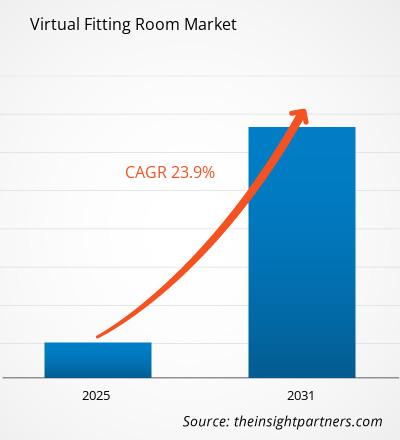
The global Virtual Fitting Room market was valued at US$ 7.1 billion in 2025 and is expected to reach US$ 21.17 billion by 2034; it is estimated to record a CAGR of 12.91% during 2026-2034.
Virtual Fitting Room Market Assessment and Insights
- North America holds an estimated 37–40% share in 2025 and is expected to grow at a 17–20% CAGR between 2026–2034, supported by advanced digital retail infrastructure, strong AI adoption, and extensive omnichannel investment.
- US accounts for approximately 86–89% of North America's 2025 market, with growth projected at a 18–21% CAGR between 2026–2034, led by large retailers and technology-intensive e-commerce platforms.
- Europe represents approximately 25–28% share in 2025 and is projected to register a 16–19% CAGR between 2026–2034. The UK, Germany, France, Italy, and Spain are important adoption markets as retailers emphasize personalization and digital customer engagement.
- Asia Pacific represents approximately 22–25% share in 2025 and is projected to expand at a 26–28% CAGR between 2026–2034. China, Japan, South Korea, and India provide strong foundations through mobile commerce, AI investment, and digitally oriented consumers.
- Largest Segment: Software, representing a 48–51% market share in 2025 and expanding at a 15–18% CAGR during 2026–2034, reflecting demand for scalable AI, AR, and computer-vision platforms.
- High Growth Segment: Virtual Stores, with a 53–56% market share in 2025 and a 17–20% CAGR during 2026–2034, driven by digital commerce integration and photo-based try-on experiences.
- Key companies analyzed in detail: 3D-A-PORTER, AstraFit, Coitor IT Tech, ELSE Corp Srl, Fitnect Interactive, Magic Mirror, Metail Limited, Sizebay, Visualook, Zugara Inc., and 3DLOOK.
Source: The Insight Partners' analysis based on proprietary research, government publications, company annual reports, investor presentations, industry databases, and expert interviews.
Market developments have moved from digital mirror technologies based on cameras to AI visualization, body measurement, garment segmentation, and recommendation engines. Digitization of products is becoming more software-driven, compared to retail devices, whereas generative models can generate realistic images of garments based on minimal visual data. These developments enhance scalability, allowing retailers to offer experiences through product web pages, mobile apps, and connected store displays.
During the forecast period, investments will focus on interoperable platforms encompassing product catalogs, customer profiles, inventory, recommendation engines, and analytics. Developing Asian markets will see increased deployments as consumers continue their shift towards mobile-first shopping. Privacy controls, consent mechanisms, image-processing safeguards, and transparent communication regarding generated imagery will become increasingly important as retailers scale consumer-facing applications, according to the Virtual Fitting Room Market report.
Virtual Fitting Room Market Report Scope
| Report Attribute | Details |
|---|---|
| Market size in 2025 | US$ 7.1 Billion |
| Market Size by 2034 | US$ 21.17 Billion |
| Global CAGR (2026 - 2034) | 12.91% |
| Historical Data | 2021-2024 |
| Forecast period | 2026-2034 |
Virtual Fitting Room Market Analysis
Consumer demand is driven by shoppers who want more assurance about their purchases due to not being able to physically inspect products. Fashion apparel continues to be the main use case, since things like the size, shape, color, and style cannot be adequately assessed using product photography. The entire ecosystem consists of camera and display hardware, software and AI, 3D content, platform solutions for retailers, cloud, analytics, and integrations.
On the supply side, the trend towards cloud-based software and APIs that can connect with current commerce systems continues. Retailers prefer solutions that require minimal 3D modeling in order to handle the catalog. Hardware plays an important role in physical stores, especially for interactive mirrors, but software-driven solutions are more geographically scalable and updatable. Vendors able to combine fit intelligence with product recommendations can address both customer experience and merchandising objectives, as highlighted in the Virtual Fitting Room Market forecast.
Competition will become more tech-oriented as incumbent experts and new AI players compete in the same retail processes. AstraFit, Metail Limited, Sizebay, Visualook, and Zugara Inc. provide a diverse range of sizing, visualization, and interactive commerce solutions, and 3D-A-PORTER, ELSE Corp Srl, Fitnect Interactive, and Magic Mirror provide specific visualization solutions. 3DLOOK improves competition through body-scanning and measuring technologies.
The strategic positioning will be determined by the depth of the integration, image realism, speed of operations, privacy architecture, and retailer analytics. Generative AI, automated garment digitization, mobile-first design, and omnichannel deployment become areas of investment interest. Platforms that have reusable software architecture can support several categories of retailers without replicating the whole stack of technology for each one separately. Therefore, virtual fitting room analysis will be more and more focused on platform economics and interoperability.
● REPORT CUSTOMIZATION
Tailor This Report To Align With Your Specific Business Requirements
This report can be customized to align precisely with your business objectives, scope, and target markets. Customization options include tailored segmentation, geography, competitive analysis, and strategic insights to support informed decision-making.
Customize This Report →WHAT YOU CAN ADJUST
- ● Segmentations
- ● Geography
- ● Competitive Analysis
- ● Language Preferences
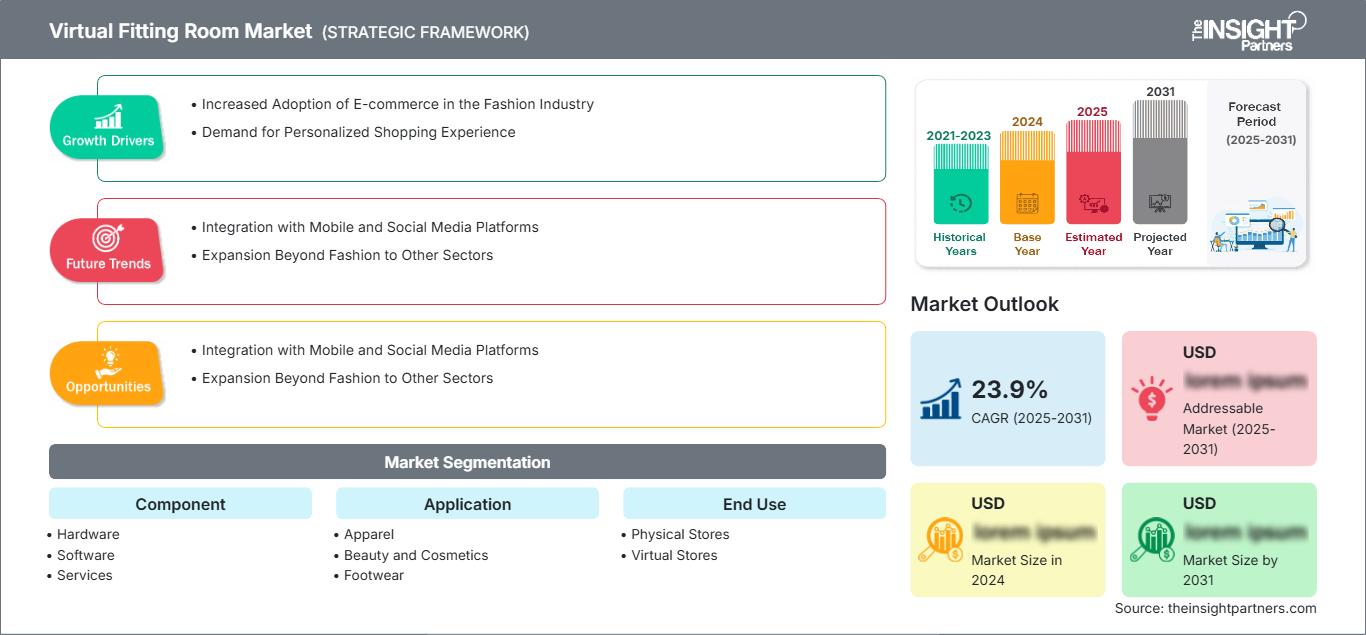
Virtual Fitting Room Market: Strategic Insights
Regional Insights
North America Virtual Fitting Room Market
North America is expected to retain the leading regional position, representing 37–40% of the Virtual Fitting Room Market share in 2025 and recording a 17–20% CAGR through 2034. America holds the reins when it comes to regional demand, backed by big digital retailing, cloud computing technology, the use of smartphones, and technology for personal shopping.
Canada brings in its share through fashion e-commerce, digital department stores, and technology retailers. Brick-and-mortar retail is also utilizing interactive mirrors alongside traditional fitting rooms to aid in customer interaction. The focus on regional demand has shifted from augmented reality effects to AI try-on and body visualization.
U.S. Virtual Fitting Room Market
The US represents approximately 86–89% of North America's 2025 Virtual Fitting Room Market share and is expected to grow at an 18–21% CAGR through 2034. Virtual experiences are being leveraged within the space of apparel, footwear, eyewear, and beauty and combined with m-commerce and product recommendation capabilities.
Technology players are rapidly increasing consumer awareness through offering the try-on feature inside the shopping experience journey. The evaluation of solutions by retailers is now based on engagement, conversion rate, catalog coverage, and the customer data needs. The maturity of the e-commerce ecosystem, together with high adoption rates, should ensure that the US remains the leading national market in North America.
Europe Virtual Fitting Room Market
Europe is estimated to account for 25–28% share of the Virtual Fitting Room Market in 2025, with a projected 16–19% CAGR. The UK is a significant adoption market with high-level fashion retailing online and advanced omnichannel approach. Germany is the leader in terms of combining technology adoption with a huge apparel and footwear consumer market, whereas France focuses on luxury goods, cosmetics, and personalization of digital experiences. Italy and Spain present further options with the help of fashion retail digitization and mobile commerce. The UK is predicted to be the leading European market due to linking virtual visualization and product discovery, loyalty, and customer service platforms.
APAC Virtual Fitting Room Market
APAC represents approximately 22–25% share of the Virtual Fitting Room Market in 2025 and is expected to achieve a 26–28% CAGR, making it the fastest-growing region. Mobile commerce and artificial intelligence shopping are most popular in China, followed by Japan, South Korea, and India, where the trends are growing fast.
Australia brings its contribution through developed digital retail, while India enjoys the growing trends of smartphone commerce and access to AI-assisted shopping. Growth in the region is fueled by digital transformation initiatives, growing fashion e-commerce platforms, mobile infrastructure development, and generative AI.
Middle East & Africa Virtual Fitting Room Market
The Middle East and Africa Virtual Fitting Room Market is expected to record a 17–20% CAGR through 2034. These countries have become leading markets owing to their investments in digital retail, high-quality shopping experience, and infrastructure based on technology advancements. South Africa acts as an African adoption market owing to its capability in e-commerce and retail technology.
Opportunities in the broader MEA region include mall upgrades, tourism-oriented retail, adoption of smartphones, and digital payments. The UAE will continue being the leading market due to luxury, beauty, and fashion retailers' experiments using immersive shopping technology and digital-assisted consumer experience.
Segmentation Analysis
Component
Component segmentation comprises Hardware, Software, and Services. Software is the leading component, supported by scalable AI, AR, computer vision, and cloud architectures. The component is expected to expand at a 15–18% CAGR from 2026–2034, while services gain importance as retailers require integration, maintenance, consulting, and model optimization, reflecting key Virtual Fitting Room Market trends.
- Hardware: Interactive mirrors, cameras, sensors, displays, and scanning equipment remain important for physical retail installations where immersive experiences require dedicated infrastructure and real-time visualization.
- Software: AI visualization, body measurement, recommendation engines, garment rendering, and analytics form the core scalable layer for digital commerce deployments across multiple retail channels.
- Services: Integration, consulting, deployment, maintenance, and optimization support retailers managing complex commerce architectures and continually updating product catalogs.
Application
Application includes Apparel, Beauty and Cosmetics, Footwear, Eyewear, and Others. Apparel remains the largest application, supported by fit-related purchase uncertainty. The segment is expected to maintain strong adoption as retailers combine visualization with recommendations and personalized product discovery.
- Apparel: Clothing provides the broadest opportunity because consumers need visual information about silhouette, drape, styling, and body compatibility before completing purchases.
- Beauty and Cosmetics: Facial visualization allows shoppers to assess makeup shades and styles digitally, supporting experimentation while reducing dependence on physical product sampling.
- Footwear: Digital visualization helps consumers assess style, color, proportions, and compatibility, creating opportunities for mobile-first try-on experiences.
- Eyewear: Face tracking enables consumers to compare frames rapidly, making eyewear particularly suitable for camera-based visualization integrated into product pages and applications.
End Use
End Use comprises Physical Stores and Virtual Stores. Virtual Stores represent the largest end-use category and are projected to grow at a 17–20% CAGR during 2026–2034. Online deployment benefits from broad reach, low hardware dependency, and direct integration with digital merchandising.
- Physical Stores: Smart mirrors and interactive displays enhance fitting-area efficiency, product discovery, and staff-assisted selling while providing retailers with new engagement touchpoints.
- Virtual Stores: Mobile and web-based experiences extend try-on functionality across geographic markets, allowing retailers to connect visualization with catalog browsing, recommendations, and checkout.
Opportunity Snapshot
| Application | Revenue Contribution (High/Medium/Low) | Trend Tag | Adoption Stage |
| Apparel | High | Fit Visualization | Mature |
| Beauty and Cosmetics | Medium | Shade Matching | Scaling |
| Footwear | Medium | Shoe Try-On | Scaling |
| Eyewear | Medium | Frame Matching | Scaling |
| Others | Low | Accessory Visualization | Emerging |
Virtual Fitting Room Market Growth Drivers and Impact Analysis
AI-Based Personalization Improves Digital Purchase Confidence
AI-powered models have started delivering increased accuracy in the representation of digitally visualized products through the interpretation of body shape, garment design, posture, lighting, and characteristics of the product. This way, retailers no longer deliver a one-size-fits-all representation but rather a more tailored representation of garments based on how they might appear on specific shoppers. The value created by such solutions goes beyond the visual experience itself, since retailers will be able to offer relevant recommendations, sizing assistance, and alternatives to their customers alongside generated images. Increased personalization is also likely to make the process of comparison between products more efficient for shoppers, who would not have to visit multiple physical stores. With declining costs of computation and increasing accuracy of models, AI-driven experiences are set to become increasingly easy to implement in mobile applications and web pages.
Expansion of Omnichannel Retail Infrastructure
Modern retailers have started integrating their online and offline channels, thus making the need for technologies capable of providing seamless customer experience through websites, mobile applications, physical stores, and social shopping. In turn, virtual try-on could be used as one of the layers of interface integration with inventory management, customer profiles, recommendation systems, etc. Physical retailers may employ digital mirrors to present their products in case they are not available in a particular store, while online retailers can mimic some aspects of in-store try-on. The integration allows for more versatile merchandising and keeps customers involved during the entire process of purchasing. In the case of fashion industry players who have large product catalogs and several collections per year, as well as multiple geographically distributed physical stores, such a technology may offer an additional way to guide customers to products.
Rising Need for Efficient Product Visualization
For fashion retailers, there is a greater need to find ways to enrich the experience of products without a corresponding increase in photography, studio, sample and physical display costs. Artificial intelligence can help in creating product visuals through the use of catalog visuals, structured product information and automation of the rendering process. This effect becomes more powerful for retailers who have thousands of constantly changing SKUs and where the production of assets can become a limiting factor. It is also possible to translate digital representations in terms of languages, markets, body sizes and customer interfaces, hence improving the efficiency of content creation. In the long run, automation of visualization processes will inspire retailers to see product information as a strategic asset rather than just an operational necessity.
Virtual Fitting Room Market Future Trends
Generative AI Moves Toward Dynamic Virtual Try-On
Trends in virtual fitting rooms are now leaning toward a more generative approach, where a full context representation of the object would be produced rather than just putting a two-dimensional clothing object over a picture taken by a camera. In future systems, it will be possible to model all the details, such as the behavior of fabrics, movements, lights, layering and styling in one operation. This way, users would be able to check out the full outfit and its alternatives without having to start the trial procedure again and again. Another trend is the production of personalized digital representations from very little information entered by a user, minimizing reliance on full-body photos or sensors.
Virtual Try-On Becomes an Embedded Commerce Layer
Virtual experience will have to integrate into product discovery as opposed to being an isolated application. Try-ons could be delivered through search interfaces, retailer websites, social commerce platforms, mobile apps, and digital ads, among others, at the moment when the customers are assessing the products. It is less disruptive since customers will not have to leave the shopping path to visualize products. When it is integrated with inventory and price systems, it can recommend options that are readily available in the customers’ markets or stores. In the long run, it will get easier with the API and the standardization of product data structure. It will bring more connectedness into the shopping process, whereby visualization, personalization, recommendation, and checkout will flow seamlessly in the digital process.
Virtual Fitting Room Market Opportunities
Expansion Across Emerging Digital Retail Markets
The most promising investment opportunity exists in countries in which the adoption of smartphones in commerce is outpacing the development of brick-and-mortar retail technology infrastructure. In India, Southeast Asia, the Middle East, and certain Latin American countries, there is an opportunity to develop lighter-weight, cloud-based solutions that do not involve costly on-site installations. Companies can focus on delivering mobile-oriented services and local body and product data sets, along with local language interfaces and integrations into local commerce ecosystems. Retailers in these countries can leverage digital try-on as a differentiating factor without the need to duplicate the infrastructure of Western retailing.
Integrated Fit Intelligence and Retail Analytics
The other possibility lies in the fusion of visualization with fit intelligence, customer analysis, and merchandising. The retail industry now requires technology that will enable understanding of what consumers think about before making a purchase, at what point users abandon the try-on process, what sizes get their attention, and what visual factors affect buying decisions. Such a platform would help to extract more value from the visualization tool than just from the fitting room experience. Hence, investments in this area have to be made into the analytics infrastructure, privacy-compliant data processing, and APIs linking visualization to commerce infrastructure. Vendors would be able to distinguish themselves by delivering value in the form of dashboards rather than image quality alone.
Frequently Asked Questions

- Comprehensive Market Sizing and Forecast Analysis
- Detailed Segmentation Analysis
- In-Depth Market Dynamics Assessment
- Regional and Country-Level Insights
- Competitive Landscape and Company Benchmarking
- Strategic Business Intelligence
Recent Reports
Testimonials

The Insight Partners' SCADA System Market report is comprehensive, with valuable insights on current trends and future forecasts. The team was highly professional, responsive, and supportive throughout. We are very satisfied and highly recommend their services.
RAN KEDEM Partner, Reali Technologies LTDs
I requested a report on a very specific software market and the team produced the report in a few days. The information was very relevant and well presented. I then requested some changes and additions to the report. The team was again very responsive and I got the final report in less than a week.
JEAN-HERVE JENN Chairman, Future Analytica
We worked with The Insight Partners for an important market study and forecast. They gave us clear insights into opportunities and risks, which helped shape our plans. Their research was easy to use and based on solid data. It helped us make smart, confident decisions. We highly recommend them.
PIYUSH NAGPAL Sr. Vice President, High Beam Global
The Insight Partners delivered insightful, well-structured market research with strong domain expertise. Their team was professional and responsive throughout. The user-friendly website made accessing industry reports seamless. We highly recommend them for reliable, high-quality research services
YUKIHIKO ADACHI CEO, Deep Blue, LLC.
This is the first time I have purchased a market report from The Insight Partners.While I was unsure at first, I visited their web site and felt more comfortable to take the risk and purchase a market report.I am completely satisfied with the quality of the report and customer service. I had several questions and comments with the initial report, but after a couple of dialogs over email with their analyst I believe I have a report that I can use as input to our strategic planning process.Thank you so much for taking the extra time and making this a positive experience.I will definitely recommend your service to others and you will be my first call when we need further market data.
JOHN SUZUKI President and Chief Executive Officer, Board Director, BK Technologies
I wish to appreciate your support and the professionalism you displayed in the course of attending to my request for information regarding to infectious disease IVD market in Nigeria. I appreciate your patience, your guidance, and the fact that you were willing to offer a discount, which eventually made it possible for us to close a deal. I look forward to engaging The Insight Partners in the future, all thanks to the impression you have created in me as a result of this first encounter.
DR CHIJIOKE ONYIA MANAGING DIRECTOR, PineCrest Healthcare Ltd.Reason to Buy
- Informed Decision-Making
- Understanding Market Dynamics
- Competitive Analysis
- Identifying Emerging Markets
- Customer Insights
- Market Forecasts
- Risk Mitigation
- Boosting Operational Efficiency
- Strategic Planning
- Investment Justification
- Tracking Industry Innovations
- Aligning with Regulatory Trends





 Get Free Sample for