
Walk-Behind Carpet Extractors Market Share, Size & Demand by 2034
Coverage: By Type (Mid-sized Carpet Extractor, Large-sized Carpet Extractor); Application (Commercial, Residential) , and Geography (North America, Europe, Asia Pacific, and South and Central America)
- Status : Data Released
- Report Code : TIPRE00019857
- Category : Manufacturing and Construction
- No. of Pages : 150
- Available Report Formats :


- Last update date : September 28, 2026


2025 Market Size
US$ 1.07 Bn
Base year value
2034 Forecast
US$ 1.55 Bn
Projected by 2034
CAGR 2026-2034
4.15 %
Growth rate
Addressable Market
US$ 11.87 Bn
(2026-2034)
The walk-behind carpet extractors market was valued at US$ 1.07 Billion in 2025 and is projected to reach US$ 1.55 Billion by 2034, registering a CAGR of 4.15% during 2026–2034. The market covers equipment designed for deep extraction of carpets and textile flooring through water, cleaning solution, agitation, and vacuum recovery. Demand is shaped by recurring commercial cleaning requirements, equipment replacement cycles, and increasing attention to operator productivity and resource efficiency.
Walk-Behind Carpet Extractors Market size remains significant in North America, supported by established professional cleaning services, extensive carpeted commercial facilities, and replacement demand from hospitality, healthcare, education, and office environments. The market is estimated to expand at a CAGR of 3.8–4.4% during 2026–2034. Higher equipment utilization, preference for self-contained machines, and greater emphasis on reducing drying time are supporting purchasing decisions across the region.
Walk-Behind Carpet Extractors Market Assessment and Insights
- North America: North America is expected to account for a 40–42% share in 2025 and grow at a 3.8–4.4% CAGR between 2026–2034, supported by mature commercial cleaning infrastructure, replacement demand, and professional service contracts.
- US: The US is projected to represent 72–75% of North America's 2025 market and expand at a 3.8–4.4% CAGR between 2026–2034, led by hospitality, healthcare, and facility-management applications.
- Europe: Europe is estimated to hold a 25–27% share in 2025 and grow at a 3.6–4.2% CAGR between 2026–2034, with Germany, the UK, France, Italy, and Spain supporting demand through professional cleaning and sustainability-oriented procurement.
- Asia Pacific: Asia Pacific is expected to capture a 20–22% share in 2025 and advance at a 4.8–5.5% CAGR between 2026–2034, with China, Japan, India, South Korea, and Australia benefiting from expanding commercial facilities and modern cleaning practices.
- Largest Segment: Commercial applications are estimated to hold a 68–72% market share in 2025, with a 4.2–4.7% CAGR from 2026–2034, reflecting recurring institutional and professional cleaning requirements.
- High Growth Segment: Mid-sized carpet extractors are estimated at a 56–60% market share in 2025, with a 4.4–4.9% CAGR from 2026–2034, supported by maneuverability and broad facility suitability.
- Key companies analyzed in detail: Alfred Kärcher SE & Co. KG, The Hoover Company, Koblenz & Co., Transformco, Tennant Company, Nilfisk, Inc., Oreck Corporation, Tacony Corporation, Koninklijke Philips N.V., and WAXIE Sanitary Supply.
Source: The Insight Partners' analysis based on proprietary research, government publications, company annual reports, investor presentations, industry databases, and expert interviews.
The walk-behind carpet extractors market has evolved from basic spray-and-recovery equipment toward machines emphasizing controlled solution delivery, stronger extraction, maneuverability, operator ergonomics, and faster drying. Product development increasingly combines wider cleaning paths with compact profiles, accessible service components, improved brush systems, and lower water or chemical consumption. Current commercial offerings demonstrate this shift through features such as variable solution pressure, high-efficiency vacuum systems, self-contained recovery tanks, and controls intended to simplify consistent operation.
The Walk-Behind Carpet Extractors Market report indicates that, over the forecast period, manufacturers are expected to concentrate investment on equipment that improves labor productivity without materially increasing ownership complexity. Emerging Asian markets should provide incremental volume as organized facility management expands, while established Western markets will emphasize replacement and efficiency upgrades. Regulatory attention to water use, indoor environmental quality, chemical handling, and energy consumption should reinforce demand for equipment capable of extracting moisture effectively and supporting shorter carpet drying intervals.
Walk-Behind Carpet Extractors Market Report Scope
| Report Attribute | Details |
|---|---|
| Market size in 2025 | US$ 1.07 Billion |
| Market Size by 2034 | US$ 1.55 Billion |
| Global CAGR (2026 - 2034) | 4.15% |
| Historical Data | 2021-2024 |
| Forecast period | 2026-2034 |
Walk-Behind Carpet Extractors Market Analysis
The walk-behind carpet extractors market growth is closely linked to the recurring need for deep cleaning in facilities where carpet appearance, hygiene, and asset preservation influence operating standards. Equipment makers, part makers, cleaning chemicals, distributors, facility managers, and final consumers make up the value chain. The demand for this service is high in places where there is enough carpeted area to use machinery for extraction and not large enough to use ride-on machines.
There are factors that affect the supply, which include motors, pumps, brushes, tanks, control systems, hoses, and special molded parts. It is common for manufacturers to differentiate based on machine durability, maintenance availability, recovery rate, and operator comfort rather than mere extraction capabilities. Distributors will remain relevant due to the need for demonstrations, support services, and spare parts in the case of commercial purchases.
The walk-behind carpet extractors market analysis indicates a fragmented competitive environment in which established cleaning-equipment manufacturers compete with specialist brands and diversified floor-care suppliers. Companies such as Alfred Kärcher SE & Co. KG, Tennant Company, Nilfisk, Inc., and Tacony Corporation focus on professional market requirements by means of equipment product lines for extraction, floor care, and maintenance purposes. The Hoover brand still has its relevance to household carpet cleaning market requirements. Companies like Koblenz & Co., Transformco, and Oreck Corporation participate through consumer equipment.
The competitive advantage is based more and more on operating costs rather than the purchase cost. In such a context, manufacturers focus on ease of maintenance, fewer chemicals used, extended life of the components, and higher productivity per cleaning cycle. Moreover, investment is oriented towards the development of the architecture of the equipment so that it can clean various types of textile surfaces. Such an approach allows manufacturers to generate additional revenues from accessories, replacement parts, and cleaning solutions.
● REPORT CUSTOMIZATION
Tailor This Report To Align With Your Specific Business Requirements
This report can be customized to align precisely with your business objectives, scope, and target markets. Customization options include tailored segmentation, geography, competitive analysis, and strategic insights to support informed decision-making.
Customize This Report →WHAT YOU CAN ADJUST
- ● Segmentations
- ● Geography
- ● Competitive Analysis
- ● Language Preferences
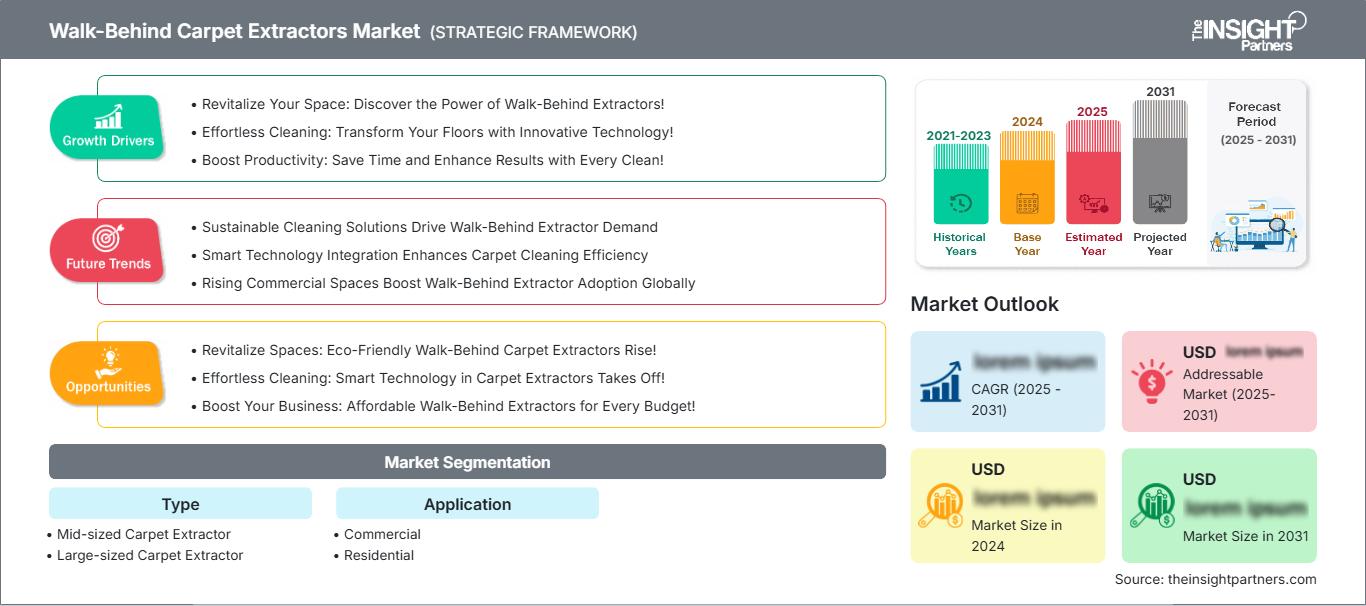
Walk-Behind Carpet Extractors Market: Strategic Insights
Regional Insights
North America Walk-Behind Carpet Extractors Market
North America is estimated to represent 40–42% of the walk-behind carpet extractors market in 2025, with a projected 3.8–4.4% CAGR through 2034. The US is the leading consumer in the region due to the significant presence of commercial establishments, hotels, healthcare facilities, educational institutions, and professional cleaning companies with carpeted floors. Buyers tend to give preference to reliability, efficiency, serviceability, and ease of access to replacement parts.
Canada is participating in the market via the hospitality sector, institutions, and commercial use. The United States continues to remain the leading country. The replacement of old machinery is a significant demand driver as professional operators consider factors such as machine downtime, need for labor, recovery capability, and longevity of the machinery. The manufacturers are responding to the demand for efficient and quick utilization of water and chemicals.
U.S. Walk-Behind Carpet Extractors Market
The US is expected to account for 72–75% of North America's 2025 Walk-Behind Carpet Extractors Market and expand at a 3.8–4.4% CAGR during 2026–2034. Larger-scale facility management firms, hotel chains, healthcare organizations, schools, and specialized commercial carpet cleaning firms are among the primary customers. Equipment purchasing often involves weighing purchase price against productivity, reach, and anticipated life span.
A mature market is helped by well-known manufacturers and effective distribution systems such as Kärcher, Tennant, Nilfisk, Powr-Flite, Hoover, and other cleaning equipment brands. Increasingly, commercial buyers demand equipment that makes training easy and minimizes operator exertion by means of ergonomically designed handles, easily accessible controls, and mobile frames. Uses for equipment have moved beyond occasional restorative cleaning to routine maintenance when appearances and moisture control of carpets become critical to maintaining facility standards.
Europe Walk-Behind Carpet Extractors Market
Europe is projected to hold a 25–27% share in 2025 and record a 3.6–4.2% CAGR through 2034, with Germany serving as a leading country. The United Kingdom and Germany offer high levels of demand from contract cleaners, hotel chains, hospitals, and corporate real estate management companies, while France, Italy, and Spain contribute through increased activities of professional facility management.
Demand in the United Kingdom arises from high levels of outsourced cleaning services and large numbers of hotels and offices, favoring equipment with higher labor productivity and lower drying times. Germany values high-quality engineering, efficiency, and durability, thus generating demand for solutions that have precise control systems and high serviceability. The United States, Italy, and Spain are expected to generate continuous demand owing to the increased modernization of equipment by professional cleaners with lower operating costs.
APAC Walk-Behind Carpet Extractors Market
APAC is expected to account for 20–22% of the 2025 Walk-Behind Carpet Extractors Market and expand at a 4.8–5.5% CAGR during 2026–2034, with China as the leading country. Japan and South Korea will cater to advanced demand requirements through technology, whereas India and Australia will bring about growth through business buildings, the hospitality sector, and facilities management.
The importance of China and India stems from the fact that with increasing commercial infrastructure, there is an increased demand for professional cleaning systems. Japan and South Korea concentrate on small but robust and user-friendly systems, while Australia has an existing demand in the hospitality and institutional sectors. There is scope for policymakers to consider issues of workplace standards, water use, and facility management to increase mechanized cleaning systems.
Middle East & Africa Walk-Behind Carpet Extractors Market
The Middle East and Africa Walk-Behind Carpet Extractors Market is estimated to represent 7–8% of the 2025 market and expand at a 3.5–4.2% CAGR through 2034, with Saudi Arabia expected to lead regional demand. The UAE is still relevant due to hospitality, airports, commercial sites, and large mixed-use complexes, while South Africa offers contributions through institutions and commercial real estate.
In Saudi Arabia, the investment in infrastructure and hospitality facilitates the purchase of professional cleaning equipment, while in the UAE, the presence of high-density commercial and tourism centers plays a crucial role. The demand in South Africa is strong in offices, retail, healthcare, and hospitality. Other MEA markets are fragmented, with the purchases depending on the availability of distributors and service support. Hot weather, dustiness, and frequent use of facilities necessitate the durability of equipment and recovery.
Segmentation Analysis
Type
Walk-Behind Carpet Extractors Market trends indicate that the Type segment is divided between mid-sized and large-sized carpet extractors. Mid-sized machines benefit from maneuverability and suitability for offices, hotels, schools, and medium-scale facilities, while large-sized units address extensive carpeted areas where higher productivity offsets greater equipment size. The segment is expected to develop at a 4.0–4.9% CAGR during 2026–2034, with purchasing increasingly influenced by cleaning path, tank capacity, recovery performance, and operator handling.
- Mid-sized Carpet Extractor: Mid-sized equipment serves facilities requiring professional extraction without the footprint of larger machines. Its balance of maneuverability, capacity, and storage makes it strategically important for contractors and multi-room commercial properties.
- Large-sized Carpet Extractor: Large-sized machines are suited to extensive carpeted facilities where broader cleaning paths and higher tank capacities can reduce cycle interruptions. Demand is strongest among high-volume commercial operators and specialist cleaning contractors.
Application
The Application segment comprises commercial and residential use. Commercial demand remains dominant because carpeted offices, hotels, healthcare facilities, educational buildings, and retail environments require recurring deep-cleaning programs. Residential adoption is supported by households seeking deeper carpet maintenance and stain removal. The segment is projected to expand at a 3.9–4.7% CAGR during 2026–2034, with commercial procurement remaining the principal contributor.
- Commercial: Commercial users prioritize productivity, durability, recovery performance, and serviceability because equipment downtime directly affects cleaning schedules. Contract cleaners and facility operators increasingly evaluate machines according to labor savings and cost per cleaning cycle.
- Residential: Residential demand is influenced by carpet replacement costs, stain removal requirements, pets, and preferences for periodic deep cleaning. Compact operating requirements and simplified controls are strategically important for households seeking convenient equipment handling.
Opportunity Snapshot
| Application | Revenue Contribution | Trend Tag | Adoption Stage |
| Commercial | High | Contract Cleaning | Mature |
| Residential | Medium | Home Deep-Cleaning | Scaling |
Walk-Behind Carpet Extractors Market Growth Drivers and Impact Analysis
Rising Professional Cleaning Outsourcing
Growth in outsourced facility management represents a structural driver for demand since contractors service a number of customer locations and need machinery that will function reliably across varying carpets. Outsourcing affects the purchasing logic in that professional cleaning companies can afford better equipment as a result of increased efficiency, which enables them to do more planned work during the same labor time. This leads to increased demand for self-contained models, more voluminous recovery tanks, effective vacuuming systems, and machines that minimize operator strain. The effect goes beyond the demand for equipment, in that professional contractors also need a number of accessories, brushes, hoses, replacement parts, and cleaning fluids for their equipment over its whole life cycle. The growth in outsourcing cleaning contracts by commercial property owners creates an association between equipment choice and the performance level of the service provider.
Greater Emphasis on Carpet Asset Preservation
Carpet replacement involves substantial facility costs, which makes preventive extraction increasingly important for companies wanting to prolong the life of their flooring. Periodic extraction of soils can help prevent the buildup of abrasive materials, causing early wear of carpets, and controlled moisture recovery helps to avoid excessive moisture. There is a motive for hotels, hospitals, offices, and educational institutions to keep up with a regular cleaning schedule instead of depending only on vacuuming and occasional restoration of carpets. This motivation creates the need for machines that can perform agitation, chemical application, and moisture recovery in a single cleaning cycle. Vendors that provide cleaning results consistently while using small amounts of water, chemicals, and labor can gain an advantage over their competitors in institutional purchases. The result of such an approach will be gradual fleet updating through the purchase of more efficient machines.
Focus on Water, Chemical, and Labor Efficiency
Efficiency is emerging as a critical consideration when it comes to purchasing decisions, as cleaning companies need to manage costs of labor and resource use together. Machines that have the ability to dispense solutions in measured amounts, recover moisture better, and facilitate ease in setup can help save multiple passes and drying time. Nilfisk, for instance, has focused on controlled chemical dispensing and minimized water usage in all its professional extraction machines, while machines currently manufactured by other companies are giving importance to ease of serviceability and operability. Such considerations mean that procurement decisions in the industry will be moving from being driven purely by performance to cost of ownership considerations. Buyers will increasingly compare productivity, consumption of resources, servicing time, and life cycle of machines.
Walk-Behind Carpet Extractors Market Future Trends
Smart Operator Guidance and Assisted Cleaning
The next wave of cleaning equipment will probably come with enhanced assistance of the user through various visual signals, easy controls, and feedback. These elements can aid in ensuring that the cleaning process maintains an optimal pace of cleaning, application of solutions, and extraction process regardless of the individual operating the equipment. The Kärcher 2026 BRC 40/34 C is a case in point for such a trend by incorporating the technology called SmartSpeed that offers visual signals meant to enable the operator to keep the right driving speed during the spray extraction process. The same idea could be applied increasingly to walk-behind models to help decrease the need for training and improve the repeatability. In the future, assisted operation might distinguish itself as a key criterion for multi-site contracts in order to guarantee uniform cleaning quality independent from operator experience.
Low-Moisture Extraction and Faster Carpet Recovery
Future developments in products are forecast to pay increased attention to low moisture and fast recovery of carpets. Faster drying may minimize interruptions in office buildings, hotels, retail sites, and health care facilities where the cleaned surface has to get back to its functioning state quickly. Nilfisk's existing extraction process stresses the importance of using less moisture under high temperature conditions in order to accomplish faster drying and minimize consumption of resources. Future manufacturers' efforts are expected to focus on improvements of heating systems, vacuuming, air flow, and delivery of solutions in order to reach similar results by using less moisture. This could also affect chemical formulae, brushes, and the design of recovery tanks.
Walk-Behind Carpet Extractors Market Opportunities
Fleet Modernization in Emerging Commercial Centers
Manufacturers can pursue expansion opportunities in India, China, Southeast Asia, the Middle East, and selected Latin American markets where commercial real estate, hospitality, healthcare, and organized facility management are developing. The walk-behind carpet extractors market forecasts indicate that replacement-led demand in mature economies will remain important, but emerging markets can provide incremental equipment volume as professional cleaning practices become more standardized. Suppliers can strengthen these opportunities through local distributors, financing arrangements, spare parts availability, operator training, and machines adapted to regional facility sizes. Mid-sized equipment is particularly suited to customers transitioning from manual or portable methods toward mechanized extraction. Establishing service networks early can create a competitive advantage because buyers in developing markets often evaluate the availability of technical support almost as closely as equipment specifications.
Service-Based Equipment and Consumables Models
A second opportunity lies in service-oriented business models that combine equipment with maintenance, accessories, chemicals, and replacement components. The walk-behind carpet extractors market scope extends beyond machine sales because professional cleaning providers require consumables and technical support throughout the operating lifecycle. Manufacturers and distributors can offer scheduled maintenance packages, replacement-part programs, chemical bundles, and equipment-as-a-service arrangements to lower the initial purchasing barrier for smaller contractors. Such models can also generate more predictable revenue and provide suppliers with information about machine utilization and component failure patterns. Strategic partnerships with facility-management companies may further support recurring procurement by standardizing equipment across customer sites. Suppliers that connect machine reliability with dependable after-sales service can differentiate themselves in markets where purchasing decisions increasingly consider lifecycle economics rather than upfront price alone.
Frequently Asked Questions

- Comprehensive Market Sizing and Forecast Analysis
- Detailed Segmentation Analysis
- In-Depth Market Dynamics Assessment
- Regional and Country-Level Insights
- Competitive Landscape and Company Benchmarking
- Strategic Business Intelligence
Recent Reports
Testimonials

The Insight Partners provided valuable market intelligence that supported our global go-to-market strategy. Their team was professional, responsive, and attentive to our feedback, providing thoughtful analysis and helpful methodological clarifications throughout the project.
Junmo Kim Chief Financial Officer (CFO), Enertech Co., Ltd.
The Insight Partners' SCADA System Market report is comprehensive, with valuable insights on current trends and future forecasts. The team was highly professional, responsive, and supportive throughout. We are very satisfied and highly recommend their services.
RAN KEDEM Partner, Reali Technologies LTDs
I requested a report on a very specific software market and the team produced the report in a few days. The information was very relevant and well presented. I then requested some changes and additions to the report. The team was again very responsive and I got the final report in less than a week.
JEAN-HERVE JENN Chairman, Future Analytica
We worked with The Insight Partners for an important market study and forecast. They gave us clear insights into opportunities and risks, which helped shape our plans. Their research was easy to use and based on solid data. It helped us make smart, confident decisions. We highly recommend them.
PIYUSH NAGPAL Sr. Vice President, High Beam Global
The Insight Partners delivered insightful, well-structured market research with strong domain expertise. Their team was professional and responsive throughout. The user-friendly website made accessing industry reports seamless. We highly recommend them for reliable, high-quality research services
YUKIHIKO ADACHI CEO, Deep Blue, LLC.
This is the first time I have purchased a market report from The Insight Partners.While I was unsure at first, I visited their web site and felt more comfortable to take the risk and purchase a market report.I am completely satisfied with the quality of the report and customer service. I had several questions and comments with the initial report, but after a couple of dialogs over email with their analyst I believe I have a report that I can use as input to our strategic planning process.Thank you so much for taking the extra time and making this a positive experience.I will definitely recommend your service to others and you will be my first call when we need further market data.
JOHN SUZUKI President and Chief Executive Officer, Board Director, BK Technologies
I wish to appreciate your support and the professionalism you displayed in the course of attending to my request for information regarding to infectious disease IVD market in Nigeria. I appreciate your patience, your guidance, and the fact that you were willing to offer a discount, which eventually made it possible for us to close a deal. I look forward to engaging The Insight Partners in the future, all thanks to the impression you have created in me as a result of this first encounter.
DR CHIJIOKE ONYIA MANAGING DIRECTOR, PineCrest Healthcare Ltd.Reason to Buy
- Informed Decision-Making
- Understanding Market Dynamics
- Competitive Analysis
- Identifying Emerging Markets
- Customer Insights
- Market Forecasts
- Risk Mitigation
- Boosting Operational Efficiency
- Strategic Planning
- Investment Justification
- Tracking Industry Innovations
- Aligning with Regulatory Trends





 Get Free Sample for