
Warewashing Equipment Market Size, Share & Demand by 2034
Coverage: By Product (Boosters heaters, Dishwashers, Glasswashers, Sinks, Conveyor dishwashers, Others); Solution (Detergent, Rinse aids, Sanitizer); Sales Channel (Online, Offline); End-Use (Hospitals, Hotels, College and University, Others) , and Geography (North America, Europe, Asia Pacific, and South and Central America)
- Status : Data Released
- Report Code : TIPRE00023139
- Category : Manufacturing and Construction
- No. of Pages : 150
- Available Report Formats :


- Last update date : September 28, 2026


2025 Market Size
US$ 6 Bn
Base year value
2034 Forecast
US$ 9.02 Bn
Projected by 2034
CAGR 2026-2034
4.64 %
Growth rate
Addressable Market
US$ 68.21 Bn
(2026-2034)
The warewashing equipment market is projected to grow from US$ 6 Billion in 2025 to US$ 9.02 Billion by 2034, registering a CAGR of 4.64% during 2026–2034. Demand is being shaped by commercial kitchens that need faster throughput, measurable sanitation, lower water use, and reduced labor dependency. Hotels, hospitals, colleges, universities, and foodservice operators are increasingly treating automated warewashing as a compliance-critical infrastructure investment rather than a discretionary equipment purchase.
North America remains a major demand center for warewashing equipment market size expansion, supported by mature hospitality infrastructure, high food safety expectations, and replacement of older machines with connected, energy-efficient systems. The region is expected to advance at a CAGR range of 4.1–4.6% through 2034, with growth led by hotels, hospitals, institutional kitchens, and quick-service restaurant chains seeking lower operating costs and consistent wash validation.
Warewashing Equipment Market Assessment and Insights
- North America accounted for an estimated 31–34% share in 2025 and is expected to grow at a CAGR of 4.1–4.6% during 2026–2034, supported by regulatory hygiene needs and replacement demand.
- US represented nearly 72–76% of North America in 2025, advancing at a CAGR of 4.2–4.7% as restaurants, healthcare kitchens, and hotels upgrade to automated systems.
- Europe held an estimated 28–31% share in 2025 and is expected to grow at 4.0–4.5%, led by Germany, the UK, France, Italy, and Spain.
- Asia Pacific captured around 24–27% share in 2025 and is projected to grow at 5.1–5.8%, with China, Japan, India, South Korea, and Australia leading adoption.
- Largest Segment: Dishwashers held an estimated 50–55% market share in 2025 and are expected to grow at a CAGR of 4.5–5.0% during 2026–2034.
- High Growth Segment: Conveyor dishwashers held an estimated 14–18% share in 2025 and are expected to expand at 5.2–5.9% as high-volume kitchens automate workflows.
- Key companies analyzed in detail: Omniwash s.r.l., HOBART GmbH, Ecolab Inc., Electrolux Professional AB, MEIKO Maschinenbau GmbH & Co. KG, The Middleby Corporation, Jackson WWS, Inc., Sammic S.L., Classeq Ltd., and Simoniz USA, Inc.
Source: The Insight Partners' analysis based on proprietary research, government publications, company annual reports, investor presentations, industry databases, and expert interviews.
Commercial warewashing has evolved from basic mechanical cleaning into a connected sanitation workflow. Modern systems integrate heat recovery, detergent dosing, automated rinse control, filtration, telemetry, and predictive maintenance. This shift is changing purchasing criteria across the warewashing equipment market growth cycle, as operators evaluate lifecycle operating cost, documented hygiene performance, utility consumption, and service uptime alongside the upfront machine price.
The warewashing equipment market report indicates that future demand will be shaped by institutional kitchens, hotel refurbishments, and the expansion of organized foodservice operations across emerging economies. Regulatory pressure on food-contact sanitation, combined with labor shortages and utility cost volatility, is encouraging faster replacement of older equipment. Manufacturers that combine high-throughput performance with lower water, chemical, and energy consumption are positioned to benefit from broader procurement standardization.
Warewashing Equipment Market Report Scope
| Report Attribute | Details |
|---|---|
| Market size in 2025 | US$ 6 Billion |
| Market Size by 2034 | US$ 9.02 Billion |
| Global CAGR (2026 - 2034) | 4.64% |
| Historical Data | 2021-2024 |
| Forecast period | 2026-2034 |
Warewashing Equipment Market Analysis
Demand drivers in the warewashing equipment market growth outlook are concentrated around hygiene compliance, labor productivity, and commercial kitchen modernization. Restaurants, hotels, hospitals, and schools all need systems capable of disinfecting large dish loads without a lot of manual handling. Automated cycles, automated sensors, and automated chemical feeders ensure better quality control and aid users to comply with cleaning protocols.
The supply chain comprises stainless steel producers, pump and heater suppliers, chemicals, distributors, installation contractors, and after-sale services. Energy efficiency, easy access to spare parts, and preventive maintenance capabilities impact supply dynamics. More and more consumers are opting for companies that deliver complete solutions including the equipment itself, detergents, rinses, sanitizer, training, and maintenance services.
The rivalry is fierce since the market leaders compete on factors like sanitary efficiency, capacity, reliability, and cost cutting. Firms like HOBART GmbH, MEIKO Maschinenbau GmbH & Co. KG, Electrolux Professional AB, The Middleby Corporation, Jackson WWS, Inc., and Ecolab Inc. are positioning themselves by innovation, automation, and service-based differentiation. Companies that cater to the special requirements of operators include Omniwash s.r.l., Sammic S.L., Classeq Ltd., and Simoniz USA, Inc.
Money is being spent on AI-enabled washing machines, diagnostics, and energy-saving appliances. Launching HOBART’s 2025 AI-enabled flight type dishwasher is an example. The warewashing equipment market analysis indicates that buyers will continue favoring suppliers that can prove measurable savings, faster turnaround, and consistent sanitation across multi-site kitchen portfolios.
● REPORT CUSTOMIZATION
Tailor This Report To Align With Your Specific Business Requirements
This report can be customized to align precisely with your business objectives, scope, and target markets. Customization options include tailored segmentation, geography, competitive analysis, and strategic insights to support informed decision-making.
Customize This Report →WHAT YOU CAN ADJUST
- ● Segmentations
- ● Geography
- ● Competitive Analysis
- ● Language Preferences
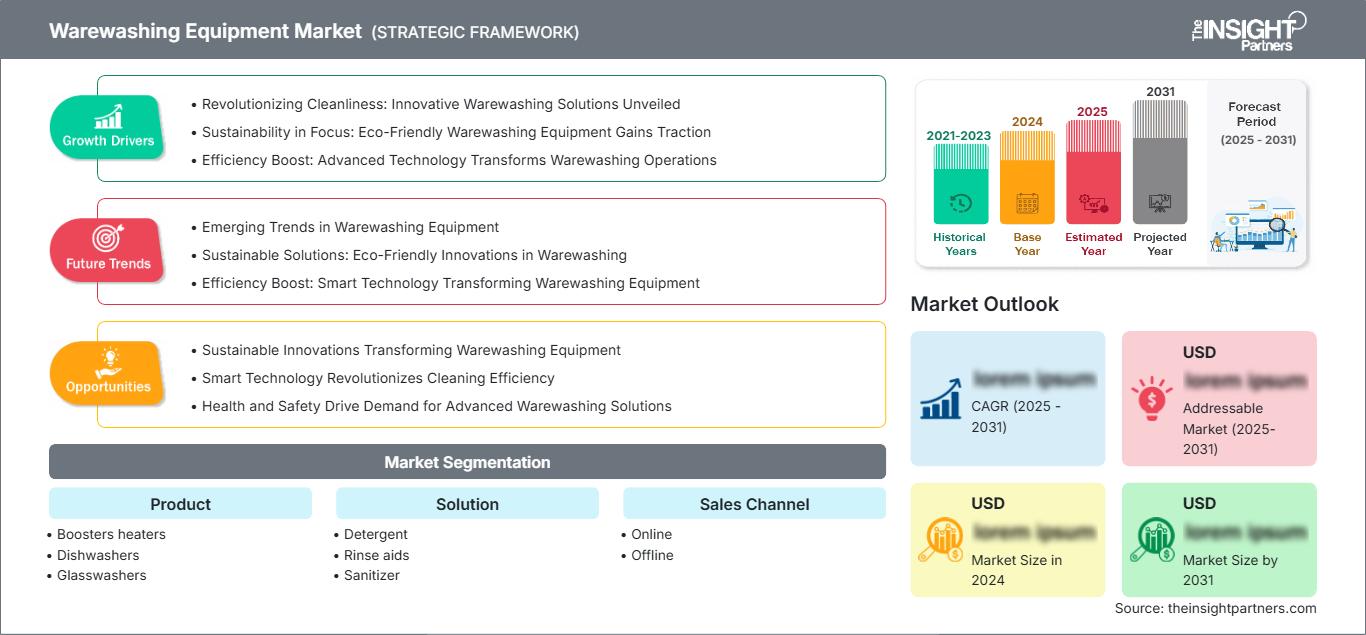
Warewashing Equipment Market: Strategic Insights
Regional Insights
North America warewashing equipment market
North America is estimated to account for 31–34% of the warewashing equipment market share in 2025, supported by established foodservice chains, hospitals, hotels, and university dining facilities. In the region, operators have shown preference for equipment that reduces human labor exposure, sanitation tracking, and utility usage. The demand for equipment replacement is higher in high-volume kitchens, as the downtime of kitchen machinery can affect service capabilities.
It is expected that the growth rate in the region would remain in the CAGR range of 4.1–4.6% from 2026 to 2034. Factors supporting demand include the ongoing recovery of restaurant traffic, high hygiene standards of institutions, and effective service infrastructure. In this regard, the United States forms the anchor market, and Canada provides replacement demand due to hospitality and healthcare renovations.
U.S. warewashing equipment Market
The US represented approximately 72–76% of North America revenue in 2025 and is expected to grow at a CAGR of 4.2–4.7% during 2026–2034. The need for the product is mainly present in quick service restaurants, full service dining facilities, hotels, hospitals, and on college campuses. Customers are demanding equipment that allows high temperatures, conveyor models, and automated chemical dosing systems.
Market strength includes presence within equipment manufacture, chemical distribution, installation, and services. Companies such as Ecolab Inc., The Middleby Corporation, Jackson WWS, Inc., and HOBART GmbH help facilitate adoption due to wide-ranging service options and their relationships with the operators. Multi-location foodservice operations in the US are another market strength.
Europe warewashing equipment Market
Europe held an estimated 28–31% share in 2025 and is projected to expand at a 4.0–4.5% CAGR through 2034. The Germany market leads based on the strength of engineering, while UK gains because of hotels and chain restaurant investment. The demand for France is sustained by hospitality and institutional catering improvements.
There is constant growth in Italy and Spain as a result of hospitality businesses driven by tourism that depend on glass washing, dish washing, and conveyors. The importance of water-saving and efficient energy use cannot be overlooked by the European market players. This market has leading companies like MEIKO Maschinenbau GmbH & Co. KG, HOBART GmbH, and Electrolux Professional AB.
APAC warewashing equipment Market
APAC accounted for an estimated 24–27% share in 2025 and is expected to post the fastest CAGR range of 5.1–5.8% during 2026–2034. The demand from the installed base comes from China and Japan, while demand growth is provided by India, South Korea, and Australia via planned foodservice, hospitality, healthcare, and institutional catering.
The factors responsible for the growing adoption include increasing industrial kitchen installations, higher cost of labor, and food safety issues. While China leads in terms of demand volume, India provides faster demand growth via chain restaurants, hotels, and universities.
Middle East & Africa warewashing equipment Market
The Middle East & Africa region is expected to grow at a CAGR of 4.6–5.2% through 2034, led by Saudi Arabia, the UAE, and South Africa. Construction services, airline catering, hospitals, and institutional kitchens are some of the major drivers of demand. Manufacturers prefer equipment that is tough enough to operate in demanding service environments and offer high output.
Saudi Arabia and the UAE are the forerunners of this trend owing to their investments in tourism, hotel development projects, and foodservices projects. The demand in South Africa emanates from hospitals, education sector, and commercial catering. In this region, good service and water efficiency are critical buying considerations.
Segmentation Analysis
Product
Product is expected to grow at a CAGR range of 4.5–5.1% during 2026–2034. The warewashing equipment market scope across products is shaped by kitchen size, dish volume, labor availability, and required turnaround speed. Dishwashers dominate because they serve broad commercial applications, while conveyor systems gain traction in high-volume institutional and hotel kitchens.
- Boosters heaters support sanitation performance by raising rinse temperatures where high-temperature washing is required, making them important for hospitals, hotels, and kitchens with strict hygiene documentation needs.
- Dishwashers remain the core equipment category because they address daily utensil, plate, and cookware cleaning across restaurants, hotels, colleges, hospitals, and catering operations.
- Glasswashers serve bars, hotels, restaurants, and banquet venues where spotless glass presentation, fast cycles, and compact footprints are critical to beverage service quality.
- Sinks remain relevant for pre-rinse, soaking, and manual support tasks, particularly where mixed ware types or space constraints limit full automation.
- Conveyor dishwashers are strategically important for high-volume kitchens because they provide continuous throughput, reduced manual handling, and predictable sanitation for institutional foodservice.
Solution
Solution is projected to grow at a CAGR range of 4.3–4.9% over 2026–2034. Detergents, rinse aids, and sanitizers are recurring revenue categories tied directly to installed equipment usage. Suppliers that provide compatible chemical programs and dosing systems can improve cleaning consistency while reducing waste and rewash rates.
- Detergent demand is linked to wash intensity, soil load, water hardness, and operating frequency, making formulation compatibility essential for consistent cleaning outcomes.
- Rinse aids improve drying, reduce spotting, and support faster ware turnaround, especially in glassware-heavy hospitality, banquet, and beverage service environments.
- Sanitizer solutions remain critical for low-temperature systems and hygiene-sensitive kitchens where documented microbial control forms part of operating procedures.
Sales Channel
Sales Channel is expected to grow at a CAGR range of 4.2–4.8% during 2026–2034. Offline channels dominate because commercial buyers require installation, configuration, service contracts, and training. Online channels are expanding for smaller equipment, replacements, accessories, and chemical replenishment as procurement teams digitize purchasing workflows.
- Online sales are gaining relevance for standardized purchases, smaller models, spare parts, and recurring consumables where buyers already understand specifications.
- Offline channels remain strategically important because installation, site assessment, after-sales service, and operator training are decisive in commercial kitchen procurement.
End-Use
End-Use is projected to expand at a CAGR range of 4.4–5.0% during 2026–2034. Hotels lead revenue contribution because of continuous dish, glass, and banquet ware turnover. Hospitals require rigorous sanitation and documentation, while colleges and universities need durable systems for peak meal periods and centralized dining operations.
- Hospitals prioritize sanitation assurance, traceable cleaning processes, and reliable uptime because dishware handling forms part of broader infection-control and patient-service standards.
- Hotels generate high demand for dishwashers, glasswashers, and conveyor systems due to restaurants, banquets, room service, and event operations.
- College and University kitchens require high-throughput systems that can handle concentrated meal periods, diverse ware types, and recurring sanitation checks.
Opportunity Snapshot
| End-Use | Revenue Contribution | Trend Tag | Adoption Stage |
| Hospitals | Medium | Sanitation Logs | Scaling |
| Hotels | High | Banquet Flow | Mature |
| College and University | Medium | Peak Dining | Scaling |
Warewashing Equipment Market Growth Drivers and Impact Analysis
Commercial Kitchen Automation and Labor Efficiency
Shortage of labor in the hospitality and foodservice industries is boosting investments in automatic washing equipment. High-volume dishwashers and conveyors limit the need for hand washing, increase the efficiency of the employees, and provide consistent results in wash operations when demand is at its peak. For businesses that operate through more than one shift, automatic cycles minimize the effort required for training. The effect is most felt in hotels, hospitals, colleges, and fast food chains.
Stronger Hygiene Compliance in Foodservice and Healthcare
Safety standards are continuing to drive the need for consistent wash and sanitize systems. Wash equipment manufacturers are being asked to provide wash equipment capable of delivering validated temperatures, chemical dosing, and wash results. Hospitals and institutions are placing an emphasis on the need for hygiene reporting due to the risk that sanitation failures can pose to operations and reputation.
Energy, Water, and Chemical Cost Optimization
Rising utility expenses are making efficient warewashing resource management a quantifiable purchasing objective. The latest technology involving heat recovery, efficient spraying, smart dispensing, and reduced water usage can result in less overall cost to operate the equipment throughout its lifetime. Purchasers are now evaluating washing machines based on the cost of water, energy, chemicals, and maintenance as well as purchase price.
Warewashing Equipment Market Future Trends
AI-Supported Wash Flow Optimization
The warewashing equipment market trends are moving toward AI-assisted controls that adjust wash performance, resource use, and throughput based on operating conditions. The flight and conveyor-based systems would certainly be among the first to reap the advantages because of their nature of dealing with continuous flow of work and heavy loads. There is a potential for the kitchen to use AI-assisted monitoring to cut down on its consumption of water and identify maintenance requirements.
Connected Service and Predictive Maintenance
Washing systems that are connected would become increasingly popular as businesses look for minimal breakdowns and cost of life cycle control. Sensors would be used to monitor washing cycles, use of chemicals, temperature levels, fault patterns, and component wear. Predictive maintenance would enable service providers to plan for maintenance before breakdowns interfere with cooking in the kitchens. Multi-site operators are likely to install dashboards to compare performance of machines across different sites.
Warewashing Equipment Market Opportunities
Institutional Kitchen Modernization
The warewashing equipment market forecasts indicate meaningful opportunity in hospitals, universities, and large foodservice facilities that operate under predictable peak loads. These customers require robust conveyor systems, boost heaters, sanitizing systems, and maintenance services that will relieve staff stress without compromising on cleanliness requirements. Providers may be able to gain from offering their equipment bundled with detergents, rinse agents, preventative maintenance services, and training for operators. This business potential is most promising for aged facilities needing upgrade.
Emerging Hospitality and Foodservice Chains
The potential for growth lies in emerging markets where there is increased development of hotels, organized restaurants, cloud kitchens, and catering services. Those operators who are transitioning from hand-washing to automated solutions require scalable products, finance, installation, and after-sale services. Those suppliers that adapt their distribution and make available smaller and more efficient machines can serve kitchens with limited space.
Frequently Asked Questions

- Comprehensive Market Sizing and Forecast Analysis
- Detailed Segmentation Analysis
- In-Depth Market Dynamics Assessment
- Regional and Country-Level Insights
- Competitive Landscape and Company Benchmarking
- Strategic Business Intelligence
Recent Reports
Testimonials

The Insight Partners provided valuable market intelligence that supported our global go-to-market strategy. Their team was professional, responsive, and attentive to our feedback, providing thoughtful analysis and helpful methodological clarifications throughout the project.
Junmo Kim Chief Financial Officer (CFO), Enertech Co., Ltd.
The Insight Partners' SCADA System Market report is comprehensive, with valuable insights on current trends and future forecasts. The team was highly professional, responsive, and supportive throughout. We are very satisfied and highly recommend their services.
RAN KEDEM Partner, Reali Technologies LTDs
I requested a report on a very specific software market and the team produced the report in a few days. The information was very relevant and well presented. I then requested some changes and additions to the report. The team was again very responsive and I got the final report in less than a week.
JEAN-HERVE JENN Chairman, Future Analytica
We worked with The Insight Partners for an important market study and forecast. They gave us clear insights into opportunities and risks, which helped shape our plans. Their research was easy to use and based on solid data. It helped us make smart, confident decisions. We highly recommend them.
PIYUSH NAGPAL Sr. Vice President, High Beam Global
The Insight Partners delivered insightful, well-structured market research with strong domain expertise. Their team was professional and responsive throughout. The user-friendly website made accessing industry reports seamless. We highly recommend them for reliable, high-quality research services
YUKIHIKO ADACHI CEO, Deep Blue, LLC.
This is the first time I have purchased a market report from The Insight Partners.While I was unsure at first, I visited their web site and felt more comfortable to take the risk and purchase a market report.I am completely satisfied with the quality of the report and customer service. I had several questions and comments with the initial report, but after a couple of dialogs over email with their analyst I believe I have a report that I can use as input to our strategic planning process.Thank you so much for taking the extra time and making this a positive experience.I will definitely recommend your service to others and you will be my first call when we need further market data.
JOHN SUZUKI President and Chief Executive Officer, Board Director, BK Technologies
I wish to appreciate your support and the professionalism you displayed in the course of attending to my request for information regarding to infectious disease IVD market in Nigeria. I appreciate your patience, your guidance, and the fact that you were willing to offer a discount, which eventually made it possible for us to close a deal. I look forward to engaging The Insight Partners in the future, all thanks to the impression you have created in me as a result of this first encounter.
DR CHIJIOKE ONYIA MANAGING DIRECTOR, PineCrest Healthcare Ltd.Reason to Buy
- Informed Decision-Making
- Understanding Market Dynamics
- Competitive Analysis
- Identifying Emerging Markets
- Customer Insights
- Market Forecasts
- Risk Mitigation
- Boosting Operational Efficiency
- Strategic Planning
- Investment Justification
- Tracking Industry Innovations
- Aligning with Regulatory Trends





 Get Free Sample for