
Washing Machine Market Share, Growth & Demand by 2034
Coverage: By Product Type (Fully Automatic, Semi automatic); Technology (Top Load, Front Load); Machine Capacity (Below 6 Kg, 6 to 8 Kg, Above 8 Kg); Energy Rating (1 Star, 2 Star, 3 Star, 4 Star, 5 Star); End User (Residential, Commercial) , and Geography (North America, Europe, Asia Pacific, and South and Central America)
- Status : Data Released
- Report Code : TIPRE00008292
- Category : Electronics and Semiconductor
- No. of Pages : 150
- Available Report Formats :


- Last update date : September 28, 2026


2025 Market Size
US$ 47.22 Bn
Base year value
2034 Forecast
US$ 99.86 Bn
Projected by 2034
CAGR 2026-2034
8.68 %
Growth rate
Addressable Market
US$ 659.33 Bn
(2026-2034)
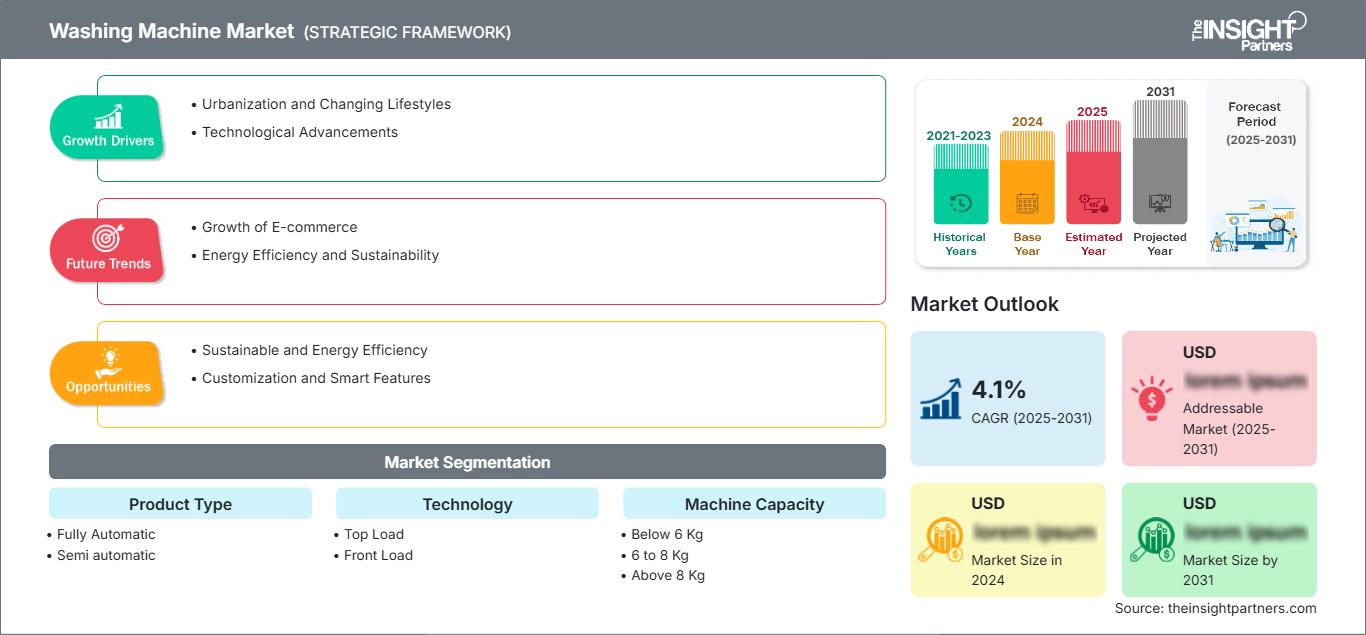
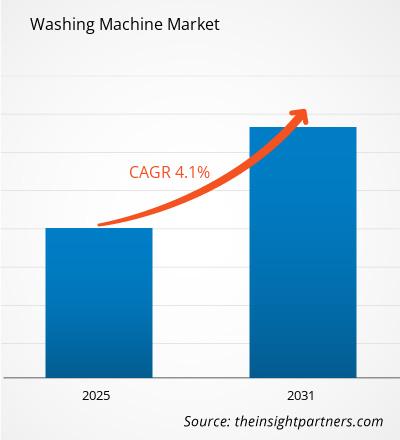
The washing machine market is projected to grow from US$ 47.22 Billion in 2025 to US$ 99.86 Billion by 2034, registering a CAGR of 8.68% during 2026–2034. Demand is supported by higher urban household formation, wider appliance penetration, and consumer preference for automated laundry systems that reduce time, water use, and manual effort across residential and commercial settings.
North America remains a structurally important region as replacement demand, ENERGY STAR-aligned purchasing, connected-home adoption, and premium front-load upgrades support the washing machine market size. Regional growth is expected to remain in the 7.8–8.4% CAGR range during 2026–2034, led by smart laundry adoption, water-efficiency awareness, and steady multifamily housing activity.
Washing Machine Market Assessment and Insights
- North America accounted for 27–30% share in 2025 and is expected to grow at a CAGR of 7.8–8.4% during 2026–2034, supported by replacement cycles, smart appliance ecosystems, and energy-efficient model upgrades.
- US represented 82–86% of North America demand in 2025 and is projected to grow at a CAGR of 7.9–8.5% during 2026–2034.
- Europe held 22–25% share in 2025 and is expected to grow at a CAGR of 7.2–7.9%, led by Germany, the UK, France, Italy, and Spain.
- Asia Pacific held 34–38% share in 2025 and is expected to grow at a CAGR of 9.2–9.9%, led by China, India, Japan, South Korea, and Australia.
- Largest Segment: Fully automatic machines held 69–73% market share in 2025 and are expected to grow at a CAGR of 8.9–9.4% during 2026–2034.
- High Growth Segment: Front load machines held 44–48% market share in 2025 and are expected to grow at a CAGR of 9.4–10.1% during 2026–2034.
- Key companies analyzed in detail: BSH Hausgeräte GmbH, AB Electrolux, Glen Dimplex Home Appliances, Godrej & Boyce Mfg. Co. Ltd., Haier Inc., LG Electronics Inc., Panasonic Holdings Corporation, Samsung Electronics Co., Ltd., Toshiba Lifestyle Products & Services Corporation, and Whirlpool Corporation.
Source: The Insight Partners' analysis based on proprietary research, government publications, company annual reports, investor presentations, industry databases, and expert interviews.
Technology migration has transformed the market into a competition where the performance is not just on the ability to clean effectively but on being connected, automated, and saving on overall energy costs as well as caring for specific fabrics. Companies are increasingly developing features such as inverter motors, AI washing programs, steam, and automatic dosing of detergent.
The washing machine market report indicates that future growth will be shaped by emerging-market penetration, premium replacement demand in developed economies, and regulation-driven efficiency upgrades. Appliance manufacturers have begun localizing their operations, expanding their service network, and developing smaller appliances with large capacities for urban settings. It is believed that this trend will help in the growth of the market and increase competition.
Washing Machine Market Report Scope
| Report Attribute | Details |
|---|---|
| Market size in 2025 | US$ 47.22 Billion |
| Market Size by 2034 | US$ 99.86 Billion |
| Global CAGR (2026 - 2034) | 8.68% |
| Historical Data | 2021-2024 |
| Forecast period | 2026-2034 |
Washing Machine Market Analysis
Market growth will be driven by the growing number of middle-class households, higher awareness of cleanliness, increased number of rentals, and the requirement for replacement of old washing machines. Market demand is also boosted by the commercial use of washers in laundry services, hotels, hospitals, and other residences where downtime savings and water conservation influence purchases.
The value chain includes steel, motors, electronics, sensors, drums, pumps, membranes, distribution, retailing, servicing, and networking capabilities. The supply side relies on the cost of the components, local assembly requirements, certification requirements, and after-sales servicing. Efficient production enables brands to retain their margins and differentiate through unique product offerings.
Market Analysis reveals that the market competition is concentrated on international appliance companies specializing in AI washing cycles, front loader, direct drive, and energy-efficient washing machines. The competing firms in the market are LG Electronics Inc., Samsung Electronics Co., Ltd., Whirlpool Corporation, Haier Inc., BSH Hausgeräte GmbH, and AB Electrolux with their brands and features.
Now, the focus has been changed to invest in technology for smart diagnostics, noiseless motors, manufacturing at the local level, and linkages with retail channels. Godrej & Boyce Mfg. Co. Ltd., Panasonic Holdings Corporation, Toshiba Lifestyle Products & Services Corporation, and Glen Dimplex Home Appliances have expanded their regional presence through cost-effective products, different capacity sizes, and service centers.
● REPORT CUSTOMIZATION
Tailor This Report To Align With Your Specific Business Requirements
This report can be customized to align precisely with your business objectives, scope, and target markets. Customization options include tailored segmentation, geography, competitive analysis, and strategic insights to support informed decision-making.
Customize This Report →WHAT YOU CAN ADJUST
- ● Segmentations
- ● Geography
- ● Competitive Analysis
- ● Language Preferences
Washing Machine Market: Strategic Insights
Regional Insights
North America washing machine market
North America held 27–30% share in 2025 and is expected to expand at a CAGR of 7.8–8.4% during 2026–2034. The washing machine market share is supported by high appliance ownership, replacement purchases, connected-home adoption, and consumer focus on lower electricity and water consumption.
The demand is highest in the US market, where high-end front load washing machines, high capacity models, and intelligent laundry systems are making their way into homes. The retailers keep on focusing on the energy labeling of products as well as value added services related to installation.
U.S. washing machine Market
The US accounted for 82–86% of North America demand in 2025 and is expected to grow at a CAGR of 7.9–8.5% during 2026–2034. Replacement demand forms the key driver as consumers move away from old-fashioned top-loading washing machines towards efficient front-loading and impeller washers.
The competition is widespread and includes such companies as LG Electronics Inc., Samsung Electronics Co., Ltd., Whirlpool Corporation, BSH Hausgeräte GmbH, and AB Electrolux on the basis of smart technologies, drum size, fabric treatment, and after-sales service.
Europe washing machine Market
Europe held 22–25% share in 2025 and is projected to grow at a CAGR of 7.2–7.9% during 2026–2034. Germany stands out due to high adoption of premium appliance category, efficient housing stock and preference for durable front-loading machines with wash programs.
On the other hand, the UK keeps growing through replacements and small machines suitable for kitchen installations while France, Italy and Spain drive demand through energy labeling and urban apartment renovations. The consumers in Europe focus on low noise level, low water consumption and durability of the products.
APAC washing machine Market
APAC held 34–38% share in 2025 and is expected to grow at a CAGR of 9.2–9.9% during 2026–2034. China still leads the pack, driven by volume of manufacturing, demand for smart appliances, and large replacement numbers in urban homes.
In India, Japan, South Korea, and Australia, category growth is fueled by new buyers, premium products, water-efficient models, and ratings. Domestic manufacturing initiatives, ecommerce access, and growing after-sales channels help increase category penetration in cities of different tiers.
Middle East & Africa washing machine Market
The Middle East & Africa region is expected to grow at a CAGR of 7.5–8.2% during 2026–2034. Demand leaders such as Saudi Arabia and the UAE drive demand via development of residential buildings, upscale shopping facilities, and usage of high-load washers that can cater to larger families.
The demand drivers for South Africa and other MEA countries include gradual expansion via availability of appliances, urbanization, and financing in retail. Energy and water usage considerations will affect choice of products, providing opportunities for fully automatic washers equipped with good motors and warranty.
Segmentation Analysis
Product Type
Washing Machine Market forecast indicates that Product Type segmentation covers fully automatic and semi-automatic machines. This market scope is led by fully automatic models, which held 69–73% share in 2025 and are projected to grow at a CAGR of 8.9–9.4% during 2026–2034 as consumers prioritize convenience, preset cycles, and lower manual handling.
- Fully Automatic machines dominate urban and premium household demand because they combine washing, rinsing, and spinning in one cycle, improving convenience, time savings, and fabric-care consistency.
- Semi automatic machines remain relevant in price-sensitive markets where affordability, lower water pressure dependence, and easy repairability support adoption among first-time buyers.
Technology
Technology segmentation includes top load and front load machines. Front load models are the high-growth segment, with 44–48% share in 2025 and a CAGR of 9.4–10.1% during 2026–2034, driven by energy efficiency, water savings, fabric protection, and premium kitchen or laundry-room integration.
- Top Load machines retain broad appeal due to ergonomic loading, faster cycle familiarity, lower entry prices, and strong acceptance in markets where consumers prefer simpler access.
- Front Load machines are increasingly selected for lower water usage, high spin speed, stackable formats, and premium features such as steam, auto-dose, and AI fabric sensing.
Machine Capacity
Machine Capacity segmentation covers below 6 Kg, 6 to 8 Kg, and above 8 Kg. The 6 to 8 Kg segment remains the mainstream family category and is expected to grow at a CAGR of 8.3–8.9% during 2026–2034, balancing purchase cost, load flexibility, and household utility.
- Below 6 Kg machines serve single-person homes, students, rentals, and compact apartments where space constraints and lower laundry volume shape purchase decisions.
- 6 to 8 Kg machines address the largest household base, offering sufficient load capacity for regular family washing without the premium cost of larger units.
- Above 8 Kg machines gain traction among large households and commercial users requiring bulk washing, bedding cycles, and higher drum volumes.
Energy Rating
Energy Rating segmentation includes 1 Star, 2 Star, 3 Star, 4 Star, and 5 Star models. The segment is expected to grow at a CAGR of 8.6–9.1% during 2026–2034 as electricity costs, policy standards, and consumer total-cost awareness shift demand toward efficient machines.
- 1 Star models address low-entry-price buyers but face pressure as operating-cost awareness and minimum efficiency standards become more influential.
- 2 Star models remain present in budget channels where consumers balance upfront affordability with basic automatic washing functionality.
- 3 Star models provide a mid-range option for buyers seeking reasonable efficiency without paying premium prices for advanced features.
- 4 Star models attract value-conscious urban households that compare monthly electricity savings, brand reliability, and warranty coverage.
- 5 Star models gain priority among premium buyers, green-building residents, and consumers aiming to reduce lifetime energy consumption.
Opportunity Snapshot
| Machine Capacity | Revenue Contribution | Trend Tag | Adoption Stage |
| Below 6 Kg | Low | Compact Living | Mature |
| 6 to 8 Kg | High | Family Core | Mature |
| Above 8 Kg | Medium | Bulk Loads | Scaling |
Washing Machine Market Growth Drivers and Impact Analysis
Rising Preference for Fully Automatic Laundry Systems
There is an increasing need for fully automated machines as there is a greater preference in households towards convenience and programmable cleaning. There are dual income families, apartment dwellers, and urban buyers who prefer machines that take care of the wash, rinse, and spin cycles automatically. This driver helps in premiumizing products and increases the average selling price as well.
Energy and Water Efficiency Becoming Purchase Priorities
Being energy efficient is no longer just an important feature but a determining factor when purchasing due to the lifetime cost of usage. Water-efficient drum design, inverter motor technology, load sensing, and higher star ratings allow brands to cope with issues associated with costs of utilities and regulations regarding energy efficiency. It can be seen in the cycles of product renewal as retailers promote energy-efficient appliances and manufacturers redesign their basic ranges.
Urbanization and Expanding Appliance Penetration
The urbanization trend will increase the number of consumers who can buy the washing machines because of the demand for laundry machines in apartments and small houses. For example, the residents of developing countries have become first time buyers who are shifting from hand washing clothes to buying semi-automatic or fully automatic washing machines.
Washing Machine Market Future Trends
AI-Based Fabric Care and Predictive Maintenance
The washing machine market trends will increasingly center on AI-enabled fabric sensing, predictive maintenance, and connected diagnostics. The machines would automatically recognize the weight of the load, fabric being used, degree of soiling and type of detergent needed to determine the best possible wash time. These functions provide manufacturers with competitive advantages in addition to capacity and cost. Consumers benefit from reduced fabric wear, service delays, and operational complexity.
Expansion of Compact High-Capacity Designs
It is envisaged that compact and high capacity appliances would become increasingly visible as families in urban areas look for drum capacities that are large but that do not take up more space. Stackable front load appliances, slim top load washing machines, and laundry centers would allow manufacturers to offer their products to apartment and condominium complexes and other residential real estate projects.
Washing Machine Market Opportunities
Premium Replacement Demand in Developed Economies
Cycle of premium replacements provides a chance for companies to change older customers using old washers into customers buying newer, more energy-efficient, and quieter washers. Mature market consumers tend to replace their appliances even before they completely wear out due to the obvious savings or conveniences brought about by the new features.
Localized Affordable Automation in Emerging Markets
There is a lot of scope for expanding affordable automation via localization of production, robust construction and partnerships in distribution. There are many households where people have made the switch from doing their laundry manually or semi-automatically to fully automatic machines. It becomes possible for companies to develop brand loyalty by matching the prices and services to suit the needs of their clients.
Frequently Asked Questions

- Comprehensive Market Sizing and Forecast Analysis
- Detailed Segmentation Analysis
- In-Depth Market Dynamics Assessment
- Regional and Country-Level Insights
- Competitive Landscape and Company Benchmarking
- Strategic Business Intelligence
Recent Reports
Testimonials

The Insight Partners provided valuable market intelligence that supported our global go-to-market strategy. Their team was professional, responsive, and attentive to our feedback, providing thoughtful analysis and helpful methodological clarifications throughout the project.
Junmo Kim Chief Financial Officer (CFO), Enertech Co., Ltd.
The Insight Partners' SCADA System Market report is comprehensive, with valuable insights on current trends and future forecasts. The team was highly professional, responsive, and supportive throughout. We are very satisfied and highly recommend their services.
RAN KEDEM Partner, Reali Technologies LTDs
I requested a report on a very specific software market and the team produced the report in a few days. The information was very relevant and well presented. I then requested some changes and additions to the report. The team was again very responsive and I got the final report in less than a week.
JEAN-HERVE JENN Chairman, Future Analytica
We worked with The Insight Partners for an important market study and forecast. They gave us clear insights into opportunities and risks, which helped shape our plans. Their research was easy to use and based on solid data. It helped us make smart, confident decisions. We highly recommend them.
PIYUSH NAGPAL Sr. Vice President, High Beam Global
The Insight Partners delivered insightful, well-structured market research with strong domain expertise. Their team was professional and responsive throughout. The user-friendly website made accessing industry reports seamless. We highly recommend them for reliable, high-quality research services
YUKIHIKO ADACHI CEO, Deep Blue, LLC.
This is the first time I have purchased a market report from The Insight Partners.While I was unsure at first, I visited their web site and felt more comfortable to take the risk and purchase a market report.I am completely satisfied with the quality of the report and customer service. I had several questions and comments with the initial report, but after a couple of dialogs over email with their analyst I believe I have a report that I can use as input to our strategic planning process.Thank you so much for taking the extra time and making this a positive experience.I will definitely recommend your service to others and you will be my first call when we need further market data.
JOHN SUZUKI President and Chief Executive Officer, Board Director, BK Technologies
I wish to appreciate your support and the professionalism you displayed in the course of attending to my request for information regarding to infectious disease IVD market in Nigeria. I appreciate your patience, your guidance, and the fact that you were willing to offer a discount, which eventually made it possible for us to close a deal. I look forward to engaging The Insight Partners in the future, all thanks to the impression you have created in me as a result of this first encounter.
DR CHIJIOKE ONYIA MANAGING DIRECTOR, PineCrest Healthcare Ltd.Reason to Buy
- Informed Decision-Making
- Understanding Market Dynamics
- Competitive Analysis
- Identifying Emerging Markets
- Customer Insights
- Market Forecasts
- Risk Mitigation
- Boosting Operational Efficiency
- Strategic Planning
- Investment Justification
- Tracking Industry Innovations
- Aligning with Regulatory Trends





 Get Free Sample for