
Welding Neck Flanges Market Size, Growth & Trends by 2034
Coverage: By Type (Ring-Type Joint, Flat Face, Raised Face); Application (Chemical Processing, Petrochemical, Metallurgy, Pharmaceutical, Others) , and Geography (North America, Europe, Asia Pacific, and South and Central America)
- Status : Data Released
- Report Code : TIPRE00020783
- Category : Manufacturing and Construction
- No. of Pages : 150
- Available Report Formats :


- Last update date : September 28, 2026


2025 Market Size
US$ 4 Bn
Base year value
2034 Forecast
US$ 6.55 Bn
Projected by 2034
CAGR 2026-2034
5.61 %
Growth rate
Addressable Market
US$ 47.77 Bn
(2026-2034)
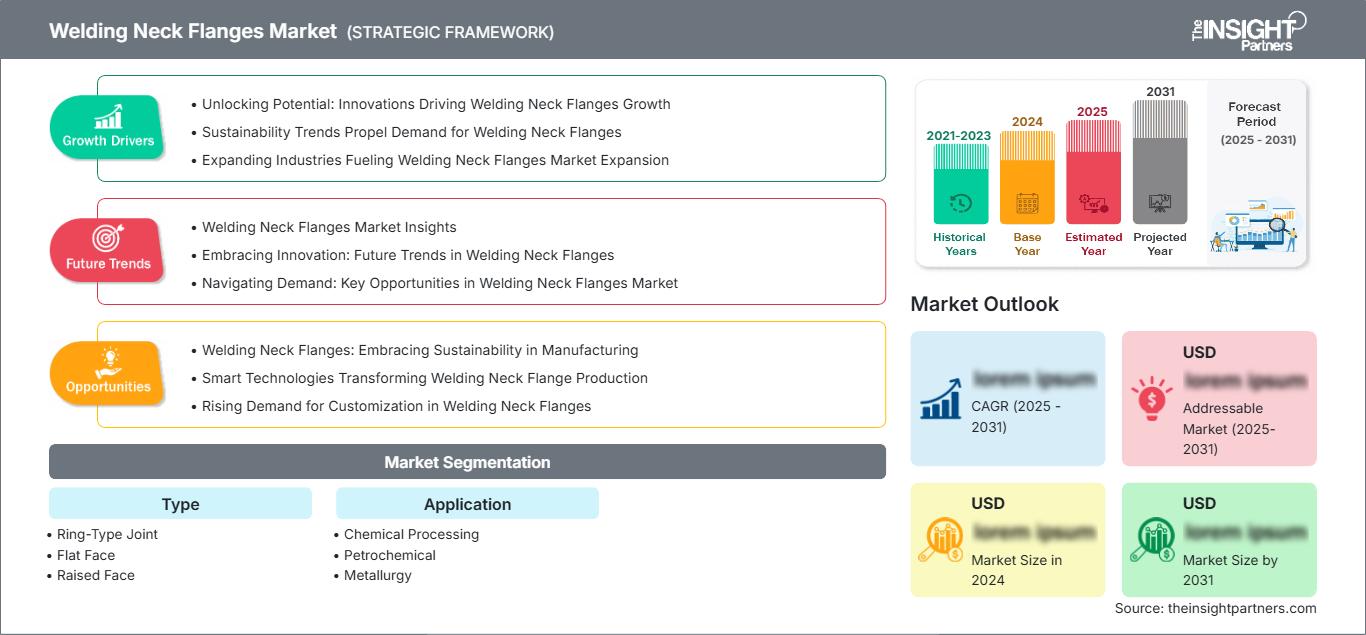
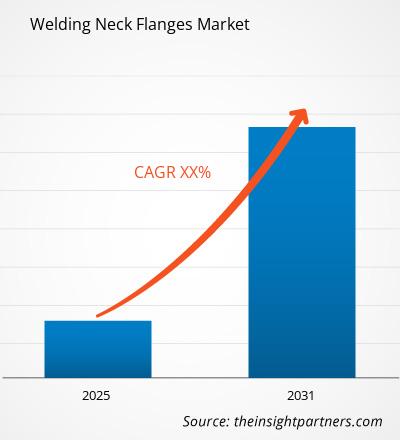
The welding neck flanges market is expanding from a base of US$ 4.00 Billion in 2025 toward US$ 6.55 Billion by 2034, registering a CAGR of 5.61% during 2026–2034. Demand is closely linked to the specification of pressure-rated piping systems in process industries, where welded connections are selected for structural reliability, dimensional stability, and resistance to cyclic loading. Material traceability, standardized dimensions, and inspection requirements continue to influence procurement decisions across industrial projects.
North America is positioned for steady expansion, supported by refinery modernization, chemical capacity additions, LNG infrastructure, and replacement of aging process-piping assets. The welding neck flanges market size is benefiting from increased emphasis on pressure integrity and documented component qualification. Regional demand is expected to maintain an estimated 5.8–6.2% CAGR through 2034, with the US remaining the principal consumption center because of its extensive installed base and project pipeline.
Welding Neck Flanges Market Assessment and Insights
- North America commands an estimated 31–35% share in 2025 and is expected to expand at a CAGR of 5.8–6.2% between 2026–2034. Refinery upgrades, LNG projects, chemical processing investments, and replacement demand support resilient component procurement.
- US represents approximately 66–70% of North American demand in 2025 and is projected to grow at a CAGR of 5.5–5.9% between 2026–2034, supported by energy infrastructure and industrial maintenance.
- Europe accounts for an estimated 25–29% share in 2025 and is expected to register a CAGR of 5.2–5.6% between 2026–2034. Germany, Italy, France, the UK, and Spain provide demand through chemicals, pharmaceuticals, energy, and advanced manufacturing.
- Asia Pacific holds approximately 28–32% of global demand in 2025 and is projected to grow at a CAGR of 6.0–6.5% between 2026–2034. China, Japan, South Korea, and India benefit from expanding process industries and infrastructure investment.
- Largest Segment: Raised Face is estimated to hold a 55–59% market share in 2025 and is projected to grow at a CAGR of 5.6–5.9% through 2034, reflecting broad pressure-piping adoption.
- High Growth Segment: Pharmaceutical application represents an estimated 10–14% share in 2025 and is expected to advance at a CAGR of 7.2–7.8% through 2034, supported by hygienic process expansion.
- Key companies analyzed in detail: Amco Metals, Coastal Flange, Fit-Wel Industries, Metal Industries, Metline Industries, Metal Udyog, Neo Impex Stainless, Rexino Stainless and Alloys, Rajtilak Metal, Shijiazhuang Duwa Piping, Bonney Forge, ASC Engineered Solutions, Norma India Ltd., ULMA Piping, and Shanxi Anbao Forging Co., Ltd.
Source: The Insight Partners' analysis based on proprietary research, government publications, company annual reports, investor presentations, industry databases, and expert interviews.
This has resulted in increased dimensional control, a wider range of alloy use, computerized machining and increased traceability in forging and finishing processes. Welding neck design is critical as the flange and piping interface gradually tapers through a hub, reducing stress levels in comparison with other methods of connections. ASME B16.5:2025 still provides definitions of pressure-temperature ratings, materials, dimensional specifications, tolerances, markings, tests and flange joint specifications of covered sizes and classes.
Future requirements are influenced by investments in chemical plants, LNG terminals, refinery modernization, pharma manufacturing and industrial de-carbonization schemes. The Welding Neck Flanges Market report highlights that suppliers that combine forging, heat treatment, machining, nondestructive testing, certification, and export logistics can reduce qualification friction for engineering contractors. Emerging procurement models also favor documented material certificates, controlled welding procedures, and consistent batch quality, particularly where components are incorporated into critical process systems.
Welding Neck Flanges Market Report Scope
| Report Attribute | Details |
|---|---|
| Market size in 2025 | US$ 4 Billion |
| Market Size by 2034 | US$ 6.55 Billion |
| Global CAGR (2026 - 2034) | 5.61% |
| Historical Data | 2021-2024 |
| Forecast period | 2026-2034 |
Welding Neck Flanges Market Analysis
The welding neck flanges market growth is supported by the need for durable pipe connections across high-pressure and high-temperature service. The supply chain starts with raw materials in the form of carbon steel, stainless steel, alloy steel, and special metals; forging; heat treatment; machining; facing; drilling; marking; inspecting; and packaging. Engineering contractors and distributors install the product in the piping systems as per the specific design, pressure rating, dimension, and material requirements.
Thus, the demand for these products not only depends on the installation of new plants but also on maintenance, repairs, turnaround, debottlenecking, and the replacement of equipment. The buyers generally consider parameters like dimensional tolerance, pressure rating, material, weld preparation, documentation of inspections, and delivery schedule. Manufacturers with flexible manufacturing facilities can cater to the standard product requirement as well as custom engineering orders, whereas distributors offer inventory availability in the case of maintenance purchases.
The welding neck flanges market analysis indicates a fragmented competitive structure, with specialist manufacturers competing alongside diversified forged-component suppliers and regional distributors. Companies such as Amco Metals, Coastal Flange, Fit-Wel Industries, Metal Industries, Metline Industries, Metal Udyog, Neo Impex Stainless, Rexino Stainless & Alloys, Rajtilak Metal, and Shijiazhuang Duwa Piping are among the players involved in the value chain, especially those requiring customization in sizes, materials, and export documentation.
Bonney Forge and ASC Engineered Solutions enhance competition by providing a strong portfolio of engineered connections, whereas Norma India Ltd., ULMA Piping, and Shanxi Anbao Forging Co., Ltd. add manufacturing capabilities in various regions. The focus of investment is increasingly turning to machining systems, inspection systems, production data recording, and material qualifications. According to the Welding Neck Flanges Market forecast, strategic positioning is consequently shifting from price-only competition toward reliability, certification, delivery consistency, and technical responsiveness.
● REPORT CUSTOMIZATION
Tailor This Report To Align With Your Specific Business Requirements
This report can be customized to align precisely with your business objectives, scope, and target markets. Customization options include tailored segmentation, geography, competitive analysis, and strategic insights to support informed decision-making.
Customize This Report →WHAT YOU CAN ADJUST
- ● Segmentations
- ● Geography
- ● Competitive Analysis
- ● Language Preferences
Welding Neck Flanges Market: Strategic Insights
Regional Insights
North America welding neck flanges market
North America is estimated to account for 31–35% of global demand in 2025 and is expected to record a CAGR of 5.8–6.2% through 2034. While the US is leading in regional demand, Canada supplies its contribution to the market through energy, mining, chemicals, and pipeline-related segments. Modernizations of refineries, LNG facilities, petrochemical plants, and the replacement of old pipelines make sure that there is continuous demand for pressure flanges. Traceability, testing documentation, and compliance with existing piping codes are becoming more and more important factors in the procurement of flanges.
Lead times are also important for industrial customers because they need reliable availability of components during plant shutdowns and turnarounds. Both domestic producers and imports compete in their ability to offer stock items, customized orders, and fast certifications. Demand exists in all sectors such as energy, chemicals, food, pharma, and general manufacturing; however, heavy process industries continue being the main demand drivers.
U.S. welding neck flanges Market
The US represents approximately 66–70% of North American welding neck flanges market demand in 2025 and is projected to grow at a CAGR of 5.5–5.9% through 2034. Extensive refinery, LNG, chemical, and power infrastructure creates a large replacement and maintenance base. The growing importance of pressure systems that are exposed to pressure, temperature, vibration, and cyclic operations necessitates the use of dependable weld joints in the application requirements. The local engineering and distribution network ensures quick supply for turnaround activity.
There are many firms like Bonney Forge and ASC Engineered Solutions that operate under highly competitive conditions where the issues of dimensional tolerance, material certification, and pressure class are significant factors in buying decisions. There is also the issue of expansion in the processing industry. The pharmaceutical industry requires controlled materials and cleanable processes, and the energy industry requires mechanical soundness and inspection.
Europe welding neck flanges Market
Europe is estimated to hold a 25–29% of the welding neck flanges market share in 2025 and is expected to grow at a CAGR of 5.2–5.6% through 2034. Germany remains a leading industrial market, supported by chemicals, machinery, energy systems, and process manufacturing. The UK helps via energy systems, refineries, offshore support activities, and industrial maintenance. The French requirement comes from chemicals, pharmaceuticals, aerospace-based processing, and utilities.
The Italian and Spanish requirement also comes from petrochemicals, food processing, pharmaceuticals, energy systems, and industrial equipment. The European customers normally put more value on the aspects of certification, traceability, dimension control, and documented quality procedures. ULMA Piping and other regional manufacturers get advantages from close locations to engineering contractors and industrial centers. Energy transition activities are also giving rise to the need for piping systems in hydrogen, renewable fuels, carbon management, and low-carbon chemistry.
APAC welding neck flanges Market
APAC represents approximately 28–32% of the global welding neck flanges market demand in 2025 and is projected to grow at a CAGR of 6.0–6.5% through 2034. China continues to be the dominant player, followed by Japan, South Korea, India, and Australia. The development of facilities for refining, petrochemical, chemical, pharmaceutical, and industrial production provides an avenue for continued consumption of components. China takes advantage of its well-established processing industry capacity, whereas Japan and South Korea have technologically advanced manufacturing sectors. India is aided by investments in refining, chemicals, pharmaceuticals, and infrastructure development, whereas Australia helps in LNG, mining, and resource processing. Material certification becomes an increasing requirement within the region.
Middle East & Africa welding neck flanges Market
The Middle East and Africa welding neck flanges market demand is expected to advance at a CAGR of 5.8–6.3% through 2034, supported by energy infrastructure, refinery upgrades, petrochemical integration, and industrial diversification. Saudi Arabia is the leading market, followed by the UAE and South Africa, while the rest of the region contributes through oil, gas, chemicals, water infrastructure, and industrial projects.
Saudi Arabia and the UAE are developing downstream capacity and integrated industrial ecosystems, increasing requirements for pressure-rated piping components. South Africa contributes through mining, chemicals, power, and infrastructure maintenance. Project specifications commonly prioritize pressure integrity, corrosion resistance, traceability, and compliance documentation. Regional demand should remain closely tied to capital expenditure in energy and industrial facilities, with specialized suppliers benefiting from project qualification and local distribution capabilities.
Segmentation Analysis
Type
Product type is expected to expand at a CAGR of 5.4–5.8% during 2026–2034. Product selection depends on pressure class, piping geometry, gasket arrangement, maintenance requirements, and the operating environment. Raised Face remains the dominant configuration because of its broad compatibility with industrial piping systems, while Ring-Type Joint products serve demanding high-pressure applications. Current Welding Neck Flanges Market trends indicate a growing preference for application-specific flange designs that improve sealing performance, reliability, and compliance with increasingly stringent industrial standards.
- Ring-Type Joint: Used where high-integrity sealing is required, particularly in demanding oil, gas, petrochemical, and high-pressure process environments. Its grooved sealing arrangement supports applications where controlled gasket seating and leak resistance are critical.
- Flat Face: Favored for selected low-pressure or equipment-interface applications where mating surfaces require controlled alignment. Its practical design supports cost-sensitive installations and systems where full raised-face geometry is unnecessary.
- Raised Face: The most broadly specified configuration because its standardized geometry supports common gasket arrangements and pressure-rated piping. It remains strategically important across refineries, chemical plants, utilities, and general process facilities.
Application
Application is projected to grow at a CAGR of 5.7–6.1% during 2026–2034. Industrial expansion, maintenance requirements, and increasingly stringent process-integrity expectations influence demand. Petrochemical projects provide substantial volume, while pharmaceutical manufacturing is expected to record the fastest expansion as production capacity increases and hygienic engineering requirements become more demanding.
- Chemical Processing: Requires dependable flange connections across extensive networks carrying corrosive, reactive, heated, or pressurized fluids. Material selection and documented inspection are strategically important for maintaining process reliability.
- Petrochemical: Represents a major demand center because refineries and integrated complexes contain extensive pressure-rated piping. Long operating cycles and turnaround requirements favor robust welded connections with traceable material documentation.
- Metallurgy: Uses flanged piping in furnaces, utilities, gas systems, cooling circuits, and material-processing operations. Demand is influenced by plant modernization, operating temperatures, and the need for durable connections.
- Pharmaceutical: Demand is supported by the expansion of drug and biologics production facilities. Buyers emphasize controlled materials, surface quality, cleanability, documentation, and repeatable manufacturing processes for regulated production environments.
Opportunity Snapshot
| Application | Revenue Contribution | Trend Tag | Adoption Stage |
| Chemical Processing | High | Corrosion Control | Mature |
| Petrochemical | High | Refinery Upgrades | Mature |
| Metallurgy | Medium | Furnace Modernization | Scaling |
| Pharmaceutical | Medium | Hygienic Processing | Scaling |
Welding Neck Flanges Market Growth Drivers and Impact Analysis
Expansion of Integrated Refining and Petrochemical Capacity
Investment in integrated refinery and petrochemical plants will raise the demand for piping components designed for use under pressure because the process units will need extensive piping systems for feed, intermediates, utilities, and products. It is also true that integrated plants will use engineering standards for the selection and purchase of components, resulting in a repeatable procurement process for different process units. Recent investments in Saudi Arabia, China, Singapore, and other processing centers prove that there is still focus on downstream value-added operations. For flange manufacturers, it means more opportunities for bigger orders, qualification, and maintenance contracts once the plants are commissioned. Since the turnaround cycles involve the replacement of parts over the entire operating life of the plant, it creates an opportunity for the suppliers who can handle project documentation.
Stronger Focus on Mechanical Integrity and Leak Prevention
Operators of industrial facilities have come to recognize the importance of mechanical integrity, as leaks, unexpected shutdowns, and pressure boundary breaches often lead to adverse safety, environmental, and monetary impacts. Welding neck-type flanges are appropriate for cases where load transfer, weldability, and cyclic strength play an important role. The significance is underlined by engineering codes, which specify pressure and temperature ratings, material specifications, dimensional tolerances, testing, and marking of these flanges. With plant life extending, maintenance personnel are now replacing flange components due to condition checks rather than after catastrophic failures. This contributes to a replacement-driven demand pipeline along with fresh project consumption. Manufacturers are favored if they supply material test reports, dimensional inspection reports, non-destructive testing documentation, and heat number tracking.
Industrial Modernization and Higher Specification Requirements
Modernization initiatives are bringing about changes in buying criteria within chemicals, metallurgy, pharmaceuticals, and energy infrastructure. There has been a trend among plant managers to adopt modern products that ensure traceability of the material used, high dimensional tolerance and compatibility with current engineering specifications. Pharmaceutical and specialty chemical plants have an extra focus on surface finish and corrosion resistance, along with special manufacturing environments, whereas metallurgy and energy applications may require a higher level of alloy composition or special pressure ratings. With the use of digital inspection equipment, manufacturers can track down their production process and deviations prior to shipment. It is facilitating the movement from buying commodities to specification-based purchasing. Suppliers who are able to offer standard products in addition to engineered products will find great value in the market, as buyers are looking forward to having a smaller number of qualified suppliers meeting several material grades, sizes, pressure ratings, inspection criteria and delivery requirements.
Welding Neck Flanges Market Future Trends
Digital Traceability Across Flange Manufacturing
welding neck flanges market trends increasingly point toward digital traceability as manufacturers and buyers seek stronger control over component provenance. Future production systems are likely to connect forging records, heat-treatment parameters, machining measurements, nondestructive testing, dimensional inspection, and material certificates through unified digital records. Such systems can reduce documentation errors and simplify audits for engineering contractors operating across multiple jurisdictions. Automated identification technologies may also link individual components or production batches to inspection histories, improving recall management and replacement planning. For buyers, the value extends beyond compliance because digital records can support predictive maintenance, asset registers, and lifecycle documentation. Suppliers investing in integrated manufacturing execution and quality systems may therefore improve responsiveness while reducing manual administrative work. Over time, traceability could become a differentiating procurement criterion alongside price, delivery time, and product availability.
Engineered Flanges for Lower-Carbon Process Systems
Future demand will increasingly include piping systems associated with hydrogen, carbon capture, low-carbon fuels, advanced recycling, and energy-efficiency projects. These applications may expose components to operating conditions that differ from conventional hydrocarbon service, increasing attention to material compatibility, pressure cycling, temperature ranges, corrosion behavior, and welding procedures. Manufacturers are likely to broaden alloy options and develop more application-specific engineering support rather than relying exclusively on standardized catalog configurations. Engineering contractors may also require greater documentation to validate component suitability during project qualification. This trend does not eliminate conventional oil, gas, or chemical demand; instead, it adds new application layers to the addressable opportunity. Suppliers that develop technical expertise in emerging process systems can position themselves for early participation in pilot facilities and subsequent commercial-scale projects.
Welding Neck Flanges Market Opportunities
Regional Manufacturing and Qualified Supplier Networks
The welding neck flanges market offers investment opportunities in regional manufacturing hubs located close to major process-industry clusters. Buyers increasingly value shorter lead times, responsive engineering support, and the ability to replenish standard configurations during maintenance shutdowns. Establishing or expanding machining, heat treatment, inspection, and finishing capabilities near refinery, chemical, pharmaceutical, and industrial centers can reduce logistics exposure and improve service responsiveness. Another opportunity lies in supplier qualification programs that combine standardized production with application-specific documentation. Manufacturers can target engineering contractors and distributors that serve multiple projects, thereby building recurring demand instead of relying on individual spot orders. Regional partnerships can also improve access to export markets by aligning products with local standards, certification expectations, packaging requirements, and documentation practices. Investment should prioritize quality infrastructure as much as production capacity.
Specialty Materials and High-Integrity Applications
A second opportunity exists in higher-value applications requiring stainless steel, alloy steel, duplex materials, or engineered configurations. Process facilities handling corrosive chemicals, elevated temperatures, aggressive media, or demanding pressure cycles often require more than a standard carbon-steel product. Suppliers can capture additional value by developing expertise in material selection, heat treatment, machining tolerances, corrosion considerations, and inspection requirements. Pharmaceutical and specialty-chemical facilities provide a further avenue because qualification processes can favor suppliers with consistent documentation and repeatable manufacturing controls. High-integrity applications also create opportunities for smaller specialist producers that can respond quickly to customized dimensions or project-specific requirements. Strategic investment in metallurgical testing, nondestructive examination, precision machining, and technical sales can therefore support higher-value contracts while reducing exposure to purely price-driven competition.
Frequently Asked Questions

- Comprehensive Market Sizing and Forecast Analysis
- Detailed Segmentation Analysis
- In-Depth Market Dynamics Assessment
- Regional and Country-Level Insights
- Competitive Landscape and Company Benchmarking
- Strategic Business Intelligence
Recent Reports
Testimonials

The Insight Partners' SCADA System Market report is comprehensive, with valuable insights on current trends and future forecasts. The team was highly professional, responsive, and supportive throughout. We are very satisfied and highly recommend their services.
RAN KEDEM Partner, Reali Technologies LTDs
I requested a report on a very specific software market and the team produced the report in a few days. The information was very relevant and well presented. I then requested some changes and additions to the report. The team was again very responsive and I got the final report in less than a week.
JEAN-HERVE JENN Chairman, Future Analytica
We worked with The Insight Partners for an important market study and forecast. They gave us clear insights into opportunities and risks, which helped shape our plans. Their research was easy to use and based on solid data. It helped us make smart, confident decisions. We highly recommend them.
PIYUSH NAGPAL Sr. Vice President, High Beam Global
The Insight Partners delivered insightful, well-structured market research with strong domain expertise. Their team was professional and responsive throughout. The user-friendly website made accessing industry reports seamless. We highly recommend them for reliable, high-quality research services
YUKIHIKO ADACHI CEO, Deep Blue, LLC.
This is the first time I have purchased a market report from The Insight Partners.While I was unsure at first, I visited their web site and felt more comfortable to take the risk and purchase a market report.I am completely satisfied with the quality of the report and customer service. I had several questions and comments with the initial report, but after a couple of dialogs over email with their analyst I believe I have a report that I can use as input to our strategic planning process.Thank you so much for taking the extra time and making this a positive experience.I will definitely recommend your service to others and you will be my first call when we need further market data.
JOHN SUZUKI President and Chief Executive Officer, Board Director, BK Technologies
I wish to appreciate your support and the professionalism you displayed in the course of attending to my request for information regarding to infectious disease IVD market in Nigeria. I appreciate your patience, your guidance, and the fact that you were willing to offer a discount, which eventually made it possible for us to close a deal. I look forward to engaging The Insight Partners in the future, all thanks to the impression you have created in me as a result of this first encounter.
DR CHIJIOKE ONYIA MANAGING DIRECTOR, PineCrest Healthcare Ltd.Reason to Buy
- Informed Decision-Making
- Understanding Market Dynamics
- Competitive Analysis
- Identifying Emerging Markets
- Customer Insights
- Market Forecasts
- Risk Mitigation
- Boosting Operational Efficiency
- Strategic Planning
- Investment Justification
- Tracking Industry Innovations
- Aligning with Regulatory Trends





 Get Free Sample for