
Wireless Gaming Headset Market Demand, Size & Forecast by 2034
Coverage: by Technology (RF gaming headsets, Bluetooth gaming headsets); Application (Commercial Use, Personal Use) , and Geography (North America, Europe, Asia Pacific, and South and Central America)
- Status : Data Released
- Report Code : TIPRE00011235
- Category : Electronics and Semiconductor
- No. of Pages : 150
- Available Report Formats :


- Last update date : September 30, 2026


2025 Market Size
US$ 2.46 Bn
Base year value
2034 Forecast
US$ 7.51 Bn
Projected by 2034
CAGR 2026-2034
13.19 %
Growth rate
Addressable Market
US$ 43.27 Bn
(2026-2034)
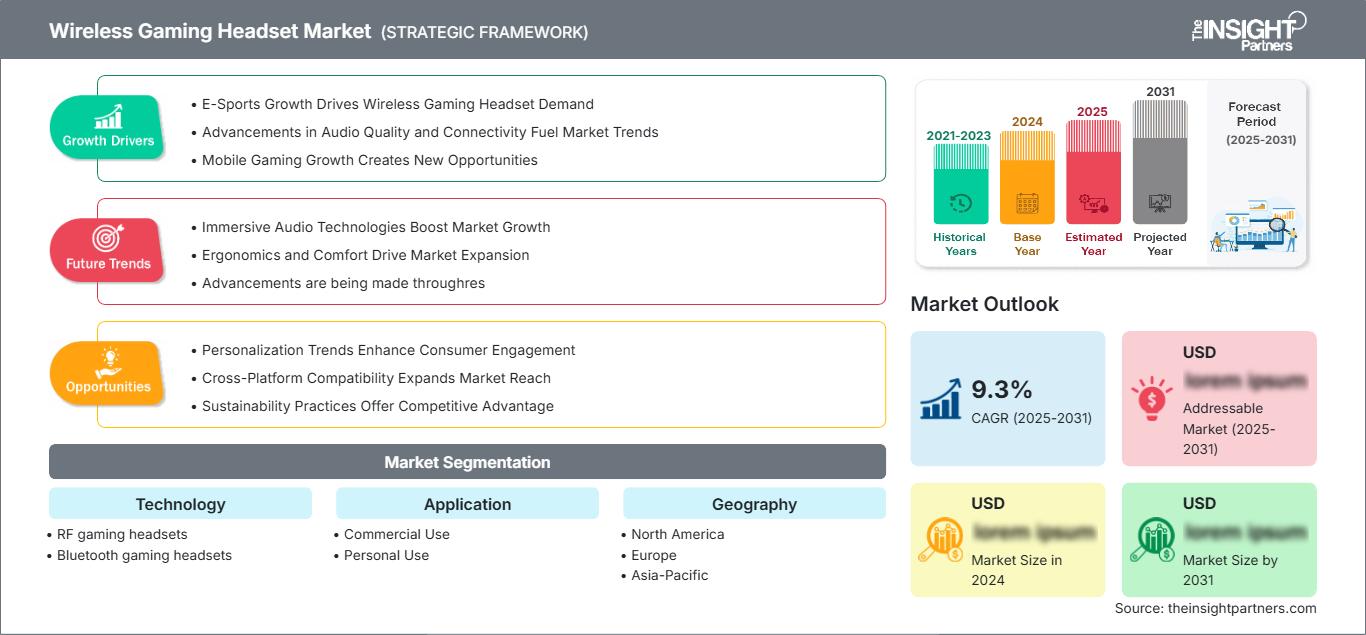
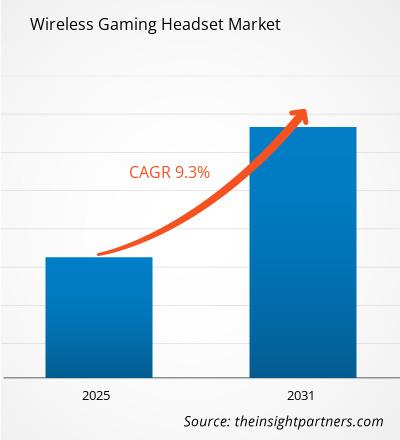
The wireless gaming headset market was valued at US$ 2.46 Billion in 2025 and is projected to reach US$ 7.51 Billion by 2034, registering a CAGR of 13.19% during 2026–2034. Expansion is supported by increasing preference for cable-free gaming, broader PC and console adoption, and continued improvements in wireless audio performance. Product development is increasingly centered on low latency, multi-platform compatibility, microphone clarity, battery endurance, and software-enabled personalization for competitive and recreational players.
North America remains a strategically important regional market, with the wireless gaming headset market size expected to expand at approximately 11–13% CAGR during 2026–2034. High household gaming penetration, strong accessory spending, esports participation, and rapid adoption of premium PC and console peripherals support demand. The US represents the principal regional revenue base, while Canada contributes through growing online gaming participation and replacement demand for higher-performance audio equipment.
Wireless Gaming Headset Market Assessment and Insights
- North America: North America accounted for approximately 31–34% share in 2025 and is expected to grow at a CAGR of 11–13% during 2026–2034, supported by mature gaming ecosystems, premium peripheral adoption, esports, and replacement purchases.
- US: The US represented approximately 69–72% of North American revenue in 2025 and is projected to grow at 11–13% CAGR during 2026–2034, led by PC, console, and competitive gaming demand.
- Europe: Europe held approximately 25–28% share in 2025 and is forecast to expand at a CAGR of 12–14% during 2026–2034. Germany, the UK, France, Italy, and Spain provide broad consumer and esports demand.
- Asia Pacific: Asia Pacific represented approximately 28–31% share in 2025 and is expected to register 14–16% CAGR during 2026–2034. China, Japan, South Korea, and India are major contributors, supported by gaming communities and expanding digital entertainment.
- Largest Segment: RF gaming headsets represented approximately 62–66% share in 2025 and are expected to grow at 12–14% CAGR during 2026–2034 because low-latency connectivity remains central to competitive gaming.
- High Growth Segment: Bluetooth gaming headsets held approximately 34–38% share in 2025 and are projected to grow at 15–17% CAGR during 2026–2034 as mobile, hybrid, and multi-device gaming expand.
- Key companies analyzed in detail: ASUSTeK Computer Inc.; Audio-Technica Corporation; Corsair Gaming, Inc.; Dell Inc.; Kingston Technology Company, Inc.; Logitech International S.A.; Razer Inc.; Sennheiser electronic SE & Co. KG; SteelSeries ApS; Turtle Beach Corporation.
Source: The Insight Partners' analysis based on proprietary research, government publications, company annual reports, investor presentations, industry databases, and expert interviews.
Wireless gaming headsets are transitioning from simple wireless audio to communication and multi-device integration. Manufacturers have integrated 2.4 GHz radio frequency connectivity with Bluetooth, USB connections, programmable equalization, spatial audio, and advanced microphones. Supply chains, meanwhile, are being transformed by the adoption of light-weight materials, bigger battery sizes, efficient chipsets, and common components which can serve multiple product lines yet still maintain distinction through acoustics, software, comfort, and industrial design.
From a future standpoint, the market for wireless gaming headsets will receive traction in new gaming markets, where PC cafes, consoles, esports sites, and content creators will develop at the same time. There will be investments in cross-platform platforms, improvements in battery and electronics, personalization software, and accessibility. The need for regulations on battery and electronics recycling, e-waste, radio frequencies, and sustainability will determine the product design process, because of technological advances in the Bluetooth standard.
Wireless Gaming Headset Market Report Scope
| Report Attribute | Details |
|---|---|
| Market size in 2025 | US$ 2.46 Billion |
| Market Size by 2034 | US$ 7.51 Billion |
| Global CAGR (2026 - 2034) | 13.19% |
| Historical Data | 2021-2024 |
| Forecast period | 2026-2034 |
Wireless Gaming Headset Market Analysis
The demand for wireless gaming headsets relies on the growing need for immersive audio and real-time voice communications. The competitiveness of games makes directional audio and latency especially crucial, but the popularity of multiplayer and social games raises the microphone requirement. The value chain includes semiconductor suppliers, wireless chipset makers, acoustic component makers, battery suppliers, OEMs, software platform providers, retailers, and gaming devices ecosystems. In this way, the cost of goods sold is made up of both hardware and software costs.
The supply side gets more complicated as brands deploy multiple wireless technologies within the same product family. RF technology is still preferred in latency-sensitive cases, and Bluetooth technology allows for versatility in smartphone, tablet, laptop, and console connectivity. Combining these two technologies helps companies to provide a more versatile offering as well as enables the implementation of a price segmentation strategy to offer affordable as well as premium products.
As per the wireless gaming headset market report, competition among wireless gaming headsets is getting more intense as the well-established brands of gaming accessories fight for their high-end positions and extend themselves into more affordable price points. Logitech International S.A., Razer Inc., Corsair Gaming, Inc., SteelSeries ApS, and Turtle Beach Corporation compete based on wireless technology, acoustic tuning, software solutions, comfort, and cross-platform compatibility. ASUSTeK Computer Inc. and Kingston Technology Company, Inc. focus on developing PC peripherals, while Audio-Technica Corporation and Sennheiser electronic SE & Co. KG apply their audio engineering know-how.
Investments are being made less and less on the hardware itself and more and more on the integration of various platforms through the product. Simultaneous Bluetooth and RF connection, profile-based audio software, improvements in microphones and charging technologies in order to minimize disruptions are just some of the areas being developed. The launch of wireless headsets at affordable prices will enable companies to increase the potential market size and not lose the high-end audience in the process.
● REPORT CUSTOMIZATION
Tailor This Report To Align With Your Specific Business Requirements
This report can be customized to align precisely with your business objectives, scope, and target markets. Customization options include tailored segmentation, geography, competitive analysis, and strategic insights to support informed decision-making.
Customize This Report →WHAT YOU CAN ADJUST
- ● Segmentations
- ● Geography
- ● Competitive Analysis
- ● Language Preferences
Wireless Gaming Headset Market: Strategic Insights
Regional Insights
North America wireless gaming headset market
North America held around 31–34% of the wireless gaming headset market share in 2025 and will continue to grow at a CAGR of 11–13% until 2034. North America holds advantages in high levels of gaming activity, developed PC and consoles markets, premium accessory consumption, and intensive online multiplayer gaming. The US is the leading national market within the region, with Canada providing additional demand through its own replacement and increased use of digital entertainment.
The competition, streaming, and work/play behaviors of gamers ensure the need for headsets that can operate in different audio conditions. The major companies have good distribution channels, but the specialized stores that sell games and the online platforms can also be used to extend product coverage. The advanced headsets now offer competition through low latency audio, spatial audio, multiple connections, and capabilities of microphone processing. Headset replacement will also be influenced by battery life, changing of consoles, and weight reduction.
U.S. wireless gaming headset Market
In 2025, the United States accounted for around 69–72% of the North America wireless gaming headset sales and will continue to witness growth at a CAGR of 11–13% up to 2034. There is a huge player base, high consumer spending and high penetration of computers and consoles.
There is high frequency of product change and the US wireless gaming headset market has high presence of Logitech International S.A., Razer Inc., Corsair Gaming, Inc., Turtle Beach Corporation, and SteelSeries ApS. Dual connectivity mode, longer battery life, ability to customize sound and comfortability are some of the aspects which consumers prefer today. As per Entertainment Software Association, in 2026 there were 212 million Americans who played video games.
Europe wireless gaming headset Market
Europe held approximately 25–28% share in 2025 and is projected to expand at 12–14% CAGR. The UK has a mature gaming culture and strong esports participation, Germany combines a large consumer electronics base with PC gaming demand, while France benefits from active console and PC communities. Italy and Spain provide additional growth through expanding digital entertainment and online multiplayer participation. Germany is expected to remain a leading national market because of its purchasing power and established gaming hardware distribution.
In the wireless gaming headsets industry, European consumers are becoming more concerned about sound quality, comfort, battery life, maintainability, and cross-compatibility. Companies are trying to adapt their offerings to local conditions in terms of price and regulation, and online shopping provides an easy way for comparisons by specifications. The emphasis on sustainability in Europe might lead to development of reusable materials, exchangeable parts, effective charging, and extended lifespan.
APAC wireless gaming headset market
Asia Pacific has been estimated to be having a market share of about 28-31% in 2025 and is projected to have 14-16% CAGR up until 2034. China leads the region in terms of contribution to the segment owing to its large gaming community and developed PC gaming ecosystem. Japan and South Korea add through their consumer electronics and esport culture, whereas India and Australia offer promising expansion opportunities.
Wireless gaming headset market gets boost due to gaming cafes, migration from mobile gaming to PC gaming, creators community and competitive gaming. Companies are increasingly developing light weight and affordable wireless gaming headsets for specific buying trends of regions. Improvements in digital connectivity, wider reach of gaming consoles along with investments in gaming contents are likely to help market growth.
Middle East & Africa wireless gaming headset Market
MEA & Africa will register around 10-13% CAGR until 2034, backed by growth in gaming population and development in digital infrastructure. The key countries in the region driving demand for premium segment include Saudi Arabia and UAE, whereas South Africa serves as a strong base of gaming equipment. The RoMEA segment continues to be price sensitive but offers new business opportunities.
The factors driving the wireless gaming headset market include infrastructure investments, demographic structure, esports investments, and increase in digital entertainment consumption. The position of Saudi Arabia as a prominent market in the region is driven by gaming & esports investments, while in the case of UAE, it is due to purchasing power and technology focus of consumers.
Segmentation Analysis
Technology
Technology is a core determinant of latency, compatibility, range, power consumption, and user experience. The wireless gaming headset market within this segment is expected to grow at approximately 13–15% CAGR during 2026–2034. Manufacturers increasingly combine RF and Bluetooth capabilities to balance competitive performance with device flexibility.
- RF gaming headsets: RF products remain the preferred choice for latency-sensitive PC and console gaming. Their dedicated wireless links support responsive audio and stable connections, making them strategically important for esports and competitive applications.
- Bluetooth gaming headsets: Bluetooth products address mobile, laptop, hybrid, and casual gaming requirements. Improved gaming-oriented profiles and broader device compatibility strengthen their role as consumers increasingly expect one headset to operate across several devices.
Application
Application determines purchasing priorities because commercial environments emphasize durability, interoperability, and fleet economics, while individual users prioritize comfort, performance, aesthetics, and personal software customization. The application segment is expected to expand at approximately 12–14% CAGR during 2026–2034.
- Commercial Use: Commercial applications include gaming cafés, esports facilities, entertainment venues, training environments, and other shared-use settings. Buyers prioritize robust construction, simple deployment, replaceability, hygiene considerations, and dependable connectivity.
- Personal Use: Personal use represents the broadest consumer opportunity, spanning competitive players, casual gamers, streamers, and multi-device users. Comfort, microphone quality, battery endurance, platform support, and software personalization strongly influence purchase decisions.
Opportunity Snapshot
| Application | Revenue Contribution | Trend Tag | Adoption Stage |
|---|---|---|---|
| Commercial Use | Medium | Venue Audio | Scaling |
| Personal Use | High | Multi-Device | Mature |
Wireless Gaming Headset Market Growth Drivers and Impact Analysis
Expansion of cross-platform gaming ecosystems
Cross-platform gaming is increasing the value proposition of a single wireless audio device that can move between PC, console, and mobile environments. This shift changes purchasing criteria from simple console compatibility toward flexible connectivity, device switching, software profiles, and consistent microphone performance. Manufacturers can therefore increase average selling opportunities by integrating multiple wireless standards into a single platform. The impact extends across product design, channel strategy, and customer retention because users may remain within one accessory ecosystem when software profiles and settings transfer between devices. For suppliers, this creates opportunities to differentiate through interoperability rather than only acoustic specifications. It also reduces the practical need for separate headsets, strengthening premium positioning while making versatile mid-range products more attractive to mainstream users.
Demand for low-latency competitive audio
Competitive gaming places unusual emphasis on timing accuracy because sound cues can influence reaction and decision-making. Wireless technology has therefore shifted from being viewed primarily as a convenience feature toward becoming a performance attribute. Dedicated RF connections, optimized signal processing, and improved wireless chipsets allow manufacturers to reduce latency while maintaining stable connections. This directly affects purchasing decisions among esports players, streamers, and serious PC gamers, where interruptions or perceptible delays can weaken product appeal. The commercial impact is visible in premium product positioning, as brands can justify higher prices through measurable connectivity performance, microphone clarity, and software control. Continued competition around latency will encourage investment in radio design, firmware optimization, antenna engineering, and power management, increasing technical differentiation across product tiers.
Growth of social and creator-oriented gaming
Gaming increasingly overlaps with streaming, online communities, voice chat, and creator activity, expanding the role of the headset beyond game audio. Users require microphones that maintain clarity during extended sessions, software that permits voice and game mixing, and comfortable designs suitable for long periods of use. This creates demand for products that combine gaming performance with communication functionality. Manufacturers can respond through improved microphone arrays, real-time voice processing, sidetone controls, and customizable profiles. The resulting opportunity extends beyond traditional competitive gaming because social players and creators also value dependable wireless performance. As content creation becomes integrated with gaming participation, headset specifications are increasingly evaluated as part of a broader setup that includes webcams, keyboards, mice, streaming software, and displays, strengthening ecosystem-based competition.
Wireless Gaming Headset Market Future Trends
Gaming Audio Profiles Become More Software-Defined
The wireless gaming headset market trends is moving toward software-defined audio experiences in which users can configure sound profiles according to individual games, genres, platforms, or communication scenarios. Future products are likely to integrate deeper game-specific equalization, adaptive spatial processing, microphone noise management, and cloud-synchronized preferences. Rather than treating the headset as a fixed acoustic device, manufacturers can use software to extend product functionality after purchase. This model also creates opportunities for recurring engagement through firmware updates, profile libraries, community presets, and integrations with game platforms. Artificial intelligence may increasingly support voice enhancement and automatic sound adjustments, although processing efficiency and privacy considerations will influence implementation. Over time, software capability could become a stronger differentiator than incremental hardware changes between competing premium models.
Hybrid Connectivity Becomes the Default Premium Architecture
Future wireless headsets are likely to increasingly combine dedicated RF connectivity with Bluetooth and wired USB functionality as standard architecture. This approach allows one product to support competitive gaming, mobile entertainment, communication, and productivity without forcing consumers to maintain separate audio devices. Bluetooth LE Audio developments, including gaming-oriented specifications, can further improve interoperability and power efficiency. Manufacturers will likely focus on seamless switching, simultaneous audio streams, low-power standby, and intelligent device prioritization. Battery management will become equally important as additional radios and processing functions increase energy requirements. The resulting premium architecture can support broader use cases while reducing device fragmentation. Brands that deliver reliable switching without complicated configuration will be better positioned to capture consumers seeking convenience without sacrificing gaming-grade responsiveness.
Wireless Gaming Headset Market Opportunities
Affordable Dual-Mode Products for Emerging Gamers
A significant opportunity lies in developing affordable headsets that combine dedicated RF connectivity with Bluetooth without excessive complexity or premium pricing. Emerging gaming markets often contain consumers who use smartphones, laptops, PCs, and consoles interchangeably, creating demand for equipment that can serve several roles. Manufacturers in the wireless gaming headset market forecast can address this opportunity through simplified industrial designs, efficient chipsets, durable plastics, replaceable ear cushions, and software features focused on essential controls rather than expensive customization. Regional assembly or localized distribution can further improve price competitiveness. Retailers can bundle headsets with gaming platforms, subscription services, or entry-level peripherals to reduce acquisition barriers. Such strategies could expand wireless adoption among first-time buyers while establishing brand loyalty that supports later upgrades into higher-performance products.
Commercial Gaming and Esports Fleet Solutions
Commercial gaming venues provide an opportunity for manufacturers to sell headset fleets rather than individual units. Gaming cafés, esports arenas, universities, entertainment centers, and event organizers require equipment that can withstand frequent handling while remaining easy to configure and maintain. Vendors can develop commercial packages with standardized wireless profiles, charging stations, replaceable components, inventory controls, and simplified sanitation procedures. Fleet-oriented service agreements could add value through scheduled replacement of batteries, ear cushions, and microphones. This model would shift competition from individual specifications toward total ownership cost, reliability, and service responsiveness. Companies with broad distribution networks and established gaming software ecosystems may be particularly well positioned to serve these customers. Regional esports growth can further create recurring institutional demand beyond conventional consumer replacement cycles.
Frequently Asked Questions

- Comprehensive Market Sizing and Forecast Analysis
- Detailed Segmentation Analysis
- In-Depth Market Dynamics Assessment
- Regional and Country-Level Insights
- Competitive Landscape and Company Benchmarking
- Strategic Business Intelligence
Recent Reports
Testimonials

The Insight Partners provided valuable market intelligence that supported our global go-to-market strategy. Their team was professional, responsive, and attentive to our feedback, providing thoughtful analysis and helpful methodological clarifications throughout the project.
Junmo Kim Chief Financial Officer (CFO), Enertech Co., Ltd.
The Insight Partners' SCADA System Market report is comprehensive, with valuable insights on current trends and future forecasts. The team was highly professional, responsive, and supportive throughout. We are very satisfied and highly recommend their services.
RAN KEDEM Partner, Reali Technologies LTDs
I requested a report on a very specific software market and the team produced the report in a few days. The information was very relevant and well presented. I then requested some changes and additions to the report. The team was again very responsive and I got the final report in less than a week.
JEAN-HERVE JENN Chairman, Future Analytica
We worked with The Insight Partners for an important market study and forecast. They gave us clear insights into opportunities and risks, which helped shape our plans. Their research was easy to use and based on solid data. It helped us make smart, confident decisions. We highly recommend them.
PIYUSH NAGPAL Sr. Vice President, High Beam Global
The Insight Partners delivered insightful, well-structured market research with strong domain expertise. Their team was professional and responsive throughout. The user-friendly website made accessing industry reports seamless. We highly recommend them for reliable, high-quality research services
YUKIHIKO ADACHI CEO, Deep Blue, LLC.
This is the first time I have purchased a market report from The Insight Partners.While I was unsure at first, I visited their web site and felt more comfortable to take the risk and purchase a market report.I am completely satisfied with the quality of the report and customer service. I had several questions and comments with the initial report, but after a couple of dialogs over email with their analyst I believe I have a report that I can use as input to our strategic planning process.Thank you so much for taking the extra time and making this a positive experience.I will definitely recommend your service to others and you will be my first call when we need further market data.
JOHN SUZUKI President and Chief Executive Officer, Board Director, BK Technologies
I wish to appreciate your support and the professionalism you displayed in the course of attending to my request for information regarding to infectious disease IVD market in Nigeria. I appreciate your patience, your guidance, and the fact that you were willing to offer a discount, which eventually made it possible for us to close a deal. I look forward to engaging The Insight Partners in the future, all thanks to the impression you have created in me as a result of this first encounter.
DR CHIJIOKE ONYIA MANAGING DIRECTOR, PineCrest Healthcare Ltd.Reason to Buy
- Informed Decision-Making
- Understanding Market Dynamics
- Competitive Analysis
- Identifying Emerging Markets
- Customer Insights
- Market Forecasts
- Risk Mitigation
- Boosting Operational Efficiency
- Strategic Planning
- Investment Justification
- Tracking Industry Innovations
- Aligning with Regulatory Trends





 Get Free Sample for