Wireless Neurostimulators Market 2026-2034 | Size, Share & Trends
Wireless Neurostimulators Market Size and Forecast (2021 - 2034), Global and Regional Share, Trend, and Growth Opportunity Analysis Report Coverage: By Product (Integrated Wireless Neurostimulator Systems, Standalone Wireless Neurostimulator Devices); Component (Hardware, Services); Delivery Mode (Wireless Implantable Neurostimulators, Wearable/Wireless External Neurostimulators, Hybrid Systems (Wireless + Wired Modules)); End-Use Industry (Hospitals & Clinics, Outpatient Neuromodulation Centres, Specialty Clinics, Home Healthcare & Ambulatory Care Providers, Others); and Geography
Historic Data: 2021-2024 | Base Year: 2025 | Forecast Period: 2026-2034- Report Date : Apr 2026
- Report Code : TIPRE00042198
- Category : Life Sciences
- Status : Upcoming
- Available Report Formats :


- No. of Pages : 150

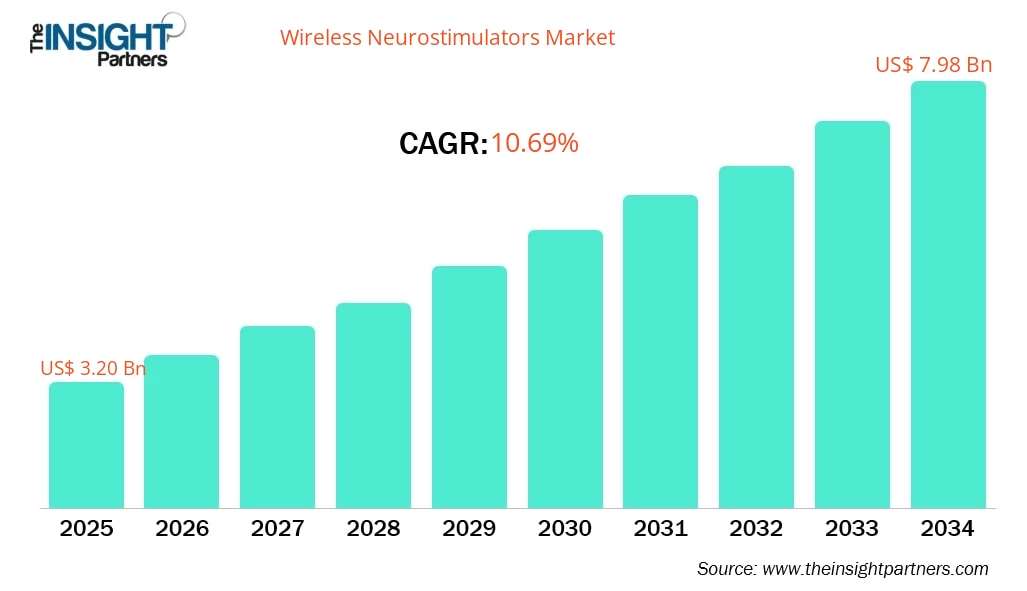
The Wireless Neurostimulators Market size is expected to reach US$ 7.98 billion by 2034 from US$ 3.20 billion in 2025, registering a CAGR of 10.69% during 2026–2034.
Wireless Neurostimulators Market Analysis
The Wireless Neurostimulators Market forecast indicates strong growth, driven by the rising prevalence of neurological and chronic pain conditions, increased adoption of wireless and minimally invasive stimulation technologies, and the growing patient preference for ambulatory and home-based therapy models. Integration of wireless connectivity, wearable devices, remote monitoring, and telehealth further supports expansion, as well as a shift toward battery-rechargeable, MRI-compatible implantable systems. Additional tailwinds include expansion of neurostimulation into indications such as epilepsy, incontinence, movement disorders, and new nerve targets, opening fresh market opportunities.
Wireless Neurostimulators Market Overview
Wireless neurostimulators (WNS) refer to implantable or wearable devices designed to deliver electrical stimulation to neural tissues (e.g., spinal cord, brain, peripheral nerves) without the constraints of bulky wired leads or tethered systems. Such devices facilitate neuromodulation for treating chronic pain, epilepsy, Parkinson’s disease, urinary/fecal incontinence, gastroparesis, and other neurological disorders. They enable improved patient mobility, remote programming, fewer surgical revisions, and better comfort, thus enabling healthcare providers to focus more on therapy outcomes rather than manual device management. WNS systems serve as the backbone of advanced neuromodulation care and are increasingly central to both large hospital networks and outpatient specialty clinics.
Customize This Report To Suit Your Requirement
Get FREE CUSTOMIZATIONWireless Neurostimulators Market: Strategic Insights

-
Get Top Key Market Trends of this report.This FREE sample will include data analysis, ranging from market trends to estimates and forecasts.
Wireless Neurostimulators Market Drivers and Opportunities
Market Drivers:
- Growing Prevalence of Neurological and Chronic Pain Conditions: An increasing incidence of disorders such as Parkinson’s disease, epilepsy, failed back surgery syndrome, and incontinence is driving demand for neurostimulation technologies.
- Adoption of Wireless & Minimally-Invasive Neurostimulator Systems: The shift toward wireless, wearable, and remote-connectivity systems enhances patient compliance and care settings beyond the hospital, spurring WNS uptake.
- Rise of Home-based and Ambulatory Therapies: Telehealth, remote monitoring, and the move from inpatient to outpatient models favour wireless neurostimulators that can be managed outside traditional hospital settings.
Market Opportunities:
- Expansion in Emerging Markets with Larger Untapped Patient Pools: Growth in Asia Pacific, Latin America, and the Middle East & Africa is enabled by increasing healthcare spending, rising neurological disorder incidence, and expanding private healthcare infrastructure.
- Integration with Digital Health, Analytics, and Closed-Loop Systems: WNS devices are increasingly integrated with sensors, feedback loops, AI/ML analytics, and remote monitoring, enabling smarter stimulation therapies and improved outcomes.
- Multi-Indication & Novel Therapy Applications: Opportunities lie in extending wireless neurostimulator use into new therapeutic areas (e.g., psychiatric disorders, obesity, cognitive impairment) and across multiple neuromodulation targets.
Wireless Neurostimulators Market Report Segmentation Analysis
By Product:
- Integrated Wireless Neurostimulator Systems
- Standalone Wireless Neurostimulator Devices
By Component:
- Hardware
- Services
By Delivery Mode:
- Wireless Implantable Neurostimulators
- Wearable/Wireless External Neurostimulators
- Hybrid Systems (Wireless + Wired Modules)
By End-Use Industry:
- Hospitals & Clinics
- Outpatient Neuromodulation Centres
- Specialty Clinics
- Home Healthcare & Ambulatory Care Providers
- Others
By Geography:
- North America
- Europe
- Asia Pacific
- South & Central America
- Middle East & Africa
Wireless Neurostimulators Market Report Scope
| Report Attribute | Details |
|---|---|
| Market size in 2025 | US$ 3.20 Billion |
| Market Size by 2034 | US$ 7.98 Billion |
| Global CAGR (2026 - 2034) | 10.69% |
| Historical Data | 2021-2024 |
| Forecast period | 2026-2034 |
| Segments Covered |
By Product
|
| Regions and Countries Covered |
North America
|
| Market leaders and key company profiles |
|
Wireless Neurostimulators Market Players Density: Understanding Its Impact on Business Dynamics
The Wireless Neurostimulators Market is growing rapidly, driven by increasing end-user demand due to factors such as evolving consumer preferences, technological advancements, and greater awareness of the product's benefits. As demand rises, businesses are expanding their offerings, innovating to meet consumer needs, and capitalizing on emerging trends, which further fuels market growth.
Wireless Neurostimulators Market Share Analysis by Geography
North America:
Market Share: Holds the largest share, due to advanced healthcare infrastructure, high adoption of implantable wireless neurostimulators, and supportive reimbursement/regulatory frameworks.
Key Drivers: strong private healthcare, high patient awareness, and early adoption of neuromodulation.
Trends: shift toward completely wireless implant systems, tele-monitoring, and remote device management.
Europe:
Market Share: Significant, driven by public healthcare digitization and regulatory mandates for advanced neuromodulation therapies.
Key Drivers: NHS/EU initiatives, data governance, and aging population.
Trends: increased use of interoperable wireless neurostimulator platforms across multi-specialty practices and cross-border care.
Asia Pacific:
Market Share: Expected to be the fastest-growing region, owing to rapid healthcare digitization, increasing incidence of neurological disorders, growth of medical tourism, and expanding private neuromodulation services.
Key Drivers: government health IT investment, surge in private clinics, and increasing patient volumes.
Trends: adoption of wireless neurostimulators with language/localization features, cost-effective cloud-based therapy management.
South & Central America:
Market Share: Emerging region with ample growth opportunities.
Key Drivers: public-private partnerships, need for cost-efficient wireless neuromodulation devices in underserved clinics.
Trends: cloud-based wireless neurostimulator solutions are gaining traction among small-to-medium providers.
Middle East & Africa:
Market Share: Developing market with strong growth potential driven by expanding healthcare infrastructure and rising demand for neuro-care automation.
Key Drivers: national e-health strategies, neuromodulation centre expansion.
Trends: implementation of wireless neurostimulator systems within integrated care models (primary diagnosis to specialty referral) often as part of larger neuromodulation platforms.
Wireless Neurostimulators Market Players Density: Understanding Its Impact on Business Dynamics
High market density and competition are evident in the Wireless Neurostimulators Market, with major device manufacturers and niche wireless/neuromodulation specialists vying for leadership. This competitive environment drives vendors to differentiate via:
- Seamless wireless connectivity, remote monitoring & implantable telemetry integration
- Scalable, full-ecosystem wireless neurostimulator platforms tailored to both large hospital networks and outpatient/home care settings
- AI-enabled therapies for feedback control, patient monitoring, and optimization of stimulation parameters
- Interoperability with third-party systems (e.g., digital health apps, hospital EMRs, wearable sensors)
Major Companies operating in the Wireless Neurostimulators Market include:
- Medtronic Plc
- Boston Scientific Corporation
- Abbott Laboratories
- Nevro Corp
- LivaNova Plc
- Synapse Biomedical Inc
- ElectroCore Inc
- MicroTransponder Inc
- Nalu Medical Inc
- Beijing Pins Medical Co., Ltd.
Other companies analysed during the course of research:
- Neuronetics Inc
- NeuroPace Inc
- BioControl Medical
- Stimwave Technologies Inc
Wireless Neurostimulators Market News and Recent Developments
- In August 2023, Medtronic obtained CE Mark approval for its Inceptiv closed-loop rechargeable spinal cord neurostimulator, the first of its kind to adapt stimulation based on patient movement and physiology autonomously.
- Wireless and wearable neurostimulator platforms integrating remote patient monitoring and mobile-app-based programming are gaining traction, enabling home-based management of chronic neurological conditions.
- Major players are investing in AI-enabled feedback control and implantable telemetry to optimize treatment, reduce revisions, and improve patient outcomes.
Wireless Neurostimulators Market Report Coverage and Deliverables
The “Wireless Neurostimulators Market Size and Forecast (2026–2034)” report provides a detailed analysis covering the following areas:
- Market size and forecast at global, regional, and country levels for all key segments covered under the scope.
- Market trends as well as market dynamics, such as drivers, restraints, and key opportunities
- Detailed PEST and SWOT analysis
- Market analysis covering key market trends, global and regional framework, major players, regulations, and recent market developments
- Industry landscape and competition analysis covering market concentration, heat-map analysis, prominent players, and recent developments in the Wireless Neurostimulators Market
- Detailed company profiles
Frequently Asked Questions
Hospitals and Clinics: Use wireless neurostimulators for advanced neuromodulation therapies in tertiary care settings.
Outpatient Specialty Clinics and Ambulatory Care: Adopt WNS for pain management, movement disorders, and neuromodulation services in less-invasive settings.
Home Healthcare & Ambulatory Care Providers: Use wireless neurostimulators for remote-managed, home-based neuromodulation treatment of chronic conditions.
Research Institutes and Rehabilitation Centres: Emerging users for neuromodulation innovation and therapy expansion.
Growing prevalence of neurological and chronic pain disorders requiring neuromodulation therapies.
Adoption of wireless and minimally invasive neurostimulator devices enabling easier therapy delivery and patient mobility.
Increased deployment of telehealth/home-care models and remote monitoring for neurostimulation, pushing market adoption of wireless platforms.

- Historical Analysis (2 Years), Base Year, Forecast (7 Years) with CAGR
- PEST and SWOT Analysis
- Market Size Value / Volume - Global, Regional, Country
- Industry and Competitive Landscape
- Excel Dataset
Recent Reports
Testimonials

The Insight Partners' SCADA System Market report is comprehensive, with valuable insights on current trends and future forecasts. The team was highly professional, responsive, and supportive throughout. We are very satisfied and highly recommend their services.
RAN KEDEM Partner, Reali Technologies LTDs
I requested a report on a very specific software market and the team produced the report in a few days. The information was very relevant and well presented. I then requested some changes and additions to the report. The team was again very responsive and I got the final report in less than a week.
JEAN-HERVE JENN Chairman, Future Analytica
We worked with The Insight Partners for an important market study and forecast. They gave us clear insights into opportunities and risks, which helped shape our plans. Their research was easy to use and based on solid data. It helped us make smart, confident decisions. We highly recommend them.
PIYUSH NAGPAL Sr. Vice President, High Beam Global
The Insight Partners delivered insightful, well-structured market research with strong domain expertise. Their team was professional and responsive throughout. The user-friendly website made accessing industry reports seamless. We highly recommend them for reliable, high-quality research services
YUKIHIKO ADACHI CEO, Deep Blue, LLC.
This is the first time I have purchased a market report from The Insight Partners.While I was unsure at first, I visited their web site and felt more comfortable to take the risk and purchase a market report.I am completely satisfied with the quality of the report and customer service. I had several questions and comments with the initial report, but after a couple of dialogs over email with their analyst I believe I have a report that I can use as input to our strategic planning process.Thank you so much for taking the extra time and making this a positive experience.I will definitely recommend your service to others and you will be my first call when we need further market data.
JOHN SUZUKI President and Chief Executive Officer, Board Director, BK Technologies
I wish to appreciate your support and the professionalism you displayed in the course of attending to my request for information regarding to infectious disease IVD market in Nigeria. I appreciate your patience, your guidance, and the fact that you were willing to offer a discount, which eventually made it possible for us to close a deal. I look forward to engaging The Insight Partners in the future, all thanks to the impression you have created in me as a result of this first encounter.
DR CHIJIOKE ONYIA MANAGING DIRECTOR, PineCrest Healthcare Ltd.Reason to Buy
- Informed Decision-Making
- Understanding Market Dynamics
- Competitive Analysis
- Identifying Emerging Markets
- Customer Insights
- Market Forecasts
- Risk Mitigation
- Boosting Operational Efficiency
- Strategic Planning
- Investment Justification
- Tracking Industry Innovations
- Aligning with Regulatory Trends




 Get Free Sample For