
Agricultural Adjuvants Market Size, Trends & Demand by 2034
Coverage: By Formulation (Suspension Concentrates, Emulsifiable Concentrates); Function (Activator Adjuvants, Utility Adjuvants); Application (Insecticides, Herbicides, Fungicides), and Geography (North America, Europe, Asia Pacific, and South and Central America)
- Status : Data Released
- Report Code : TIPRE00005829
- Category : Chemicals and Materials
- No. of Pages : 150
- Available Report Formats :


- Last update date : July 21, 2026


2025 Market Size
US$ 4.43 Bn
Base year value
2034 Forecast
US$ 7.00 Bn
Projected by 2034
CAGR 2026-2034
5.21 %
Growth rate
Addressable Market
US$ 51.84 Bn
(2026-2034)
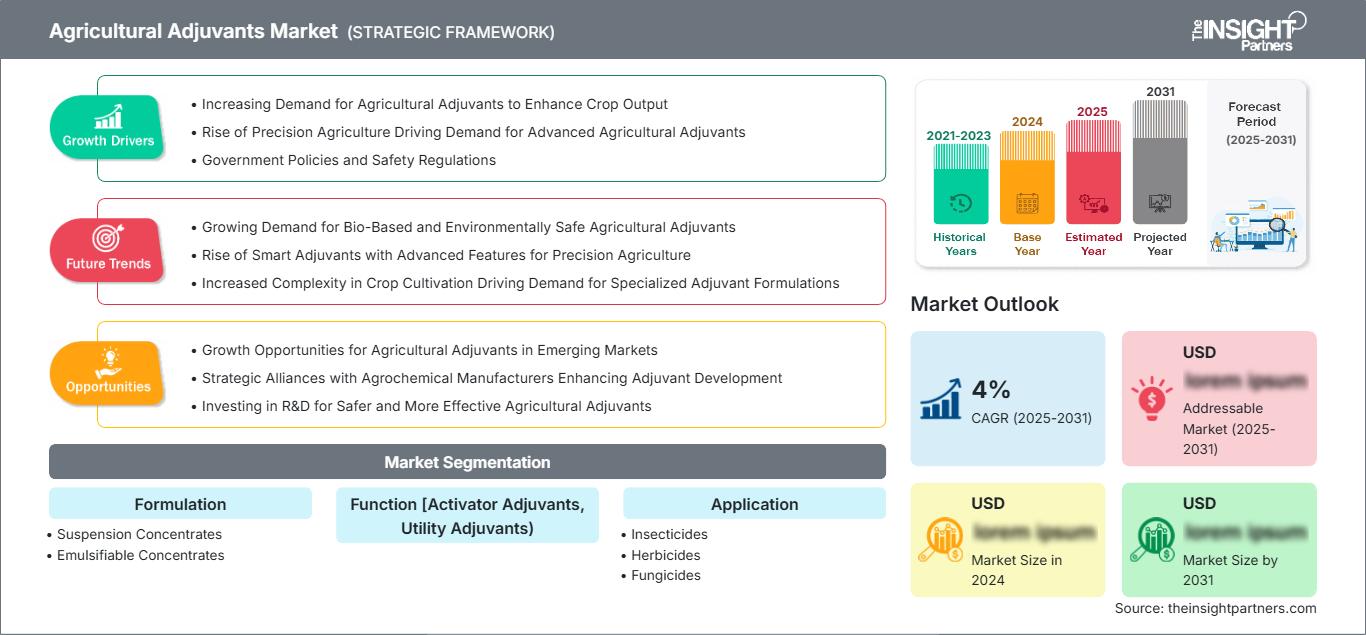
The agricultural adjuvants market is valued at US$ 4.43 billion in 2025 and is projected to reach US$ 7.00 billion by 2034, registering a CAGR of 5.21% during 2026–2034. Growing emphasis on maximizing pesticide performance, improving spray application efficiency, and reducing off-target losses continues to support market expansion. Advancements in precision agriculture, increasing adoption of sustainable crop protection practices, and innovations in multifunctional adjuvant formulations are expected to strengthen long-term demand across commercial farming systems.
Driven by highly mechanized agriculture and widespread adoption of advanced crop protection technologies, North America remains one of the most established regional markets. The agricultural adjuvants market size continues expanding at an estimated 4.9–5.3% CAGR through 2034, supported by increasing use of precision spraying equipment, herbicide resistance management strategies, and growing demand for products that improve pesticide efficacy while optimizing agricultural input utilization.
Agricultural Adjuvants Market Assessment and Insights
- North America: The region benefits from large-scale commercial farming, advanced precision agriculture, and widespread use of crop protection products. Share in 2025: 34–38%; CAGR between 2026–2034: 4.9–5.3%.
- US: Extensive cultivation of corn, soybean, wheat, and cotton supports strong adjuvant adoption across herbicide and fungicide applications. Share in 2025: 81–85% of North America; CAGR between 2026–2034: 4.8–5.2%.
- Europe: Sustainable farming regulations and integrated pest management practices continue driving demand across Germany, France, the UK, Italy, and Spain. Share in 2025: 23–27%; CAGR between 2026–2034: 5.0–5.4%.
- Asia Pacific: Expanding commercial agriculture, increasing agrochemical consumption, and supportive government initiatives accelerate the agricultural adjuvants market development across China, India, Japan, and Australia. Share in 2025: 29–33%; CAGR between 2026–2034: 6.0–6.4%.
- Largest Segment: Function – Activator Adjuvants dominate the market by enhancing pesticide spreading, penetration, and retention across multiple crop protection applications. Market share in 2025: 60–64%; CAGR between 2026–2034: 5.3–5.7%.
- High Growth Segment: Application – Herbicides demonstrates the fastest expansion due to increasing herbicide-resistant weeds and precision weed management practices. Market share in 2025: 45–49%; CAGR between 2026–2034: 5.8–6.2%.
- Key companies analyzed in detail: Bayer AG, Ingevity Corporation, Clariant International Ltd, Croda International Plc, UPL Limited, Ashland Inc., BASF SE, Corteva Agriscience LLC, Nouryon Chemicals Holding B.V., Evonik Industries AG.
Source: The Insight Partners' analysis based on proprietary research, government publications, company annual reports, investor presentations, industry databases, and expert interviews.
In the case of crop protection, there has been an increased focus on advanced adjuvant technologies, which not only enhance the biological efficacy of pesticides but also reduce application losses. Innovation in the area has moved from the simple use of surfactants to multi-purpose products which can provide wetting, spreading, penetrating, depositing and rain-fastness benefits. The ongoing development of precision spraying technologies, biological crop protection products and digital agriculture technologies has encouraged manufacturers to create customized adjuvants for different types of formulations and applications.
Opportunities for future growth are expected to arise from the modernization of agricultural economies, the increase in planting of high value crops and adoption of sustainable agricultural practices. Efforts from regulatory bodies to promote efficient usage of pesticides along with the increased collaborations between agrochemical companies and specialty chemicals companies have encouraged more research into bio-adjuvants and multi-functional chemistries.
Agricultural Adjuvants Market Report Scope
| Report Attribute | Details |
|---|---|
| Market size in 2025 | US$ 4.43 Billion |
| Market Size by 2034 | US$ 7.00 Billion |
| Global CAGR (2026 - 2034) | 5.21% |
| Historical Data | 2021-2024 |
| Forecast period | 2026-2034 |
Agricultural Adjuvants Market Analysis
The agricultural adjuvants market growth is supported by increasing demand for crop protection products that deliver higher biological efficiency with reduced chemical losses. Adjuvants play an increasingly important role within the agricultural value chain by improving pesticide deposition, retention, spreading, and penetration across diverse crop systems. Growing adoption of precision farming technologies, rising concerns regarding herbicide-resistant weeds, and increasing emphasis on sustainable agricultural production continue driving demand. Manufacturers are also strengthening supply chains by expanding production of specialty surfactants, vegetable oil derivatives, organosilicones, and multifunctional additives to meet evolving industry requirements.
Raw material procurement remains closely linked with petrochemical feedstocks, renewable vegetable oils, specialty esters, silicone chemistry, and performance additives. Strategic partnerships between agrochemical producers and specialty chemical manufacturers are enabling development of crop-specific solutions that improve compatibility with modern pesticide formulations. Increasing demand for biological crop protection products is also creating opportunities for innovative adjuvant technologies designed to improve product stability and field performance.
The agricultural adjuvants market analysis indicates that innovation, formulation expertise, regulatory compliance, and agronomic support increasingly define competitive positioning. Bayer AG, BASF SE, Corteva Agriscience LLC, Clariant International Ltd, Croda International Plc, Evonik Industries AG, Nouryon Chemicals Holding B.V., Ashland Inc., Ingevity Corporation, and UPL Limited continue investing in research and development to expand portfolios addressing both conventional and biological crop protection markets. Strategic collaboration, growth of regional manufacturing capability, and customization of products continue to play key roles in long-term differentiation.
Investment areas have started to become more focused on biodegradable chemistry, renewable sources, and multi-functional adjuvants, which enhance spray efficiency without any negative effect on the environment. In addition, manufacturers have started to integrate digital agronomy platforms and application technologies to deliver evidence-based spraying solutions.
● REPORT CUSTOMIZATION
Tailor This Report To Align With Your Specific Business Requirements
This report can be customized to align precisely with your business objectives, scope, and target markets. Customization options include tailored segmentation, geography, competitive analysis, and strategic insights to support informed decision-making.
Customize This Report →WHAT YOU CAN ADJUST
- ● Segmentations
- ● Geography
- ● Competitive Analysis
- ● Language Preferences
Agricultural Adjuvants Market: Strategic Insights
Regional Insights
North America Agricultural Adjuvants Market
North America accounted for an estimated 34–38% share in 2025 and is projected to register a CAGR of 4.9–5.3% during 2026–2034. The agricultural adjuvants market share remains the largest globally owing to extensive commercial farming, widespread precision agriculture adoption, and high utilization of crop protection products across major row crops. Corn, soybean, wheat, cotton, and canola cultivation continue generating consistent demand for advanced adjuvants that improve pesticide spreading, retention, penetration, and spray deposition while reducing off-target drift and maximizing field performance.
Commercial growers increasingly integrate GPS-guided sprayers, drone-assisted crop monitoring, and variable-rate application technologies with advanced adjuvant formulations to improve operational efficiency and reduce overall input costs. Continued investment in digital agriculture, integrated pest management, and herbicide resistance mitigation is supporting sustained market development. Product innovation emphasizing multifunctional, bio-based, and environmentally compatible adjuvants is expected to further strengthen regional competitiveness throughout the forecast period.
U.S. Agricultural Adjuvants Market
The United States represented approximately 81–85% of the North American Agricultural Adjuvants Market in 2025 and is anticipated to expand at a CAGR of 4.8–5.2% through 2034. Extensive cultivation of corn, soybean, cotton, wheat, rice, and specialty crops creates strong demand for adjuvants that enhance pesticide efficacy under diverse climatic and agronomic conditions. Precision spraying technologies and integrated crop management practices continue accelerating adoption across both large commercial farms and specialty crop producers.
Major market participants maintain extensive research facilities, technical support networks, and distribution channels throughout the country. Increasing use of biological crop protection products, drone spraying, and advanced tank-mix technologies is encouraging manufacturers to develop highly compatible adjuvant formulations. Continuous investment in sustainable chemistry and application optimization is expected to reinforce the country's leadership position within the North American market over the forecast period.
Europe Agricultural Adjuvants Market
Europe held an estimated 23–27% share in 2025 and is projected to record a CAGR of 5.0–5.4% during 2026–2034. Germany leads regional demand owing to its advanced agrochemical industry, precision farming adoption, and emphasis on sustainable crop protection technologies. The United Kingdom continues to strengthen demand through increasing implementation of integrated pest management practices and greater adoption of precision application systems that improve pesticide efficiency while reducing environmental impact.
France, Italy, and Spain collectively account for a significant proportion of regional agricultural production, particularly across cereals, vineyards, fruits, vegetables, and oilseeds. Growers increasingly utilize advanced adjuvants to improve spray coverage, rainfastness, and pesticide deposition while meeting stringent environmental regulations. Continued investment in biological crop protection, precision spraying equipment, and sustainable agricultural practices is expected to support steady regional expansion, with Germany maintaining its leading market position.
APAC Agricultural Adjuvants Market
Asia Pacific accounted for approximately 29–33% of the global Agricultural Adjuvants Market in 2025 and is expected to register the fastest regional CAGR of 6.0–6.4% during 2026–2034. China remains the largest regional market due to extensive agricultural production and high agrochemical consumption, while India continues experiencing strong growth supported by agricultural modernization, mechanization, and increasing awareness of efficient pesticide application technologies.
Japan, South Korea, and Australia continue investing in precision agriculture, digital farming, and sustainable crop management practices. Government initiatives promoting food security, higher agricultural productivity, and efficient resource utilization are expected to support long-term adoption of advanced agricultural adjuvant technologies across the region.
Middle East & Africa Agricultural Adjuvants Market
The Middle East & Africa agricultural adjuvants market is projected to expand at a CAGR of 5.4–5.8% during 2026–2034, supported by increasing commercial agriculture, improved irrigation infrastructure, and expanding food security initiatives. Saudi Arabia leads regional adoption through agricultural modernization programs, while the UAE continues promoting protected cultivation and precision farming technologies to optimize crop productivity under water-constrained conditions.
South Africa remains the region's largest agricultural producer, generating consistent demand for advanced crop protection technologies across cereals, fruits, vineyards, and horticultural crops. The Rest of the Middle East & Africa is expected to benefit from increasing mechanization, infrastructure development, and the gradual adoption of precision spraying technologies that improve pesticide efficiency and overall farm productivity.
Segmentation Analysis
Formulation
The Formulation segment is projected to expand at a CAGR of 5.0–5.4% during 2026–2034, driven by continuous innovation in pesticide delivery systems and increasing demand for stable, high-performance formulations. Manufacturers are focusing on formulation technologies that improve storage stability, compatibility with multiple active ingredients, and application efficiency across modern spraying systems. The agricultural adjuvants market scope continues to broaden as advanced formulations support both conventional and biological crop protection products.
- Suspension Concentrates: Suspension concentrates are widely adopted because they provide excellent storage stability, uniform dispersion, and compatibility with a broad range of crop protection products while supporting efficient field application across commercial farming operations.
- Emulsifiable Concentrates: Emulsifiable concentrates remain important for formulations requiring superior spreading, penetration, and rapid mixing characteristics, enabling consistent pesticide performance across diverse crops and varying environmental conditions.
Function
The Function segment is anticipated to register a CAGR of 5.3–5.7% during 2026–2034. Increasing emphasis on maximizing pesticide efficacy and minimizing application losses continues driving demand for specialized adjuvant functions. Product innovation is centered on improving spray deposition, droplet retention, spreading, and compatibility with precision agriculture technologies while supporting regulatory compliance and sustainable farming objectives.
- Activator Adjuvants: Activator adjuvants account for the largest market share because they enhance pesticide absorption, spreading, wetting, and penetration, significantly improving biological performance across herbicides, insecticides, and fungicides.
- Utility Adjuvants: Utility adjuvants improve spray quality by addressing operational challenges such as foaming, drift, evaporation, water conditioning, and equipment cleaning, helping growers achieve more efficient pesticide applications.
Application
The Application segment is expected to grow at a CAGR of 5.5–5.9% during 2026–2034, supported by increasing crop protection requirements and wider adoption of precision spraying technologies. Rising demand for improved pesticide performance across major agricultural crops continues to encourage the use of specialized adjuvants tailored to different crop protection chemistries and application conditions.
- Insecticides: Insecticide applications utilize adjuvants to improve canopy penetration, spray retention, and leaf coverage, increasing pest control efficiency while supporting optimized pesticide utilization across commercial agriculture.
- Herbicides: Herbicides represent the fastest-growing application because adjuvants improve weed control effectiveness, enhance active ingredient uptake, and help manage herbicide-resistant weed populations through improved application performance.
- Fungicides: Fungicide applications increasingly incorporate adjuvants to improve spray uniformity, rainfastness, and disease control efficiency, particularly in high-value fruit, vegetable, vineyard, and specialty crop production systems.
Opportunity Snapshot
| Application | Revenue Contribution | Trend Tag | Adoption Stage |
| Insecticides | Medium | Canopy Coverage | Mature |
| Herbicides | High | Resistance Control | Mature |
| Fungicides | Medium | Disease Shield | Scaling |
Agricultural Adjuvants Market Growth Drivers and Impact Analysis
Increasing Adoption of Precision Agriculture and Smart Spraying Technologies
Precision farming is changing the way of using pesticides because of precise spraying and avoidance of excessive pesticide usage. Agricultural adjuvants are used to optimize droplets, improve spray coverage, retention, and deposition on the plant canopy in order to provide the highest performance of precision technologies. The increased use of sprayers controlled by GPS technology, drones for pesticide application, variable rate applications, and management systems for farms will create more demand for highly sophisticated formulations of adjuvants suitable for use with advanced equipment for spraying. With the rising emphasis of agricultural producers on efficiency and rational input usage, there are increasing investments into development of adjuvants that can make pesticides effective and minimize their drifting, evaporation, and runoff.
Growing Focus on Improving Crop Protection Product Performance
The constant pressure on the maximization of efficiency in agriculture coupled with minimizing production costs has led to the rise of the necessity of highly effective crop protection systems. Adjuvants help to increase the effectiveness of pesticides through improving their spreading, wetting, penetrating ability and rainfastness; therefore, active substances can act in a more effective way depending on different environmental conditions. The farmers increasingly use such products to increase the effectiveness of herbicides, insecticides and fungicides usage without the proportional rise in chemical usage amount. Increasing problems with herbicide resistant plants and pests have raised the demand for new adjuvant technologies which would improve pesticide effectiveness.
Expansion of Biological Crop Protection and Sustainable Agriculture
The shift towards sustainable agriculture practices at a global level has presented many opportunities to the makers of agricultural adjuvants. Growing use of biological pest control agents, microbial solutions, and bio-formulations necessitates the availability of adjuvants compatible with such products to increase their performance and stability. Growing regulatory efforts in terms of lower environmental impacts and efficient use of pesticides have been pushing the development of biodegradable surfactants and other environmentally compatible formulations made using renewable raw materials. There have been growing efforts by companies to partner in research towards developing adjuvants that would work well with both conventional and biological crop protection agents.
Agricultural Adjuvants Market Future Trends
Rising Development of Bio-based and Multifunctional Adjuvant Technologies
The agricultural adjuvants market trends indicate a steady transition toward bio-based and multifunctional formulations that improve pesticide efficiency while addressing environmental and regulatory expectations. Manufacturers are increasingly utilizing renewable feedstocks, biodegradable surfactants, and plant-derived oils to develop products with enhanced wetting, spreading, penetration, and deposition characteristics. Future innovation will focus on adjuvants that remain compatible with conventional agrochemicals as well as biological crop protection products. Increasing investment in sustainable chemistry and green formulation technologies is expected to strengthen product differentiation while enabling growers to achieve higher application efficiency with reduced environmental impact across diverse agricultural production systems.
Integration of Adjuvants with Digital and Autonomous Farming Systems
The quick pace of progress in the field of precision agriculture is prompting research into the creation of adjuvants that have been designed for future generations of application technology. Companies are working on solutions that will reliably function in combination with autonomous sprayers, drones, smart nozzles, and variable rate application machines. Digital agronomy systems are projected to utilize weather, crop growth data, and water quality analysis to make suggestions on adjuvant selection based on specific field circumstances. Demand for innovative adjuvant formulas, which can be used with intelligent spraying devices, will only grow along with global adoption of automation in agriculture.
Agricultural Adjuvants Market Opportunities
Expansion Across Emerging Agricultural Economies
The agricultural adjuvants market forecast depicts high prospects for investments in Asia Pacific, Latin America, the Middle East, and certain parts of Africa as governments around the world are still emphasizing the importance of agricultural modernization and food security programs. High levels of mechanization, growth in commercial production of cereals, oilseeds, fruits, and vegetables along with the realization of the need for optimal use of pesticides, form a good base for the use of adjuvants. Manufacturers with plants and technical support in the region along with dedicated products for crops, are likely to enhance market reach.
Innovation in Adjuvants for Biological Crop Protection Products
The growing commercialization of biological pesticides provides some exciting possibilities to companies focused on the development of innovative adjuvants. Biological products need higher stability, better leaf retention, more optimal spraying, and better environmental compatibility in order to demonstrate their efficiency in the field conditions. Companies that are working on innovative formulation techniques, special surfactants, and renewable raw materials will benefit from their work as biological crop protection becomes more popular. The cooperation between the company, agrochemical manufacturers, and biotechnology firms will help to develop highly effective adjuvants for biological products and biostimulants.
Recent Developments
- March 2026: Clariant AG expanded its agricultural formulation portfolio by introducing Dispersogen PSL 100 and Tonnegel 50 at CAC 2026. The new formulation technologies are designed to enhance the stability, dispersion, and application performance of crop protection products, including agricultural adjuvant formulations and biological solutions, supporting improved spray efficiency and compatibility across modern farming applications.
- March 2025: Evonik Industries AG showcased its latest agricultural adjuvant innovations at ISAA 2025, featuring BREAK-THRU SF 420, BREAK-THRU MSO MAX, and advanced drone spray technologies. The company highlighted bio-based activator adjuvants and formulation solutions designed to improve spray coverage, pesticide uptake, and application efficiency, strengthening its portfolio for precision agriculture and sustainable crop protection.
Frequently Asked Questions

- Comprehensive Market Sizing and Forecast Analysis
- Detailed Segmentation Analysis
- In-Depth Market Dynamics Assessment
- Regional and Country-Level Insights
- Competitive Landscape and Company Benchmarking
- Strategic Business Intelligence
Recent Reports
Testimonials

The Insight Partners' SCADA System Market report is comprehensive, with valuable insights on current trends and future forecasts. The team was highly professional, responsive, and supportive throughout. We are very satisfied and highly recommend their services.
RAN KEDEM Partner, Reali Technologies LTDs
I requested a report on a very specific software market and the team produced the report in a few days. The information was very relevant and well presented. I then requested some changes and additions to the report. The team was again very responsive and I got the final report in less than a week.
JEAN-HERVE JENN Chairman, Future Analytica
We worked with The Insight Partners for an important market study and forecast. They gave us clear insights into opportunities and risks, which helped shape our plans. Their research was easy to use and based on solid data. It helped us make smart, confident decisions. We highly recommend them.
PIYUSH NAGPAL Sr. Vice President, High Beam Global
The Insight Partners delivered insightful, well-structured market research with strong domain expertise. Their team was professional and responsive throughout. The user-friendly website made accessing industry reports seamless. We highly recommend them for reliable, high-quality research services
YUKIHIKO ADACHI CEO, Deep Blue, LLC.
This is the first time I have purchased a market report from The Insight Partners.While I was unsure at first, I visited their web site and felt more comfortable to take the risk and purchase a market report.I am completely satisfied with the quality of the report and customer service. I had several questions and comments with the initial report, but after a couple of dialogs over email with their analyst I believe I have a report that I can use as input to our strategic planning process.Thank you so much for taking the extra time and making this a positive experience.I will definitely recommend your service to others and you will be my first call when we need further market data.
JOHN SUZUKI President and Chief Executive Officer, Board Director, BK Technologies
I wish to appreciate your support and the professionalism you displayed in the course of attending to my request for information regarding to infectious disease IVD market in Nigeria. I appreciate your patience, your guidance, and the fact that you were willing to offer a discount, which eventually made it possible for us to close a deal. I look forward to engaging The Insight Partners in the future, all thanks to the impression you have created in me as a result of this first encounter.
DR CHIJIOKE ONYIA MANAGING DIRECTOR, PineCrest Healthcare Ltd.Reason to Buy
- Informed Decision-Making
- Understanding Market Dynamics
- Competitive Analysis
- Identifying Emerging Markets
- Customer Insights
- Market Forecasts
- Risk Mitigation
- Boosting Operational Efficiency
- Strategic Planning
- Investment Justification
- Tracking Industry Innovations
- Aligning with Regulatory Trends





 Get Free Sample for