
Air Traffic Control Market Demand, Share & Growth by 2034
Coverage: by Component (Hardware, Software); Center (Air Traffic Control Tower (ATCT), Air Traffic Control System Command Center (ATCSCC), Air Route Traffic Control Center (ARTCC), Flight Service Station (FSS), Terminal Radar Approach Control (TRACN)); Application (Communication, Navigation, Surveillance, Automation); End-user (Defense, Commercial) , and Geography (North America, Europe, Asia Pacific, and South and Central America)
- Status : Data Released
- Report Code : TIPRE00005420
- Category : Aerospace and Defense
- No. of Pages : 150
- Available Report Formats :


- Last update date : November 02, 2026


2025 Market Size
US$ 15.14 Bn
Base year value
2034 Forecast
US$ 24.21 Bn
Projected by 2034
CAGR 2026-2034
5.35 %
Growth rate
Addressable Market
US$ 178.43 Bn
(2026-2034)
The air traffic control market was valued at US$ 15.14 Billion in 2025 and is expected to reach US$ 24.21 Billion by 2034, reflecting a corrected CAGR of 5.35% during 2026–2034. The market encompasses hardware and software supporting communications, navigation, surveillance, and automation across towers, control centers, route centers, flight service stations, and terminal radar facilities. Demand is shaped by rising flight volumes, airspace complexity, modernization of legacy infrastructure, cybersecurity requirements, and the transition toward integrated digital air traffic management.
Across North America, the air traffic control market size is supported by extensive installed infrastructure, high controller workloads, and sustained replacement requirements for communications, surveillance, navigation, and automation systems. The regional market is projected to expand at a defensibly modeled CAGR of ~5% through 2034, supported by modernization programs, digital communications, trajectory management, and investment in resilient national airspace infrastructure. The FAA has identified aging ATC systems as a continuing modernization priority, while NextGen has already shifted significant functions toward digital communications, satellite-enabled navigation and surveillance, and integrated information exchange.
Air Traffic Control Market Assessment and Insights
Regional Outlook
- North America: ~35% of the global market in 2025 | ~5% CAGR through 2034. Market position: North America represents the largest regional market, supported by a large installed base, dense commercial aviation activity, defense requirements, and extensive modernization programs covering communications, surveillance, automation, and airspace information management.
- US: ~80% of North American market revenue in 2025 | ~5% CAGR through 2034. Market position: The US accounts for the majority of North American demand because of the scale of its national airspace system, extensive controller infrastructure, airport network, and ongoing replacement of aging ATC hardware, software, telecommunications, and radar systems.
- Europe: ~28% of the global market in 2025 | ~4% CAGR through 2034. Market position: Europe has a mature and highly integrated ATM ecosystem. The UK, Germany, France, Italy, and Spain are major national markets, with demand shaped by airspace efficiency, SESAR programs, digitalization, cross-border coordination, and sustainability objectives.
- Asia Pacific: ~25% of the global market in 2025 | ~7% CAGR through 2034. Market position: Asia Pacific is the fastest-growing region, driven by expanding passenger traffic, airport construction, modernization of surveillance networks, and rising demand for automated ATM capabilities. China is the leading country in Asia Pacific, followed by established markets including Japan, South Korea, India, and Australia.
Segment Outlook
- Hardware: ~58% Share in 2025 | ~5% CAGR through 2034. Market position: Hardware leads because radar, communications equipment, navigation infrastructure, controller workstations, surveillance systems, and associated equipment constitute the physical foundation of ATC operations and require replacement, expansion, and technology upgrades.
- Automation: ~22% Share in 2025 | ~7% CAGR through 2034. Market position: Automation is the high-growth main segment as air navigation service providers seek greater controller decision support, conflict detection, trajectory management, digital tower capabilities, and capacity optimization without proportionally expanding manual workloads.
Competitive Coverage
Adacel Technologies Limited, BAE Systems plc, Harris Corporation, Honeywell International Inc., Indra Sistemas, S.A., Leonardo S.p.A., Lockheed Martin Corporation, Northrop Grumman Corporation, Raytheon Company, Thales Group
Methodology
The Insight Partners follows Data Collection & Secondary Research, Primary Research, Data Analysis, and Data Triangulation & Final Review to validate market estimates and insights.
Source: The Insight Partners' analysis based on proprietary research, government publications, company annual reports, investor presentations, industry databases, and expert interviews.
The air traffic control market has grown to be more of a combination of technologies that use digital platforms that include surveillance, data communication, satellite navigation, automation, and management of information. In the US, NextGen has made some capabilities move from ground systems into satellite navigation and surveillance technology. Digital communication and information exchange have become an integral part of decision making by the controllers. This development has been seen in Europe too where efforts are being made to achieve synchronization among aircrafts, controllers, airports, and network managers.
In the future, procurement will see more instances where the replacement of infrastructure will occur with the transformation to digitization. Some of the emerging aviation markets in Asia Pacific and the Middle East region have been expanding their capacity at airports and developing their national and regional ATMs. Europe is concurrently looking for network efficiency and trajectory synchronization. According to EUROCONTROL, the traffic levels in Europe returned to pre-pandemic levels in 2025 and is expecting further growth in traffic levels in 2026-2032.
Air Traffic Control Market Report Scope
| Report Attribute | Details |
|---|---|
| Market size in 2025 | US$ 15.14 Billion |
| Market Size by 2034 | US$ 24.21 Billion |
| Global CAGR (2026 - 2034) | 5.35% |
| Historical Data | 2021-2024 |
| Forecast period | 2026-2034 |
Air Traffic Control Market Analysis
Air Traffic Control Market Growth Dynamics are linked with rising number of flights, capacity expansion of airports, controller workload, safety considerations, and improvement in airspace utilization efficiency. Market demand starts with air navigation service providers, civil aviation authorities, defense agencies, and airports that set specifications for communications, navigation, surveillance, and automation systems. The system integration includes the design of a combination of radar, radio, data processing, controller workstations, software, networks, and cybersecurity elements into operational architectures. The issue of replacement becomes especially critical when legacy systems cannot be supported any longer or become incompatible with new digital standards. Modernization studies carried out by FAA show the challenges generated by legacy systems in a high-throughput national airspace.
The air traffic control market trend is shifting more toward suppliers who have the ability to integrate the various functions of ATC rather than those who can provide individual components. Radar companies will be competing against software firms, communications companies, simulators, and major defense companies. The cycle of acquisition is long due to the need for safety validation, testing for interoperability, controller training, and approval. Therefore, the experience of the installed base, the ability to certify the systems, to integrate them, and the overall lifecycle support can have an impact on the selection of the suppliers.
Competition in the air traffic control market report is made up of established defense and aerospace companies together with dedicated ATM technology firms. Thales and Indra are characterized by wide-ranging portfolios of surveillance, communications, automation, and control center systems, while Honeywell offers navigation, communications, airport, and air-side technologies. Leonardo, BAE Systems, Lockheed Martin, Northrop Grumman, and Raytheon Company are involved through various mixes of surveillance, command and control, defense, communications, and systems integration abilities. Adacel Technologies Limited offers simulation, training, and digital tower offerings.
Investments are increasingly being made into software defined architecture, digital communications, remote towers, AI-based decision support systems, cybersecurity, and trajectory based operations. Indra’s FAA NEXCOM offering demonstrates the need to move away from analog air-ground communications into digital and VoIP capable ones. At the same time, Thales continues growing its ATM offerings in civil aviation. The investments show that competitive positioning does not depend just on hardware capabilities but also on integration, modernization, cybersecurity, and services.
● REPORT CUSTOMIZATION
Tailor This Report To Align With Your Specific Business Requirements
This report can be customized to align precisely with your business objectives, scope, and target markets. Customization options include tailored segmentation, geography, competitive analysis, and strategic insights to support informed decision-making.
Customize This Report →WHAT YOU CAN ADJUST
- ● Segmentations
- ● Geography
- ● Competitive Analysis
- ● Language Preferences
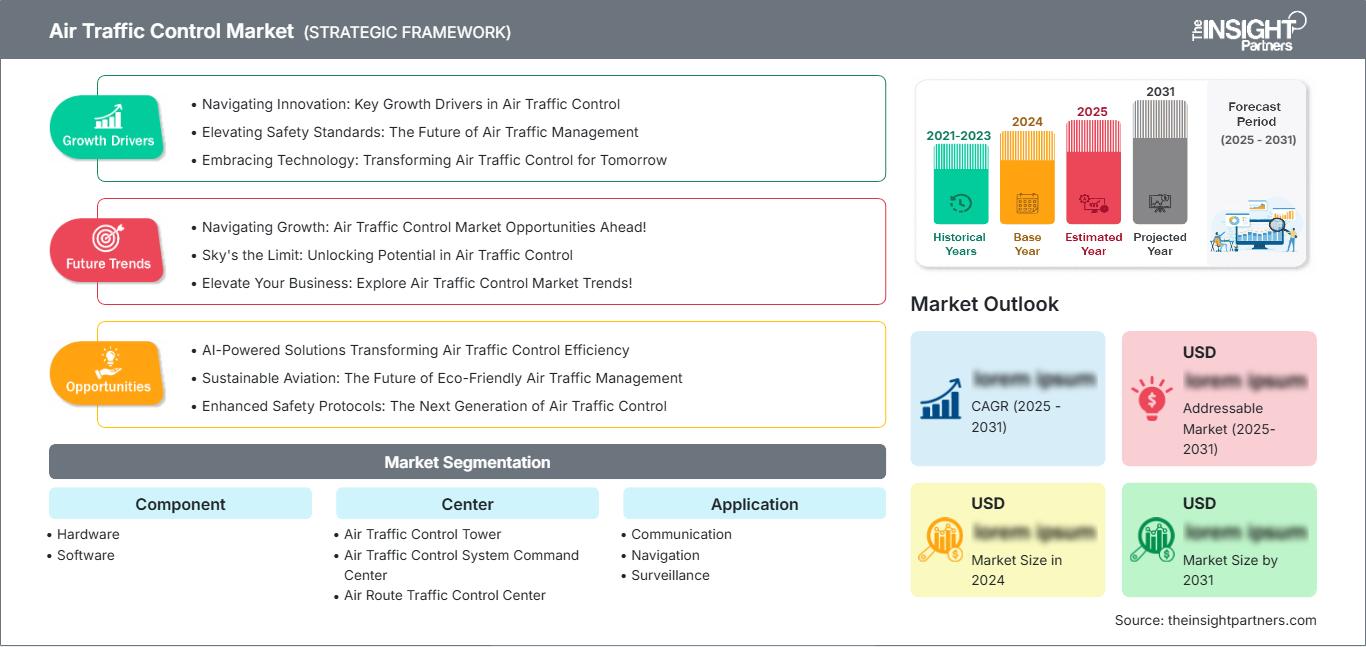
Air Traffic Control Market: Strategic Insights
Regional Insights
North America air traffic control market
North America represents the largest regional demand center, with ~5% CAGR through 2034. The US accounts for the majority of regional activity because the Federal Aviation Administration operates one of the world's largest and most complex national airspace systems. Canada contributes through modernization of surveillance, communications, and flight-data infrastructure, while demand in Mexico is linked to airport expansion and airspace modernization. The regional installed base creates recurring opportunities for replacement and integration rather than only greenfield deployments.
Modernization demands for the US market are emerging in areas such as radar, telecommunication, control systems, navigation, and automation. According to FAA documentation, NextGen has produced some operational gains due to the use of digital communication, satellite navigation and surveillance, and information exchange. FAA also intends to continue with the modernization process by replacing outdated equipment.
U.S. air traffic control market
North America generates approximately 80% of all revenue, and it is expected to grow at a 5% CAGR till 2034. The demand is mainly driven from the en-route centers, terminal buildings, air traffic control towers, and the related communication and surveillance systems. Because of the large amount of the existing infrastructure, there are two major requirements to maintain the current systems and implement newer digital systems.
There are numerous companies operating within the industry, including Adacel Technologies Limited, Honeywell International Inc., Lockheed Martin Corporation, Northrop Grumman Corporation, Raytheon Company, BAE Systems plc, among others. Modernization of the FAA has led to the increasing role of digital communications, trajectory management, surveillance modernization, and controllers support technologies. GAO has pointed out the aging of the air traffic control infrastructure and workforce shortage as the factors influencing system performance.
Europe air traffic control market
Europe is estimated to hold a ~28% of the global air traffic control market share in 2025, growing at a ~4% CAGR from 2025-2034. Europe boasts a developed ATM infrastructure base; however, there is an ongoing need for interoperability and coordination on a network level due to fragmentation among national air navigation service providers. The UK has a robust ATM system thanks to NATS and major airports, while Germany, France, Italy, and Spain add a large share of commercial aircraft control and operation. France and Germany are considered to be key markets in Europe, which have well-developed airspace operations and capabilities in the ATM sphere.
In the UK, there is an influence of airport density and efficiency in airspaces. In Germany, there is a combination of large passenger and freight traffic volume with a large amount of en-route and terminal requirements. France is characterized by a powerful civil and military aerospace sector, while Italy and Spain have large aviation volumes of the tourist nature and distributed airports' networks. According to EUROCONTROL, European traffic volume reached its pre-COVID-19 level in 2025 (11.05 million flights).
Investment across Europe increasingly emphasizes trajectory-based operations, integrated network management, digital communications, remote and virtualized services, and environmental efficiency. SESAR initiatives are testing approaches that synchronize aircraft and ground trajectories using four-dimensional data, enabling better capacity utilization and operational predictability.
APAC air traffic control market
Asia Pacific held ~25% of global revenue in 2025 and is projected to grow at ~7% CAGR through 2034, making it the fastest-growing region. China is the leading country in Asia Pacific, supported by large aviation volumes, airport investment, and continued development of national ATM infrastructure. Japan and South Korea have mature systems requiring modernization, while India and Australia present opportunities associated with expanding traffic, airport development, and digitalization.
China and India are important demand centers because of their expanding aviation ecosystems, while Japan and South Korea emphasize sophisticated surveillance and automation. Australia requires advanced ATM capabilities across a geographically extensive airspace. IATA data show particularly strong international traffic growth in Asia Pacific during 2025, reinforcing the need for scalable surveillance, communication, navigation, and automation infrastructure.
Middle East & Africa air traffic control market
Middle East & Africa is supported by ~6% CAGR through 2034. Saudi Arabia and the UAE are important markets in the Middle East because major airports, airline hubs, defense requirements, and national aviation strategies require advanced surveillance and airspace-management infrastructure. South Africa represents a key African market, while the Rest of MEA includes countries investing selectively in airport and airspace modernization.
The Middle East combines high-volume hub operations with large-scale airport development and increasingly complex regional traffic flows. Africa presents a more heterogeneous opportunity profile, with modernization often focused on surveillance coverage, communications reliability, navigation infrastructure, and training. Digital tower systems and automation can be particularly relevant where service providers seek to improve coverage and operational capability without replicating the full infrastructure footprint of conventional facilities.
Segmentation Analysis
Component
Component segment in the air traffic control market is divided into Hardware and Software. The segment is projected to grow at ~5% CAGR through 2034. Hardware remains central because radar, radios, navigation aids, controller displays, processing equipment, and networking infrastructure form the physical foundation of airspace operations. Software demand is rising as operators migrate toward integrated automation, data processing, cybersecurity, and decision-support architectures.
- Hardware: Hardware includes surveillance equipment, communications systems, navigation infrastructure, controller working positions, processors, and associated networking equipment. Replacement of aging installations and expansion at airports and control centers sustain demand, while newer digital architectures increasingly require modular, interoperable equipment.
- Software: Software supports flight-data processing, surveillance processing, controller decision support, conflict detection, trajectory management, information exchange, and system monitoring. Demand is strengthened by virtualization, automation, remote operations, cybersecurity requirements, and the need to integrate heterogeneous legacy and next-generation systems.
Center
Center segment in the air traffic control market includes Air Traffic Control Tower, Air Traffic Control System Command Center, Air Route Traffic Control Center, Flight Service Station, and Terminal Radar Approach Control. The segment is expected to grow at ~4% CAGR through 2034. Investment differs by facility type, with towers emphasizing surface and terminal operations while route centers require extensive surveillance, flight-data, and communications capabilities.
- Air Traffic Control Tower: Towers require systems for aircraft sequencing, surface movement, communications, navigation, surveillance, and runway safety. Airport expansion and remote tower adoption create demand for integrated control environments and centralized service models.
- Air Traffic Control System Command Center: Command centers coordinate national or regional traffic flows, particularly during congestion, weather disruptions, and capacity constraints. Digital decision-support tools improve network visibility and enable earlier intervention in traffic management.
- Air Route Traffic Control Center: Route centers manage aircraft across high-volume en-route airspace. Their technology requirements include long-range surveillance, flight-data processing, controller communications, trajectory management, and automated conflict-detection capabilities.
- Flight Service Station: Flight service stations support pilots with operational information, weather, flight planning, and related services. Modernization increasingly relies on digital information delivery and integration with broader aviation information systems.
- Terminal Radar Approach Control: Terminal radar approach facilities coordinate aircraft arriving and departing through congested terminal airspace. Surveillance accuracy, controller displays, sequencing, and automation are strategically important for improving runway utilization and maintaining safe separation.
Application
Application segment in the air traffic control market comprises Communication, Navigation, Surveillance, and Automation. The segment is expected to grow at ~7% CAGR through 2034. Automation is the strongest growth contributor as service providers seek to increase capacity, reduce controller workload, improve situational awareness, and coordinate increasingly data-intensive airspace operations.
- Communication: Communication systems provide reliable aircraft-to-ground and ground-to-ground connectivity. Migration from legacy analog equipment toward digital and IP-enabled systems supports replacement demand, resilience, interoperability, and greater data exchange.
- Navigation: Navigation technologies support accurate aircraft positioning and route execution. Satellite-enabled navigation and performance-based procedures are reducing dependence on some conventional ground-based methods while increasing requirements for resilient positioning and navigation infrastructure.
- Surveillance: Surveillance combines radar, transponder, ADS-B, surface detection, and data processing to maintain aircraft awareness. Demand reflects higher traffic density, improved coverage requirements, airport safety objectives, and the need to integrate cooperative and non-cooperative surveillance sources.
- Automation: Automation covers conflict detection, trajectory management, decision support, traffic sequencing, remote tower functions, and other software-driven capabilities. Its strategic importance is increasing as controllers must manage higher information volumes and more complex airspace interactions.
End-user
End-user segment in the air traffic control market includes Defense and Commercial. The segment is projected to grow at ~5% CAGR through 2034. Commercial aviation generates broad demand through airports, air navigation service providers, and civil aviation authorities, while defense users require surveillance, command-and-control, secure communications, and specialized airspace-management capabilities.
- Defense: Defense applications require resilient surveillance, secure communications, airspace coordination, and command-and-control capabilities. Integration with broader defense networks increases demand for systems capable of operating across civil and military airspace environments.
- Commercial: Commercial users include civil aviation authorities, airports, airlines, and air navigation service providers. Demand is driven by passenger traffic, airport expansion, congestion management, safety requirements, and modernization of legacy communications, navigation, surveillance, and automation infrastructure.
Opportunity Snapshot
| End-user | Revenue Contribution | Trend Tag | Adoption Stage |
|---|---|---|---|
| Defense | Medium | Secure Airspace | Mature |
| Commercial | High | Traffic Automation | Scaling |
Air Traffic Control Market Growth Drivers and Impact Analysis
Rising airspace congestion and controller workload
Increasing flight activity raises the operational value of systems that improve controller productivity, traffic sequencing, and airspace utilization. The effect is particularly visible in high-density markets where additional flight movements can create bottlenecks without corresponding increases in controller capacity or physical infrastructure. In the US, GAO has highlighted the scale of the national airspace system and the dependence of controllers on numerous interconnected systems for surveillance, communications, navigation, and weather information. This creates demand for automation, conflict detection, digital communications, and integrated decision support. The commercial impact extends beyond new system purchases because operators also require upgrades, software releases, cybersecurity improvements, training, maintenance, and lifecycle support.
Replacement of aging air traffic infrastructure
Legacy infrastructure is creating a sustained replacement cycle across communications, surveillance, navigation, processing, and telecommunications. Modern ATM systems increasingly require interoperable digital architectures that can exchange information across facilities rather than relying on isolated equipment. In the US, government assessments have identified substantial portions of FAA's ATC portfolio as unsustainable or potentially unsustainable, while the agency's modernization initiative targets replacement of outdated radar, software, hardware, and telecommunications infrastructure. This environment creates opportunities for suppliers offering migration pathways that preserve operational continuity while introducing new capabilities. The impact is also relevant in mature international markets where installed systems remain operational but increasingly require modernization to meet cybersecurity, data-sharing, and performance requirements.
Digitalization of communications, surveillance, and automation
Digital transformation is changing the composition of ATM investment by shifting value toward software, data processing, automation, and network connectivity. Digital communications allow controllers and pilots to exchange information more efficiently, while integrated surveillance sources improve situational awareness. Automation can support trajectory management, conflict detection, sequencing, and controller decision-making. FAA NextGen programs have already introduced operational capabilities based on digital communications and satellite-enabled navigation and surveillance. European initiatives similarly emphasize four-dimensional trajectory exchange and coordinated aircraft-ground operations. For vendors, this expands the opportunity beyond replacement hardware into recurring software, systems integration, cybersecurity, analytics, simulation, and support services.
Air Traffic Control Market Future Trends
AI-assisted trajectory and traffic-flow management
AI-assisted ATM is likely to move from experimental decision support toward operational deployment where regulators can validate reliability, explainability, and safety performance. Algorithms can combine flight schedules, weather, airport capacity, surveillance information, and historical traffic patterns to identify congestion and recommend interventions. The emerging model is not necessarily autonomous control; instead, AI can provide controllers and traffic managers with earlier warnings, scenario comparisons, and optimized routing options. Recent FAA activity illustrates this direction, with AI-based tools being introduced to support traffic-flow decisions and reduce delays. As adoption expands, suppliers will need to demonstrate robust data governance, cybersecurity, human oversight, and compatibility with existing safety-critical architectures.
Trajectory-based and connected airspace operations
Trajectory-based operations are expected to become more important as aircraft, controllers, airports, and network managers exchange richer four-dimensional flight information. Rather than managing aircraft only through discrete tactical instructions, the system can continuously compare planned and actual trajectories and adjust operations based on changing conditions. European SESAR work is testing this approach to improve capacity and reduce unnecessary fuel consumption, while aircraft manufacturers and ATM suppliers are collaborating on connected operational concepts. The air traffic control market trend could increase demand for high-integrity data links, interoperable flight-data processing, advanced surveillance, and automation capable of coordinating information across multiple operational stakeholders.
Air Traffic Control Market Opportunities
Modernization-as-a-service for legacy ATM infrastructure
A substantial commercial opportunity in the air traffic control market forecast exists in modernization programs that replace aging systems without requiring complete operational shutdowns. Service providers can combine hardware refreshes, software migration, cybersecurity, communications upgrades, testing, training, and lifecycle support into phased modernization packages. This model is relevant to national authorities and air navigation service providers that operate complex installed bases and must maintain continuity while introducing new architectures. Suppliers with established integration capabilities can use modular approaches to migrate individual facilities before connecting them into wider networks. The opportunity also extends to recurring maintenance and software support because safety-critical systems require continuous certification, patching, configuration management, and performance monitoring throughout their operational lives.
Digital towers and scalable ATM for emerging aviation hubs
Remote and digital tower technologies provide an opportunity for airports and national aviation authorities seeking to expand air traffic services without duplicating conventional tower infrastructure at every location. High-resolution cameras, sensors, communications, data processing, and controller interfaces can support centralized service delivery across multiple airports. Adacel Technologies Limited's recent remote tower deployment activity demonstrates commercial interest in this operating model, particularly where training, simulation, and operational systems can be combined. The opportunity is relevant to emerging aviation hubs in Asia Pacific, the Middle East, and other markets where airport networks are expanding and operators require scalable service models.
Frequently Asked Questions

- Comprehensive Market Sizing and Forecast Analysis
- Detailed Segmentation Analysis
- In-Depth Market Dynamics Assessment
- Regional and Country-Level Insights
- Competitive Landscape and Company Benchmarking
- Strategic Business Intelligence
Recent Reports
Testimonials

The Insight Partners provided valuable market intelligence that supported our global go-to-market strategy. Their team was professional, responsive, and attentive to our feedback, providing thoughtful analysis and helpful methodological clarifications throughout the project.
Junmo Kim Chief Financial Officer (CFO), Enertech Co., Ltd.
The Insight Partners' SCADA System Market report is comprehensive, with valuable insights on current trends and future forecasts. The team was highly professional, responsive, and supportive throughout. We are very satisfied and highly recommend their services.
RAN KEDEM Partner, Reali Technologies LTDs
I requested a report on a very specific software market and the team produced the report in a few days. The information was very relevant and well presented. I then requested some changes and additions to the report. The team was again very responsive and I got the final report in less than a week.
JEAN-HERVE JENN Chairman, Future Analytica
We worked with The Insight Partners for an important market study and forecast. They gave us clear insights into opportunities and risks, which helped shape our plans. Their research was easy to use and based on solid data. It helped us make smart, confident decisions. We highly recommend them.
PIYUSH NAGPAL Sr. Vice President, High Beam Global
The Insight Partners delivered insightful, well-structured market research with strong domain expertise. Their team was professional and responsive throughout. The user-friendly website made accessing industry reports seamless. We highly recommend them for reliable, high-quality research services
YUKIHIKO ADACHI CEO, Deep Blue, LLC.
This is the first time I have purchased a market report from The Insight Partners.While I was unsure at first, I visited their web site and felt more comfortable to take the risk and purchase a market report.I am completely satisfied with the quality of the report and customer service. I had several questions and comments with the initial report, but after a couple of dialogs over email with their analyst I believe I have a report that I can use as input to our strategic planning process.Thank you so much for taking the extra time and making this a positive experience.I will definitely recommend your service to others and you will be my first call when we need further market data.
JOHN SUZUKI President and Chief Executive Officer, Board Director, BK Technologies
I wish to appreciate your support and the professionalism you displayed in the course of attending to my request for information regarding to infectious disease IVD market in Nigeria. I appreciate your patience, your guidance, and the fact that you were willing to offer a discount, which eventually made it possible for us to close a deal. I look forward to engaging The Insight Partners in the future, all thanks to the impression you have created in me as a result of this first encounter.
DR CHIJIOKE ONYIA MANAGING DIRECTOR, PineCrest Healthcare Ltd.Reason to Buy
- Informed Decision-Making
- Understanding Market Dynamics
- Competitive Analysis
- Identifying Emerging Markets
- Customer Insights
- Market Forecasts
- Risk Mitigation
- Boosting Operational Efficiency
- Strategic Planning
- Investment Justification
- Tracking Industry Innovations
- Aligning with Regulatory Trends





 Get Free Sample for