
Automotive Flooring Market Size & Demand Insights 2034
Coverage: By Material (Polypropylene, Polyamide 6, Polyamide 66, Thermoplastic Elastomers, Rubber, PVC, Polyester, Recycled Polymers, and Others), Product Type (Floor Carpets, Floor Mats, Trunk Mats, Cargo or Load Floor Systems, and Others), Manufacturing Process (Tufted Carpets, Needle-Punch Carpets, Compression Molding or Thermoforming, Injection Molding, and Others), Vehicle Type (Passenger Cars, Light Commercial Vehicles, and Heavy Commercial Vehicles), and Geography (North America, Europe, Asia Pacific, the Middle East and Africa, and South and Central America)
- Status : Published
- Report Code : TIPRE00002783
- Category : Chemicals and Materials
- No. of Pages : 460
- Available Report Formats :


- Last update date : October 06, 2026


2025 Market Size
US$ 9,026.30 Mn
Base year value
2034 Forecast
US$ 13,446.65 Mn
Projected by 2034
CAGR 2026-2034
4.5 %
Growth rate
Addressable Market
US$ 101,890.76 Mn
(2026-2034)
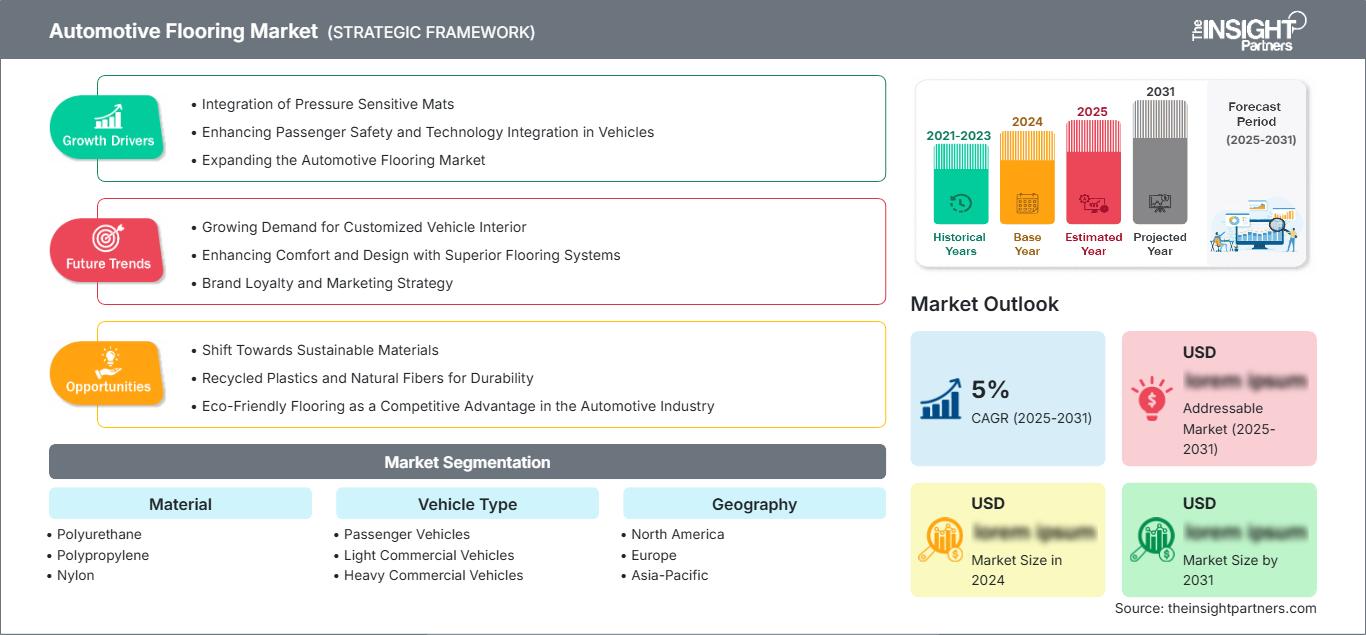
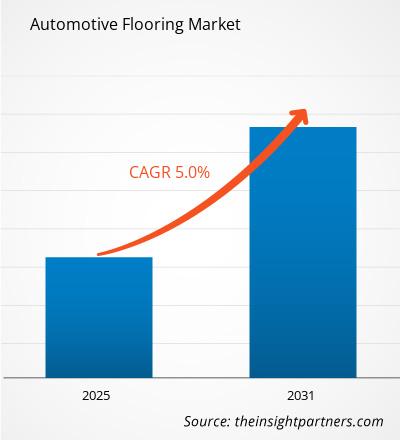
In 2025, the global automotive flooring market had a value of US$ 9,026.30 million and is expected to amount to US$13,446.65 million by 2034, thus achieving a CAGR of 4.5% between 2026 and 2034. The market includes floor carpets, mats, trunk and cargo flooring, and other related systems, which are made from polymeric, textile, rubber, and recycled materials for use in passenger and commercial vehicles. The demand for these products is affected by vehicle production, interior comfort requirements, acoustic performance, lightweighting, durability, and the growing use of recyclable materials.
The automotive flooring market in North America is well developed and is backed by a solid base of vehicle manufacturing, steady demand for replacements, and a growing use of lightweight and recyclable flooring systems. During the period up to 2034, the region is projected to see a compound annual growth rate of about 4 percent, with demand being driven by electric vehicle production, higher specifications for interior features, and suppliers' increased investment in manufacturing locally. Together with the car makers' requirements regarding reduced vehicle weight and better cabin acoustics, these factors are prompting suppliers to redesign the carpet substrates, the insulation layers, and the integrated flooring assemblies.
Automotive Flooring Market Assessment and Insights
Regional Outlook
- North America: ~24% of the global market in 2025 | ~4% CAGR through 2034. Market position: North America remains a major regional market, supported by established OEM production, strong supplier networks, replacement activity, and increasing adoption of lightweight flooring systems for passenger vehicles and commercial platforms
- US: ~80% of North American market revenue in 2025 | ~4% CAGR through 2034. Market position: The US represents the largest country market within North America, supported by its vehicle production base, large passenger-vehicle fleet, commercial vehicle demand, and established Tier 1 supplier ecosystem serving domestic and international OEMs
- Europe: ~22% of the global market in 2025 | ~3% CAGR through 2034. Market position: Europe is a mature automotive flooring market, with Germany leading regional demand, followed by the UK, France, Italy, and Spain. Lightweight construction, recycling requirements, and premium vehicle interiors support continued supplier innovation
- Asia Pacific: ~47% of the global market in 2025 | ~5% CAGR through 2034. Market position: Asia Pacific is the largest and fastest-growing regional market, supported by high vehicle production, expanding domestic OEM ecosystems, increasing EV manufacturing, and growing adoption of locally produced interior components. China leads regional demand
Segment Outlook
- Floor carpets: 48% of the market in 2025 | a compound annual growth rate of about 4% through 2034. The reason floor carpets are the largest product category is that they provide both a cabin appearance and passenger comfort, along with acoustic control, insulation, and floor protection. Demand for them remains strong due to integration by original equipment manufacturers and the growing use of molded and nonwoven systems across different vehicle platforms
- Recycled polymers: A market share of about 10% in 2025 and a compound annual growth rate of about 8% through 2034. In terms of market position, recycled polymers are the high-growth material category since car manufacturers and suppliers are increasing the amount of recycled content, simplifying their material combinations, and creating recyclable mono-material flooring systems. The shift is being supported by regulatory pressure and the need to consider vehicles at the end of their life
Competitive Coverage
SUMINOE Co., Ltd., Hitkari Hitech Private Limited, Bajaj Carpet Industries Limited, 3M Co, Autoneum Holding Ltd, TOYOTA BOSHOKU CORPORATION, UGN, Inc., Auria Solutions, HAYASHI TELEMPU CORPORATION, Lydall Inc, Adler Pelzer Holding GmbH, Ergis S.A., EIDAIKAKO CO., LTD, FroGum Sp. z o.o., A.T. Industries GmbH.
Methodology
The Insight Partners follows Data Collection & Secondary Research, Primary Research, Data Analysis, and Data Triangulation & Final Review to validate market estimates and insights.
Source: The Insight Partners' analysis based on proprietary research, government publications, company annual reports, investor presentations, industry databases, and expert interviews.
The market has moved from using traditional textile carpets and rubber mats to engineered flooring systems, which combine pleasing surface appearance with acoustic insulation, reduced weight, durability, and easier integration into the manufacturing process. There is a growing use of nonwoven carpets, molded parts, thermoplastic systems, and fiber-based insulation in order to improve component weight and vehicle NVH performance. The manufacturing processes have also become more integrated, thanks to techniques such as tufting, needle punching, thermoforming, compression molding, and injection molding, which allow for vehicle-specific shapes and the combination of different functions. Recycled polyester, polypropylene, and other recovered polymers are being used more and more in flooring materials as the suppliers meet the OEMs' sustainability requirements.
In the future, the electrification of vehicles is likely to affect flooring requirements by placing a greater focus on lightweight construction, cabin acoustics, thermal management, and material circularity. Investments are being drawn to new manufacturing sites in the Asia Pacific and North America as vehicle manufacturers look to shorten their supply chains and source materials locally. At the same time, changes in European regulation concerning recycled content, vehicle circularity, and the treatment of vehicles at the end of their life are prompting suppliers to simplify the materials they use. These factors will therefore help to lead to the development of carpets that are recyclable, lightweight floor insulators, and integrated flooring systems by 2034.
Automotive Flooring Market Report Scope
| Report Attribute | Details |
|---|---|
| Market size in 2025 | US$ 9,026.30 Million |
| Market Size by 2034 | US$ 13,446.65 Million |
| Global CAGR (2026 - 2034) | 4.5% |
| Historical Data | 2021-2024 |
| Forecast period | 2026-2034 |
Automotive Flooring Market Analysis
There is a close relationship between demand and global vehicle production, although the requirements for products now go well beyond simple floor coverage. The original equipment manufacturers are looking for flooring components that have abrasion resistance, dimensional stability, acoustic absorption, thermal insulation, a low weight, and a consistent appearance. The value chain involves polymer and fiber producers, nonwoven and textile processors, compounders, carpet makers, molding specialists, Tier 1 interior suppliers, and the vehicle manufacturers themselves. The process of qualifying suppliers is affected by their tooling capability, the consistency of their material, results from acoustic testing, fire performance, logistics, and their ability to produce components specific to each model.
The availability of supplies is becoming more regional as car manufacturers set up their production in China, India, Southeast Asia, Mexico, and North America. Suppliers who have vertical integration in the areas of fiber, textiles, molding, and assembly are able to reduce the amount of material handling and to coordinate the specifications of their components with the original equipment manufacturer's programs. The use of recycled polymer is also becoming strategically important since higher requirements for recycled content can lead to competition for appropriate feedstocks. Cost is still an important factor, especially in the case of high-volume passenger vehicles, while in the case of premium vehicles, higher-value carpet constructions and integrated acoustic systems are supported.
The market situation involves global Tier 1 suppliers as well as specialist flooring manufacturers. Autoneum has created a range of interior floor products, which include needlepunch and tufted carpets, floor insulators, and technologies using recycled materials, whereas Auria Solutions provides flooring systems comprising carpets, mats, insulators, and absorptive systems. SUMINOE offers floor carpets and car mats together with more extensive capabilities in automotive textiles. TOYOTA BOSHOKU CORPORATION and HAYASHI TELEMPU CORPORATION have established strong positions in the field of integrated vehicle interiors and floor carpet systems.
More of the investment is now being made in lightweighting, recycling, acoustic performance, and manufacturing locally. Bajaj Carpet Industries Limited and Hitkari Hitech Private Limited have the ability to manufacture locally in India, whereas UGN supplies vehicles made in Japan through its manufacturing network in North America. Adler Pelzer Holding GmbH offers combined carpet and insulation technologies, and FroGum places a strong emphasis on rubber and TPE floor mats and trunk liners. The way the market is structured gives an advantage to suppliers who can combine material innovation with large-scale production for original equipment manufacturers.
● REPORT CUSTOMIZATION
Tailor This Report To Align With Your Specific Business Requirements
This report can be customized to align precisely with your business objectives, scope, and target markets. Customization options include tailored segmentation, geography, competitive analysis, and strategic insights to support informed decision-making.
Customize This Report →WHAT YOU CAN ADJUST
- ● Segmentations
- ● Geography
- ● Competitive Analysis
- ● Language Preferences
Automotive Flooring Market: Strategic Insights
Regional Insights
North America automotive flooring market
In 2025, North America made up about 24% of global demand and is anticipated to grow at a rate of about 4% per year until 2034. The United States is the main centre of demand thanks to its large vehicle production and vehicle ownership numbers, its large fleet of commercial vehicles, and the fact that it has a high concentration of manufacturers of automotive components. Mexico also plays a part in the regional supply by means of expanding automotive production and its export-oriented manufacturing.
The area shows a high demand for lightweight carpets, molded mats, trunk flooring, and acoustic floor systems. Since production of electric vehicles is growing, there is a greater need for low-weight and sound-absorbing materials as the reduced powertrain noise makes other sources of interior noise more apparent. In response, suppliers are creating flooring systems that achieve good acoustic performance together with lower mass and the use of recyclable materials. Furthermore, sourcing by North American original equipment manufacturers prefers suppliers who can carry out local production, make rapid changes to their models, and integrate with wider vehicle interior programs.
U.S. automotive flooring market
In 2025, the United States accounted for about 80 percent of revenue in the North American market and is projected to achieve a compound annual growth rate of about 4 percent until 2034. This position is due to the large scale of production of both passenger and commercial vehicles, the existing demand from the aftermarket sector, and the widespread involvement of global Tier 1 automotive interior suppliers. These major suppliers produce carpets, mats, insulators, and other components for a number of vehicle platforms.
There is a growing demand from customers for vehicles that are lighter in weight, more durable, better at absorbing sound, and made with a higher proportion of recycled materials. Although passenger cars are still important, pickup trucks, SUVs, vans, and commercial vehicles are driving the need for tough flooring and cargo solutions.
Companies such as UGN, Auria Solutions, Autoneum, 3M Co, and others are involved in the wider US automotive interior sector. The increase in the production of electric vehicles is also promoting the development of lightweight and acoustically improved flooring systems designed for the quieter electric powertrains.
Europe automotive flooring market
Europe accounted for approximately ~22% of global market revenue in 2025 and is projected to grow at a CAGR of ~3% through 2034. Germany is the leading country in Europe, supported by its large automotive manufacturing base, concentration of premium vehicle producers, and extensive Tier 1 supplier ecosystem. Germany is followed by the UK, France, Italy, and Spain, each supported by established vehicle assembly and component manufacturing activity.
Germany has particularly strong demand for engineered carpet and insulation systems because premium and performance-oriented vehicles place greater emphasis on cabin acoustics, tactile quality, appearance, and lightweighting. The UK maintains demand through vehicle production and aftermarket activity, while France and Italy support both passenger vehicles and specialized commercial platforms. Spain remains an important production location for high-volume passenger vehicles and exports.
European flooring suppliers are also exposed to increasingly important circularity requirements. Recycled polyester and other recovered polymers are being integrated into carpets and insulation products, while mono-material designs can simplify end-of-life processing. These developments create opportunities for suppliers that can combine recycled feedstocks with consistent surface quality, acoustic performance, and OEM-grade durability.
APAC automotive flooring market
In 2025, the Asia Pacific region accounted for about 47 percent of the global market and is projected to grow at a compound annual growth rate of about 5 percent until 2034, which means it is the fastest-growing region. China leads the way in the Asia Pacific area due to its large vehicle production, the rapid expansion of its electric vehicle manufacturing, and its broad domestic capacity for automotive suppliers. Japan, South Korea, India, and Australia also make contributions through their well-established original equipment manufacturer ecosystems and rising vehicle demand.
The growth in China of its production of electric vehicles is leading to greater demand for lightweight and acoustically efficient interiors. In Japan, there is continued demand for carpets and mats, which are technically engineered, while South Korea enjoys the benefits of having large vehicle and component manufacturers. India is becoming more important as a centre for both the production and export of motor vehicles, with suppliers increasing their local capacity for carpets, mats, insulation, and molded interior parts. Australia is still small in size, but it does cater to the demand for replacement and commercial vehicles.
Middle East & Africa automotive flooring market
In the Middle East and Africa, the demand is expected to grow at a compound annual growth rate of about 4% by 2034, thanks to vehicle imports, the use of commercial transportation, fleet expansion, and infrastructure development. Within the region, Saudi Arabia is an important market because of the rise in automotive localization and industrial development, which is increasing the demand for vehicle components. The UAE acts as a major distribution and after-sales service centre, while South Africa keeps a manufacturing base to support both its domestic and export-oriented vehicle programs.
The area has a preference for durable floor mats, along with rubber and TPE systems, trunk liners, and types of flooring that can endure heat, dust, moisture, and heavy use. There is a greater demand for strong flooring materials in commercial vehicles, buses, and utility vehicles. Having the ability to manufacture and distribute locally can lower exposure to logistics problems, and premium passenger vehicles, in turn, create demand for higher-quality carpeting.
Segmentation Analysis
Material
Material selection is a primary driver of product differentiation in automotive flooring, directly impacting weight, abrasion resistance, flexibility, acoustic performance, recyclability, processing efficiency, and cost structure. The material segment is projected to register a CAGR of approximately 5% from 2026 to 2034. Recycled polymers are gaining strategic relevance as sustainability targets intensify, while polypropylene, polyamide, rubber, PVC, polyester, and thermoplastic elastomers continue to underpin diverse flooring system architectures.
- Polypropylene: Polypropylene is selected for applications requiring low weight, chemical resistance, process efficiency, and cost competitiveness. Its compatibility with nonwoven and molded processes supports broad adoption in floor carpets, mats, and insulation components
- Polyamide 6: Polyamide 6 is well-suited to applications demanding durable textile surfaces, abrasion resistance, and a premium appearance. It is particularly relevant for high-quality carpet constructions where long-term surface integrity and tactile performance are critical to OEM requirements
- Polyamide 66: Provides strong thermal and mechanical properties for demanding interior applications. Its positioning is linked to durability and performance requirements, although material economics can influence substitution decisions in high-volume vehicle programs. Thermoplastic Elastomers: Thermoplastic elastomers offer flexibility, resilience, and design versatility for molded mats and liners. Their combination of rubber-like properties with thermoplastic processability enables precise vehicle-specific geometries and advanced floor protection solutions
- Rubber: Rubber is retained in durable floor mats and commercial vehicle flooring due to its resistance to abrasion, moisture, and intensive use. It is preferred in applications prioritizing ruggedness and ease of cleaning over textile appearance
- PVC: PVC is applied in resilient flooring and mat systems where moisture resistance, durability, and cost-effective processing are required. Its established processing infrastructure supports deployment in both passenger and commercial vehicle flooring
- Polyester: Polyester is gaining relevance in carpets and insulation due to its processability, durability, and compatibility with recycled feedstocks. Mono-material polyester systems facilitate recycling and advance circularity objectives
- Recycled Polymers: Recycled polymers are gaining importance as OEMs target higher recycled content and enhanced end-of-life recyclability. Recycled PET, polypropylene, and other recovered polymers are integrated into carpet surfaces, substrates, insulation, and molded components
Product Type
Product Type is projected to grow at a CAGR of approximately 4% from 2026 to 2034, with floor carpets maintaining the largest share due to integration across diverse vehicle platforms. Demand is further supported by replacement cycles, vehicle-specific fit, acoustic requirements, and the adoption of integrated trunk and cargo flooring systems.
- Floor Carpets: Floor carpets deliver surface aesthetics, acoustic absorption, insulation, comfort, and floor protection. Nonwoven and tufted constructions are engineered to reduce weight while preserving appearance and durability
- Floor Mats: Floor mats offer removable protection against dirt, moisture, abrasion, and staining. TPE, rubber, textile, and hybrid constructions address varying vehicle classes and customer specifications, with model-specific fit gaining importance. They protect cargo areas from dirt, spills, and mechanical wear. Molded thermoplastic and rubber systems are particularly suited to utility-focused vehicles because they can incorporate raised edges and vehicle-specific contours
- Cargo or Load Floor Systems: Cargo and load floor systems provide structural support, protection, acoustic treatment, and storage functionality. These systems are increasingly engineered as integrated components for SUVs, commercial vehicles, vans, and electric vehicles
Manufacturing Process
Manufacturing Process is projected to expand at a CAGR of approximately 4% from 2026 to 2034, driven by OEM requirements for precise geometries, lightweight structures, and integrated functional layers. Needle punching and tufting remain central to carpet production, while thermoforming, compression molding, and injection molding enable customized mats and rigid or semi-rigid systems. Tufting enables controlled pile construction, color variation, and premium surface finishes. It remains important where appearance, tactile quality, and design flexibility are key purchasing criteria.
- Needle-Punch Carpets: Needle punching enables efficient production of nonwoven carpets and insulation materials, supporting the incorporation of recycled fibres. Its suitability for lightweight and acoustic components sustains OEM demand.
- Compression Molding or Thermoforming: Compression molding and thermoforming enable the production of three-dimensional floor components with controlled geometry and thickness. These processes are applied to molded mats, cargo systems, and lightweight structures requiring precise vehicle-specific fit. Injection molding supports repeatable production of thermoplastic mats, trims, and rigid flooring components. It offers dimensional consistency and efficient high-volume manufacturing, particularly for complex shapes and integrated fastening features.
Vehicle Type
Vehicle Type is projected to grow at a CAGR of approximately 4% from 2026 to 2034, reflecting sustained vehicle production and increasing differentiation between passenger and commercial platforms. Passenger cars represent the primary demand base, while light and heavy commercial vehicles require flooring solutions capable of supporting higher utilization and heavier loads.
- Passenger Cars: Passenger cars drive demand for carpets, mats, trunk systems, and acoustic floor components. Comfort, appearance, low weight, and use of recyclable materials are key considerations across economy, mid-range, and premium segments.
- Light Commercial Vehicles: Light commercial vehicles require flooring that balances durability, ease of cleaning, weight, and frequent loading. Molded mats, cargo systems, and resilient floor coverings are deployed across vans, pickups, and delivery vehicles.
- Heavy Commercial Vehicles: Heavy commercial vehicles prioritize durability, resistance to intensive use, and acoustic comfort. Flooring solutions for trucks and buses require robust rubber, PVC, molded, or textile systems capable of withstanding demanding operating conditions.
Opportunity Snapshot
| End User | Revenue Contribution | Trend Tag | Adoption Stage |
|---|---|---|---|
| Residential | Low | Replacement Mats | Mature |
| Commercial | High | Fleet Interiors | Scaling |
| Industrial | Medium | Heavy-Duty Flooring | Scaling |
| Government and Municipal | Medium | Fleet Procurement | Scaling |
| Others | Low | Specialty Vehicles | Emerging |
Automotive Flooring Market Growth Drivers and Impact Analysis
Increasing Vehicle Production and Interior Content Requirements
The rise in global vehicle production directly increases the total amount of floor carpets, mats, trunk flooring, and other related insulation systems that can be sold. Yet the effect on the market is not merely due to the number of units produced, since more modern vehicles are incorporating a number of different functional layers into their flooring. Manufacturers need components that, at the same time, meet requirements regarding appearance, acoustic comfort, durability, thermal performance, and weight. The higher interior standards in SUVs, premium passenger cars, and electric vehicles can result in greater amounts of materials and engineering being used in each vehicle. There is also another demand coming from commercial vehicles since their high level of use leads to a greater need for durable and easy-to-maintain flooring. Because vehicle platforms are becoming more distinct, suppliers who have tooling specific to individual models and the ability to produce flexibly can secure contracts for a number of different types of vehicles.
Vehicle Lightweighting and Acoustic Optimization
Lightweighting is so important since the parts used in the floor contribute to the overall weight of the vehicle while at the same time carrying out acoustic and thermal functions. In response, suppliers are creating lightweight felts, lighter carpet backings, optimizing the thickness of the materials, and designing integrated structures to replace the more heavy conventional arrangements. The fact that electric vehicles increase this need can be seen because the greater mass of the battery makes weight reduction all the more valuable, and since electric powertrains are quieter, road, tire, and structural noises become more apparent inside the cabin. Flooring thus becomes an element of the wider NVH strategy rather than just a decorative item. Those manufacturers who are able to achieve a lower mass without sacrificing abrasion resistance, dimensional stability, fire performance, or acoustic absorption will gain more importance in new vehicle programs.
Rising Demand for Recyclable and Recycled Automotive Materials
The need for circularity is growing, and this is making it more important to use recycled polymers and to adopt simpler material designs in automotive interiors. Flooring systems can include recycled PET, polypropylene, and other reclaimed materials in the carpet surface, the substrate, the insulation, and the molded parts. Mono-material construction is especially significant since separating incompatible materials at the end of a vehicle's life can lead to greater processing difficulty. As a result, the car manufacturers' sustainability initiatives are pushing suppliers to reduce the amount of adhesive they use, increase the proportion of recycled material, and design the components so that they are easier to recover. This factor has a simultaneous impact on the choice of materials, the manufacturing processes, the qualification of suppliers, and product development. Companies that are able to keep the same quality of appearance and performance as OEM standards while raising the level of recycled content can meet both the regulatory requirements and the automakers' sustainability goals.
Automotive Flooring Market Future Trends
Mono-Material Flooring Systems and Circular Design
Flooring systems in the future are expected to place more emphasis on mono-material designs, which decrease the number of incompatible layers found in carpets and in insulation assemblies. Since the same polymer family can be used in both the surface and the backing parts while still ensuring acoustic and mechanical performance, constructions based on polyester are especially well suited to this approach. By eliminating or reducing the amount of latex and other materials that are hard to separate, manufacturing can be simplified and end-of-life recovery made easier. Suppliers will also be likely to make greater use of recycled feedstocks in these types of designs, setting up a system in which post-industrial and post-consumer materials become a controlled input. The trend should therefore move product development from a focus on optimizing individual components to one concerning the entire flooring system's recyclability.
Integrated Smart and Multifunctional Flooring
Vehicle floorings are likely to shift from a merely protective role to becoming multifunctional systems that combine acoustic, thermal, structural, storage, sensing, and comfort functions. The development of electric vehicles provides the chance to align the floor structure with the needs relating to battery protection, thermal management, and cabin acoustics. Cargo and load floor systems will probably include modular storage, hidden compartments, and adjustable configurations. By using materials that have controlled stiffness and local reinforcement, manufacturers will be able to optimize the thickness of components depending on the load and acoustic requirements rather than having to use uniformly structured parts. This trend will favor suppliers who have expertise in simulation, prototyping, molding, and textiles since future flooring programs will demand coordinated engineering covering a number of functions.
Automotive Flooring Market Opportunities
Expansion of Localized Manufacturing in Emerging Automotive Hubs
The growth of vehicle manufacturing in India, Southeast Asia, Mexico, and some parts of Central and Eastern Europe offer flooring suppliers the chance to set up local production and thus shorten their supply chains. By producing locally, companies can lower their transportation costs, become more responsive to changes in OEM programs, and be able to provide customer-specific tooling. India is especially important since the rise in vehicle production, and the greater localization of components can, in turn, increase the demand for carpets, mats, insulation, and molded flooring. Suppliers who already have well-developed technology platforms can modify their existing designs to suit local vehicle programs while using polymers and fibres that are available in the region. Manufacturers can secure their first volumes through strategic partnerships with Tier 1 interior suppliers and by obtaining direct access to OEMs and then go on to expand their range of products.
Premium and Electric Vehicle Flooring Solutions
Since electric and premium vehicles offer the chance to use higher-value flooring systems—where good acoustic performance, lighter weight, tactile feel, sustainability, and design integration are more important—suppliers are able to create specialized carpets, low-density insulation, molded mats, and cargo systems that are designed for EV platforms rather than merely adjusting existing flooring designs. In premium interiors it is possible to use advanced textile surfaces and add improved acoustic layers, while electric vehicles generate a need for integrated solutions that take into account the lower level of powertrain noise and the greater battery-related packaging limitations. Product developers can also achieve differentiation through recycled-content certifications, mono-material construction, the use of digital design tools, and modularity that is specific to the vehicle. Such capabilities can enhance the supplier's position in situations where original equipment manufacturers are looking for fewer components that have a broader range of functions.
Recent Developments
- April 2026: Toyota Boshoku Corporation completed the full acquisition of PT. Toyota Boshoku Device Indonesia, through its subsidiary Toyota Boshoku Asia, acquired the remaining 20% stake. The move strengthens the group's expertise in manufacturing seat structural components, including seat recliners, floor carpets, and seat slides, while enhancing its competitiveness in the global automotive components market
- July 2025: Autoneum introduced N-Join1, an innovative monomaterial carpet system made from recycled materials and free of latex and adhesives. The technology improves recyclability, reduces resource consumption, and supports circular economy goals while providing acoustic performance for both internal combustion and electric vehicles
Frequently Asked Questions

- Comprehensive Market Sizing and Forecast Analysis
- Detailed Segmentation Analysis
- In-Depth Market Dynamics Assessment
- Regional and Country-Level Insights
- Competitive Landscape and Company Benchmarking
- Strategic Business Intelligence
Recent Reports
Testimonials

The Insight Partners provided valuable market intelligence that supported our global go-to-market strategy. Their team was professional, responsive, and attentive to our feedback, providing thoughtful analysis and helpful methodological clarifications throughout the project.
Junmo Kim Chief Financial Officer (CFO), Enertech Co., Ltd.
The Insight Partners' SCADA System Market report is comprehensive, with valuable insights on current trends and future forecasts. The team was highly professional, responsive, and supportive throughout. We are very satisfied and highly recommend their services.
RAN KEDEM Partner, Reali Technologies LTDs
I requested a report on a very specific software market and the team produced the report in a few days. The information was very relevant and well presented. I then requested some changes and additions to the report. The team was again very responsive and I got the final report in less than a week.
JEAN-HERVE JENN Chairman, Future Analytica
We worked with The Insight Partners for an important market study and forecast. They gave us clear insights into opportunities and risks, which helped shape our plans. Their research was easy to use and based on solid data. It helped us make smart, confident decisions. We highly recommend them.
PIYUSH NAGPAL Sr. Vice President, High Beam Global
The Insight Partners delivered insightful, well-structured market research with strong domain expertise. Their team was professional and responsive throughout. The user-friendly website made accessing industry reports seamless. We highly recommend them for reliable, high-quality research services
YUKIHIKO ADACHI CEO, Deep Blue, LLC.
This is the first time I have purchased a market report from The Insight Partners.While I was unsure at first, I visited their web site and felt more comfortable to take the risk and purchase a market report.I am completely satisfied with the quality of the report and customer service. I had several questions and comments with the initial report, but after a couple of dialogs over email with their analyst I believe I have a report that I can use as input to our strategic planning process.Thank you so much for taking the extra time and making this a positive experience.I will definitely recommend your service to others and you will be my first call when we need further market data.
JOHN SUZUKI President and Chief Executive Officer, Board Director, BK Technologies
I wish to appreciate your support and the professionalism you displayed in the course of attending to my request for information regarding to infectious disease IVD market in Nigeria. I appreciate your patience, your guidance, and the fact that you were willing to offer a discount, which eventually made it possible for us to close a deal. I look forward to engaging The Insight Partners in the future, all thanks to the impression you have created in me as a result of this first encounter.
DR CHIJIOKE ONYIA MANAGING DIRECTOR, PineCrest Healthcare Ltd.Reason to Buy
- Informed Decision-Making
- Understanding Market Dynamics
- Competitive Analysis
- Identifying Emerging Markets
- Customer Insights
- Market Forecasts
- Risk Mitigation
- Boosting Operational Efficiency
- Strategic Planning
- Investment Justification
- Tracking Industry Innovations
- Aligning with Regulatory Trends





 Get Free Sample for