
Dicyclopentadiene (DCPD) Market Size, Trends & Demand by 2034
Coverage: By Type (DCPD Resin Grade, DCPD UPR Grade, DCPD High Purity); End-Use (Building and Construction, Automotive, Marine, Electrical And Electronic, Others); Application (Unsaturated Polyester Resin, Hydrocarbon Resins, Ethylene Propylene Diene Monomer (EPDM) Elastomers, Cyclic Olefin Copolymer (COC) and Cyclic Olefin Polymer (COP), Poly-DCPD, Others), and Geography (North America, Europe, Asia Pacific, and South and Central America)
- Status : Data Released
- Report Code : TIPRE00013634
- Category : Chemicals and Materials
- No. of Pages : 150
- Available Report Formats :


- Last update date : July 20, 2026


2025 Market Size
US$ 891.34 Mn
Base year value
2034 Forecast
US$ 1,358.26 Mn
Projected by 2034
CAGR 2026-2034
4.79 %
Growth rate
Addressable Market
US$ 10,210.56 Mn
(2026-2034)
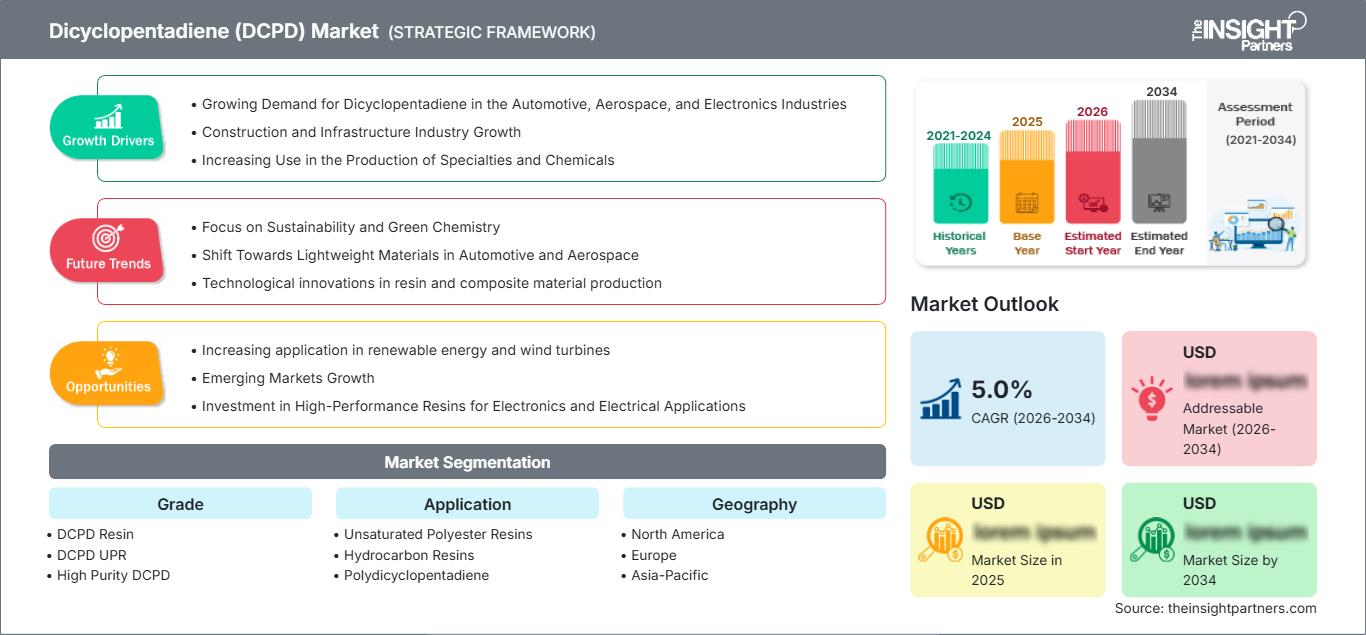
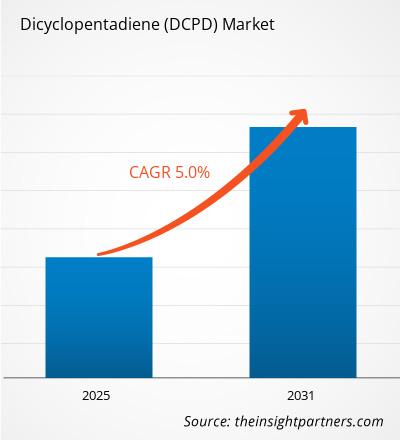
The Dicyclopentadiene Market size stood at US$ 891.34 million in 2025 and is forecasted to reach US$ 1,358.26 million by 2034, growing at a CAGR of 4.79% between 2026 and 2034. The market is evolving owing to the rising need for dependable C5-based intermediates among resin manufacturers, elastomers formulators, and specialty polymers manufacturers.
North America is a technically mature demand region, where market growth is estimated to occur at a CAGR of 4.2% to 4.8%, fueled by petrochemical integration and resin demand. Factors impacting the growth and size of the market include refinery-linked availability of C5 in the U.S., demand from unsaturated polyester resin manufacturers, and the increasing use of high-purity DCPD in cyclic olefins and specialty polymers.
Dicyclopentadiene (DCPD) Market Assessment and Insights
- North America: Share in 2025 of 23–27% and CAGR between 4.2–4.8%. Integrated cracking assets, resin demand, and specialty chemical conversion support steady regional consumption.
- US: Share in 2025 of 76–80% of North America and CAGR between 4.3–4.9%. Domestic petrochemical capacity and composite applications sustain demand.
- Europe: Share in 2025 of 18–22% and CAGR between 3.8–4.4%. Germany, France, Italy, and the UK lead demand through coatings, resins, elastomers, and specialty polymers.
- Asia Pacific: Share in 2025 of 43–47% and CAGR between 5.3–5.9%. China, Japan, South Korea, and India benefit from resin production, electronics, automotive, and adhesive growth.
- Largest Segment: Unsaturated Polyester Resins held 39–43% market share in 2025 and CAGR of 4.5–5.1% during 2026–2034, supported by composites, construction panels, marine parts, and corrosion-resistant products.
- High Growth Segment: Cyclic Olefin held 7–10% market share in 2025 and CAGR of 6.0–6.8% during 2026–2034, driven by optical polymers, medical packaging, diagnostics, and electronic components.
- Key companies analyzed in detail: Braskem S.A., Chevron Phillips Chemical Company LLC, Dow Inc., ENEOS Corporation, Kolon Industries, Inc., LyondellBasell Industries N.V., NOVA Chemicals Corporation, Cymetech Corporation, Shell Chemicals, ZEON Corporation.
Source: The Insight Partners' analysis based on proprietary research, government publications, company annual reports, investor presentations, industry databases, and expert interviews.
With production dynamics undergoing changes, recovery, purification, and conversion of C5 stream technologies are becoming critical for profit maximization. The key priorities of market players are feedstock flexibility due to the fact that DCPD availability depends on steam cracker configuration, level of naphtha cracking, and by-products isolation. High purity streams are increasingly in demand for cyclic olefin polymers and specialty resins, but resin grade material is required for hydrocarbon resins and UPR.
The future demand will be highest where petrochemical capacity, resin conversion, and manufacturing exports meet. The Asia-Pacific region will continue dominating the market because of increased downstream specialty chemicals development in China and South Korea, while the US can boast the advantage of feedstock integration. Increased regulatory interest in reducing emissions and ensuring safety in chemical usage promotes closed systems, better purification, and contract discipline.
Dicyclopentadiene (DCPD) Market Report Scope
| Report Attribute | Details |
|---|---|
| Market size in 2025 | US$ 891.34 Million |
| Market Size by 2034 | US$ 1,358.26 Million |
| Global CAGR (2026 - 2034) | 4.79% |
| Historical Data | 2021-2024 |
| Forecast period | 2026-2034 |
Dicyclopentadiene (DCPD) Market Analysis
DCPD market growth trends are associated with stable demand in unsaturated polyester resins, hydrocarbon resins, EPDM intermediates, and poly-DCPDs. DCPD contributes to stiffness, heat resistance, adhesion properties, and chemical resistance in derivatives. Demand also comes from automotive weight reduction, composite building panels, marine laminates, hot melt adhesives, and specialty packaging materials. As DCPD is derived from C5 fractions, its availability relies on ethylene cracker feedstocks and the economics of petroleum refining-based petrochemistry.
Value chain management is essential due to the price fluctuations of crude oil and naphtha. Integrated producers with their own crackers and purification units are able to ensure steady quality and delivery, whereas merchant buyers will be dependent on regional logistics. The market will also profit from demand for nonwovens adhesives, packaging tackifiers, corrosion resistant piping systems, sanitary wares, electrical components, and optical materials.
The Dicyclopentadiene Market Analysis is characterized by competitiveness driven by access to raw materials, quality of grades, customer partnerships, and geographical spread. Companies like Chevron Phillips Chemical Company LLC, Shell Chemicals, LyondellBasell Industries N.V., Braskem S.A., and Dow Inc. compete using their petrochemical complexes. ENEOS Corporation, Kolon Industries, Inc., ZEON Corporation, NOVA Chemicals Corporation, and Cymetech Corporation enhance the ecosystem using specialized grades, geographical presence, and technical expertise in applications.
Investments are being made in high-quality production, enhanced separation efficiency, and supply resilience with resin and elastomer customers. Firms with the capability to produce DCPD resin, DCPD UPR, and high-purity DCPD grades are well placed to benefit from premium applications. Strategic positioning is increasingly becoming a matter of balancing commodity volumes with specialized polymers. Customers are increasingly basing their selections on documentation, storage conditions, batch management, and support for formulating tests, as failure in downstream processes results in higher costs than procurement of different raw materials.
● REPORT CUSTOMIZATION
Tailor This Report To Align With Your Specific Business Requirements
This report can be customized to align precisely with your business objectives, scope, and target markets. Customization options include tailored segmentation, geography, competitive analysis, and strategic insights to support informed decision-making.
Customize This Report →WHAT YOU CAN ADJUST
- ● Segmentations
- ● Geography
- ● Competitive Analysis
- ● Language Preferences
Dicyclopentadiene (DCPD) Market: Strategic Insights
Regional Insights
North America Dicyclopentadiene Market
North America was estimated to contribute 23%–27% of 2025 revenue and is projected to witness growth at a CAGR of 4.2% to 4.8% till 2034. North America Dicyclopentadiene Market shares are indicative of integration into C5 recovery operations, infrastructure for crackers in the U.S., and usage by composite resin manufacturers. Industrial consumers use DCPD in UPR, hydrocarbon resins, and EPDM-related applications.
Growth drivers in the region include automotive lightweighting, building restoration, adhesives production, and demand for specialty polymers. Manufacturers can leverage their network of technical services and well-developed logistics into resin clusters. Regulations relating to hazardous air pollutants and VOCs make process control necessary, giving an advantage to those that have state-of-the-art separation, storage, and handling facilities.
U.S. Dicyclopentadiene Market Market
U.S. constituted 76-80% of the North American market in 2025 and expected to record a CAGR of 4.3-4.9%. Drivers of the demand include petrochemical integration along the Gulf Coast, resin production, and specialty chemicals transformation. The market is driven by demand from UPR composites, hydrocarbon resin tackifiers, EPDM intermediates, and poly-DCPD compounds for transportations and industrial equipment.
Companies' penetration into the industry is wide, including Chevron Phillips Chemical Company LLC, Dow Inc., LyondellBasell Industries N.V., NOVA Chemicals Corporation, Shell Chemicals, and Cymetech Corporation in supporting production and derivatives. Trend applications for dicyclopentadiene include high purity grades in optical polymer production and pharmaceutical packaging, but the resin grades continue to support construction panels, marine components, adhesives, and corrosion-resistant products.
Europe Dicyclopentadiene Market Market
Europe held 18–22% of 2025 revenue and is expected to expand at a 3.8–4.4% CAGR. Germany remains the leading country due to its automotive, coatings, elastomer, and engineering plastics base. The Dicyclopentadiene Market in Europe is shaped by environmental controls, high-quality resin demand, and advanced materials used in industrial and transportation applications.
The UK emphasizes specialty chemicals, adhesives, and composite refurbishment, while Germany benefits from downstream engineering and automotive component demand. France, Italy, and Spain contribute through marine laminates, sanitary ware, construction composites, and packaging adhesives. European buyers are prioritizing traceable feedstocks, low-emission handling, and stable quality, which supports suppliers offering technical documentation and consistent grade performance. REACH-oriented compliance expectations also favor producers that can provide impurity profiles, safe handling guidance, and reliable logistics into established chemical clusters.
APAC Dicyclopentadiene Market Market
APAC represents 43-47% of revenues in 2025 and is expected to witness CAGR of 5.3-5.9%. China will be the largest country in terms of dicyclopentadiene market size driven by capacities in resins, adhesives, automobiles, electronics, and petrochemicals. Japan and South Korea represent high purity cyclic olefins applications, while India is adding construction composites and industrial resin demand.
The manufacturing investment due to policy, electronics localization, and infrastructure development initiatives drive adoption in the region. Australia drives niche demand in terms of marine and construction composites. Asian value chain integration has improved hydrocarbon resin manufacturing, tackifier exports, and specialty polymer offerings. Thus, APAC is the key volume driver for the market during 2021-2034. There is also quality improvement among the APAC converters as export clients impose stringent color, odor, and application requirements for the polymers.
Middle East & Africa Dicyclopentadiene Market Market
Middle East and Africa is forecast to expand at a 4.6 – 5.2% CAGR till 2034. Saudi Arabia is leading the market due to petrochemical integration, infrastructure activities, and industrial diversification. UAE contributes through construction chemicals, marine sector, and logistics-based distribution, whereas South Africa helps in demand for composites and adhesives.
The investments made on account of energy will help in improving availability of C5 derivatives in this region, although the demand in Middle East and Africa region is less flexible than APAC and NA region. Demand from rest of MEA is linked to infrastructural activities, fiberglass products, protective coatings, and industrial maintenance. Suppliers with imports and regional warehousing can enhance their service offering in the market.
Segmentation Analysis
Grade
Grade is expected to grow at a 4.6–5.2% CAGR during 2026–2034. The Dicyclopentadiene Market scope is widening as buyers differentiate between resin-grade, UPR-grade, and high-purity products based on color, purity, reactivity, and downstream specification needs. Feedstock quality and purification capability increasingly determine supplier preference. Resin and UPR grades are selected for cost-performance balance, while high-purity grades require tighter controls because optical, medical, and specialty polymer applications have lower tolerance for contaminants.
- DCPD Resin: Resin-grade material supports hydrocarbon resins, adhesives, coatings, and rubber compounding. Demand is tied to packaging, nonwovens, woodworking, and construction products requiring tack, adhesion, and durability.
- DCPD UPR: UPR-grade DCPD is used in unsaturated polyester resin systems for marine, sanitary ware, panels, pipes, and automotive composites where corrosion resistance and mechanical strength are important.
- High Purity DCPD: High-purity grades serve cyclic olefin polymers, specialty intermediates, optical materials, medical packaging, antioxidants, and advanced polymer systems requiring controlled impurities and consistent performance.
Application
Application is forecast to grow at a 4.7–5.3% CAGR through 2034. Consumption is concentrated in resin and polymer routes where DCPD improves strength, heat resistance, adhesion, and dimensional stability. The market benefits from diverse demand across construction, automotive, packaging, electronics, marine, and specialty chemical value chains. Application selection is increasingly influenced by lifecycle performance, processing efficiency, regulatory documentation, and the ability of suppliers to support customers through formulation adjustments.
- Unsaturated Polyester Resins: This application leads demand because DCPD-modified UPR systems are used in composites, tanks, pipes, marine parts, sanitary ware, and corrosion-resistant construction materials.
- Hydrocarbon Resins: Hydrocarbon resins use DCPD to improve tack, compatibility, and thermal properties in adhesives, rubber compounding, paints, packaging tapes, labels, and nonwoven hygiene products.
- Polydicyclopentadiene: Poly-DCPD supports impact-resistant molded parts for transportation, agriculture, industrial housings, and protective equipment where lightweight strength and chemical resistance are valued.
- Ethylene Propylene Diene Monomer Elastomers: DCPD derivatives contribute to EPDM routes used in seals, hoses, roofing membranes, automotive profiles, and weather-resistant rubber products.
- Cyclic Olefin: Cyclic olefin applications require high-purity DCPD for transparent polymers used in lenses, diagnostic consumables, medical containers, electronic films, and precision optical components.
Opportunity Snapshot
| Segment Name | Revenue Contribution | Trend Tag | Adoption Stage |
| Unsaturated Polyester Resins | High | Composite Parts | Mature |
| Hydrocarbon Resins | High | Hot Melt | Scaling |
| Polydicyclopentadiene | Medium | Impact Molding | Scaling |
| Ethylene Propylene Diene Monomer Elastomers | Medium | Weather Seals | Mature |
| Cyclic Olefin | Medium | Optical Polymer | Emerging |
Dicyclopentadiene (DCPD) Market Growth Drivers and Impact Analysis
Rising Use in Unsaturated Polyester Resin Composites
Unsaturated polyester resin remains the largest market segment owing to the ability of DCPD-based resins to strike the right balance among cost, strength, chemical resistance, and processing capabilities. These resins are used by composite manufacturers for the fabrication of marine applications, building panels, pipes, sanitary ware, and automobile components. The market benefits from the substitution of heavier material when corrosion resistance and ease of maintenance become important. Repair of infrastructure, water management, and light-weighted components manufacturing lead to repetitive demand. The ability of suppliers to provide a steady stream of UPR grade material enables resin makers to improve their yields and customer satisfaction.
Growth in Hydrocarbon Resins and Adhesive Systems
The growth of hydrocarbon resins becomes evident since packaging, hygiene products, tapes, labels, and woodworking demand dependable tackifiers. The DCPD resin technology is favorable for producing hot melt adhesives for nonwovens, cartons, and pressure-sensitive products. The importance of the trend is high for Asia, where production capacity and export activities related to packaging keep growing. This trend helps to drive the market as it associates the petrochemical waste with common materials used by industry. Firms that have dependable sources of resin grade can supply the manufacturers of adhesives, which need the reliable softening point, color, compatibility, and odor performance.
Specialty Polymer Demand for High Purity DCPD
High purity DCPD is gaining strategic importance as cyclic olefin polymers, electronic materials, medical packaging, and optical components require tighter impurity control. These applications may represent smaller volumes than UPR or hydrocarbon resins, but they create higher-value opportunities for producers with advanced purification technology. The market benefits when suppliers can move from by-product recovery toward specialty chemical positioning. Demand from diagnostics, lenses, microfluidics, and transparent packaging supports investment in quality systems, traceability, and application-specific technical collaboration. Producers that qualify into these applications may gain longer customer relationships because material validation cycles are demanding and switching costs can be high.
Dicyclopentadiene (DCPD) Market Future Trends
Higher Purity Streams for Advanced Materials
Dicyclopentadiene Market trends indicate a stronger shift toward high-purity grades as optical polymers, medical diagnostics, precision packaging, and electronics demand tighter specifications. Producers will invest in improved distillation, impurity management, and quality documentation to serve customers requiring high transparency, low extractables, and stable polymerization behavior. This trend can gradually change profitability by increasing the share of value-added grades. It may also encourage closer partnerships between DCPD producers, polymer developers, and device manufacturers seeking reliable feedstocks for specialized materials. Over time, qualification-based selling may become more important than spot-volume trading in premium applications.
Supply Chain Localization and Contracted Feedstock Security
Future procurement strategies are expected to emphasize regional supply security as DCPD availability depends on cracker operations and C5 separation economics. Resin and elastomer producers may increase long-term contracts, dual sourcing, and inventory planning to reduce exposure to petrochemical outages. The market will likely see stronger coordination between upstream producers and downstream converters. Localization can reduce logistics risk, improve delivery reliability, and support customers that need consistent grades for continuous resin, adhesive, and specialty polymer production. This trend also encourages regional storage hubs, more disciplined forecasting, and customer-specific allocation planning during supply disruptions.
Dicyclopentadiene (DCPD) Market Opportunities
Expansion in Cyclic Olefin Polymer Applications
Cyclic olefin applications offer attractive opportunities because medical packaging, diagnostic consumables, optical lenses, and electronic films require transparent polymers with low moisture absorption and strong dimensional stability. Investment strategies aligned with Dicyclopentadiene Market Forecasts should prioritize high-purity purification assets, technical collaboration with polymer makers, and validated quality systems. Producers that can provide reliable impurity profiles and documentation may capture premium demand. This opportunity is action-oriented because it requires targeted capital expenditure rather than simple volume expansion. Early qualification with specialty polymer customers can also create defensible positions because approved materials are not easily replaced once validated in regulated or precision applications.
Resin Demand from Infrastructure and Adhesive Manufacturing
Infrastructure rehabilitation, packaging growth, and nonwoven hygiene demand create practical opportunities for resin-grade and UPR-grade DCPD suppliers. Manufacturers can strengthen positions by aligning supply with composite fabricators, hydrocarbon resin producers, and adhesive formulators in Asia Pacific and North America. The market can gain from technical service programs that help customers optimize formulations for corrosion resistance, tack, color, and processing stability. Strategic warehousing near resin clusters can further improve responsiveness and reduce disruption risk. Suppliers can also develop application-specific grade portfolios to serve construction, marine, packaging, and industrial maintenance customers with clearer performance positioning.
Recent Developments
- May 2026: Zeon Corporation has approved a major investment at its GPI facility in Kurashiki, Japan, to enhance its competitiveness in the C5 chemicals market. This project will increase dicyclopentadiene (DCPD) production capacity by about 20%, supporting key products like Cyclo-Olefin Polymers (COP) and aligning with the "STAGE30" business plan.
- Febuary 2026: altM, a deep-tech materials company, has launched its fully integrated biorefinery pilot plant in Bengaluru, transitioning from lab R&D to pilot-scale manufacturing. This facility demonstrates the company's capability to produce industrial-grade, bio-derived materials compatible with existing manufacturing systems.
Frequently Asked Questions

- Comprehensive Market Sizing and Forecast Analysis
- Detailed Segmentation Analysis
- In-Depth Market Dynamics Assessment
- Regional and Country-Level Insights
- Competitive Landscape and Company Benchmarking
- Strategic Business Intelligence
Recent Reports
Testimonials

The Insight Partners' SCADA System Market report is comprehensive, with valuable insights on current trends and future forecasts. The team was highly professional, responsive, and supportive throughout. We are very satisfied and highly recommend their services.
RAN KEDEM Partner, Reali Technologies LTDs
I requested a report on a very specific software market and the team produced the report in a few days. The information was very relevant and well presented. I then requested some changes and additions to the report. The team was again very responsive and I got the final report in less than a week.
JEAN-HERVE JENN Chairman, Future Analytica
We worked with The Insight Partners for an important market study and forecast. They gave us clear insights into opportunities and risks, which helped shape our plans. Their research was easy to use and based on solid data. It helped us make smart, confident decisions. We highly recommend them.
PIYUSH NAGPAL Sr. Vice President, High Beam Global
The Insight Partners delivered insightful, well-structured market research with strong domain expertise. Their team was professional and responsive throughout. The user-friendly website made accessing industry reports seamless. We highly recommend them for reliable, high-quality research services
YUKIHIKO ADACHI CEO, Deep Blue, LLC.
This is the first time I have purchased a market report from The Insight Partners.While I was unsure at first, I visited their web site and felt more comfortable to take the risk and purchase a market report.I am completely satisfied with the quality of the report and customer service. I had several questions and comments with the initial report, but after a couple of dialogs over email with their analyst I believe I have a report that I can use as input to our strategic planning process.Thank you so much for taking the extra time and making this a positive experience.I will definitely recommend your service to others and you will be my first call when we need further market data.
JOHN SUZUKI President and Chief Executive Officer, Board Director, BK Technologies
I wish to appreciate your support and the professionalism you displayed in the course of attending to my request for information regarding to infectious disease IVD market in Nigeria. I appreciate your patience, your guidance, and the fact that you were willing to offer a discount, which eventually made it possible for us to close a deal. I look forward to engaging The Insight Partners in the future, all thanks to the impression you have created in me as a result of this first encounter.
DR CHIJIOKE ONYIA MANAGING DIRECTOR, PineCrest Healthcare Ltd.Reason to Buy
- Informed Decision-Making
- Understanding Market Dynamics
- Competitive Analysis
- Identifying Emerging Markets
- Customer Insights
- Market Forecasts
- Risk Mitigation
- Boosting Operational Efficiency
- Strategic Planning
- Investment Justification
- Tracking Industry Innovations
- Aligning with Regulatory Trends





 Get Free Sample for