
Floriculture Market Share, Size & Demand by 2034
Coverage: by Product Type (Cut flowers, Bedding plants, Potted plants, Others); Application (Perfumes, Decoration, Pharmaceuticals, Others); Distribution Channel (Supermarkets and Hypermarkets, Specialty Stores, Direct Sales, Others) , and Geography (North America, Europe, Asia Pacific, and South and Central America)
- Status : Data Released
- Report Code : TIPRE00008732
- Category : Chemicals and Materials
- No. of Pages : 150
- Available Report Formats :


- Last update date : November 06, 2026


2025 Market Size
US$ 55.26 Bn
Base year value
2034 Forecast
US$ 83.95 Bn
Projected by 2034
CAGR 2026-2034
4.76 %
Growth rate
Addressable Market
US$ 632.06 Bn
(2026-2034)
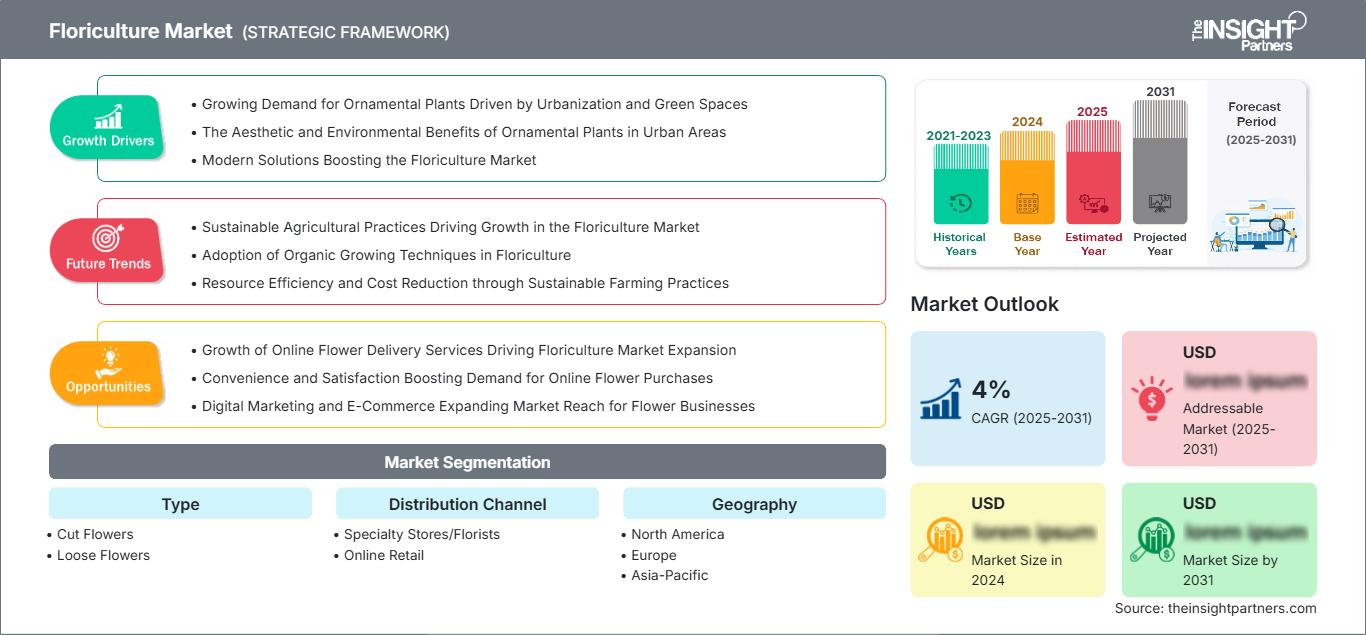
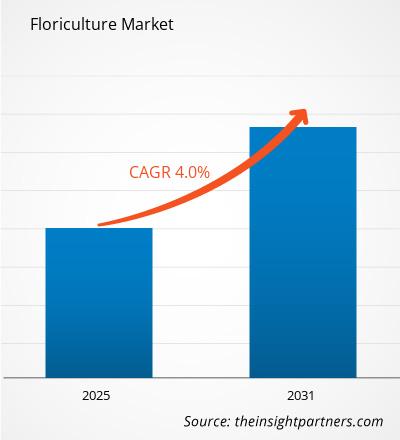
The floriculture market was valued at US$ 55.26 Billion in 2025 and is projected to reach US$ 83.95 Billion by 2034, registering a CAGR of 4.76% during 2026–2034. Market expansion is supported by demand for ornamental plants, fresh flowers for personal and institutional occasions, improvements in breeding and propagation, and the development of specialized retail channels. Production efficiency, cold-chain logistics, changing consumer preferences, and international trade relationships will influence how growers and distributors compete and capture value throughout the forecast period.
North America remains an important commercial center for the floriculture market, size supported by established floral retail networks, organized distribution, consumer spending on decorative products, and demand from weddings, hospitality businesses, corporate buyers, and households. The region's modeled CAGR is ~4% through 2034. Investment in controlled-environment cultivation, improved post-harvest handling, and digital ordering can strengthen product availability and reduce losses. However, imported flower dependence, freight costs, and perishability will continue to influence procurement decisions, supplier relationships, and the relative competitiveness of domestic growers.
Floriculture Market Assessment and Insights
Regional Outlook
- North America: ~30% of the global market in 2025 | ~4% CAGR through 2034. Market position: A mature, commercially significant region supported by established florists, supermarket floral departments, online ordering, and institutional purchases. Cold-chain investment and premium floral services support value creation, although imported supply and logistics costs affect margins.
- US: ~75% of North American market revenue in 2025 | ~4% CAGR through 2034. Market position: The largest national market within North America, supported by extensive retail networks, event-related purchasing, and established floral distribution. Demand for convenient delivery, customized arrangements, and reliable year-round availability reinforces the importance of efficient sourcing.
- Europe: ~31% of the global market in 2025 | ~4% CAGR through 2034. Market position: A mature production, breeding, trading, and consumption region. The Netherlands occupies a central position in European flower distribution, while Germany, the UK, France, Italy, and Spain contribute through retail demand, domestic production, and horticultural specialization.
- Asia Pacific: ~29% of the global market in 2025 | ~6% CAGR through 2034. Market position: The fastest-growing region in this assessment, supported by expanding urban consumption, event spending, evolving gifting practices, and investment in protected cultivation. China and India offer substantial demand-development potential, while Japan, South Korea, and Australia contribute established consumer markets.
Segment Outlook
- Cut Flowers: ~65% Share in 2025 | ~5% CAGR through 2034. Market position: The largest product sub-segment, supported by bouquets, celebrations, weddings, gifting, hospitality, and everyday decorative applications. Its commercial importance depends on freshness, variety availability, consistent stem quality, and effective post-harvest logistics.
- Online Retail: ~15% Share in 2025 | ~8% CAGR through 2034. Market position: The high-growth distribution sub-segment, benefiting from digital discovery, mobile ordering, scheduled delivery, and personalization. Its expansion depends on dependable fulfillment, transparent product presentation, delivery coverage, and the ability to preserve quality in transit.
Competitive Coverage
Danziger, Dümmen Orange, Karen Roses, Karuturi Global Limited, Multiflora, Oserian, Ruparelia Group, Selecta One, Syngenta Flowers Inc., The Kariki Group
Methodology
The Insight Partners follows Data Collection & Secondary Research, Primary Research, Data Analysis, and Data Triangulation & Final Review to validate market estimates and insights.
Source: The Insight Partners' analysis based on proprietary research, government publications, company annual reports, investor presentations, industry databases, and expert interviews.
Floriculture has developed due to advances in plant breeding, propagation, greenhouse management, and post-harvest activities. Producers become more reliant on varieties developed for high productivity, homogeneity, aesthetics, and suitability for transportation. Flower production becomes dispersed among consumer markets and export-oriented production sites, establishing networks of interrelationships between breeders, propagators, farmers, distributors, and retailers. Temperature control, grading, packaging, and logistics become crucial due to perishable nature of flowers and their quick loss of economic value under improper handling.
Future development would depend on production investments, wider digitalization, and grower adaptability to the new climatic and resource realities. New centers of consumption in Asia-Pacific and the Middle East could provide the impetus for local production, imports, and special retail formats. Plant breeding efforts to develop heat resistance, consistent flowering, and extended shelf life of flowers would help achieve better efficiency in production. Resource issues such as water conservation, energy prices, labor availability, phytosanitary regulations, and sustainability considerations would be among key concerns for the investors, especially for exporters.
Floriculture Market Report Scope
| Report Attribute | Details |
|---|---|
| Market size in 2025 | US$ 55.26 Billion |
| Market Size by 2034 | US$ 83.95 Billion |
| Global CAGR (2026 - 2034) | 4.76% |
| Historical Data | 2021-2024 |
| Forecast period | 2026-2034 |
Floriculture Market Analysis
The projections of growth of the floriculture market are influenced by the demand from household gifting, weddings, parties, hospitality businesses, commercial interior decor needs, landscaping purchases, and institutional events. The demand will be driven by people’s disposable income, cultural habits, seasons, and their readiness to pay for convenience and differentiation of the product. The supply chain includes breeders, propagators, growers, exporters, wholesalers, florists, Internet vendors, and others who take part in the selling process. Every link adds value to the product via breeding, cultivation, selection, handling, assortment, branding, and delivery. Due to the perishable nature of goods, careful coordination of stock levels and deliveries is essential.
The supply conditions differ depending on climatic factors, availability of land and water resources, labor prices, the presence of greenhouses, as well as access to sea or refrigerated shipping. Export-oriented manufacturers can use favorable climatic conditions and be closer to the transport hubs for exports, however, they face potential risks of disruption of the logistics, customs procedures, exchange rate fluctuations, and changing costs of inputs. Domestic manufacturers could have shorter delivery times and higher responsiveness to the preferences of locals, however, the seasonal production and high costs can limit their competitiveness.
According to the Floriculture Market Report, positioning covers breeding capability, production scale, export performance, and retail relationships. Danziger and Dümmen Orange have a competitive edge in ornamental genetics and grower-specific products, while Syngenta Flowers Inc. has a good capacity in breeding and propagation. Karen Roses, Oserian, Karuturi Global Limited, Multiflora, Ruparelia Group, and The Kariki Group are examples of production and logistics companies that specialize in flower growing and selling. Selecta One provides breeding and propagation capabilities. Each company differs by geographical coverage, product specialization, and retail links, and thus competitiveness cannot be based on production volume only.
Priority areas of investment include production efficiency, propagation capacity, drought-resistant varieties, internet sales infrastructure, and improvement in post-harvest operations. Strategic alliances can help breeders partner with growers, distributors, and retailers and thus streamline the process of turning breeding variety into commercial product. The merger of 2026 between Syngenta and Dümmen Orange on ornamental breeding and propagation activities is an example of how firms try to get complementary portfolio and additional capabilities. The floriculture industry analysis requires the consideration not only of the physical capacity of supplies but also of other forms of advantage, including intellectual property, buyer links, forecasting capacity, quality control, and reliable delivery.
● REPORT CUSTOMIZATION
Tailor This Report To Align With Your Specific Business Requirements
This report can be customized to align precisely with your business objectives, scope, and target markets. Customization options include tailored segmentation, geography, competitive analysis, and strategic insights to support informed decision-making.
Customize This Report →WHAT YOU CAN ADJUST
- ● Segmentations
- ● Geography
- ● Competitive Analysis
- ● Language Preferences
Floriculture Market: Strategic Insights
Regional Insights
North America Floriculture Market
The floriculture market share in North America will hold an estimated share of ~30% of the global market in 2025 and will expand at a CAGR of ~4% up to 2034. North America has the advantage of having an established retail network, high occasions-driven demand, and easy availability of both domestically produced and imported flowers. In the United States, there is national level demand, while Canada adds value to the regional market through retail sales, greenhouse cultivation and flower imports. Mexico takes part in the regional supply chain through horticultural production and trade.
Development of commercial relationships is contingent upon management of the distance between producers and consumers more than ever. Retailers and wholesalers require timely availability, consistent grading and quick delivery, especially during holidays and important events. Domestic greenhouse production may be helpful in this case, however, there are costs of energy, labor and infrastructure that play an important role in this type of production. Importers should synchronize their supply and transport processes in order to maintain freshness and minimize any loss. Digital orders and schedule deliveries offer new options for florists.
U.S. Floriculture Market
The US constitutes approximately ~75% of North American floriculture industry revenue in 2025 and is expected to achieve a CAGR of ~4% till 2034. Its role in North America is determined by well-established floral retail infrastructure, significant consumer base, and use in gift-giving, weddings, funerals, hospitality industry, and corporate segment. There are supermarkets, individual flower shops, online retailers, and event-focused businesses serving distinct types of purchases. Customers now expect easy ordering, reliable deliveries, and customized orders based on budget and needs.
The competitive environment connects breeders and producers abroad with importers, wholesalers, and retailers in the region. Companies like Danziger and Syngenta Flowers Inc. work in breeding and propagation industry, and import-dependent distributors organize deliveries from international production facilities. Business considerations relate to freshness of flowers, stem length consistency, choice of species and timely deliveries. Retail companies can create unique offers through design services, subscription services, personalization, and merchandising depending on the occasion. However, high seasonality of demand creates extreme purchase volumes and risks associated with inventory management. Better forecasting, flexible purchasing and rotations can help address these challenges.
Europe Floriculture Market
Europe constitutes roughly ~31% Floriculture Market share in 2025 and is forecast to grow at CAGR of ~4% during 2026-2034. This region combines high consumer demand with specific production, breeding, auction, wholesale, and distribution capabilities. The leader within the country market in Europe is the Netherlands, which serves as a trade and distribution center, thanks to its logistics infrastructure and dense horticultural environment. Germany and the UK provide considerable retail demand, while France, Italy, and Spain provide consumption, production, and country-specific floral traditions.
The German market relies on the current florist network, flower availability in retail stores, and number of events concerning gift giving. The UK market encompasses the business activities of independent florists, selling in supermarkets, and ordering online, with purchases being driven by import logistics and delivery options. The French market encompasses the demands of customers for household decoration, ceremonies, and florist-related services. The Italian market is driven by celebrations, religious holidays, and national specificities, while Spanish market combines the production aspect with the demands of consumers and tourists.
Competitiveness of European markets also involves breeding knowledge, production quality and cross border logistics. The Dutch distribution network assists in connecting breeders and international suppliers with buyers within Europe and internationally. Growers and sellers will be forced to balance the consumption of energy resources, water, labor, and waste management. Investment into efficient greenhouses, transparent sourcing, better packaging and more effective transportation might assist in protecting profit margins. The companies operating in several European countries should balance regional coordination and specifics of products sold in certain regions, as well as language specific merchandising and purchasing occasions.
APAC Floriculture Market
The Asia Pacific region makes up about ~29% of the global floriculture market in 2025 and is expected to experience a CAGR of ~6% over 2034, being the region that will see the highest rates of growth in this forecast. The China is seen as the leader in Asia Pacific in terms of modeled market size, driven by its large consumer population, developed retailing systems, giving nature and increasing horticultural activity. India provides extra growth through weddings, religious holidays, festivals and growing flower retail organizations. Japan, South Korea and Australia contribute through existing culture of flower consumption, quality-oriented purchases and specialized retail.
Regional development is affected by income level, cultivation technologies, logistics, and consumer preferences. China and India provide chances for domestic production and distribution investments, while Japan and South Korea are particularly focused on quality and good presentation. Australia is affected by domestic production, imports and retail and event consumption demand. Development of greenhouses, improvements in plant reproduction, cold storage and logistics coordination can help the commercialization process. Paying attention to horticultural modernization and agriculture infrastructure can help producers overcome supply limitations in spite of water scarcity, heat stress, uncoordinated distribution and poor access to the cold chain.
Middle East & Africa Floriculture Market
The Middle East and Africa floriculture market share is projected to expand at a modeled CAGR of ~5% through 2034. South Africa is an important production and consumption center within the region, while Kenya and Ethiopia contribute to export-oriented flower supply. Within the Middle East, Saudi Arabia and the UAE provide demand opportunities through urban retail, hospitality, weddings, and premium gifting. The UAE has a strategically relevant distribution role because international connectivity supports the movement of perishable products into regional consumption markets.
The regional perspective will depend on the interplay between the production environment and infrastructure. The energy-intensive nature of greenhouses operating in desert conditions requires a good balance in terms of cooling, water, and electricity expenses. Irrigation efficiency, controlled environment cultivation, and protection in logistics may be useful for the reliability of the system, although the economics of investments are very different from country to country. Exporting producers in Africa require reliable airfreight, product certification, and international markets. In the Gulf, it is beneficial for importers and retailers to have reliable distribution and assortments planning.
Segmentation Analysis
Type
The Type category defines the product composition of the floriculture market and influences cultivation methods, quality requirements, packaging, and buyer selection. Demand reflects the balance between decorative use, gifting, event requirements, and the commercial needs of retailers and professional floral designers. Product differentiation depends on appearance, freshness, availability, and consistency across orders. Cut Flowers are estimated to expand at a CAGR of ~5% during 2026–2034, supported by established commercial applications and recurring purchase occasions. Producers that coordinate variety development with customer preferences can improve sell-through and reduce losses.
- Cut Flowers: Cut flowers serve bouquet makers, florists, event planners, supermarkets, hospitality businesses, and individual consumers. Commercial value depends on stem quality, flower maturity, color consistency, vase life, and transport resilience. Reliable post-harvest handling is essential because quality deterioration can quickly reduce the product's saleability.
- Loose Flowers: Loose flowers are purchased for garlands, religious offerings, traditional ceremonies, decorative arrangements, and customer-designed floral combinations. Demand is closely linked to local customs, seasonal occasions, and price sensitivity. Local sourcing and rapid turnover can be important where flowers are sold fresh for immediate use.
Distribution Channel
Distribution Channel determines how flowers reach final buyers and how product availability, assortment, pricing, and service are managed. Channel selection influences customer acquisition, inventory exposure, delivery costs, and the ability to personalize orders. Traditional retail remains important where buyers value physical inspection, design advice, and immediate availability, while digital ordering supports convenience and broader geographic reach. Online Retail is projected to record a CAGR of ~8% during 2026–2034 as retailers develop integrated ordering, payment, and fulfillment systems. Businesses that connect digital demand signals with reliable sourcing can improve service and manage perishable inventory more effectively.
- Specialty Stores/Florists: Specialty stores and florists provide expert arrangement, product selection, occasion-based advice, and customization. Their physical presence supports customers seeking visual assessment and personal service. Relationships with local growers and wholesalers help these businesses respond to seasonal demand and deliver arrangements suited to specific events.
- Online Retail: Online retail enables customers to browse arrangements, compare designs, schedule deliveries, and send flowers across geographic boundaries. Product photography, clear delivery terms, payment convenience, and reliable fulfillment influence conversion. Inventory synchronization and protective packaging are important for limiting substitutions, complaints, and quality losses during delivery.
Opportunity Snapshot
| Distribution Channel | Revenue Contribution | Trend Tag | Adoption Stage |
| Specialty Stores/Florists | High | Custom Arrangements | Mature |
| Online Retail | Medium | Scheduled Delivery | Scaling |
Floriculture Market Growth Drivers and Impact Analysis
Expansion of Gifting and Occasion-Based Purchasing
Flowers remain closely associated with celebrations, anniversaries, weddings, funerals, religious events, and personal expressions of appreciation. This diversity of occasions creates multiple demand sources rather than dependence on a single end use. Retailers can adapt assortments and price points to local customs, seasonal calendars, and different customer budgets. Event planners and hospitality buyers also require coordinated volumes, specific colors, and predictable delivery schedules. For growers, these requirements create incentives to plan flowering cycles and diversify varieties according to anticipated orders. However, concentrated demand periods can create procurement pressure, increase transport requirements, and raise the risk of unsold inventory after events. Suppliers that combine seasonal planning with flexible sourcing and rapid distribution are better positioned to meet demand while limiting waste and protecting margins.
Improvements in Breeding and Protected Cultivation
Breeding and production improvements influence the economics of floriculture by affecting crop uniformity, flowering schedules, resistance to environmental stress, and the consistency of saleable output. Protected cultivation can help producers control growing conditions and coordinate harvest timing, while improved propagation supports more predictable crop establishment. These capabilities matter to wholesale buyers and retailers that need consistent products across repeated orders. Breeders also influence the market by developing varieties suited to specific climates, handling requirements, and consumer preferences. Nevertheless, improved genetics do not remove the need for skilled labor, crop monitoring, irrigation, and post-harvest management. Investment returns depend on whether productivity and quality improvements offset input costs and whether growers can secure customers willing to purchase the resulting products at commercially viable prices.
Development of Integrated Floral Distribution
The integration of sourcing, wholesale distribution, retail inventory, and delivery services can improve the flow of perishable products through the floriculture market. Businesses that share demand information across the supply chain can coordinate procurement more accurately, reduce unnecessary handling, and direct products toward customers before quality deteriorates. Cold storage and controlled transport support longer distribution windows, while standardized grading improves purchasing confidence. Integration is particularly relevant for retailers serving multiple locations or handling large event orders. Its impact depends on practical execution, including order visibility, transport availability, and clear responsibility for quality at each transfer point. Companies that build dependable relationships between farms, wholesalers, and retailers can improve service consistency, although smaller operators may face barriers involving technology costs, fragmented suppliers, and limited logistics capacity.
Floriculture Market Future Trends
Climate-Resilient Genetics and Resource-Efficient Production
Floriculture market trends are likely to place greater emphasis on varieties that tolerate heat, maintain flowering consistency, and perform under tighter water and energy constraints. Breeding programs can help growers respond to climate variability while preserving the visual characteristics buyers expect. Production systems may increasingly combine protected cultivation, precision irrigation, environmental monitoring, and more efficient crop scheduling. These approaches can improve resource use, but their commercial value will depend on local climate, infrastructure, and crop economics. Growers will need to assess whether new varieties perform reliably under actual operating conditions rather than relying solely on trial results. Breeders and propagation businesses that provide practical cultivation guidance alongside plant material may strengthen customer relationships and support more predictable production outcomes.
Data-Connected Commerce and Traceable Supply Chains
The next phase of floriculture distribution may involve closer integration between online storefronts, inventory systems, growers, wholesalers, and delivery providers. Better information exchange can help retailers identify seasonal demand, coordinate procurement, and reduce substitutions when specific varieties are unavailable. Digital product catalogs and standardized product information can also improve purchasing decisions for professional buyers. Traceability may become more important as customers and business buyers seek clearer information about origin, handling, and production practices. Adoption will depend on interoperability, data quality, implementation costs, and the willingness of independent suppliers to participate. Businesses that combine reliable digital ordering with disciplined physical handling can differentiate themselves through service consistency rather than competing exclusively on price.
Floriculture Market Opportunities
Investment in Localized Production and Post-Harvest Infrastructure
Investors and operators in the Floriculture Market forecast can evaluate opportunities in production facilities located near growing consumption centers, particularly where imported flowers face long delivery routes or variable availability. Greenhouses, propagation facilities, grading operations, cold rooms, and refrigerated transport can address different bottlenecks within the supply chain. The most attractive investment depends on local demand, resource costs, available skills, and access to buyers. In water-constrained locations, irrigation efficiency and climate management should form part of project economics from the outset. Operators should also assess seasonality, crop suitability, labor requirements, and the cost of maintaining consistent quality. Partnerships with established retailers, wholesalers, or export buyers can help validate demand before substantial capacity is committed and reduce exposure to uncertain sales volumes.
Premiumization, Customized Services, and Digital Customer Acquisition
Businesses can create additional value by combining differentiated flower varieties with tailored arrangements, dependable delivery, and services designed around specific customer occasions. Digital storefronts provide opportunities to present product collections, coordinate scheduled purchases, and develop relationships with repeat customers. Florists may also target corporate accounts, hospitality venues, event planners, and subscription customers to diversify demand beyond individual transactions. For producers and breeders, collaboration with retailers can reveal which colors, forms, and product characteristics generate repeat orders. However, premium positioning requires consistent quality and a credible service proposition. Businesses should test customer willingness to pay, monitor fulfillment costs, and evaluate repeat-purchase behavior before expanding customized offerings. Strong execution can improve margins without requiring every participant in the supply chain to increase production volumes.
Recent Developments
- May 20, 2026: Syngenta Group announced an agreement to place its Flowers business into a strategic joint venture with Dümmen Orange. The planned combination brings together ornamental breeding and propagation portfolios, including cut flowers, seed varieties, annuals, perennials, and potted plants. The companies stated that the transaction remains subject to applicable regulatory approvals. The proposed structure reflects a strategic focus on complementary capabilities, research and development, production processes, and commercial networks.
- April 30, 2025: Selecta One announced the acquisition of Wagagai Ltd., a major flower-cutting production business based in Uganda near Lake Victoria. Selecta One said the transaction would strengthen its production capacity in East Africa and continue existing operations and social programs. The company also indicated that it would maintain cooperation with other breeders using Wagagai as a propagation partner. The development demonstrates the strategic importance of geographically diversified production capacity and established relationships within the international ornamental horticulture supply chain.
Frequently Asked Questions

- Comprehensive Market Sizing and Forecast Analysis
- Detailed Segmentation Analysis
- In-Depth Market Dynamics Assessment
- Regional and Country-Level Insights
- Competitive Landscape and Company Benchmarking
- Strategic Business Intelligence
Recent Reports
Testimonials

The Insight Partners provided valuable market intelligence that supported our global go-to-market strategy. Their team was professional, responsive, and attentive to our feedback, providing thoughtful analysis and helpful methodological clarifications throughout the project.
Junmo Kim Chief Financial Officer (CFO), Enertech Co., Ltd.
The Insight Partners' SCADA System Market report is comprehensive, with valuable insights on current trends and future forecasts. The team was highly professional, responsive, and supportive throughout. We are very satisfied and highly recommend their services.
RAN KEDEM Partner, Reali Technologies LTDs
I requested a report on a very specific software market and the team produced the report in a few days. The information was very relevant and well presented. I then requested some changes and additions to the report. The team was again very responsive and I got the final report in less than a week.
JEAN-HERVE JENN Chairman, Future Analytica
We worked with The Insight Partners for an important market study and forecast. They gave us clear insights into opportunities and risks, which helped shape our plans. Their research was easy to use and based on solid data. It helped us make smart, confident decisions. We highly recommend them.
PIYUSH NAGPAL Sr. Vice President, High Beam Global
The Insight Partners delivered insightful, well-structured market research with strong domain expertise. Their team was professional and responsive throughout. The user-friendly website made accessing industry reports seamless. We highly recommend them for reliable, high-quality research services
YUKIHIKO ADACHI CEO, Deep Blue, LLC.
This is the first time I have purchased a market report from The Insight Partners.While I was unsure at first, I visited their web site and felt more comfortable to take the risk and purchase a market report.I am completely satisfied with the quality of the report and customer service. I had several questions and comments with the initial report, but after a couple of dialogs over email with their analyst I believe I have a report that I can use as input to our strategic planning process.Thank you so much for taking the extra time and making this a positive experience.I will definitely recommend your service to others and you will be my first call when we need further market data.
JOHN SUZUKI President and Chief Executive Officer, Board Director, BK Technologies
I wish to appreciate your support and the professionalism you displayed in the course of attending to my request for information regarding to infectious disease IVD market in Nigeria. I appreciate your patience, your guidance, and the fact that you were willing to offer a discount, which eventually made it possible for us to close a deal. I look forward to engaging The Insight Partners in the future, all thanks to the impression you have created in me as a result of this first encounter.
DR CHIJIOKE ONYIA MANAGING DIRECTOR, PineCrest Healthcare Ltd.Reason to Buy
- Informed Decision-Making
- Understanding Market Dynamics
- Competitive Analysis
- Identifying Emerging Markets
- Customer Insights
- Market Forecasts
- Risk Mitigation
- Boosting Operational Efficiency
- Strategic Planning
- Investment Justification
- Tracking Industry Innovations
- Aligning with Regulatory Trends





 Get Free Sample for