
Hemostasis Analyzers Market Size, Share & Growth by 2034
Coverage: By Product Type [Laboratory Analyzer (Automated Systems, Semi-Automated Systems, and Manual Systems) and Point-of-Care Testing Systems], Test [Activated Partial Thromboplastin Time, D-Dimer Test, Fibrinogen Test, Prothrombin Time (PT) Test, and Others], and End User (Hospitals/Clinics, Independent Diagnostic Laboratories, Home Care Setting, and Others)
- Status : Data Released
- Report Code : TIPRE00016709
- Category : Life Sciences
- No. of Pages : 150
- Available Report Formats :


- Last update date : February 04, 2026


2025 Market Size
US$ 4.95 Bn
Base year value
2034 Forecast
US$ 11.25 Bn
Projected by 2034
CAGR 2026-2034
9.54 %
Growth rate
Addressable Market
US$ 72.22 Bn
(2026-2034)
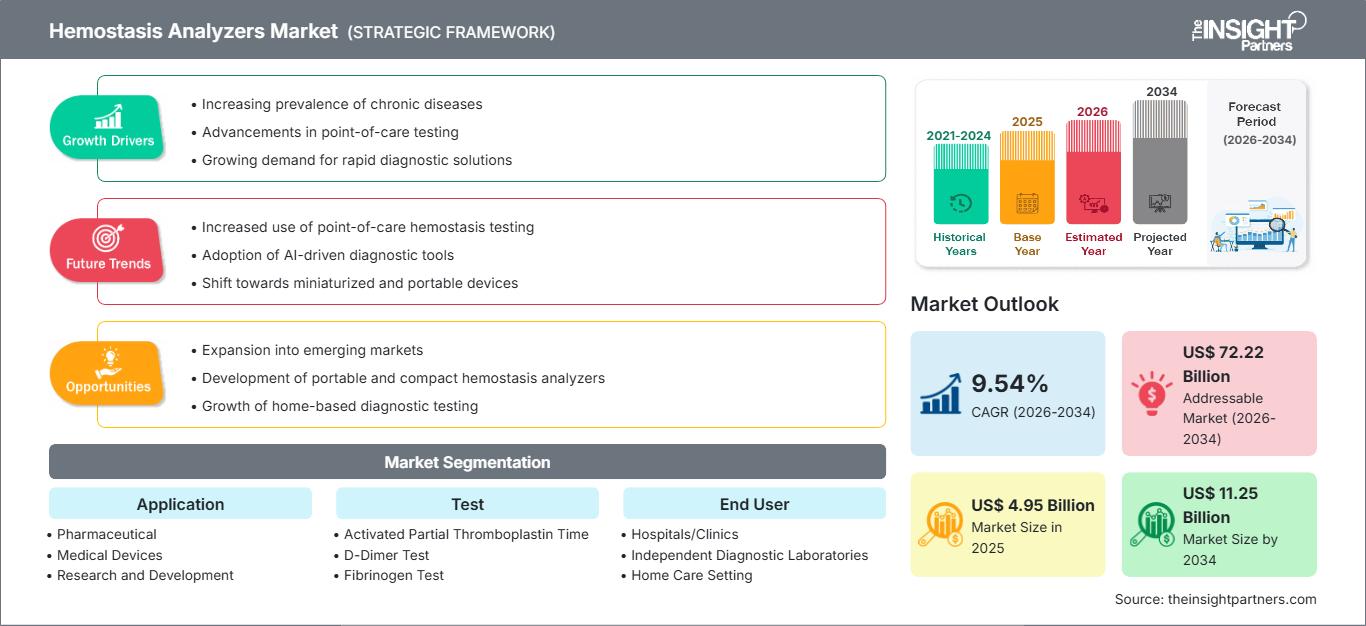
The hemostasis analyzers market size is expected to reach US$ 11.25 billion by 2034 from US$ 4.95 billion in 2025. The market is anticipated to register a CAGR of 9.54% during 2026–2034
Hemostasis Analyzers Market Analysis
Strategically, the market offers significant opportunities for innovation and differentiation. Demand is accelerating for automated, high-throughput systems in hospital labs and cartridge-based POC analyzers for emergency and surgical settings. Competitive intensity is high, with global players like Roche, Siemens, and Sysmex focusing on AI-driven platforms, connectivity with electronic health records, and microfluidic technologies to improve accuracy and turnaround times. Emerging trends include viscoelastic testing (TEG®, ROTEM®) for trauma and critical care, and integration of biosensors for multi-parameter analysis. For businesses, entry strategies should prioritize partnerships with diagnostic labs, development of cost-effective solutions for emerging markets, and investment in digital workflows to align with the growing demand for personalized and rapid coagulation testing.
Hemostasis Analyzers Market Overview
The global hemostasis analyzers market represents a critical segment of in-vitro diagnostics, focused on blood coagulation testing for conditions such as hemophilia, thrombosis, and cardiovascular disorders. Valued at approximately USD 2.9 billion in 2025, it is projected to surpass USD 5 billion by 2034, driven by rising surgical volumes, aging populations, and increasing prevalence of clotting disorders. The market is characterized by a shift toward automation, point-of-care (POC) solutions, and digital integration, reflecting broader trends in healthcare toward efficiency and precision. Developed regions like North America and Europe dominate due to advanced infrastructure and early adoption of technology, while Asia-Pacific is emerging as the fastest-growing region, fueled by expanding healthcare access and investments in diagnostic capabilities.
Market Research Highlights
- Global market for Hemostasis Analyzers was valued at US$ 4.95 Billion in 2025
- Annual market size is expected to reach US$ 11.25 Billion by 2034
- Total addressable market (TAM) during 2026-2034 is projected to reach approximately US$ 72.22 Billion
- Market is anticipated to register a CAGR of 9.54% during the forecast period
- The United States represents a key market, supported by Increasing prevalence of chronic diseases, Advancements in point-of-care testing, Growing demand for rapid diagnostic solutions, as well as evolving industry dynamics
- Market analysis covers North America, Europe, Asia-Pacific, South and Central America, Middle East and Africa, with growth evaluated across the forecast period
- Market opportunities such as Expansion into emerging markets, Development of portable and compact hemostasis analyzers, Growth of home-based diagnostic testing are expected to influence market dynamics and addressable market
- Report profiles industry participants, including Accenture PLC, Amazon Web Services, Inc., door2door GmbH, General Electric Company, IBM Corporation, Intel Corporation, KONUX GmbH, Microsoft Corporation, Nvidia, while analyzing competitive strategies and innovation developments
-
Source: The Insight Partners' analysis based on proprietary research, government publications, company annual reports, investor presentations, industry databases, and expert interviews.
● REPORT CUSTOMIZATION
Tailor This Report To Align With Your Specific Business Requirements
This report can be customized to align precisely with your business objectives, scope, and target markets. Customization options include tailored segmentation, geography, competitive analysis, and strategic insights to support informed decision-making.
Customize This Report →WHAT YOU CAN ADJUST
- ● Segmentations
- ● Geography
- ● Competitive Analysis
- ● Language Preferences
Hemostasis Analyzers Market: Strategic Insights
-
Get Top Key Market Trends of this report.This FREE sample will include data analysis, ranging from market trends to estimates and forecasts.
Hemostasis Analyzers Market Drivers and Opportunities
Market Drivers
- Rising Prevalence of Coagulation Disorders and Cardiovascular Diseases: Hemostasis analyzers are essential for diagnosing and monitoring conditions such as hemophilia, deep vein thrombosis, and atrial fibrillation. With cardiovascular diseases remaining the leading cause of mortality globally and bleeding disorders affecting millions, the demand for accurate coagulation testing is surging. This trend is further amplified by the growing use of anticoagulant therapies, which require regular monitoring to prevent complications.
- Increase in Surgical Procedures and Aging Population: The global rise in surgical interventions—ranging from cardiac surgeries to orthopedic procedures—necessitates reliable coagulation testing to minimize perioperative risks. Additionally, the aging population is more susceptible to clotting and bleeding disorders, driving hospitals and diagnostic centers to adopt advanced hemostasis analyzers for pre- and post-operative care.
- Technological Advancements and Automation in Diagnostics: Innovations such as fully automated analyzers, AI-driven interpretation, and integration with laboratory information systems (LIS) are transforming coagulation testing. These advancements improve throughput, reduce human error, and enable faster turnaround times, making them indispensable for high-volume labs and emergency care settings.
Market Opportunities
- Expansion of Point-of-Care (POC) Testing Solutions: The shift toward decentralized healthcare and rapid diagnostics creates a strong opportunity for portable, cartridge-based hemostasis analyzers. These systems allow clinicians to perform coagulation tests at the bedside or in operating rooms, improving decision-making in trauma and critical care scenarios.
- Integration of Digital Health and Connectivity: The growing emphasis on connected healthcare systems opens avenues for analyzers that seamlessly integrate with electronic health records (EHR) and telemedicine platforms. This connectivity enhances workflow efficiency, supports remote monitoring, and aligns with the global trend toward data-driven healthcare.
- Emerging Markets and Cost-Effective Solutions: Developing regions in Asia-Pacific, Latin America, and Africa present untapped potential due to improving healthcare infrastructure and rising awareness of coagulation disorders. Manufacturers offering affordable, easy-to-use analyzers tailored for resource-limited settings can capture significant market share while addressing critical diagnostic gaps.
Hemostasis Analyzers Market Segmentation Analysis
By Product Type
- Laboratory Analyzers
- Automated Systems: High-throughput analyzers designed for large hospitals and reference labs, offering full automation for efficiency and accuracy.
- Semi-Automated Systems: Mid-range analyzers requiring partial manual intervention, suitable for medium-volume labs.
- Manual Systems: Basic instruments for low-volume settings or backup testing, often used in resource-limited environments.
- Point-of-Care Testing Systems: Portable, cartridge-based devices enabling rapid coagulation testing at bedside or in surgical/critical care settings.
By Test
- Activated Partial Thromboplastin Time (APTT): Measures intrinsic pathway clotting time, critical for monitoring heparin therapy.
- D-Dimer Test: Detects fibrin degradation products, widely used for diagnosing thrombotic conditions like DVT and pulmonary embolism.
- Fibrinogen Test: Assesses fibrinogen levels, essential for evaluating bleeding risk and liver function.
- Prothrombin Time (PT) Test: Evaluates the extrinsic pathway, commonly used to monitor patients on warfarin therapy.
- Others: Includes specialized assays such as platelet function tests, anti-Factor Xa, and ACT for comprehensive coagulation profiling.
By End User
- Hospitals/Clinics: Primary users for preoperative, emergency, and routine coagulation testing.
- Independent Diagnostic Laboratories: High-volume testing centers offering specialized coagulation panels.
- Home Care Setting: Emerging segment for patients requiring frequent monitoring of anticoagulant therapy through portable devices.
- Others: Includes research institutes and ambulatory surgical centers focusing on advanced coagulation studies.
Hemostasis Analyzers Market Report Scope
| Report Attribute | Details |
|---|---|
| Market size in 2025 | US$ 4.95 Billion |
| Market Size by 2034 | US$ 11.25 Billion |
| Global CAGR (2026 - 2034) | 9.54% |
| Historical Data | 2021-2024 |
| Forecast period | 2026-2034 |
| Segments Covered |
By Application
|
| Regions and Countries Covered |
North America
|
| Market leaders and key company profiles |
|
Hemostasis Analyzers Market Players Density: Understanding Its Impact on Business Dynamics
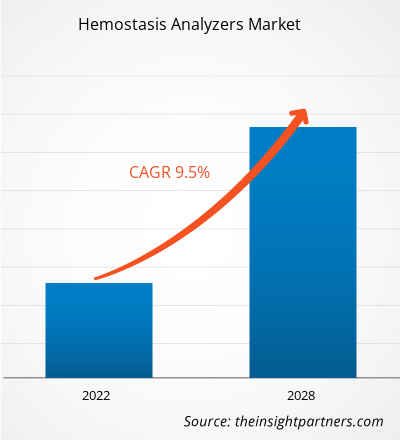
The Hemostasis Analyzers Market is growing rapidly, driven by increasing end-user demand due to factors such as evolving consumer preferences, technological advancements, and greater awareness of the product's benefits. As demand rises, businesses are expanding their offerings, innovating to meet consumer needs, and capitalizing on emerging trends, which further fuels market growth.
Hemostasis Analyzers Market Geographic Analysis
North America
- Market Share: Largest share (~35–36%) due to advanced healthcare infrastructure and high testing volumes.
- Key Drivers:
- High Prevalence of Cardiovascular and Bleeding Disorders
- Advanced Healthcare Infrastructure
- Favorable Reimbursement Policies
- Trends: Rapid integration of AI-driven analyzers and connectivity with EHR systems; growing demand for point-of-care solutions in trauma and surgical settings.
Europe
- Market Share: Significant share supported by established diagnostic networks and regulatory compliance (CE-certified devices).
- Key Drivers:
- Government-Backed Healthcare Programs
- High Surgical Volumes
- Regulatory Compliance and Quality Standards
- Trends: Rising preference for viscoelastic testing (ROTEM®) in critical care; adoption of digital workflows in centralized labs.
Asia-Pacific
- Market Share: Fastest-growing region driven by expanding healthcare infrastructure and rising awareness of coagulation disorders.
- Key Drivers:
- Expanding Healthcare Infrastructure
- Geriatric Population
- Medical Tourism Growth
- Trends: Accelerated adoption of cost-effective semi-automated analyzers and portable POC systems; increasing role of medical tourism in boosting demand.
Latin America
- Market Share: Emerging region with moderate growth, supported by private healthcare expansion.
- Key Drivers:
- Private Healthcare Expansion
- Increasing Awareness of Coagulation Disorders
- Affordability of Semi-Automated Systems
- Trends: Gradual shift toward automated analyzers in urban centers; growing partnerships with global manufacturers for technology transfer.
Middle East & Africa
- Market Share: Developing market with growing demand for coagulation testing in tertiary care hospitals.
- Key Drivers:
- Healthcare Infrastructure Development
- Government Initiatives for Modernization
- Rising Chronic Disease Burden
- Trends: Adoption of imported high-end analyzers in Gulf countries; rising interest in portable POC devices for remote and emergency care.
Hemostasis Analyzers Market Players Density: Understanding Its Impact on Business Dynamics
High Market Density and Competition
The hemostasis analyzers market is highly competitive, with numerous global and regional players offering advanced coagulation testing solutions. The competition is characterized by rapid technological innovation, automation, and integration of digital health capabilities. Vendors are focusing on improving accuracy, reducing turnaround time, and enabling point-of-care testing to differentiate themselves in a crowded market.
Vendors differentiate through:
- High-throughput, fully automated analyzers for large hospitals and reference labs.
- Point-of-care cartridge-based systems for rapid testing in trauma and surgical settings.
- Integration with LIS/EHR platforms for seamless data management and workflow efficiency.
- AI-driven interpretation and microfluidic technologies for enhanced precision and multi-parameter testing.
Opportunities and Strategic Moves
- Strategic partnerships with hospitals, diagnostic labs, and healthcare networks to expand market penetration.
- Expansion into emerging markets with cost-effective semi-automated and portable analyzers tailored for resource-limited settings.
- Investment in digital health and connectivity solutions to align with telemedicine and remote monitoring trends.
- Development of advanced viscoelastic and biosensor-based systems for critical care and personalized medicine applications.
Market Player Density & Competitive Dynamics
- Accenture PLC
- Amazon Web Services, Inc.
- door2door GmbH
- General Electric Company
- IBM Corporation
- Intel Corporation
- KONUX GmbH
- Microsoft Corporation
- Nvidia
News & Recent Developments
- In April 2024, HemoSonics, a medical device company focused on acute bleeding management, announced that it had received Special 510(k) clearance from the U.S. Food and Drug Administration (FDA) for the expanded use of arterial blood samples with its Quantra QStat® Cartridge. The QStat Cartridge, when used with the Quantra Hemostasis Analyzer, had previously received 510(k) clearance from the FDA in 2022 for venous whole blood samples. This clearance enabled hospitals to further standardize and operationalize viscoelastic testing by allowing both arterial and venous indications for HemoSonics' QStat Cartridge and QPlus® Cartridge.
- Sysmex America, Inc., a leading diagnostic solutions company, announced that it had received FDA clearance for the CN-6000™ Hemostasis Analyzer, an automated blood coagulation system. The clearance included reagent products for five commonly performed hemostasis tests: Prothrombin Time (PT) and PT INR with Dade® Innovin®, Activated Partial Thromboplastin Time (APTT) with Dade® Actin® FSL, Fibrinogen (Fbg) with Dade® Thrombin Reagent, Antithrombin (AT) with INNOVANCE® Antithrombin, and D-dimer with INNOVANCE® D-Dimer.
Hemostasis Analyzers Market Report Coverage and Deliverables
The "Hemostasis analyzers Market Size and Forecast (2021–2034)" report provides a detailed analysis of the market covering below areas:
- Hemostasis analyzers Market size and forecast at global, regional, and country levels for all the key market segments covered under the scope
- Hemostasis analyzers Market trends, as well as market dynamics such as drivers, restraints, and key opportunities
- Detailed PEST and SWOT analysis
- Hemostasis analyzers Market analysis covering key market trends, global and regional framework, major players, regulations, and recent market developments
- Industry landscape and competition analysis covering market concentration, heat map analysis, prominent players, and recent developments in the Hemostasis analyzers Market
- Detailed company profiles
Frequently Asked Questions
2. Increased surgical interventions and cardiovascular disease
3. Adoption of automated and POC diagnostic technologies.
2. Asia Pacific shows the fastest growth due to healthcare infrastructure expansion.
2. Cartridge-based, viscoelastic POC systems (TEG, Quantra).

- Comprehensive Market Sizing and Forecast Analysis
- Detailed Segmentation Analysis
- In-Depth Market Dynamics Assessment
- Regional and Country-Level Insights
- Competitive Landscape and Company Benchmarking
- Strategic Business Intelligence
Recent Reports
Testimonials

The Insight Partners' SCADA System Market report is comprehensive, with valuable insights on current trends and future forecasts. The team was highly professional, responsive, and supportive throughout. We are very satisfied and highly recommend their services.
RAN KEDEM Partner, Reali Technologies LTDs
I requested a report on a very specific software market and the team produced the report in a few days. The information was very relevant and well presented. I then requested some changes and additions to the report. The team was again very responsive and I got the final report in less than a week.
JEAN-HERVE JENN Chairman, Future Analytica
We worked with The Insight Partners for an important market study and forecast. They gave us clear insights into opportunities and risks, which helped shape our plans. Their research was easy to use and based on solid data. It helped us make smart, confident decisions. We highly recommend them.
PIYUSH NAGPAL Sr. Vice President, High Beam Global
The Insight Partners delivered insightful, well-structured market research with strong domain expertise. Their team was professional and responsive throughout. The user-friendly website made accessing industry reports seamless. We highly recommend them for reliable, high-quality research services
YUKIHIKO ADACHI CEO, Deep Blue, LLC.
This is the first time I have purchased a market report from The Insight Partners.While I was unsure at first, I visited their web site and felt more comfortable to take the risk and purchase a market report.I am completely satisfied with the quality of the report and customer service. I had several questions and comments with the initial report, but after a couple of dialogs over email with their analyst I believe I have a report that I can use as input to our strategic planning process.Thank you so much for taking the extra time and making this a positive experience.I will definitely recommend your service to others and you will be my first call when we need further market data.
JOHN SUZUKI President and Chief Executive Officer, Board Director, BK Technologies
I wish to appreciate your support and the professionalism you displayed in the course of attending to my request for information regarding to infectious disease IVD market in Nigeria. I appreciate your patience, your guidance, and the fact that you were willing to offer a discount, which eventually made it possible for us to close a deal. I look forward to engaging The Insight Partners in the future, all thanks to the impression you have created in me as a result of this first encounter.
DR CHIJIOKE ONYIA MANAGING DIRECTOR, PineCrest Healthcare Ltd.Reason to Buy
- Informed Decision-Making
- Understanding Market Dynamics
- Competitive Analysis
- Identifying Emerging Markets
- Customer Insights
- Market Forecasts
- Risk Mitigation
- Boosting Operational Efficiency
- Strategic Planning
- Investment Justification
- Tracking Industry Innovations
- Aligning with Regulatory Trends





 Get Free Sample for