
Modular Chain Drive Market Size, Share & Growth by 2034
Coverage: by Product Type (Straight, Radius, and Spiral); Material Used (Metal, and Plastic); and End-user Industry (Food & Beverages, Mining, Automotive, Packaging, and Other), and Geography (North America, Europe, Asia Pacific, and South and Central America)
- Status : Data Released
- Report Code : TIPMC00002756
- Category : Manufacturing and Construction
- No. of Pages : 150
- Available Report Formats :


- Last update date : July 28, 2026


2025 Market Size
US$ 1.43 Bn
Base year value
2034 Forecast
US$ 2.76 Bn
Projected by 2034
CAGR 2026-2034
7.53 %
Growth rate
Addressable Market
US$ 18.83 Bn
(2026-2034)
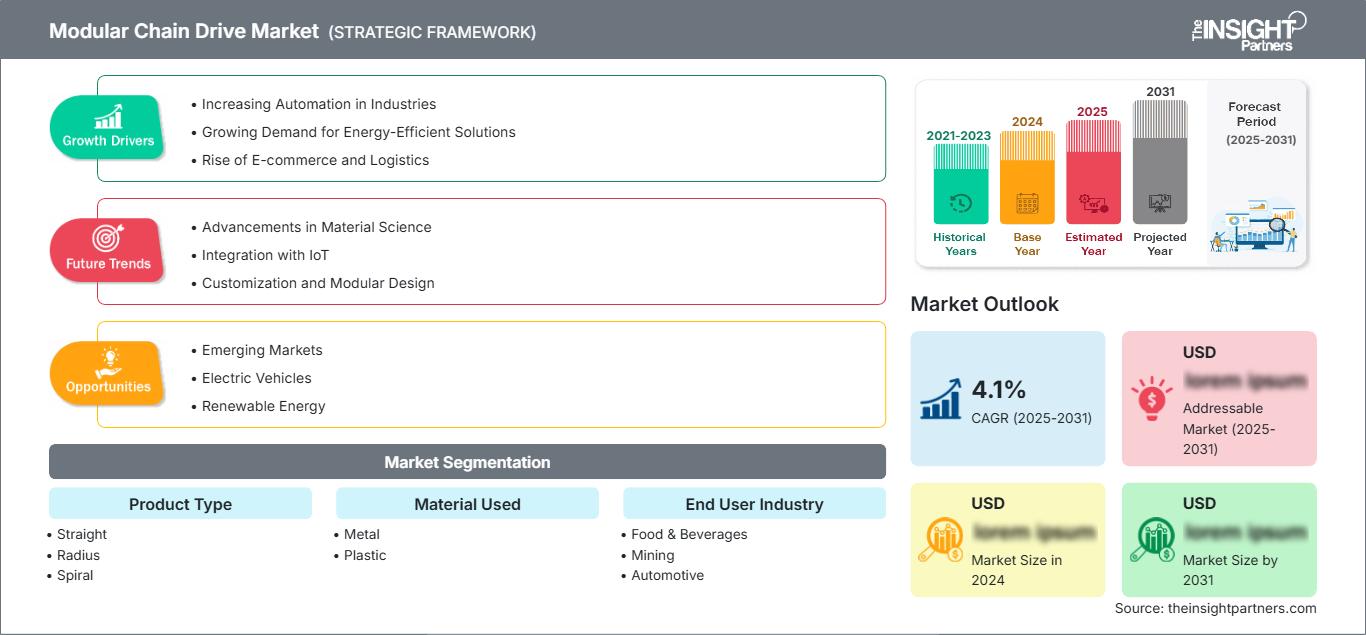
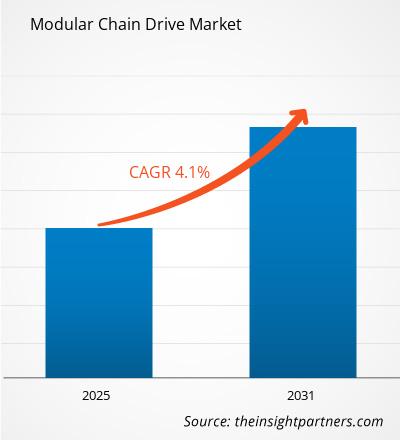
The Modular Chain Drive Market size stood at US$ 1.43 billion in 2025 and is forecast to reach a value of US$ 2.76 billion in 2034 with a CAGR of 7.53% during 2026-2034. The growth in demand is driven by the need for modular, easily replaceable, and hygienic parts used in conveyors on continuous production lines, which affects profitability through their impact on downtime, contamination prevention, and product loading.
North America continues to be an important demand region for the Modular Chain Drive Market, with growth in demand being driven by upgrades of existing systems to increase automation and meet food-grade processing requirements. Growth in the region is anticipated to occur at a CAGR of 6.8–7.4% during 2026-2034.
Modular Chain Drive Market Assessment and Insights
- North America accounted for 30–33% share in 2025 and is growing at a CAGR between 6.8–7.4% during 2026–2034, supported by food processing automation, packaging upgrades, and brownfield intralogistics projects.
- US represented 78–82% of North America in 2025 and is growing at a CAGR between 6.9–7.5% during 2026–2034, driven by automation-intensive food and parcel facilities.
- Europe held 25–28% share in 2025 and is growing at a CAGR between 6.2–6.8% during 2026–2034, led by Germany, Italy, France, and the UK in packaging machinery and hygienic conveying.
- Asia Pacific captured 32–36% share in 2025 and is growing at a CAGR between 8.0–8.8% during 2026–2034, with China, Japan, South Korea, and India expanding automation capacity.
- Largest Segment Plastic held 58–62% market share in 2025 and is growing at a CAGR between 7.8–8.5% during 2026–2034 due to hygiene, corrosion resistance, and design flexibility.
- High Growth Segment Spiral products held 18–22% market share in 2025 and are growing at a CAGR between 8.5–9.3% during 2026–2034 as space-saving cooling and accumulation systems expand.
- Key companies analyzed in detail: Haberkorn GmbH, Wippermann jr. GmbH, Tsubakimoto Chain Co., Habasit Holding AG, KONE New Zealand Limited, Regal Rexnord Corporation, Pro Handling Solutions Limited, GEPPERT-Band GmbH, Interroll (Asia) Pte. Ltd., and Progressive Marketing Group, Inc.
Source: The Insight Partners' analysis based on proprietary research, government publications, company annual reports, investor presentations, industry databases, and expert interviews.
In contrast to fixed conveyors used in production processes, new approaches are being adopted in which modular, customizable conveyors are built from exchangeable components, standard sprockets, and chain designs tailored to the materials being conveyed. While food processing plants increasingly adopt plastic chains for easy washing and minimal friction, mining and automotive plants still rely on metal chains that can withstand high temperatures and loads.
In terms of forward market demand, there is potential for growth in Southeast Asia, India, Mexico, and Gulf nations due to localized processing and packing and distributing equipment acquisitions by manufacturing companies. Sanitation and health and safety regulations are prompting the adoption of cleaner, accumulation control, and wear-resistant chains systems. Companies capable of offering materials engineering knowledge and local service will benefit in this respect.
Modular Chain Drive Market Report Scope
| Report Attribute | Details |
|---|---|
| Market size in 2025 | US$ 1.43 Billion |
| Market Size by 2034 | US$ 2.76 Billion |
| Global CAGR (2026 - 2034) | 7.53% |
| Historical Data | 2021-2024 |
| Forecast period | 2026-2034 |
Modular Chain Drive Market Analysis
The Modular Chain Drive Market growth will be highly contingent upon the automation of repetitive product handling in factories, where belt wear-and-tear, contamination concerns, or design inflexibility reduce productivity. Cleanability is a key requirement in food and beverage manufacturing applications, whereas stability in curve and incline transfer, along with compact footprint requirements, drives demand in packaging.
The supply side will still be affected by polymer availability, steel production costs, machining capabilities, and regional assembly facilities. The vendors will try to keep prices down while meeting increasing demand for FDA-compatible polymers, detectable plastics, and enhanced chain pins. Since only broken links, but not entire belts, can be substituted in modular chain drives, total cost of ownership will become an important purchasing criterion.
The Competitive Landscape of Modular Chain Drive Market reveals a moderately fragmented market with motion-control solution providers globally competing with conveyor chain makers specializing in their products. Habasit Holding AG, Regal Rexnord Corporation, Tsubakimoto Chain Co. and Interroll (Asia) Pte. Ltd. concentrate on engineered product ranges, whereas Wippermann jr. GmbH, GEPPERT-Band GmbH and Pro Handling Solutions Limited stress on applicability and service.
Market trends include investment in platforms, detectable materials and commissioning software to minimize integration period. Both Regal Rexnord Corporation and Interroll (Asia) Pte. Ltd. promote the idea of automation ecosystem, while Haberkorn GmbH and Progressive Marketing Group, Inc. improve distributor-based access. The competitive edge is based on fast customization, proven hygiene performance and field support for different end users industries.
● REPORT CUSTOMIZATION
Tailor This Report To Align With Your Specific Business Requirements
This report can be customized to align precisely with your business objectives, scope, and target markets. Customization options include tailored segmentation, geography, competitive analysis, and strategic insights to support informed decision-making.
Customize This Report →WHAT YOU CAN ADJUST
- ● Segmentations
- ● Geography
- ● Competitive Analysis
- ● Language Preferences
Modular Chain Drive Market: Strategic Insights
Regional Insights
North America Modular Chain Drive Market
North America comprised 30-33% of revenue in 2025 and is estimated to grow at a CAGR of 6.8-7.4% in 2026-2034. The existing base of facilities for food, beverages, parcels, and automobiles is an important factor that creates constant replacement demand in this market segment. The presence of washdown rules, automation of packaging, and modular chain conveyor cells contribute to the Modular Chain Drive Market share in North America.
The importance of brownfield upgrades cannot be overstated, since many facilities choose to upgrade equipment in stages rather than replace the entire production line. Modular chain drives help plants install curved, inclined, and accumulation areas without much change to their facility configurations. The demand for such technology is highest where conventional belts cannot be used due to specific requirements.
U.S. Modular Chain Drive Market
The U.S. represented 78-82% of North America in 2025 and is estimated to register a CAGR of 6.9-7.5% during 2025-2034. High penetration of the product in applications such as processed foods, beverages, e-commerce packing, and automotive parts make the country an important market in the region. Companies like Interroll (Asia) Pte. Ltd., Regal Rexnord Corporation, Habasit Holding AG, and Tsubakimoto Chain Co. help the buyers in the U.S. with their availability of products and engineering & integrator contacts.
Usage trends include the increased application of modular plastic chains in washdown areas and metal chains in heavy duty transfer systems. The replacement opportunities come from facilities looking for reduced downtime, faster link replacement, and better consistency of product handling in high speed packaging and sorting operations.
Europe Modular Chain Drive Market
Europe had 25-28% market share in 2025, growing at a CAGR of 6.2-6.8% in 2026-2034. Germany dominates this region because of its machinery production, automobile automation, and precision packaging machinery. In the UK, market dynamics include automation of the food processing process and distribution processes owing to space constraints favoring chain conveyors that are easier to maintain.
Germany capitalizes on OEM linkages and a large number of conveyor engineering companies, while Italy remains significant in packaging and food machinery. The main concerns for France, Spain, and the UK are hygiene, energy efficiency, and local retrofits. Europe is very conscious about material tracking and low noise.
APAC Modular Chain Drive Market
The APAC region held a 32%-36% share in 2025 and is expected to grow at a 8.0%-8.8% CAGR up until 2034, becoming the fastest-growing region. China leads the pack owing to its capabilities in packaging, automotive, electronics, and food processing. Japan and South Korea drive the need for automation, while India and Australia drive new processing and logistics projects.
Government policies, incentives to automate factories, and supply chain localization within the region is speeding up adoption. End users are demanding more from their systems, in terms of modularity that can adapt with changing lines, increased product diversity, and food safety requirements.
Middle East & Africa Modular Chain Drive Market
Middle East & Africa is expected to grow at a 6.0–6.7% CAGR during 2026–2034. Saudi Arabia leads regional adoption as food security investment, industrial zones, and logistics infrastructure expand. The UAE supports demand through packaging, airports, and distribution centers, while South Africa remains important for mining, food processing, and consumer goods production.
Energy-sector diversification and infrastructure spending are creating adjacent opportunities for durable conveying systems. Modular chain drives are valued where operators need abrasion resistance, corrosion control, and manageable maintenance in harsh environments. Rest of MEA demand remains project-led but improves as local service channels mature.
Segmentation Analysis
Product Type
Product Type is expected to grow at a 7.2–7.9% CAGR during 2026–2034 as users select chain geometry around transfer path, footprint, and load behavior. The Modular Chain Drive Market scope across straight, radius, and spiral products reflects growing demand for flexible layouts that reduce floor space while maintaining throughput. Product choice is increasingly linked to plant reconfiguration needs.
- Straight chains remain the baseline choice for linear conveying, offering stable movement, easier alignment, and straightforward maintenance in packaging, automotive, and general manufacturing lines.
- Radius chains support curved transfers where plants need to avoid multiple drive sections, reduce footprint, and maintain product orientation through changing line directions.
- Spiral chains serve cooling, freezing, accumulation, and elevation applications, making them strategically important for food plants and compact facilities with limited production space.
Material Used
Material Used is projected to grow at a 7.4–8.1% CAGR during 2026–2034 as buyers balance hygiene, strength, chemical exposure, and lifecycle cost. Plastic is favored in washdown and packaged-food environments, while metal remains essential for mining, high-load, and high-temperature applications. Material selection increasingly determines compliance, maintenance frequency, and energy consumption.
- Metal chains provide strength, heat tolerance, and abrasion resistance for mining, automotive, and heavy-duty transfer applications where impact loads and harsh operating conditions are common.
- Plastic chains dominate sanitary and corrosion-sensitive environments because they reduce weight, support modular repairs, and offer quieter operation across food, beverage, and packaging lines.
End User Industry
End User Industry is expected to grow at a 7.1–7.8% CAGR during 2026–2034 as automation spending spreads across processing, extraction, assembly, and packaging operations. Food and beverages remain the anchor vertical, while automotive and packaging add demand for precision movement, accumulation, and space-efficient layouts. Mining uses the technology selectively where durability is decisive.
- Food & Beverages represents the strongest adoption base because processors require hygienic conveying, rapid cleaning, controlled product handling, and components compatible with frequent washdown cycles.
- Mining uses metal chain systems in abrasive and heavy-load conditions, prioritizing ruggedness, controlled material movement, and maintainability in remote or high-dust operating environments.
- Automotive demand is linked to flexible assembly lines, parts transfer, and durable handling systems that support mixed-model production and predictable uptime.
- Packaging relies on modular chains for curves, accumulation, and high-speed product flow, especially where compact layouts and quick changeovers are operational priorities.
Opportunity Snapshot
| End User Industry | Revenue Contribution | Trend Tag | Adoption Stage |
| Food & Beverages | High | Hygienic Lines | Mature |
| Mining | Medium | Abrasive Duty | Scaling |
| Automotive | Medium | Flexible Cells | Scaling |
| Packaging | High | Compact Flow | Mature |
Modular Chain Drive Market Growth Drivers and Impact Analysis
Automation Retrofits in Food and Packaging Plants
Automation retrofits are a major driver because many food and packaging facilities need higher throughput without rebuilding entire lines. Modular chain drives allow operators to replace conventional belts, add curves, improve accumulation, and shorten repair cycles using standardized sections. Public information on modular plastic chain conveyors shows 2025 demand supported by automation in food processing, pharmaceuticals, and logistics, with plastic systems valued for hygiene and corrosion resistance. This directly supports adoption where downtime, cleaning time, and product damage carry measurable cost.
Shift Toward Hygienic and Detectable Materials
Food safety requirements are changing buyer specifications from basic movement capability to cleanability, contamination prevention, and traceability. Plastic modular chains made from acetal, polypropylene, and polyethylene are widely used because they tolerate washdown chemicals and can support food-contact expectations. Detectable belt and chain materials are gaining attention where processors want to reduce foreign-object risk. The result is higher replacement value per line, stronger demand for specialist suppliers, and more rigorous material documentation during procurement.
Need for Space-Efficient Conveyor Layouts
Manufacturers are under pressure to increase output within existing buildings, making compact conveyor geometry a practical growth driver. Radius and spiral chain systems help reduce floor space, consolidate movement paths, and improve product accumulation without lengthy straight-line layouts. This is especially relevant in urban food plants, packaging centers, and brownfield automotive facilities. As expansion space becomes costly, users are more willing to pay for engineered modular chains that enable tighter turns, vertical movement, and efficient cooling or buffering.
Modular Chain Drive Market Future Trends
Intelligent Modular Conveyor Ecosystems
The next phase of Modular Chain Drive Market trends will be shaped by conveyor ecosystems that combine mechanical modules, decentralized drives, and software-assisted commissioning. Interroll’s MCP PLAY launch demonstrates how layout-based configuration can reduce programming effort and raise throughput in automated material flow systems. Chain drive suppliers are likely to align components with smarter controls, condition monitoring, and plug-compatible platforms. This will make purchasing decisions less about individual chains and more about integrated performance, commissioning speed, and lifecycle data visibility.
Sustainable Materials and Lower-Energy Movement
Sustainability will move from corporate reporting into conveyor component specification. Buyers will ask for lighter chains, recyclable polymers, lower-friction surfaces, and designs that reduce motor load. Modular repairability already supports waste reduction because damaged sections can be replaced without discarding an entire belt or chain. Over the forecast period, suppliers that document energy savings, material origin, and component longevity will be better positioned with multinational food, beverage, and packaging customers facing stricter environmental audits.
Modular Chain Drive Market Opportunities
Emerging-Market Processing and Packaging Capacity
Emerging economies present a clear opportunity as food processing, beverage filling, and packaged consumer goods capacity shifts closer to demand centers. Modular Chain Drive Market Forecasts point to stronger installation potential in India, Southeast Asia, Mexico, Saudi Arabia, and selected African markets where new plants can adopt modern modular layouts from the start. Suppliers should prioritize distributor training, local spare-part stocking, and application engineering. Early involvement with OEMs and system integrators can secure specification positions before plant designs are finalized.
Premium Retrofit Kits for Brownfield Lines
Brownfield retrofits create an attractive opportunity because operators want performance improvement with limited shutdown time. Suppliers can package modular chains, sprockets, guides, wear strips, and installation documentation as upgrade kits for common line types. This approach is commercially useful in food, packaging, and automotive plants where maintenance teams prefer predictable installation windows. Companies that quantify payback through reduced cleaning time, fewer emergency repairs, and higher throughput can convert replacement demand into higher-margin engineered solutions.
Recent Developments
- March 2026: Interroll Holding AG presented an integrated material flow ecosystem at LogiMAT 2026, emphasizing modular conveying, drives, controls, and sorting on a common platform to simplify integration and commissioning for warehouse, manufacturing, and distribution automation projects.
- March 2025: Regal Rexnord Corporation has showcased its intralogistics technologies at LogiMAT 2025, including the Modsort modular conveying system and 1533 MatTop Chain, positioning its conveying portfolio around energy efficiency, product flow optimization, and integration with automated material handling systems.
- June 2025: NORD DRIVESYSTEMS provides boost efficiency of baggage handling systems by providing NORD ECO Service to support airports. The primary goal of the service is to reveal potential savings in applications to optimize energy consumption, lower CO2 emissions, and provide cost savings. NORD’s extensive knowledge and experience in producing drive system solutions for more than 100 industries enables them to develop better drives for targeted application optimization. With the ECO Service, the drive specialist has already helped many companies improve their system’s performance and energy efficiency through modernization while simultaneously reducing system variants.
Frequently Asked Questions

- Comprehensive Market Sizing and Forecast Analysis
- Detailed Segmentation Analysis
- In-Depth Market Dynamics Assessment
- Regional and Country-Level Insights
- Competitive Landscape and Company Benchmarking
- Strategic Business Intelligence
Recent Reports
Testimonials

The Insight Partners' SCADA System Market report is comprehensive, with valuable insights on current trends and future forecasts. The team was highly professional, responsive, and supportive throughout. We are very satisfied and highly recommend their services.
RAN KEDEM Partner, Reali Technologies LTDs
I requested a report on a very specific software market and the team produced the report in a few days. The information was very relevant and well presented. I then requested some changes and additions to the report. The team was again very responsive and I got the final report in less than a week.
JEAN-HERVE JENN Chairman, Future Analytica
We worked with The Insight Partners for an important market study and forecast. They gave us clear insights into opportunities and risks, which helped shape our plans. Their research was easy to use and based on solid data. It helped us make smart, confident decisions. We highly recommend them.
PIYUSH NAGPAL Sr. Vice President, High Beam Global
The Insight Partners delivered insightful, well-structured market research with strong domain expertise. Their team was professional and responsive throughout. The user-friendly website made accessing industry reports seamless. We highly recommend them for reliable, high-quality research services
YUKIHIKO ADACHI CEO, Deep Blue, LLC.
This is the first time I have purchased a market report from The Insight Partners.While I was unsure at first, I visited their web site and felt more comfortable to take the risk and purchase a market report.I am completely satisfied with the quality of the report and customer service. I had several questions and comments with the initial report, but after a couple of dialogs over email with their analyst I believe I have a report that I can use as input to our strategic planning process.Thank you so much for taking the extra time and making this a positive experience.I will definitely recommend your service to others and you will be my first call when we need further market data.
JOHN SUZUKI President and Chief Executive Officer, Board Director, BK Technologies
I wish to appreciate your support and the professionalism you displayed in the course of attending to my request for information regarding to infectious disease IVD market in Nigeria. I appreciate your patience, your guidance, and the fact that you were willing to offer a discount, which eventually made it possible for us to close a deal. I look forward to engaging The Insight Partners in the future, all thanks to the impression you have created in me as a result of this first encounter.
DR CHIJIOKE ONYIA MANAGING DIRECTOR, PineCrest Healthcare Ltd.Reason to Buy
- Informed Decision-Making
- Understanding Market Dynamics
- Competitive Analysis
- Identifying Emerging Markets
- Customer Insights
- Market Forecasts
- Risk Mitigation
- Boosting Operational Efficiency
- Strategic Planning
- Investment Justification
- Tracking Industry Innovations
- Aligning with Regulatory Trends





 Get Free Sample for