
MPOS Terminals Market Size, Demand & Growth by 2034
Coverage: by Component (Hardware, Software); Application (Restaurants, Hospitality, Healthcare, Retail, Warehouse, Entertainment, Others) , and Geography (North America, Europe, Asia Pacific, and South and Central America)
- Status : Data Released
- Report Code : TIPRE00010122
- Category : Banking, Financial Services, and Insurance
- No. of Pages : 150
- Available Report Formats :


- Last update date : November 25, 2026


2025 Market Size
US$ 49.18 Bn
Base year value
2034 Forecast
US$ 104.74 Bn
Projected by 2034
CAGR 2026-2034
8.76 %
Growth rate
Addressable Market
US$ 689.50 Bn
(2026-2034)
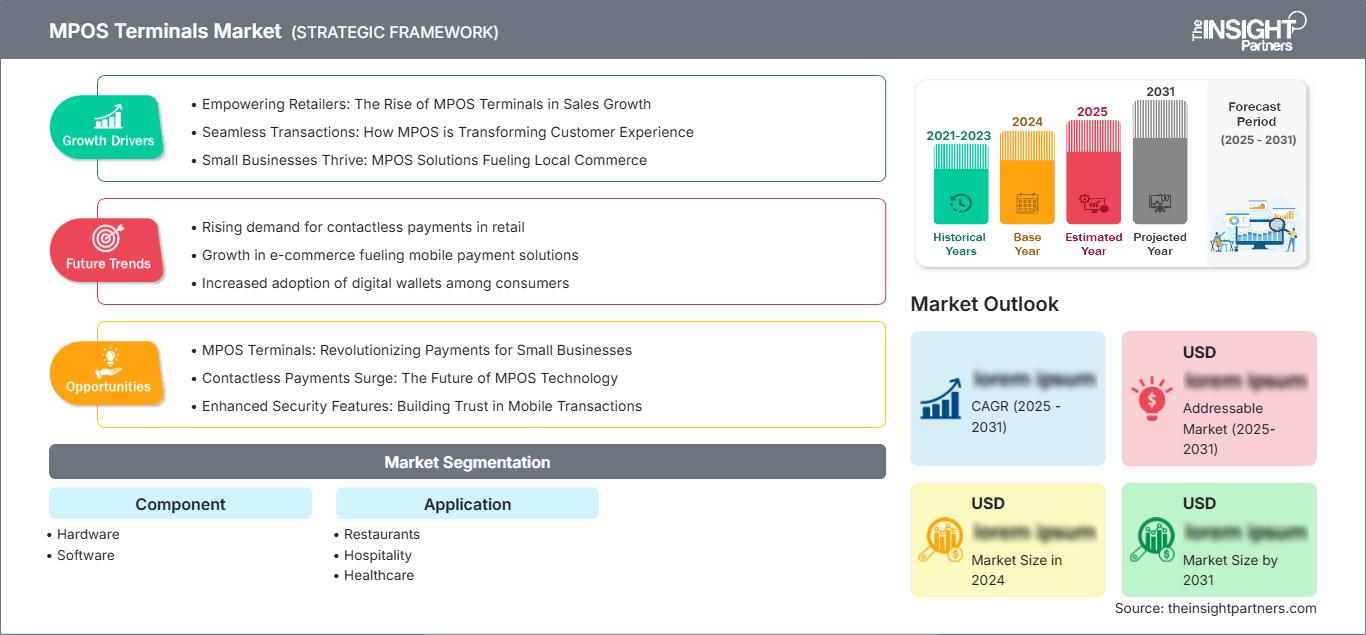
The mPOS terminals market is evolving as businesses seek flexible, secure, and cost-effective payment acceptance solutions across physical and mobile commerce environments. The market was valued at US$ 49.18 billion in 2025 and is projected to reach US$ 104.74 billion by 2034, registering a CAGR of 8.76% during 2026–2034. Increasing digital payment adoption, expanding contactless transactions, demand for portable checkout systems, and the integration of payment acceptance with business management software are supporting market expansion across retail, hospitality, and service-oriented industries.
The North American market benefits from established electronic payment infrastructure, widespread card acceptance, and continued investment in connected commerce technologies. The mPOS Terminals Market size in the region is expected to grow steadily through 2034, supported by merchants upgrading payment equipment, service providers extending mobile checkout capabilities, and businesses seeking integrated transaction reporting. Demand also reflects the operational requirements of restaurants, healthcare facilities, and retailers that need to accept payments beyond conventional fixed counters. As payment security expectations and customer preferences evolve, suppliers that combine reliable hardware, software compatibility, and streamlined transaction experiences are well positioned to meet the region's replacement and expansion needs.
MPOS Terminals Market Assessment and Insights
Regional Outlook
- North America: ~35% of the global market in 2025 | ~8% CAGR through 2034. Market position: North America is the largest regional market, supported by an established card-payment infrastructure, extensive merchant-acquiring networks, mature digital commerce, and demand for portable checkout across retail and hospitality. Merchant technology upgrades support replacement demand.
- US: ~85% of North American market revenue in 2025 | ~8% CAGR through 2034. Market position: The United States is the largest national market in North America. Its extensive retail base, restaurant ecosystem, payment-processing infrastructure, and broad availability of merchant services support adoption across independent businesses and large multi-location operators.
- Europe: ~25% of the global market in 2025 | ~8% CAGR through 2034. Market position: Europe has a mature electronic payment environment, with demand supported by contactless acceptance, established banking infrastructure, and merchant digitization. The UK and Germany are important national markets, while France, Italy, and Spain contribute through retail, tourism, and hospitality activity.
- Asia Pacific: ~30% of the global market in 2025 | ~11% CAGR through 2034. Market position: Asia Pacific is the fastest-growing region, driven by expanding digital payment acceptance, diverse merchant ecosystems, and ongoing retail modernization. China, Japan, South Korea, India, and Australia provide distinct demand centers, ranging from advanced payment infrastructure to rapid merchant digitization.
Segment Outlook
- Hardware: ~65% Share in 2025 | ~8% CAGR through 2034. Market position: Hardware leads because every physical mPOS deployment requires a device or compatible mobile endpoint to capture and transmit transactions. Replacement cycles, peripheral compatibility, and the requirements for reliable connectivity sustain demand for equipment.
- Software: ~35% Share in 2025 | ~10% CAGR through 2034. Market position: Software has a comparatively strong growth outlook as merchants seek integrated payment applications, centralized transaction management, reporting, and updates that improve operational visibility without requiring complete hardware replacement.
Competitive Coverage
Bixolon Co., Ltd., Citizen Systems Europe GmbH, Dspread Technology, Inc., Fiserv, Inc., Hewlett-Packard Development Company, L.P., Intuit Inc., Zettle AB, Oracle Corporation, PAX Technology Limited, Posiflex Technology, Inc.
Methodology
The Insight Partners follows Data Collection & Secondary Research, Primary Research, Data Analysis, and Data Triangulation & Final Review to validate market estimates and insights.
Source: The Insight Partners' analysis based on proprietary research, government publications, company annual reports, investor presentations, industry databases, and expert interviews.
The mPOS terminals market has evolved from basic portable card readers into a broader set of payment devices, merchant applications, connectivity, and transaction management services. Earlier deployments primarily extended card acceptance beyond fixed checkout counters, whereas current systems increasingly support integrated workflows across store floors, tableside service, temporary sales locations, and field operations. Improvements in mobile processors, wireless connectivity, battery performance, and payment security have expanded the practical applications of these systems. Hardware suppliers, software developers, payment processors, and merchant service providers now contribute complementary capabilities to the deployment and maintenance of mobile payment infrastructure.
Looking ahead, the development of the mPOS terminals market will depend on the pace of merchant digitization, investment in payment infrastructure, and providers' ability to support diverse regulatory and commercial environments. Emerging economies offer opportunities as smaller businesses formalize electronic payment acceptance, while developed markets present opportunities through equipment replacement and software modernization. Suppliers that simplify installation, remote configuration, and compatibility with existing payment networks can reduce adoption barriers. Regional expansion will also depend on local acquisition partnerships, language and currency support, reliable connectivity, and the ability to meet applicable payment security requirements.
MPOS Terminals Market Report Scope
| Report Attribute | Details |
|---|---|
| Market size in 2025 | US$ 49.18 Billion |
| Market Size by 2034 | US$ 104.74 Billion |
| Global CAGR (2026 - 2034) | 8.76% |
| Historical Data | 2021-2024 |
| Forecast period | 2026-2034 |
MPOS Terminals Market Analysis
The mPOS terminals market's growth is driven by the shift toward flexible checkout experiences and the increasing integration of payments into day-to-day business operations. Mobile terminals enable merchants to accept payments away from traditional cash registers, reduce queues, and serve customers across multiple points within a premises. Smaller businesses can also adopt portable systems without having to implement the infrastructure associated with larger fixed installations. Transaction volumes, merchant service costs, connectivity requirements, payment-method compatibility, and the availability of affordable financing or subscription-based equipment influence demand.
The value chain connects device manufacturers, component suppliers, operating-system and application developers, payment processors, acquiring banks, distributors, and merchants. Hardware makers supply devices and peripherals, while software providers manage transaction interfaces, reporting, and integration with merchant systems. Acquirers and processors facilitate authorization and settlement, making interoperability an important purchasing consideration. Supply conditions are affected by semiconductor availability, device certification, product lifecycle management, and after-sales support. Vendors that coordinate these activities can improve deployment reliability and reduce integration friction for businesses operating multiple outlets.
Competition spans dedicated payment-terminal manufacturers, technology companies, payment processors, and providers of integrated merchant platforms. Bixolon Co., Ltd. and Citizen Systems Europe GmbH contribute printing and peripheral capabilities, while Dspread Technology, Inc., PAX Technology Limited, and Posiflex Technology, Inc. participate in payment-device and point-of-sale hardware markets. Fiserv, Inc. and Intuit Inc. connect payment acceptance with merchant services and business applications. Hewlett-Packard Development Company, L.P. and Oracle Corporation contribute broader capabilities in computing and retail technology, while Zettle AB serves merchants through its payment ecosystem.
Investment increasingly favors systems that combine device reliability with software flexibility, secure payment processing, and straightforward integration. Vendors compete through distribution partnerships, processor compatibility, device certification, application ecosystems, and ongoing service capabilities rather than hardware specifications alone. Merchant platform providers can strengthen retention by integrating payments with inventory, accounting, customer management, and operational reporting. Hardware specialists, meanwhile, can improve their position through dependable device design, product customization, and compatibility with third-party platforms. Strategic partnerships can shorten deployment cycles, broaden mPOS terminals market access, and help suppliers serve merchants with different technical requirements.
● REPORT CUSTOMIZATION
Tailor This Report To Align With Your Specific Business Requirements
This report can be customized to align precisely with your business objectives, scope, and target markets. Customization options include tailored segmentation, geography, competitive analysis, and strategic insights to support informed decision-making.
Customize This Report →WHAT YOU CAN ADJUST
- ● Segmentations
- ● Geography
- ● Competitive Analysis
- ● Language Preferences
MPOS Terminals Market: Strategic Insights
Regional Insights
North America mPOS terminals market
North America accounts for an estimated ~35% of the global mPOS terminals market in 2025, with a modeled CAGR of ~8% through 2034. The region is served well by mature card acceptance, networks for merchant acquirers, and mature payment processors and business software solutions ecosystems. Merchants and restaurants use mobile payments to enhance workflow, enable assisted selling, and minimize the need for fixed terminals. Independent merchants will also benefit from compact terminal solutions, which offer bundled payment services that include hardware and transaction and business reporting processing.
The United States is the leading national demand source in the region, driven by the sheer number of merchants and payment services in place. Canada contributes through retail modernization and hospitality activities, as well as the use of integrated merchant technology. Mexico is an additional source of demand, as the use of electronic payment acceptance becomes more widespread in small businesses and service establishments. Regional adoption depends on merchants’ size, economics of transactions, connectivity, and the complexity of current payment infrastructure. Providers who have existing distribution capabilities, robust technical support, and flexible onboarding capabilities are more prepared to meet the replacement and adoption demand.
U.S. mPOS terminals market
The United States accounts for an estimated ~85% of the North American mPOS terminals market in 2025 and is projected to register a ~8% CAGR through 2034. Its placement is indicative of the diversity of its retail and food services industries, a mature payments infrastructure, and good merchant technology availability by way of processors, banks, software platforms, and dedicated distributors. The mobile payment terminals are used for checkouts at tables, on floors, at events, counters, and temporary venues. Businesses also need transactional reporting and integration capabilities with existing accounting and inventory software.
Competitive companies include device vendors and providers of integrated payment solutions. Fiserv, Inc. provides payment services to merchants via its Clover ecosystem, while Intuit Inc. links payment processing to small business financial software. PAX Technology Limited and Dspread Technology, Inc. join in providing terminals, while Oracle Corporation covers the wider field of retail software. Purchase criteria include security, transaction fees, support, application compatibility, and product life cycle. Further adoption would rely partly on the economics of replacing existing hardware and benefits that vendors can demonstrate in addition to payment processing capability.
Europe mPOS terminals market
Europe represents an estimated ~25% of the global mPOS terminals market in 2025, with a modeled CAGR of ~8% through 2034. The established system of electronic payments, contactless acceptance, tourism, and the development of merchants play a key role in creating demand. There are two large national markets, such as the UK and Germany, due to the high level of retail activity and a developed payment system. France offers opportunities in food service, specialty retail, and tourism, while Italy and Spain benefit from hospitality services, restaurants, and small merchants that require flexible checkout facilities.
The UK market has its own characteristics due to competition among payment service providers and merchants preferring portable terminals with reporting capabilities. The demand in Germany is formed by the large number of retailers and service companies, along with continuous modernization of payment acceptance. The French market has potential in terms of restaurants, accommodation, and independent retail when transactions can be made without a register.
The region's mPOS terminals market growth will be contingent upon establishing payment-service partnerships, obtaining product certification, including local payment options, and adhering to relevant data and payment security regulations. Germany is one of the significant markets in Europe, while the United Kingdom remains a vital hub of innovation in merchant payments. Differences in the operations, payments, and distribution will need to be considered when working with suppliers from different regions.
APAC mPOS terminals market
Asia Pacific accounts for an estimated ~30% of the global mPOS terminals market in 2025 and is the fastest-growing region, with a modeled CAGR of ~11% through 2034. Growth is driven by increased use of electronic payments, diverse retail channels, merchant digitization, and investment in connected commerce. China is an important regional source of demand due to its large merchant network and existing digital payment infrastructure. Japan and South Korea add value via their advanced retail solutions and demand for reliable payment solutions, whereas India provides additional prospects due to electronic transaction implementation among small businesses.
The contribution from Australia is based on existing demand for payments and integration of solutions for retail, hospitality, and services segments. The market environment varies greatly across regions: developed countries will focus on integration and hardware replacement, whereas developing countries will be more concerned with affordability and ease of deployment. Local payment solutions, language support, network reliability, and presence of distributors determine the type of device that will be purchased.
Middle East & Africa mPOS terminals market
The Middle East and Africa markets benefit from tourism, retail investment, hospitality expansion, and the ongoing modernization of payment infrastructure. Its modeled CAGR is ~9% through 2034. Saudi Arabia and the United Arab Emirates are important demand centers in the Middle East, where investment in tourism, commercial development, and digital services creates opportunities for the acceptance of portable payments. South Africa represents an established mPOS terminals market in Africa, supported by formal retail, banking services, and demand from small and medium-sized businesses.
Saudi Arabia constitutes an important national market within the MEA region, as it receives support from retail and hospitality development, as well as efforts to increase digital payments. The UAE has access to tourism from abroad, restaurants, hotels, and a range of business services. South Africa is represented in the market through merchant acquiring and retail, while the remainder of MEA has markets in various stages of payment infrastructure development. Barriers to adoption include issues such as device cost, connection capabilities, coverage areas, and interoperability with local payment infrastructures.
Segmentation Analysis
Component
The component category represents the technological foundation of the mPOS terminals market, combining physical payment-acceptance equipment with the applications that enable transactions and support merchant workflows. Hardware remains essential because merchants need compatible devices to capture payment credentials and communicate with processing systems. Software adoption is strategically important because functionality, updates, reporting, and integration increasingly influence the overall value of a deployment. The hardware sub-segment is projected to expand at a ~8% CAGR during 2026–2034, driven by new installations, device replacements, and demand for portable payment acceptance.
- Hardware: Hardware encompasses payment terminals and compatible mobile devices used to initiate, capture, and transmit payment transactions. Merchants assess durability, battery performance, screen usability, connectivity, peripheral support, and certification. Equipment selection also depends on whether the terminal must operate independently or connect with an existing point-of-sale environment.
- Software: Software provides the transaction interface and supports device configuration, payment workflows, reporting, and integration with merchant applications. Its relevance increases when businesses need consistent processes across locations or want to connect payment activity with operational data. Compatibility and security maintenance influence purchasing decisions.
Application
The application category reflects the variety of business environments in which mobile payment terminals are deployed. Adoption depends on transaction patterns, customer interactions, staff workflows, connectivity, and the need to collect payments outside a conventional checkout. Software compatibility and equipment durability shape purchasing requirements, while businesses increasingly assess whether accepting mobile payments can simplify service delivery. Within this mPOS terminals market category, the Restaurants sub-segment is projected to register a ~10% CAGR during 2026–2034, reflecting continued interest in tableside payments and flexible service workflows.
- Restaurants: Restaurants use mobile terminals to accept payments at tables, counters, outdoor seating areas, and temporary service stations. Portable checkout can reduce staff movement and help separate payment collection from fixed cashier operations. Device reliability and integration with ordering workflows are important considerations.
- Hospitality: Hotels and related hospitality businesses use mobile payment devices for transactions across reception, food service, events, and guest-facing activities. Adoption depends on the ability to support multiple service points while maintaining consistent transaction records and compatibility with property-management or billing systems.
- Healthcare: Healthcare providers can use mobile payment terminals for eligible patient payments, pharmacy purchases, and transactions at decentralized service counters. Deployment decisions require careful consideration of privacy, access controls, workflow integration, and the separation of payment information from sensitive clinical records.
- Retail: Retailers deploy mPOS solutions for assisted selling, queue management, pop-up shops, and checkout across the sales floor. Compatibility with inventory and customer-management systems can help staff complete transactions without returning to a fixed register, particularly in stores with varied product ranges.
- Warehouse: Warehouse environments can use mobile payment acceptance for selected counter sales, trade transactions, collections, and service operations. Ruggedness, wireless coverage, and integration with existing inventory or enterprise systems influence suitability. Deployment needs vary with environmental conditions and the nature of customer-facing transactions.
- Entertainment: Entertainment venues use portable terminals at concessions, merchandise stands, events, and temporary sales points. Mobility can help operators manage variable customer flows and multiple transaction locations. Battery life, network resilience, rapid transaction processing, and ease of deployment are relevant purchasing criteria.
Opportunity Snapshot
| Application | Revenue Contribution | Trend Tag | Adoption Stage |
| Restaurants | High | Tableside Payments | Scaling |
| Hospitality | High | Guest Checkout | Scaling |
| Healthcare | Low | Patient Payments | Emerging |
| Retail | High | Mobile Checkout | Mature |
| Warehouse | Low | Trade Payments | Emerging |
| Entertainment | Medium | Event Payments | Scaling |
MPOS Terminals Market Growth Drivers and Impact Analysis
Expansion of electronic payment acceptance among small businesses
Small businesses increasingly require payment systems that are easy to deploy, affordable to maintain, and adaptable to changing transaction volumes. Portable terminals satisfy these criteria by allowing merchants to take electronic payments through the use of portable terminals rather than having to set up separate checkout infrastructure for every location of sale. This is especially pertinent to sole proprietors, food service providers, mobile service providers, and companies selling from temporary locations. Payment processors and merchant service providers may help increase adoption by combining terminals with payment processing services, onboarding services, and reporting systems. Adoption will have more than just revenue implications since every sale made could result in ongoing demand for payment processing, software maintenance, and hardware maintenance. Nonetheless, adoption will be influenced by factors like transaction fees, connectivity, costs of devices, and local support.
Growing need for flexible checkout and improved customer flow
Organizations are revisiting their checkout strategies to enable greater flexibility in service delivery, the distribution of selling areas, and customer convenience. Mobile terminals enable staff members to receive payments at the tables, close to the display of items, during events, or at temporary service counters. Such features prove especially useful where queuing, staff mobility, or a lack of counter space limits service efficiency. Restaurants can integrate payment processing into table service, while retailers can offer assisted checkouts without customers having to return to the counters. The effect of such devices in the market would depend on the compatibility of the features and procedures. The merchants require terminals with sufficient battery life, a user-friendly interface, an efficient wireless connection, and compatibility with the current system.
Integration of payment terminals with merchant management platforms
Merchants are starting to view payment technologies not as independent devices but as part of an interconnected business environment. By connecting payments to accounting, inventory, sales reports, and customer management applications, merchants can decrease the need for manual reconciliation processes and gain more access to transactional data. In multi-store environments and across sales channels, integrating payment technologies is crucial. This means that payment service providers, software vendors, and terminal makers have an interest in improving compatibility and simplifying the process of installing applications. Merchants will gain more insights into their sales performance and eliminate duplication of effort by implementing an integrated system. For suppliers, integration opens up the possibility of differentiating their offerings based on software compatibility and services. Integration comes with its own technical considerations of security, software updates, and system availability.
MPOS Terminals Market Future Trends
Cloud-managed terminals and modular payment software
The mPOS terminals market trends are likely to include a greater emphasis on cloud-managed device fleets and modular software architectures. These approaches can allow merchants and service providers to configure terminal settings, deploy application updates, monitor device status, and maintain consistent workflows across locations. Modular software can also simplify the introduction of new merchant functions without requiring every change to be implemented through a hardware replacement. For larger businesses, centralized management may improve oversight of devices distributed across stores, restaurants, and service locations. Smaller merchants may benefit from simplified setup and access to software features through service subscriptions. Realizing these benefits requires dependable connectivity, secure remote administration, and practical offline transaction handling where supported. Suppliers will need to balance ease of management with appropriate controls over software changes, device access, and payment-system compatibility.
Security-focused device design and flexible connectivity
Future terminal development is likely to place greater emphasis on security throughout the device lifecycle, including manufacturing, deployment, software maintenance, and retirement. Merchants and payment providers need confidence that devices remain compatible with applicable security requirements and can receive timely updates. Secure boot processes, controlled software installation, device monitoring, and appropriate protection of payment credentials can contribute to a more resilient deployment environment. Flexible connectivity will also matter as merchants operate across indoor stores, outdoor service areas, events, and locations with inconsistent network coverage. Depending on the device and payment configuration, connectivity options may include Wi-Fi, cellular networks, or Bluetooth connections to companion equipment. Suppliers will need to design for practical interoperability while avoiding unnecessary complexity. Procurement decisions are likely to increasingly consider lifecycle support, update policies, and security maintenance alongside purchase price and physical design.
MPOS Terminals Market Opportunities
Developing affordable solutions for underserved merchant segments
Suppliers have an opportunity to serve small merchants that require dependable electronic payment acceptance but face cost, technical, or onboarding barriers. Entry-level devices, simplified installation, flexible service packages, and clear transaction pricing can make mobile payment systems more accessible to independent businesses. Partnerships with local banks, acquiring institutions, distributors, and business software providers can help vendors reach merchants that may not be served efficiently through direct enterprise sales. Product localization is also important, including support for regional payment methods, local languages, and applicable certification requirements. Investors and technology providers should evaluate the total cost of ownership rather than focusing solely on terminal pricing. A commercially viable offering must balance affordability with security, service availability, and adequate support margins. Suppliers that establish trusted local distribution and maintenance capabilities can create a foundation for repeat business as merchants expand their digital operations.
Building integrated solutions for multi-location merchants
Another opportunity lies in integrated payment solutions designed for businesses managing multiple outlets, mobile sales teams, or diverse service environments. Such customers may need consistent transaction records, centralized device administration, common reporting, and compatibility with existing business applications. Vendors can develop partnerships that combine terminal hardware, payment processing, software integration, and ongoing technical support into coordinated deployments. This approach can reduce the burden on merchants that would otherwise manage separate suppliers for different system components. Commercial opportunities also arise from upgrading legacy payment environments and extending mobile acceptance to areas previously served by fixed registers. Before investing, providers should assess integration complexity, support requirements, customer acquisition costs, and the ability to scale deployments across different locations. A clearly defined implementation process and reliable post-deployment service can help convert initial equipment contracts into longer-term merchant relationships.
Frequently Asked Questions

- Comprehensive Market Sizing and Forecast Analysis
- Detailed Segmentation Analysis
- In-Depth Market Dynamics Assessment
- Regional and Country-Level Insights
- Competitive Landscape and Company Benchmarking
- Strategic Business Intelligence
Recent Reports
Testimonials

The Insight Partners provided valuable market intelligence that supported our global go-to-market strategy. Their team was professional, responsive, and attentive to our feedback, providing thoughtful analysis and helpful methodological clarifications throughout the project.
Junmo Kim Chief Financial Officer (CFO), Enertech Co., Ltd.
The Insight Partners' SCADA System Market report is comprehensive, with valuable insights on current trends and future forecasts. The team was highly professional, responsive, and supportive throughout. We are very satisfied and highly recommend their services.
RAN KEDEM Partner, Reali Technologies LTDs
I requested a report on a very specific software market and the team produced the report in a few days. The information was very relevant and well presented. I then requested some changes and additions to the report. The team was again very responsive and I got the final report in less than a week.
JEAN-HERVE JENN Chairman, Future Analytica
We worked with The Insight Partners for an important market study and forecast. They gave us clear insights into opportunities and risks, which helped shape our plans. Their research was easy to use and based on solid data. It helped us make smart, confident decisions. We highly recommend them.
PIYUSH NAGPAL Sr. Vice President, High Beam Global
The Insight Partners delivered insightful, well-structured market research with strong domain expertise. Their team was professional and responsive throughout. The user-friendly website made accessing industry reports seamless. We highly recommend them for reliable, high-quality research services
YUKIHIKO ADACHI CEO, Deep Blue, LLC.
This is the first time I have purchased a market report from The Insight Partners.While I was unsure at first, I visited their web site and felt more comfortable to take the risk and purchase a market report.I am completely satisfied with the quality of the report and customer service. I had several questions and comments with the initial report, but after a couple of dialogs over email with their analyst I believe I have a report that I can use as input to our strategic planning process.Thank you so much for taking the extra time and making this a positive experience.I will definitely recommend your service to others and you will be my first call when we need further market data.
JOHN SUZUKI President and Chief Executive Officer, Board Director, BK Technologies
I wish to appreciate your support and the professionalism you displayed in the course of attending to my request for information regarding to infectious disease IVD market in Nigeria. I appreciate your patience, your guidance, and the fact that you were willing to offer a discount, which eventually made it possible for us to close a deal. I look forward to engaging The Insight Partners in the future, all thanks to the impression you have created in me as a result of this first encounter.
DR CHIJIOKE ONYIA MANAGING DIRECTOR, PineCrest Healthcare Ltd.Reason to Buy
- Informed Decision-Making
- Understanding Market Dynamics
- Competitive Analysis
- Identifying Emerging Markets
- Customer Insights
- Market Forecasts
- Risk Mitigation
- Boosting Operational Efficiency
- Strategic Planning
- Investment Justification
- Tracking Industry Innovations
- Aligning with Regulatory Trends





 Get Free Sample for