Nursery Planters and Pots Market Growth, Trends & Demand by 2034
Nursery Planters and Pots Market Size and Forecast (2021 - 2034), Global and Regional Share, Trend, and Growth Opportunity Analysis Report Coverage: By Material (Clay, Plastic, Metal, and Others), End User (Residential, Greenhouse and Container Farming, and Others); and Distribution Channel (Supermarkets and Hypermarkets, Specialty Stores, Online Retail, and Others)
Historic Data: 2021-2024 | Base Year: 2025 | Forecast Period: 2026-2034- Report Date : Apr 2026
- Report Code : TIPRE00022064
- Category : Consumer Goods
- Status : Upcoming
- Available Report Formats :


- No. of Pages : 150

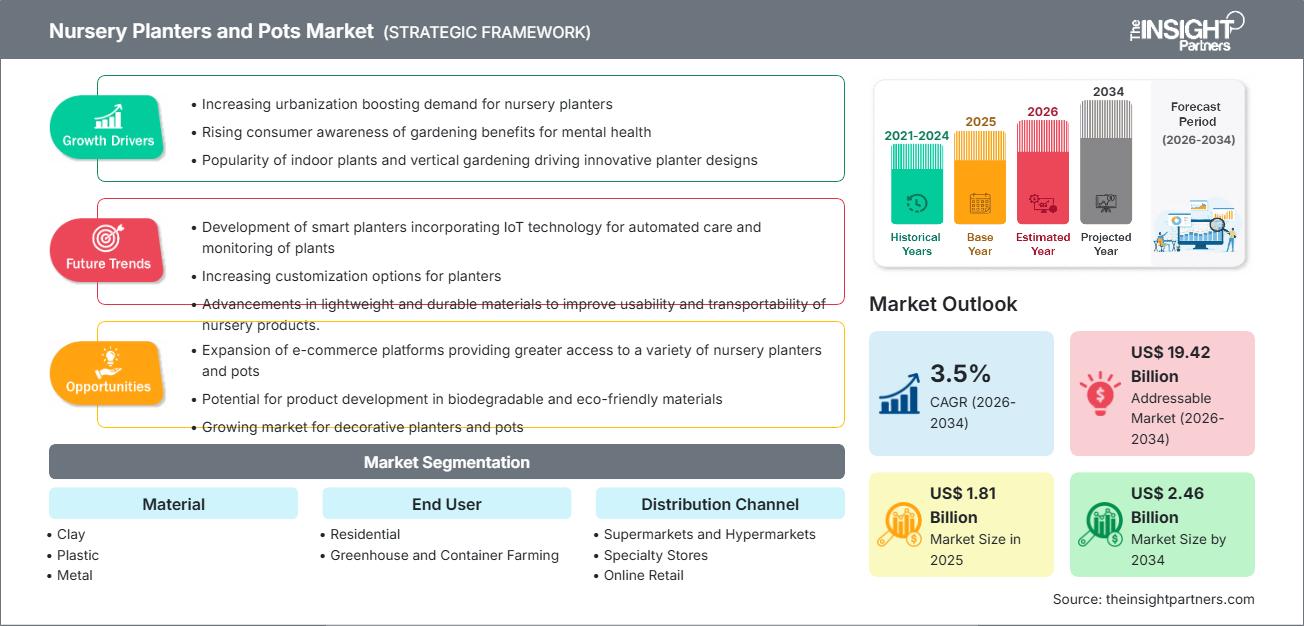
The global Nursery Planters and Pots market size is projected to reach US$ 2.46 billion by 2034 from US$ 1.81 billion in 2025. The market is anticipated to register a CAGR of 3.5% during the forecast period 2026–2034. Key market dynamics include a rising global interest in indoor gardening and "biophilic" interior design, the expansion of commercial greenhouse operations to support food security, and an increasing consumer preference for sustainable, biodegradable gardening solutions. Additionally, the market is expected to benefit from the growth of urban vertical farming, the rising popularity of home-grown herbs and vegetables, and the integration of smart-irrigation technologies within high-end planter systems.
Nursery Planters and Pots Market Analysis
The nursery planters and pots market analysis indicates a strategic shift toward high-durability and resource-efficient containers as commercial growers prioritize yield optimization. Procurement trends suggest a growing divide between the cost-sensitive traditional plastic pot sector and the high-growth eco-friendly segment utilizing materials like bamboo fiber and recycled ocean plastics. Strategic opportunities are emerging in the integration of "smart" features—such as self-watering reservoirs and sensor-compatible drainage systems—which offer a clear competitive advantage in the premium residential and professional landscaping sectors. The analysis also emphasizes that market expansion is increasingly reliant on regional manufacturing hubs to mitigate high shipping costs associated with bulky containers. Competitive differentiation is now focused on "circular economy" branding, where manufacturers implement buy-back programs for used nursery pots and utilize carbon-neutral production processes to appeal to environmentally conscious retail chains and institutional buyers.
Nursery Planters and Pots Market Overview
Nursery planters and pots are evolving from a basic horticultural utility into a critical component of both the aesthetic home décor and professional agricultural industries. While the nursery planters and pots market was historically dominated by standard terracotta and black plastic nursery pots, it has expanded into a diverse range of value-added products, including decorative ceramic vessels, heavy-duty fabric grow bags, and automated vertical planting systems. The market involves a fragmented landscape of small-scale artisanal potters and large-scale industrial manufacturers, both of whom are increasingly focusing on UV-stabilized and weather-resistant materials to cater to varying climates. Increasing urbanization in regions like Asia-Pacific and North America has fueled the demand for space-saving planting solutions, positioning planters as essential tools for the "green city" movement. Europe remains a significant hub for design innovation, while manufacturing powerhouses in Asia continue to lead in high-volume export capacities. For instance, the market in the US is characterized by a robust DIY gardening culture and a sophisticated professional landscaping sector. Growth is driven by the expansion of large-scale home improvement retailers and a surging interest in "edible landscapes." Consumers are increasingly seeking premium, aesthetically versatile containers that complement modern outdoor living spaces.
Customize This Report To Suit Your Requirement
Get FREE CUSTOMIZATIONNursery Planters and Pots Market: Strategic Insights
-
Get Top Key Market Trends of this report.This FREE sample will include data analysis, ranging from market trends to estimates and forecasts.
Nursery Planters and Pots Market Drivers and Opportunities
Market Drivers:
- Surge in Urban Gardening and Biophilic Trends: As urban living spaces become more compact, there is a heightened demand for portable and vertical planting solutions. The psychological and health benefits associated with indoor plants are driving consistent retail sales of decorative planters in metropolitan areas.
- Modernization of Greenhouse and Controlled Environment Agriculture (CEA): The transition toward high-tech farming requires specialized, stackable, and reusable containers designed for hydroponic and aeroponic systems. This industrial demand ensures stable, large-volume contracts for specialized pot manufacturers.
- E-commerce Proliferation and Specialized Packaging: The rapid growth of online plant nurseries has necessitated the development of lightweight, shatterproof, and nestable pots that reduce shipping weights and prevent damage during transit, expanding the reachable market for niche suppliers.
Market Opportunities:
- Development of Bio-based and Compostable Materials: There is a significant opportunity to replace traditional petroleum-based plastics with PLA, coconut coir, or rice husk composites. These "plant-and-forget" pots, which decompose in the soil, cater to the high-growth organic gardening segment.
- Expansion into Smart Home Ecosystems: Integrating planters with IoT-enabled moisture sensors and automated nutrient delivery systems represents a lucrative frontier for high-end consumer electronics partnerships, targeting tech-savvy urban professionals.
- Strategic Collaboration with Large-Scale Retailers: Forming exclusive design partnerships with global home improvement and furniture chains allows manufacturers to secure high-visibility shelf space and tap into established logistics networks for seasonal product launches.
Nursery Planters and Pots Market Report Segmentation Analysis
The Nursery Planters and Pots Market share is analyzed across various segments to provide a clearer understanding of its structure, growth potential, and emerging trends. Below is the standard segmentation approach used in most industry reports:
By Material:
- Clay: A traditional and highly breathable option preferred for specific plant species. It remains a staple in the premium and artisanal segments due to its aesthetic appeal and natural properties.
- Plastic: The dominant material by volume, valued for its lightweight nature, durability, and cost-effectiveness in both retail and commercial nursery operations.
- Metal: A growing niche in the decorative and modern landscaping sector, often utilized for its durability and contemporary industrial look.
- Others: Includes innovative materials such as wood, fabric, and biodegradable fibers like bamboo or coir, gaining traction due to sustainability initiatives.
By End User:
- Residential: Driven by individual hobbyists and home decorators seeking containers for indoor and outdoor domestic use.
- Greenhouse and Container Farming: A professional segment focused on high-efficiency, standardized pots designed for commercial cultivation and food production.
- Others: Includes public infrastructure, corporate offices, and botanical gardens where large-scale landscaping and decorative greenery are required.
By Distribution Channel:
- Supermarkets and Hypermarkets: Major hubs for seasonal gardening supplies, offering convenience and a wide variety of mass-market planter options.
- Specialty Stores: Focused on high-quality gardening centers and boutiques that provide expert advice and premium, niche brands.
- Online Retail: The fastest-growing channel, enabling consumers to access a global variety of designs and facilitating the direct-to-consumer (D2C) shipment of large-scale orders.
- Others: Includes direct B2B sales to commercial nurseries, landscapers, and municipal departments.
By Geography:
- North America
- Europe
- Asia Pacific
- South & Central America
- Middle East & Africa
Nursery Planters and Pots Market Report Scope
| Report Attribute | Details |
|---|---|
| Market size in 2025 | US$ 1.81 Billion |
| Market Size by 2034 | US$ 2.46 Billion |
| Global CAGR (2026 - 2034) | 3.5% |
| Historical Data | 2021-2024 |
| Forecast period | 2026-2034 |
| Segments Covered |
By Material
|
| Regions and Countries Covered |
North America
|
| Market leaders and key company profiles |
|
Nursery Planters and Pots Market Players Density: Understanding Its Impact on Business Dynamics
The Nursery Planters and Pots Market is growing rapidly, driven by increasing end-user demand due to factors such as evolving consumer preferences, technological advancements, and greater awareness of the product's benefits. As demand rises, businesses are expanding their offerings, innovating to meet consumer needs, and capitalizing on emerging trends, which further fuels market growth.
Nursery Planters and Pots Market Share Analysis by Geography
Asia-Pacific is expected to grow fastest in the coming years. Emerging markets in South & Central America, the Middle East, and Africa also have many untapped opportunities for premium container producers and sustainable agricultural equipment manufacturers to expand.
The nursery planters and pots market is undergoing a significant transformation, moving from a basic horticultural utility to a globally traded aesthetic and functional commodity. Growth is driven by the rising popularity of urban gardening, a surge in "green city" infrastructure projects, and the expansion of the commercial greenhouse sector. Below is a summary of market share and trends by region:
North America
- Market Share: Holds a leading global position driven by a mature DIY gardening culture and extensive professional landscaping services.
- Key Drivers:
- Rising consumer preference for aesthetically versatile and UV-resistant outdoor containers.
- Mainstreaming of edible landscaping and home vegetable gardening in suburban demographics.
- Strong presence of major home improvement retail giants facilitating high-volume distribution.
- Trends: Scaling of "smart" planter adoption and the successful integration of recycled ocean plastics into high-end retail product lines to appeal to eco-conscious consumers.
Europe
- Market Share: Commands a significant share of the global market, anchored by deep-seated floriculture traditions and strict environmental standards for plastic usage.
- Key Drivers:
- High demand for traditional and PDO-style artisanal ceramics in countries like Italy and Spain.
- Robust regulatory frameworks promoting the use of biodegradable and fiber-based nursery containers.
- Established commercial greenhouse infrastructure in Northern Europe requiring standardized technical pots.
- Trends: A strategic shift toward closed-loop recycling systems for professional growers and a rising focus on vertical gardening solutions to address limited urban living spaces.
Asia-Pacific
- Market Share: The fastest-growing region, with massive manufacturing hubs and a rapidly expanding domestic consumer base in China and India.
- Key Drivers:
- Massive urban greening initiatives and government-supported agricultural modernization projects.
- Rising disposable incomes are leading to a preference for "lifestyle" gardening and premium decorative pots.
- Dominance in global exports of cost-effective plastic and clay nursery containers.
- Trends: Heavy reliance on e-commerce platforms for cross-border sales and the rapid development of innovative, space-saving vertical planting systems for high-density residential complexes.
South and Central America
- Market Share: An emerging market with a growing commercial horticultural sector and a nascent boutique residential segment.
- Key Drivers:
- Increasing awareness of the benefits of container-based farming for specialized high-value crops.
- Modernization of local nursery facilities to meet international export standards for ornamental plants.
- Rising interest in Mediterranean-style patio gardening among the urban middle class.
- Trends: Growth of "farm-to-table" home kits and the introduction of planters made from regional natural fibers to differentiate from imported mass-market plastics.
Middle East and Africa
- Market Share: A developing market with a strong focus on large-scale landscaping for luxury real estate and food security initiatives.
- Key Drivers:
- High demand for specialized self-watering and UHT-resistant pots suitable for arid climates.
- Strategic investments in high-tech "Smart Agriculture" to reduce reliance on imported produce.
- Expansion of high-end hospitality projects requiring extensive decorative greenery and durable planters.
- Trends: Implementation of modern irrigation-compatible containers to maximize water efficiency, coupled with a focus on high-durability materials for municipal "green belt" projects.
High Market Density and Competition
Competition is intensifying due to the presence of established leaders such as Nursery Supplies, Inc., The HC Company, T.O. Plastics, PöPPELMANN GMBH AND CO. KG, Keter, Landmark Plastic Corporation, Anderson Pots, Pot Incorporated, and Fertil, also contributing to a diverse and rapidly expanding market landscape.
This competitive environment pushes vendors to differentiate through:
- Premiumization and Functional Branding: Positioning planters as superior horticultural tools by emphasizing features like advanced aeration systems, UV stabilization, and self-watering mechanisms for time-constrained urban gardeners.
- Diversified Product Portfolios: Nursery products now include more than just standard pots. Companies offer decorative indoor vessels, heavy-duty commercial grow bags, and modular vertical wall systems designed for high-density living.
- Vertical Supply Chain Integration: Producers manage the entire lifecycle, from sourcing post-consumer recycled (PCR) plastics to local distribution. This ensures quality control, supply chain transparency, and adherence to strict "Clean Label" environmental standards.
- Innovative Manufacturing Technologies: New processing techniques, such as precision injection molding and thermoforming, help create lightweight yet ultra-durable nursery pots used in high-tech greenhouse operations and automated farming systems worldwide.
Opportunities and Strategic Moves
- Partner with high-end retail channels and e-commerce platforms to tap into the surging demand for space-efficient and designer-grade gardening products in the North American and European urban markets.
- Incorporate sustainable farming practices and regenerative agriculture certifications to appeal to environmentally conscious millennials and Gen Z consumers seeking ethical alternatives to traditional petroleum-based plastics.
Major Companies operating in the Nursery Planters and Pots Market are:
- Nursery Supplies, Inc.
- The HC Company
- T.O. Plastics
- PöPPELMANN GMBH AND CO. KG
- Keter
- Landmark Plastic Corporation
- Anderson Pots
- Pot Incorporated
- Fertil
Disclaimer: The companies listed above are not ranked in any particular order.
Nursery Planters and Pots Market News and Recent Developments
- In June 2024, Nursery Supplies Inc., a portfolio company of Mill Point Capital LLC and a leader in sustainable horticulture packaging solutions, announced the formation of CREO Group. This new parent company integrated the rich history and innovative strengths of Nursery Supplies Inc. and Summit Plastic Company, which had previously merged in 2013 after a multi-year partnership. This strategic move positioned CREO for future growth in the global nursery planters and pots, and container solutions market.
- In July 2025, Growscape made its official debut at Cultivate'25, bringing with it a wave of innovation, sustainability, and strategic leadership. Born from the expertise of two industry leaders, The HC Companies and Classic Home and Garden, Growscape led the way in garden and décor by offering the most innovative and sustainable solutions for nursery planters and pots.
Nursery Planters and Pots Market Report Coverage and Deliverables
The "Nursery Planters and Pots Market Size and Forecast (2021–2034)" report provides a detailed analysis of the market covering below areas:
- Nursery Planters and Pots Market size and forecast at global, regional, and country levels for all the key market segments covered under the scope
- Nursery Planters and Pots Market trends, as well as market dynamics such as drivers, restraints, and key opportunities
- Detailed PEST and SWOT analysis
- Nursery Planters and Pots Market analysis covering key market trends, global and regional framework, major players, regulations, and recent market developments
- Industry landscape and competition analysis covering market concentration, heat map analysis, prominent players, and recent developments in the Nursery Planters and Pots Market.
- Detailed company profiles
Frequently Asked Questions

- Historical Analysis (2 Years), Base Year, Forecast (7 Years) with CAGR
- PEST and SWOT Analysis
- Market Size Value / Volume - Global, Regional, Country
- Industry and Competitive Landscape
- Excel Dataset
Recent Reports
Testimonials

The Insight Partners' SCADA System Market report is comprehensive, with valuable insights on current trends and future forecasts. The team was highly professional, responsive, and supportive throughout. We are very satisfied and highly recommend their services.
RAN KEDEM Partner, Reali Technologies LTDs
I requested a report on a very specific software market and the team produced the report in a few days. The information was very relevant and well presented. I then requested some changes and additions to the report. The team was again very responsive and I got the final report in less than a week.
JEAN-HERVE JENN Chairman, Future Analytica
We worked with The Insight Partners for an important market study and forecast. They gave us clear insights into opportunities and risks, which helped shape our plans. Their research was easy to use and based on solid data. It helped us make smart, confident decisions. We highly recommend them.
PIYUSH NAGPAL Sr. Vice President, High Beam Global
The Insight Partners delivered insightful, well-structured market research with strong domain expertise. Their team was professional and responsive throughout. The user-friendly website made accessing industry reports seamless. We highly recommend them for reliable, high-quality research services
YUKIHIKO ADACHI CEO, Deep Blue, LLC.
This is the first time I have purchased a market report from The Insight Partners.While I was unsure at first, I visited their web site and felt more comfortable to take the risk and purchase a market report.I am completely satisfied with the quality of the report and customer service. I had several questions and comments with the initial report, but after a couple of dialogs over email with their analyst I believe I have a report that I can use as input to our strategic planning process.Thank you so much for taking the extra time and making this a positive experience.I will definitely recommend your service to others and you will be my first call when we need further market data.
JOHN SUZUKI President and Chief Executive Officer, Board Director, BK Technologies
I wish to appreciate your support and the professionalism you displayed in the course of attending to my request for information regarding to infectious disease IVD market in Nigeria. I appreciate your patience, your guidance, and the fact that you were willing to offer a discount, which eventually made it possible for us to close a deal. I look forward to engaging The Insight Partners in the future, all thanks to the impression you have created in me as a result of this first encounter.
DR CHIJIOKE ONYIA MANAGING DIRECTOR, PineCrest Healthcare Ltd.Reason to Buy
- Informed Decision-Making
- Understanding Market Dynamics
- Competitive Analysis
- Identifying Emerging Markets
- Customer Insights
- Market Forecasts
- Risk Mitigation
- Boosting Operational Efficiency
- Strategic Planning
- Investment Justification
- Tracking Industry Innovations
- Aligning with Regulatory Trends




 Get Free Sample For