
Vertical Farming Crops Market Size, Share & Forecast by 2034
Coverage: By Crop Type (Tomato, Leafy Greens, Herbs, and Others), End-Use (Food Retail and Food Service), and Farming Technique (Hydroponics, Aeroponics, and Aquaponics)
- Status : Data Released
- Report Code : TIPRE00018004
- Category : Consumer Goods
- No. of Pages : 150
- Available Report Formats :


- Last update date : February 24, 2026


2025 Market Size
US$ 606.21 Mn
Base year value
2034 Forecast
US$ 3,370.46 Mn
Projected by 2034
CAGR 2026-2034
21.0 %
Growth rate
Addressable Market
US$ 15,927.45 Mn
(2026-2034)
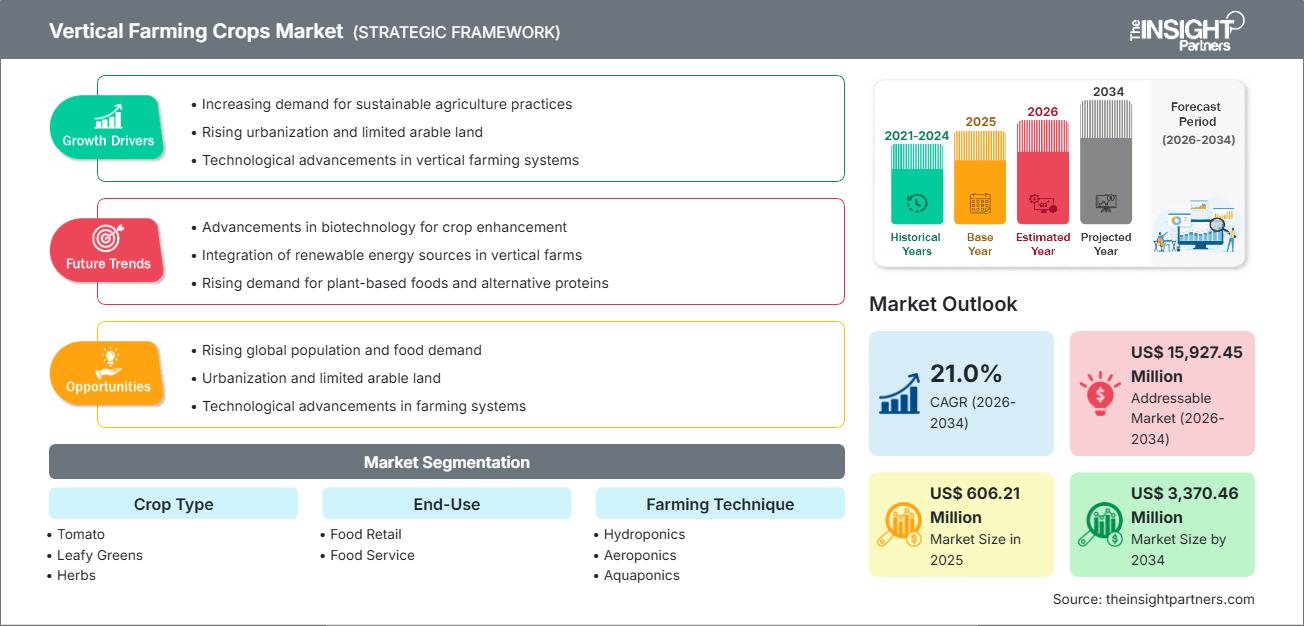
The global Vertical Farming Crops market size is projected to reach US$ 3,370.46 million by 2034 from US$ 606.21 million in 2025. The market is anticipated to register a CAGR of 21.0% during the forecast period 2026–2034. Key market dynamics include the rising global demand for pesticide-free organic produce, the increasing necessity for climate-resilient agriculture, and the rapid urbanization that limits traditional arable land. Additionally, the market is expected to benefit from advancements in LED lighting efficiency, the integration of AI-driven climate control systems in indoor farms, and a growing consumer preference for locally grown, "farm-to-fork" freshness in metropolitan areas.
Vertical Farming Crops Market Analysis
The vertical farming crops market analysis reveals a strategic pivot toward hyper-local production to mitigate the risks associated with volatile global supply chains and high transportation costs. Strategic opportunities are emerging in the pharmaceutical and nutraceutical sectors, where controlled-environment agriculture (CEA) allows for the precise cultivation of crops with specific bioactive profiles. The analysis indicates that market participants should prioritize the optimization of "crop recipes"—specific combinations of light spectrum and nutrient delivery—to reduce energy consumption, which remains the primary operational hurdle. Competitive differentiation is increasingly defined by the ability to achieve price parity with conventional greenhouse produce through automation and the scaling of high-density growing modules. Furthermore, companies are encouraged to secure long-term offtake agreements with major grocery retailers to stabilize revenue streams in a capital-intensive industry.
Vertical Farming Crops Market Overview
Vertical farming crops are transitioning from a niche technological experiment to a vital component of the global food security infrastructure. Originally focused on low-value microgreens and lettuce, vertical farming crops are diversifying into high-calorie and high-value crops, including strawberries, dwarf tomatoes, and specialized herbs. Both venture-backed technology firms and traditional agribusinesses are investing in stacked growing systems that utilize soil-less cultivation methods. The rising awareness regarding water scarcity and the environmental impact of industrial runoff has positioned vertical farming as a "cleaner" alternative to traditional field farming. While North America and Europe have been early adopters of these technologies, the Asia-Pacific region is rapidly scaling operations to feed its dense urban populations. For instance, the market in the US, the vertical farming crops market is characterized by a mature ecosystem of technology providers and large-scale commercial operators. Growth is driven by the expansion of indoor facilities near major coastal cities, reducing food miles for perishable goods. The market emphasizes sustainable branding and the consistent, year-round delivery of premium produce.
Market Assessment and Insights
- Global market for Vertical Farming Crops was valued at US$ 606.21 Million in 2025
- Annual market size is expected to reach US$ 3,370.46 Million by 2034
- Total addressable market (TAM) during 2026-2034 is projected to reach approximately US$ 15,927.45 Million
- Market is anticipated to register a CAGR of 21% during the forecast period
- The United States represents a key market, supported by Increasing demand for sustainable agriculture practices, Rising urbanization and limited arable land, Technological advancements in vertical farming systems, as well as evolving industry dynamics
- Market analysis covers North America, Europe, Asia-Pacific, South and Central America, Middle East and Africa, with growth evaluated across the forecast period
- Market opportunities such as Rising global population and food demand, Urbanization and limited arable land, Technological advancements in farming systems are expected to influence market dynamics and addressable market
- Report profiles industry participants, including AeroFarms, Agricool, Bowery Farming Inc., CropOne, Infarm, Plantlab, Plenty Unlimited Inc., Gotham Greens, MIRAI Co., Ltd., BrightFarms, while analyzing competitive strategies and innovation developments
-
Source: The Insight Partners' analysis based on proprietary research, government publications, company annual reports, investor presentations, industry databases, and expert interviews.
● REPORT CUSTOMIZATION
Tailor This Report To Align With Your Specific Business Requirements
This report can be customized to align precisely with your business objectives, scope, and target markets. Customization options include tailored segmentation, geography, competitive analysis, and strategic insights to support informed decision-making.
Customize This Report →WHAT YOU CAN ADJUST
- ● Segmentations
- ● Geography
- ● Competitive Analysis
- ● Language Preferences
Vertical Farming Crops Market: Strategic Insights
-
Get Top Key Market Trends of this report.This FREE sample will include data analysis, ranging from market trends to estimates and forecasts.
Vertical Farming Crops Market Drivers and Opportunities
Market Drivers:
- Year-Round Climate Independence and Resilience: Vertical farming operates as a "climate-agnostic" system, decoupling food production from the volatility of external weather patterns. In an era of increasing droughts, floods, and temperature shifts, the ability to maintain consistent crop cycles regardless of the season provides a critical buffer for global food security. This driver is particularly influential in regions with harsh climates, such as the Middle East or Northern Europe, where traditional outdoor farming is restricted to short windows.
- Radical Resource Efficiency and Water Conservation: Standard field agriculture accounts for approximately 70% of global freshwater withdrawals. Vertical farming systems—specifically hydroponics and aeroponics—utilize closed-loop irrigation that recycles water, consuming up to 95% less water than conventional methods. This efficiency, combined with a 90% reduction in land requirements due to vertical stacking, addresses the growing scarcity of arable land and clean water resources.
- Demand for "Better-Than-Organic" Nutrient Profiles: Modern consumers are increasingly prioritizing nutrient density and food safety. Vertical farms provide a sterile environment that eliminates the need for chemical pesticides, herbicides, and fungicides. Furthermore, the use of precision "light recipes" (specific LED spectra) can actually enhance the phytochemical content of crops, such as increasing the levels of antioxidants in kale or vitamins in lettuce, surpassing the nutritional quality of traditional organic produce.
Market Opportunities:
- High-Value Pharmaceutical and "Plant-as-a-Factory" Applications: There is a significant burgeoning opportunity to use vertical farming for the cultivation of specialized medicinal plants and "biopharming." By precisely controlling environmental parameters, operators can maximize the yield of specific secondary metabolites used in pharmaceuticals, skincare, and nutraceuticals. This includes the production of plant-based vaccines, high-potency CBD from hemp, or rare botanical extracts that are difficult to cultivate consistently in the wild.
- Diversification into Staple and High-Calorie Crops: While leafy greens dominate the current market, the next frontier lies in the genetic and technical optimization of staple crops like dwarf wheat, rice, and soy. As technology costs decrease and lighting efficiency increases, moving beyond "salad crops" into calorie-dense staples offers a massive opportunity to address the food needs of a global population projected to reach 10 billion by 2050, particularly in land-constrained urban centers.
- Integration with Smart City Infrastructure and Circular Economies: Vertical farms are uniquely positioned to integrate with urban "Smart City" ecosystems. Opportunities exist to collocate farms with residential or industrial buildings to utilize excess heat, captured CO2, or greywater for irrigation. This "circular agriculture" model not only lowers operational costs but also appeals to ESG-focused (Environmental, Social, and Governance) investors and urban planners seeking to build self-sustaining metropolitan hubs.
Vertical Farming Crops Market Report Segmentation Analysis
The Vertical Farming Crops Market share is analyzed across various segments to provide a clearer understanding of its structure, growth potential, and emerging trends. Below is the standard segmentation approach used in most industry reports:
By Crop Type:
- Tomato: A high-value segment gaining traction as breeders develop dwarf varieties optimized for vertical configurations and high-density planting.
- Leafy Greens: The dominant volume driver and most mature segment, encompassing lettuce, kale, and spinach due to their fast growth cycles and high suitability for hydroponic systems.
- Herbs: A premium niche including basil, mint, and cilantro, favored for their high profit margins and consistent demand from the food service sector.
- Others: Includes emerging categories such as strawberries, peppers, and medicinal plants that are currently undergoing commercial scaling.
By End-Use:
- Food Retail: Remains the primary channel, with products sold through supermarkets and high-end grocery chains under premium, sustainable branding.
- Food Service: A rapidly rising channel where vertical farms supply restaurants and catering businesses with ultra-fresh, specialized produce that is often harvested on the day of delivery.
By Farming Technique:
- Hydroponics: The most widely adopted technique, utilizing nutrient-rich water solvents instead of soil to support plant growth.
- Aeroponics: A high-tech niche that grows plants in an air or mist environment, offering superior oxygenation and even lower water usage than hydroponics.
- Aquaponics: An integrated system combining aquaculture (fish farming) with hydroponics, creating a symbiotic ecosystem that appeals to the circular economy movement.
By Geography:
- North America
- Europe
- Asia Pacific
- South & Central America
- Middle East & Africa
Vertical Farming Crops Market Report Scope
| Report Attribute | Details |
|---|---|
| Market size in 2025 | US$ 606.21 Million |
| Market Size by 2034 | US$ 3,370.46 Million |
| Global CAGR (2026 - 2034) | 21.0% |
| Historical Data | 2021-2024 |
| Forecast period | 2026-2034 |
| Segments Covered |
By Crop Type
|
| Regions and Countries Covered |
North America
|
| Market leaders and key company profiles |
|
Vertical Farming Crops Market Players Density: Understanding Its Impact on Business Dynamics
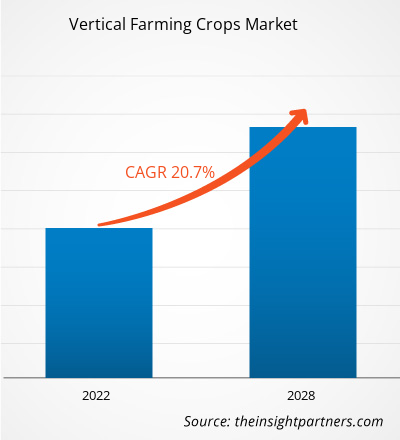
The Vertical Farming Crops Market is growing rapidly, driven by increasing end-user demand due to factors such as evolving consumer preferences, technological advancements, and greater awareness of the product's benefits. As demand rises, businesses are expanding their offerings, innovating to meet consumer needs, and capitalizing on emerging trends, which further fuels market growth.
Vertical Farming Crops Market Share Analysis by Geography
Asia-Pacific is expected to grow fastest in the coming years. Emerging markets in South & Central America, the Middle East, and Africa also have many untapped opportunities for premium dairy producers and infant formula manufacturers to expand.
The vertical farming crops market is undergoing a significant transformation, moving from a traditional Mediterranean staple to a global high-value functional food. Growth is driven by the rising prevalence of cow-milk allergies, a surge in "alternative" dairy demand, and the expansion of the luxury artisanal cheese sector. Below is a summary of market share and trends by region:
North America
- Market Share: Holds a significant share supported by massive capital investment and a robust network of ag-tech startups.
- Key Drivers:
- Rising consumer preference for pesticide-free, high-quality "clean" produce in urban centers.
- Presence of industry-leading innovators and large-scale automated facilities.
- Transition toward reducing transportation carbon footprints by moving farms closer to metropolitan consumers.
- Trends: Scaling of retail partnerships with high-end grocery chains and the integration of advanced AI and robotics to lower operational costs.
Europe
- Market Share: Holds the largest share globally, anchored by a deep-seated commitment to sustainable agriculture and high consumer demand for organic produce.
- Key Drivers:
- Stringent government regulations regarding environmental sustainability and pesticide use.
- Limited availability of traditional arable land in Western European nations.
- High adoption rates of energy-efficient LED technologies to combat high electricity tariffs.
- Trends: A strategic shift toward "building-integrated" vertical farms in urban supermarkets and a focus on circular economy models that reuse waste heat and CO2.
Asia-Pacific
- Market Share: The fastest-growing region, with countries like Singapore and Japan acting as the primary engines for technological innovation and food security.
- Key Drivers:
- Massive urban population base seeking premium, hypoallergenic, and locally grown nutrition.
- Strong government-supported initiatives aimed at achieving national food self-sufficiency.
- Rapid urbanization is leading to the depletion of traditional agricultural land.
- Trends: Heavy reliance on "smart city" vertical infrastructure and the emergence of high-value "crop recipes" tailored for the Asian nutraceutical and beauty industries.
South and Central America
- Market Share: Emerging market with a growing artisanal and commercial sector in countries like Brazil, Argentina, and Chile.
- Key Drivers:
- Increasing awareness of food safety and the environmental impact of traditional industrial runoff.
- Modernization of indoor farming techniques to mitigate the effects of extreme climate unpredictability.
- Rising interest in hydroponic and greenhouse-hybrid systems among tech-savvy younger farmers.
- Trends: Growth of "farm-to-table" boutique brands and the introduction of vertically grown Roma tomatoes and specialty herbs to differentiate from regional bovine-led markets.
Middle East and Africa
- Market Share: Developing market with deep strategic roots in overcoming arid climates, transitioning toward formalized commercial indoor production.
- Key Drivers:
- High demand for year-round fresh produce in desert regions with limited water resources.
- Strategic sovereign wealth fund investments in "Food Tech Valleys" to reduce reliance on food imports.
- Implementation of "Smart Agriculture" to improve local food security and climate resilience.
- Trends: Rapid deployment of hyper-efficient aeroponic systems and solar-powered cooling technologies to formalize local production and reduce food price volatility.
High Market Density and Competition
Competition is intensifying due to the presence of established leaders such as AeroFarms, Agricool, Bowery Farming Inc., CropOne, Infarm, Plantlab, Plenty Unlimited Inc., Gotham Greens, and MIRAI Co., Ltd., which also contribute to a diverse and rapidly expanding market landscape.
This competitive environment pushes vendors to differentiate through:
- Premiumization and Functional Branding: Positioning vertical farming crops as a superior nutritional alternative to field-grown produce by emphasizing zero-pesticide usage, non-GMO status, and the higher phytonutrient density achieved through optimized "light recipes."
- Crop Diversification: Vertical farming products now include more than just leafy greens. Companies are expanding into high-value berries, gourmet herbs, and pollinated crops like dwarf tomatoes, utilizing advanced AI to manage the complex growth cycles of flowering plants.
- Vertical Integration and Automation: Producers manage the entire supply chain, from proprietary seed selection and climate-controlled germination to automated harvesting and direct-to-retail packaging. This approach ensures maximum freshness, transparency, and meets rigorous ESG standards.
- Next-Generation Processing Technologies: New infrastructure, such as AI-driven computer vision and modular robotic systems, helps optimize yields and reduce energy consumption, allowing for the stable year-round production of crops regardless of external climate volatility.
Opportunities and Strategic Moves
- Partner with high-end retail channels and e-commerce platforms: Tap into the surging demand for traceable and "clean label" produce in the Asia-Pacific and North American markets by securing dedicated shelf space in organic-focused grocery chains.
- Incorporate sustainable farming practices and renewable energy microgrids: Appeal to environmentally conscious Gen Z and Millennial consumers by adopting solar-powered lighting and circular water systems to mitigate the high carbon footprint traditionally associated with indoor climate control.
- Strategic Mergers and Restructuring for Scalability: As seen with recent industry consolidations, companies are moving toward mergers and asset-refinancing to achieve the necessary scale for profitability and to expand geographic footprints into high-demand urban corridors.
Major Companies operating in the Vertical Farming Crops Market are:
- AeroFarms
- Agricool
- Bowery Farming Inc.
- CropOne
- Infarm
- Plantlab
- Plenty Unlimited Inc.
- Gotham Greens
- MIRAI Co., Ltd.
- BrightFarms
Disclaimer: The companies listed above are not ranked in any particular order.
Vertical Farming Crops Market News and Recent Developments
- In February 2025, 80 Acres Farms announced capital raises totaling US$ 115 million and the acquisition of Plantae Biosciences, an Israeli biotechnology company. Mike Zelkind, CEO and co-founder of 80 Acres Farms, stated that the ability to raise capital in a challenging market demonstrated investor confidence in the necessity of controlled environment agriculture and the company's vision. The new funding allowed the firm to broaden its technology platform, grow its retail footprint, and develop an ingredients channel for vertical farming crops to meet evolving customer needs. This strategic move enabled the company to execute long-term expansion plans while delivering immediate results in the premium produce sector.
- In September 2024, Plenty Unlimited Inc. opened the world's first industrial-scale facility dedicated to growing indoor, vertically farmed berries. This milestone demonstrated that vertical farming crops could move beyond traditional leafy greens into high-value fruit categories. Plenty's farms were recognized as the most technologically advanced in the world, utilizing a modular system that removed the unpredictability of "Mother Nature." By precisely controlling environmental variables, the company made it possible to grow produce with peak-season flavor, year-round, and almost anywhere in the world.
Vertical Farming Crops Market Report Coverage and Deliverables
The "Vertical Farming Crops Market Size and Forecast (2021–2034)" report provides a detailed analysis of the market covering below areas:
- Vertical Farming Crops Market size and forecast at global, regional, and country levels for all the key market segments covered under the scope
- Vertical Farming Crops Market trends, as well as market dynamics such as drivers, restraints, and key opportunities
- Detailed PEST and SWOT analysis
- Vertical Farming Crops Market analysis covering key market trends, global and regional framework, major players, regulations, and recent market developments
- Industry landscape and competition analysis covering market concentration, heat map analysis, prominent players, and recent developments in the Vertical Farming Crops Market.
- Detailed company profiles
Frequently Asked Questions

- Comprehensive Market Sizing and Forecast Analysis
- Detailed Segmentation Analysis
- In-Depth Market Dynamics Assessment
- Regional and Country-Level Insights
- Competitive Landscape and Company Benchmarking
- Strategic Business Intelligence
Recent Reports
Testimonials

The Insight Partners provided valuable market intelligence that supported our global go-to-market strategy. Their team was professional, responsive, and attentive to our feedback, providing thoughtful analysis and helpful methodological clarifications throughout the project.
Junmo Kim Chief Financial Officer (CFO), Enertech Co., Ltd.
The Insight Partners' SCADA System Market report is comprehensive, with valuable insights on current trends and future forecasts. The team was highly professional, responsive, and supportive throughout. We are very satisfied and highly recommend their services.
RAN KEDEM Partner, Reali Technologies LTDs
I requested a report on a very specific software market and the team produced the report in a few days. The information was very relevant and well presented. I then requested some changes and additions to the report. The team was again very responsive and I got the final report in less than a week.
JEAN-HERVE JENN Chairman, Future Analytica
We worked with The Insight Partners for an important market study and forecast. They gave us clear insights into opportunities and risks, which helped shape our plans. Their research was easy to use and based on solid data. It helped us make smart, confident decisions. We highly recommend them.
PIYUSH NAGPAL Sr. Vice President, High Beam Global
The Insight Partners delivered insightful, well-structured market research with strong domain expertise. Their team was professional and responsive throughout. The user-friendly website made accessing industry reports seamless. We highly recommend them for reliable, high-quality research services
YUKIHIKO ADACHI CEO, Deep Blue, LLC.
This is the first time I have purchased a market report from The Insight Partners.While I was unsure at first, I visited their web site and felt more comfortable to take the risk and purchase a market report.I am completely satisfied with the quality of the report and customer service. I had several questions and comments with the initial report, but after a couple of dialogs over email with their analyst I believe I have a report that I can use as input to our strategic planning process.Thank you so much for taking the extra time and making this a positive experience.I will definitely recommend your service to others and you will be my first call when we need further market data.
JOHN SUZUKI President and Chief Executive Officer, Board Director, BK Technologies
I wish to appreciate your support and the professionalism you displayed in the course of attending to my request for information regarding to infectious disease IVD market in Nigeria. I appreciate your patience, your guidance, and the fact that you were willing to offer a discount, which eventually made it possible for us to close a deal. I look forward to engaging The Insight Partners in the future, all thanks to the impression you have created in me as a result of this first encounter.
DR CHIJIOKE ONYIA MANAGING DIRECTOR, PineCrest Healthcare Ltd.Reason to Buy
- Informed Decision-Making
- Understanding Market Dynamics
- Competitive Analysis
- Identifying Emerging Markets
- Customer Insights
- Market Forecasts
- Risk Mitigation
- Boosting Operational Efficiency
- Strategic Planning
- Investment Justification
- Tracking Industry Innovations
- Aligning with Regulatory Trends






 Get Free Sample for