
Soundbar Market Trends, Demand & Growth by 2034
Coverage: by Type (2.1 Channel, 5.1 Channel, 7.1 Channel)); Distribution Channel (Online, Offline) , and Geography (North America, Europe, Asia Pacific, and South and Central America)
- Status : Data Released
- Report Code : TIPRE00010779
- Category : Electronics and Semiconductor
- No. of Pages : 150
- Available Report Formats :


- Last update date : October 30, 2026


2025 Market Size
US$ 8.72 Bn
Base year value
2034 Forecast
US$ 19.14 Bn
Projected by 2034
CAGR 2026-2034
9.13 %
Growth rate
Addressable Market
US$ 124.59 Bn
(2026-2034)
The Soundbar Market is projected to expand from US$ 8.72 Billion in 2025 to US$ 19.14 Billion by 2034, registering a 9.13% CAGR from 2026 to 2034. The market encompasses consumer and commercial audio solutions categorized by channel configuration, installation method, installation type, and application. Demand is supported by the shift toward immersive home entertainment, increasing integration between televisions and external audio devices, and product innovation across compact, connected, and multi-channel soundbar architectures.
Rising television screen sizes, smart-home adoption, and demand for simplified home cinema configurations are strengthening the Soundbar Market size opportunity across North America. The region is expected to record a modeled CAGR of ~8% through 2034, supported by replacement demand, premium home entertainment spending, wireless connectivity, and increasing consumer preference for integrated audio systems that deliver surround-sound effects without the complexity of conventional speaker installations.
Soundbar Market Assessment and Insights
Regional Outlook
- North America: ~31% of the global market in 2025 | ~8% CAGR through 2034. Market position: North America maintains a major regional position due to high penetration of smart televisions, established premium-audio ecosystems, replacement demand, and consumer acceptance of connected home entertainment products.
- US: ~80% of North American market revenue in 2025 | ~8% CAGR through 2034. Market position: The US represents the largest country market within North America, supported by strong home theater adoption, premium television ownership, streaming consumption, and established participation from global audio and consumer-electronics brands.
- Europe: ~26% of the global market in 2025 | ~8% CAGR through 2034. Market position: Europe combines mature consumer-electronics demand with replacement-driven purchases and premium audio adoption. Germany represents the leading country in Europe, followed by substantial demand across the UK, France, Italy, and Spain.
- Asia Pacific: ~30% of the global market in 2025 | ~11% CAGR through 2034. Market position: Asia Pacific is the fastest-growing region, supported by expanding television ownership, urban housing, local electronics manufacturing, connected-home adoption, and rising demand across China, Japan, South Korea, India, and Australia.
Segment Outlook
- 2.1 Channel: ~43% Share in 2025 | ~8% CAGR through 2034. Market position: 2.1 Channel products maintain the largest segment position because they combine stereo sound enhancement with a dedicated low-frequency component while retaining compact dimensions, straightforward installation, and relatively accessible pricing.
- 7.1 Channel: ~13% Share in 2025 | ~12% CAGR through 2034. Market position: 7.1 Channel systems represent the high-growth segment as consumers seeking immersive home cinema increasingly adopt advanced multi-channel architectures, spatial audio processing, and television-linked surround configurations.
Competitive Coverage
Polk Audio, Bose Corporation, Onkyo Corporation, Pioneer Corporation, Plantronics, Inc., Sennheiser Electronic GmbH and Co. KG, Sentry Industries, Inc., TCL Corporation, LG Electronics Inc., Samsung Electronics Co., Ltd.
Methodology
The Insight Partners follows Data Collection & Secondary Research, Primary Research, Data Analysis, and Data Triangulation & Final Review to validate market estimates and insights.
Source: The Insight Partners' analysis based on proprietary research, government publications, company annual reports, investor presentations, industry databases, and expert interviews.
The Soundbar Market has transitioned from relatively straightforward TV audio accessories to connected entertainment devices featuring multi-channel audio processing, wireless subwoofers, audio immersion technologies, room calibration, voice amplification, and integration with televisions. Trends in production focus more and more on compact acoustic engineering, digital signal processing, and modular product design. Manufacturers are creating product offerings for different room designs, allowing for placement on tables, mounting to walls, and other positioning capabilities. All these changes have expanded the potential customer base from specialized home theater aficionados to families looking for a convenient replacement for ordinary speakers.
When looking at future development trends in the industry until 2034, expansion is predicted to continue in such regions as Asia Pacific and emerging markets where TV upgrade, video streaming, urban housing, and adoption of smart houses increase the need for external audio. Investments will probably be focused on acoustic processing, wireless interaction, artificial intelligence-based sound optimization, energy-saving parts, and software-driven product differentiation. Attention of regulators to efficiency of electronic devices, connectivity standards, and sustainability of product design can affect part choices, packaging, and manufacturing process as well.
Soundbar Market Report Scope
| Report Attribute | Details |
|---|---|
| Market size in 2025 | US$ 8.72 Billion |
| Market Size by 2034 | US$ 19.14 Billion |
| Global CAGR (2026 - 2034) | 9.13% |
| Historical Data | 2021-2024 |
| Forecast period | 2026-2034 |
Soundbar Market Analysis
Soundbar Market Growth is highly related to the evolution of home entertainment economics. Larger televisions create a situation where there is a discrepancy between the capabilities of visual output and built-in audio system; hence, prompting consumers to purchase soundbars without having to install several speakers. Streaming content, gaming, sports, and movies further enhance the need for clear dialogue, wide soundstage, and better bass response. Replacement demand becomes relevant in that consumers can upgrade their soundbars without necessarily upgrading their televisions.
The supply chain consists of acoustic components providers, semiconductor/digital signal processing providers, enclosure and drivers providers, wireless components providers, original equipment providers, television providers, retail shops, e-commerce portals, and post-sale service networks. The supply chain strategy emphasizes the scalable manufacturing and platforming of various models, allowing manufacturers to differentiate themselves via their channel structure and prices but using a shared electronics platform. Availability of components, logistics costs, compatibility of the device, and availability of audio technology become central to the economics of manufacturing.
The Soundbar Market Report characterizes a combination of diversified consumer electronics companies with dedicated audio manufacturers. Samsung Electronics Co., Ltd. and LG Electronics Inc. can take advantage of the television ecosystems to offer synchronized audio experiences, whereas Bose Corporation, Polk Audio, Sennheiser Electronic GmbH and Co. KG, Onkyo Corporation, and Pioneer Corporation focus on offering audio excellence and unique acoustic technology brands. TCL Corporation is represented via its diverse range of portfolio products for television and connected homes, while Sentry Industries, Inc. is concerned about addressing selective consumer requirements for audio. Plantronics, Inc. represents experience in the field of audio engineering, particularly personal and communication audio, with portfolio positioning in the home entertainment market providing extra opportunities.
The areas of investment are changing from the hardware specification to software-defined differentiation. The areas of differentiation can be related to acoustic calibration, adaptive equalization, wireless connectivity, voice enhancement, content-aware processing, and ecosystem integration. Vendors can strategically differentiate themselves by means of television bundling, retail alliances, direct consumer offerings, and regional product customization. Premium products are able to reach high-end customers through immersive formats, whereas small 2.1 Channel products offer volume through easier installation and increased household compatibility.
● REPORT CUSTOMIZATION
Tailor This Report To Align With Your Specific Business Requirements
This report can be customized to align precisely with your business objectives, scope, and target markets. Customization options include tailored segmentation, geography, competitive analysis, and strategic insights to support informed decision-making.
Customize This Report →WHAT YOU CAN ADJUST
- ● Segmentations
- ● Geography
- ● Competitive Analysis
- ● Language Preferences
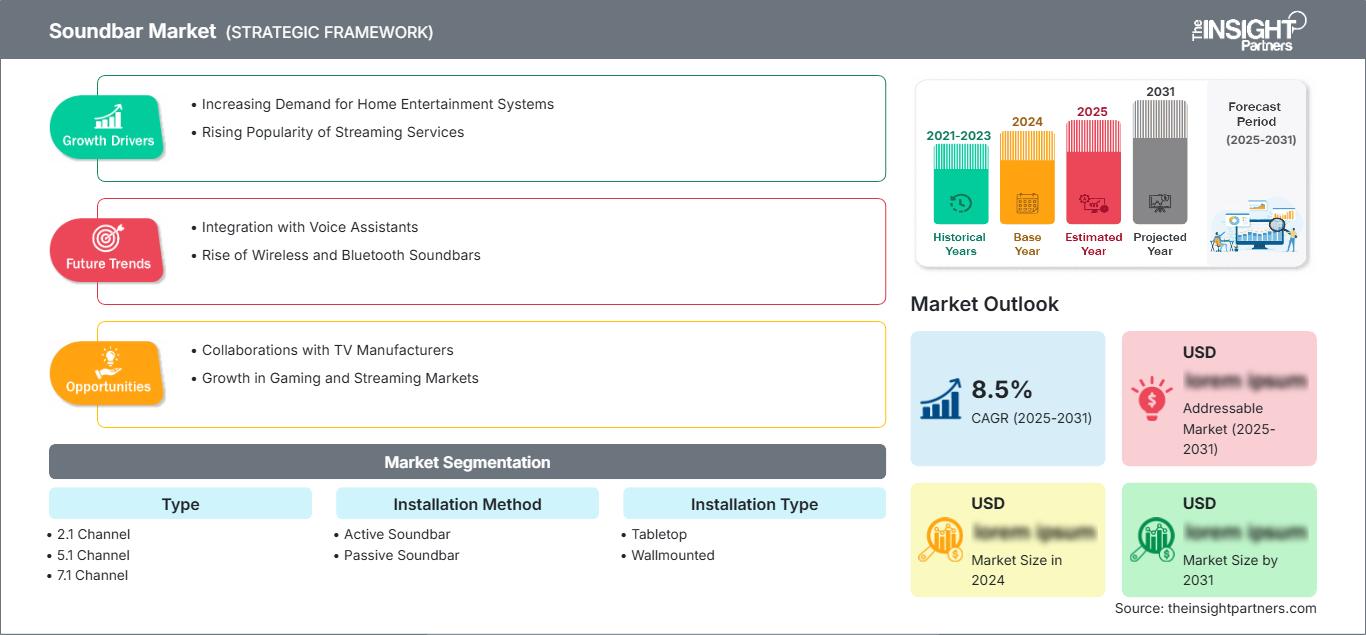
Soundbar Market: Strategic Insights
Regional Insights
North America Soundbar Market
North America contributed to ~31% of total revenue in 2025 and is forecast to grow at ~8% CAGR till 2034. Key factors contributing to growth in the regional market include development of consumer electronics distribution network, high saturation of connected televisions, high streaming consumption, and home entertainment expenditure. Demand is further facilitated by product replacement, wherein consumers replace traditional television speakers with wireless and immersive audio systems.
The United States accounts for the primary market for soundbars in the region, driven by wide availability and participation of leading brands in the audio and television categories. Other contributors to North American demand include Canada, owing to its premium consumer electronics products and connected home technology, and Mexico due to growing TV ownership and development of retail distribution networks. In general, soundbar purchases in the region have shifted focus from the traditional home theater system setup to convenience, compatibility, and compatibility with gaming and streaming systems.
U.S. Soundbar Market
The US accounted for ~80% of North American revenue in 2025 and is forecast to expand at ~8% CAGR over the period until 2034. Growth drivers include the presence of a huge base of televisions, frequent streaming, entertainment spending, and consumer awareness about wireless audio solutions. Soundbars are aided by the fact that they provide better audio performance without the need for lots of wiring and specialized rooms.
Competitors in the market include professional audio brands and television manufacturers, including Bose Corporation, Polk Audio, Samsung Electronics Co., Ltd., and LG Electronics Inc. The applications involve watching TV, video gaming, attending sports events, listening to music, and home movie theaters. High-quality multi-speaker systems gain popularity among enthusiasts, while small systems meet needs of people living in apartments and recreation areas. Online and retail sales are still significant, as customers can compare the characteristics and functionalities before buying the product.
Europe Soundbar Market
Europe was ~26% of the Soundbar Market Share in 2025 and is expected to grow at ~8% CAGR until 2034. Germany is the most prominent country in Europe due to its large consumer electronics industry and high interest in premium audio gear. The UK also makes up for another notable market with demand driven by streaming, gaming, and entertainment home system upgrades. France offers its contribution to the demand via TV replacement and connected homes, whereas Italy and Spain bring demand from urban dwellings and entertainment-focused customers.
Within the region, selection is shaped by factors such as apartment life, integration into the interior, energy consumption, and easy installation. Wall mounts can work alongside modern room designs, whereas table models will suit customers preferring easier installations. In addition, demand in Europe favors interoperability between televisions, streaming services, wireless speakers, and home automation. Accordingly, competition in the market is conducted through industrial design compactness, good dialogue reproduction, multi-room capabilities, and immersive processing, not just output power.
APAC Soundbar Market
The Asia Pacific region held ~30% share of the total global market in 2025 and is estimated to show the highest regional growth at ~11% CAGR up to 2034. The main countries in this region include China, owing to its strong electronics manufacturing presence and consumer electronics demand, along with Japan and South Korea due to their technology-oriented audio and television segment, and India and Australia on account of growing adoption of home entertainment systems.
Some of the key drivers that have influenced the regional expansion are urbanization, presence of smart TV, local manufacture, e-commerce, and increasing need for immersive entertainment solutions. While South Korea is strong in terms of electronics brands and connected home ecosystem, India is an emerging consumer market looking for larger screens and improved audio experience.
Middle East & Africa Soundbar Market
The Middle East and Africa region is modeled to expand at ~9% CAGR through 2034. The UAE represents a leading country in the Middle East & Africa market, supported by premium consumer electronics, hospitality infrastructure, high-end residential development, and strong demand for connected entertainment. Saudi Arabia is also important as household modernization and large-scale residential and commercial projects increase demand for integrated audiovisual systems.
Demand from South Africa constitutes one of the key centers in Africa. The rest of the MEA region consists of countries wherein the uptake will grow along with the rise in incomes, urbanization, and digital entertainment access. In the entire region, energy efficiency, ease of wireless installation, small size, and compatibility with large TV screens may help enhance the uptake rate.
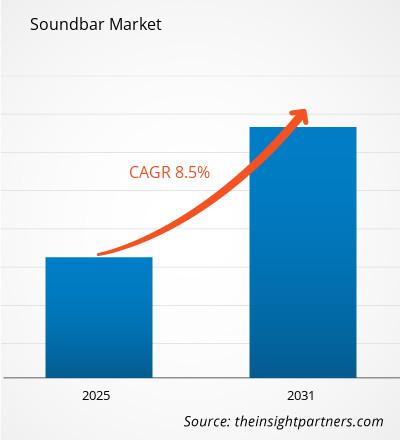
Segmentation Analysis
Type
The Type segment in the Soundbar Market is modeled to expand at ~9% CAGR from 2026 to 2034. Channel configuration remains a key purchase criterion because it determines the complexity of audio reproduction, surround effects, physical architecture, and pricing. Entry-level systems emphasize simplicity and accessibility, while higher-channel configurations target consumers seeking immersive home cinema. The segment is therefore shaped by the trade-off between acoustic performance, room size, installation complexity, and household budget.
- 2.1 Channel: This configuration serves consumers seeking stronger television audio with a dedicated low-frequency component while maintaining a relatively compact installation. Its straightforward architecture supports broad residential adoption across bedrooms, apartments, living rooms, and mainstream entertainment setups.
- 5.1 Channel: 5.1 Channel systems provide a stronger surround-oriented experience and appeal to consumers seeking a more cinematic presentation without moving to the highest-complexity architectures. They occupy an important middle position between conventional stereo enhancement and premium immersive systems.
- 7.1 Channel: 7.1 Channel products target advanced home entertainment users who value wider sound distribution and more sophisticated surround processing. Demand is supported by gaming, premium streaming content, home cinema upgrades, and consumers seeking theater-style audio from integrated equipment.
Installation Method
The Installation Method segment in the Soundbar Market is projected to grow at ~10% CAGR through 2034. Active soundbars benefit from integrated amplification and processing, simplifying installation and reducing the number of external components required. Passive designs retain relevance where users prefer separate amplification and system customization. The segment is influenced by consumer preference for convenience, system flexibility, available living space, and compatibility with existing audiovisual equipment.
- Active Soundbar: Active soundbars integrate amplification, processing, and frequently wireless connectivity within the primary unit. Their simplified architecture supports broad household adoption and makes them suitable for consumers prioritizing quick installation, compact systems, and seamless television integration.
- Passive Soundbar: Passive soundbars rely more heavily on external amplification and system components. They appeal to users seeking greater configuration flexibility or integration with existing audio systems, although installation requirements can limit mainstream adoption compared with integrated alternatives.
Installation Type
The Installation Type segment in the Soundbar Market is expected to register approximately ~9% CAGR during 2026–2034. Installation flexibility has become increasingly important as households differ in room dimensions, furniture arrangements, and television placement. Manufacturers are consequently designing products that can maintain acoustic performance across multiple positions. This trend supports both tabletop and wall-mounted formats, while also encouraging adjustable processing and placement-aware sound optimization.
- Tabletop: Tabletop soundbars offer straightforward installation below or near the television and suit consumers who prioritize portability and minimal installation effort. They are particularly relevant where users frequently rearrange entertainment equipment or do not want permanent wall fixtures.
- Wallmounted: Wallmounted soundbars support cleaner visual integration with wall-mounted televisions and can optimize available floor space. Demand is associated with modern interior design, large-screen television installations, and consumers seeking a coordinated audiovisual setup with minimal visible cabling.
Application
The Application segment in the Soundbar Market is modeled to grow at ~9% CAGR through 2034. Home Audio remains the central demand environment, but commercial applications create additional opportunities across hospitality, retail, corporate spaces, and entertainment venues. The segment is influenced by the need for simple installation, consistent audio performance, space efficiency, and integration with television or media-display systems.
- Home Audio: Home Audio remains the core application because soundbars directly address the limitations of television speakers while providing a simpler alternative to multi-speaker home theater systems. Streaming, gaming, sports, and cinematic content support continued household adoption.
- Commercial: Commercial applications include hospitality rooms, meeting spaces, retail environments, and entertainment areas where compact audio systems can support displays without extensive speaker deployment. Demand is shaped by installation efficiency, reliability, aesthetics, and centralized audiovisual management.
Opportunity Snapshot
| Application | Revenue Contribution | Trend Tag | Adoption Stage |
|---|---|---|---|
| Home Audio | High | Immersive TV | Mature |
| Commercial | Medium | AV Integration | Scaling |
Soundbar Market Growth Drivers and Impact Analysis
Large-Screen Television Adoption and Audio Performance Gaps
The use of bigger screen sizes by television buyers is a structural strength in favor of external audio since smaller speaker size, lower speaker volume, and poor bass production are the challenges faced by thin television designs. Buyers buying high-quality screen sizes could therefore be in need of complementary products that will enhance dialogue production, low frequency and spatialization without necessarily having to install a whole home theater system. This structure favors soundbars since it occupies lesser space compared to regular speakers but still easy to use. The television producers could drive faster acceptance through complementary bundling and ecosystem synchronization. With rising ownership of smart big screen televisions, soundbar purchases could be boosted through complementary replacement process.
Expansion of Immersive and Connected Home Entertainment
The consumers are expecting more from home entertainment systems such as streaming, gaming, music, and movie modes through a common interface. This raises the needs of the soundbar functionalities from being mere amplifiers for televisions. The inclusion of wireless capabilities, immersive audio processing, voice enhancing, room tuning, and compatibility with other televisions can help raise the value of the products. Gaming is an important aspect because audio location and connectivity may affect the overall entertainment experience. The use of connected homes will provide opportunities to soundbars as well in order to be used in conjunction with other devices like televisions, wireless speakers, and smart assistants.
Retail Expansion and Multi-Tier Product Availability
Broader distribution across online marketplaces, specialist electronics retailers, mass merchants, and brand-owned channels can reduce purchasing friction and expose soundbars to a wider consumer base. Multi-tier portfolios allow manufacturers to serve consumers seeking basic audio improvement as well as buyers willing to pay for immersive multi-channel systems. Online retail also improves product comparison by making specifications, compatibility, connectivity, and installation information more visible before purchase. This supports category education and can reduce uncertainty among first-time buyers. Regional manufacturing and localized product portfolios further allow companies to address different price sensitivities and television ecosystems. The resulting channel diversity can reinforce market expansion by combining high-volume entry products with premium systems that increase average transaction value.
Soundbar Market Future Trends
AI-Enabled Acoustic Personalization and Adaptive Sound
AI-assisted acoustic personalization is positioned to become a more important differentiator as manufacturers seek to improve performance across varied rooms and content types. Instead of relying solely on fixed sound modes, future products can increasingly analyze content, environmental characteristics, listener preferences, and device placement to adjust audio output dynamically. This development could make advanced processing more accessible to mainstream households by reducing the need for manual calibration. The Soundbar Market trends associated with adaptive audio also extend to clearer dialogue, automated bass management, and context-sensitive gaming or movie profiles. Competitive differentiation may therefore shift from the number of channels alone toward the quality of software, sensors, processing algorithms, and ecosystem integration embedded within each product.
Flexible Form Factors and Ecosystem-Based Audio Architectures
Future soundbars are likely to place greater emphasis on flexible physical placement and coordinated operation with other household devices. Consumers increasingly expect a single audio product to work across tabletop and wall-mounted environments while maintaining consistent sound characteristics. Convertible designs, wireless rear speakers, compact subwoofers, and television synchronization can make premium audio easier to configure in different room layouts. Ecosystem-based architectures may also encourage manufacturers to connect soundbars with televisions, smart speakers, mobile devices, and streaming platforms. These developments can reduce the distinction between a standalone soundbar and a broader home audio hub, creating additional opportunities for software updates, accessory sales, and cross-device integration through 2034.
Soundbar Market Opportunities
Premium Television Bundling and Integrated Home Cinema
Television manufacturers have an opportunity to strengthen soundbar adoption by packaging audio with premium display products or presenting coordinated upgrade pathways. Bundling can reduce compatibility concerns because the television and soundbar are designed to operate together, while synchronized controls can simplify setup. Premium televisions also create a natural target audience for advanced sound systems because buyers investing in visual performance may seek comparable audio quality. The opportunity extends beyond direct bundles to financing programs, retail demonstrations, installation services, and ecosystem-based loyalty strategies. Vendors can use this route to differentiate products through integrated user experiences rather than isolated hardware specifications. Such approaches may also improve customer retention by encouraging consumers to remain within a single television and audio ecosystem.
Emerging-Market Audio Upgrades and Localized Product Portfolios
Emerging markets provide opportunities for manufacturers that can combine affordable pricing with meaningful improvements over built-in television audio. Localized product development can address room sizes, television ownership patterns, connectivity preferences, retail structures, and household budgets. A tiered portfolio covering compact 2.1 Channel systems through advanced multi-channel products can broaden the addressable customer base without requiring every consumer to purchase a premium configuration. Partnerships with e-commerce platforms, television retailers, and local distributors can improve reach, while localized demonstrations can communicate the difference between television speakers and dedicated audio systems. The Soundbar Market Forecasts therefore indicate commercial opportunity not only in premium immersive products but also in scalable products designed around the needs of rapidly expanding consumer-electronics markets.
Recent Developments
- August 2025: Samsung Electronics Co., Ltd. launched its 2025 soundbar lineup in India, including the HW-Q990F and HW-QS700F. The portfolio introduced AI Sound Optimization, Dynamic Bass Control, Active Voice Amplifier Pro, Wireless Dolby Atmos, and a convertible design using a gyro sensor to adapt audio according to placement. The launch illustrates continued product development around adaptive sound, smart-home integration, and flexible installation.
- February 2025: LG Electronics Inc. announced new premium soundbars in India, including the S95TR and S90TY. The products incorporated Wireless Dolby Atmos, wireless rear surround speakers, up-firing speakers, spatial audio technologies, and AI-assisted room calibration. LG positioned the models around integrated operation with compatible televisions, reinforcing the movement toward coordinated TV and soundbar ecosystems.
- February 2025: Panasonic introduced three soundbar models in India, covering 5.1-channel and 2.1-channel configurations. The SC-HTS600GWK and SC-HTS400GWK targeted immersive home entertainment with 5.1-channel architectures, while the SC-HTS160GWK provided a more compact 2.1-channel configuration. The launch demonstrates continued segmentation across channel configurations and consumer requirements for compact home audio upgrades.
Frequently Asked Questions

- Comprehensive Market Sizing and Forecast Analysis
- Detailed Segmentation Analysis
- In-Depth Market Dynamics Assessment
- Regional and Country-Level Insights
- Competitive Landscape and Company Benchmarking
- Strategic Business Intelligence
Recent Reports
Testimonials

The Insight Partners provided valuable market intelligence that supported our global go-to-market strategy. Their team was professional, responsive, and attentive to our feedback, providing thoughtful analysis and helpful methodological clarifications throughout the project.
Junmo Kim Chief Financial Officer (CFO), Enertech Co., Ltd.
The Insight Partners' SCADA System Market report is comprehensive, with valuable insights on current trends and future forecasts. The team was highly professional, responsive, and supportive throughout. We are very satisfied and highly recommend their services.
RAN KEDEM Partner, Reali Technologies LTDs
I requested a report on a very specific software market and the team produced the report in a few days. The information was very relevant and well presented. I then requested some changes and additions to the report. The team was again very responsive and I got the final report in less than a week.
JEAN-HERVE JENN Chairman, Future Analytica
We worked with The Insight Partners for an important market study and forecast. They gave us clear insights into opportunities and risks, which helped shape our plans. Their research was easy to use and based on solid data. It helped us make smart, confident decisions. We highly recommend them.
PIYUSH NAGPAL Sr. Vice President, High Beam Global
The Insight Partners delivered insightful, well-structured market research with strong domain expertise. Their team was professional and responsive throughout. The user-friendly website made accessing industry reports seamless. We highly recommend them for reliable, high-quality research services
YUKIHIKO ADACHI CEO, Deep Blue, LLC.
This is the first time I have purchased a market report from The Insight Partners.While I was unsure at first, I visited their web site and felt more comfortable to take the risk and purchase a market report.I am completely satisfied with the quality of the report and customer service. I had several questions and comments with the initial report, but after a couple of dialogs over email with their analyst I believe I have a report that I can use as input to our strategic planning process.Thank you so much for taking the extra time and making this a positive experience.I will definitely recommend your service to others and you will be my first call when we need further market data.
JOHN SUZUKI President and Chief Executive Officer, Board Director, BK Technologies
I wish to appreciate your support and the professionalism you displayed in the course of attending to my request for information regarding to infectious disease IVD market in Nigeria. I appreciate your patience, your guidance, and the fact that you were willing to offer a discount, which eventually made it possible for us to close a deal. I look forward to engaging The Insight Partners in the future, all thanks to the impression you have created in me as a result of this first encounter.
DR CHIJIOKE ONYIA MANAGING DIRECTOR, PineCrest Healthcare Ltd.Reason to Buy
- Informed Decision-Making
- Understanding Market Dynamics
- Competitive Analysis
- Identifying Emerging Markets
- Customer Insights
- Market Forecasts
- Risk Mitigation
- Boosting Operational Efficiency
- Strategic Planning
- Investment Justification
- Tracking Industry Innovations
- Aligning with Regulatory Trends





 Get Free Sample for