SPECT Equipment Market Size, Share & Opportunities by 2034
SPECT Equipment Market Size and Forecast (2021 - 2034), Global and Regional Share, Trend, and Growth Opportunity Analysis Report Coverage: By Type [Hybrid SPECT (SPECT-MR and SPECT- CT) and Standalone SPECT], Radioisotope Type (Iodine-123, Technetium-99m, Xenon-133, Thallium-201, Radium-223, Gallium-66, and Others), Application (Seizures, Stroke, Stress Fractures, Infections, Tumors, and Others), and End User (Hospitals, Imaging Centers, and Others)
Historic Data: 2021-2024 | Base Year: 2025 | Forecast Period: 2026-2034- Report Date : Apr 2026
- Report Code : TIPRE00026136
- Category : Life Sciences
- Status : Upcoming
- Available Report Formats :


- No. of Pages : 150

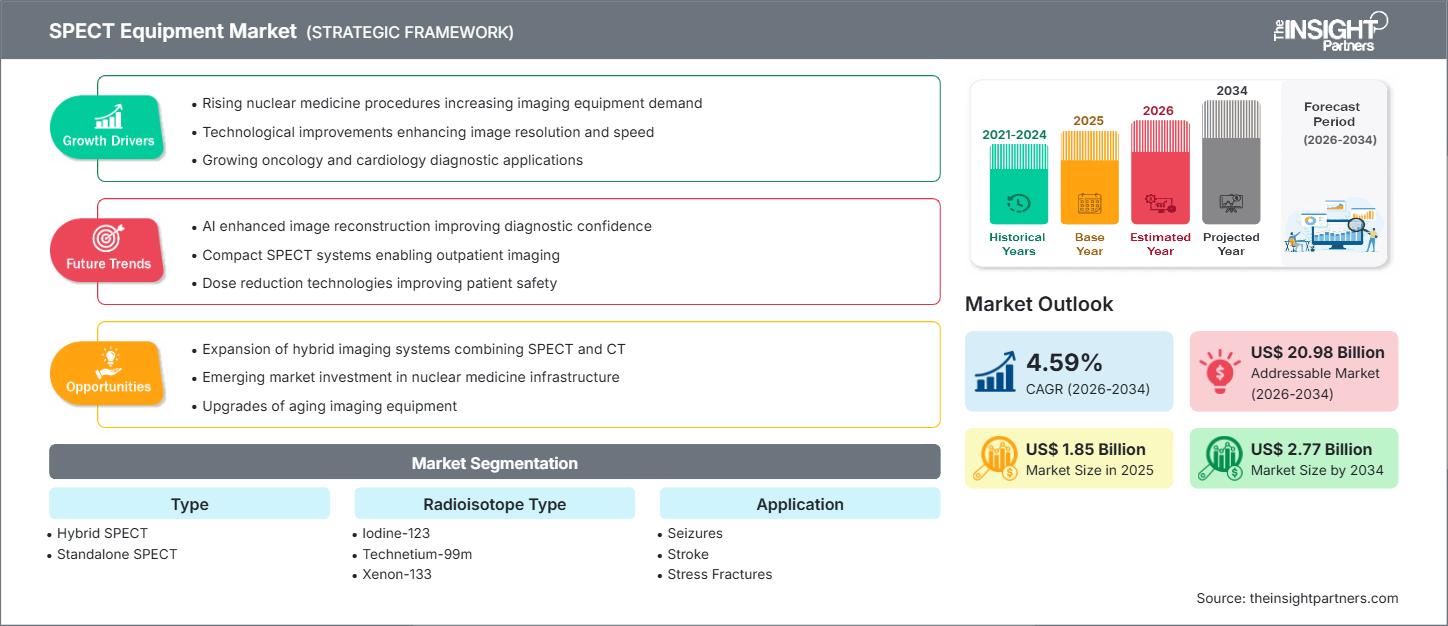
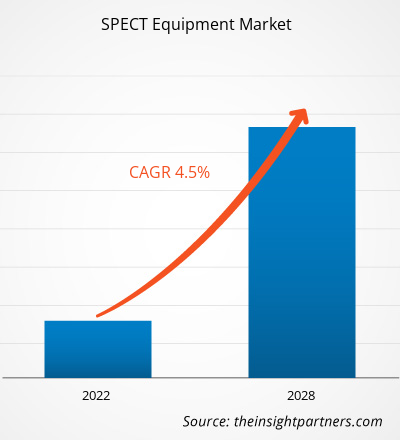
The global SPECT equipment market size is expected to reach US$ 2.77 billion by 2034 from US$ 1.85 billion in 2025. The market is anticipated to register a CAGR of 4.59% during 2026–2034.
SPECT Equipment Market Analysis
The SPECT equipment market is experiencing a significant transition from traditional qualitative imaging to precision quantitative molecular diagnostics. To remain competitive, vendors are required to shift from offering standalone hardware to offering integrated Cardiovascular-Renal-Metabolic (CVRM) and cancer diagnostic platforms. One important opportunity is using Cadmium Zinc Telluride (CZT) solid-state detectors, which improve spatial resolution and reduce scan times. These changes are important for helping more patients and reducing radioisotope waste. Manufacturers should also update their hybrid SPECT/CT products to match the rising Theranostics trend, where SPECT is used as a key tool to check doses for targeted alpha and beta therapies. Success in the next decade will be defined by the ability to provide AI-augmented reconstruction software that compensates for low-count statistics, thereby enabling lower patient radiation doses while maintaining diagnostic integrity across diverse clinical networks.
SPECT Equipment Market Overview
The SPECT equipment market represents a specialized segment within nuclear medicine imaging, employing gamma-emitting radiopharmaceuticals to visualize physiological processes. These systems, including both hybrid SPECT/CT and standalone units, form the basis for functional imaging uses such as myocardial perfusion, bone scans, and neuro-functional assessments. The market is undergoing a significant transformation as more diagnostic workflows become digital and hybrid systems that combine anatomical and functional data are used more often. In the past, supply chain issues with Technetium-99m caused instability; the market is becoming more stable due to regional radiopharmacy networks and new ways to produce isotopes without generators. This sector serves a critical role in global healthcare by enabling non-invasive early detection of diseases, thereby reducing the long-term clinical and financial burden on hospital systems and outpatient imaging centers.
Customize This Report To Suit Your Requirement
Get FREE CUSTOMIZATIONSPECT Equipment Market: Strategic Insights
-
Get Top Key Market Trends of this report.This FREE sample will include data analysis, ranging from market trends to estimates and forecasts.
SPECT Equipment Market Drivers and Opportunities
Market Drivers:
- Rising Demand for Operational Efficiency in Nuclear Medicine: Healthcare organizations are experiencing higher patient volumes and elevated operational costs due to isotope decay. As a result, there is a growing demand for SPECT/CT systems equipped with high-speed CZT detectors to ensure high throughput and clinical accuracy.
- Advancements in Hybrid Imaging and Protocol Standardization: The worldwide shift to SPECT/CT has broadened nuclear medicine use in clinics. Adding CT for attenuation correction and anatomical localization is now standard in oncology and cardiology, not just an extra feature.
- Expanding Radiopharmaceutical Portfolios and Isotope Stability: Government-led initiatives to stabilize the Technetium-99m supply chain and the approval of novel tracers for neurology and infection are driving the widespread implementation of SPECT IT solutions and hardware updates.
Market Opportunities:
- Expansion into Emerging Markets with Growing Diagnostic Sectors: Countries such as China, India, and Brazil are seeing increased adoption of SPECT systems. This growth is driven by substantial investments in nuclear medicine infrastructure and the rise of private oncology centers.
- Integration with AI-Driven Quantitative Analytics: Pairing SPECT hardware with advanced AI analytics makes data management smoother. Machine learning also helps clinicians make clearer decisions when monitoring therapy, especially when tracking how bone metastases respond to treatment.
- Demand for Theranostics-Ready Infrastructure: The trend toward precision medicine is a main driver for specialized SPECT systems. These units enable the visualization of "target" uptake before radiotherapy, contributing to the improvement of personalized healthcare delivery.
SPECT Equipment Market Report Segmentation Analysis
The SPECT equipment market share is analyzed across various segments to provide a clearer understanding of its structure, growth potential, and emerging trends. Below is the standard segmentation approach used in most industry reports:
By Type:
- Hybrid SPECT
- Standalone SPECT
By Radioisotope Type:
- Iodine-123
- Technetium-99m
- Xenon-133
- Thalium-201
- Radium-223
- Gallium-66
By Application:
- Seizures
- Stroke
- Stress Fractures
- Infections
- Tumors
By End User:
- Hospitals
- Imaging Centers
By Geography:
- North America
- Europe
- Asia Pacific
- South & Central America
- Middle East & Africa
SPECT Equipment Market Report Scope
| Report Attribute | Details |
|---|---|
| Market size in 2025 | US$ 1.85 Billion |
| Market Size by 2034 | US$ 2.77 Billion |
| Global CAGR (2026 - 2034) | 4.59% |
| Historical Data | 2021-2024 |
| Forecast period | 2026-2034 |
| Segments Covered |
By Type
|
| Regions and Countries Covered |
North America
|
| Market leaders and key company profiles |
|
SPECT Equipment Market Players Density: Understanding Its Impact on Business Dynamics
The SPECT Equipment Market is growing rapidly, driven by increasing end-user demand due to factors such as evolving consumer preferences, technological advancements, and greater awareness of the product's benefits. As demand rises, businesses are expanding their offerings, innovating to meet consumer needs, and capitalizing on emerging trends, which further fuels market growth.
SPECT Equipment Market Share Analysis by Geography
Asia Pacific is expected to grow fastest in the coming years. Emerging markets in South & Central America, the Middle East, and Africa also have many untapped opportunities for diagnostic imaging providers to expand.
The SPECT equipment market shows a different growth trajectory in each region due to factors such as healthcare infrastructure, nuclear medicine maturity, regulatory environments, and the establishment of radiopharmaceutical networks. Below is a summary of market share and trends by region:
1. North America
- Market Share: Holds the largest market share due to advanced nuclear medicine networks and early adoption of hybrid technology.
- Key Drivers:
- Strong presence of innovators like GE HealthCare, Cardinal Health, and Lantheus
- Favorable reimbursement for myocardial perfusion imaging (MPI)
- High demand for advanced Revenue Cycle Management (RCM) tools in diagnostics
- Trends: Shift toward cloud-based image processing and AI-aided dose optimization to enhance patient safety and workflow efficiency in high-volume imaging centers.
2. Europe
- Market Share: Significant share driven by strict diagnostic governance and national health initiatives.
- Key Drivers:
- Mandatory regulatory compliance and adherence to EMA safety standards
- High uptake of hybrid SPECT/CT for complex neurology and oncology cases
- Strong government support for "Chemicals Strategy for Sustainability" affects radiotracer production
- Trends: Increasing use of interoperable platforms to support cross-border health data exchange and unified care delivery in nuclear medicine across the EU.
3. Asia Pacific
- Market Share: Fastest-growing region owing to rapid urbanization and government-led digital health missions in China and India.
- Key Drivers:
- Rapid expansion of biomanufacturing and new radiopharmacy establishments
- Surge in private specialty hospitals and diagnostic centers
- Rising prevalence of cardiovascular and oncology-related patient volumes
- Trends: Adoption of AI-driven SPECT systems for faster patient throughput and automated lesion detection, catering to the massive patient demand in urban healthcare hubs.
4. South and Central America
- Market Share: Emerging market with growing adoption of minimally invasive diagnostic tools and hybrid systems.
- Key Drivers:
- Modernization of oncology and cardiology centers in Brazil and Mexico
- Rising demand for cost-effective nuclear imaging compared to PET/CT
- Expansion of private health insurance coverage for advanced diagnostics
- Trends: Increasing penetration of global medical imaging brands alongside the development of regional radiopharmaceutical production to stabilize the isotope supply chain.
5. Middle East and Africa
- Market Share: Developing market with high growth potential driven by heavy investments in healthcare infrastructure.
- Key Drivers:
- National "Smart Hospital" initiatives and e-health strategies in GCC countries
- Establishment of new precision-medicine clusters focusing on molecular diagnostics
- High demand for medical practice automation in integrated care models
- Trends: Implementation of specialized SPECT/CT systems in newly built oncology centers and medical cities as part of broader national health transformation programs.
SPECT Equipment Market Players Density: Understanding Its Impact on Business Dynamics
High Market Density and Competition
Competition is intensifying due to the presence of major vendors such as GE HealthCare Technologies Inc., Siemens Healthineers, and Philips Healthcare. Regional and specialized players like Mediso Ltd (Hungary) and MiE GmbH (Germany) also contribute to the crowded and technologically sophisticated market landscape.
This competitive environment pushes vendors to differentiate through:
- Hybrid Imaging Modalities: Integrating SPECT with Computed Tomography (CT) or Magnetic Resonance (EMR) on a single gantry to provide superior anatomical localization alongside functional data.
- Solid-State Detector Technology: Transitioning from traditional sodium iodide crystals to Cadmium-Zinc-Telluride (CZT) detectors to achieve higher spatial resolution and faster image acquisition.
- AI-Powered Image Reconstruction: Utilizing artificial intelligence and machine learning algorithms to reduce noise, shorten scan times, and lower the necessary radiopharmaceutical dose for patients.
- Theranostic Support Capabilities: Designing equipment that supports the growing "theranostics" trend, allowing for precise treatment monitoring and personalized dosimetry in oncology and cardiology.
Opportunities and Strategic Moves
- Partner with radiopharmaceutical suppliers and research institutes to support the development of next-generation tracers, ensuring equipment compatibility with emerging diagnostic and therapeutic agents.
- Incorporate cloud-based informatics and digital workflow solutions to streamline data management across hospital networks and diagnostic imaging centers.
Major Companies operating in the SPECT Equipment Market are:
- Cardinal Health, Inc. – United States
- Curium – France
- Lantheus Medical Imaging, Inc. – United States
- Mediso Ltd – Hungary
- NTP Radioisotopes – South Africa
- Bracco Imaging S.p.A. – Italy
- Star Equity Holdings, Inc. – United States
- Bruker Corporation – United States
- MiE GmbH – Germany
Disclaimer: The companies listed above are not ranked in any particular order.
SPECT Equipment Market News and Recent Developments
- In May 2025, GE HealthCare received FDA 510(k) clearance for its Aurora dual-head SPECT/CT system with AI-powered Clarify DL deep learning reconstruction technology. The system enhances image quality and scan efficiency, supporting adoption in hospitals and diagnostic centers.
- In January 2024, Siemens Healthineers received FDA clearance for syngo Virtual Cockpit, the first multi-vendor remote scanning software supporting SPECT, SPECT/CT, and other imaging modalities. The technology enables real-time remote scanning and support across multiple scanners, addressing technologist shortages and improving operational efficiency, thereby supporting adoption and utilization in the SPECT equipment market.
SPECT Equipment Market Report Coverage and Deliverables
The "SPECT Equipment Market Size and Forecast (2021–2034)" report provides a detailed analysis of the market covering below areas:
- SPECT Equipment Market size and forecast at global, regional, and country levels for all the key market segments covered under the scope
- SPECT Equipment Market trends, as well as market dynamics such as drivers, restraints, and key opportunities
- Detailed PEST and SWOT analysis
- SPECT Equipment Market analysis covering key market trends, global and regional framework, major players, regulations, and recent market developments
- Industry landscape and competition analysis covering market concentration, heat map analysis, prominent players, and recent developments in the SPECT Equipment Market
- Detailed company profiles
Frequently Asked Questions

- Historical Analysis (2 Years), Base Year, Forecast (7 Years) with CAGR
- PEST and SWOT Analysis
- Market Size Value / Volume - Global, Regional, Country
- Industry and Competitive Landscape
- Excel Dataset
Recent Reports
Testimonials

The Insight Partners' SCADA System Market report is comprehensive, with valuable insights on current trends and future forecasts. The team was highly professional, responsive, and supportive throughout. We are very satisfied and highly recommend their services.
RAN KEDEM Partner, Reali Technologies LTDs
I requested a report on a very specific software market and the team produced the report in a few days. The information was very relevant and well presented. I then requested some changes and additions to the report. The team was again very responsive and I got the final report in less than a week.
JEAN-HERVE JENN Chairman, Future Analytica
We worked with The Insight Partners for an important market study and forecast. They gave us clear insights into opportunities and risks, which helped shape our plans. Their research was easy to use and based on solid data. It helped us make smart, confident decisions. We highly recommend them.
PIYUSH NAGPAL Sr. Vice President, High Beam Global
The Insight Partners delivered insightful, well-structured market research with strong domain expertise. Their team was professional and responsive throughout. The user-friendly website made accessing industry reports seamless. We highly recommend them for reliable, high-quality research services
YUKIHIKO ADACHI CEO, Deep Blue, LLC.
This is the first time I have purchased a market report from The Insight Partners.While I was unsure at first, I visited their web site and felt more comfortable to take the risk and purchase a market report.I am completely satisfied with the quality of the report and customer service. I had several questions and comments with the initial report, but after a couple of dialogs over email with their analyst I believe I have a report that I can use as input to our strategic planning process.Thank you so much for taking the extra time and making this a positive experience.I will definitely recommend your service to others and you will be my first call when we need further market data.
JOHN SUZUKI President and Chief Executive Officer, Board Director, BK Technologies
I wish to appreciate your support and the professionalism you displayed in the course of attending to my request for information regarding to infectious disease IVD market in Nigeria. I appreciate your patience, your guidance, and the fact that you were willing to offer a discount, which eventually made it possible for us to close a deal. I look forward to engaging The Insight Partners in the future, all thanks to the impression you have created in me as a result of this first encounter.
DR CHIJIOKE ONYIA MANAGING DIRECTOR, PineCrest Healthcare Ltd.Reason to Buy
- Informed Decision-Making
- Understanding Market Dynamics
- Competitive Analysis
- Identifying Emerging Markets
- Customer Insights
- Market Forecasts
- Risk Mitigation
- Boosting Operational Efficiency
- Strategic Planning
- Investment Justification
- Tracking Industry Innovations
- Aligning with Regulatory Trends




 Get Free Sample For