
Stone Picker Market Growth, Trends & Demand by 2034
Coverage: by Type (Hay Balers, Combines and Others); Application (Landscaping and Farming); , and Geography (North America, Europe, Asia Pacific, and South and Central America)
- Status : Data Released
- Report Code : TIPEL00002419
- Category : Manufacturing and Construction
- No. of Pages : 150
- Available Report Formats :


- Last update date : October 16, 2026


2025 Market Size
US$ 1.38 Bn
Base year value
2034 Forecast
US$ 2.87 Bn
Projected by 2034
CAGR 2026-2034
8.48 %
Growth rate
Addressable Market
US$ 19.07 Bn
(2026-2034)
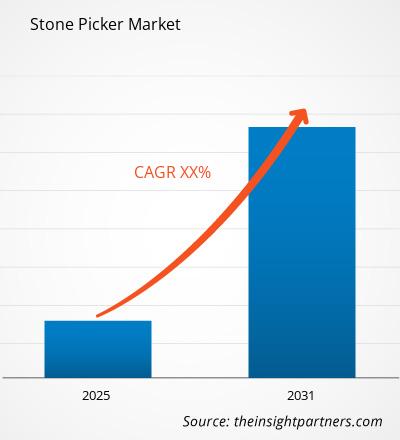
The Stone Picker Market was valued at US$ 1.38 Billion in 2025 and is projected to reach US$ 2.87 Billion by 2034, registering a 8.48% CAGR during 2026–2034. Demand is supported by mechanized field preparation, replacement of labor-intensive stone removal practices, expansion of commercial farming, and increasing emphasis on protecting downstream agricultural equipment.
Across North America, the Stone Picker Market size is supported by extensive mechanized agriculture, large field sizes, and recurring stone-removal requirements in regions affected by glacial deposits and rocky soils. The region is projected to register a ~9% CAGR through 2034. Adoption is reinforced by demand for higher-capacity implements, contractor-based field services, durable hydraulic systems, and equipment that reduces harvesting interruptions and maintenance costs.
Stone Picker Market Assessment and Insights
Regional Outlook
- North America: ~32% of the global Stone Picker Market share in 2025 | ~9% CAGR through 2034. Market position: North America represents the largest regional market, supported by extensive mechanized farming, large commercial fields, established tractor fleets, and recurring rock-removal requirements across Canada and the US.
- US: ~80% of North American market revenue in 2025 | ~9% CAGR through 2034. Market position: The US is the leading country in North America, with strong demand from commercial farms and agricultural contractors. Equipment purchases emphasize productivity, hydraulic performance, durability, and compatibility with high-horsepower tractors.
- Europe: ~30% of the global market in 2025 | ~8% CAGR through 2034. Market position: Europe is a mature stone-removal market, with Germany representing a leading country in Europe. The UK, France, Italy, and Spain contribute through specialized agriculture, contractor services, and land-reclamation activities.
- Asia Pacific: ~25% of the global market in 2025 | ~10% CAGR through 2034. Market position: Asia Pacific is a rapidly expanding market as mechanization improves. China is the leading country in Asia Pacific, while Japan, South Korea, India, and Australia contribute through commercial farming, equipment modernization, and expanding mechanized field operations.
Segment Outlook
- Hay Balers: ~55% Share in 2025 | ~8% CAGR through 2034. Market position: Hay Balers represent the largest main segment because their operating environments overlap with stone-prone agricultural fields where debris removal is important before repeated mowing, baling, and harvesting operations.
- Combines: ~45% Share in 2025 | ~10% CAGR through 2034. Market position: Combines represent the high-growth main segment, supported by increasing attention to crop-harvesting equipment protection, field cleanliness, reduced downtime, and the need to improve operational continuity on large mechanized farms.
Competitive Coverage
Rite Way Mfg. Co. Ltd., Degelman Industries Ltd., Rock King, Remlinger Mfg., Summers Manufacturing, Inc., Kongskilde Agriculture, Highline Manufacturing, elho, Tasias S.A, Pel-Tuote Ltd.
Methodology
The Insight Partners follows Data Collection & Secondary Research, Primary Research, Data Analysis, and Data Triangulation & Final Review to validate market estimates and insights.
Source: The Insight Partners' analysis based on proprietary research, government publications, company annual reports, investor presentations, industry databases, and expert interviews.
In terms of construction, the technology of stone picking has gone through considerable progress from primitive mechanical devices to powerful hydraulic machines intended for fast stone gathering, efficient soil screening, and limited human participation. Modern stone pickers feature durable picking tools, adjustable soil penetration, large hoppers, effective unloading capacity, and hydraulics. Moreover, product architectures have started taking into account the necessity to overcome the performance bottleneck related to repeated stone collecting and unloading. The current product lineups from specialized companies prove this point, featuring advanced stone pickers and powerful hydraulic systems.
Regarding future development of stone pickers, the growing usage of mechanization in agriculture, further consolidation of farms, and increasing activity of land reclamation can be considered as factors that can boost demand in such machines, which will enable quick field preparation. In this context, investments will be made in stone pickers, which are compatible with tractors and have reduced soil compaction and maintenance needs. In addition, products will have automated depth control, electronically controlled hydraulic mechanisms, adjustable screening, and effective materials handling.
Stone Picker Market Report Scope
| Report Attribute | Details |
|---|---|
| Market size in 2025 | US$ 1.38 Billion |
| Market Size by 2034 | US$ 2.87 Billion |
| Global CAGR (2026 - 2034) | 8.48% |
| Historical Data | 2021-2024 |
| Forecast period | 2026-2034 |
Stone Picker Market Analysis
The market growth for Stone Picker Market can be seen in relation to the economics of protecting equipment from stone damage and ensuring field continuity. Stones can cause damage to harvesting and mowing machines, creating maintenance issues and delays in field work. Hence, the highest demand comes where stone density, acreage of land under cultivation, equipment usage, and cost of downtime create enough incentives for using machines for stone removal. This ecosystem features specialized manufacturing companies, tractor suppliers, agriculture dealers, contractors, repair services, and farms, which either buy equipment directly or use contract labor for stone removal.
The supply side remains highly specialized due to the need for tough frames, hydraulics, stone picker reel, screen mechanism, high-wear parts, and efficient dumping. Competition on the part of the manufacturers lies not so much in equipment availability but more in such attributes as the volume of stones which can be removed at once, machine durability, field speed, tractor adaptability, and machine serviceability.
The Stone Picker Market analysis also shows that there is competition among manufacturers who are specialists and have product expertise as well as dealer networks. In this market, companies like Degelman Industries, Rite Way Mfg., Highline Manufacturing, elho, Summers Manufacturing, Remlinger Mfg., Kongskilde Agriculture, Tasias S.A, and Pel-Tuote Ltd serve regional and operational needs differently whereas Rock King is closely linked to the range of rock removal solutions offered by Degelman. Product differentiation is now based more on capacity, pickup geometry, hydraulics, durability, and visibility.
Priorities in investments now focus more on efficiency-based products rather than bigger products. For instance, Highline’s recently introduced RP800 focuses more on having an 80-inch picking width, a high-capacity bucket, adjustable dumping height, replaceable wear parts, and increased visibility. Similarly, ELHO also features hydraulic drives, electronic control, automatic depth control, and adjustable screening in its portfolio. This clearly shows that stone removal is becoming a quantifiable productivity aspect in agricultural mechanization.
● REPORT CUSTOMIZATION
Tailor This Report To Align With Your Specific Business Requirements
This report can be customized to align precisely with your business objectives, scope, and target markets. Customization options include tailored segmentation, geography, competitive analysis, and strategic insights to support informed decision-making.
Customize This Report →WHAT YOU CAN ADJUST
- ● Segmentations
- ● Geography
- ● Competitive Analysis
- ● Language Preferences
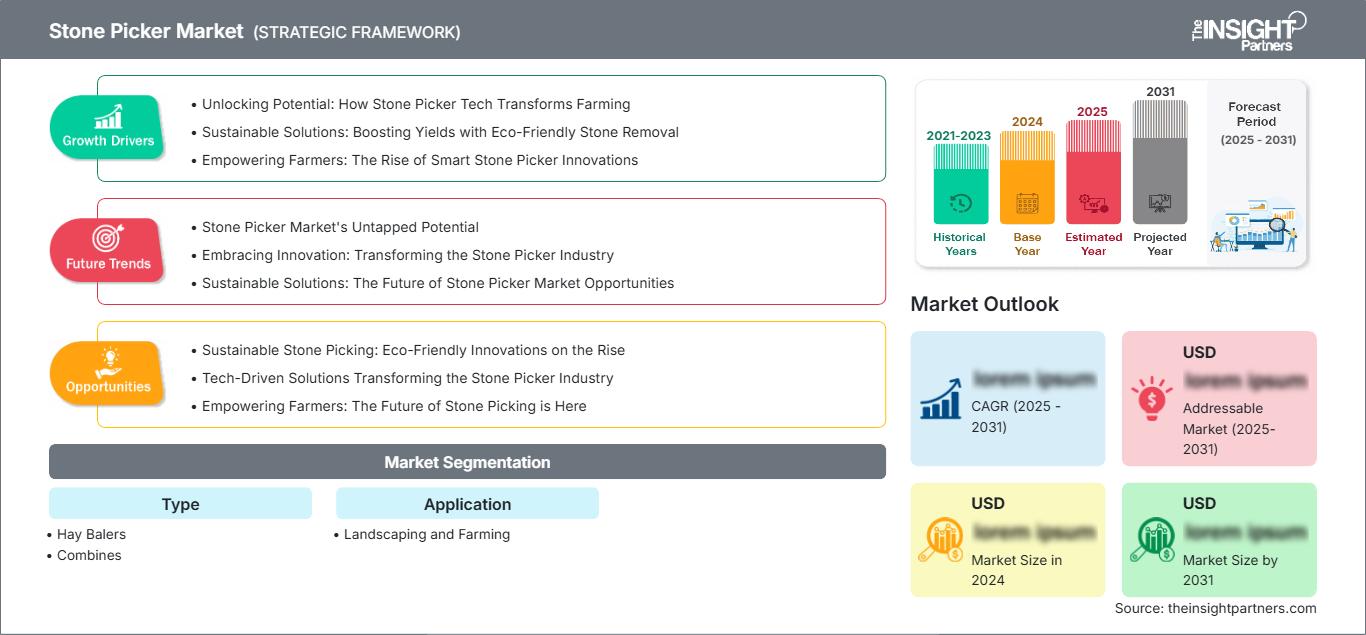
Stone Picker Market: Strategic Insights
Regional Insights
North America Stone Picker Market
North America represents the largest regional opportunity, accounting for approximately ~32% of global revenue in 2025 and recording a projected ~9% CAGR through 2034. There are vast areas of intensive cultivation in Canada and the US, where rocks hinder activities such as tilling, seeding, mowing, baling, and harvesting. The presence of large farm holdings and machinery operated by contractors drives the need for high-performance machines which can cover vast stretches of land in a short seasonal period.
The main demand center for the products is the US, but Canada is advantaged by the production of agricultural goods in its prairie provinces and other places with the presence of rocks. Factors which play an important role in product choice are the tractor power, field size, hopper capacity, reliability, transportability, and dealer availability. Rite Way and Degelman remain relevant players in the specialized equipment market of Canada and North America, while Highline provides special machines for the removal of rocks.
U.S. Stone Picker Market
The US accounted for approximately ~80% of North American revenue in 2025 and is expected to expand at a ~9% CAGR through 2034. The country's large-scale mechanized farming base creates demand for equipment that minimizes field preparation time and prevents stones from reaching high-value harvesting machinery. Commercial farms and agricultural contractors are important customer groups because machine utilization can be spread across multiple fields and customers.
The demand depends on the soil conditions and geography, but stone removal is especially important in cases when there are stones appearing due to glacial activities, rock formations, and repeated plowing. The competition consists of such North American companies as Degelman, Rite Way, Highline, Summers Manufacturing, and Remlinger. There are growing application demands for increased capacity, fast unloading, high durability of wear components, and hydraulic controls that ensure productivity without constant interventions from the operator.
Europe Stone Picker Market
Europe represented approximately ~30% of the global Stone Picker Market in 2025 and is projected to grow at a ~8% CAGR through 2034. Germany is one of the leading nations in Europe, and the UK, France, Italy, and Spain support this industry through their mechanized agriculture, specialist contractors, and land management practices. Europe’s demand is relatively mature; however, replacement needs and product enhancements offer further opportunities.
In Germany, there exists not only a thriving agricultural machinery ecosystem, but also demand for specialized field equipment. In France, a large cultivated area together with a well-developed machinery distribution network allows professional stone removal services. UK’s market is driven by the presence of specialists and field management practices, where soils and the nature of the terrain create problems with stones. Italy and Spain are diverse from the perspective of agriculture: there is a specialized farming practice and places where land preparations and reclamation may require debris removal.
Finally, European companies make significant contributions to product development. ELHO develops hydraulic stone pickers in Finland: the equipment is specially developed for stone-prone territories and has such features as automatic depth adjustment, electronics, hydraulic screening, and high capacity. Pel-Tuote and Tasias also make additional contributions to specialist equipment production. Thus, the competitive situation in this region includes both replacement needs and technology-driven purchases.
APAC Stone Picker Market
APAC accounted for approximately ~25% of the global Stone Picker Market in 2025 and is projected to record a ~10% CAGR through 2034. China is the leading country in Asia Pacific, supported by its large agricultural base and continuing machinery modernization. Japan and South Korea contribute through technologically advanced farming systems, while India and Australia offer distinct opportunities linked to mechanization and large-scale agricultural operations.
China and India provide long-term demand potential as farms and agricultural contractors adopt machinery that reduces manual field preparation. Australia has particularly strong relevance for large-acreage mechanized agriculture, where productivity and equipment durability influence purchasing decisions. Japan and South Korea provide opportunities for compact, efficient machinery suited to specialized farms and higher technology adoption. Regional growth is therefore linked less to a single crop and more to increasing mechanization, farm productivity requirements, and professional equipment utilization.
Middle East & Africa Stone Picker Market
Middle East & Africa is projected to record a ~11% CAGR through 2034, supported by agricultural development, land-reclamation programs, mechanized farming, and infrastructure-related land preparation. Saudi Arabia and the UAE are important commercial markets, while South Africa provides a stronger agricultural machinery base within Africa. The rest of MEA remains more fragmented because purchasing capacity and agricultural mechanization vary considerably by country.
The UAE functions as a leading commercial equipment hub in the Middle East & Africa, supported by established machinery distribution and access to regional customers. Saudi Arabia's agricultural modernization and land-development activities provide additional demand, while South Africa's commercial farming sector supports specialist machinery adoption. In less mechanized markets, equipment demand is more likely to develop through contractors, government-supported agricultural projects, and land-reclamation work rather than direct purchases by smaller farms.
Segmentation Analysis
Type
Hay Balers represent the largest main type, with a projected ~8% CAGR from 2026 to 2034. Their importance is linked to agricultural fields where stones can damage mowing, baling, and harvesting equipment. Stone removal before repeated field operations helps reduce repair exposure and improve machinery availability. Demand is particularly relevant for commercial farms and contractors operating intensive forage systems, where equipment downtime during narrow harvesting windows can have a direct effect on operational efficiency.
- Hay Balers: This sub-segment is closely associated with forage and hay-production environments where repeated passes across fields increase the importance of removing stones before harvesting. Demand emphasizes dependable pickup, durable components, and compatibility with existing tractor fleets.
- Combines: This sub-segment serves grain and broadacre operations where field debris can expose harvesting equipment to damage. Strategic importance comes from protecting expensive machinery, maintaining harvesting continuity, and reducing interruptions during time-sensitive crop collection.
Application
Landscaping and Farming form the application framework for the supplied market taxonomy, with the combined application segment projected at a ~9% CAGR through 2034. Farming represents the principal recurring use case because cultivated land requires stone removal before planting and harvesting cycles. Landscaping demand is more project-oriented and can arise during site preparation, turf development, reclamation, and development of green spaces.
- Landscaping: Demand is linked to preparing land for lawns, recreational areas, green spaces, and development projects. Stone removal supports surface preparation and reduces obstacles before grading, planting, turf establishment, or other landscaping activities.
- Farming: Farming is the core recurring application because stones interfere with tillage and harvesting operations. Dedicated machines help producers and contractors remove field stones efficiently, improve equipment protection, and prepare cultivated acreage for subsequent agricultural activities.
Opportunity Snapshot
| Application | Revenue Contribution | Trend Tag | Adoption Stage |
|---|---|---|---|
| Landscaping | Medium | Site Preparation | Scaling |
| Farming | High | Field Mechanization | Mature |
Stone Picker Market Growth Drivers and Impact Analysis
Rising Mechanization of Large-Scale Farming
Agricultural mechanization increases the economic value of rapid stone removal because modern tractors and harvesting machines can cover substantial acreage within narrow operating windows. As machinery becomes larger and more productive, a single stone entering a harvesting or mowing system can create disproportionately high downtime and repair costs. Dedicated stone pickers address this problem by shifting removal from manual labor toward repeatable mechanical operations. Large farms can justify ownership when equipment utilization is high, while contractors can spread machine costs across multiple customers. This dynamic supports demand for wider pickup systems, larger hoppers, hydraulic drives, and faster unloading. Manufacturers that combine high throughput with tractor compatibility can therefore capture replacement and expansion demand as farms increasingly evaluate equipment according to total operating cost rather than purchase price alone.
Greater Emphasis on Equipment Protection and Uptime
Stone removal is increasingly viewed as a preventive maintenance activity rather than an isolated field-cleaning task. Rocks can damage harvesting machinery, mowing systems, tires, and other implements, while repair events can interrupt time-sensitive agricultural operations. The financial impact becomes more significant when labor, replacement parts, and lost operating time are considered together. This creates a direct incentive for farms and contractors to invest in reliable stone-picking equipment before major field operations begin. Manufacturers are responding with stronger pickup components, replaceable wear parts, improved screening, and hydraulic systems capable of handling blockages. Current products from ELHO, Degelman, Rite Way, and Highline demonstrate this emphasis on durability and continuous operation.
Expansion of Contractor-Based Agricultural Services
Contractor-operated agricultural equipment can lower the ownership barrier for farms that experience stone-removal requirements only during particular periods. Professional contractors can deploy specialized machines across several farms, increasing annual utilization and spreading capital expenditure over a broader customer base. This business model supports demand for equipment that is transportable, durable, simple to maintain, and capable of rapid field deployment. It also encourages manufacturers to develop machines for varied tractor fleets rather than highly standardized farm configurations. Equipment such as ELHO's smaller Scorpio 430 illustrates this direction by targeting farmers, contractors, and cooperatives while maintaining hydraulic functionality and compatibility with smaller tractors. Such flexibility can expand the addressable customer base beyond very large farms.
Stone Picker Market Future Trends
Automation of Depth, Screening, and Hydraulic Functions
Stone Picker Market trends are increasingly moving toward operator-assistance features that improve consistency rather than simply increasing machine size. Automatic depth adjustment can help maintain a stable pickup position across changing ground contours, while electronically controlled hydraulic systems allow operators to manage working depth, screening, rotor speed, and unloading functions from the tractor. Adjustable screens can also help balance stone collection against unwanted soil movement. These capabilities are particularly relevant as farms seek to improve machine utilization while reducing operator workload. Future equipment is likely to integrate more sensing and control functions around existing hydraulic architectures, creating incremental automation without requiring fully autonomous machinery. The commercial value will come from consistent pickup performance, lower blockage risk, improved fuel efficiency, and easier operation across different soil conditions.
Higher-Capacity Machines With Lower Soil Disturbance
Future product development is likely to balance greater throughput with protection of cultivated soil. Larger buckets, wider pickup systems, flotation tires, and improved reel designs can increase productivity, but excessive soil disturbance can undermine field quality and raise operating costs. Manufacturers are therefore emphasizing pickup geometry that lifts stones while allowing soil to pass through screening systems. ELHO's hydraulic pickup systems and Highline's guided reel architecture illustrate how manufacturers are addressing this engineering trade-off. The next generation of equipment can be expected to place greater emphasis on controllable ground engagement, efficient unloading, replaceable wear components, and machine configurations matched to specific tractor capacities.
Stone Picker Market Opportunities
Premium Equipment for High-Utilization Contractors
The Stone Picker Market Forecasts point to an opportunity in premium machines designed specifically for contractors and large farms that require high annual utilization. Buyers in this group can place greater value on throughput, hopper capacity, rapid unloading, durability, transportability, and service access than on minimum acquisition cost. Manufacturers can respond with modular configurations that allow customers to select pickup width, hydraulic systems, screening options, and unloading arrangements according to operating conditions. Dealer networks and parts availability are equally important because contractor downtime affects several customer jobs rather than a single farm. Equipment leasing, seasonal rental, and contractor partnerships can further expand access to higher-capacity machines. This model also creates opportunities for manufacturers to build recurring revenue through replacement components, service agreements, and machine upgrades.
Compact Stone Pickers for Smaller Tractors and Emerging Markets
Compact equipment represents another commercial opportunity because many farms cannot justify a large stone picker or do not operate high-horsepower tractors. Smaller machines can widen the customer base among family farms, cooperatives, contractors, orchards, vineyards, and landscaping operators. ELHO's Scorpio 430 demonstrates this product direction, combining a narrower working width with lower tractor and hydraulic requirements than larger models. Similar configurations could support adoption in emerging agricultural markets where tractor fleets are mixed and capital budgets are more constrained. Manufacturers can strengthen this opportunity through simplified maintenance, modular wear parts, dealer training, financing arrangements, and machines designed for both agricultural and land-preparation applications.
Recent Developments
- 2026: Highline introduced the RP800 Rock Picker as a new-generation rock-removal machine. The model features an 80-inch picking width, a high-capacity bucket, adjustable dump height, replaceable tine components, improved visibility, and a hydraulically positioned hitch. The design is positioned around faster rock collection, reduced unloading frequency, and easier maintenance for demanding agricultural operations.
- July 2025: ELHO highlighted its new Scorpio 430 stone picker as a more compact and cost-effective addition to its stone-picker range. The machine is designed for farmers, contractors, and cooperatives using smaller tractors and incorporates hydraulic drive, durable Hardox components, and field-oriented stone collection capabilities. Its introduction broadens the company's product coverage toward smaller agricultural operations.
- August 2025: Degelman's updated R570P Prong Picker operator and parts documentation was issued in August 2025, providing operating, maintenance, safety, and troubleshooting guidance for its rock-removal equipment. The documentation reinforces the company's continued support for dedicated stone-picking machinery and long-term equipment operation within agricultural applications.
Frequently Asked Questions

- Comprehensive Market Sizing and Forecast Analysis
- Detailed Segmentation Analysis
- In-Depth Market Dynamics Assessment
- Regional and Country-Level Insights
- Competitive Landscape and Company Benchmarking
- Strategic Business Intelligence
Recent Reports
Testimonials

The Insight Partners provided valuable market intelligence that supported our global go-to-market strategy. Their team was professional, responsive, and attentive to our feedback, providing thoughtful analysis and helpful methodological clarifications throughout the project.
Junmo Kim Chief Financial Officer (CFO), Enertech Co., Ltd.
The Insight Partners' SCADA System Market report is comprehensive, with valuable insights on current trends and future forecasts. The team was highly professional, responsive, and supportive throughout. We are very satisfied and highly recommend their services.
RAN KEDEM Partner, Reali Technologies LTDs
I requested a report on a very specific software market and the team produced the report in a few days. The information was very relevant and well presented. I then requested some changes and additions to the report. The team was again very responsive and I got the final report in less than a week.
JEAN-HERVE JENN Chairman, Future Analytica
We worked with The Insight Partners for an important market study and forecast. They gave us clear insights into opportunities and risks, which helped shape our plans. Their research was easy to use and based on solid data. It helped us make smart, confident decisions. We highly recommend them.
PIYUSH NAGPAL Sr. Vice President, High Beam Global
The Insight Partners delivered insightful, well-structured market research with strong domain expertise. Their team was professional and responsive throughout. The user-friendly website made accessing industry reports seamless. We highly recommend them for reliable, high-quality research services
YUKIHIKO ADACHI CEO, Deep Blue, LLC.
This is the first time I have purchased a market report from The Insight Partners.While I was unsure at first, I visited their web site and felt more comfortable to take the risk and purchase a market report.I am completely satisfied with the quality of the report and customer service. I had several questions and comments with the initial report, but after a couple of dialogs over email with their analyst I believe I have a report that I can use as input to our strategic planning process.Thank you so much for taking the extra time and making this a positive experience.I will definitely recommend your service to others and you will be my first call when we need further market data.
JOHN SUZUKI President and Chief Executive Officer, Board Director, BK Technologies
I wish to appreciate your support and the professionalism you displayed in the course of attending to my request for information regarding to infectious disease IVD market in Nigeria. I appreciate your patience, your guidance, and the fact that you were willing to offer a discount, which eventually made it possible for us to close a deal. I look forward to engaging The Insight Partners in the future, all thanks to the impression you have created in me as a result of this first encounter.
DR CHIJIOKE ONYIA MANAGING DIRECTOR, PineCrest Healthcare Ltd.Reason to Buy
- Informed Decision-Making
- Understanding Market Dynamics
- Competitive Analysis
- Identifying Emerging Markets
- Customer Insights
- Market Forecasts
- Risk Mitigation
- Boosting Operational Efficiency
- Strategic Planning
- Investment Justification
- Tracking Industry Innovations
- Aligning with Regulatory Trends





 Get Free Sample for