
Wavefront Sensor Market Size, Share & Forecast by 2034
Coverage: By Type (Shack-Hartmann Wavefront Sensor, Wavefront Curvature Sensor, Pyramid Wavefront Sensor, Common Path Interferometer, Multilateral Shearing Interferometer, Others); Application (Biomedical, Consumer, Military and Defense, Industrial and Manufacturing, Communication, Others), and Geography (North America, Europe, Asia Pacific, and South and Central America)
- Status : Data Released
- Report Code : TIPRE00016025
- Category : Electronics and Semiconductor
- No. of Pages : 150
- Available Report Formats :


- Last update date : September 28, 2026


2025 Market Size
US$ 382.89 Mn
Base year value
2034 Forecast
US$ 831.02 Mn
Projected by 2034
CAGR 2026-2034
8.99 %
Growth rate
Addressable Market
US$ 5,431.56 Mn
(2026-2034)
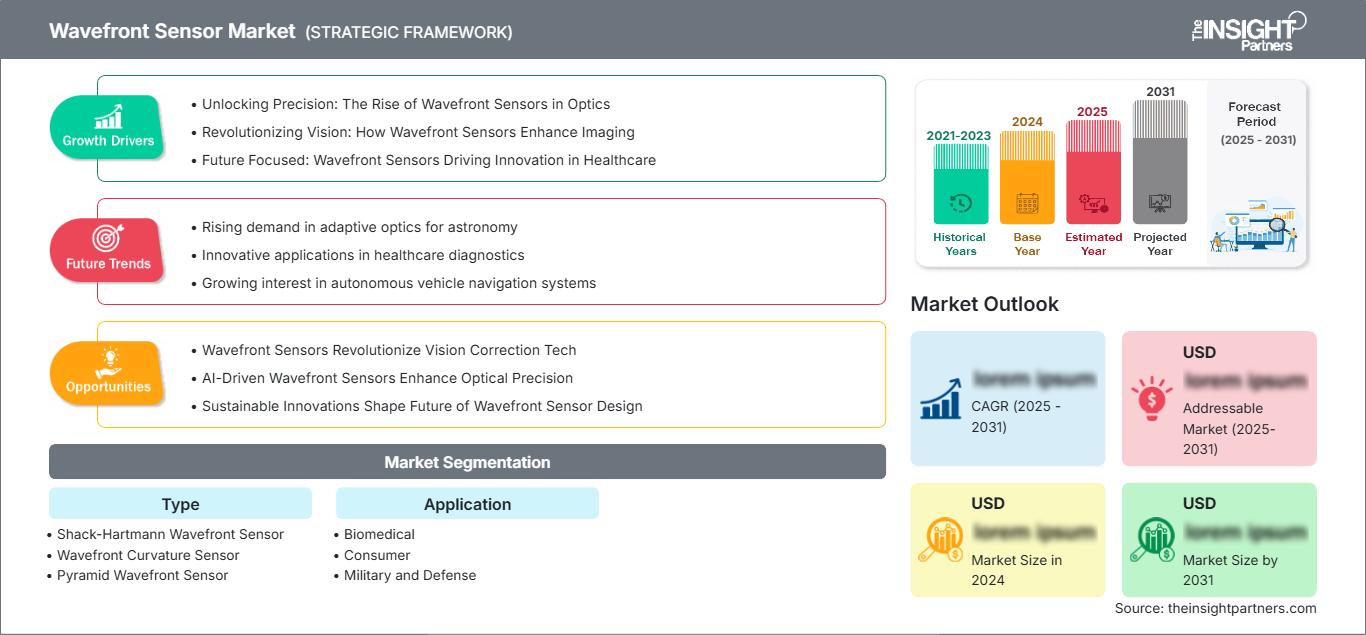
The wavefront sensor market is projected to grow from US$ 382.89 Million in 2025 to US$ 831.02 Million by 2034, registering a CAGR of 8.99% during 2026–2034. Demand is expanding as precision optical measurement becomes essential in adaptive optics, biomedical imaging, laser diagnostics, communication systems, industrial metrology, and defense-grade imaging platforms.
North America is expected to remain a leading regional contributor, supported by defense modernization, advanced ophthalmic diagnostics, photonics research, and strong adoption of adaptive optics in laboratories and aerospace programs. The wavefront sensor market size in the region is reinforced by demand for higher imaging resolution, laser beam stability, and precision correction across commercial and mission-critical optical systems.
Wavefront Sensor Market Assessment and Insights
- North America: The region is estimated to account for 38–42% share in 2025 and grow at 8.3–9.1% CAGR during 2026–2034, led by adaptive optics, defense imaging, and biomedical research demand.
- U.S.: The U.S. is expected to represent 72–78% of North America in 2025 and expand at 8.5–9.3% CAGR.
- Europe: Europe is estimated to hold 24–28% share in 2025 and grow at 7.8–8.6% CAGR, with Germany, France, and the UK supporting precision optics demand.
- Asia Pacific: APAC is projected to account for 21–25% share in 2025 and grow at 9.6–10.4% CAGR, supported by China, Japan, South Korea, and India.
- Largest Segment: Shack-Hartmann Wavefront Sensor is expected to hold 58–64% market share in 2025 and grow at 8.2–9.0% CAGR.
- High Growth Segment: Pyramid Wavefront Sensor is projected to hold 9–13% share in 2025 and grow at 10.2–11.4% CAGR.
- Key companies analyzed in detail: AKA Optics SAS, Bertin Alpao SAS, Flexible Optical B.V., IRIS AO, Inc., Nanohmics Inc., Olympus Corporation, Optical Physics Company, Optocraft GmbH, PHASICS S.A., and Thorlabs, Inc.
Source: The Insight Partners' analysis based on proprietary research, government publications, company annual reports, investor presentations, industry databases, and expert interviews.
The market has progressed from specialty laboratory instrumentation to becoming a platform for imaging, sensing, and optical correction. While the early adoption was confined to astronomy and research optics, the current demand drivers include advancements in the miniaturization of sensors, faster cameras, better calibration algorithms, and deformable mirrors. All of these trends lead to greater repeatability and broader applicability to the biomedical, industrial, and military sectors.
Future demand drivers will come from investment in optical free space communication, semiconductor inspection, retinal imaging, and laser manufacturing. The most attractive segments from the perspective of market growth are where the optical system must work at higher speeds and with better precision. Future demand from APAC research and military photonics procurements will broaden the customer base until 2034.
Wavefront Sensor Market Report Scope
| Report Attribute | Details |
|---|---|
| Market size in 2025 | US$ 382.89 Million |
| Market Size by 2034 | US$ 831.02 Million |
| Global CAGR (2026 - 2034) | 8.99% |
| Historical Data | 2021-2024 |
| Forecast period | 2026-2034 |
Wavefront Sensor Market Analysis
The need for wavefront sensors is growing as the optical systems tend to get more sensitive to phase distortions, beam wander, and alignment instabilities. The biomedical sector uses wavefront sensors to diagnose eye diseases, visualize retinas and carry out high-resolution microscopy, whereas the industrial sector applies them to characterize the laser beams, conduct optical measurements, and perform precision inspections. Adaptive optics and photonics developments add to the range of potential applications.
The market includes the manufacturers of sensors, cameras, adaptive optics and optics, military labs, and research organizations. Increased demand is driven by investments into precise measurements, semiconductor manufacturing, laser systems and scientific instrumentation. With higher demands for optical performance, the focus shifts to accuracy and integration of the sensors.
Supply dynamics are shifting toward packaged solutions that combine sensor heads, control software, calibration tools, and compatible correction hardware. The Wavefront Sensor Market report indicates that customers increasingly compare latency, wavelength range, calibration stability, ease of integration, and software workflow rather than sensor hardware alone. Such a pattern will be beneficial for manufacturers that can consistently perform well in terms of research, manufacturing and field application while at the same time simplify installation and operation of the products.
The market environment is still fragmented but very specialized with Thorlabs, Inc., PHASICS S.A., Optocraft GmbH, Bertin Alpao SAS and AKA Optics SAS concentrating on the areas of precision optics, adaptive optics and metrology. IRIS AO, Inc. and Flexible Optical B.V. add strength to the market with the help of their technologies related to deformable mirrors and correction, while Olympus Corporation helps to address the needs of the biomedical imaging industry.
● REPORT CUSTOMIZATION
Tailor This Report To Align With Your Specific Business Requirements
This report can be customized to align precisely with your business objectives, scope, and target markets. Customization options include tailored segmentation, geography, competitive analysis, and strategic insights to support informed decision-making.
Customize This Report →WHAT YOU CAN ADJUST
- ● Segmentations
- ● Geography
- ● Competitive Analysis
- ● Language Preferences
Wavefront Sensor Market: Strategic Insights
Regional Insights
North America wavefront sensor market
North America is expected to hold 38–42% wavefront sensor market share in 2025 and expand at 8.3–9.1% CAGR during 2026–2034. Demand is supported by adaptive optics research, funded defense imaging programs, ophthalmic diagnostics, and strong photonics laboratories. The region benefits from established component suppliers and early adoption of high-speed optical measurement platforms.
The U.S. dominates regional procurement, while Canada contributes through academic photonics and medical imaging research. Users prioritize sensors that support repeatable calibration, broad wavelength coverage, and compatibility with deformable mirrors. Defense, biomedical, and industrial laser applications are expected to sustain premium demand.
U.S. wavefront sensor Market
The U.S. is projected to account for 72–78% of North America in 2025 and grow at 8.5–9.3% CAGR. Defense imaging, directed-energy research, retinal diagnostics, and free-space optical communication pilots are major adoption areas. The country’s strong laboratory infrastructure supports recurring purchases of high-performance Shack-Hartmann and interferometric systems.
Company presence also strengthens demand. Thorlabs, Inc., Nanohmics Inc., Optical Physics Company, and IRIS AO, Inc. support domestic supply and application development. U.S. buyers increasingly seek integrated software, low-latency acquisition, and robust support for experimental and production environments.
Europe wavefront sensor Market
Europe is estimated to hold 24–28% share in 2025 and grow at 7.8–8.6% CAGR. Germany leads through optical metrology, industrial inspection, and photonics manufacturing, while France benefits from adaptive optics expertise and specialist suppliers. The UK contributes through defense research, imaging laboratories, and academic optics programs.
France is strategically important due to PHASICS S.A., AKA Optics SAS, and Bertin Alpao SAS, while Germany’s Optocraft GmbH supports high-precision wavefront metrology. Regional demand is shaped by EU research funding, industrial automation, microscopy innovation, and aerospace optical testing requirements.
APAC wavefront sensor Market
APAC is expected to hold 21–25% share in 2025 and expand at 9.6–10.4% CAGR, making it the fastest-growing region. China, Japan, South Korea, and India are increasing investment in semiconductor inspection, advanced manufacturing, ophthalmic diagnostics, and optical communication.
Japan leads in precision optics and biomedical imaging, while China supports industrial adoption through photonics manufacturing capacity. South Korea’s electronics base and India’s expanding research infrastructure create additional demand for compact, software-enabled sensing systems.
Middle East & Africa wavefront sensor Market
The Middle East & Africa region is projected to grow at 7.1–7.9% CAGR during 2026–2034. Saudi Arabia and the UAE are adopting photonics-linked technologies in defense, energy infrastructure, universities, and optical communication pilots, while South Africa contributes through astronomy and research optics.
Demand remains smaller than in other regions but is becoming more strategic. Procurement is concentrated in research centers, industrial inspection, and defense-linked optical systems, where harsh operating conditions require stable wavefront measurement and correction.
Segmentation Analysis
Type
Type is expected to grow at 8.5–9.3% CAGR during 2026–2034. The market scope across types is led by Shack-Hartmann systems because they offer mature design, direct slope measurement, and strong compatibility with adaptive optics platforms. Interferometric and pyramid designs are gaining attention where higher sensitivity or specialized phase reconstruction is required.
- Shack-Hartmann Wavefront Sensor: This sub-segment remains the preferred choice for laboratories, ophthalmology, laser diagnostics, and adaptive optics because it offers proven measurement stability, relatively simple alignment, and broad commercial availability.
- Wavefront Curvature Sensor: Curvature sensors serve applications requiring phase correction from intensity variation, particularly in adaptive optics research, where system designers prioritize sensitivity and compact optical layouts.
- Pyramid Wavefront Sensor: Pyramid sensors are gaining strategic relevance in astronomy and high-performance adaptive optics because they can support high sensitivity under demanding correction conditions.
- Common Path Interferometer: Common path interferometer systems are valued for stability in optical metrology because reference and measurement paths share the same environmental disturbances.
- Multilateral Shearing Interferometer: This sub-segment supports high-precision wavefront reconstruction in optical testing, semiconductor inspection, and advanced metrology, where detailed phase information is required.
Application
Application is forecast to expand at 8.7–9.5% CAGR during 2026–2034. Biomedical and defense uses provide stable premium demand, while industrial manufacturing and communication applications are expanding as optical systems require tighter beam control. Consumer applications remain emerging but could scale as compact imaging, AR optics, and computational sensing architectures mature.
- Biomedical: Biomedical adoption is driven by retinal imaging, ophthalmic diagnostics, microscopy, and research tools that require wavefront correction to improve image clarity and measurement reliability.
- Consumer: Consumer applications are developing around compact cameras, AR optics, and advanced imaging modules where wavefront correction can improve optical performance.
- Military and Defense: Defense demand is linked to surveillance, satellite imaging, directed-energy research, and free-space optical links that need high-speed correction under variable conditions.
- Industrial and Manufacturing: Industrial users apply wavefront sensing to laser beam characterization, semiconductor inspection, material processing, and quality control, where beam stability affects yield.
- Communication: Communication applications are expanding in free-space optical systems where turbulence compensation, beam steering, and real-time correction improve link reliability.
Opportunity Snapshot
| Application | Revenue Contribution | Trend Tag | Adoption Stage |
| Biomedical | High | Retinal Imaging | Mature |
| Consumer | Low | AR Optics | Emerging |
| Military and Defense | High | Directed Energy | Scaling |
| Industrial and Manufacturing | Medium | Laser Control | Scaling |
| Communication | Medium | Free Space | Emerging |
Wavefront Sensor Market Growth Drivers and Impact Analysis
Rising Need for Adaptive Optics in High-Resolution Imaging
Adaptive optics is evolving from its origins in astronomical applications into areas such as biomedical imaging, ophthalmic testing, laser beam correction, and military imaging systems. Wavefront sensors are important since they detect phase aberrations and allow corrective devices to be employed for restoring either imaging or beam quality. As the need arises for greater clarity of imagery through biological tissues, atmospheric conditions, and optical systems, the sensor’s performance directly becomes a measure of the system’s worth.
Expansion of Laser-Based Manufacturing and Metrology
Lasers used in industry must have a stable laser beam quality so that processes can be done accurately when cutting, welding, inspecting semiconductors, and fabricating micromechanical devices. Wavefront sensors can aid in identifying aberrations, misalignments, and thermal distortions that may lower yield or repeatability of the process. With manufacturing processes increasingly becoming more automated, there is an increasing need for sensors to be incorporated in the production process at the early stages.
Defense and Optical Communication Modernization
There is an ever-increasing demand for real-time optical compensation from defense agencies and communication systems that make use of satellite imaging and surveillance, targeting and free space optical communications. The presence of atmospheric turbulence, vibrations and thermal gradients may affect the quality of the signal and therefore, there is a need for measurement and correction. Wavefront sensors will be useful in such systems through the provision of fast feedback control loops.
Wavefront Sensor Market Future Trends
AI-Assisted Wavefront Correction Workflows
The wavefront sensor market trends point toward software-led differentiation as users seek faster interpretation of complex phase data. AI-assisted calibration, aberration classification, and closed-loop correction can reduce setup time and make adaptive optics usable beyond expert laboratories. Suppliers that combine hardware with intuitive analytics and automation are likely to capture higher value, especially in biomedical imaging, industrial inspection, and communication systems.
Compact Sensors for Embedded Optical Platforms
The next phase of adoption will favor smaller sensor heads, faster cameras, and ruggedized designs that can be embedded into instruments rather than used only as standalone laboratory tools. This trend will support industrial inspection systems, portable ophthalmic devices, field-deployed defense optics, and free-space communication terminals. Compact integration will also encourage new business models around modular optical subsystems.
Wavefront Sensor Market Opportunities
Free-Space Optical Communication Deployment
The Wavefront Sensor Market forecast is increasingly linked to the growth of free-space optical communication systems, where maintaining beam quality across turbulent atmospheric conditions is critical for reliable data transmission. Wavefront sensors enable real-time detection and correction of optical distortions, supporting adaptive optics in ground stations, airborne communication platforms, satellite links, and defense communication networks. As governments, space agencies, and commercial operators invest in high-bandwidth optical communication infrastructure, demand for fast and accurate wavefront sensing solutions is expected to rise. Vendors that develop compact, low-latency, and energy-efficient sensor modules can capitalize on this opportunity by addressing strict performance requirements related to signal integrity, communication reliability, and system responsiveness. Increasing integration with adaptive optics platforms and advanced control software is likely to further strengthen adoption across communication applications.
Clinical and Research Imaging Expansion
Biomedical imaging represents a significant long-term opportunity because wavefront correction technologies can substantially improve the visualization of retinal structures, cellular activity, and biological tissue samples. Hospitals, ophthalmology clinics, research institutes, and life-science laboratories are increasingly adopting advanced imaging systems to enhance diagnostic accuracy and research outcomes. Wavefront sensors support applications ranging from retinal imaging and refractive diagnostics to high-resolution microscopy and optical coherence tomography. Growth in healthcare research funding, expanding eye-care infrastructure, and rising demand for precision diagnostics are creating favorable conditions for market expansion. Suppliers can strengthen their position by offering user-friendly sensors, advanced software platforms, automated calibration capabilities, and seamless integration with microscopy and ophthalmic equipment. Partnerships with medical device manufacturers and research organizations may further accelerate adoption and broaden commercial opportunities within the biomedical imaging segment.
Frequently Asked Questions

- Comprehensive Market Sizing and Forecast Analysis
- Detailed Segmentation Analysis
- In-Depth Market Dynamics Assessment
- Regional and Country-Level Insights
- Competitive Landscape and Company Benchmarking
- Strategic Business Intelligence
Recent Reports
Testimonials

The Insight Partners provided valuable market intelligence that supported our global go-to-market strategy. Their team was professional, responsive, and attentive to our feedback, providing thoughtful analysis and helpful methodological clarifications throughout the project.
Junmo Kim Chief Financial Officer (CFO), Enertech Co., Ltd.
The Insight Partners' SCADA System Market report is comprehensive, with valuable insights on current trends and future forecasts. The team was highly professional, responsive, and supportive throughout. We are very satisfied and highly recommend their services.
RAN KEDEM Partner, Reali Technologies LTDs
I requested a report on a very specific software market and the team produced the report in a few days. The information was very relevant and well presented. I then requested some changes and additions to the report. The team was again very responsive and I got the final report in less than a week.
JEAN-HERVE JENN Chairman, Future Analytica
We worked with The Insight Partners for an important market study and forecast. They gave us clear insights into opportunities and risks, which helped shape our plans. Their research was easy to use and based on solid data. It helped us make smart, confident decisions. We highly recommend them.
PIYUSH NAGPAL Sr. Vice President, High Beam Global
The Insight Partners delivered insightful, well-structured market research with strong domain expertise. Their team was professional and responsive throughout. The user-friendly website made accessing industry reports seamless. We highly recommend them for reliable, high-quality research services
YUKIHIKO ADACHI CEO, Deep Blue, LLC.
This is the first time I have purchased a market report from The Insight Partners.While I was unsure at first, I visited their web site and felt more comfortable to take the risk and purchase a market report.I am completely satisfied with the quality of the report and customer service. I had several questions and comments with the initial report, but after a couple of dialogs over email with their analyst I believe I have a report that I can use as input to our strategic planning process.Thank you so much for taking the extra time and making this a positive experience.I will definitely recommend your service to others and you will be my first call when we need further market data.
JOHN SUZUKI President and Chief Executive Officer, Board Director, BK Technologies
I wish to appreciate your support and the professionalism you displayed in the course of attending to my request for information regarding to infectious disease IVD market in Nigeria. I appreciate your patience, your guidance, and the fact that you were willing to offer a discount, which eventually made it possible for us to close a deal. I look forward to engaging The Insight Partners in the future, all thanks to the impression you have created in me as a result of this first encounter.
DR CHIJIOKE ONYIA MANAGING DIRECTOR, PineCrest Healthcare Ltd.Reason to Buy
- Informed Decision-Making
- Understanding Market Dynamics
- Competitive Analysis
- Identifying Emerging Markets
- Customer Insights
- Market Forecasts
- Risk Mitigation
- Boosting Operational Efficiency
- Strategic Planning
- Investment Justification
- Tracking Industry Innovations
- Aligning with Regulatory Trends





 Get Free Sample for