
钻头市场:规模、增长与预测 2034年
钻头市场规模及预测(2021-2034 年)、全球及区域份额、趋势和增长机会分析报告涵盖范围:按产品类型(固定切削钻头、滚锥切削钻头);应用(陆上钻井、海上钻井);以及地理区域(北美、欧洲、亚太地区以及南美和中美洲)划分。
- 状态 : 数据发布
- 报告代码 : TIPRE00010758
- 类别 : 制造和建筑
- 页数 : 150
- 可用报告格式 :


- 最后更新日期 : July 22, 2026


2025 Market Size
US$ 8.75 Bn
Base year value
2034 Forecast
US$ 13.99 Bn
Projected by 2034
CAGR 2026-2034
5.35 %
Growth rate
Addressable Market
US$ 103.12 Bn
(2026-2034)
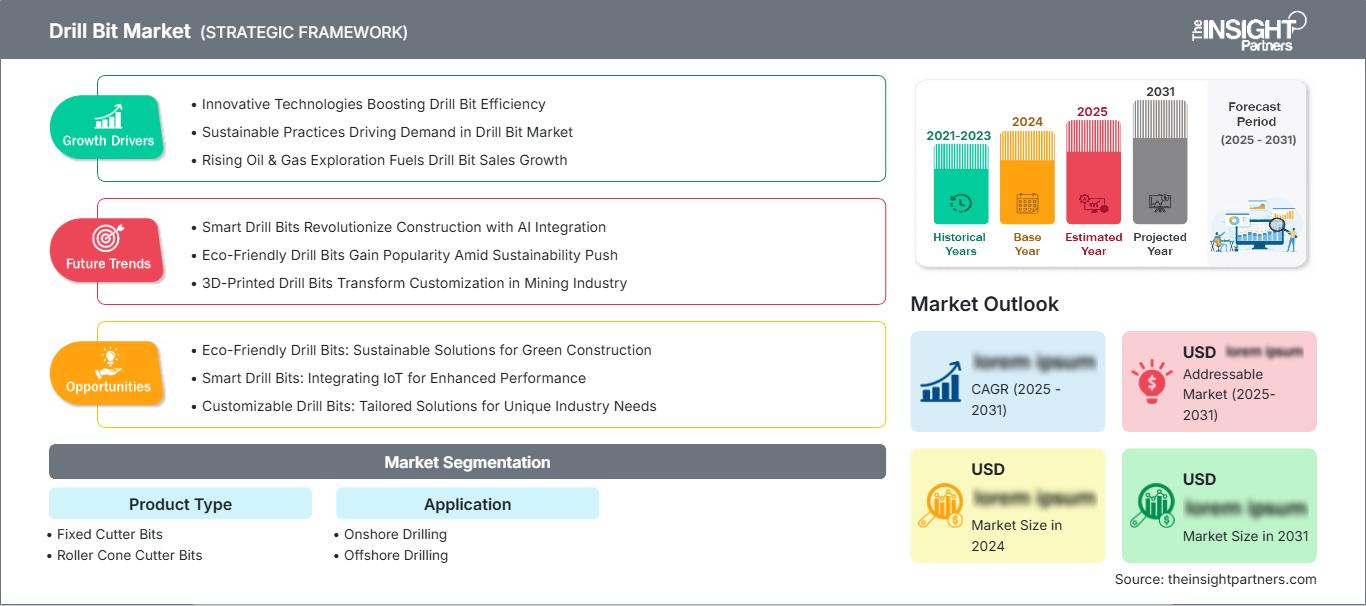
The drill bit market was valued at US$ 8.75 Billion in 2025 and is projected to reach US$ 13.99 Billion by 2034, registering a CAGR of 5.35% during 2026–2034. Demand is supported by oil and gas drilling, construction fastening, metalworking, mining, and infrastructure maintenance, where bit durability, penetration rate, and cost per hole remain central procurement criteria for industrial buyers.
North America remains a priority demand center, with the drill bit market size supported by shale activity, construction retrofits, and high replacement intensity in professional tools. The region is expected to expand at a 4.9–5.4% CAGR during 2026–2034, driven by horizontal well designs, infrastructure rehabilitation, and contractor preference for premium carbide, PDC, and application-specific drilling accessories.
Drill Bit Market Assessment and Insights
- North America held 36–39% share in 2025 and is expected to grow at a 4.9–5.4% CAGR between 2026–2034, supported by shale wells, maintenance drilling, and premium bit replacement.
- US represented 78–82% of North America in 2025 and is projected to grow at a 4.8–5.3% CAGR between 2026–2034, led by Permian and Gulf activity.
- Europe accounted for 18–21% share in 2025 and is forecast to grow at a 4.2–4.8% CAGR between 2026–2034, led by Germany, the UK, France, Italy, and Spain.
- Asia Pacific captured 25–28% share in 2025 and is likely to expand at a 6.1–6.8% CAGR between 2026–2034, with China, India, Japan, South Korea, and Australia driving demand.
- Largest Segment Fixed Cutter Bits held 54–58% market share in 2025 and are expected to grow at a 5.6–6.1% CAGR during 2026–2034 due to efficiency advantages.
- High Growth Segment Offshore Drilling held 28–32% market share in 2025 and is projected to grow at a 6.2–6.9% CAGR during 2026–2034 as deepwater projects restart.
- Key companies analyzed in detail: Stanley Black & Decker, Inc., Halliburton Company, Hartner GmbH, Hilti Corporation, IZAR Cutting Tools S.A.L., Makita Corporation, Metabowerke GmbH, Robert Bosch Tool Corporation, RUKO GmbH Präzisionswerkzeuge, SLB, Baker Hughes Company, NOV Inc.
Source: The Insight Partners' analysis based on proprietary research, government publications, company annual reports, investor presentations, industry databases, and expert interviews.
Technology migration is causing changes in the drill bit portfolio in terms of its shifting from high-speed steel type drill bits to the use of carbide tipped, diamond impregnated, fixed cutter, and computer analyzed drill bits for their higher durability and efficiency. Flute design, cutter location, coating materials, and body composition have all been optimized by the manufacturers for increased efficiency in cutting through abrasive materials, reinforced concrete, and high temperature settings. While manufacturing is increasingly becoming international, qualification standards still have a strong local component.
Future demands would be determined by the growth of industries in Asia-Pacific region, investments in the upstream sector in the Middle East, unconventional drilling operations in North America, and infrastructure renewal initiatives in Europe. In addition, with increasing attention to regulations on employee safety, dust management, well integrity, and energy efficiency, the adoption of more efficient drilling products would be encouraged. Consequently, the procurement process would slowly shift from cost-effective consumable products to drilling systems.
Drill Bit Market Report Scope
| Report Attribute | Details |
|---|---|
| Market size in 2025 | US$ 8.75 Billion |
| Market Size by 2034 | US$ 13.99 Billion |
| Global CAGR (2026 - 2034) | 5.35% |
| Historical Data | 2021-2024 |
| Forecast period | 2026-2034 |
Drill Bit Market Analysis
Drill bit industry growth will be further spurred by active rig activity, construction equipment mechanization, mining exploration, and plant maintenance. Active rigs are an early indicator of drilling consumable usage according to Baker Hughes’ rig counts, while the rotary rig activity continues in both onshore and offshore environments according to the Energy Information Administration’s figures.
Steel, tungsten carbide, synthetic diamond, coatings, heat treatment, CNC grinding, field application engineering, and distribution comprise the supply chain. The supply dynamic advantages companies that are able to integrate materials science with the geology of the application or the substrate being worked with. Oilfield clients consider well costs rather than unit costs, whereas construction clients consider speed, hole formation, and available accessories.
Competitive assessment of the drill bit industry exhibits a varied competition between oilfield professionals and industrial tool providers in their respective sales chains. The competition by the likes of Halliburton Company and SLB focuses on well-construction efficiency, while that of Stanley Black & Decker, Inc., Hilti Corporation, Makita Corporation, Metabowerke GmbH, Robert Bosch Tool Corporation, IZAR Cutting Tools S.A.L., Hartner GmbH, and RUKO GmbH Präzisionswerkzeuge is trade-based and involves application versatility and innovative accessories.
Investments are being made in the areas of cutter design, wear detection, drilling feedback automation, carbide technology, and resilience in regional production capacity. Other companies involved in this competitive assessment include Baker Hughes Company and NOV Inc., which compete in the area of oilfield bit systems, and Bosch, Hilti, and Makita, which focus on the cordless ecosystem.
● REPORT CUSTOMIZATION
Tailor This Report To Align With Your Specific Business Requirements
This report can be customized to align precisely with your business objectives, scope, and target markets. Customization options include tailored segmentation, geography, competitive analysis, and strategic insights to support informed decision-making.
Customize This Report →WHAT YOU CAN ADJUST
- ● Segmentations
- ● Geography
- ● Competitive Analysis
- ● Language Preferences
Drill Bit Market:
自定义此报告以满足您的要求
您将免费获得任何报告的定制,包括本报告的部分内容,或国家级分析、Excel 数据包,以及为初创企业和大学提供超值优惠和折扣
钻头市场: 战略洞察
-
获取本报告的主要市场趋势。这个免费样本将包括数据分析,从市场趋势到估计和预测。
Regional Insights
North America Drill Bit Market
North America held 36–39% share in 2025 and is projected to grow at a 4.9–5.4% CAGR during 2026–2034. The drill bit market share reflects shale basin intensity, high contractor replacement rates, and a mature professional tool channel. Baker Hughes reported U.S., Canada, and international rig counts as key drilling barometers, linking active rigs directly with consumable demand.
Onshore drilling remains the regional base, but offshore Gulf of Mexico, Canadian gas, industrial fabrication, and concrete anchoring add resilience. Buyers increasingly prefer bits that reduce tool changes, heat buildup, and hole deviation. Regional growth is therefore less volume-led and more value-led, as premium fixed cutter, carbide, and masonry systems gain share.
U.S. Drill Bit Market
The U.S. represented 78–82% of North America in 2025 and is expected to grow at a 4.8–5.3% CAGR through 2034. EIA annual drilling data recorded 561 rotary rigs in operation in 2025, including 547 onshore and 14 offshore rigs, underscoring persistent well construction demand despite capital discipline. With the current levels of activity in major shale plays, infrastructure repairs, and industrial construction, there is still significant demand for drilling tools and related products. With continued focus on productivity and asset maintenance in a world where commodity prices fluctuate, it is clear that the market remains stable. The market is very wide-ranging, with firms such as Halliburton Company, SLB, Baker Hughes Company, NOV Inc., Stanley Black & Decker, Inc., Hilti Corporation, Makita Corporation, and Robert Bosch Tool Corporation playing significant roles through their services, retail operations, and contracting. Some application areas in this market include horizontal shale laterals, concrete anchors, utility repairs, and metal fabrication, all of which have specific performance specifications and durability requirements, as well as tool designs for productivity.
Europe Drill Bit Market
Europe accounted for 18–21% share in 2025 and is forecast to expand at a 4.2–4.8% CAGR during 2026–2034. Germany is the leading country due to its strong precision manufacturing base, machinery exports, and demand for products from Hartner GmbH, RUKO GmbH Präzisionswerkzeuge, Bosch, and Metabo. Industrial users prioritize tolerance control, tool longevity, coating performance, and repeatable hole quality to support high-precision production environments.
Infrastructural renovation activities, offshore maintenance work, and retrofits of buildings in the UK necessitate the use of a variety of masonry and metal drilling products. The automotive industry in France, construction services in Italy and Spain, aerospace production, and renewables installation projects all add to the requirement. Throughout the area, customers are very quality conscious and emphasize durability, efficiency, and strict adherence to workplace safety regulations. Standards governing dust and vibration control, along with workplace safety regulations, have ensured steady growth in the engineered drill bit systems market.
APAC Drill Bit Market
APAC held 25–28% share in 2025 and is projected to grow at a 6.1–6.8% CAGR during 2026–2034, making it the fastest regional cluster. China dominates in terms of manufacturing volumes and requirements for infrastructure development, while India gains strength through its building works, mining, energy well-drilling, and industrial expansion projects. Investments into manufacturing and infrastructure build-up go on, which continues to contribute to the growth of tools' sales within key application markets.
Japan and South Korea are driven by their metal-cutting, automobile manufacturing, and electronics-related tooling uses, while Australia is a result of mining and energy projects. Policies that focus on manufacturing and transportation infrastructure and energy security stimulate purchases of both high-end and mid-range products. Local distributors are essential as the customers need fast delivery of required sizes, technical support, and replacement services.
Middle East & Africa Drill Bit Market
The Middle East & Africa is expected to grow at a 5.5–6.2% CAGR during 2026–2034, led by Saudi Arabia and the UAE. Energy investment, brownfield redevelopment, and offshore drilling sustain oilfield bit demand, while utility, industrial, and construction megaprojects support the adoption of masonry and metal drilling accessories. Continued infrastructure expansion, mining activity, and economic diversification initiatives are further contributing to market growth across the region. South Africa anchors industrial and mining-related consumption, while the Rest of MEA adds selective demand from infrastructure corridors, resource projects, and upstream exploration activities. Harsh geological conditions, high operating temperatures, and remote project locations encourage the use of durable, high-performance drill bits that reduce replacement frequency, minimize downtime, and improve operational efficiency in demanding field environments. As a result, end users increasingly favor products that offer longer service life, greater drilling accuracy, and lower total operating costs.
Segmentation Analysis
Product Type
Product Type is expected to grow at a 5.2–5.8% CAGR during 2026–2034 as buyers shift toward engineered geometries, better materials, and task-specific performance. The drill bit market scope across this segment includes heavy-duty oilfield bits, construction masonry bits, metalworking bits, and precision industrial tools, with procurement increasingly tied to life-cycle cost rather than purchase price.
- Fixed Cutter Bits lead demand because they deliver high penetration rates, fewer moving parts, and strong performance in directional drilling, abrasive construction substrates, and repetitive industrial drilling tasks.
- Roller Cone Cutter Bits remain strategically important in variable formations, impact-heavy drilling, and applications where crushing action, formation adaptability, and established field familiarity support continued procurement.
Application
Application is projected to grow at a 5.4–6.0% CAGR during 2026–2034. Demand is anchored in onshore drilling because land-based wells, construction sites, mines, and industrial plants generate frequent bit consumption. Offshore drilling, although smaller, requires premium technologies that tolerate vibration, pressure, corrosive fluids, and restricted intervention windows.
- Onshore Drilling dominates usage because shale wells, construction anchoring, quarrying, mining, and plant maintenance require repeated drilling cycles, broad size availability, and reliable supply through distributors.
- Offshore Drilling is strategically premium because deepwater wells demand bits with high durability, directional stability, erosion resistance, and the ability to reduce costly trips.
Opportunity Snapshot
|
Application |
Revenue Contribution |
Trend Tag |
Adoption Stage |
|
Onshore Drilling |
High |
Shale Laterals |
Mature |
|
Offshore Drilling |
Medium |
Deepwater Bits |
Scaling |
Drill Bit Market Growth Drivers and Impact Analysis
Higher Complexity in Well Construction
Directional, horizontal, and extended-reach wells increase mechanical stress on bits and raise the value of designs that improve steerability, cutter durability, and hydraulic cleaning. Operators are willing to pay for tools that reduce trips because rig time can exceed the bit cost by a wide margin. The commercial impact is a shift from standard replacement purchasing toward engineered assemblies, field application support, and performance-based supplier evaluation.
Construction Retrofit and Infrastructure Maintenance
Urban renovation projects, transport network repairs, utility infrastructure upgrades, and commercial building retrofits generate steady demand for masonry, concrete, metal, and multi-material drill bits. Contractors increasingly prioritize accessories that can drill accurately through reinforced materials, reduce dust generation and heat buildup, and maintain compatibility with modern cordless rotary hammers and power tools. This demand driver helps broaden the market beyond cyclical oilfield activity, supporting consistent consumption across construction and maintenance sectors. As a result, brands with strong distribution networks, contractor training programs, and integrated tool ecosystems are well-positioned to strengthen their presence in professional construction channels.
Material Science and Coating Upgrades
Advances in tungsten carbide formulations, PDC cutter technology, diamond-impregnated materials, optimized flute geometries, and integrated wear indicators are improving drill bit performance and service life in abrasive, high-temperature, and demanding operating environments. These innovations enhance cutting efficiency, maintain drilling accuracy, and reduce downtime, helping lower the overall cost per hole and making premium tools more attractive to buyers. As procurement teams increasingly focus on productivity and lifecycle value, suppliers that can demonstrate faster penetration rates, fewer tool failures, and longer replacement intervals are better positioned to protect margins and differentiate their offerings in competitive industrial markets.
Drill Bit Market Future Trends
Digital Bit Selection and Downhole Feedback
The drill bit market will increasingly adopt data-guided selection and performance optimization, where drilling parameters, formation characteristics, vibration data, and wear history are used to recommend the most suitable bit before deployment. In oilfield applications, service providers are already integrating at-bit sensing technologies, automated drilling controls, and performance analytics to improve well construction efficiency and reduce non-productive time. Over time, similar practices are expected to expand into construction and industrial markets through digital application databases, connected tool platforms, and distributor advisory systems. These tools can help users match bit designs to specific substrate conditions, improving drilling accuracy, extending tool life, reducing replacement costs, and enhancing overall jobsite productivity.
Premiumization of Jobsite Accessories
Professional users are increasingly shifting away from basic, general-purpose bit assortments toward task-specific accessories that deliver higher productivity, greater safety, and more consistent results across demanding applications. The growing adoption of cordless tool platforms, the use of stronger concrete formulations, and the rise in mixed-material renovation projects are raising performance expectations for drilling accessories. Contractors are placing greater emphasis on faster drilling speeds, longer tool life, and reduced downtime, particularly in commercial construction and infrastructure maintenance environments. This trend favors manufacturers that offer integrated solutions combining drill bits with rotary hammers, dust extraction systems, anchoring technologies, and user training programs. It also enhances product differentiation in retail and distributor channels, where durability, performance, and efficiency claims play an increasingly important role in purchasing decisions. Suppliers that can demonstrate measurable improvements in productivity, accuracy, and jobsite safety are likely to strengthen their competitive position among professional users.
Drill Bit Market Opportunities
Localized Manufacturing and Basin-Specific Engineering
Suppliers can improve margins by pairing regional manufacturing with application engineering for shale, carbonate, geothermal, mining, and construction substrates. The drill bit market forecasts indicate that buyers will reward shorter lead times, rapid customization, and local technical support. Establishing regional grinding, coating, and repair capabilities can reduce logistics exposure while enabling faster product iteration based on field failure analysis and customer feedback.
Integrated Tool and Consumable Bundles
Power tool manufacturers have an opportunity to bundle drill bits, rotary hammers, dust extraction systems, anchors, batteries, and service plans into trade-specific solutions tailored to the needs of professional users. By offering integrated packages, suppliers can shift purchasing decisions away from the price of individual accessories and toward overall productivity, safety, and regulatory compliance on the jobsite. This approach also helps strengthen customer loyalty and creates additional recurring revenue opportunities through service and replacement programs.
For oilfield suppliers, bundled drilling assemblies, bit optimization software, real-time performance monitoring, and technical support services can enhance value for operators seeking greater drilling efficiency. As operators increasingly focus on reducing trips, minimizing downtime, and improving drilling consistency, integrated solution providers are better positioned to build long-term customer relationships and differentiate themselves in a competitive market.
Recent Developments
- January 2026: Halliburton Company — launched the HyperSteer MX directional drill bit, described as a shankless matrix-body bit designed to improve durability, directional control, erosion resistance, and performance in abrasive, high-flow environments while reducing trips and well construction time.
- May 2025: SLB — received Hart Energy’s 2025 Meritorious Award for Engineering Innovation in Drill Bits for the DualHelix multiformation performance bit, which uses cutter placement geometry to adapt engagement across soft and hard formations and improve cutting efficiency.
- April 2025: Robert Bosch Tool Corporation — introduced the Bulldog Xtreme8 8-cutter SDS-plus concrete drill bit and Blue Xtreme carbide-tipped drill bits, emphasizing rebar-hit durability, carbide strength, centering accuracy, dust removal, and wear indication for concrete drilling applications.
Frequently Asked Questions

Nivedita 是一位经验丰富的研究专业人士,在市场研究和商业咨询领域拥有超过 9 年的经验。她目前担任 The Insight Partners 的 ICT 领域项目经理,在管理和执行跨技术领域的联合研究、定制研究、订阅研究和咨询研究方面拥有深厚的专业知识。
Nivedita 在提供数据驱动的分析和切实可行的洞察方面拥有丰富的经验,并已成为多个关键项目的关键贡献者。她的工作涉及端到端的项目执行——从理解客户目标、分析市场趋势到制定战略建议。她与领先的 ICT 公司广泛合作,帮助他们识别市场机遇并引领行业变革。
Nivedita 拥有德拉敦 IMS 的管理学 MBA 学位。在加入 The Insight Partners 之前,她在浦那的 MarketsandMarkets 和 Future Market Insights 积累了宝贵的经验,担任过各种研究职位,并在行业分析和客户互动方面奠定了坚实的基础。
- 全面的市场规模与预测分析
- 详细的细分市场分析
- 深入的市场动态评估
- 区域及国家级洞察
- 竞争格局与企业对标分析
- 战略性商业情报
客户评价

Insight Partners 的 SCADA 系统市场报告内容全面,对当前趋势和未来预测提供了宝贵的见解。该团队始终高度专业、响应迅速且乐于助人。我们非常满意,强烈推荐他们的服务。
兰·凯德姆 伙伴, Reali Technologies LTD
我请求一份关于特定软件市场的报告,团队在几天内就完成了。报告信息非常相关,而且呈现得非常出色。之后,我请求对报告进行一些修改和补充。团队再次迅速响应,不到一周我就收到了最终报告。
让-埃尔韦·詹恩 主席, 未来分析公司
我们与 Insight Partners 合作进行了一项重要的市场研究和预测。他们清晰地洞察了机遇和风险,帮助我们制定了计划。他们的研究简单易用,数据可靠,帮助我们做出了明智而自信的决策。我们强烈推荐他们。
皮尤什·纳格帕尔 高级副总裁, 远光全球
Insight Partners 凭借其深厚的行业专业知识,提供了富有洞察力、结构合理的市场研究。他们的团队始终专业且响应迅速。用户友好的网站让访问行业报告变得顺畅无阻。我们强烈推荐他们可靠、高质量的研究服务。
安达幸彦 首席执行官, 深蓝有限责任公司
这是我第一次从The Insight Partners购买市场报告。起初我有些犹豫,但访问了他们的网站后,我更放心地冒险购买市场报告。我对报告的质量和客户服务非常满意。我对最初的报告有一些疑问和意见,但在与他们的分析师通过电子邮件沟通了几次后,我相信这份报告可以作为我们战略规划流程的参考。非常感谢您抽出宝贵的时间,让这次体验如此愉快。我一定会向其他人推荐你们的服务,当我们需要更多市场数据时,你们将是我的首选。
约翰·铃木 总裁兼首席执行官、董事会董事, BK科技
感谢您在处理我关于尼日利亚传染病体外诊断市场信息请求的过程中所展现的支持和专业精神。感谢您的耐心、指导,以及您愿意提供的折扣,最终促成了这笔交易。我期待未来与 Insight Partners 继续合作,这一切都要归功于您与我初次接触后留下的良好印象。
奇吉奥克博士 ONYIA 董事总经理, PineCrest 医疗保健有限公司购买理由
- 明智的决策
- 了解市场动态
- 竞争分析
- 客户洞察
- 市场预测
- 风险规避
- 战略规划
- 投资论证
- 识别新兴市场
- 优化营销策略
- 提升运营效率
- 顺应监管趋势



















 获取免费样品 -