
能量采集系统市场:规模、市场趋势与预测 2034年
能量采集系统市场规模及预测(2021-2034 年)、全球及区域份额、趋势和增长机会分析报告涵盖范围:按技术(光能采集、振动能采集、电磁/射频 (RF) 能量采集、热能采集);组件(传感器、电源管理集成电路 (PMIC)、二次电池);应用(楼宇和家庭自动化、消费电子、工业、交通运输、安防);以及地域(北美、欧洲、亚太地区以及南美和中美洲)。
- 状态 : 数据发布
- 报告代码 : TIPRE00014527
- 类别 : 电子和半导体
- 页数 : 150
- 可用报告格式 :


- 最后更新日期 : August 26, 2026


2025年市场规模
6.9091 亿美元
基准年值
2034 年预测
15.5404 亿美元
预计到2034年
2026-2034年复合年增长率
9.42 %
增长率
目标市场
100.1879 亿美元
(2026-2034)
能量采集系统市场规模预计将从2025年的6.9091亿美元增长到2034年的15.5404亿美元,2026年至2034年间的复合年增长率为9.42%。这一趋势与分布式传感、自动化、电子、交通和安防系统中环境能量采集架构日益增长的可行性相一致,这得益于更先进的传感器、高效的电源管理集成电路和可充电电池的结合。
预计到2034年,北美能量采集系统市场规模将以约8.6%至9.2%的复合年增长率增长。工业物联网系统的高密度应用以及节能改造推动了强劲的需求,而丰富的半导体设计经验则有助于加快集成速度。由于建筑能耗约占全球总能耗的30%,免维护无线传感器对楼宇运营商更具吸引力。
能量采集系统市场评估与洞察
- 北美:预计到 2025 年市场份额将达到 31%–34%,2026 年至 2034 年的复合年增长率为 8.6%–9.2%,这得益于工业传感器密度、智能建筑改造和成熟的半导体生态系统。
- 美国:到 2025 年,其市场份额将占北美市场的 78% 至 82%,2026 年至 2034 年的复合年增长率为 8.8% 至 9.4%,主要得益于工业自动化和互联基础设施的发展。
- 欧洲:预计 2025 年市场份额将达到 34%–37%,2026 年至 2034 年的复合年增长率为 8.4%–9.0%;德国领先,其次是英国和法国。
- 亚太地区:预计 2025 年市场份额将达到 24%–27%,2026 年至 2034 年的复合年增长率为 10.8%–11.6%;中国领先,而日本、韩国和印度正在扩大采用率。
- 最大细分市场:光能收集在 2025 年占据 33-36% 的市场份额,并在 2026-2034 年期间保持 9.0-9.6% 的复合年增长率,反映了可利用的室内外辐照度。
- 高增长领域:电磁/射频能量收集在 2025 年占据 18-21% 的市场份额,随着无线电力基础设施的规模化发展,在 2026-2034 年期间将保持 10.8-11.6% 的复合年增长率。
- 重点分析的公司有: ABB有限公司、Analog Devices公司、Cymbet公司、EnOcean GmbH公司、富士通有限公司、霍尼韦尔国际公司、Microchip Technology Incorporated公司、Powercast公司、意法半导体公司和德州仪器公司。
资料来源: Insight Partners 根据专有研究、政府出版物、公司年报、投资者报告、行业数据库和专家访谈进行的分析。
Commercial evolution is transforming energy harvesters from stand-alone laboratory converters to application-ready subsystems. Previously, energy harvesters were capable of coping with intermittent power generation and bespoke electronics controllers; today's solutions combine the optimized transducers of photovoltaics, piezoelectricity, thermoelectricity, and RF technologies with ultralow-power PMICs, edge processors, and batteries. As a result, commercial development is gradually moving from reference designs, validated modules, and wireless interoperability protocols. In addition, suppliers have started to minimize standby losses, ensure cold starts, and provide custom-packaging solutions for devices with restricted size, heavy industrial equipment, and retrofitted building sensors.
Over the 2034 period, investment flows need to expand from Europe and North America to Asian electronics clusters, Gulf smart infrastructures, and emerging industrial zones. Purchasing decisions will be made taking into account cost savings from no more battery maintenance and sustainability reporting requirements. Building efficiency regulations, factory automation programs, and rising requirements on secure edge devices will benefit the suppliers providing certified modules, lengthy lifecycle guarantees, and quantified energy budgets.
Energy Harvesting System Market Report Scope
| Report Attribute | Details |
|---|---|
| Market size in 2025 | US$ 690.91 Million |
| Market Size by 2034 | US$ 1,554.04 Million |
| Global CAGR (2026 - 2034) | 9.42% |
| Historical Data | 2021-2024 |
| Forecast period | 2026-2034 |
Energy Harvesting System Market Analysis
Market dynamics of Energy Harvesting System Market are supported by the growing numbers of wireless sensors that have to function in areas where either wiring or battery services do not make economic sense. Requirements start from selecting a transducer, continue through power conditioning and power storage, and lead to module manufacturers, device OEMs, integrators, and plant owners. Each stage determines conversion efficiency, cold start capabilities, radio duty cycle, and lifetime cost.
The supply side is specialized since ambient energy sources are determined by the place of application and the specific load curve. Semiconductor companies compete with low quiescent currents and reference designs, while transducers stand out due to material characteristics, durability, and shape. Validating an entire energy budget becomes a trend among integrators, leading to co-designed hardware, firmware, and protocols.
Energy Harvesting System market analysis finds that the competitive landscape in the industry comprises automation players with diverse portfolios, analog semiconductor providers with large portfolios, and wireless power solutions providers. Automation firms like ABB Ltd and Honeywell International Inc include sensor harvesting technologies in their automation solutions. The competing firms in the field of analog semiconductors are Analog Devices, Inc., Microchip Technology Incorporated, STMicroelectronics N.V., and Texas Instruments Incorporated.
Positioning in the Energy Harvesting System Market becomes more focused on the breadth of the ecosystem. EnOcean GmbH provides interoperable building control technology; Powercast Corporation works on RF infrastructure technology, while Cymbet Corporation provides solutions for compact storage. Materials and devices are provided by Fujitsu Limited. Investments become focused on demonstrator solutions that help to avoid maintenance costs, over-the-air management, and scalable production.
● REPORT CUSTOMIZATION
Tailor This Report To Align With Your Specific Business Requirements
This report can be customized to align precisely with your business objectives, scope, and target markets. Customization options include tailored segmentation, geography, competitive analysis, and strategic insights to support informed decision-making.
Customize This Report →WHAT YOU CAN ADJUST
- ● Segmentations
- ● Geography
- ● Competitive Analysis
- ● Language Preferences
Energy Harvesting System Market:
自定义此报告以满足您的要求
您将免费获得任何报告的定制,包括本报告的部分内容,或国家级分析、Excel 数据包,以及为初创企业和大学提供超值优惠和折扣
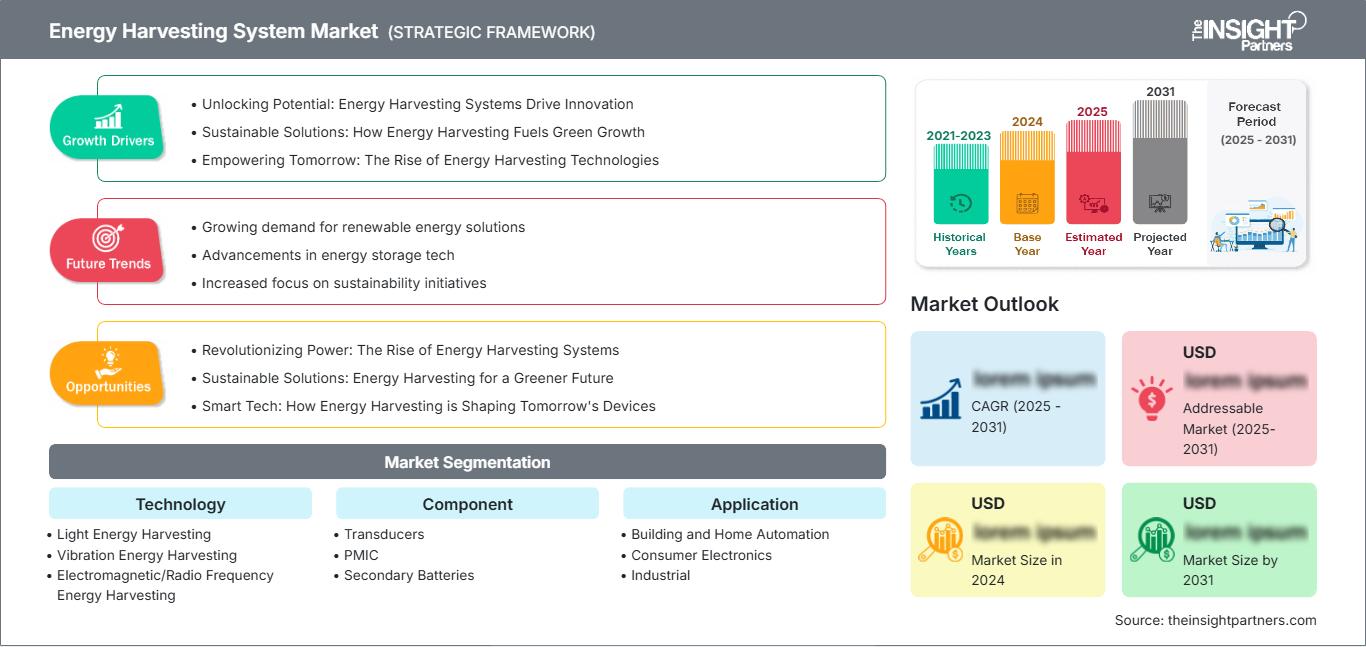
能量收集系统市场: 战略洞察
-
获取本报告的主要市场趋势。这个免费样本将包括数据分析,从市场趋势到估计和预测。
Regional Insights
North America Energy Harvesting System Market
The region has a modeled market share of 31–34% for Energy Harvesting Systems in 2025 and is anticipated to experience 8.6–9.2% CAGR up to 2034. The demand arises mainly from applications in smart buildings, industrial condition monitoring, logistics, and defense-based sensing in which case the replacement labor costs more than the component itself. Existing design and distribution expertise enable quick prototyping of solutions, with retrofits involving wireless solutions due to no need for new wiring.
While Canada participates with remote infrastructure, energy, and environment monitoring, Mexico brings its expertise in electronics and automotive manufacturing. American semiconductor innovations ensure availability of PMICs, microcontrollers, and connectivity solutions. Increasingly, regional customers demand proven economic value over the product lifecycle, cybersecurity, and predictable behavior in changing conditions of illumination, vibrations, temperatures, or RF environment.
U.S. Energy Harvesting System Market
US accounts for 78-82% of North American revenues in 2025 and is forecast to exhibit 8.8-9.4% CAGR through 2034. Automation, warehouse telemetry, building controls, and transport applications offer deployment potential. Local expertise on semiconductors and wireless power companies enables OEMs to manage energy budgets based on sensing periods, computing, and radio communications.
Applications show strength in areas with difficult maintenance and large numbers of sensors. Vibration energy harvesting for machinery, light energy harvesting for control applications, and RF energy harvesting for logistics are being considered by manufacturers. The presence of vendors such as Analog Devices, Inc., Honeywell International Inc., Microchip Technology Incorporated, Powercast Corporation, Texas Instruments Incorporated, among others, allows for reference design and pilot programs. Public infrastructure improvements provide additional addressable market potential for autonomous sensors.
Europe Energy Harvesting System Market
Europe constitutes a modeled 34-37% share of market in 2025 and is expected to grow at a CAGR of 8.4-9.0% until 2034, with Germany as the key market. Energy performance regulations, advanced manufacturing capabilities, and building automation are factors aiding adoption. In the UK, there is focus on commercial retrofits and transportation monitoring, with wireless installations helping reduce disruption and providing flexibility in space usage.
Industrial automation, automotive technology, and good controls ecosystems are the strengths of Germany. In France, smart buildings along with aerospace applications and infrastructure monitoring form an attractive application field. For Italy and Spain, there are manufacturing, logistics, hospitality, and solar energy based applications. Battery disposal considerations, maintenance frequency, cybersecurity issues, and interoperability are becoming part of regional procurement decisions. The presence of ABB Ltd., EnOcean GmbH, and STMicroelectronics N.V. adds further expertise in sensing, energy conversion, communication, and automation.
APAC Energy Harvesting System Market
Asia Pacific holds a modeled 24–27% share in 2025 and should lead growth at a 10.8–11.6% CAGR through 2034. China leads through electronics manufacturing and smart infrastructure, while Japan and South Korea contribute precision components, automotive platforms, and advanced materials.
India adds industrial digitization and expanding building stock; Australia supports mining and remote-asset monitoring. Policy support for efficient infrastructure, regional semiconductor capacity, and high-volume device assembly should reduce unit costs. The resulting ecosystem favors scalable light, vibration, thermal, and RF harvesting designs.
Middle East & Africa Energy Harvesting System Market
Middle East and Africa is modeled to grow at an 8.0–8.8% CAGR through 2034. The UAE leads through smart-building and logistics investment, while Saudi Arabia offers large infrastructure programs and industrial monitoring needs.
South Africa presents opportunities in mining, utilities, and remote equipment; the Rest of MEA remains selective and project-led. High solar availability supports light harvesting, while difficult service conditions strengthen the case for autonomous sensors. Adoption will depend on durable packaging, channel support, and integration with building, energy, and security platforms.
Segmentation Analysis
Technology
Technology is modeled to advance at a 9.2–9.8% CAGR during 2026–2034. The Energy Harvesting System Market scope spans conversion methods suited to different ambient profiles, power densities, and installation constraints. Buyers increasingly select hybrid architectures to stabilize intermittent input, while improvements in materials, packaging, and control algorithms widen acceptable operating windows and support smaller, more autonomous devices.
- Light Energy Harvesting: Leads adoption because photovoltaic conversion works across outdoor and optimized indoor lighting, supporting building controls, consumer devices, asset tags, and distributed sensors with predictable source characterization.
- Vibration Energy Harvesting: Serves rotating machinery, transport assets, and structural monitoring where recurring motion is available, creating strategic value in predictive maintenance and hard-to-access industrial installations.
- Electromagnetic/Radio Frequency Energy Harvesting: Gains relevance for battery-free tags and controlled wireless-power environments, linking communication infrastructure with distributed sensing while reducing dependence on disposable batteries and fixed wiring.
- Thermal Energy Harvesting: Converts temperature differentials around engines, processes, pipes, and wearables, offering durable generation where heat gradients persist and conventional service access remains costly.
Component
Components are modeled to grow at a 9.0–9.7% CAGR during 2026–2034 as system value shifts toward coordinated conversion, regulation, and storage. PMIC efficiency determines whether weak ambient inputs become usable, while transducer durability and storage cycle life shape field economics. Vendors offering characterized combinations can shorten qualification and improve reliability across variable duty cycles.
- Transducers: Represent the energy-conversion interface and remain central to differentiation through sensitivity, mechanical robustness, material choice, operating range, and compatibility with light, motion, RF, or heat sources.
- PMIC:协调整流、冷启动、电压调节、最大功率跟踪和负载控制,使得超低静态电流对于间歇供电的传感器和嵌入式系统具有重要的战略意义。
- 二次电池:缓冲不规则的环境输入,并支持峰值无线电或处理负载,其需求受紧凑性、泄漏、循环寿命、安全性和与重复浅充电的兼容性的影响。
应用
预计2026年至2034年间,应用领域将以9.3%至10.0%的复合年增长率增长。在无需布线、接入或电池维护成本的自主传感领域,应用最为广泛。楼宇自动化可提供规模化解决方案,工业监控可带来丰厚的回报,而交通运输领域则对恶劣环境提出了更高的要求。随着边缘处理和事件唤醒架构降低功耗,安防和消费电子产品领域也涌现出更多机遇。
- 楼宇和家庭自动化:在人员占用、照明、暖通空调、门禁和环境感知方面拥有广泛的部署,免维护无线设备简化了改造,并实现了更密集的运行数据。
- 消费电子产品:利用收集的能量来延长可穿戴设备、配件、遥控器和个人设备的运行时间或启用低功耗辅助功能,外形尺寸和用户体验决定了其普及程度。
- 工业领域:优先考虑状态监测、过程遥测和资产可视性,尤其是在电缆或电池更换会中断运营的场所,因此可靠性和环境耐受性是重要的采购标准。
- 交通运输:将振动、热、光和射频源应用于车辆、铁路、物流和基础设施,支持在严格的资质要求下对轮胎、部件、货物和结构进行传感。
- 安全性:受益于自主门窗、运动和周界传感器,降低了安装的复杂性,但网络安全、防篡改和可靠的低光照性能仍然至关重要。
机遇概览
|
应用 |
收入贡献 |
趋势标签 |
收养阶段 |
|
楼宇和家庭自动化 |
高的 |
无线改造 |
规模化 |
|
消费电子产品 |
中等的 |
运行时扩展 |
规模化 |
|
工业的 |
高的 |
状态监测 |
规模化 |
|
运输 |
中等的 |
资产遥测 |
新兴 |
|
安全 |
中等的 |
无电池传感 |
规模化 |
能量采集系统市场增长驱动因素及影响分析
分布式传感的维护经济性
大型传感器系统暴露了一次性电池和有线安装的隐性成本。设备本身可能价格低廉,但维护设备、技术人员工时、停机协调以及合规性记录等成本都会使每次维护变得相当昂贵。能量采集技术通过将环境光、振动、热量或射频转化为运行电源并延长存储寿命,改变了这种商业模式。这种技术在高天花板、密封机械、运输设备和地理位置分散的基础设施中影响尤为显著。能够记录能量来源可用性、工作周期和避免干预次数的供应商可以将技术性能转化为采购价值。这使得采购决策从组件价格转向生命周期成本,从而提高了高端传感器、电源管理集成电路 (PMIC) 和集成模块的接受度。
低功耗边缘智能的扩展
微控制器、传感器和事件驱动处理技术的进步降低了采集、分类和传输有用数据所需的能量。设备可以保持休眠状态,在达到阈值时唤醒,进行本地处理,并且仅发送异常信息,从而使能耗与能量采集器的小幅间歇性输出相匹配。这种架构转变将应用范围从简单的开关扩展到状态监测、占用分析、安防和紧凑型视觉等领域。更小的存储需求、更少的传输次数和更高的响应速度带来了商业上的影响。将超低功耗处理技术与特性明确的能量采集前端相结合的半导体供应商可以简化设计并降低风险。最终,将涌现出更多能够在极少维护的情况下长时间运行的自主产品。
建筑能效和改造要求
建筑能耗约占全球能源需求的30%,因此提高运营可视性和控制力的压力日益增大。无线数据采集传感器无需拆墙或铺设新线路即可获取人员占用、温度、光照、空气质量和设备数据。对于布局经常变化且安装会造成经济损失的办公楼、公共建筑、酒店和综合用途建筑而言,其改造优势尤为显著。更完善的数据支持按需控制的暖通空调和照明系统,而免维护设备则使高密度传感成为可能。市场影响涵盖传感器、电源管理集成电路 (PMIC)、网关和自动化软件等各个方面。能够证明其与现有协议兼容并具备安全设备管理能力的供应商,最有可能将节能项目转化为可复制的投资组合。
能量采集系统市场未来趋势
混合式能量采集与预测性电力协调
能量采集系统市场趋势将日益青睐混合式设计,这种设计将两种环境能量源与预测性电源管理相结合。例如,楼宇传感器可以融合室内光照和射频信号,而工业节点则可以结合振动和温度梯度。固件会预测可用能量,安排传感任务,并在存储容量低于工作阈值之前调整无线电占空比。与过度设计单个传感器相比,这种方法可以提供更好的连续性。供应商将通过感知能量源的算法、可互操作的电源管理集成电路 (PMIC) 以及在安装前验证能量预算的数字孪生技术来脱颖而出。该技术应首先应用于高端工业和基础设施项目,然后随着组件集成降低开发成本,逐步推广到标准化模块中。
安全的能源自主设备生态系统
未来能量采集系统市场的架构将把网络安全视为功耗预算的一部分,而非附加功能。安全启动、加密通信、凭证轮换和受保护的存储都会消耗能源,因此需要硬件加速和精心安排的更新。供应商会将采集、处理、无线电和安全模块集成到特性化的平台中。建筑和工业领域的买家将更倾向于那些能够证明其自主运行和生命周期可管理性的设备,包括经过签名的固件和可预测的恢复行为。基于标准的互操作性应支持更广泛的多供应商部署,而边缘过滤则可限制传输和风险暴露。能够将低功耗工程与安全认证、长期可用性和透明的更新策略相结合的供应商将获得这一趋势的回报。
能量采集系统市场机遇
绩效合同式智能建筑改造
投资者和解决方案提供商可以将自供电传感器与控制软件和基于结果的改造合同打包出售。该模式通过将付款与已记录的节能效果、空间利用率、维护成本降低或室内环境性能挂钩,从而减少了前期投入的阻力。合作伙伴应包括传感器专家、自动化供应商、安装商、融资方和测量服务提供商。优先考虑的场所包括布局重复、电力成本高且租户频繁变更的建筑群。标准化套件可以缩短审核和部署时间,而安全网关则可实现集中监控。成功的项目应发布经过验证的安装和服务指标,从而创建参考案例,支持在办公楼、教育机构、医疗机构、酒店和公共建筑等场所进行复制,而无需进行大规模的新布线。
面向边缘数据的无线供电基础设施
射频能量采集技术为将通信基础设施转变为低功耗传感器和标签的分布式电源层创造了投资良机。开发人员可以瞄准仓库、医疗机构、零售环境和数据中心等已有读写器或接入点覆盖的区域。商业策略应从受控区域、测量场强和明确定义的传感工作负载入手,然后通过可重复的接收器设计进行扩展。与无线电基础设施供应商和系统集成商建立合作关系可以降低部署的不确定性。收入来源可以包括发射器、接收器芯片组、模块、设计服务和监控软件。明确的合规性、共存性测试和生命周期经济性对于试点项目后的规模化应用至关重要。
最新进展
- 2025年7月:Enphase Energy在意大利和瑞士推出IQ8P微型逆变器,进一步拓展了其在欧洲的太阳能产品组合。这款新型微型逆变器旨在提升最新一代高功率太阳能组件的能量采集效率,可提供高达480瓦的峰值交流输出。IQ8P可处理高达14安培的连续直流电流,并支持额定功率高达670瓦直流的太阳能组件。与之前的Enphase微型逆变器型号相比,更高的输入能力使该系统能够从高功率光伏面板中捕获更多能量。
- 2025年4月:旭化成微电子(AKM)开发出AP4413系列超低电流电源管理集成电路(PMIC),该系列产品是能量采集应用中电池充电系统的理想之选。AP4413系列能够高效充电,同时功耗仅为52 nA,并包含四种型号,其电压阈值特性可与多种常见的可充电电池类型相匹配。AP4413采用3.0 × 3.0 × 0.37 mm的HXQFN封装,并已于2025年2月开始量产。
- 2023年8月:e-peas公司推出了AEM13920,这是一款能量采集电源管理集成电路(PMIC),旨在同时管理来自两个独立能源的能量。该公司表示,该器件为开发结合不同环境能源的紧凑型低功耗系统的设计人员提供了更大的灵活性。AEM13920可以从光伏电池、热电发电机、射频能量采集器和动能源的组合中采集能量。与通常针对单一采集技术优化的传统PMIC不同,这款新器件可以同时处理两种能源。
常见问题解答

Naveen 是一位经验丰富的市场研究和咨询专业人士,在定制项目、联合项目和咨询项目方面拥有超过 9 年的专业经验。他目前担任副总裁,成功管理了项目价值链中的利益相关者,撰写了 100 多份研究报告和 30 多项咨询项目。他的工作涵盖工业和政府项目,为客户的成功和数据驱动的决策做出了重要贡献。
Naveen 拥有卡纳塔克邦 VTU 的电子与通信工程学位,以及马尼帕尔大学的市场营销与运营 MBA 学位。他已担任 IEEE 会员 9 年,积极参与各种会议、技术研讨会,并在分部和地区层面担任志愿者。在此之前,他曾担任 IndustryARC 的助理战略顾问和惠普(惠普全球)的工业服务器顾问。
- 全面的市场规模与预测分析
- 详细的细分市场分析
- 深入的市场动态评估
- 区域及国家级洞察
- 竞争格局与企业对标分析
- 战略性商业情报
客户评价

Insight Partners 的 SCADA 系统市场报告内容全面,对当前趋势和未来预测提供了宝贵的见解。该团队始终高度专业、响应迅速且乐于助人。我们非常满意,强烈推荐他们的服务。
兰·凯德姆 伙伴, Reali Technologies LTD
我请求一份关于特定软件市场的报告,团队在几天内就完成了。报告信息非常相关,而且呈现得非常出色。之后,我请求对报告进行一些修改和补充。团队再次迅速响应,不到一周我就收到了最终报告。
让-埃尔韦·詹恩 主席, 未来分析公司
我们与 Insight Partners 合作进行了一项重要的市场研究和预测。他们清晰地洞察了机遇和风险,帮助我们制定了计划。他们的研究简单易用,数据可靠,帮助我们做出了明智而自信的决策。我们强烈推荐他们。
皮尤什·纳格帕尔 高级副总裁, 远光全球
Insight Partners 凭借其深厚的行业专业知识,提供了富有洞察力、结构合理的市场研究。他们的团队始终专业且响应迅速。用户友好的网站让访问行业报告变得顺畅无阻。我们强烈推荐他们可靠、高质量的研究服务。
安达幸彦 首席执行官, 深蓝有限责任公司
这是我第一次从The Insight Partners购买市场报告。起初我有些犹豫,但访问了他们的网站后,我更放心地冒险购买市场报告。我对报告的质量和客户服务非常满意。我对最初的报告有一些疑问和意见,但在与他们的分析师通过电子邮件沟通了几次后,我相信这份报告可以作为我们战略规划流程的参考。非常感谢您抽出宝贵的时间,让这次体验如此愉快。我一定会向其他人推荐你们的服务,当我们需要更多市场数据时,你们将是我的首选。
约翰·铃木 总裁兼首席执行官、董事会董事, BK科技
感谢您在处理我关于尼日利亚传染病体外诊断市场信息请求的过程中所展现的支持和专业精神。感谢您的耐心、指导,以及您愿意提供的折扣,最终促成了这笔交易。我期待未来与 Insight Partners 继续合作,这一切都要归功于您与我初次接触后留下的良好印象。
奇吉奥克博士 ONYIA 董事总经理, PineCrest 医疗保健有限公司购买理由
- 明智的决策
- 了解市场动态
- 竞争分析
- 客户洞察
- 市场预测
- 风险规避
- 战略规划
- 投资论证
- 识别新兴市场
- 优化营销策略
- 提升运营效率
- 顺应监管趋势




















 获取免费样品 -