
Energy Harvesting System Market Size, Share & Growth by 2034
Coverage: By Technology (Light Energy Harvesting, Vibration Energy Harvesting, Electromagnetic/Radio Frequency (RF), Energy Harvesting, Thermal Energy Harvesting); Component (Transducers, PMIC, Secondary Batteries); Application (Building and Home Automation, Consumer Electronics, Industrial, Transportation, Security), and Geography (North America, Europe, Asia Pacific, and South and Central America)
- Status : Data Released
- Report Code : TIPRE00014527
- Category : Electronics and Semiconductor
- No. of Pages : 150
- Available Report Formats :


- Last update date : August 26, 2026


2025 Market Size
US$ 690.91 Mn
Base year value
2034 Forecast
US$ 1,554.04 Mn
Projected by 2034
CAGR 2026-2034
9.42 %
Growth rate
Addressable Market
US$ 10,018.79 Mn
(2026-2034)
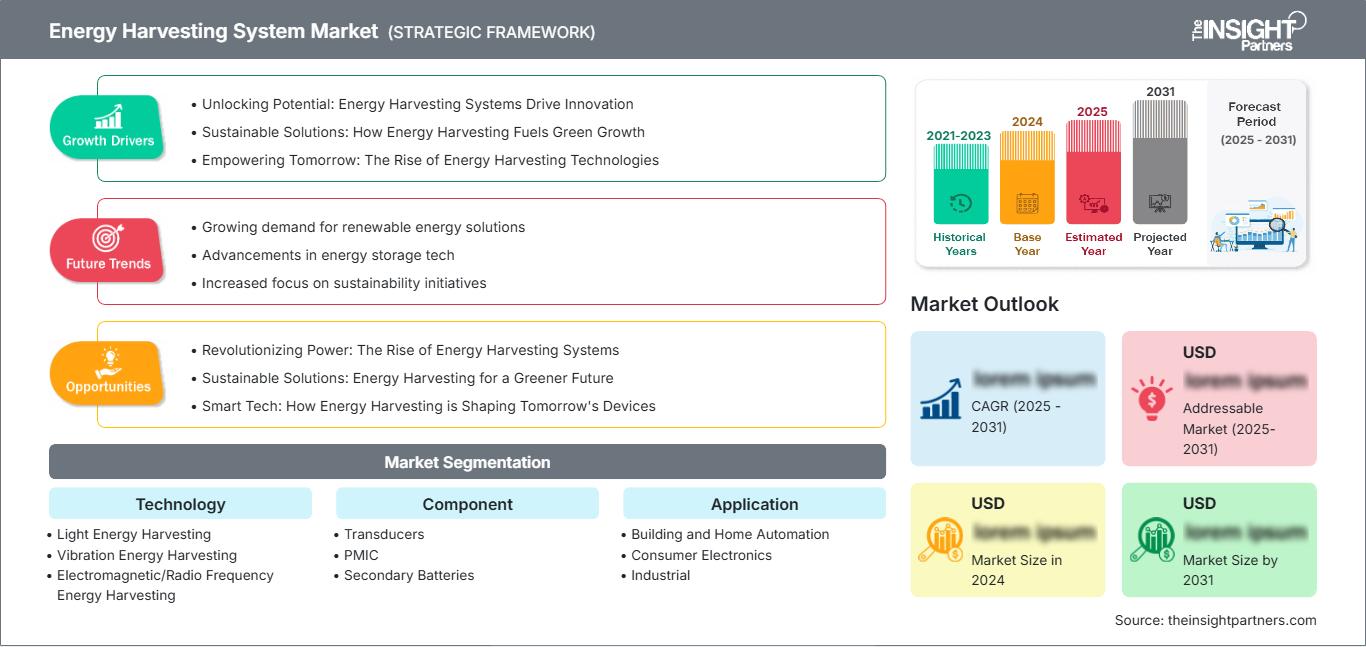
The Energy Harvesting System Market size is set to rise from US$ 690.91 Million in 2025 to US$ 1,554.04 Million by 2034, growing at a 9.42% CAGR between 2026-2034. This pattern is consistent with growing viability of power-from-the-ambient architectures in distributed sensing, automation, electronics, transport, and security systems through the combination of better transducers with effective power management ICs and battery rechargeables.
North American Energy Harvesting System Market size is poised to grow at an approximate 8.6–9.2% CAGR in the coming years until 2034. High density of industrial IoT systems along with energy efficiency retrofits contribute to a strong demand basis, with solid semiconductor design experience leading to faster integration periods. Maintenance-free wireless sensors are more attractive for building operators, due to buildings’ share of about 30% in total global energy consumption.
Energy Harvesting System Market Assessment and Insights
- North America: Share in 2025 is modeled at 31–34%, with CAGR between 2026–2034 of 8.6–9.2%, supported by industrial sensor density, smart-building retrofits, and mature semiconductor ecosystems.
- US: Share in 2025 represents 78–82% of North America, with CAGR between 2026–2034 of 8.8–9.4%, led by industrial automation and connected infrastructure.
- Europe: Share in 2025 is modeled at 34–37%, with CAGR between 2026–2034 of 8.4–9.0%; Germany leads, followed by the UK and France.
- Asia Pacific: Share in 2025 is modeled at 24–27%, with CAGR between 2026–2034 of 10.8–11.6%; China leads, while Japan, South Korea, and India broaden adoption.
- Largest Segment: Light Energy Harvesting holds 33–36% market share in 2025 and records a 9.0–9.6% CAGR during 2026–2034, reflecting accessible indoor and outdoor irradiance.
- High Growth Segment: Electromagnetic/Radio Frequency Energy Harvesting holds 18–21% market share in 2025 and posts a 10.8–11.6% CAGR during 2026–2034 as wireless-power infrastructure scales.
- Key companies analyzed in detail: ABB Ltd, Analog Devices, Inc., Cymbet Corporation, EnOcean GmbH, Fujitsu Limited, Honeywell International Inc., Microchip Technology Incorporated, Powercast Corporation, STMicroelectronics N.V., and Texas Instruments Incorporated.
Source: The Insight Partners' analysis based on proprietary research, government publications, company annual reports, investor presentations, industry databases, and expert interviews.
Commercial evolution is transforming energy harvesters from stand-alone laboratory converters to application-ready subsystems. Previously, energy harvesters were capable of coping with intermittent power generation and bespoke electronics controllers; today's solutions combine the optimized transducers of photovoltaics, piezoelectricity, thermoelectricity, and RF technologies with ultralow-power PMICs, edge processors, and batteries. As a result, commercial development is gradually moving from reference designs, validated modules, and wireless interoperability protocols. In addition, suppliers have started to minimize standby losses, ensure cold starts, and provide custom-packaging solutions for devices with restricted size, heavy industrial equipment, and retrofitted building sensors.
Over the 2034 period, investment flows need to expand from Europe and North America to Asian electronics clusters, Gulf smart infrastructures, and emerging industrial zones. Purchasing decisions will be made taking into account cost savings from no more battery maintenance and sustainability reporting requirements. Building efficiency regulations, factory automation programs, and rising requirements on secure edge devices will benefit the suppliers providing certified modules, lengthy lifecycle guarantees, and quantified energy budgets.
Energy Harvesting System Market Report Scope
| Report Attribute | Details |
|---|---|
| Market size in 2025 | US$ 690.91 Million |
| Market Size by 2034 | US$ 1,554.04 Million |
| Global CAGR (2026 - 2034) | 9.42% |
| Historical Data | 2021-2024 |
| Forecast period | 2026-2034 |
Energy Harvesting System Market Analysis
Market dynamics of Energy Harvesting System Market are supported by the growing numbers of wireless sensors that have to function in areas where either wiring or battery services do not make economic sense. Requirements start from selecting a transducer, continue through power conditioning and power storage, and lead to module manufacturers, device OEMs, integrators, and plant owners. Each stage determines conversion efficiency, cold start capabilities, radio duty cycle, and lifetime cost.
The supply side is specialized since ambient energy sources are determined by the place of application and the specific load curve. Semiconductor companies compete with low quiescent currents and reference designs, while transducers stand out due to material characteristics, durability, and shape. Validating an entire energy budget becomes a trend among integrators, leading to co-designed hardware, firmware, and protocols.
Energy Harvesting System market analysis finds that the competitive landscape in the industry comprises automation players with diverse portfolios, analog semiconductor providers with large portfolios, and wireless power solutions providers. Automation firms like ABB Ltd and Honeywell International Inc include sensor harvesting technologies in their automation solutions. The competing firms in the field of analog semiconductors are Analog Devices, Inc., Microchip Technology Incorporated, STMicroelectronics N.V., and Texas Instruments Incorporated.
Positioning in the Energy Harvesting System Market becomes more focused on the breadth of the ecosystem. EnOcean GmbH provides interoperable building control technology; Powercast Corporation works on RF infrastructure technology, while Cymbet Corporation provides solutions for compact storage. Materials and devices are provided by Fujitsu Limited. Investments become focused on demonstrator solutions that help to avoid maintenance costs, over-the-air management, and scalable production.
● REPORT CUSTOMIZATION
Tailor This Report To Align With Your Specific Business Requirements
This report can be customized to align precisely with your business objectives, scope, and target markets. Customization options include tailored segmentation, geography, competitive analysis, and strategic insights to support informed decision-making.
Customize This Report →WHAT YOU CAN ADJUST
- ● Segmentations
- ● Geography
- ● Competitive Analysis
- ● Language Preferences
Energy Harvesting System Market: Strategic Insights
Regional Insights
North America Energy Harvesting System Market
The region has a modeled market share of 31–34% for Energy Harvesting Systems in 2025 and is anticipated to experience 8.6–9.2% CAGR up to 2034. The demand arises mainly from applications in smart buildings, industrial condition monitoring, logistics, and defense-based sensing in which case the replacement labor costs more than the component itself. Existing design and distribution expertise enable quick prototyping of solutions, with retrofits involving wireless solutions due to no need for new wiring.
While Canada participates with remote infrastructure, energy, and environment monitoring, Mexico brings its expertise in electronics and automotive manufacturing. American semiconductor innovations ensure availability of PMICs, microcontrollers, and connectivity solutions. Increasingly, regional customers demand proven economic value over the product lifecycle, cybersecurity, and predictable behavior in changing conditions of illumination, vibrations, temperatures, or RF environment.
U.S. Energy Harvesting System Market
US accounts for 78-82% of North American revenues in 2025 and is forecast to exhibit 8.8-9.4% CAGR through 2034. Automation, warehouse telemetry, building controls, and transport applications offer deployment potential. Local expertise on semiconductors and wireless power companies enables OEMs to manage energy budgets based on sensing periods, computing, and radio communications.
Applications show strength in areas with difficult maintenance and large numbers of sensors. Vibration energy harvesting for machinery, light energy harvesting for control applications, and RF energy harvesting for logistics are being considered by manufacturers. The presence of vendors such as Analog Devices, Inc., Honeywell International Inc., Microchip Technology Incorporated, Powercast Corporation, Texas Instruments Incorporated, among others, allows for reference design and pilot programs. Public infrastructure improvements provide additional addressable market potential for autonomous sensors.
Europe Energy Harvesting System Market
Europe constitutes a modeled 34-37% share of market in 2025 and is expected to grow at a CAGR of 8.4-9.0% until 2034, with Germany as the key market. Energy performance regulations, advanced manufacturing capabilities, and building automation are factors aiding adoption. In the UK, there is focus on commercial retrofits and transportation monitoring, with wireless installations helping reduce disruption and providing flexibility in space usage.
Industrial automation, automotive technology, and good controls ecosystems are the strengths of Germany. In France, smart buildings along with aerospace applications and infrastructure monitoring form an attractive application field. For Italy and Spain, there are manufacturing, logistics, hospitality, and solar energy based applications. Battery disposal considerations, maintenance frequency, cybersecurity issues, and interoperability are becoming part of regional procurement decisions. The presence of ABB Ltd., EnOcean GmbH, and STMicroelectronics N.V. adds further expertise in sensing, energy conversion, communication, and automation.
APAC Energy Harvesting System Market
Asia Pacific holds a modeled 24–27% share in 2025 and should lead growth at a 10.8–11.6% CAGR through 2034. China leads through electronics manufacturing and smart infrastructure, while Japan and South Korea contribute precision components, automotive platforms, and advanced materials.
India adds industrial digitization and expanding building stock; Australia supports mining and remote-asset monitoring. Policy support for efficient infrastructure, regional semiconductor capacity, and high-volume device assembly should reduce unit costs. The resulting ecosystem favors scalable light, vibration, thermal, and RF harvesting designs.
Middle East & Africa Energy Harvesting System Market
Middle East and Africa is modeled to grow at an 8.0–8.8% CAGR through 2034. The UAE leads through smart-building and logistics investment, while Saudi Arabia offers large infrastructure programs and industrial monitoring needs.
South Africa presents opportunities in mining, utilities, and remote equipment; the Rest of MEA remains selective and project-led. High solar availability supports light harvesting, while difficult service conditions strengthen the case for autonomous sensors. Adoption will depend on durable packaging, channel support, and integration with building, energy, and security platforms.
Segmentation Analysis
Technology
Technology is modeled to advance at a 9.2–9.8% CAGR during 2026–2034. The Energy Harvesting System Market scope spans conversion methods suited to different ambient profiles, power densities, and installation constraints. Buyers increasingly select hybrid architectures to stabilize intermittent input, while improvements in materials, packaging, and control algorithms widen acceptable operating windows and support smaller, more autonomous devices.
- Light Energy Harvesting: Leads adoption because photovoltaic conversion works across outdoor and optimized indoor lighting, supporting building controls, consumer devices, asset tags, and distributed sensors with predictable source characterization.
- Vibration Energy Harvesting: Serves rotating machinery, transport assets, and structural monitoring where recurring motion is available, creating strategic value in predictive maintenance and hard-to-access industrial installations.
- Electromagnetic/Radio Frequency Energy Harvesting: Gains relevance for battery-free tags and controlled wireless-power environments, linking communication infrastructure with distributed sensing while reducing dependence on disposable batteries and fixed wiring.
- Thermal Energy Harvesting: Converts temperature differentials around engines, processes, pipes, and wearables, offering durable generation where heat gradients persist and conventional service access remains costly.
Component
Components are modeled to grow at a 9.0–9.7% CAGR during 2026–2034 as system value shifts toward coordinated conversion, regulation, and storage. PMIC efficiency determines whether weak ambient inputs become usable, while transducer durability and storage cycle life shape field economics. Vendors offering characterized combinations can shorten qualification and improve reliability across variable duty cycles.
- Transducers: Represent the energy-conversion interface and remain central to differentiation through sensitivity, mechanical robustness, material choice, operating range, and compatibility with light, motion, RF, or heat sources.
- PMIC: Coordinates rectification, cold start, voltage regulation, maximum-power tracking, and load control, making ultralow quiescent current strategically important for intermittently powered sensors and embedded systems.
- Secondary Batteries: Buffer irregular ambient input and support peak radio or processing loads, with demand shaped by compactness, leakage, cycle life, safety, and compatibility with repeated shallow charging.
Application
Applications are modeled to expand at a 9.3–10.0% CAGR during 2026–2034. Adoption is strongest where autonomous sensing avoids wiring, access, or battery-service expense. Building automation supplies scale, industrial monitoring offers strong payback, and transportation broadens harsh-environment requirements. Security and consumer electronics add opportunities as edge processing and wake-on-event architectures lower power demand.
- Building and Home Automation: Commands broad deployment across occupancy, lighting, HVAC, access, and environmental sensing, where maintenance-free wireless devices simplify retrofits and enable denser operational data.
- Consumer Electronics: Uses harvested energy to extend runtime or enable low-power auxiliary functions in wearables, accessories, remotes, and personal devices, with form factor and user experience determining adoption.
- Industrial: Prioritizes condition monitoring, process telemetry, and asset visibility in locations where cabling or battery replacement disrupts operations, making reliability and environmental tolerance essential purchasing criteria.
- Transportation: Applies vibration, thermal, light, and RF sources to vehicles, rail, logistics, and infrastructure, supporting tire, component, cargo, and structural sensing under demanding qualification requirements.
- Security: Benefits from autonomous door, window, motion, and perimeter sensors that reduce installation complexity, although cybersecurity, tamper resistance, and dependable low-light performance remain critical.
Opportunity Snapshot
| Application | Revenue Contribution | Trend Tag | Adoption Stage |
| Building and Home Automation | High | Wireless Retrofits | Scaling |
| Consumer Electronics | Medium | Runtime Extension | Scaling |
| Industrial | High | Condition Monitoring | Scaling |
| Transportation | Medium | Asset Telemetry | Emerging |
| Security | Medium | Batteryless Sensing | Scaling |
Energy Harvesting System Market Growth Drivers and Impact Analysis
Maintenance Economics of Distributed Sensing
Large sensor estates expose the hidden cost of disposable batteries and wired installation. A device may be inexpensive, yet access equipment, technician time, shutdown coordination, and compliance records make each service event materially costly. Harvesting changes the business case by converting ambient light, vibration, heat, or RF into operating power and extending storage life. The impact is strongest in high ceilings, sealed machinery, transport assets, and geographically dispersed infrastructure. Vendors that document source availability, duty cycles, and avoided interventions can translate technical performance into procurement value. This shifts buying decisions from component price toward lifecycle cost, improving acceptance of premium transducers, PMICs, and integrated modules.
Expansion of Low-Power Edge Intelligence
Advances in microcontrollers, sensors, and event-driven processing reduce the energy required to capture, classify, and transmit useful data. Devices can remain asleep, wake on a threshold, process locally, and send only exceptions, thereby aligning consumption with the small and intermittent output of harvesters. This architectural shift expands feasible applications beyond simple switches toward condition monitoring, occupancy analytics, security, and compact vision. Commercial impact appears through smaller storage requirements, fewer transmissions, and improved responsiveness. Semiconductor vendors that pair ultralow-power processing with characterized energy-harvesting front ends can simplify design and reduce risk. The result is a broader pipeline of autonomous products capable of operating for long periods with minimal servicing.
Building Efficiency and Retrofit Requirements
Buildings account for around 30% of global energy demand, increasing pressure to improve operational visibility and control. Wireless harvesting-enabled sensors can add occupancy, temperature, light, air-quality, and equipment data without opening walls or installing new power lines. Their retrofit advantage is particularly relevant in offices, public buildings, hotels, and mixed-use assets where layouts change and installation disruption carries economic cost. Better data supports demand-driven HVAC and lighting, while maintenance-free devices make denser sensing practical. Market impact extends across transducers, PMICs, gateways, and automation software. Suppliers that demonstrate compatibility with established protocols and secure device management are best placed to convert efficiency projects into repeatable portfolios.
Energy Harvesting System Market Future Trends
Hybrid Harvesting with Predictive Power Orchestration
Energy Harvesting System Market trends will increasingly favor hybrid designs that combine two ambient sources with predictive power management. A building sensor could blend indoor light and RF, while an industrial node combines vibration and thermal gradients. Firmware will forecast available energy, schedule sensing, and adjust radio duty cycles before storage falls below operating thresholds. This approach can provide better continuity than oversizing a single transducer. Suppliers will differentiate through source-aware algorithms, interoperable PMICs, and digital twins that validate energy budgets before installation. Adoption should begin in premium industrial and infrastructure projects, then migrate into standardized modules as component integration lowers development cost.
Secure Energy-Autonomous Device Ecosystems
Future architectures in the Energy Harvesting System Market will treat cybersecurity as part of the power budget rather than an added function. Secure boot, encrypted communication, credential rotation, and protected storage consume energy, requiring hardware acceleration and carefully scheduled updates. Vendors will therefore integrate harvesting, processing, radio, and security blocks into characterized platforms. Building and industrial buyers will prefer devices that prove both autonomous operation and lifecycle manageability, including signed firmware and predictable recovery behavior. Standards-based interoperability should support broader multi-vendor deployment, while edge filtering limits transmissions and exposure. The trend will reward suppliers able to combine low-power engineering with security certification, long availability, and transparent update policies.
Energy Harvesting System Market Opportunities
Performance-Contracted Smart Building Retrofits
Investors and solution providers can package self-powered sensors with controls software and outcome-based retrofit contracts. The model reduces upfront friction by tying payment to documented energy savings, space utilization, maintenance reduction, or indoor-environment performance. Partnerships should combine sensor specialists, automation vendors, installers, financiers, and measurement providers. Priority sites include portfolios with repetitive layouts, high electricity costs, and frequent tenant changes. Standardized kits can shorten audits and deployment, while secure gateways enable centralized monitoring. Successful projects should publish verified installation and service metrics, creating reference cases that support replication across offices, education, healthcare, hospitality, and public buildings without depending on extensive new wiring.
Wireless-Power Infrastructure for Edge Data
RF energy harvesting creates an investable opportunity to turn communication infrastructure into a distributed power layer for low-energy sensors and tags. Developers can target warehouses, healthcare facilities, retail environments, and data centers where reader or access-point coverage already exists. The commercial strategy should begin with controlled zones, measured field strength, and narrowly defined sensing workloads, then expand through repeatable receiver designs. Partnerships with radio infrastructure vendors and systems integrators can reduce deployment uncertainty. Revenue can combine transmitters, receiver chipsets, modules, design services, and monitoring software. Clear compliance, coexistence testing, and lifecycle economics will be essential for scaling beyond pilots.
Recent Developments
- July 2025: Enphase Energy has expanded its solar energy portfolio in Europe with the launch of its IQ8P Microinverters in Italy and Switzerland. The new microinverters are designed to improve energy harvesting from the latest generation of high-powered solar modules, offering a peak AC output of 480 W. The IQ8P can handle up to 14 A of continuous DC current and support solar modules rated up to 670 W DC. This higher input capability enables the system to capture more energy from high-power photovoltaic panels compared with previous Enphase microinverter models.
- April 2025: Asahi Kasei Microdevices (AKM) has developed the AP4413, a new series of ultra-low current power management ICs (PMICs) ideal for battery charging systems used in energy harvesting applications. The AP4413 series enables efficient battery charging while consuming an extremely low current of 52 nA and features four variants with voltage threshold characteristics matching several common rechargeable battery types. The AP4413 comes in a tiny 3.0 × 3.0 × 0.37 mm HXQFN package and has been in mass production since February of 2025.
- August 2023: e-peas has introduced the AEM13920, an energy-harvesting power management IC (PMIC) designed to simultaneously manage energy from two independent sources. The company says the device provides greater flexibility for designers developing compact, low-power systems that combine different ambient energy sources. The AEM13920 can harvest energy from combinations of photovoltaic (PV) cells, thermoelectric generators (TEGs), RF energy harvesters and kinetic energy sources. Unlike conventional PMICs that are typically optimised for a single harvesting technology, the new device can process two energy sources at the same time.
Frequently Asked Questions

- Comprehensive Market Sizing and Forecast Analysis
- Detailed Segmentation Analysis
- In-Depth Market Dynamics Assessment
- Regional and Country-Level Insights
- Competitive Landscape and Company Benchmarking
- Strategic Business Intelligence
Recent Reports
Testimonials

The Insight Partners' SCADA System Market report is comprehensive, with valuable insights on current trends and future forecasts. The team was highly professional, responsive, and supportive throughout. We are very satisfied and highly recommend their services.
RAN KEDEM Partner, Reali Technologies LTDs
I requested a report on a very specific software market and the team produced the report in a few days. The information was very relevant and well presented. I then requested some changes and additions to the report. The team was again very responsive and I got the final report in less than a week.
JEAN-HERVE JENN Chairman, Future Analytica
We worked with The Insight Partners for an important market study and forecast. They gave us clear insights into opportunities and risks, which helped shape our plans. Their research was easy to use and based on solid data. It helped us make smart, confident decisions. We highly recommend them.
PIYUSH NAGPAL Sr. Vice President, High Beam Global
The Insight Partners delivered insightful, well-structured market research with strong domain expertise. Their team was professional and responsive throughout. The user-friendly website made accessing industry reports seamless. We highly recommend them for reliable, high-quality research services
YUKIHIKO ADACHI CEO, Deep Blue, LLC.
This is the first time I have purchased a market report from The Insight Partners.While I was unsure at first, I visited their web site and felt more comfortable to take the risk and purchase a market report.I am completely satisfied with the quality of the report and customer service. I had several questions and comments with the initial report, but after a couple of dialogs over email with their analyst I believe I have a report that I can use as input to our strategic planning process.Thank you so much for taking the extra time and making this a positive experience.I will definitely recommend your service to others and you will be my first call when we need further market data.
JOHN SUZUKI President and Chief Executive Officer, Board Director, BK Technologies
I wish to appreciate your support and the professionalism you displayed in the course of attending to my request for information regarding to infectious disease IVD market in Nigeria. I appreciate your patience, your guidance, and the fact that you were willing to offer a discount, which eventually made it possible for us to close a deal. I look forward to engaging The Insight Partners in the future, all thanks to the impression you have created in me as a result of this first encounter.
DR CHIJIOKE ONYIA MANAGING DIRECTOR, PineCrest Healthcare Ltd.Reason to Buy
- Informed Decision-Making
- Understanding Market Dynamics
- Competitive Analysis
- Identifying Emerging Markets
- Customer Insights
- Market Forecasts
- Risk Mitigation
- Boosting Operational Efficiency
- Strategic Planning
- Investment Justification
- Tracking Industry Innovations
- Aligning with Regulatory Trends





 Get Free Sample for