
Air Cargo Market Overview and Growth by 2028
Published Report - Air Cargo Market Forecast to 2028 - COVID-19 Impact and Global Analysis by Type (Air Mail and Air Freight), Service (Express and Regular), and End User (Retail, Pharmaceutical & Healthcare, Food & Beverage, Consumer Electronics, Automotive, and Others)
- Status : Published
- Report Code : TIPAR100001311
- Category : Automotive and Transportation
- No. of Pages : 173
- Available Report Formats :


- Last update date : June 13, 2024


2022 Market Size
US$ 123.9 Bn
Base year value
2028 Forecast
US$ 175.24 Bn
Projected by 2028
CAGR 2023-2028
5.9 %
Growth rate
Addressable Market
US$ 912.93 Bn
(2023-2028)
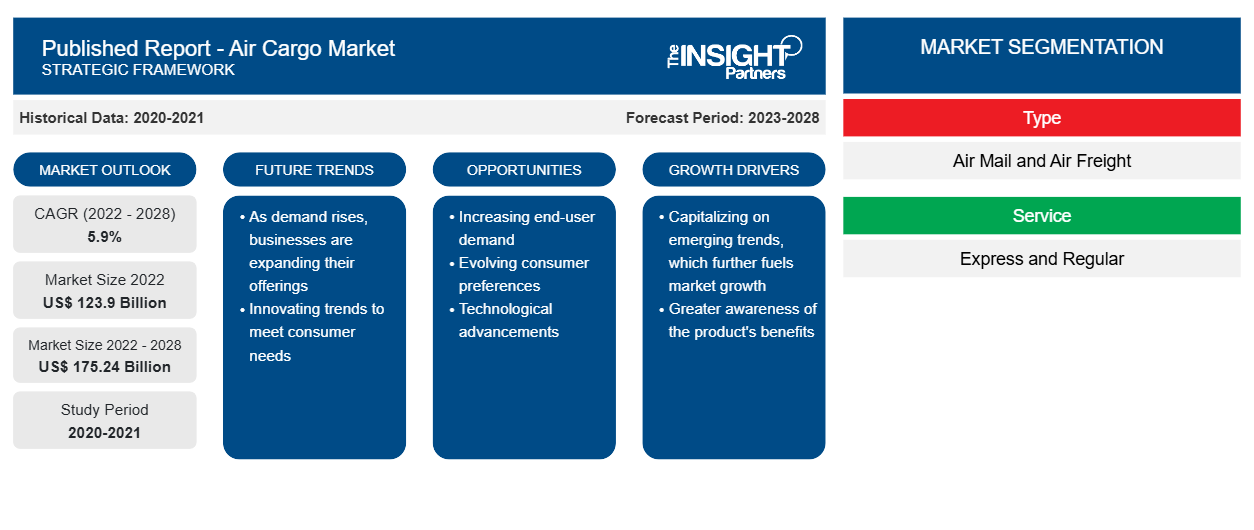
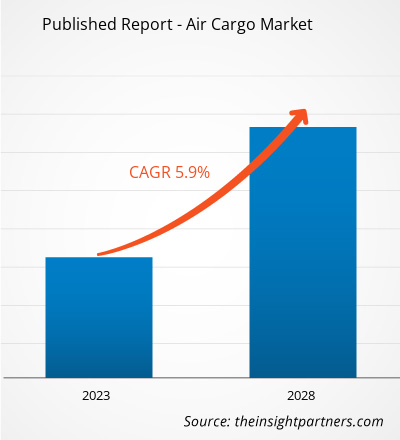
The air cargo market is expected to grow from US$ 123.90 billion in 2022 to US$ 175.24 billion by 2028; it is estimated to grow at a CAGR of 5.9% from 2022 to 2028.
The air cargo market ecosystem involves the physical as well as the documentary movement of freight from the origin (forwarder) to the destination (consignee). The flows of consignments are always indistinguishable; however, the agents involved in the process could be different.
Forwarder: A company that subcontracts to a third-party and manages cargo from origin to destination. The selection of the third-party agent depends on various factors, including product lifespan, cost of cargo shipment, nature of the cargo (perishable, temperature sensitive, etc.), level of seasonality, and economic cost of the air forwarding routes.
Forwarding agent: Intermediate responsible for required arrangements and/or offers complementary services for air cargo transportation and related services on the forwarder and/or consignee’s behalf. The decision variables for forwarding agents include the security level essential by the product, the level of dangerous goods that requires specific safety measures, the requirement of specific temperature during transport, special conditions in terms of special chambers, intermodal level at the origin and destination, and required documentation.
● REPORT CUSTOMIZATION
Tailor This Report To Align With Your Specific Business Requirements
This report can be customized to align precisely with your business objectives, scope, and target markets. Customization options include tailored segmentation, geography, competitive analysis, and strategic insights to support informed decision-making.
Customize This Report →WHAT YOU CAN ADJUST
- ● Segmentations
- ● Geography
- ● Competitive Analysis
- ● Language Preferences
Published Report - Air Cargo Market: Strategic Insights
-
Get Top Key Market Trends of this report.This FREE sample will include data analysis, ranging from market trends to estimates and forecasts.
Impact of COVID-19 Pandemic on Air Cargo Market
In FY 2020, despite the COVID-19 pandemic, the demand for air cargo across different regions had been driven by large transportation of medical and pharmaceutical products along with COVID-19 vaccines across different Asian countries. For instance, in 2020, Germany Airline’s cargo team was chosen to transport the Moderna and AstraZeneca vaccines from Luxembourg, Amsterdam, Bangkok, Memphis, and other locations back to Taiwan. Furthermore, in 2020, the Chinese Airlines network was also used to transport vaccines to other countries. Such operations have driven the demand for air cargo services in Europe during the COVID-19 pandemic in FY 2020. Additionally, in 2021, several air cargo vendors have also partnered with different vaccine manufacturing companies to transfer, supply, and distribute the vaccines to other countries after the vaccine development in 2021. For instance, in 2021, DHL Global Forwarding UK and ANA partnered for the delivery of Pfizer's COVID-19 vaccine across the UK. Such developments have driven the air cargo market in the FY 2020-2021. Thus, the global air cargo market growth has increased during the FY 2020.
Market Insights – Air Cargo Market
The huge demand for air cargo in Asia Pacific is attributed to the economic growth of the region and increased focus on retail enactment. Foreign players prefer Asian countries for the expansion of their manufacturing activities due to the availability of a cheaper workforce. Factors such as continuous urbanization, strong economic growth, and a large middle-class population create high domestic demand for fast-moving consumer goods, personal automobiles, household items, and luxury items. Additionally, companies in the e-commerce market opt for various logistic alternatives, including surface transport and air transport, to deliver items to their clients which is in turn catalyzing the air cargo market growth. Thus, with the flourishment of the e-commerce business, different purchase habits and trends have been noted in various countries in Asia Pacific. The proliferating e-commerce industry is likely to boost the air cargo market growth in Asia Pacific in the coming years with the rise in demand for parcel delivery services across the region.
Services-Based Insights
Based on services, the air cargo market size is bifurcated into express and regular. The regular segment, in terms of revenue, is expected to continue its dominance in the global air cargo market by 2028. A few of the factors driving the growth of the regular services segment are increasing air freight fleets across different regions. Majority of the cargo aircraft operators have been pushing their investments to increase their respective air cargo aircraft fleets. For this, the operators are focusing on implementing collaboration and aircraft lease strategies wherein the companies lease cargo aircraft models to serve many customers, which also allows them an opportunity to expand into new regions. Also, the air cargo operators that provide regular air cargo services are collaborating with aircraft OEMs to provide them with reliable aircraft products for their respective cargo operations. For instance, in May 2022, Lufthansa Cargo announced its plans to operate the Airbus A321F fly for the Group's subsidiary, Lufthansa CityLine. Such initiatives have been boosting the need for cargo aircraft fleet among the cargo operators that is likely to generate new opportunities for the air cargo market players during the forecast period.
The air cargo market size is derived on the basis of type, services, and end user. Based on type, the air cargo market is bifurcated into air mail and air freight. Based on services, the air cargo market is bifurcated into express and regular. Based on end user, the air cargo market is segmented into retail, pharmaceutical & healthcare, food & beverage, consumer electronics, automotive, and others.
Air Cargo
Published Report - Air Cargo Market Report Scope
| Report Attribute | Details |
|---|---|
| Market size in 2022 | US$ 123.9 Billion |
| Market Size by 2028 | US$ 175.24 Billion |
| Global CAGR (2022 - 2028) | 5.9% |
| Historical Data | 2020-2021 |
| Forecast period | 2023-2028 |
| Segments Covered |
By Type
|
| Regions and Countries Covered |
North America
|
| Market leaders and key company profiles |
|
Published Report - Air Cargo Market Players Density: Understanding Its Impact on Business Dynamics
The Published Report - Air Cargo Market is growing rapidly, driven by increasing end-user demand due to factors such as evolving consumer preferences, technological advancements, and greater awareness of the product's benefits. As demand rises, businesses are expanding their offerings, innovating to meet consumer needs, and capitalizing on emerging trends, which further fuels market growth.
The air cargo market players are mainly focused on the development of advanced and efficient products.
- In 2022, Turkish Cargo announced that it has been investing in infrastructure and technology to provide flexible, cost-saving, and privileged shipment offers by means of three new air cargo service models that include TK SMART, TK PREMIUM, and TK URGENT.
- In 2022, Dedicated booking tiers for cargo shipments were introduced by Cathay Pacific Airways Limited as part of a suite of priority choices for its customers. Customers will have more alternatives and clearer service options owing to shipping priority, including faster shipping, more capacity, and shipment assurance.
Frequently Asked Questions
2. Implementation of Several Software Solutions
2. Constant Need to Transport Temperature-Sensitive Products

- Comprehensive Market Sizing and Forecast Analysis
- Detailed Segmentation Analysis
- In-Depth Market Dynamics Assessment
- Regional and Country-Level Insights
- Competitive Landscape and Company Benchmarking
- Strategic Business Intelligence
Recent Reports
Testimonials

The Insight Partners' SCADA System Market report is comprehensive, with valuable insights on current trends and future forecasts. The team was highly professional, responsive, and supportive throughout. We are very satisfied and highly recommend their services.
RAN KEDEM Partner, Reali Technologies LTDs
I requested a report on a very specific software market and the team produced the report in a few days. The information was very relevant and well presented. I then requested some changes and additions to the report. The team was again very responsive and I got the final report in less than a week.
JEAN-HERVE JENN Chairman, Future Analytica
We worked with The Insight Partners for an important market study and forecast. They gave us clear insights into opportunities and risks, which helped shape our plans. Their research was easy to use and based on solid data. It helped us make smart, confident decisions. We highly recommend them.
PIYUSH NAGPAL Sr. Vice President, High Beam Global
The Insight Partners delivered insightful, well-structured market research with strong domain expertise. Their team was professional and responsive throughout. The user-friendly website made accessing industry reports seamless. We highly recommend them for reliable, high-quality research services
YUKIHIKO ADACHI CEO, Deep Blue, LLC.
This is the first time I have purchased a market report from The Insight Partners.While I was unsure at first, I visited their web site and felt more comfortable to take the risk and purchase a market report.I am completely satisfied with the quality of the report and customer service. I had several questions and comments with the initial report, but after a couple of dialogs over email with their analyst I believe I have a report that I can use as input to our strategic planning process.Thank you so much for taking the extra time and making this a positive experience.I will definitely recommend your service to others and you will be my first call when we need further market data.
JOHN SUZUKI President and Chief Executive Officer, Board Director, BK Technologies
I wish to appreciate your support and the professionalism you displayed in the course of attending to my request for information regarding to infectious disease IVD market in Nigeria. I appreciate your patience, your guidance, and the fact that you were willing to offer a discount, which eventually made it possible for us to close a deal. I look forward to engaging The Insight Partners in the future, all thanks to the impression you have created in me as a result of this first encounter.
DR CHIJIOKE ONYIA MANAGING DIRECTOR, PineCrest Healthcare Ltd.Reason to Buy
- Informed Decision-Making
- Understanding Market Dynamics
- Competitive Analysis
- Identifying Emerging Markets
- Customer Insights
- Market Forecasts
- Risk Mitigation
- Boosting Operational Efficiency
- Strategic Planning
- Investment Justification
- Tracking Industry Innovations
- Aligning with Regulatory Trends





 Get Free Sample for