
Collagen Market Outlook and Strategic Insights by 2028
Published Report - Collagen Market Forecast to 2028 - COVID-19 Impact and Global Analysis By Source (Bovine, Porcine, Marine, Plant-based/Vegan, and Others), Product Type (Gelatin, Hydrolyzed Collagen, and Native Collagen), and Application (Food & Beverages, Pharmaceuticals & Nutraceuticals, Personal Care, and Others)
- Status : Published
- Report Code : TIPAR00003543
- Category : Food and Beverages
- No. of Pages : 162
- Available Report Formats :


- Last update date : June 13, 2024


2021 Market Size
US$ 4.12 Bn
Base year value
2028 Forecast
US$ 7.21 Bn
Projected by 2028
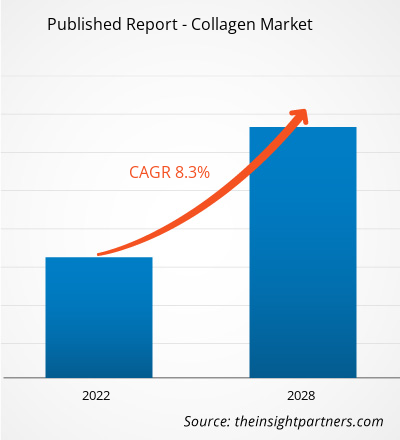
CAGR 2022-2028
8.3 %
Growth rate
Addressable Market
US$ 40.18 Bn
(2022-2028)
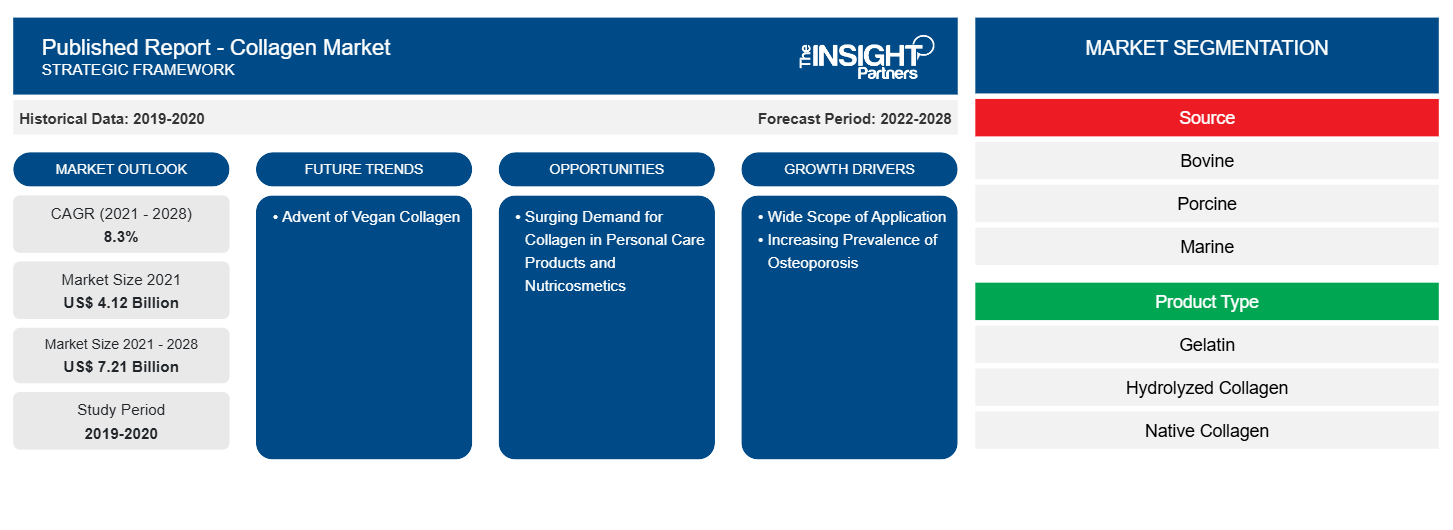
[Research Report] The collagen market was valued at US$ 4,120.19 million in 2021 and is projected to reach US$ 7,205.03 million by 2028. It is expected to grow at a CAGR of 8.3% from 2021 to 2028.
Market Insights and Analyst View:
Collagen is one of the most important structural proteins found in humans and animals such as cattle, pigs, and marine animals. In humans, collagen accounts for 30% of the total protein content. As humans age, the body produces less amount of collagen which negatively impacts the bone health and skin & hair health. Therefore, dieticians and healthcare practitioners recommend consuming collagen-induce supplements and foods and beverages. Moreover, the number of people suffering from osteoporosis is increasing rapidly. Osteoporosis is more prevalent in women than in men. Women in the post-menopausal period suffer from osteoporosis the most. Collagen supplements increase the bone mineral density in the body and help in treating osteoporosis. All these factors are boosting the collagen market growth.
Growth Drivers and Challenges:
Collagen is a structural protein found in connective tissue, skin, tendons, bones, cartilages, and other body parts. It supports tissues structurally and is involved in cellular functions such as tissue healing, immunological response, cellular communication, and cellular migration. Collagen is generally obtained from bovine connective tissues or marine sources. It has a wide range of applications across multiple end-use industries, including food & beverages, pharmaceuticals & nutraceuticals, and personal care. In the food & beverages industry, collagen is used in yogurts, smoothie blends, nutritional bars, ready-to-drink beverages, and others. Collagen-induced foods and beverages enhance collagen levels in the body; moreover, they help in repairing skin texture, improving bone and muscle health, and strengthening joints. Rising awareness regarding the health benefits of collagen among customers is driving the demand for collagen-induced foods and beverages.
Collagen peptides are becoming increasingly popular across the nutraceuticals industry. They are used to manufacture dietary supplements and protein powders. In the past few years, the demand for dietary supplements has increased dramatically due to the rise in consumer preference for products boosting physical strength and fitness. Collagen is easy to digest, and it can slow down the aging process of a body if consumed regularly. Manufacturers are launching a wide range of collagen supplements in different flavors. There is a vast availability of various collagen supplements and powders in retail stores. Moreover, collagen is also used in sports nutrition products to maintain joint and bone health.
However, commercial collagen is extracted from animal sources such as bovine and pigs, and is widely used in the food & beverages, personal care, pharmaceuticals, and biomedical industries. However, in recent years, outbreaks of transmissible spongiform encephalopathy (TSE), bovine spongiform encephalopathy (BSE), and foot-and-mouth disease (FMD) in terrestrial animals have highlighted concerns regarding the use of collagen and its impact on the health of consumers. In addition, collagen purification is a difficult and expensive process. The protein undergoes rigorous quality checks before it is made commercially available for human consumption. In the European Union, raw materials such as bones, hides, and skin used to produce collagen should be obtained from licensed slaughterhouses and fish farms where a veterinarian examines all animals. The stringent conventional slaughter, control, and approval procedures guarantee that the raw materials used for manufacturing collagen have been approved for human consumption. The EU regulations also compel food companies to verify that raw materials used in the production of gelatin and collagen for human consumption originate from sources fulfilling public and animal health and hygiene standards.
● REPORT CUSTOMIZATION
Tailor This Report To Align With Your Specific Business Requirements
This report can be customized to align precisely with your business objectives, scope, and target markets. Customization options include tailored segmentation, geography, competitive analysis, and strategic insights to support informed decision-making.
Customize This Report →WHAT YOU CAN ADJUST
- ● Segmentations
- ● Geography
- ● Competitive Analysis
- ● Language Preferences
Published Report - Collagen Market: Strategic Insights
-
Get Top Key Market Trends of this report.This FREE sample will include data analysis, ranging from market trends to estimates and forecasts.
Report Segmentation and Scope:
The “Global Collagen Market” is segmented based on source, product type, application, and geography. Based on source, the collagen market is segmented into bovine, porcine, marine, plant-based/vegan, and others. Based on product type, the market is classified into gelatin, hydrolyzed collagen, and native collagen. Based on application, the collagen market is segmented into Food & beverages, pharmaceuticals & nutraceuticals, personal care, and others. The collagen market based on geography is segmented into North America (US, Canada, and Mexico), Europe (Germany, France, Italy, UK, Russia, and Rest of Europe), Asia Pacific (Australia, China, Japan, India, South Korea, and Rest of Asia Pacific), Middle East & Africa (South Africa, Saudi Arabia, UAE, and Rest of Middle East & Africa), and South & Central America (Brazil, Argentina, and Rest of South & Central America)
Segmental Analysis:
Based on source, the collagen market is segmented into bovine, porcine, marine, plant-based/vegan, and others. The marine segment held the significant share in the collagen market and is expected to register the significant growth in the collagen market over the forecast period. Marine hydrolyzed collagen is mainly obtained from different fish varieties, jellyfish, and sponges. It helps in improving cartilage and skin health. In cell culture, marine collagen enhances collagen quality. When given to animals, as a dietary supplement, it helps develop bone mineral density and toughness. Optimal dietary protein intake beneficially influences weight management, muscle repair, lean body mass, and immune function, among other benefits. Preclinical studies show that ingesting marine collagen repairs skin collagen and elastin protein fibers and causes a significant thickening of the outer skin surface (epidermis). Marine collagen consists of lysine, proline, glycine, and hydroxyproline, among other amino acids. In addition to promoting promotes bone health, proline and glycine act as major antioxidants by providing protection against free radicals that cause cell damage.
Regional Analysis:
Based on geography, the collagen market is divided into five key regions: North America, Europe, Asia Pacific, South & Central America, and Middle East & Africa. The global collagen market was dominated by Europe which accounted for US$ 1,449.34 Million in 2020. North America is a second major contributor holding more than 26% share in the global market. Asia Pacific is expected to register the considerable growth at a CAGR of over 9% in collagen market over the forecast period. The collagen market in Asia-Pacific is subsegmented into Australia, China, India, Japan, South Korea, and the Rest of Asia-Pacific. Emerging countries in the region are witnessing a surge in health-conscious consumers as a result of the impact of social media. The growing demand for nutritional supplements and increasing use in personal and sports nutrition products are driving the demand for collagen in Asia-Pacific. Functional food and beverages have gained immense popularity among the health-conscious population. Due to high nutritional values and economic feasibility, collagen allows food, beverage, and dietary supplement companies to meet the market's insatiable targets of protein supplementation.
Industry Developments and Future Opportunities:
Various initiatives taken by the key players operating in the collagen market are listed below:
- In 2020, Nitta Introduces Replenwell – Clinically Proven & Performance Optimized Collagen Peptides.
- In 2020, GELITA AG acquires majority of stake in Turkish Gelatine producer SelJel.
Collagen
Published Report - Collagen Market Report Scope
| Report Attribute | Details |
|---|---|
| Market size in 2021 | US$ 4.12 Billion |
| Market Size by 2028 | US$ 7.21 Billion |
| Global CAGR (2021 - 2028) | 8.3% |
| Historical Data | 2019-2020 |
| Forecast period | 2022-2028 |
| Segments Covered |
By Source
|
| Regions and Countries Covered |
North America
|
| Market leaders and key company profiles |
|
Published Report - Collagen Market Players Density: Understanding Its Impact on Business Dynamics
The Published Report - Collagen Market is growing rapidly, driven by increasing end-user demand due to factors such as evolving consumer preferences, technological advancements, and greater awareness of the product's benefits. As demand rises, businesses are expanding their offerings, innovating to meet consumer needs, and capitalizing on emerging trends, which further fuels market growth.
Covid-19 Impact:
The COVID-19 pandemic affected almost all industries in various countries. Lockdowns, travel restrictions, and business shutdowns in North America, Europe, Asia Pacific (APAC), South & Central America (SAM), and the Middle East & Africa (MEA) hampered the growth of several industries, including the consumer goods industry. The shutdown of manufacturing units disturbed global supply chains, manufacturing activities, delivery schedules, and essential and nonessential product sales. Various companies witnessed delays in product deliveries and a slump in sales of their products in 2020. Due to the pandemic-induced economic recession, consumers became more cautious and selective in their purchasing decisions. Non-essential purchases were significantly reduced by consumers due to lower incomes and uncertain earning prospects, especially in developing regions. Many manufacturers of collagen faced decline in profits due to reduced consumer demand during the initial phase of pandemic. However, by the end of 2021, many countries were fully vaccinated, and governments announced relaxation in certain regulations including lockdowns and travel bans. People started focusing on their appearance and are increasingly seeking natural and safe alternatives to keep themselves healthy and strengthen their immune systems which increased the demand for collagen. All these factors had a positive impact in the growth of collagen market across different regions.
Competitive Landscape and Key Companies:
Some of the prominent players operating in the global collagen market include Gelita AG; Gelnex; Lapi Gelatine S.p.A; Nippi Inc.; Nitta Gelatin, Inc.; RABJ Co., Ltd.; Vinh Hoan Corporation; Weishardt; Protein SA, and Ewald-Gelatine GmbH.
Frequently Asked Questions

- Comprehensive Market Sizing and Forecast Analysis
- Detailed Segmentation Analysis
- In-Depth Market Dynamics Assessment
- Regional and Country-Level Insights
- Competitive Landscape and Company Benchmarking
- Strategic Business Intelligence
Recent Reports
Testimonials

The Insight Partners' SCADA System Market report is comprehensive, with valuable insights on current trends and future forecasts. The team was highly professional, responsive, and supportive throughout. We are very satisfied and highly recommend their services.
RAN KEDEM Partner, Reali Technologies LTDs
I requested a report on a very specific software market and the team produced the report in a few days. The information was very relevant and well presented. I then requested some changes and additions to the report. The team was again very responsive and I got the final report in less than a week.
JEAN-HERVE JENN Chairman, Future Analytica
We worked with The Insight Partners for an important market study and forecast. They gave us clear insights into opportunities and risks, which helped shape our plans. Their research was easy to use and based on solid data. It helped us make smart, confident decisions. We highly recommend them.
PIYUSH NAGPAL Sr. Vice President, High Beam Global
The Insight Partners delivered insightful, well-structured market research with strong domain expertise. Their team was professional and responsive throughout. The user-friendly website made accessing industry reports seamless. We highly recommend them for reliable, high-quality research services
YUKIHIKO ADACHI CEO, Deep Blue, LLC.
This is the first time I have purchased a market report from The Insight Partners.While I was unsure at first, I visited their web site and felt more comfortable to take the risk and purchase a market report.I am completely satisfied with the quality of the report and customer service. I had several questions and comments with the initial report, but after a couple of dialogs over email with their analyst I believe I have a report that I can use as input to our strategic planning process.Thank you so much for taking the extra time and making this a positive experience.I will definitely recommend your service to others and you will be my first call when we need further market data.
JOHN SUZUKI President and Chief Executive Officer, Board Director, BK Technologies
I wish to appreciate your support and the professionalism you displayed in the course of attending to my request for information regarding to infectious disease IVD market in Nigeria. I appreciate your patience, your guidance, and the fact that you were willing to offer a discount, which eventually made it possible for us to close a deal. I look forward to engaging The Insight Partners in the future, all thanks to the impression you have created in me as a result of this first encounter.
DR CHIJIOKE ONYIA MANAGING DIRECTOR, PineCrest Healthcare Ltd.Reason to Buy
- Informed Decision-Making
- Understanding Market Dynamics
- Competitive Analysis
- Identifying Emerging Markets
- Customer Insights
- Market Forecasts
- Risk Mitigation
- Boosting Operational Efficiency
- Strategic Planning
- Investment Justification
- Tracking Industry Innovations
- Aligning with Regulatory Trends





 Get Free Sample for