
Sleep Apnea Devices Market Drivers and Forecasts by 2025
Published Report - Sleep Apnea Devices Market to 2025 - Global Analysis and Forecasts by Diagnostic Devices (Polysomnography Devices, Respiratory Polygraphs, Actigraphy Systems, and Single-Channel Screening Devices); Therapeutic Devices (Facial Interfaces, Adaptive Servo-Ventilation Instruments (ASV), Positive Airway Pressure (PAP) Devices, Oxygen Concentrators, Airway Clearance Systems, Oral Appliances and Accessories); and End User (Home Healthcare and Sleep Laboratories & Hospitals)
- Status : Published
- Report Code : TIPAR100000846
- Category : Life Sciences
- No. of Pages : 171
- Available Report Formats :


- Last update date : June 11, 2024


2016 Market Size
US$ 4.03 Bn
Base year value
2025 Forecast
US$ 8.31 Bn
Projected by 2025
CAGR 2017-2025
7.9 %
Growth rate
Addressable Market
US$ 54.07 Bn
(2017-2025)
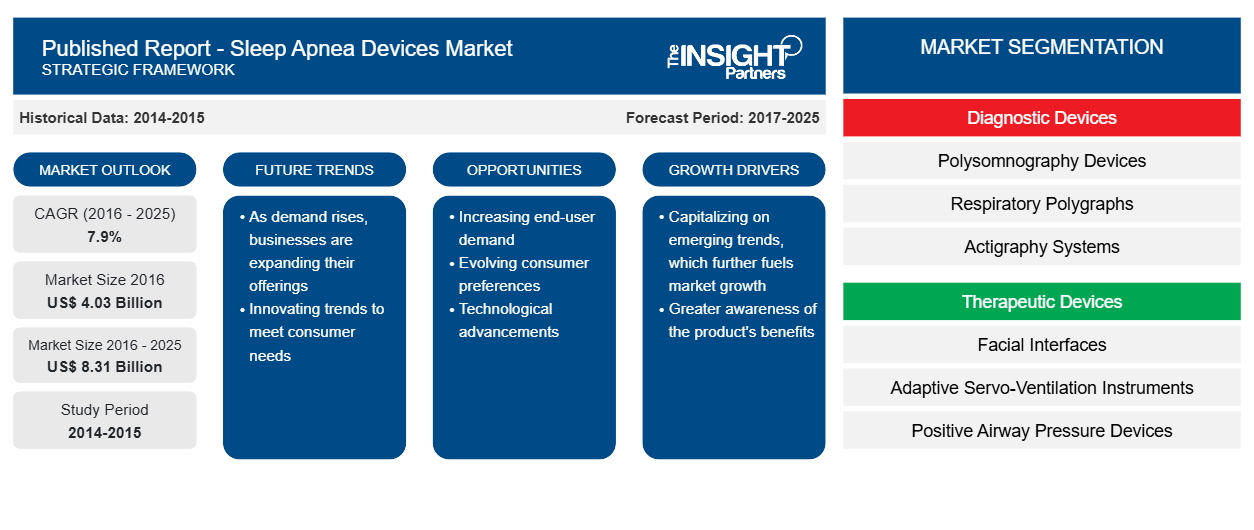
[Research Report] The sleep apnea devices market was valued at US$ 4,033.0 million in 2016 and it is projected to reach US$ 8,305.3 million in 2025; it is expected to grow at a CAGR of 7.9% from 2016 to 2025.
Market Insights and Analyst View:
Sleep apnea is a medical condition wherein breathing repeatedly stops and starts during sleep. Sleep apnea has three types: central sleep apnea, obstructive sleep apnea (OSA), and complex sleep apnea syndrome. Factors that narrow the airway, such as large tonsils, obesity, nasal congestion, constant smoking and drinking, family history, and changes in hormone levels, can increase the patient's risk for sleep apnea. The symptoms of sleep apnea are variations in breathing, loud snoring, waking in between sleep, lack of attention, excess daytime sleep, irritability, and lack of sleep during the night.
The increasing prevalence of respiratory diseases, sedentary lifestyle, increasing aging population (over 60 years), and growing prevalence of chronic disorders is likely to contribute to the rise in the prevalence of sleep apnea. Also, increasing life expectancy across the globe is likely to increase the prevalence of sleep disorders. The study ‘Global Prevalence of Obstructive Sleep Apnea in the Elderly and Related Factors: A Systematic Review and Meta-Analysis Study,’ published in June 2023, aimed to combine data and statistics on the worldwide prevalence of OSA in the elderly population. It combined data from 39 studies with a total sample size of 33,353 people were included. The pooled prevalence of OSA in the elderly population was 35.9% (95% confidence interval: 28.7%-43.8%; I2 = 98.81%). Thus, the abovementioned factors are likely to propel the global sleep apnea devices market size.
● REPORT CUSTOMIZATION
Tailor This Report To Align With Your Specific Business Requirements
This report can be customized to align precisely with your business objectives, scope, and target markets. Customization options include tailored segmentation, geography, competitive analysis, and strategic insights to support informed decision-making.
Customize This Report →WHAT YOU CAN ADJUST
- ● Segmentations
- ● Geography
- ● Competitive Analysis
- ● Language Preferences
Published Report - Sleep Apnea Devices Market: Strategic Insights
-
Get Top Key Market Trends of this report.This FREE sample will include data analysis, ranging from market trends to estimates and forecasts.
Growth Drivers and Challenges:
Obstructive sleep apnea (OSA) is a normal and very common disorder categorized by the upper airway's repetitive, complete, or partial closure. In contrast, sleep is helpful in the fragmentation of sleep and oxygen desaturation. The disorder causes significant morbidity, especially in terms of impairment of daytime functioning and the impact this has on quality of life. The recent indication from the controlled trials is proof that oral appliance therapy is very effective in controlling OSA in up to 50.0% of patients, including some patients with more severe forms of OSA. This is associated with a significant improvement in symptoms, including snoring and daytime sleepiness. This evidence is strong for short-term and emerging long-term treatment of OSA with oral appliances. Various companies have developed their products for treating sleep apnea and related accessories. For instance, SomnoDent devices developed by SomnoMed Limited have increased in the previous year, 2016, from 68% to 68.6%, which signifies that the products have achieved the signature line of products. Additionally, SomnoDent Alpha has developed and received FDA approval in September 2016. The Alpha is an instant fit device used in sleep clinics for offering the patient and delivering efficacy data of a continuous open airway therapy (COAT) treatment relating to a specific patient before a device is custom-made for the patient.
Owing to the rising usage of oral devices across the globe and growing awareness of advanced oral devices for treating OSA will increase the demand for sleep apnea devices will ultimately increase the growth of the therapeutic obstructive sleep apnea devices market.
Report Segmentation and Scope:
The “Global Sleep Apnea Devices Market” is segmented based on diagnostic devices, therapeutic devices, end users, and geography. The sleep apnea diagnostic devices market is categorized into polysomnography devices, respiratory polygraphs, actigraphy systems, and oximeters. The market for sleep apnea is majorly driven by polysomnography devices, as these are more advanced and specialized devices than others.
The sleep apnea therapeutic devices market is segmented into facial interfaces, adaptive servo-ventilation instruments (ASV), positive airway pressure (PAP) devices, oxygen concentrators, airway clearance systems, oral appliances, and accessories.
The global sleep apnea market, based on the end-user, was segmented into home healthcare, sleep laboratories, and hospitals.
The sleep apnea devices market based on geography is segmented into North America (US, Canada, and Mexico), Europe (Germany, France, Italy, UK, Spain, and Rest of Europe), Asia Pacific (Australia, China, Japan, India, South Korea, and Rest of Asia Pacific), Middle East & Africa (South Africa, Saudi Arabia, UAE, and Rest of Middle East & Africa), and South & Central America (Brazil, Argentina, and Rest of South & Central America)
Segmental Analysis:
The global sleep apnea market, based on the end-user, was segmented into home healthcare, and sleep laboratories & hospitals. In 2017, the home healthcare segment held the largest share of the market by end user. In addition, the segment is also expected to grow at the fastest rate during the coming years owing to the advantages of the home healthcare segments. Home healthcare services are similar to skilled nursing facilities and hospitals available to treat patients at home. These facilities are used to treat injuries and diseases with more convenience and less cost. This service helps patients treat their sicknesses and injuries and helps them be self-sufficient to regain their independence. The patients feel more comfortable and relaxed in their own houses and respond well to the treatment.
Regional Analysis:
Based on geography, the sleep apnea devices market is divided into five key regions: North America, Europe, Asia Pacific, South & Central America, and Middle East & Africa. In terms of revenue, North America dominated the sleep apnea devices market share. The North America sleep apnea devices market has been segmented into US, Canada, and Mexico. The US holds the largest share of the North American sleep apnea devices market. Increasing prevalence of sleep apnea disorder among the American population is key factor increasing the demand for sleep apnea devices, thus driving the North America sleep apnea devices market.
Further, high prevalence of sleep apnea and rising awareness about sleep disorders and its risk factors in the US is likely to drive the US sleep apnea devices market. As per the Centers for Disease Control and Prevention (CDC), around one third of the US Population gets less than required amount of sleep. Additionally, as per the American Sleep Apnea Association, around 22 million Americans suffer from sleep apnea. Thus, the growing prevalence of sleep apnea will likely contribute to the growth of the US sleep apnea devices market size.
Additionally, the Asia Pacific sleep apnea devices market, based on countries, is segmented into China, Japan, Australia, India, South Korea, and the Rest of Asia Pacific. The sleep apnea devices market in Asia Pacific is likely to witness rapid growth owing to a large population, rising medical tourism and availability of cost-effective sleep apnea treatment devices. Thus, the abovementioned factors will likely drive the sleep apnea treatment devices market in the Asia Pacific region.
Further, Europe sleep apnea devices market includes the consolidated markets for France, Germany, the United Kingdom (UK), Spain, Italy, and the Rest of Europe. Europe occupies the second position in the global sleep apnea devices market and is expected to register a robust growth rate over the forecast period. The UK occupies a significant position in the Europe sleep apnea devices market and is expected to record vigorous growth during the forecast period. Various factors, such as focus on research and development activities on sleep disorders, increasing government support for research and favorable reimbursement policies in European countries such as U.K and Germany govern the growth of the market.
Middle East & Africa market includes countries such as Saudi Arabia, U.A.E., South Africa, Rest of the Middle East, and Africa. The region is expected to experience a steady growth rate from 2016 to 2025. The market for sleep apnea exhibits steady growth due to various factors such as the high prevalence of sleep disorders, the availability of qualified healthcare professionals and the focus on specialized sleep services, and the development of specialty hospitals. In the Middle East, the high prevalence of obesity, smoking, and diabetes play an important role in the risk factors for OSA. Most OSA-related obesity is rapidly increasing in the Middle East (Saudi Arabia, United Arab Emirates, Qatar, Bahrain, Kuwait, and Oman). As per the recent study ‘Symptoms and Risk of Obstructive Sleep Apnea in Patients Attending Primary Health Care Clinics in Riyadh, Saudi Arabia’ published in January 2023, Saudi Arabian patients with hypertension were found to have an increased risk of developing sleep apnea.
The market in South and Central America is driven by various initiatives undertaken by government organizations and the need for treatment and diagnostic services in the region. The healthcare sector is observing steady but progressive growth in Brazil, increasing the demand for sleep apnea diagnostic and therapeutic devices in various healthcare settings.
Industry Developments and Future Opportunities:
Some of the activities undertaken by the company, which have promoted its growth are product launches, expansion, and others. Such activities the major market players is likely to boost the global sleep apnea diagnostic and therapeutic devices market. Various initiatives taken by key players operating in the global sleep apnea devices market are listed below:
- In August 2020, Nihon Kohden launched Polysmith 12 polysomnography software. Version 12 of the Polysmith software includes more than 40 market-driven features that offer sleep specialists improved workflow, analysis and outcomes.
- In October 2021, Evora Full – a compact full-face mask for sleep apnea has a floating seal and stability wings that work together to create the next generation of Dynamic Support Technology. The compact seal floats under the nose to provide patients with a clear line of sight, while stability wings keep the seal stable.
- In February 2020, Fisher & Paykel Healthcare Corporation Limited launched F&P Evora, a new nasal mask for the treatment of obstructive sleep apnea (OSA). The mask features CapFit headgear, which is designed to be put on like a baseball cap in one simple and intuitive movement.
- In August 2020, Cadwell Industries, Inc. re-introduced the ApneaTrak home sleep apnea testing (HSAT) device, with three models to meet multiple levels of clinical needs to help diagnose sleep apnea and to test the efficacy of treatments.
Sleep Apnea Devices
Published Report - Sleep Apnea Devices Market Report Scope
| Report Attribute | Details |
|---|---|
| Market size in 2016 | US$ 4.03 Billion |
| Market Size by 2025 | US$ 8.31 Billion |
| Global CAGR (2016 - 2025) | 7.9% |
| Historical Data | 2014-2015 |
| Forecast period | 2017-2025 |
| Segments Covered |
By Diagnostic Devices
|
| Regions and Countries Covered |
North America
|
| Market leaders and key company profiles |
|
Published Report - Sleep Apnea Devices Market Players Density: Understanding Its Impact on Business Dynamics
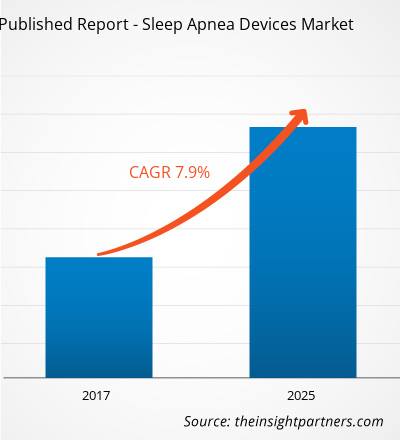
The Published Report - Sleep Apnea Devices Market is growing rapidly, driven by increasing end-user demand due to factors such as evolving consumer preferences, technological advancements, and greater awareness of the product's benefits. As demand rises, businesses are expanding their offerings, innovating to meet consumer needs, and capitalizing on emerging trends, which further fuels market growth.
Covid-19 Impact:
The effect of the COVID-19 pandemic was largely seen in the sleep apnea devices industry. Most of the patients faced serious problems with PAP devices, and half of their daily activities were affected during the COVID-19 pandemic. The COVID-19 pandemic created serious problems in terms of public health and disrupted health services in many areas across the globe. The follow-up and treatment services for many patients with chronic diseases, as for OSAS, were interrupted during the lockdown period, which obligated the patients to handle their medical condition independently. In a study evaluating the impact of the COVID-19 pandemic in Europe, laboratory-based polysomnography was performed in 92.5% of the centers in the pre-pandemic period, it continued to be performed at only 20% of the centers during the pandemic, and even the rate of telemedicine-based sleep apnea diagnoses in these centers was reported to decrease from that 30% in the pre-pandemic period to 27.5% during the pandemic. Thus, this led to a negative impact on the sleep apnea devices market. However, CPAP was successful at raising oxygen levels among people who were hospitalized with COVID-19. CPAP was also used as a non-invasive treatment for respiratory failure in COVID-19 patients. Thus, the increase in the use of PAP devices reduced the negative impact of the pandemic on the sleep apnea devices market.
Nevertheless, post-coronavirus vaccination programs, there was a quick recovery from the COVID-19 pandemic, likely favoring the sleep apnea devices market's growth.
Competitive Landscape and Key Companies:
Some of the prominent players operating in the global sleep apnea devices market include ResMed, Koninklijke Philips N.V., Fisher & Paykel, Braebon Medical Corporation, Compumedics Limited, BMC Medical Co., Ltd., Fisher & Paykel Healthcare Limited., SomnoMed Limited, Weinmann Emergency Medical Technology GmbH + CO. KG, Devilbiss Healthcare LLC among others. These companies focus on new product launches and geographical expansions to meet the growing consumer demand worldwide and increase their product range in specialty portfolios. They have a widespread global presence, allowing them to serve a large set of customers and subsequently increase their market share.
Frequently Asked Questions

- Comprehensive Market Sizing and Forecast Analysis
- Detailed Segmentation Analysis
- In-Depth Market Dynamics Assessment
- Regional and Country-Level Insights
- Competitive Landscape and Company Benchmarking
- Strategic Business Intelligence
Recent Reports
Testimonials

The Insight Partners' SCADA System Market report is comprehensive, with valuable insights on current trends and future forecasts. The team was highly professional, responsive, and supportive throughout. We are very satisfied and highly recommend their services.
RAN KEDEM Partner, Reali Technologies LTDs
I requested a report on a very specific software market and the team produced the report in a few days. The information was very relevant and well presented. I then requested some changes and additions to the report. The team was again very responsive and I got the final report in less than a week.
JEAN-HERVE JENN Chairman, Future Analytica
We worked with The Insight Partners for an important market study and forecast. They gave us clear insights into opportunities and risks, which helped shape our plans. Their research was easy to use and based on solid data. It helped us make smart, confident decisions. We highly recommend them.
PIYUSH NAGPAL Sr. Vice President, High Beam Global
The Insight Partners delivered insightful, well-structured market research with strong domain expertise. Their team was professional and responsive throughout. The user-friendly website made accessing industry reports seamless. We highly recommend them for reliable, high-quality research services
YUKIHIKO ADACHI CEO, Deep Blue, LLC.
This is the first time I have purchased a market report from The Insight Partners.While I was unsure at first, I visited their web site and felt more comfortable to take the risk and purchase a market report.I am completely satisfied with the quality of the report and customer service. I had several questions and comments with the initial report, but after a couple of dialogs over email with their analyst I believe I have a report that I can use as input to our strategic planning process.Thank you so much for taking the extra time and making this a positive experience.I will definitely recommend your service to others and you will be my first call when we need further market data.
JOHN SUZUKI President and Chief Executive Officer, Board Director, BK Technologies
I wish to appreciate your support and the professionalism you displayed in the course of attending to my request for information regarding to infectious disease IVD market in Nigeria. I appreciate your patience, your guidance, and the fact that you were willing to offer a discount, which eventually made it possible for us to close a deal. I look forward to engaging The Insight Partners in the future, all thanks to the impression you have created in me as a result of this first encounter.
DR CHIJIOKE ONYIA MANAGING DIRECTOR, PineCrest Healthcare Ltd.Reason to Buy
- Informed Decision-Making
- Understanding Market Dynamics
- Competitive Analysis
- Identifying Emerging Markets
- Customer Insights
- Market Forecasts
- Risk Mitigation
- Boosting Operational Efficiency
- Strategic Planning
- Investment Justification
- Tracking Industry Innovations
- Aligning with Regulatory Trends





 Get Free Sample for