
Forced Oscillometry Market Demand, Trends & Forecast by 2034
Coverage: By Product (Device and Accessories), Application (Asthma, COPD, and Other Applications), End User (Hospitals and Clinics, Diagnostic Laboratories, and Other End users), and Geography (North America, Europe, Asia Pacific, Middle East and Africa, and South and Central America)
- Status : Published
- Report Code : TIPRE00042702
- Category : Life Sciences
- No. of Pages : 250
- Available Report Formats :


- Last update date : April 07, 2026


2025 Market Size
US$ 62.07 Mn
Base year value
2034 Forecast
US$ 98.60 Mn
Projected by 2034
CAGR 2026-2034
5.4 %
Growth rate
Addressable Market
US$ 733.37 Mn
(2026-2034)
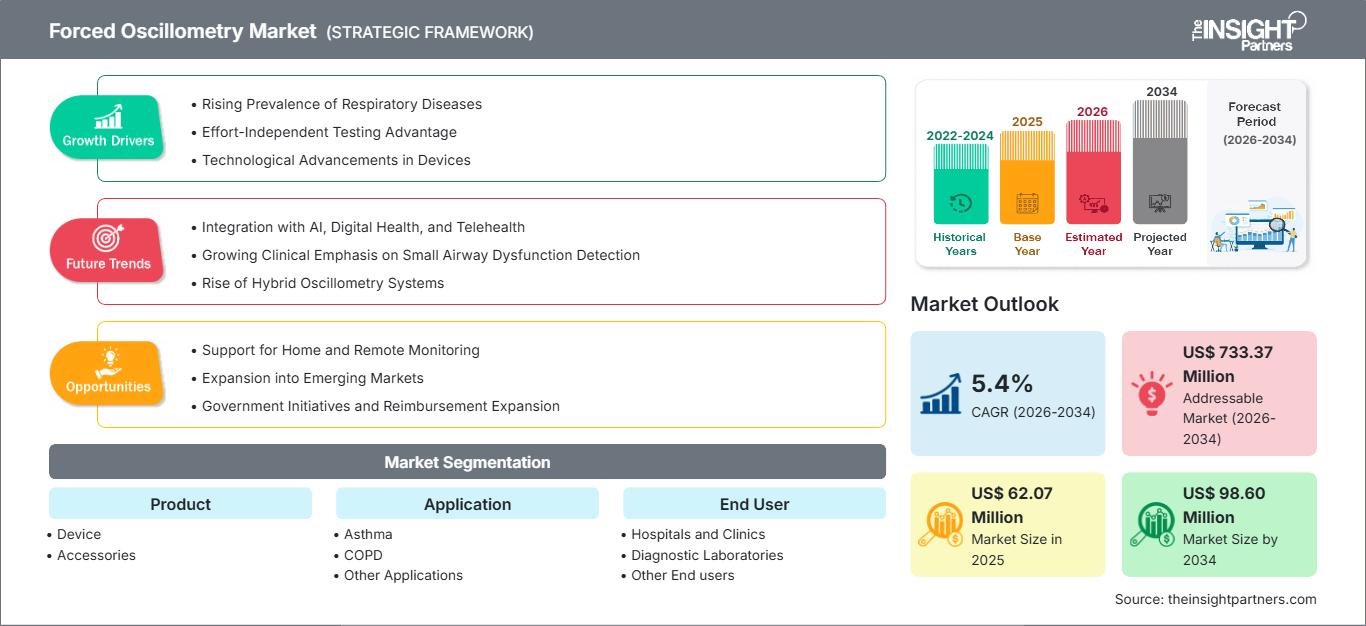
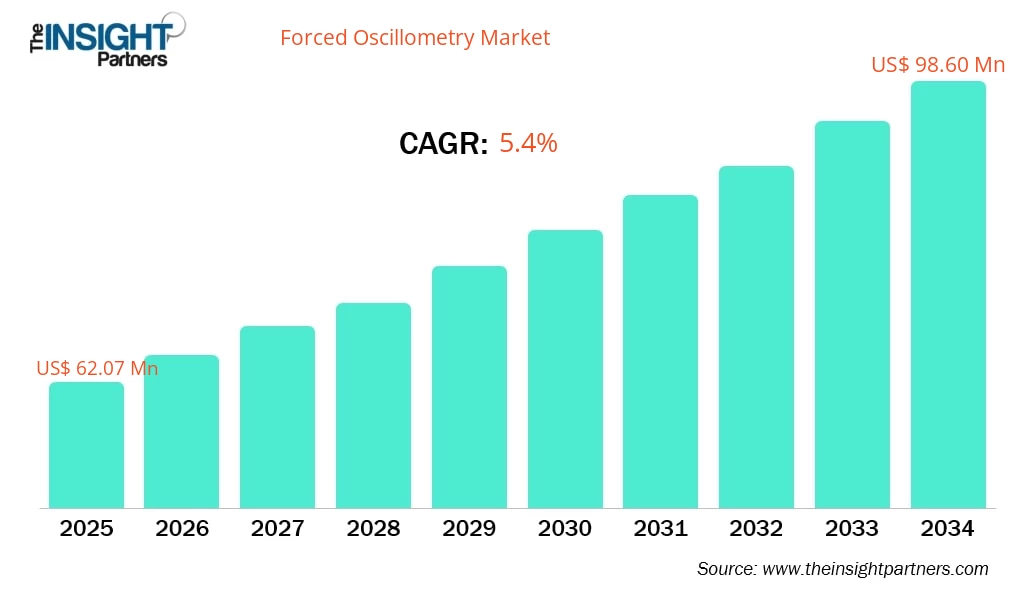
The forced oscillometry market size is projected to reach US$ 98.60 million by 2034 from US$ 62.07 million in 2025. The market is expected to register a CAGR of 5.4% during 2026–2034
Forced Oscillometry Market Analysis
The forced oscillometry market is experiencing robust growth due to the rising prevalence of respiratory conditions that require sensitive, noninvasive lung function assessments, increasing clinical adoption in pediatric and elderly care due to ease of use, and technological improvements in portable diagnostics, enhancing routine respiratory monitoring and small airway dysfunction detection across healthcare settings.
Forced Oscillometry Market Overview
The global forced oscillometry market reflects expanding applications in respiratory diagnostics as healthcare providers seek tools that assess airway mechanics without effort‑dependent maneuvers. The market has expanded owing to the increasing number of aging people who develop chronic lung diseases, the regulatory framework that supports early airway abnormality detection, and the implementation of advanced oscillometry systems in medical facilities, which include hospitals and specialized clinics. The growing awareness of small airway disease and improvements in device accuracy and patient comfort are enhancing clinical acceptance. Emerging markets are adopting oscillometry technology as part of comprehensive pulmonary function testing strategies to improve diagnostic outcomes.
Market Assessment and Insights
- North America dominated the market with 53.9% share in 2025.
- Asia Pacific is poised to grow at a CAGR of 5.9% over the forecast period.
- United States market is projected to grow at a CAGR of 5.4% over the forecast period.
- By Product, the Device segment accounted for the largest market share of 69.3% in 2025.
- By Device For Product, the Portable segment is anticipated to witness the fastest growth, registering a CAGR of 4.7% over the forecast period
- By Accessories For Product, the Filters segment accounted for the largest market share of 46% in 2025.
- By Application, the Asthma segment is anticipated to witness the fastest growth, registering a CAGR of 5.7% over the forecast period
- By End User, the Hospitals and Clinics segment accounted for the largest market share of 57% in 2025.
- The report profiles key industry players such as COSMED Srl, Chest MI Inc, Morgan Scientific Inc, THORASYS Thoracic Medical Systems Inc., Jaeger Medical GmbH, IngMar Medical, GANSHORN Medizin Electronic GmbH, Lothar Medical GmbH, Cognita Labs, LLC, RESTECH srl, while also analyzing key developments in novel ideas, disruptive products, and innovative services that could reshape the future market and reveal emerging themes across the industry.
Source: The Insight Partners' analysis based on proprietary research, government publications, company annual reports, investor presentations, industry databases, and expert interviews.
● REPORT CUSTOMIZATION
Tailor This Report To Align With Your Specific Business Requirements
This report can be customized to align precisely with your business objectives, scope, and target markets. Customization options include tailored segmentation, geography, competitive analysis, and strategic insights to support informed decision-making.
Customize This Report →WHAT YOU CAN ADJUST
- ● Segmentations
- ● Geography
- ● Competitive Analysis
- ● Language Preferences
Forced Oscillometry Market: Strategic Insights
-
Get Top Key Market Trends of this report.This FREE sample will include data analysis, ranging from market trends to estimates and forecasts.
Forced Oscillometry Market Drivers and Opportunities
Market Drivers:
- Increasing Prevalence of Respiratory Diseases: The increasing global incidence of asthma, chronic obstructive pulmonary disease (COPD), and other airway disorders drives demand for accurate, noninvasive pulmonary function testing solutions such as forced oscillometry systems.
- Effort-Independent Testing Advantage: Forced oscillometry allows accurate lung function assessment without requiring patient effort, improving compliance among children, the elderly, and severely ill patients, driving clinical adoption.
- Technological Advancements in Devices: Innovations in portable, user-friendly, and precise oscillometry devices enhance diagnostic efficiency and expand applications across hospitals, clinics, and research settings.
Market Opportunities:
- Support for Home and Remote Monitoring: Growing demand for telemedicine and remote respiratory care creates opportunities for integrating oscillometry devices in home-based patient monitoring programs.
- Expansion in Emerging Markets: Improving healthcare infrastructure, rising healthcare expenditure, and increasing focus on early disease diagnosis in developing countries present strong growth opportunities for forced oscillometry manufacturers.
- Government Initiatives and Reimbursement Expansion: Increasing public health programs and insurance reimbursement support for pulmonary diagnostics encourage the adoption of forced oscillometry worldwide.
Forced Oscillometry Market Report Segmentation Analysis
The forced oscillometry market is segmented into distinct categories to provide a clearer understanding of its operations, growth potential, and current trends. Below is the standard segmentation approach used in industry reports:
By Product:
- Device: This device segment includes fundamental hardware elements which users directly operate through devices like laptops and tablets and smartphones and wearable technology. The category establishes the main user interaction points while it determines the brand's capacity to develop technologies and its design and performance specifications. Consumers rely on their devices because these products create significant value and establish market standards for product development. Consumers base their device selection on product characteristics and product dependability and brand trust and customer satisfaction with the product. The device segment serves as the primary functional point which links software applications and accessories with the surrounding ecosystem while driving market expansion and building customer loyalty. The device segment is growing due to rising demand for accurate, noninvasive lung function testing, technological innovations, and adoption in hospitals, clinics, and research for respiratory assessment.
- Accessories: The accessories segment includes supplementary products which protect and enhance and personalize the main device through products like chargers and cases and headphones and styluses and smartwatches. This segment often has lower price points but higher volume potential which provides brands with additional revenue streams through incremental sales. Accessories provide users with better experiences because they deliver both practical benefits and fashionable elements which users cannot obtain from their base devices. The products allow customers to create personalized experiences which match their individual needs and daily routines. The accessories market maintains constant changes which result from shifting trends and current fashion styles and advancements in technology because it serves as essential support for the main device operations which enhance customer brand loyalty and adoption of the entire product ecosystem. The accessories segment is expanding as consumables like mouthpieces, filters, and calibration tools are essential for device accuracy, hygiene, and routine maintenance, driving recurring purchases and supporting widespread clinical use.
By Application:
- Asthma
- COPD
- Other Applications
By End User:
- Hospitals and Clinics
- Diagnostic Laboratories
- Other End users
By Geography:
- North America
- Europe
- Asia Pacific
- South and Central America
- Middle East and Africa
Forced Oscillometry Market Report Scope
| Report Attribute | Details |
|---|---|
| Market size in 2025 | US$ 62.07 Million |
| Market Size by 2034 | US$ 98.60 Million |
| Global CAGR (2026 - 2034) | 5.4% |
| Historical Data | 2021-2024 |
| Forecast period | 2026-2034 |
| Segments Covered |
By Product
|
| Regions and Countries Covered |
North America
|
| Market leaders and key company profiles |
|
Forced Oscillometry Market Players Density: Understanding Its Impact on Business Dynamics
The Forced Oscillometry Market is growing rapidly, driven by increasing end-user demand due to factors such as evolving consumer preferences, technological advancements, and greater awareness of the product's benefits. As demand rises, businesses are expanding their offerings, innovating to meet consumer needs, and capitalizing on emerging trends, which further fuels market growth.
Forced Oscillometry Market Share Analysis by Geography
The market is expected to grow at the fastest rate in Asia Pacific over the coming years. Emerging markets in South America, the Middle East, and Africa have untapped opportunities for forced oscillometry providers to expand.
The growth of the forced oscillometry market varies across regions due to rising respiratory disease burden, expanding healthcare infrastructure, increasing diagnostic awareness, and improving access to advanced pulmonary testing technologies. Below is a summary of market share and trends by region:
1. North America
- Market Share: Holds a significant portion of the global market
- Key Drivers: Growth is driven by advanced healthcare infrastructure, high respiratory disease prevalence, strong reimbursement frameworks, and rapid adoption of innovative pulmonary diagnostic technologies.
- Trends: Integration of AI-driven diagnostics and tele-pulmonology solutions to improve remote respiratory monitoring and enhance patient outcomes across clinical and home-care settings.
2. Europe
- Market Share: Substantial market share
- Key Drivers: Market expansion supported by a growing aging population, government-backed healthcare systems, rising respiratory research initiatives, and widespread clinical adoption of noninvasive diagnostic solutions.
- Trends: Shift toward personalized respiratory care with standardized forced oscillometry protocols and cross-country collaborations to support early diagnosis in chronic lung disease management.
3. Asia Pacific
- Market Share: Fastest-growing region with an annually increasing market share
- Key Drivers: Rising pollution-related respiratory conditions, expanding healthcare investments, growing awareness of early diagnosis, and improving access to advanced diagnostic devices fuel regional growth.
- Trends: Growing adoption of affordable, portable devices in community healthcare, and increased local manufacturing to meet rising demand in the region.
4. South and Central America
- Market Share: Steadily growing market share
- Key Drivers: Growth attributed to improving healthcare facilities, increasing respiratory disease cases, expanding public health programs, and the gradual adoption of modern pulmonary diagnostic equipment.
- Trends: Public–private partnerships and mobile health diagnostic programs facilitate wider deployment of pulmonary function testing in underserved regions.
5. Middle East and Africa
- Market Share: Small market share, growing at a rapid pace
- Key Drivers: Market growth supported by rising healthcare expenditure, growing burden of chronic respiratory diseases, infrastructure development, and increasing focus on early disease detection.
- Trends: Investment in digital health initiatives and training programs to strengthen respiratory diagnostics, combined with expanding screening campaigns for chronic airway diseases.
High Market Density and Competition
Competition is strong due to the presence of established players such as THORASYS Thoracic Medical Systems Inc., and Chest MI Inc. Regional and niche providers add to the competitive landscape across regions.
The high level of competition urges companies to stand out by offering:
- Advanced products and services
- Compliance with regulatory guidelines
Opportunities and Strategic Moves
- Rising adoption of remote respiratory monitoring and telehealth solutions presents growth potential for forced oscillometry applications globally.
- Companies are investing in advanced device innovation, partnerships, and market expansion to enhance accessibility and clinical adoption worldwide.
Other companies analyzed during the course of research:
- Chest MI Inc
- THORASYS Thoracic Medical Systems Inc.
- GANSHORN Medizin Electronic GmbH
- Morgan Scientific Inc
- Lothar Medical GmbH
- Cognita Labs, LLC
- COSMED Srl
- RESTECH srl
- Vitalograph Ltd.
Forced Oscillometry Market News and Recent Developments
- In May 2025, Vitalograph and Thorasys Forge entered into a strategic partnership to expand respiratory diagnostics with the launch of the Tremoflo C2 oscillometer. The partnership marks the official launch of the tremoflo C2 portable oscillometer in the US, broadening access to Airwave Oscillometry System (AOS) technology for diverse patient groups.
- In September 2024, Vitalograph announced the acquisition of Massachusetts-based Morgan Scientific, a long-term partner of the respiratory diagnostics leader, strengthening its US commercial footprint and enabling it to meet the growing global demand for its innovative solutions, particularly in advanced pulmonary function testing solutions.
Forced Oscillometry Market Report Coverage and Deliverables
The "Forced Oscillometry Market Size and Forecast (2026–2034)" report provides a detailed analysis of the market covering below areas:
- Forced oscillometry market size and forecast at global, regional, and country levels for all the key market segments covered under the scope
- Forced oscillometry market trends, as well as market dynamics such as drivers, restraints, and opportunities
- Detailed PEST and SWOT analysis
- Forced oscillometry market analysis covering key trends, global and regional framework, major players, regulations, and recent market developments
- Industry landscape and competition analysis covering market concentration, heat map analysis, prominent players, and recent developments for the forced oscillometry market
- Detailed company profiles
Frequently Asked Questions

- Comprehensive Market Sizing and Forecast Analysis
- Detailed Segmentation Analysis
- In-Depth Market Dynamics Assessment
- Regional and Country-Level Insights
- Competitive Landscape and Company Benchmarking
- Strategic Business Intelligence
Recent Reports
Testimonials

The Insight Partners provided valuable market intelligence that supported our global go-to-market strategy. Their team was professional, responsive, and attentive to our feedback, providing thoughtful analysis and helpful methodological clarifications throughout the project.
Junmo Kim Chief Financial Officer (CFO), Enertech Co., Ltd.
The Insight Partners' SCADA System Market report is comprehensive, with valuable insights on current trends and future forecasts. The team was highly professional, responsive, and supportive throughout. We are very satisfied and highly recommend their services.
RAN KEDEM Partner, Reali Technologies LTDs
I requested a report on a very specific software market and the team produced the report in a few days. The information was very relevant and well presented. I then requested some changes and additions to the report. The team was again very responsive and I got the final report in less than a week.
JEAN-HERVE JENN Chairman, Future Analytica
We worked with The Insight Partners for an important market study and forecast. They gave us clear insights into opportunities and risks, which helped shape our plans. Their research was easy to use and based on solid data. It helped us make smart, confident decisions. We highly recommend them.
PIYUSH NAGPAL Sr. Vice President, High Beam Global
The Insight Partners delivered insightful, well-structured market research with strong domain expertise. Their team was professional and responsive throughout. The user-friendly website made accessing industry reports seamless. We highly recommend them for reliable, high-quality research services
YUKIHIKO ADACHI CEO, Deep Blue, LLC.
This is the first time I have purchased a market report from The Insight Partners.While I was unsure at first, I visited their web site and felt more comfortable to take the risk and purchase a market report.I am completely satisfied with the quality of the report and customer service. I had several questions and comments with the initial report, but after a couple of dialogs over email with their analyst I believe I have a report that I can use as input to our strategic planning process.Thank you so much for taking the extra time and making this a positive experience.I will definitely recommend your service to others and you will be my first call when we need further market data.
JOHN SUZUKI President and Chief Executive Officer, Board Director, BK Technologies
I wish to appreciate your support and the professionalism you displayed in the course of attending to my request for information regarding to infectious disease IVD market in Nigeria. I appreciate your patience, your guidance, and the fact that you were willing to offer a discount, which eventually made it possible for us to close a deal. I look forward to engaging The Insight Partners in the future, all thanks to the impression you have created in me as a result of this first encounter.
DR CHIJIOKE ONYIA MANAGING DIRECTOR, PineCrest Healthcare Ltd.Reason to Buy
- Informed Decision-Making
- Understanding Market Dynamics
- Competitive Analysis
- Identifying Emerging Markets
- Customer Insights
- Market Forecasts
- Risk Mitigation
- Boosting Operational Efficiency
- Strategic Planning
- Investment Justification
- Tracking Industry Innovations
- Aligning with Regulatory Trends





 Get Free Sample for