
Cancer Biopsies Market Growth, Demand & Size by 2034
Cancer Biopsies Market Size and Forecasts (2021–2034), Global and Regional Share, Trends, and Growth Opportunity Analysis Report Coverage : by Product (Instrument, Kits and Consumables, Services); Type (Tissue Biopsy, Surgical Biopsy, Liquid Biopsy, Other Types); Application (Breast Cancer, Colorectal Cancer, Cervical Cancers, Lung Cancers, Other Applications); End User (Hospitals, Diagnostics Laboratories, Other End Users); and Geography (North America, Europe, Asia Pacific, and South and Central America)
- Status : Data Released
- Report Code : TIPRE00040619
- Category : Life Sciences
- No. of Pages : 150
- Available Report Formats :


- Last update date : August 12, 2026


2025 Market Size
US$ 32.68 Bn
Base year value
2034 Forecast
US$ 66.41 Bn
Projected by 2034
CAGR 2026-2034
9.27 %
Growth rate
Addressable Market
US$ 470.27 Bn
(2026-2034)
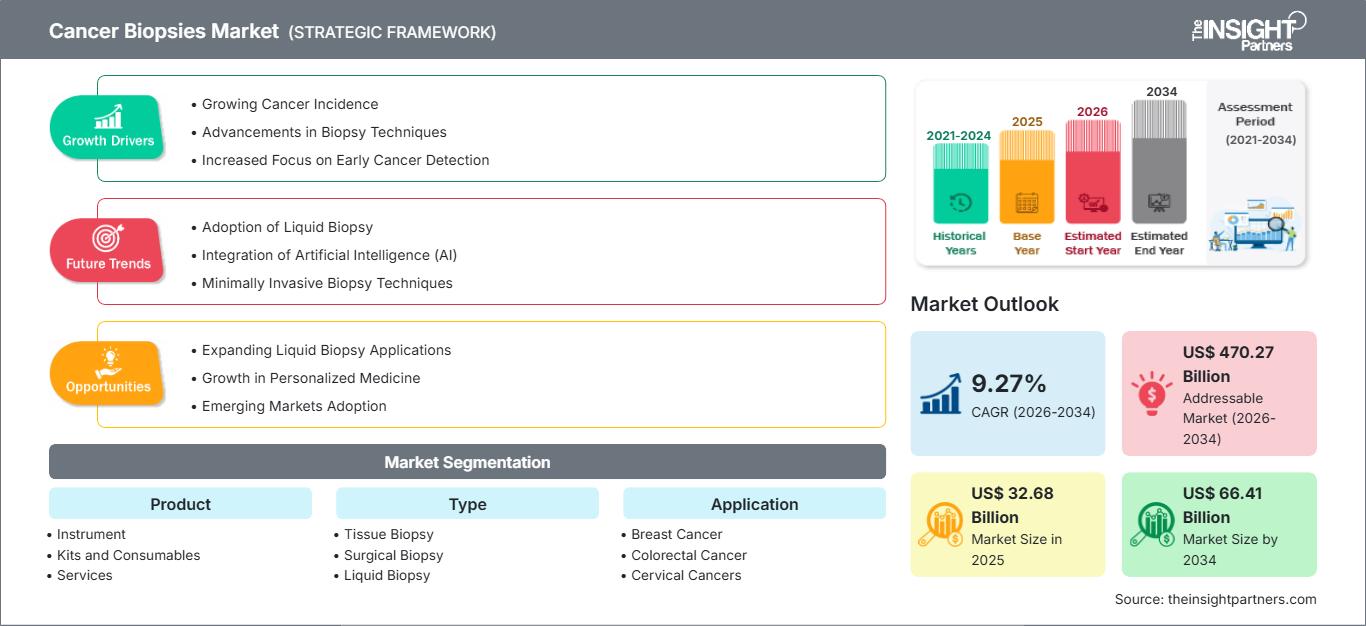
The Cancer Biopsies Market is projected to grow from US$ 32.68 Billion in 2025 to US$ 66.41 Billion by 2034, registering a CAGR of 9.27% during 2026–2034. Factors affecting the market include rising cancer prevalence, expanded molecular profiling and a change in the diagnostic approach from only morphological examination to choosing treatment options based on biomarkers.
The Cancer Biopsies Market size of North America is driven by a high level of testing intensity in oncology, efficient reimbursement procedures, and broad acceptance of genomic profiling tests. The growth rate of the region will be in the range of 8.6% to 9.4%, according to the forecast from 2026 to 2034.
Cancer Biopsies Market Assessment and Insights
- North America held 42–45% share in 2025 and is projected to grow at a CAGR of 8.6–9.4% during 2026–2034, supported by biomarker testing, reference laboratory scale, and payer-backed oncology diagnostics.
- US accounted for 83–86% of North America in 2025 and is expected to expand at a CAGR of 8.5–9.3% during 2026–2034, led by decentralized NGS testing.
- Europe represented 25–28% share in 2025 and is forecast to grow at a CAGR of 8.0–8.8% during 2026–2034, led by Germany, the UK, France, Italy, and Spain.
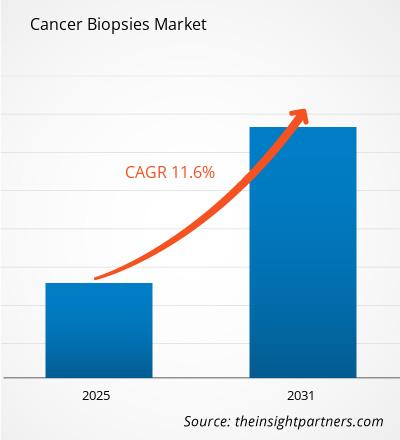
- Asia Pacific captured 20–23% share in 2025 and is projected to grow at a CAGR of 10.8–11.6% during 2026–2034, with China, Japan, India, South Korea, and Australia driving adoption.
- Largest Segment Kits and Consumables held 46–50% market share in 2025 and is forecast to grow at a CAGR of 9.0–9.8% during 2026–2034, reflecting repeat-use demand.
- High Growth Segment Liquid Biopsy accounted for 18–22% market share in 2025 and is projected to grow at a CAGR of 13.2–14.4% during 2026–2034, driven by ctDNA profiling.
- Key companies analyzed in detail: F. Hoffmann-La Roche Ltd, Thermo Fisher Scientific Inc., Hologic, Inc., Siemens Healthineers AG, Becton, Dickinson and Company, Medtronic plc, Johnson & Johnson Services, Inc., GE HealthCare Technologies Inc., Exact Sciences Corporation, Agilent Technologies, Inc., Illumina, Inc., Laboratory Corporation of America Holdings.
Source: The Insight Partners' analysis based on proprietary research, government publications, company annual reports, investor presentations, industry databases, and expert interviews.
The Cancer Biopsies Market will change from the current process-based biopsy sampling to one that includes imaging, tissue processing, molecule isolation, sequencing, and analysis all in one process. Although tissue biopsy continues to be an important component of the Cancer Biopsies, liquid biopsy is poised to transform the dynamics of the production process by creating greater need for stabilized sample tubes, circulating tumor DNA tests, and sequencing tests.
Emerging geographies will be strategically important in the future of Cancer Biopsies as more countries implement screening programs and improve their oncology infrastructure. Acceptance of companion diagnostics, national programs for precision medicine, and development of molecular pathology within hospitals will facilitate greater accessibility. Localized testing will be helpful for Cancer Biopsies in speeding up the process of matching the therapy.
Cancer Biopsies Market Report Scope
| Report Attribute | Details |
|---|---|
| Market size in 2025 | US$ 32.68 Billion |
| Market Size by 2034 | US$ 66.41 Billion |
| Global CAGR (2026 - 2034) | 9.27% |
| Historical Data | 2021-2024 |
| Forecast period | 2026-2034 |
Cancer Biopsies Market Analysis
The growth of the Cancer Biopsies Market can be attributed to the growing clinical necessity for verification of the diagnosis, categorization of tumor type, and identification of actionable mutations prior to treatment selection. The global surveillance of cancer carried out by WHO keeps indicating cancer to be one of the major health burdens with an increasing prevalence rate owing to aging population and associated risk factors.
In terms of the value chain of the market, hospitals contribute in creating the volume of procedures performed, laboratories in increasing histological and molecular testing volumes, and manufacturers in manufacturing of instrumentation, kits, probes, reagents, and software used. Increasing advantage is now observed on the side of vendors providing complete workflow solutions from collection to analysis of genomics.
Competitiveness analysis in Cancer Biopsies Market Report is centered on four core parameters: technology depth, clinical data, instrument footprint, and payer acceptance. Competing on the bases of pathology, sequencing, and companion diagnostics platforms are companies F. Hoffmann-La Roche Ltd and Thermo Fisher Scientific Inc., while Illumina, Inc., Agilent Technologies, Inc., and Laboratory Corporation of America Holdings use next generation sequencing and reference testing platforms.
Acquisitions and collaborations are bringing in a new aspect of strategic positioning. The acquisition agreement of Abbott with Exact Sciences Corporation emphasized the importance of cancer screening, precision oncology, and molecular residual disease testing, whereas Illumina, Inc. and Laboratory Corporation of America Holdings enhanced their collaboration in distributed tissue and liquid biopsy testing.
● REPORT CUSTOMIZATION
Tailor This Report To Align With Your Specific Business Requirements
This report can be customized to align precisely with your business objectives, scope, and target markets. Customization options include tailored segmentation, geography, competitive analysis, and strategic insights to support informed decision-making.
Customize This Report →WHAT YOU CAN ADJUST
- ● Segmentations
- ● Geography
- ● Competitive Analysis
- ● Language Preferences
Cancer Biopsies Market: Strategic Insights
Regional Insights
North America Cancer Biopsies Market
North America contributed 42-45% of the Cancer Biopsies Market share in 2025 and is expected to witness a CAGR of 8.6-9.4% between 2026-2034 due to high testing frequency, high utilization of companions diagnostics, and robust reference lab infrastructure. The United States is the anchor market, whereas Canada's contribution comes in the form of oncology programs.
The factors related to the structure include the provision of molecular testing, comprehensive genomic profiling, and tissue stewardship within hospitals. North America is also benefited from the presence of firms in the field of pathology, imaging, genomics, and laboratory services, like Roche, Thermo Fisher Scientific, Hologic, GE HealthCare, Illumina, and LabCorp.
U.S. Cancer Biopsies Market
The U.S. represented 83–86% of North America in 2025 and is expected to grow at a CAGR of 8.5–9.3% during 2026–2034. High cancer diagnosis volumes, broad oncology trial activity, and accelerated adoption of actionable biomarker testing make the country the largest national contributor to regional demand.
Trends in application are very strong in lung cancer, breast cancer, colorectal cancer, and hematology cancers, whereby tissue adequacy and molecular verification aid in determining the treatment regimen. The companies that provide support to this environment include Siemens Healthineers AG, Becton, Dickinson and Company, Medtronic plc, Johnson & Johnson Services, Inc., GE HealthCare Technologies Inc., and Exact Sciences Corporation.
Europe Cancer Biopsies Market
The share of Europe was 25-28% in 2025, and its growth rate is forecasted to be 8.0-8.8% during 2026-2034. Germany leads among European countries because of pathology infrastructure, cancer centers and the use of molecular diagnostics. The United Kingdom is driven by initiatives in genomic medicine and centralized referral for advanced biopsy procedures.
France, Italy, and Spain are making progress owing to their cancer strategies, increased screening and availability of next-generation sequencing in leading oncology institutions. The market for Cancer Biopsies in Europe is also influenced by CE marking of biopsy instruments, price negotiation, and introduction of digital pathology solutions.
APAC Cancer Biopsies Market
Share of APAC stood at 20-23% in 2025 and is projected to have a CAGR of 10.8-11.6% in the period 2026-2034. Demand is spearheaded by China, and supplemented by Japan, South Korea, India, and Australia due to cancer screening, private diagnostics, and precision oncology.
Factors supporting oncology infrastructure from policies, development of hospital chains, and sequencing capacity at a local level are improving the availability of tissue and liquid biopsies. Industrial factors that affect the market dynamics include localization of reagents, less expensive tests, and cooperation between international and local diagnostics companies.
Middle East & Africa Cancer Biopsies Market
Middle East & Africa is expected to exhibit a CAGR of 7.5%–8.3% from 2026–2034, with Saudi Arabia leading the pack, followed by the UAE, South Africa, and Rest of MEA. Oncology centers and modern diagnostics drive selective growth in this segment.
Financial stability provided by income from energy sources in the Gulf countries makes the funding for hospitals’ infrastructure, imaging systems, and molecular laboratories possible. Pathology is more developed in South Africa than in other countries due to the lack of reimbursement, staffing, and sample transportation problems.
Segmentation Analysis
Product
Product is projected to grow at a CAGR of 8.8–9.6% during 2026–2034. The Cancer Biopsies Market scope across products is shaped by recurring consumable use, replacement demand for biopsy instruments, and outsourcing of testing services. Laboratories increasingly prefer bundled workflows that reduce sample loss, support molecular integrity, and standardize turnaround times.
- Instrument demand is supported by biopsy guidance systems, automated tissue processors, molecular analyzers, sequencers, and imaging-enabled platforms that improve procedural accuracy and laboratory throughput.
- Kits and Consumables remain the largest revenue contributor because every diagnostic pathway requires collection devices, reagents, stains, probes, cartridges, extraction kits, and sequencing consumables.
- Services are expanding as hospitals outsource complex genomic interpretation, companion diagnostic validation, digital pathology reads, and specialized oncology testing to reference laboratories.
Type
Type is projected to grow at a CAGR of 9.2–10.1% during 2026–2034. Tissue biopsy continues to define diagnostic confirmation, while liquid biopsy adds noninvasive monitoring and mutation detection when tissue is unavailable or insufficient. The balance between invasiveness, sensitivity, cost, and clinical actionability determines adoption across tumor types.
- Tissue Biopsy remains the diagnostic reference standard because it supports histology, immunohistochemistry, tumor grading, staging, and downstream molecular testing.
- Surgical Biopsy is used where lesion location, sample volume, or prior inconclusive results require larger tissue access for definitive diagnosis and treatment planning.
- Liquid Biopsy is gaining strategic relevance for circulating tumor DNA detection, treatment monitoring, relapse assessment, and access in patients unsuitable for invasive procedures.
Application
Application is projected to grow at a CAGR of 8.9–9.7% during 2026–2034. Demand is strongest where screening programs, biomarker-driven therapies, and recurrence monitoring influence clinical decisions. Breast, lung, and colorectal cancers account for major testing intensity, while cervical and other malignancies add procedure volume in screening-led pathways.
- Breast Cancer generates sustained biopsy demand through imaging abnormalities, receptor testing, lymph node evaluation, recurrence assessment, and genomic assays guiding treatment intensity.
- Colorectal Cancer relies on biopsy for diagnostic confirmation, molecular stratification, microsatellite instability testing, recurrence monitoring, and therapy selection.
- Cervical Cancers support demand through colposcopy-directed sampling, histopathology confirmation, and follow-up testing linked to screening and vaccination programs.
- Lung Cancers drive high molecular testing needs because small tissue samples must support diagnosis, staging, PD-L1 testing, and actionable mutation profiling.
End User
End User is projected to grow at a CAGR of 8.5–9.3% during 2026–2034. Hospitals lead procedure volumes, while diagnostic laboratories capture specialized testing and reporting. Other end users support trial recruitment, ambulatory biopsy workflows, and decentralized sampling, particularly where oncology networks are extending care beyond tertiary centers.
- Hospitals dominate biopsy collection because they integrate imaging, surgical access, pathology review, oncology consultation, and immediate treatment planning.
- Diagnostics Laboratories are strategically important for molecular testing scale, reference pathology, companion diagnostic validation, and high-complexity genomic interpretation.
- Other End Users include ambulatory surgery centers, academic research units, and oncology clinics that support sampling, trial workflows, and follow-up monitoring.
Opportunity Snapshot
| Application | Revenue Contribution | Trend Tag | Adoption Stage |
| Breast Cancer | High | Receptor Testing | Mature |
| Colorectal Cancer | High | MSI Profiling | Scaling |
| Cervical Cancers | Medium | Colposcopy Sampling | Scaling |
| Lung Cancers | High | Mutation Profiling | Mature |
| Other Applications | Medium | Tumor Mapping | Emerging |
Cancer Biopsies Market Growth Drivers and Impact Analysis
Biomarker-Led Therapy Selection Increasing Sample Value
Biomarker-led oncology is increasing the commercial and clinical value of every biopsy. A single cancer sample now supports histology, immunohistochemistry, genomic profiling, companion diagnostic eligibility, and clinical trial matching. This raises demand for higher-quality tissue capture, validated preservation kits, and workflows that conserve scarce specimens. The impact is particularly visible in lung cancer, where small biopsy samples must often support multiple tests. As targeted therapies expand across tumor types, laboratories are prioritizing platforms that minimize repeat sampling and reduce failure rates. This driver strengthens demand for kits, consumables, molecular assays, and integrated software because biopsy decisions increasingly affect both first-line therapy and later treatment sequencing.
Decentralized Testing Models Reducing Turnaround Constraints
Decentralized testing is becoming a practical growth driver as hospitals seek faster biomarker results without always sending samples to distant reference laboratories. Localized tissue and liquid biopsy workflows can shorten turnaround times, improve physician confidence, and reduce sample degradation risks. The impact is strongest in community oncology networks, where delayed molecular results can postpone therapy decisions. Distributed IVD kits also create new commercialization routes for sequencing companies, laboratory networks, and pharmaceutical partners developing companion diagnostics. As health systems invest in regional molecular pathology hubs, vendors with standardized assays, training support, and interoperable reporting tools are better positioned to capture long-term recurring demand.
Rising Cancer Screening Expanding Diagnostic Follow-Up
Expanded cancer screening is increasing downstream biopsy volumes by identifying suspicious lesions earlier and in larger patient populations. Breast, colorectal, cervical, and lung screening pathways create direct demand for confirmatory tissue sampling, imaging-guided procedures, and pathology services. The commercial impact is not limited to diagnosis because positive screening results frequently trigger molecular tests, risk stratification, and recurrence monitoring. Earlier detection also increases demand for minimally invasive procedures that reduce patient burden and support outpatient workflows. As payers and governments emphasize preventable cancer mortality, biopsy suppliers benefit from sustained procedural volume, repeat consumable use, and stronger integration with screening-linked diagnostic algorithms.
Cancer Biopsies Market Future Trends
Liquid Biopsy Moving Toward Longitudinal Cancer Monitoring
Cancer Biopsies Market trends indicate that liquid biopsy will increasingly move from late-stage mutation detection toward longitudinal monitoring across treatment, remission, and recurrence risk assessment. Future protocols are expected to combine ctDNA, methylation, fragmentomics, and molecular residual disease signals for higher clinical confidence. This shift will change purchasing behavior because repeat blood-based testing requires scalable collection, extraction, sequencing, and analytics capacity. Hospitals may use liquid biopsy alongside tissue rather than as a full substitute, especially when resistance mutations emerge. The trend will favor firms that can demonstrate clinical utility, payer value, and reproducible performance across decentralized testing environments.
Digital Pathology and AI Improving Biopsy Interpretation
Digital pathology and AI-enabled image analysis are expected to reshape biopsy interpretation by improving workflow triage, biomarker scoring, tumor quantification, and inter-laboratory consistency. These tools will not eliminate pathologist oversight, but they can reduce variability and support higher case volumes. Adoption will be strongest in large laboratories with whole-slide imaging infrastructure and integrated laboratory information systems. Over time, AI-assisted analysis may also improve tissue selection for sequencing by identifying tumor-rich regions more efficiently. Vendors combining biopsy hardware, pathology staining, image management, and algorithmic decision support will gain strategic relevance as laboratories modernize diagnostic capacity.
Cancer Biopsies Market Opportunities
Community Oncology Access to Advanced Profiling
A major opportunity lies in bringing advanced biopsy testing closer to community oncology patients. Cancer Biopsies Market Forecasts support investment in distributed comprehensive genomic profiling, liquid biopsy access, and regional molecular pathology hubs. Companies can act by developing validated kits, payer evidence packages, and training models for hospitals that lack deep genomic infrastructure. The commercial upside is meaningful because many patients receive cancer care outside major academic centers, yet still require timely biomarker results. Partnerships among sequencing firms, laboratory networks, and health systems can reduce turnaround delays while expanding patient access to targeted therapies and trials.
Integrated Breast and Lung Biopsy Workflows
Breast and lung cancer offer actionable opportunities for workflow integration because both require imaging, sampling, pathology confirmation, and therapy-guiding biomarker analysis. Vendors can capture value by aligning biopsy devices, contrast-enhanced guidance, tissue handling, molecular assays, and digital reporting into coordinated pathways. This approach reduces handoff failures and supports higher diagnostic confidence. In breast cancer, opportunities center on image-guided tissue acquisition and receptor-linked treatment planning. In lung cancer, the opportunity is maximizing actionable information from limited samples. Companies that solve these workflow bottlenecks can strengthen relationships with hospitals, imaging departments, pathology laboratories, and oncology teams.
Recent Developments
- March 2026: Illumina, Inc. and Laboratory Corporation of America Holdings expanded their precision oncology collaboration to develop distributed NGS-based IVD offerings, generate payer evidence, and explore co-commercialization of Labcorp’s FDA-authorized PGDx elio plasma focus Dx with Illumina’s FDA-approved TruSight Oncology Comprehensive for tissue profiling.
- March 2026: Abbott announced that its acquisition of Exact Sciences Corporation was expected to close on March 23, 2026, following regulatory clearances. The transaction added cancer screening, precision oncology, molecular residual disease testing, and multi-cancer early detection capabilities, strengthening Abbott’s diagnostics position.
- February 2025: Hologic, Inc. obtained CE Mark for Affirm Contrast Biopsy Software, enabling clinicians to target and acquire tissue samples using contrast-enhanced mammography. The software supports breast lesion biopsy when correlation is difficult with tomosynthesis or ultrasound and offers an alternative to MRI-guided biopsy.
Frequently Asked Questions

- Comprehensive Market Sizing and Forecast Analysis
- Detailed Segmentation Analysis
- In-Depth Market Dynamics Assessment
- Regional and Country-Level Insights
- Competitive Landscape and Company Benchmarking
- Strategic Business Intelligence
Recent Reports
Testimonials

The Insight Partners' SCADA System Market report is comprehensive, with valuable insights on current trends and future forecasts. The team was highly professional, responsive, and supportive throughout. We are very satisfied and highly recommend their services.
RAN KEDEM Partner, Reali Technologies LTDs
I requested a report on a very specific software market and the team produced the report in a few days. The information was very relevant and well presented. I then requested some changes and additions to the report. The team was again very responsive and I got the final report in less than a week.
JEAN-HERVE JENN Chairman, Future Analytica
We worked with The Insight Partners for an important market study and forecast. They gave us clear insights into opportunities and risks, which helped shape our plans. Their research was easy to use and based on solid data. It helped us make smart, confident decisions. We highly recommend them.
PIYUSH NAGPAL Sr. Vice President, High Beam Global
The Insight Partners delivered insightful, well-structured market research with strong domain expertise. Their team was professional and responsive throughout. The user-friendly website made accessing industry reports seamless. We highly recommend them for reliable, high-quality research services
YUKIHIKO ADACHI CEO, Deep Blue, LLC.
This is the first time I have purchased a market report from The Insight Partners.While I was unsure at first, I visited their web site and felt more comfortable to take the risk and purchase a market report.I am completely satisfied with the quality of the report and customer service. I had several questions and comments with the initial report, but after a couple of dialogs over email with their analyst I believe I have a report that I can use as input to our strategic planning process.Thank you so much for taking the extra time and making this a positive experience.I will definitely recommend your service to others and you will be my first call when we need further market data.
JOHN SUZUKI President and Chief Executive Officer, Board Director, BK Technologies
I wish to appreciate your support and the professionalism you displayed in the course of attending to my request for information regarding to infectious disease IVD market in Nigeria. I appreciate your patience, your guidance, and the fact that you were willing to offer a discount, which eventually made it possible for us to close a deal. I look forward to engaging The Insight Partners in the future, all thanks to the impression you have created in me as a result of this first encounter.
DR CHIJIOKE ONYIA MANAGING DIRECTOR, PineCrest Healthcare Ltd.Reason to Buy
- Informed Decision-Making
- Understanding Market Dynamics
- Competitive Analysis
- Identifying Emerging Markets
- Customer Insights
- Market Forecasts
- Risk Mitigation
- Boosting Operational Efficiency
- Strategic Planning
- Investment Justification
- Tracking Industry Innovations
- Aligning with Regulatory Trends





 Get Free Sample for