
Cognitive Analytics Market Growth, Size & Forecast by 2034
Cognitive Analytics Market Size and Forecasts (2021 - 2034), Global and Regional Share, Trends, and Growth Opportunity Analysis Report Coverage : By Deployment (Cloud, On-premises), Enterprise Type (Large Enterprises, SMEs), Application (Customer Management, Fraud Detection & Security, Supply Chain Management, Sales & Marketing Management, Others), End-user (BFSI, IT & Telecom, Government, Retail, Healthcare, Education, Others); Geography (North America, Europe, Asia-Pacific, Middle East & Africa, South and Central America)
- Status : Data Released
- Report Code : TIPRE00039786
- Category : Technology, Media and Telecommunications
- No. of Pages : 150
- Available Report Formats :


- Last update date : July 30, 2026


2025 Market Size
US$ 5.16 Bn
Base year value
2034 Forecast
US$ 38.53 Bn
Projected by 2034
CAGR 2026-2034
25.03 %
Growth rate
Addressable Market
US$ 166.68 Bn
(2026-2034)
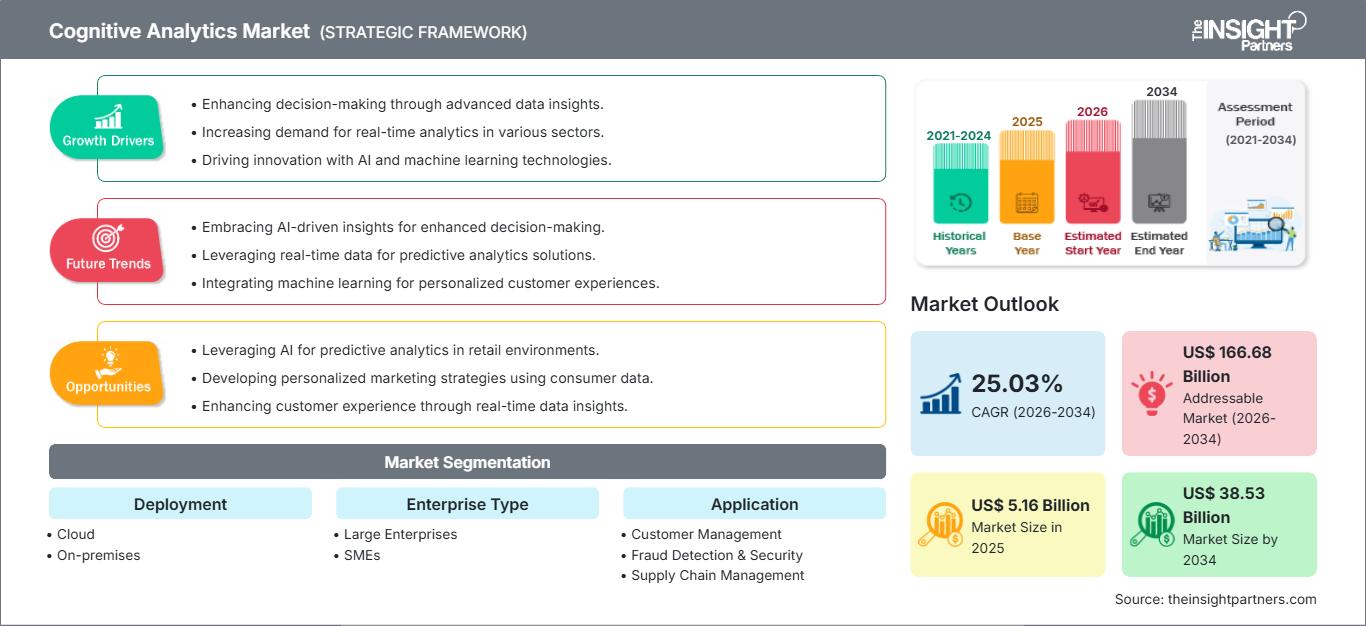
The global cognitive analytics market is undergoing a decisive shift as enterprises move from descriptive dashboards toward systems capable of independent reasoning and recommendation. Valued at US$ 5.16 Billion in 2025, the cognitive analytics market is forecast to reach US$ 38.53 Billion by 2034, expanding at a CAGR of 25.03% across the outlook period. This trajectory reflects accelerating enterprise appetite for automated, context-aware decision intelligence.
Momentum in the cognitive analytics market size across North America remains disproportionately strong, with the region expected to post a CAGR in the 22–25% range between 2026 and 2034. Growth is underpinned by dense concentrations of hyperscale cloud infrastructure, early regulatory clarity on enterprise AI governance, and sustained capital allocation toward fraud-prevention and customer-intelligence platforms across financial services and technology firms.
Cognitive Analytics Market Assessment and Insights
- North America: Holding roughly 34–38% of the cognitive analytics market in 2025, the region is expanding at a CAGR range of 22–25% through 2034, driven by dense cloud infrastructure, deep AI talent pools, and early regulatory frameworks guiding enterprise adoption.
- US: Accounting for close to 88–92% of North American revenue in 2025, the United States is growing at 22–24% CAGR, led by BFSI and technology-sector deployment.
- Europe: Capturing approximately 22–26% share in 2025 and advancing at a 21–24% CAGR through 2034, Europe's growth is anchored by Germany, the United Kingdom, and France, where data-governance maturity supports enterprise-grade cognitive deployment.
- Asia Pacific: Representing near 20–24% share in 2025 and expanding fastest at 27–30% CAGR, Asia Pacific is propelled by China, India, and Japan, where digital-first enterprises and government-backed AI programs accelerate uptake.
- Largest Segment: The Cloud deployment segment commands roughly 58–62% market share in 2025 and grows at a 25–28% CAGR through 2034, favored for its scalability and lower upfront infrastructure burden.
- High Growth Segment: Fraud Detection & Security applications post the fastest expansion at 27–30% CAGR through 2034, reflecting escalating transaction volumes and regulatory scrutiny across financial ecosystems.
- Key companies analyzed in detail: IBM Corporation, Capgemini SE, Google LLC, SAS Institute, Inc., Microsoft Corporation, Nuance Communications, Inc., Cisco Systems, Inc., Infosys Limited, Oracle Corporation, Intel Corporation.
Source: The Insight Partners' analysis based on proprietary research, government publications, company annual reports, investor presentations, industry databases, and expert interviews.
Enterprise analytics has progressively transitioned from rule-based reporting toward systems that interpret unstructured data, natural language, and behavioral signals in real time, contributing to the growth of the Cognitive Analytics Market share. Early deployments centered on structured business intelligence, but production dynamics have shifted as vendors embedded natural language processing, machine learning, and knowledge-graph reasoning directly into operational workflows, enabling continuous, adaptive decision support rather than static, backward-looking reporting cycles across large enterprise environments.
Looking forward, adoption will expand in emerging economies with lower cloud infrastructure costs and increased regional data centers. Increased funding in state-sponsored AI projects, along with regulatory standards that take into consideration algorithmic accountability, may make the compliance process more straightforward and prompt mid-market companies to leverage cognitive analytics technologies that were accessible only to bigger, well-funded corporations.
Cognitive Analytics Market Report Scope
| Report Attribute | Details |
|---|---|
| Market size in 2025 | US$ 5.16 Billion |
| Market Size by 2034 | US$ 38.53 Billion |
| Global CAGR (2026 - 2034) | 25.03% |
| Historical Data | 2021-2024 |
| Forecast period | 2026-2034 |
Cognitive Analytics Market Analysis
Demand for the cognitive analytics market growth is being shaped by the convergence of unstructured data proliferation and enterprise pressure to shorten decision cycles. BFSI, retail, and healthcare organizations are gravitating towards platforms that analyze text, voice, and transactions in a coherent manner without having to do any manual analysis to understand customer behavior and respond to risks.
The ecosystem surrounding these platforms includes cloud technology providers, experts in natural language processing, and systems integrators that set the pace for their deployment. From a supply-side perspective, vendors with pre-configured industry templates have an edge because organizations are now more likely to opt for configurable platforms rather than custom-built solutions.
Competitive intensity within the cognitive analytics market analysis is rising as established technology vendors deepen platform capabilities through targeted acquisitions and partnerships. IBM Corp and Microsoft Corp are increasing natural language and generative reasoning capabilities in current enterprise suites, whereas Oracle Corp and SAS Institute Inc are focusing on analytics embedded in ERP and risk management settings.
On the other hand, Capgemini SE and Infosys Ltd are enhancing their consulting-driven implementation capabilities, putting together software licensing and services income. Cisco Systems Inc and Intel Corp are improving compute and networking optimization for AI workloads, whereas Google LLC and Nuance Communications Inc are developing conversational intelligence further.
● REPORT CUSTOMIZATION
Tailor This Report To Align With Your Specific Business Requirements
This report can be customized to align precisely with your business objectives, scope, and target markets. Customization options include tailored segmentation, geography, competitive analysis, and strategic insights to support informed decision-making.
Customize This Report →WHAT YOU CAN ADJUST
- ● Segmentations
- ● Geography
- ● Competitive Analysis
- ● Language Preferences
Cognitive Analytics Market: Strategic Insights
Regional Insights
North America Cognitive Analytics Market
North America held an estimated 34–38% share of the cognitive analytics market in 2025 and is projected to expand at a 22–25% CAGR through 2034. The region's leadership stems from dense hyperscale cloud availability, mature enterprise IT budgets, and early institutional experience deploying machine learning within regulated industries such as banking and insurance.
Structural drivers include sustained venture and corporate investment in applied AI, a deep bench of specialized talent across major technology hubs, and growing government emphasis on responsible AI frameworks that reduce enterprise compliance uncertainty. Financial institutions and large retailers continue to serve as anchor adopters, reinforcing the region's position as the primary innovation and deployment center for cognitive analytics platforms globally.
U.S. Cognitive Analytics Market
The United States represents approximately 88–92% of North American Cognitive Analytics Market share in 2025 and is expected to grow at a CAGR of 22–24% through 2034. The concentration of enterprise software vendors, artificial intelligence developers, and hyperscale cloud providers headquartered in the country continues to anchor deployment activity and innovation within the broader region, supporting widespread adoption of cognitive analytics solutions across industries.
Company presence is particularly dense across the BFSI and technology sectors, where IBM Corporation, Microsoft Corporation, Oracle Corporation, and Google LLC maintain significant enterprise footprints. Application trends increasingly favor fraud detection, customer intelligence, and supply chain visibility use cases, as large enterprises integrate cognitive capabilities directly into existing operational and risk-management infrastructure across diverse industry verticals.
Europe Cognitive Analytics Market
Europe accounted for roughly 22–26% share of the cognitive analytics market in 2025, advancing at a 21–24% CAGR through 2034, with Germany positioned as the region's leading revenue contributor given its concentrated industrial and financial-services base.
Manufacturing and banking in Germany are the catalysts behind adoption within the 50-70 words range, adopting cognitive technologies in quality control and credit risk assessment activities, helped along by their engineering capabilities and existing enterprise software relationships among its largest industrial companies.
The United Kingdom is not far behind, with London’s dominance in financial services and an advanced data governance system making enterprise AI procurement easy. The three largest French, Italian, and Spanish economies are catching up through government digitalization initiatives and increased interest from the retail and telecommunications sectors in customer management and fraud detection use cases.
APAC Cognitive Analytics Market
Asia Pacific captured close to 20–24% share of the cognitive analytics market in 2025 and is advancing at the fastest global pace, a 27–30% CAGR through 2034, with China identified as the leading contributor given its scale of enterprise digitalization initiatives.
China's growth is reinforced by national AI strategy funding, while Japan and South Korea contribute through advanced manufacturing analytics. India is expanding rapidly on the back of IT-services exports and domestic BFSI modernization, and Australia is strengthening adoption within retail and government sectors amid supportive digital-economy policy frameworks.
Middle East & Africa Cognitive Analytics Market
The Middle East & Africa region is expanding at an estimated 20–23% CAGR through 2034, contributing to the growth of the Cognitive Analytics Market. Leading the pack in terms of cognitive analytics adoption in the region is Saudi Arabia due to the country’s initiatives in economic diversification through investments in enterprise digitalization, AI, and smart infrastructure in areas such as banking, governance, and public services.
The UAE takes second place as a result of its role as a financial hub and investments in technology within the free zones. South Africa and RoMEA lag behind in their implementation of cognitive platforms in banking, energy, and infrastructure operations because of the growth in data centers and cloud migrations in the region.
Segmentation Analysis
Deployment
The Cloud deployment segment is projected to grow at a 25–28% CAGR through 2034. The Cloud segment dominates due to lower upfront infrastructure costs, faster deployment cycles, and scalability advantages that appeal to enterprises seeking to pilot cognitive capabilities without significant capital commitment, particularly across mid-sized organizations expanding analytics footprints incrementally.
- Cloud: Preferred for elastic scalability and rapid provisioning, cloud deployment supports enterprises seeking to test cognitive analytics capabilities without heavy upfront infrastructure investment or dedicated internal technical teams.
- On-premises: Retained by highly regulated institutions prioritizing data residency and control, on-premises deployment remains strategically important for banking, government, and healthcare organizations managing sensitive information.
Enterprise Type
The Large Enterprises segment is projected to grow at a 23–26% CAGR through 2034. Large organizations continue to dominate adoption given established data infrastructure, dedicated analytics teams, and greater capacity to absorb implementation costs, though smaller organizations are increasingly entering the market through modular, subscription-based platform offerings.
- Large Enterprises: Maintaining the dominant revenue position, large enterprises leverage existing data infrastructure and dedicated technical teams to deploy cognitive analytics across multiple business functions simultaneously.
- SMEs: Adoption among smaller enterprises is accelerating through affordable, subscription-based platforms that lower technical barriers and reduce dependency on dedicated in-house data science expertise.
Application
Fraud Detection & Security applications are projected to grow at a 27–30% CAGR through 2034. Rising transaction volumes and escalating cyber-risk exposure are pushing financial institutions and retailers toward cognitive platforms capable of identifying anomalous patterns in real time, positioning this application as the fastest-expanding category within the broader segmentation.
- Customer Management: Enterprises deploy cognitive tools to personalize engagement and anticipate customer needs, strengthening retention strategies across retail, telecom, and financial services organizations.
- Fraud Detection & Security: Real-time anomaly detection capabilities are increasingly embedded within payment and transaction systems to counter escalating cyber and financial crime risks.
- Supply Chain Management: Cognitive platforms support demand forecasting and disruption anticipation, helping manufacturers and retailers maintain operational resilience amid volatile sourcing conditions.
- Sales & Marketing Management: Predictive customer scoring and campaign optimization tools are gaining traction as organizations seek measurable returns from marketing expenditure.
End-user
BFSI is projected to grow at a 24–27% CAGR through 2034. Banking, financial services, and insurance organizations remain the leading adopters given stringent regulatory reporting requirements and heightened fraud exposure, though healthcare and retail are emerging as increasingly significant contributors to overall segment expansion.
- BFSI: Regulatory reporting obligations and fraud-prevention priorities position BFSI as the leading end-user category, integrating cognitive analytics across risk, compliance, and customer-service functions.
- IT & Telecom: Network optimization and customer churn prediction remain central use cases, as telecom operators seek to reduce operational costs while improving service reliability.
- Government: Public-sector agencies are adopting cognitive tools for citizen-service optimization and fraud detection within benefits administration and taxation systems.
- Retail: Personalization engines and inventory-forecasting tools are driving adoption among retailers seeking to improve margin management amid competitive pricing pressure.
- Healthcare: Providers are leveraging cognitive analytics for diagnostic support and administrative efficiency, though adoption remains constrained by data-privacy compliance requirements.
- Education: Institutions are gradually adopting cognitive platforms for student-performance analytics and administrative resource planning.
Opportunity Snapshot
| End-user | Revenue Contribution | Trend Tag | Adoption Stage |
| BFSI | High | Fraud Analytics | Scaling |
| IT & Telecom | Medium | Churn Prediction | Scaling |
| Government | Medium | Citizen Services | Emerging |
| Retail | Medium | Personalization Engines | Scaling |
| Healthcare | Low | Diagnostic Support | Emerging |
| Education | Low | Performance Analytics | Emerging |
Cognitive Analytics Market Growth Drivers and Impact Analysis
Escalating Enterprise Data Complexity Driving Platform Adoption
The exponential growth of unstructured enterprise data, spanning customer interactions, transaction logs, and operational telemetry, is shaping key Cognitive Analytics Market trends as organizations seek platforms capable of converting diverse data types into actionable insights. Traditional business intelligence tools, designed primarily for structured datasets, are increasingly unable to process voice, text, image, and behavioral data generated across omnichannel environments. As a result, enterprises across BFSI, retail, healthcare, and other sectors are prioritizing cognitive analytics solutions with integrated natural language processing, machine learning, and advanced data interpretation capabilities. Rising demand for personalized customer experiences, faster decision-making, and real-time operational intelligence is further accelerating investment in cognitive analytics platforms, reinforcing long-term market expansion and innovation.
Regulatory Pressure Around Fraud and Financial Crime Detection
Intensifying regulatory scrutiny around financial crime, money laundering, and payment fraud is expected to remain a key driver in the Cognitive Analytics Market forecast. Financial institutions such as banks, insurance companies, and payment service providers are now increasingly adopting cognitive analytics technologies that can recognize abnormal transaction patterns in real-time and aid organizations in staying compliant with the new requirements. Through the use of machine learning models developed based on transaction history, it is possible to achieve better results compared to conventional rule-based solutions in terms of fraud detection, as well as to minimize the number of false alarms. There is high demand for such technology in cross-border payments, due to increasing transaction volumes and complexity.
Cloud Infrastructure Expansion Lowering Adoption Barriers
The expansion of hyperscale and regional clouds has considerably reduced the cost challenges linked to implementing cognitive analytics. Companies that were earlier hesitant because of the high costs of investing in hardware can now obtain equivalent computing power from cloud subscription services, thus promoting the implementation of such solutions by mid-sized companies. It is especially important for emerging markets, where the proliferation of local data centers has made it possible to comply with the data residency regulations, which earlier limited the implementation of cognitive solutions. As the reach of cloud providers keeps growing, companies have more opportunities to implement their cognitive solutions closer to end customers, expanding the geography of demand further.
Cognitive Analytics Market Future Trends
Convergence of Generative and Cognitive Analytics Capabilities
Vendors are increasingly integrating generative reasoning capabilities directly within cognitive analytics market trends, enabling platforms to move beyond pattern recognition toward generating contextual recommendations and narrative explanations for detected anomalies. Such a convergence will shape the expectations of business entities, with decision makers becoming more interested in solutions that can not only detect the pattern but also provide an explanation for the same. Vendors offering the generative features along with the already existing analytics solution framework can create a differentiation advantage in the market, given the fact that decision explainability is of increasing importance.
Vertical-Specific Platform Specialization Accelerating
Enterprise buyers are now showing a preference for vertical cognitive analytics platforms compared to horizontal platforms, which is driving vendors to create specialized templates in the areas of healthcare diagnostics, retail customization, and crime detection in the finance sector. These vertical platforms are cutting down the time required to implement the solution by incorporating industry-specific rules into the design of the platform itself, thus reducing the need for customizations on the part of the buyer. The ability of the vendor to deliver results that can be measured against specific domains will give an edge during the purchase process.
Cognitive Analytics Market Opportunities
Expanding Mid-Market Penetration Through Modular Platforms
There is an abundant opportunity available for suppliers that are designing cognitive analytics solutions through subscriptions and modular offerings, targeting mid-market companies, which had been unaffordable for full-scale implementations until now. With the continuing reduction in cloud infrastructure cost, those suppliers who have the capability to break down platform features into affordable modules will be able to generate a huge amount of untapped demand from SMEs in retail, healthcare, and professional services segments. The key focus area would be on simplification of the onboarding process and pre-configured templates for industries, along with shorter implementation time.
Cross-Border Expansion Into Emerging Digital Economies
The emerging markets of Southeast Asia, Latin America, and the Middle East have the potential to offer significant market growth opportunities as digital investments increase, along with the volumes of enterprise data being processed. Companies that forge early partnerships in these regions, build localized data centers, and deploy in a way that ensures compliance will gain a first-mover advantage as these markets move from basic digitalization to more advanced analytics solutions. Partnering with regional systems integrators and government digitalization programs can significantly reduce market risks so that companies can establish relationships within these markets before others get there, especially in banking and government industries.
Frequently Asked Questions

- Comprehensive Market Sizing and Forecast Analysis
- Detailed Segmentation Analysis
- In-Depth Market Dynamics Assessment
- Regional and Country-Level Insights
- Competitive Landscape and Company Benchmarking
- Strategic Business Intelligence
Recent Reports
Testimonials

The Insight Partners' SCADA System Market report is comprehensive, with valuable insights on current trends and future forecasts. The team was highly professional, responsive, and supportive throughout. We are very satisfied and highly recommend their services.
RAN KEDEM Partner, Reali Technologies LTDs
I requested a report on a very specific software market and the team produced the report in a few days. The information was very relevant and well presented. I then requested some changes and additions to the report. The team was again very responsive and I got the final report in less than a week.
JEAN-HERVE JENN Chairman, Future Analytica
We worked with The Insight Partners for an important market study and forecast. They gave us clear insights into opportunities and risks, which helped shape our plans. Their research was easy to use and based on solid data. It helped us make smart, confident decisions. We highly recommend them.
PIYUSH NAGPAL Sr. Vice President, High Beam Global
The Insight Partners delivered insightful, well-structured market research with strong domain expertise. Their team was professional and responsive throughout. The user-friendly website made accessing industry reports seamless. We highly recommend them for reliable, high-quality research services
YUKIHIKO ADACHI CEO, Deep Blue, LLC.
This is the first time I have purchased a market report from The Insight Partners.While I was unsure at first, I visited their web site and felt more comfortable to take the risk and purchase a market report.I am completely satisfied with the quality of the report and customer service. I had several questions and comments with the initial report, but after a couple of dialogs over email with their analyst I believe I have a report that I can use as input to our strategic planning process.Thank you so much for taking the extra time and making this a positive experience.I will definitely recommend your service to others and you will be my first call when we need further market data.
JOHN SUZUKI President and Chief Executive Officer, Board Director, BK Technologies
I wish to appreciate your support and the professionalism you displayed in the course of attending to my request for information regarding to infectious disease IVD market in Nigeria. I appreciate your patience, your guidance, and the fact that you were willing to offer a discount, which eventually made it possible for us to close a deal. I look forward to engaging The Insight Partners in the future, all thanks to the impression you have created in me as a result of this first encounter.
DR CHIJIOKE ONYIA MANAGING DIRECTOR, PineCrest Healthcare Ltd.Reason to Buy
- Informed Decision-Making
- Understanding Market Dynamics
- Competitive Analysis
- Identifying Emerging Markets
- Customer Insights
- Market Forecasts
- Risk Mitigation
- Boosting Operational Efficiency
- Strategic Planning
- Investment Justification
- Tracking Industry Innovations
- Aligning with Regulatory Trends





 Get Free Sample for