
Composite Repair Market Size, Share & Growth by 2034
Composite Repair Market Size and Forecasts (2021–2034), Global and Regional Share, Trends, and Growth Opportunity Analysis Report Coverage : by Type (Structural, Semi-Structural, Cosmetic); Process (Hand Lay-Up, Vacuum Infusion, Autoclave); End-Use Industry (Aerospace and Defense, Wind Energy, Automotive and Transportation, Marine, Construction, Pipes and Tanks); and Geography (North America, Europe, Asia Pacific, and South and Central America)
- Status : Data Released
- Report Code : TIPRE00040399
- Category : Chemicals and Materials
- No. of Pages : 150
- Available Report Formats :


- Last update date : August 19, 2026


2025 Market Size
US$ 3.98 Bn
Base year value
2034 Forecast
US$ 7.47 Bn
Projected by 2034
CAGR 2026-2034
7.25 %
Growth rate
Addressable Market
US$ 51.66 Bn
(2026-2034)
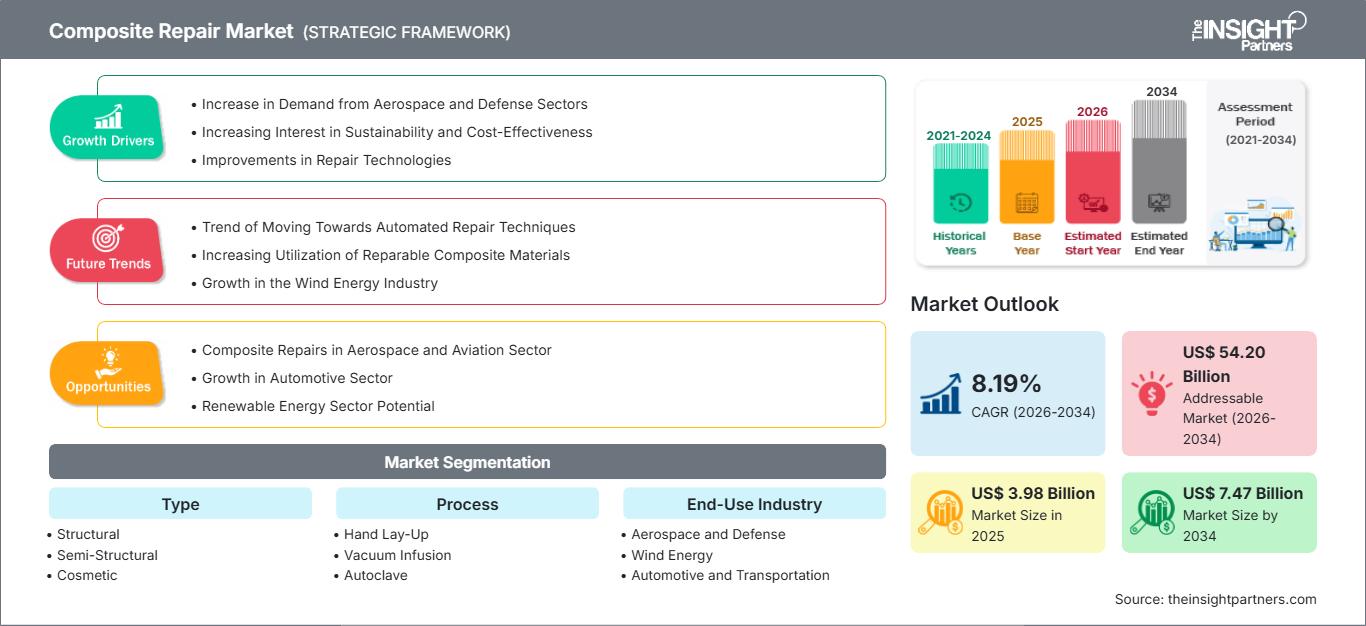
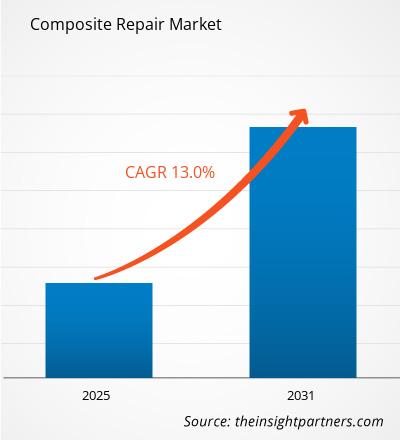
The Composite Repair market was valued at US$ 3.98 billion in 2025 and is expected to reach US$ 7.47 billion by 2034; it is estimated to record a CAGR of 7.25% during 2026-2034.
Composite Repair Market Assessment and Insights
- North America: North America is estimated to represent 30–34% Composite Repair Market share in 2025 and expand at a 7.8–8.8% CAGR between 2026–2034, supported by aerospace MRO, pipeline rehabilitation, wind blade maintenance, and infrastructure restoration.
- US: The US is estimated to hold 25–29% share in 2025 and grow at a 7.8–8.8% CAGR between 2026–2034, supported by its extensive infrastructure, aerospace fleet, pipelines, and wind installations.
- Europe: Europe is estimated at 25–29% share in 2025 and is projected to expand at a 7.5–8.5% CAGR between 2026–2034, with Germany, the UK, France, Spain, and Italy supporting regional demand.
- Asia Pacific: Asia Pacific is estimated to account for 22–26% share in 2025 and record a 9.0–10.0% CAGR between 2026–2034, led by China, Japan, India, South Korea, and Australia.
- Largest Segment: Structural repairs are estimated to hold a 52–56% market share in 2025 and grow at an 8.0–9.0% CAGR between 2026–2034, reflecting high-value load-bearing applications.
- High Growth Segment: Wind Energy is estimated at 17–21% share in 2025 and is projected to expand at a 9.5–10.5% CAGR between 2026–2034, driven by blade maintenance.
- Key companies analyzed in detail: Lufthansa Technik AG, Air France Industries KLM Engineering & Maintenance, Hong Kong Aircraft Engineering Company Limited, UpWind Solution, Total Wind Group A/S, Technical Wind Services Ltd, Clock Spring Company, Inc., Milliken Infrastructure Solutions, LLC, T.D. Williamson, Inc., Gougeon Brothers, Inc., WR Composites, Fibrwraps, and Concrete Repairs Limited.
Source: The Insight Partners' analysis based on proprietary research, government publications, company annual reports, investor presentations, industry databases, and expert interviews.
The Composite Repair Market trends have moved away from basic patching and surface repair techniques to an engineered approach involving advanced resins, composite reinforcement, non-destructive testing, proper curing, and documented repair solutions. The need for precise restoration solutions is essential in aerospace industry while field performance, durability, and asset uptime have become important criteria for other segments including wind energy, marine, pipeline, and construction.
The future scenario will be more influenced by aging assets and growing composite-intensive infrastructure. The Asia Pacific region is emerging as an important growth area due to rising number of aircraft, growing renewable energy installations, and infrastructure investments. North America and Europe are regions offering repeated opportunities in replacement avoidance. Compliance needs related to airworthiness and infrastructure integrity can favor companies with technical expertise.
Composite Repair Market Report Scope
| Report Attribute | Details |
|---|---|
| Market size in 2025 | US$ 3.98 Billion |
| Market Size by 2034 | US$ 7.47 Billion |
| Global CAGR (2026 - 2034) | 7.25% |
| Historical Data | 2021-2024 |
| Forecast period | 2026-2034 |
Composite Repair Market Analysis
Growth of the Composite Repair Market is directly linked to the growth of the composite-intensive equipment installed base. For aircraft, repairs are needed for flight control surfaces, radomes, nacelles, fan cases, and other structures, while wind turbines require repair due to erosion, impact, fatigue, lightning, and delamination problems. Pipeline and infrastructure owners apply reinforced solutions to bring assets back into operation without replacing them completely. The ecosystem encompasses material providers, inspectors, engineers, MRO facilities, repair service providers, asset owners, and certification bodies.
Material availability will differ depending on the application, as aerospace applications require traceable materials, approved process, qualified personnel, and detailed documentation, while construction and pipeline projects can employ different approaches. The availability of qualified technicians, appropriate access equipment, weather conditions, and curing systems will determine wind repair availability. Thus, material suppliers are competing on engineering capabilities, responsiveness, material availability, quality, and cost of ownership over the entire life cycle of the asset.
Competitive environment comprises aerospace MRO companies, wind service providers, composite materials firms, and infrastructure reinforcement suppliers. Lufthansa Technik AG, Air France Industries KLM Engineering & Maintenance, and Hong Kong Aircraft Engineering Company Limited hold significant market share in aircraft repairs and component repairs. UpWind Solution, Total Wind Group A/S, and Technical Wind Services Ltd provide wind maintenance services, and infrastructure firms cater to pipeline, tanks, bridges, and industrial structure needs.
Investments are now being made in mobility solutions, technician training, inspection systems, document management, and regional service capabilities. Clock Spring Company, Inc., Milliken Infrastructure Solutions, LLC, and T.D. Williamson, Inc. have their offerings in infrastructure and pipeline integrity applications. Gougeon Brothers, Inc. provides for marine and composite repairs, and WR Composites, Fibrwraps, and Concrete Repairs Limited offer specialty repair services. Increasingly, differentiation is becoming more engineering-centric than purely material-based.
● REPORT CUSTOMIZATION
Tailor This Report To Align With Your Specific Business Requirements
This report can be customized to align precisely with your business objectives, scope, and target markets. Customization options include tailored segmentation, geography, competitive analysis, and strategic insights to support informed decision-making.
Customize This Report →WHAT YOU CAN ADJUST
- ● Segmentations
- ● Geography
- ● Competitive Analysis
- ● Language Preferences
Composite Repair Market: Strategic Insights
Regional Insights
North America Composite Repair Market
According to the Composite Repair Market report, North America is estimated to account for 30–34% share in 2025 and expand at a 7.8–8.8% CAGR through 2034. The US represents the dominant regional market because of its extensive aircraft fleet, pipeline network, wind installations, bridges, industrial assets, and marine infrastructure. Canada contributes through energy infrastructure, transportation assets, and renewable-energy installations. Composite reinforcement is increasingly considered where replacement would create significant downtime or logistical complexity.
Aerospace MRO is a good source of demand since aircraft owners desire to refurbish their parts while still making sure that they are airworthy. Pipeline activities will find it easy to implement an infrastructure integrity program and have less disruption in their services. Wind farm owners have regular maintenance needs for their blades especially when the installation ages. There are rehabilitation opportunities for bridges, parking lots, industrial buildings, and concrete structures.
U.S. Composite Repair Market
US contribution to North America’s 2025 market share is expected to be in the range of 82-86%, representing 25-29% of global share and growing at a 7.8-8.8% CAGR until 2034. Applications range from aerospace, pipeline repair, wind energy, transportation, marine, and construction. Large installed asset base in the United States ensures repeat repair needs in many industries and not just one end-use industry.
Lufthansa Technik AG and Air France Industries KLM Engineering & Maintenance are involved in aerospace repair, while T.D. Williamson, Inc. and Milliken Infrastructure Solutions, LLC cater to infrastructure applications. Wind energy repair needs are buoyed by a large installed base of turbines, while repair applications in construction see increasing usage of composites for structural repair purposes. Repair procurement is based on considerations including durability of repair, engineering validation, repair expertise, quick response, certification and economic advantages of not replacing parts.
Europe Composite Repair Market
Europe is estimated to represent 25–29% share in 2025 and expand at a 7.5–8.5% CAGR through 2034. Germany is the leading national market, supported by industrial infrastructure, aerospace activity, wind energy, and transportation assets. The UK benefits from aerospace MRO, offshore wind, and marine applications, while France combines a large aviation ecosystem with infrastructure rehabilitation.
Germany enjoys widespread demand in aerospace, industrial machinery, wind turbines, and transportation infrastructure. France takes advantage of aircraft maintenance and manufacturing, generating ongoing needs for composite repairs that have been certified. Italy and Spain present business prospects in maritime, construction, transportation, and renewables applications. In Europe, operators tend to focus on extending the life of their assets and reducing material usage, and engineering practices favor documented repair practices. This demand is thus driven by aged assets and new installation of composite-based equipment.
APAC Composite Repair Market
The APAC region is projected to account for 22–26% market share by 2025, growing at a CAGR of 9.0–10.0%, with China accounting for major regional demand. Japan and South Korea provide support through aerospace, automotive, marine, and industrial applications, while India and Australia provide demand in the form of infrastructure, renewable energy, pipelines, and transportation applications.
China derives demand due to growth in its industrial and renewable infrastructure, while India is increasing its investment in transportation and energy infrastructure. Japan focuses on high-reliability industrial and aerospace applications, while South Korea excels in marine and industrial applications. Australia provides demand in wind, mining, pipeline, and infrastructure applications. Increased technical capability in the region along with increased composite material supply will drive repair solution adoption.
Middle East & Africa Composite Repair Market
Middle East & Africa is projected to expand at a 7.0–8.0% CAGR through 2034, with Saudi Arabia representing a leading market. UAE demand is supported by aviation, construction, and infrastructure, while South Africa contributes through industrial, transportation, energy, and renewable applications. The rest of MEA remains linked to energy and infrastructure maintenance.
Pipeline, tank, marine, aircraft, and civil infrastructure applications provide recurring requirements. High temperatures, corrosion, ultraviolet exposure, dust, and difficult operating environments can accelerate asset degradation. Repair technologies that reduce shutdowns and enable on-site restoration therefore provide economic value. Saudi Arabia's energy and infrastructure investment creates significant opportunities, while the UAE's aviation and construction activity supports demand for specialized repair contractors and engineered composite systems.
Segmentation Analysis
Type
Type represents a major determinant of repair complexity, reinforcement requirements, engineering involvement, and customer economics. The segment is projected to expand at an 8.0–9.0% CAGR during 2026–2034, with structural repairs retaining the largest position because aerospace, wind, pipeline, and infrastructure owners increasingly require restoration of load-bearing performance rather than surface appearance alone. The Composite Repair Market scope consequently extends from localized restoration to engineered structural rehabilitation.
- Structural: Structural repair addresses damage affecting load-bearing performance, including cracks, delamination, impact damage, and laminate degradation. It requires engineering assessment, reinforcement design, controlled curing, and verification, making it strategically important across critical assets.
- Semi-Structural: Semi-structural repair restores components exposed to moderate mechanical loads without reconstructing primary load paths. Demand includes secondary aerospace structures, equipment housings, transportation components, and selected industrial assets requiring reliable restoration.
- Cosmetic: Cosmetic repair addresses surface defects, appearance, coatings, and minor imperfections. Marine, automotive, aerospace interiors, and customer-facing structures generate demand where finish quality influences asset value, presentation, and acceptance.
Process
Process is expected to grow at a 7.5–8.5% CAGR during 2026–2034, reflecting different requirements for repair geometry, component dimensions, curing conditions, process control, and structural performance. Hand lay-up remains versatile for field work, while vacuum infusion and autoclave processing provide greater control where repair quality and repeatability are critical.
- Hand Lay-Up: Hand lay-up remains widely used for field repair because equipment requirements are limited and reinforcement can be adapted to irregular geometries. It is particularly suitable for wind blades, marine structures, and infrastructure.
- Vacuum Infusion: Vacuum infusion improves resin distribution and fiber consolidation while supporting larger repair areas. Its strategic importance increases where repair quality, repeatability, weight control, and reduced void content are important.
- Autoclave: Autoclave processing provides controlled pressure and temperature during high-performance repairs. Aerospace remains the principal application because stringent certification, repeatability, and material-performance requirements justify specialized equipment and tightly controlled processing.
End-Use Industry
End-Use Industry is projected to expand at an 8.5–9.5% CAGR during 2026–2034, reflecting differences in asset age, maintenance cycles, operating environments, and replacement economics. Aerospace and defense provide high-value applications, while wind energy represents an important growth opportunity. The Composite Repair Market Forecasts increasingly depend on installed asset populations, damage frequency, and maintenance intensity.
- Aerospace and Defense: Composite-intensive aircraft structures create high-value repair requirements where replacement components can be costly or unavailable. Certified repair procedures reduce downtime and support fleet availability while maintaining airworthiness requirements.
- Wind Energy: Wind blade repair addresses erosion, lightning, impact, fatigue, and delamination. Larger blades and expanding installed capacity create recurring maintenance requirements, particularly for offshore and aging onshore wind fleets.
- Automotive and Transportation: Composite vehicle, rail, and specialized transportation components create repair demand where replacement costs, component availability, and downtime make refurbishment economically attractive compared with complete component replacement.
- Marine: Marine repair covers hulls, decks, rudders, masts, and composite structures exposed to impact, fatigue, moisture, and ultraviolet degradation. Repair can preserve vessel integrity while avoiding expensive component replacement or prolonged dock time.
- Construction: Fiber-reinforced systems restore and strengthen concrete, masonry, bridges, buildings, and industrial structures. Adoption is supported by rehabilitation needs, constrained construction environments, and requirements to extend existing asset service lives.
- Pipes and Tanks: Composite reinforcement can restore damaged pipelines, tanks, and process equipment without complete replacement. Demand is supported by corrosion, localized defects, restricted access, and requirements to maintain continuous industrial operations.
Opportunity Snapshot
| End-Use Industry | Revenue Contribution | Trend Tag | Adoption Stage |
| Aerospace and Defense | High | Fleet MRO | Mature |
| Wind Energy | High | Blade Life | Scaling |
| Automotive and Transportation | Medium | Lightweight Repair | Scaling |
| Marine | Medium | Hull Repair | Mature |
| Construction | High | Structural Retrofit | Scaling |
| Pipes and Tanks | High | Pipeline Integrity | Mature |
Composite Repair Market Growth Drivers and Impact Analysis
Growing Installed Base of Composite-Intensive Assets
Composite use continues to increase across aircraft, wind turbines, transportation systems, marine vessels, industrial equipment, and infrastructure. As these assets mature, operators require methods to restore localized damage without replacing complete components. Aerospace provides particularly attractive value because composite components can be expensive and replacement lead times can affect aircraft availability. Wind turbines similarly generate recurring requirements for blade restoration because erosion, fatigue, impact, and lightning can affect performance. Pipeline and infrastructure owners also use engineered reinforcement where replacement would require significant excavation, shutdowns, or logistical work. The market impact extends beyond contractors to resin suppliers, reinforcement manufacturers, inspection companies, engineering firms, and equipment providers. A growing installed asset base therefore creates recurring repair demand independent of new composite production volumes.
Increasing Preference for Asset Life Extension
Asset owners increasingly compare repair with replacement using lifecycle cost, downtime, procurement lead times, remaining useful life, and operational continuity. Composite repair can restore localized damage without removing an entire asset from service for prolonged periods. This is relevant to pipelines, tanks, bridges, aircraft components, wind blades, and marine structures. The economic rationale becomes stronger when the underlying asset retains substantial remaining life and replacement components are costly or difficult to procure. As a result, repair specifications increasingly incorporate remaining-strength assessment, environmental exposure, reinforcement design, and expected service duration. Providers that combine inspection with engineering analysis can influence procurement decisions earlier in the maintenance cycle. This supports higher-value service packages incorporating materials, engineering, installation, verification, and documentation.
Expansion of Wind Energy Maintenance Requirements
Wind power expansion is increasing the installed population of composite turbine blades requiring inspection and maintenance. Larger rotor diameters introduce greater fatigue and environmental loads, while erosion, lightning, impact, and weather exposure create recurring damage mechanisms. Offshore installations create additional complexity because access costs and limited weather windows can make component replacement particularly expensive. Repair providers therefore have opportunities to improve rope-access capabilities, mobile equipment, inspection technologies, curing systems, and technician productivity. Demand is strongest in mature wind markets with aging fleets, but emerging markets will also develop repair requirements as newly installed turbines accumulate operating hours. Blade repair can become a recurring service activity throughout a turbine's lifecycle, creating opportunities for specialized contractors and suppliers of reinforcement and resin systems.
Composite Repair Market Future Trends
Digital Damage Assessment and Data-Driven Repair Planning
Digital inspection technologies are expected to become more closely integrated with repair planning as asset owners seek greater visibility into structural condition. Drones, high-resolution imaging, ultrasonic testing, thermography, and digital modeling can improve defect identification and help engineers establish repair boundaries. Future workflows are likely to connect inspection records with engineering calculations, repair instructions, material traceability, and completion documentation. In wind energy, digital inspection can prioritize blades requiring intervention, while aerospace operators can strengthen component histories through structured records. Infrastructure owners can similarly develop digital asset histories supporting long-term rehabilitation planning. Integration of inspection and repair data should enable more targeted maintenance spending, better quality assurance, and clearer evidence of asset integrity after repair completion.
Automation and Advanced Curing for Field Repairs
Automation is expected to expand from manufacturing environments into field repair activities where repeatability and labor productivity are increasingly important. Robotic surface preparation, automated resin dispensing, controlled sanding, portable heating, and digital curing monitoring can reduce variation between technicians. These technologies are particularly relevant to aerospace structures and large wind blades, where repair geometry can be complex and preparation time substantial. Portable systems could make more advanced processing practical at remote infrastructure sites. Automation may also reduce technician exposure to difficult working environments while improving repair documentation. Suppliers capable of combining robotics, inspection, materials, and software could develop differentiated service models based on measurable productivity and quality improvements rather than competing solely through labor rates.
Composite Repair Market Opportunities
Expansion of Mobile Repair and On-Site Service Networks
Mobile repair networks represent an attractive opportunity because many assets cannot be transported economically to centralized facilities. Aircraft components, wind blades, pipelines, storage tanks, bridges, and marine structures can often be repaired at their operating locations. Providers can strengthen this model by establishing regional teams equipped with inspection systems, portable curing equipment, reinforcement materials, and standardized repair procedures. Strategic hubs near aviation, wind, industrial, and infrastructure clusters can reduce response times while improving technician utilization. Partnerships with asset owners can create recurring service contracts instead of one-time project revenue. The opportunity is particularly strong in regions containing geographically dispersed assets, where faster intervention can reduce aircraft downtime, production losses, turbine outages, and infrastructure disruption.
Integrated Repair Platforms Across Multiple Asset Classes
An additional opportunity exists for companies that combine inspection, engineering, materials, repair execution, testing, certification support, and post-repair monitoring. Customers increasingly value fewer interfaces when repairs involve complex technical decisions, particularly for regulated aerospace components and critical infrastructure. Integrated providers can standardize inspection protocols, repair designs, material selection, technician training, documentation, and monitoring. Knowledge developed in one application can also support adjacent industries after appropriate validation and qualification. Investment in laboratories, digital engineering, and application-specific testing can strengthen this proposition. Companies pursuing integrated models can differentiate through technical depth and lifecycle support rather than competing solely on material pricing or labor rates. Such platforms can also generate recurring revenue through maintenance agreements and asset-monitoring services.
Recent Developments
- August 2026: Thiess expanded its Asset Services offering through a strategic partnership with Mechatronix that will see the mining services provider bring bonded carbon fibre composite and steel reinforcement technology to mining, rail and civil organisations seeking to improve asset reliability, reduce maintenance costs and extend the operational life of heavy equipment.
- July 2026: AIS completed the acquisition of Matrix Composites & Engineering, a leading Australian provider of advanced composite materials and subsea engineering solutions. The completion marks a significant milestone for AIS, accelerating its strategy to expand its global footprint in the offshore energy, marine, and defence markets. The acquisition brings together two highly complementary businesses, combining AIS’ engineering, manufacturing, and project delivery expertise with Matrix’s globally recognised syntactic foam and subsea buoyancy systems.
Frequently Asked Questions

- Comprehensive Market Sizing and Forecast Analysis
- Detailed Segmentation Analysis
- In-Depth Market Dynamics Assessment
- Regional and Country-Level Insights
- Competitive Landscape and Company Benchmarking
- Strategic Business Intelligence
Recent Reports
Testimonials

The Insight Partners' SCADA System Market report is comprehensive, with valuable insights on current trends and future forecasts. The team was highly professional, responsive, and supportive throughout. We are very satisfied and highly recommend their services.
RAN KEDEM Partner, Reali Technologies LTDs
I requested a report on a very specific software market and the team produced the report in a few days. The information was very relevant and well presented. I then requested some changes and additions to the report. The team was again very responsive and I got the final report in less than a week.
JEAN-HERVE JENN Chairman, Future Analytica
We worked with The Insight Partners for an important market study and forecast. They gave us clear insights into opportunities and risks, which helped shape our plans. Their research was easy to use and based on solid data. It helped us make smart, confident decisions. We highly recommend them.
PIYUSH NAGPAL Sr. Vice President, High Beam Global
The Insight Partners delivered insightful, well-structured market research with strong domain expertise. Their team was professional and responsive throughout. The user-friendly website made accessing industry reports seamless. We highly recommend them for reliable, high-quality research services
YUKIHIKO ADACHI CEO, Deep Blue, LLC.
This is the first time I have purchased a market report from The Insight Partners.While I was unsure at first, I visited their web site and felt more comfortable to take the risk and purchase a market report.I am completely satisfied with the quality of the report and customer service. I had several questions and comments with the initial report, but after a couple of dialogs over email with their analyst I believe I have a report that I can use as input to our strategic planning process.Thank you so much for taking the extra time and making this a positive experience.I will definitely recommend your service to others and you will be my first call when we need further market data.
JOHN SUZUKI President and Chief Executive Officer, Board Director, BK Technologies
I wish to appreciate your support and the professionalism you displayed in the course of attending to my request for information regarding to infectious disease IVD market in Nigeria. I appreciate your patience, your guidance, and the fact that you were willing to offer a discount, which eventually made it possible for us to close a deal. I look forward to engaging The Insight Partners in the future, all thanks to the impression you have created in me as a result of this first encounter.
DR CHIJIOKE ONYIA MANAGING DIRECTOR, PineCrest Healthcare Ltd.Reason to Buy
- Informed Decision-Making
- Understanding Market Dynamics
- Competitive Analysis
- Identifying Emerging Markets
- Customer Insights
- Market Forecasts
- Risk Mitigation
- Boosting Operational Efficiency
- Strategic Planning
- Investment Justification
- Tracking Industry Innovations
- Aligning with Regulatory Trends





 Get Free Sample for