
Wood Plastic Composites Market Demand & Forecast 2034
Coverage: By Product Type (Polyethylene (PE)-based, Polypropylene (PP)-based, Polyvinyl Chloride (PVC)-based, and Other Types), Manufacturing Process (Extrusion, Injection Molding, Compression Molding, and Others), Application (Decking, Fencing, Railing, Cladding and Siding, Windows and Doors, Furniture, Flooring, and Other Applications), End-use Industry (Building and Construction, Automotive, Consumer Goods, Industrial, Marine, and Other Industries), and Geography (North America, Europe, Asia Pacific, the Middle East and Africa, and South and Central America)
- Status : Published
- Report Code : TIPRE00002798
- Category : Chemicals and Materials
- No. of Pages : 512
- Available Report Formats :


- Last update date : October 08, 2026


2025 Market Size
US$ 8,264.91 Mn
Base year value
2034 Forecast
US$ 18,184.10 Mn
Projected by 2034
CAGR 2026-2034
9.2 %
Growth rate
Addressable Market
US$ 118,508.21 Mn
(2026-2034)
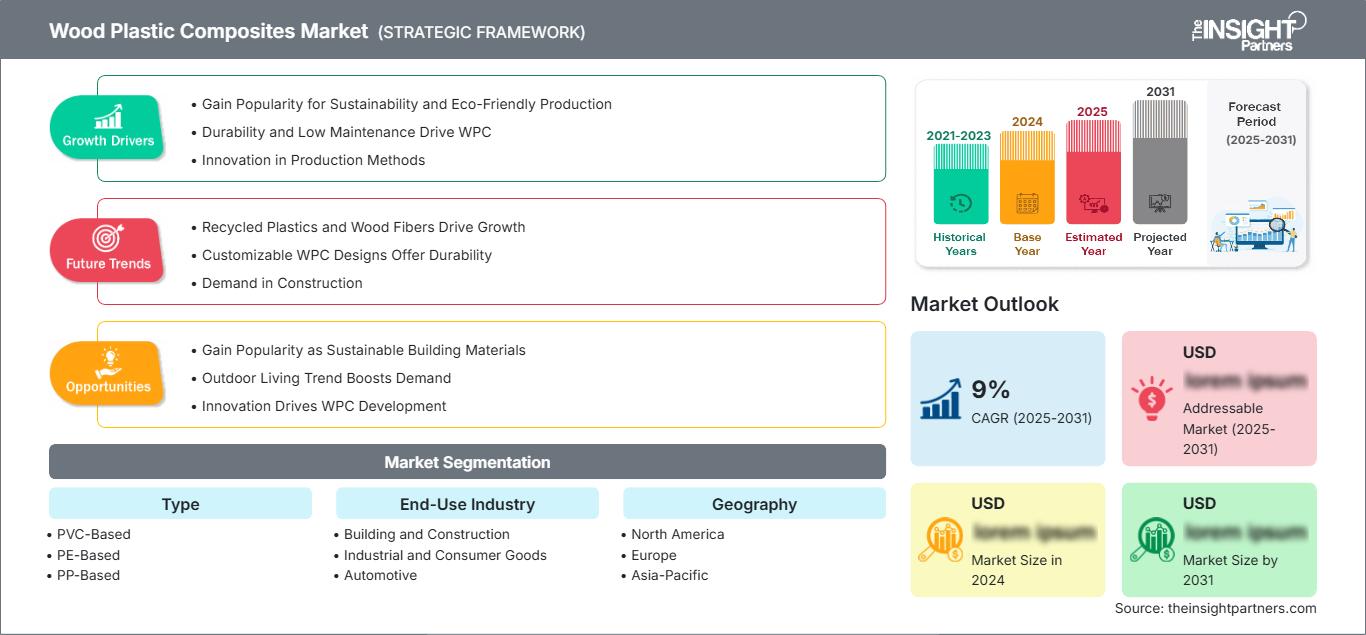
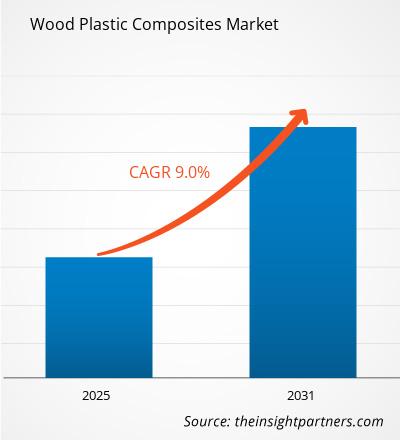
The Wood Plastic Composites Market was valued at US$ 8,264.91 million in 2025 and is projected to reach US$ 18,184.10 million by 2034, registering a CAGR of 9.2% during 2026–2034. The market covers wood fibers or wood flour combined with thermoplastics across product types, manufacturing processes, applications, and end-use industries. Demand is shaped by durable outdoor products, material substitution, recycled-content objectives, and expanding use of composite profiles in construction and related applications.
North America remains a structurally important demand center, supported by established composite decking channels, residential renovation, outdoor-living expenditure, and broad contractor familiarity with wood-alternative products. The region is expected to record a CAGR of ~8% through 2034. Replacement of conventional wood in decking and railing, together with product innovation addressing heat, moisture, fire exposure, and maintenance requirements, should support continued adoption across residential and selected commercial projects.
Wood Plastic Composites Market Assessment and Insights
Regional Outlook
- North America: ~31% of the global Wood Plastic Composites market share in 2025 | ~8% CAGR through 2034. Market position: North America represents a mature demand center, supported by established composite decking distribution, residential renovation, outdoor-living construction, contractor networks, and continued substitution of wood with low-maintenance engineered materials.
- US: ~84% of North American market revenue in 2025 | ~8% CAGR through 2034. Market position: The US anchors North American demand through extensive residential decking and railing activity, established composite-product brands, broad distribution coverage, and continued innovation in performance, appearance, heat management, and fire resistance.
- Europe: ~29% of the global market in 2025 | ~8% CAGR through 2034. Market position: Europe is a mature market with strong sustainability orientation and established WPC manufacturing. Germany is the leading country in Europe, while the UK, France, Italy, and Spain provide substantial demand through construction, landscaping, and renovation applications.
- Asia Pacific: ~33% of the global market in 2025 | ~11% CAGR through 2034. Market position: Asia Pacific is the largest regional market and the fastest-growing region, supported by manufacturing expansion, construction activity, urbanization, export-oriented production, and increasing adoption in China, Japan, South Korea, India, and Australia.
Segment Outlook
- Decking: ~48% Share in 2025 | ~10% CAGR through 2034. Market position: Decking leads because WPC combines wood-like appearance with durability, weather resistance, and reduced maintenance, making it particularly suitable for residential outdoor living, hospitality areas, commercial terraces, public spaces, and renovation projects.
- Automotive: ~8% Share in 2025 | ~12% CAGR through 2034. Market position: Automotive represents a high-growth application environment as manufacturers seek lightweight, renewable, and recycled material options for interior components, trim, panels, and other semi-structural applications where appearance and weight efficiency matter.
Competitive Coverage
Best Benner Building Corp., Deceuninck NV, Barrette Outdoor Living Inc, Fiberon, FORESTIA GROUP (Fiberdeck), Inocram SRL, James Hardie Industries plc, Kosche Holzwerkstoffe GmbH & Co. KG, NaturinForm GmbH, Pandeck WPC, Shanghai Unifloor New Material Co., Ltd, Shantou Wallong Technology Co., Ltd, Silvadec, TOP DEX LLC, Trex Company, Inc., UFP Industries, Inc, WOODPLAST, Iperwood Srl, Ecoplast, WERZALIT, Newtechwood Corp
Methodology
The Insight Partners follows Data Collection & Secondary Research, Primary Research, Data Analysis, and Data Triangulation & Final Review to validate market estimates and insights.
Source: The Insight Partners' analysis based on proprietary research, government publications, company annual reports, investor presentations, industry databases, and expert interviews.
The Wood Plastic Composites Market size has evolved from a specialized alternative-material category into a broader engineered-material platform serving outdoor construction, building products, furniture, transportation, and industrial applications. Extrusion remains central to continuous profiles such as decking, fencing, railing, and cladding, while injection and compression molding enable more complex shapes and component geometries. Product development has increasingly focused on co-extrusion, surface durability, dimensional stability, color retention, recyclability, and improved resistance to moisture, ultraviolet exposure, and biological deterioration. ASTM performance specifications for WPC deck boards and railing systems further reinforce the importance of application-specific mechanical and environmental performance requirements.
Looking ahead, the Wood Plastic Composites Market forecast is supported by investment in recycling infrastructure, regional manufacturing capacity, advanced surface technologies, and higher-performance formulations. Asia Pacific offers substantial expansion potential because local polymer processing, wood-fiber availability, construction activity, and export manufacturing can support scalable production. Europe is positioned around sustainability, durability, circularity, and premium outdoor products, while North America continues to benefit from renovation and outdoor-living demand. Regulatory attention to material efficiency, recycled content, product durability, and responsible sourcing can further encourage manufacturers to develop formulations with improved lifecycle performance.
Wood Plastic Composites Market Report Scope
| Report Attribute | Details |
|---|---|
| Market size in 2025 | US$ 8,264.91 Million |
| Market Size by 2034 | US$ 18,184.10 Million |
| Global CAGR (2026 - 2034) | 9.2% |
| Historical Data | 2021-2024 |
| Forecast period | 2026-2034 |
Wood Plastic Composites Market Analysis
The Wood Plastic Composites Market analysis indicates that demand is concentrated around applications where buyers value the appearance of wood but require greater resistance to moisture, decay, staining, insects, or routine maintenance. Residential decking is a major demand generator, while fencing, railing, cladding, furniture, and selected automotive applications broaden the addressable market. The ecosystem spans wood-fiber suppliers, polymer producers, additives and compatibilizer suppliers, compounders, profile manufacturers, fabricators, distributors, contractors, architects, and end users. Product performance depends on fiber characteristics, polymer selection, formulation, processing temperature, surface treatment, and design geometry.
Supply dynamics increasingly reflect vertical integration and regional specialization. Producers seek reliable supplies of recycled polymers and suitable wood fibers while improving formulation consistency and production yields. Extrusion equipment remains important because it enables continuous profiles with controlled dimensions and surface finishes. Co-extrusion is gaining strategic relevance for premium products because an external protective layer can improve resistance to staining, weathering, and surface wear. Manufacturers are therefore balancing raw-material economics with product durability, recycled-content requirements, logistics, and application-specific performance.
The competitive landscape includes large outdoor-living suppliers, building-product manufacturers, specialist WPC producers, and regional profile manufacturers. Trex Company, Inc. maintains a broad presence in composite decking and railing, while UFP Industries, Inc has expanded its Deckorators WPC capacity through the acquisition of MoistureShield decking assets. NaturinForm GmbH emphasizes co-extruded decking, recycling, and international distribution, whereas Silvadec combines decking, fencing, and cladding solutions. Deceuninck NV, Fiberon, Barrette Outdoor Living Inc, and FORESTIA GROUP (Fiberdeck) provide additional competitive depth across building-product and outdoor applications.
Investment is increasingly directed toward capacity expansion, product differentiation, distribution reach, and material circularity. Companies are introducing heat-mitigating surfaces, fire-performance products, co-extruded structures, improved textures, and recycled-material systems. The competitive environment therefore extends beyond resin and fiber formulation into channel availability, installation systems, warranty propositions, design options, contractor engagement, and lifecycle performance. Strategic positioning increasingly depends on converting material advantages into application-specific products that can compete with wood, plastics, and other composite materials.
● REPORT CUSTOMIZATION
Tailor This Report To Align With Your Specific Business Requirements
This report can be customized to align precisely with your business objectives, scope, and target markets. Customization options include tailored segmentation, geography, competitive analysis, and strategic insights to support informed decision-making.
Customize This Report →WHAT YOU CAN ADJUST
- ● Segmentations
- ● Geography
- ● Competitive Analysis
- ● Language Preferences
Wood Plastic Composites Market: Strategic Insights
Regional Insights
North America Wood Plastic Composites Market
North America accounted for ~31% of the global Wood Plastic Composites Market in 2025 and is expected to expand at a CAGR of ~8% through 2034. The regional market is anchored by the US, where composite decking and railing have developed mature retail, distribution, contractor, and installation ecosystems. Residential outdoor living remains a central demand source, while remodeling and replacement projects provide recurring opportunities for material substitution.
Product differentiation is also evident in the region. Research is underway in product formulation and technology development for heat, moisture, and UV resistance, fire performance, and appearance retention. This ensures that the market for the product is not limited to decks but extends to other outdoor products, such as fences, railings, cladding, and more. In Canada, demand is due to residential construction, remodeling, and outdoor living projects. Demand in Mexico is driven by both construction and manufacturing projects. Growth in the region will be sustained by market recognition.
U.S. Wood Plastic Composites Market
The US represented ~84% of North American Wood Plastic Composites Market revenue in 2025 and is projected to record a CAGR of ~8% through 2034. The country's position reflects the maturity of composite decking, widespread contractor familiarity, extensive home-improvement distribution, and continued demand for low-maintenance outdoor spaces. Composite products are particularly relevant to residential decks, railings, fences, and outdoor structures.
The competitive environment is characterized by companies such as Trex Company, Inc., Fiberon, UFP Industries, Inc, Barrette Outdoor Living Inc, and Newtechwood Corp, among others. Innovations in the product line increasingly take into consideration climate exposure and building codes. This is evidenced by fire-resistant deck products, heat management technologies, cap technology, and an expansion of the fencing lineup. In this respect, the USA remains a valuable testing ground for innovative WPC technologies, channels, and high-end outdoor living products.
Europe Wood Plastic Composites Market
Europe represented ~29% of the global Wood Plastic Composites Market in 2025 and is expected to grow at a CAGR of ~8% through 2034. Germany is the leading country in Europe, supported by a developed manufacturing base, established WPC specialists, construction demand, and strong interest in durable and responsibly sourced materials. Germany also functions as an important technology and product-development center for premium decking and profile systems.
The UK meets demand by refurbishing houses, landscaping, decking, fencing, and outdoor construction. France has a competitive edge in composite outdoor materials, driven by dedicated production and building applications, whereas Italy is boosted by furniture, aesthetically-driven construction, and outdoor spaces. Spain makes its contribution through residential building, hospitality, terraces, and landscaping, with the climate driving demand for weatherproofing materials.
European manufacturers focus more on the use of recycled materials, sustainable wood sources, product durability, and recycling possibilities. NaturinForm GmbH increases the capacity of its co-extrusion decks and expands overseas sales, whereas Silvadec implements its circularity programs and diversifies its product range, including decking, fencing, and cladding. Thus, the development of the market in Europe is characterized by the maturity of demand, premiumization, and sustainability.
APAC Wood Plastic Composites Market
APAC represented ~33% of the global Wood Plastic Composites Market in 2025 and is expected to register a CAGR of ~11% through 2034, making it the fastest-growing region. China is the leading country in Asia Pacific, supported by manufacturing capacity, polymer processing expertise, construction demand, and export-oriented production. Japan and South Korea provide technologically advanced applications and established industrial supply chains.
There are further growth opportunities for India and Australia in residential construction, infrastructure applications, landscaping, and outdoor living. It is possible for regional manufacturers to take advantage of the increased availability of recycled polymers, locally available wood fibers, and extrusion technology. There is added impetus for the use of WPC due to the efficiency of resource and waste utilization.
Middle East & Africa Wood Plastic Composites Market
The Middle East & Africa Wood Plastic Composites Market is projected to expand at a CAGR of ~10% through 2034. Saudi Arabia represents an important regional demand center because large-scale urban development, hospitality projects, tourism infrastructure, and outdoor public-space investment create applications for durable decking, cladding, fencing, and furniture. The UAE similarly benefits from commercial construction, hospitality, landscaping, and premium outdoor developments.
South Africa offers a unique market landscape due to its residential outdoor living space, landscaping, and composite product manufacturing. Markets in other parts of the Middle East and Africa are growing slowly due to increasing project opportunities and distribution channels, as well as growing awareness about WPC performance. Temperature, sunlight, moisture variability, and maintenance are important factors influencing material durability.
Segmentation Analysis
Product Type
The Wood Plastic Composites Market by product type is expected to expand at a CAGR of ~9% during 2026–2034. PE-based products remain widely established in outdoor applications because polyethylene provides processing flexibility, impact performance, and compatibility with recycled polymer streams. PP-based formulations support applications requiring higher stiffness and temperature performance, while PVC-based products serve applications where dimensional stability and surface characteristics are important.
- Polyethylene (PE) based: PE-based WPC is predominantly associated with decking, fencing, railing, and other outdoor profiles. The flexibility of processing and history of use with recycled polymer streams are some key advantages for its wide adoption in various commercial applications.
- Polypropylene (PP) based: The usage of PP-based WPCs is related to the need for higher stiffness and higher temperature stability of the material. Applications include automotive, industrial, furniture, and some building products applications.
- Polyvinyl chloride (PVC) based: PVC-based WPC provides opportunities for applications that need dimensionally stable, weather-resistant, and controlled surface appearance materials. They are relevant for profiles, cladding, windows, doors, and some outdoor applications.
Manufacturing Process
The manufacturing process segment is projected to grow at a CAGR of ~9% through 2034. Extrusion remains central because continuous profiles account for a large proportion of WPC products, particularly decking, fencing, railing, and cladding. Injection molding supports more complex components, while compression molding serves selected shapes and formulations where pressure-based consolidation is advantageous.
- Extrusion: The extrusion process is primarily used in WPC profiles that require continuity in manufacture and allows for mass production of products such as decking, fencing, railing, and cladding. Process control influences dimensions, surface texture, fiber distribution, and manufacturing efficiency.
- Injection Molding: The injection molding process is suitable for applications involving geometries and discrete components. This process gains strategic significance when WPC compounds are used in furniture, automotive, consumer goods, and other engineered products.
- Compression Molding: The compression molding process is beneficial in situations where there is a need for the application of pressure and heat in consolidating WPC compound to a certain geometry. This process may be suitable for selected panels and components.
Application
Application demand is expected to increase at a CAGR of ~10% through 2034. Decking remains the principal commercial application because WPC provides a combination of appearance, durability, weather resistance, and reduced maintenance. Fencing, railing, cladding, furniture, flooring, and openings broaden the market beyond outdoor decks and create opportunities for specialized formulations and profiles.
- Decking: Decking represents the largest opportunity due to its ability to meet the need for long-lasting, easy-to-care-for surfaces outdoors. Residential renovations, hospitality, landscaping, public areas, and high-end outdoor living projects represent a range of opportunities to expand adoption.
- Fencing: Wood plastic composites offer an alternative in situations where water and decay resistance as well as maintenance are more desirable than in wood. Privacy fences and perimeter fencing, as well as landscaping projects, generate recurring demand both residentially and commercially.
- Railing: The use of railings made from WPC often accompanies the installation of composite decking and thus creates a consistent outdoor living environment. Adoption of railing is driven by its flexibility of design, weather exposure, and maintenance benefits over painted or untreated wood.
- Cladding and Siding: Composite siding and cladding capitalize on the demand for long-lasting and wood-like exterior surface material. Architects and developers can make use of textured and co-extruded siding products for their projects.
- Windows and Doors: The WPC profiles can be used as a combination of dimensional stability, aesthetics, and environmental exposure resistance. Usage is limited to applications where the performance and consistency of profiles allow the usage instead of common materials.
- Furniture: WPC furniture includes items for outdoor seating, tables, benches, and installations within public spaces. Environmental exposure resistance and reduced finishing allow for lower maintenance needs in environments that include precipitation, sunlight, and active use.
- Flooring: Applications of WPC floors involve further extension of composite technology to interiors and semi-interiors. Product development focuses on dimensional stability, aesthetics, moisture resistance, and installation convenience.
End-use Industry
The end-use industry segment is expected to expand at a CAGR of ~10% through 2034. Building and construction remains the core demand environment, while automotive and consumer goods provide opportunities for higher-value engineered applications. Industrial and marine uses depend more heavily on formulation, exposure conditions, load requirements, and lifecycle economics.
- Building and Construction: Construction is the principal end-use industry because decking, fencing, railing, cladding, siding, and architectural profiles represent established WPC applications. Renovation and outdoor-living projects provide additional recurring demand.
- Automotive: Automotive applications offer significant growth potential for lightweight and renewable material solutions. WPCs can be considered for selected interior, trim, panel, and component applications where weight, appearance, processing, and sustainability objectives intersect.
- Consumer Goods: Consumer goods applications include furniture, outdoor products, accessories, and molded components. Demand depends on product aesthetics, durability, tactile properties, and the ability to differentiate products through recycled or bio-based content.
- Industrial: Industrial uses can include profiles, platforms, structural components, and specialized fabricated products. Adoption depends on mechanical performance, exposure conditions, processing economics, and the ability of WPCs to meet application-specific specifications.
- Marine: Marine applications benefit from resistance to moisture and reduced maintenance requirements. However, adoption is more application-specific because water exposure, dimensional stability, slip resistance, load conditions, and long-term durability require careful formulation and product engineering.
Opportunity Snapshot
| Application | Revenue Contribution | Trend Tag | Adoption Stage |
| Decking | High | Outdoor Living | Mature |
| Fencing | Medium | Privacy Systems | Scaling |
| Railing | Medium | Integrated Systems | Scaling |
| Cladding and Siding | Medium | Facade Design | Scaling |
| Windows and Doors | Low | Profile Substitution | Emerging |
| Furniture | Medium | Outdoor Furniture | Scaling |
| Flooring | Low | Moisture Resistance | Emerging |
Wood Plastic Composites Market Growth Drivers and Impact Analysis
Expansion of Low-Maintenance Outdoor Living Applications
Residential and commercial outdoor spaces are an important structural demand driver because buyers increasingly evaluate decking, fencing, railing, and related products on lifecycle maintenance rather than initial material appearance alone. WPC products can reduce requirements for painting, staining, sealing, and replacement associated with some conventional wood products, although performance varies by formulation and exposure. This creates a value proposition for homeowners, contractors, hospitality operators, and property managers seeking predictable maintenance requirements. The impact extends across the value chain because higher WPC adoption encourages distributors to expand composite inventories, contractors to develop installation expertise, and manufacturers to introduce coordinated product systems. Product suppliers can therefore capture additional demand by combining decking with railing, fencing, lighting, fasteners, and other outdoor-living components.
Increasing Preference for Durable Engineered Building Materials
Material durability is becoming a stronger purchasing consideration across construction and renovation projects exposed to moisture, ultraviolet radiation, temperature changes, and biological deterioration. WPC formulations can be engineered around these requirements through polymer selection, fiber treatment, additives, surface design, and co-extrusion. ASTM specifications for WPC deck boards and railing systems demonstrate how performance requirements encompass factors such as flexural behavior, temperature and moisture effects, ultraviolet exposure, freeze-thaw conditions, biodeterioration, and fire performance. The market impact is a shift from commodity composite profiles toward application-engineered products with defined performance characteristics. Manufacturers able to demonstrate consistent quality and application suitability can address more demanding commercial and residential projects while reducing the risk that WPC products are evaluated solely on upfront price.
Greater Integration of Recycled Materials and Circular Feedstocks
Recycled polymers and recovered wood fibers can strengthen the material-efficiency proposition of WPCs while creating additional feedstock channels for manufacturers. The ability to incorporate recycled inputs depends on contamination, polymer consistency, fiber quality, processing conditions, and required final-product performance. Companies are consequently investing in collection systems, recycling partnerships, formulation control, and production processes capable of maintaining consistent product quality. The impact is particularly relevant to decking and other high-volume profile applications where stable material streams can improve resource efficiency. Circularity also creates opportunities for manufacturers to differentiate through take-back systems, recycled-content claims, and closed-loop product strategies. Over time, better feedstock management can reduce dependence on selected virgin inputs while supporting product development aimed at longer service life and improved recyclability.
Wood Plastic Composites Market Future Trends
Co-Extruded and Performance-Engineered Surface Technologies
Co-extrusion is expected to become increasingly important for premium WPC products because it allows manufacturers to combine a structural composite core with a protective external layer. The approach can improve resistance to staining, fading, moisture, surface wear, and cleaning requirements while enabling more consistent aesthetics. As consumers and commercial buyers compare WPC products with wood, PVC, capped composites, and other engineered materials, surface performance will increasingly influence purchasing decisions. Manufacturers are likely to expand color ranges, textures, heat-management technologies, and application-specific protective layers. The trend also supports premiumization because higher-performance surfaces can justify differentiated product specifications and pricing. In the longer term, co-extrusion may become an important pathway for extending WPC use into demanding environments where conventional mono-extruded profiles face greater exposure or maintenance challenges.
Integration of Climate-Responsive Product Design
Future product development is likely to place greater emphasis on climate-specific performance. WPC manufacturers are already addressing exposure conditions such as extreme heat, moisture, ultraviolet radiation, coastal environments, and wildfire-related building requirements. Through formulation changes, surface engineering, geometry, and certification, suppliers can tailor products to regional environmental conditions rather than relying on one universal product design. This approach can support wider adoption in areas where conventional composite products face concerns over heat retention, ignition resistance, dimensional movement, or weathering. Climate-responsive design also creates opportunities for regional product portfolios and specialized building-code solutions. As architects and contractors increasingly account for resilience in material selection, WPC suppliers with tested performance data and clearly defined installation requirements can expand beyond traditional decking into more demanding exterior applications.
Wood Plastic Composites Market Opportunities
Expansion of WPC Manufacturing and Distribution in Asia Pacific
Asia Pacific provides an opportunity for manufacturers to combine regional polymer-processing capabilities with growing construction demand and export-oriented supply chains. China already provides a substantial production ecosystem, while India, Australia, Japan, and South Korea offer differentiated demand opportunities across construction, outdoor living, industrial products, and transportation. Investment can target extrusion capacity, compounding, recycled-polymer processing, co-extrusion, surface finishing, and localized distribution. Producers can also develop region-specific formulations addressing high temperatures, humidity, ultraviolet exposure, and installation practices. Strategic partnerships with building-product distributors and construction-material suppliers can accelerate market access without requiring immediate development of wholly owned sales networks. The opportunity is strongest where manufacturers can achieve consistent product quality while controlling logistics costs and adapting profiles to local construction standards and buyer requirements.
Premiumization Through Integrated Outdoor-Living Systems
Manufacturers can increase commercial value by positioning WPC products as integrated outdoor-living systems rather than standalone boards. Decking can be combined with railing, fencing, cladding, lighting, fasteners, joists, accessories, and installation support to create a coordinated specification package. This approach can increase customer retention and improve the visibility of composite materials across the entire project lifecycle. Digital design tools, configurators, contractor programs, and distributor training can further reduce installation complexity and improve conversion from material inquiry to completed project. Premium products can emphasize surface durability, heat management, fire performance, recycled content, aesthetics, and extended service life. The opportunity is particularly relevant in mature markets where basic composite decking is already established and suppliers need additional product categories and services to expand customer value.
Recent Developments
- September 2026: Palmer-Donavin announced the expansion of three exterior product lines into its Midwest market, while also introducing Owens Corning Lumber Marine Grade Decking throughout its distribution network. ACRE Siding & Trim by Modern Mill, Fiberon Decking, and NewTechWood Decking & Siding, previously available in the Southeast, will now be offered in the Midwest. In addition, Owens Corning Lumber Marine Grade Decking will be introduced across both the Midwest and Southeast markets. As a result, all four brands will be stocked at 10 Palmer-Donavin building material distribution locations serving customers across these regions.
- July 2026: Gramo BV, the investment vehicle associated with Deceuninck shareholder and former CEO Francis Van Eeckhout, has formally launched a mandatory public takeover bid for Deceuninck NV. The offer follows Gramo’s increase in its ownership stake above the 30% threshold that triggers a mandatory bid under Belgian takeover regulations. Gramo’s stake increased to 30.52?ter the exercise of 1.05 million warrants.
- July 2026: Trex Company [NYSE: TREX] manufacturer of wood-alternative decking and railing and a leading outdoor living brand, announced the realignment of its North American distribution network. As part of the changes, Specialty Building Products (SBP) will serve as Trex’s sole national distributor for decking and railing products across North America. Trex will also strengthen its regional distribution network by expanding partnerships with WS Building Materials (formerly Snavely, Weekes, and Logan), Coastal Forest Products in New England, and BlueLinx in the South Central region.
Frequently Asked Questions

- Comprehensive Market Sizing and Forecast Analysis
- Detailed Segmentation Analysis
- In-Depth Market Dynamics Assessment
- Regional and Country-Level Insights
- Competitive Landscape and Company Benchmarking
- Strategic Business Intelligence
Recent Reports
Testimonials

The Insight Partners provided valuable market intelligence that supported our global go-to-market strategy. Their team was professional, responsive, and attentive to our feedback, providing thoughtful analysis and helpful methodological clarifications throughout the project.
Junmo Kim Chief Financial Officer (CFO), Enertech Co., Ltd.
The Insight Partners' SCADA System Market report is comprehensive, with valuable insights on current trends and future forecasts. The team was highly professional, responsive, and supportive throughout. We are very satisfied and highly recommend their services.
RAN KEDEM Partner, Reali Technologies LTDs
I requested a report on a very specific software market and the team produced the report in a few days. The information was very relevant and well presented. I then requested some changes and additions to the report. The team was again very responsive and I got the final report in less than a week.
JEAN-HERVE JENN Chairman, Future Analytica
We worked with The Insight Partners for an important market study and forecast. They gave us clear insights into opportunities and risks, which helped shape our plans. Their research was easy to use and based on solid data. It helped us make smart, confident decisions. We highly recommend them.
PIYUSH NAGPAL Sr. Vice President, High Beam Global
The Insight Partners delivered insightful, well-structured market research with strong domain expertise. Their team was professional and responsive throughout. The user-friendly website made accessing industry reports seamless. We highly recommend them for reliable, high-quality research services
YUKIHIKO ADACHI CEO, Deep Blue, LLC.
This is the first time I have purchased a market report from The Insight Partners.While I was unsure at first, I visited their web site and felt more comfortable to take the risk and purchase a market report.I am completely satisfied with the quality of the report and customer service. I had several questions and comments with the initial report, but after a couple of dialogs over email with their analyst I believe I have a report that I can use as input to our strategic planning process.Thank you so much for taking the extra time and making this a positive experience.I will definitely recommend your service to others and you will be my first call when we need further market data.
JOHN SUZUKI President and Chief Executive Officer, Board Director, BK Technologies
I wish to appreciate your support and the professionalism you displayed in the course of attending to my request for information regarding to infectious disease IVD market in Nigeria. I appreciate your patience, your guidance, and the fact that you were willing to offer a discount, which eventually made it possible for us to close a deal. I look forward to engaging The Insight Partners in the future, all thanks to the impression you have created in me as a result of this first encounter.
DR CHIJIOKE ONYIA MANAGING DIRECTOR, PineCrest Healthcare Ltd.Reason to Buy
- Informed Decision-Making
- Understanding Market Dynamics
- Competitive Analysis
- Identifying Emerging Markets
- Customer Insights
- Market Forecasts
- Risk Mitigation
- Boosting Operational Efficiency
- Strategic Planning
- Investment Justification
- Tracking Industry Innovations
- Aligning with Regulatory Trends





 Get Free Sample for