
Content Recommendation Engine Market Share, Growth & Demand by 2034
Content Recommendation Engine Market Size and Forecasts (2021–2034), Global and Regional Share, Trends, and Growth Opportunity Analysis Report Coverage : By Component (Solution, Service), byFiltering Approach (Collaborative Filtering, Content-Based Filtering, Hybrid Filtering), Organization Size (Small and Medium Enterprises, Large Enterprises), Vertical (E-commerce, Media, Entertainment & Gaming, Retail & Consumer Goods, Hospitality)
- Status : Data Released
- Report Code : TIPRE00039798
- Category : Technology, Media and Telecommunications
- No. of Pages : 150
- Available Report Formats :


- Last update date : August 04, 2026


2025 Market Size
US$ 7.02 Bn
Base year value
2034 Forecast
US$ 27.19 Bn
Projected by 2034
CAGR 2026-2034
18.44 %
Growth rate
Addressable Market
US$ 161.72 Bn
(2026-2034)
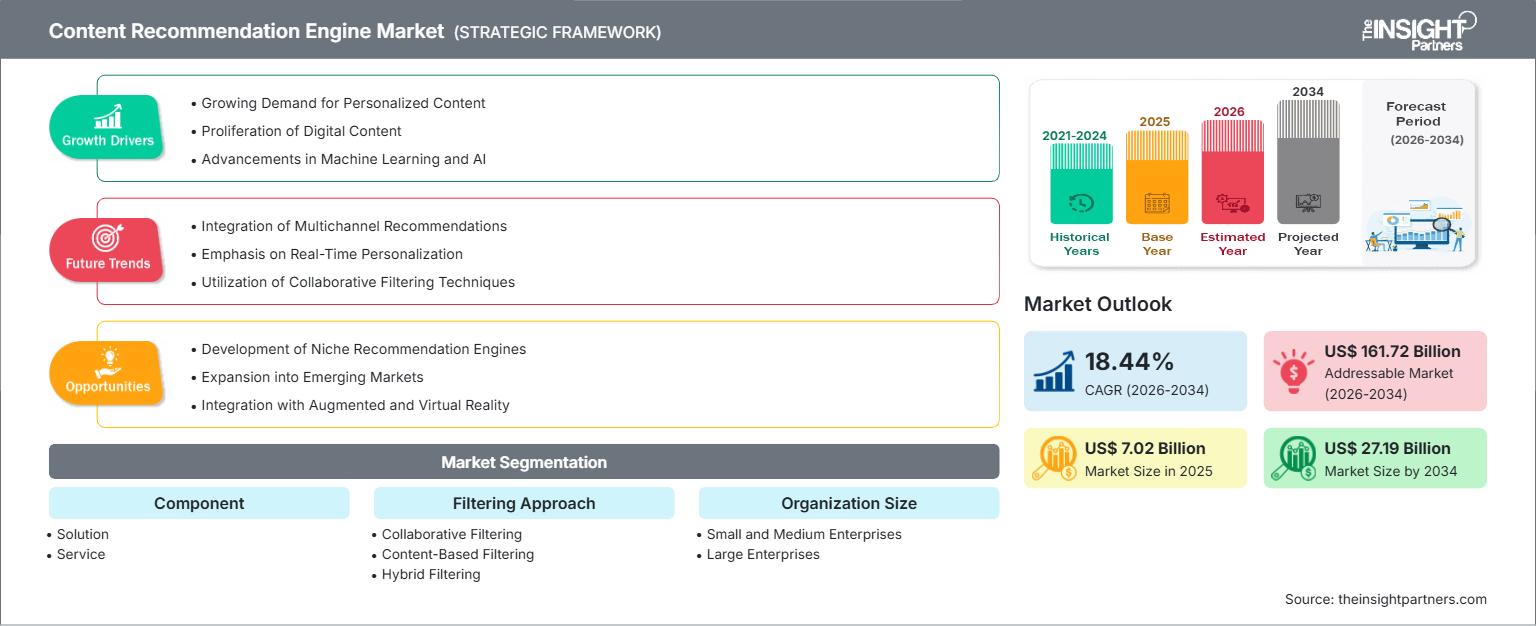
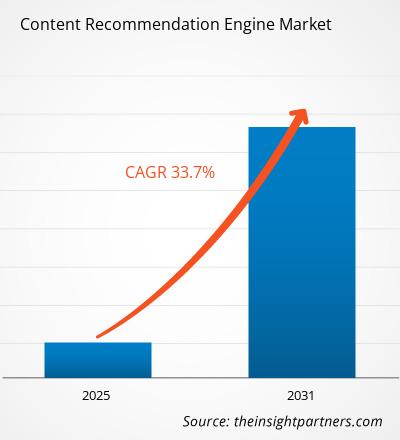
The global content recommendation engine market stood at US$ 7.02 Billion in 2025 and is on track to reach US$ 27.19 Billion by 2034, advancing at a CAGR of 18.44% between 2026 and 2034. This expansion mirrors the accelerating shift toward AI-led personalization across publishing, streaming, and retail platforms, as enterprises lean on recommendation algorithms to sustain engagement and conversion amid rising content volumes and shrinking attention spans.
North America is projected to grow at a CAGR in the 17-19% range through 2034, supported by a dense concentration of streaming, retail, and martech platforms alongside early cloud infrastructure adoption. Continued investment in first-party data strategies following privacy regulation shifts is reinforcing the content recommendation engine market size trajectory, as personalization becomes a defining competitive lever for publishers and retailers across the region.
Content Recommendation Engine Market Assessment and Insights
- North America: Held roughly 35-38% share in 2025 and is set to grow at a CAGR of 17.8-19% through 2034, aided by mature adtech infrastructure, cloud-native deployment, and dense retail-media ecosystems.
- US: Commanded nearly 82-85% of North America's 2025 share, growing at a CAGR of 17.5-18.9%, led by enterprise cloud migration.
- Europe: Accounted for 24-27% share in 2025 and is expected to expand at 16.5-18% CAGR through 2034, with the UK and Germany leading adoption via retail and media digitization.
- Asia Pacific: Captured 20-23% share in 2025, growing fastest at 20-22% CAGR through 2034, led by China and India on the back of e-commerce and mobile-first content consumption.
- Largest Segment: Solution (Component) held 62-65% market share in 2025, growing at 18-19.5% CAGR, reflecting enterprise preference for packaged recommendation platforms.
- High Growth Segment: Hybrid Filtering held 28-31% share in 2025 and is set to expand at 20-22% CAGR, driven by accuracy gains over single-method filtering.
- Key companies analyzed in detail: IBM, Amazon Web Services, Revcontent, Taboola, Outbrain, Cxense, Dynamic Yield, Curata, Boomtrain, ThinkAnalytics.
Source: The Insight Partners' analysis based on proprietary research, government publications, company annual reports, investor presentations, industry databases, and expert interviews.
The content recommendation engine market has evolved from rule-based, manually curated widgets toward machine learning pipelines capable of real-time inference across billions of daily interactions. Earlier deployments used collaborative filtering approaches with minimal degrees of personalization, while today’s platforms leverage deep learning techniques, context-based inputs, and generative content creation. Deployment trends for production processes have moved towards more modular, API-driven systems that allow for embedding recommendation functionality by publishers, merchants, and streaming services without altering underlying infrastructure, thus shortening the deployment time frame from months to weeks.
As far as the future is concerned, the vendors are moving platforms into the new geographies such as Southeast Asia, Latin America, and the Gulf region. Regulatory tailwinds around data portability and consent-based personalization are prompting investment in privacy-preserving architectures, while venture and strategic capital continue flowing toward generative recommendation start-ups, supporting gains in the Content Recommendation Engine Market share and positioning the industry for broader geographic and vertical diversification through 2034.
Content Recommendation Engine Market Report Scope
| Report Attribute | Details |
|---|---|
| Market size in 2025 | US$ 7.02 Billion |
| Market Size by 2034 | US$ 27.19 Billion |
| Global CAGR (2026 - 2034) | 18.44% |
| Historical Data | 2021-2024 |
| Forecast period | 2026-2034 |
Content Recommendation Engine Market Analysis
The content recommendation engine market growth is being driven by the proliferation of digital content, e-commerce catalogs, and streaming libraries that overwhelm manual curation. Publishers and retailers become increasingly reliant on recommendation engines for finding relevant content, extending dwell time, and increasing conversions. The ecosystem covers data infra providers, ML platform vendors, and recommendation startups solving various levels of data intake, modeling, and delivery challenges.
The supply side demonstrates an increasing dependence on the cloud-based, API-enabled approach that minimizes the burden of integration in midmarket adoption. Companies are offering recommendation components bundled with more comprehensive CX and commerce offerings, thus decreasing switching costs. As a result, bundling in conjunction with pay-as-you-go pricing allows vendors to increase the addressable market from large enterprises to small and mid-size digital companies looking for a lift in engagement without a separate data science team.
This content recommendation engine market analysis highlights an increasingly consolidated yet innovation-driven competitive landscape. The enterprise cloud space sees IBM and Amazon Web Services leading providers integrating recommendations in their overall AI and commerce platforms, while Taboola and Outbrain lead open web discovery using networks of publishers. Dynamic Yield, Cxense, Curata, Boomtrain, ThinkAnalytics, and Revcontent are some other vertical-oriented vendors competing using vertical-specific filtering solutions catering to media, retail, and hospitality customers.
Current investment areas are focused on generative AI technology, first-party data orchestration, and retail media monetization. Strategic partnerships between adtech platforms and cloud providers are expanding distribution reach, while consolidation among mid-tier vendors is expected to continue as buyers favor integrated suites over point solutions, reshaping vendor concentration through the remainder of the decade, as highlighted in the Content Recommendation Engine Market Report.
● REPORT CUSTOMIZATION
Tailor This Report To Align With Your Specific Business Requirements
This report can be customized to align precisely with your business objectives, scope, and target markets. Customization options include tailored segmentation, geography, competitive analysis, and strategic insights to support informed decision-making.
Customize This Report →WHAT YOU CAN ADJUST
- ● Segmentations
- ● Geography
- ● Competitive Analysis
- ● Language Preferences
Content Recommendation Engine Market: Strategic Insights
Regional Insights
North America content recommendation engine market
North America continues to anchor global adoption, supported by a dense concentration of e-commerce, streaming, and media platforms that depend on real-time personalization to sustain engagement. The region is projected to expand at a CAGR of 17.8-19% through 2034, underpinned by early cloud infrastructure investment, mature martech budgets, and a large base of enterprises running production-grade machine learning pipelines across retail and content platforms.
From a structural perspective are increased competition between streaming and retail platforms for consumer attention, which drives constant efforts to invest in better recommendations and latency improvement. Changes in regulations related to consumers' data rights have made companies shift towards first-party data systems, and the providers of cloud solutions for enterprises based in this region are adding recommendation solutions to their commerce and content management systems.
U.S. content recommendation engine market
The United States represents approximately 82-85% of North America's 2025 revenue, growing at a CAGR of 17.5-18.9% through 2034. Concentration of hyperscale cloud providers, streaming platforms, and large e-commerce operators sustains deep enterprise demand for recommendation infrastructure across the country's digital economy.
The ecosystem for such products is saturated with vendors ranging from cloud native platform companies, specialists in the adtech space, to enterprise software companies providing recommendation modules. Trends in applications include real-time personalization within retail checkouts, streaming media playback queue, and news discovery widgets. The preference is now moving towards hybrid recommendations that employ both collaborative and content-based recommendation engines.
Europe content recommendation engine market
Europe held an estimated 24-27% share of the global content recommendation engine market in 2025, expanding at a CAGR of 16.5-18% through 2034, with the United Kingdom leading regional adoption. Growth is shaped by stringent data protection frameworks that favor privacy-preserving, consent-based personalization architectures across retail and publishing sectors.
The UK is leading in terms of share within Europe, owing to a well-established digital publishing ecosystem and high penetration of retail e-commerce, where recommendation-based marketing dominates. Germany is not far behind as a result of the manufacturing-centric e-commerce ecosystems that exist there and increased spending on retail media advertising. The adoption rate in France, Italy, and Spain is increasing in the hospitality and media sectors.
APAC content recommendation engine market
Asia Pacific captured 20-23% share in 2025 and is forecast to expand at the fastest CAGR of 20-22% through 2034, led by China on the strength of large-scale e-commerce and short-video platforms. Japan and South Korea contribute through gaming and media personalization, while India and Australia show accelerating retail and hospitality digitization.
Support for AI infrastructure provided by industrial policy, along with increasing penetration of mobile commerce, is aiding regional momentum. Digital economy policies, backed by governments in India and Southeast Asia, are reducing the entry barrier for smaller companies in using recommendation technologies, making this region the main volume growth driver for vendors moving out of the mature Western market.
Middle East & Africa content recommendation engine market
The Middle East and Africa region is projected to grow at a CAGR of 21-23% through 2034, with Saudi Arabia leading adoption on the back of national digital economy diversification programs. The UAE follows closely, supported by retail and hospitality digitization tied to tourism-driven consumer spending growth.
South Africa and the rest of MEA are demonstrating consistent adoption within the e-commerce and media sectors, fueled by enhanced broadband and cloud infrastructure developments. Diversified investments into the energy sector, along with government-sponsored smart infrastructure projects, are contributing to corporate technology budgets, facilitating local retailing and media companies to implement recommendation solutions as part of their digital transformation strategies.
Segmentation Analysis
Component
The Component segment's Solution category is projected to grow at a CAGR of 18-19.5% between 2026 and 2034. This defines the core content recommendation engine market scope, as enterprises prioritize packaged software platforms offering embedded machine learning models, dashboards, and API connectors, reducing implementation complexity relative to custom-built, in-house recommendation infrastructure.
- Solution remains the dominant category, offering packaged recommendation engines, dashboards, and pre-trained models that reduce implementation time for enterprises across retail, media, and hospitality verticals.
- Service covers consulting, integration, and managed optimization support, addressing enterprises lacking in-house data science capacity to tune recommendation models.
Filtering Approach
The Hybrid Filtering segment is projected to expand at a CAGR of 20–22% between 2026 and 2034 in the Content Recommendation Engine Market. Hybrid approaches combine collaborative and content-based signals, delivering higher recommendation accuracy across sparse-data environments. Enterprises are increasingly favoring hybrid models to offset cold-start limitations, improving engagement across retail, media, and hospitality applications where user interaction histories are often incomplete or newly established.
- Collaborative Filtering relies on user-behavior similarity patterns, remaining widely used across established e-commerce and media platforms with dense historical interaction data.
- Content-Based Filtering analyzes item attributes directly, suiting platforms with limited user history, including new product launches and niche hospitality offerings.
- Hybrid Filtering blends both methods, increasingly preferred by enterprises seeking balanced accuracy and resilience against data sparsity across diverse customer segments.
Organization Size
The Small and Medium Enterprises segment is projected to grow at a CAGR of 19.5–21% between 2026 and 2034 in the Content Recommendation Engine Market. Cloud-based, usage-priced recommendation platforms are lowering entry barriers for smaller businesses, enabling personalization capabilities previously accessible only to large enterprises with dedicated data science teams and infrastructure budgets.
- Small and Medium Enterprises are adopting subscription-based recommendation tools to compete on personalization without heavy upfront infrastructure investment.
- Large Enterprises continue driving revenue concentration, deploying custom-tuned recommendation architectures across complex, multi-brand digital ecosystems.
Vertical
Retail & Consumer Goods is projected to expand at a CAGR of 18.5-20% between 2026 and 2034. Retailers are embedding recommendation engines across product discovery, checkout, and post-purchase engagement to lift basket size and repeat purchase frequency, reinforcing this vertical's position as a consistent adopter of advanced filtering technologies.
- E-commerce platforms deploy recommendation engines extensively across product discovery and checkout flows to lift conversion and average order value.
- Media, Entertainment & Gaming operators use recommendation engines to sustain content engagement and reduce subscriber churn across streaming libraries.
- Retail & Consumer Goods brands integrate personalization across owned digital storefronts and marketplace listings to improve customer retention.
- Hospitality operators apply recommendation engines to personalize booking journeys, upsell packages, and improve guest satisfaction scores.
Opportunity Snapshot
| Industry Vertical | Revenue Contribution | Trend Tag | Adoption Stage |
| E-commerce | High | Basket Personalization | Scaling |
| Media, Entertainment & Gaming | High | Churn Reduction | Mature |
| Retail & Consumer Goods | Medium | Omnichannel Merchandising | Scaling |
| Hospitality | Medium | Booking Personalization | Emerging |
Content Recommendation Engine Market Growth Drivers and Impact Analysis
Rising Content Volume Outpacing Manual Curation Capacity
Digital content providers and retailers are creating and storing content catalogs in volumes where manual curation becomes economically non-feasible. Businesses with large SKUs, articles, or media need automated solutions that can present relevant content in an instant manner. This demand for automation is driving the adoption of machine learning-based recommendations in mid-market companies that used to have static rules-based recommendations. In turn, this transition is leading to better engagement, longer session times, and improved conversion rates, proving the importance of recommendation systems as an operational requirement as opposed to an additional marketing feature in digital-first companies around the world.
Advertiser Demand for Measurable Personalization Outcomes
With the increased pressure on marketing budgets, advertisers and publishers are now moving toward measurable outcomes for marketing efforts. The recommendation system gives measurable uplift in the form of clicks, dwell time, and conversions, which makes it a more appealing investment than the more generalized and less measurable branding campaign. In order to achieve these kinds of performance results, adtech companies are now incorporating predictive audience and creative optimization in their offerings. With the ongoing issue of attribution post-deprecation of cookies, businesses are now leaning toward first-party recommendation signals, hence the continued need for such platforms.
Cloud Infrastructure Maturity Lowering Deployment Barriers
Cloud infrastructure maturation, along with managed ML offerings and pre-trained model sets, has enabled significant decreases in both the technical and economic costs associated with implementing recommendation systems. Data science teams are no longer needed to set up personalized systems as the managed solutions take care of the whole process from model training to model hosting and scaling. This allows the industry to move its addressable market demand from big enterprises to smaller companies within the retail, hospitality, and media industries. Therefore, more and more software providers are integrating recommendations into their cloud or e-commerce offerings, thereby increasing adoption speeds and broadening the addressable market significantly.
Content Recommendation Engine Market Future Trends
Generative AI-Enhanced Recommendation Narratives
Generative AI is being layered onto traditional recommendation pipelines to produce contextual explanations, dynamic content themes, and personalized messaging alongside item suggestions. This evolution is reshaping content recommendation engine market trends toward richer, narrative-driven personalization rather than simple ranked item lists. Vendors are integrating large language models to summarize recommended content, generate marketing copy, and power conversational discovery interfaces. Over the coming years, this convergence is expected to differentiate platforms on engagement depth rather than accuracy metrics alone, pushing competitive focus toward creative and contextual personalization capabilities across retail, media, and hospitality applications.
Shift Toward Privacy-Preserving, First-Party Personalization
With the deprecation of third-party cookies and the tightening of regulations surrounding the use of data in digital marketing and advertising, recommendation providers are designing their platforms on the basis of first-party and zero-party data signals. Federated learning and on-device inference solutions are becoming popular, thus making it possible to achieve personalization without data collection in a centralized manner. The trend is set to intensify over the coming years up to 2034 as businesses seek to align with performance goals alongside regulatory concerns. Recommendation providers that can prove a privacy-by-design architecture will have an edge in terms of positioning.
Content Recommendation Engine Market Opportunities
Expansion Into Underpenetrated Hospitality and Travel Segments
Hospitality and travel operators remain comparatively underpenetrated relative to e-commerce and media, presenting a meaningful expansion opportunity for vendors extending recommendation capabilities into booking, upsell, and loyalty personalization. Investment in vertical-specific data models tailored to seasonal booking patterns and guest preference history could unlock measurable revenue per booking gains. As reflected in current content recommendation engine market Forecasts, hospitality adoption is expected to accelerate through 2034, supported by post-pandemic travel recovery and rising direct-booking strategies among independent hotel groups seeking to reduce dependence on third-party booking intermediaries.
Retail Media Network Integration for Incremental Monetization
Companies that own their digital property and leverage retail media networks have opened up an opportunity for recommendation companies to integrate sponsored recommendations within their personalization process. This way, the company can monetize its own shopper data while remaining relevant and earn more from advertisements. Those recommendation companies that are able to integrate both personalization and advertising optimization will be able to reap maximum benefit as retail media dollars move away from walled garden advertising to the owned data-rich retail media ecosystem in the decade to come.
Frequently Asked Questions

- Comprehensive Market Sizing and Forecast Analysis
- Detailed Segmentation Analysis
- In-Depth Market Dynamics Assessment
- Regional and Country-Level Insights
- Competitive Landscape and Company Benchmarking
- Strategic Business Intelligence
Recent Reports
Testimonials

The Insight Partners' SCADA System Market report is comprehensive, with valuable insights on current trends and future forecasts. The team was highly professional, responsive, and supportive throughout. We are very satisfied and highly recommend their services.
RAN KEDEM Partner, Reali Technologies LTDs
I requested a report on a very specific software market and the team produced the report in a few days. The information was very relevant and well presented. I then requested some changes and additions to the report. The team was again very responsive and I got the final report in less than a week.
JEAN-HERVE JENN Chairman, Future Analytica
We worked with The Insight Partners for an important market study and forecast. They gave us clear insights into opportunities and risks, which helped shape our plans. Their research was easy to use and based on solid data. It helped us make smart, confident decisions. We highly recommend them.
PIYUSH NAGPAL Sr. Vice President, High Beam Global
The Insight Partners delivered insightful, well-structured market research with strong domain expertise. Their team was professional and responsive throughout. The user-friendly website made accessing industry reports seamless. We highly recommend them for reliable, high-quality research services
YUKIHIKO ADACHI CEO, Deep Blue, LLC.
This is the first time I have purchased a market report from The Insight Partners.While I was unsure at first, I visited their web site and felt more comfortable to take the risk and purchase a market report.I am completely satisfied with the quality of the report and customer service. I had several questions and comments with the initial report, but after a couple of dialogs over email with their analyst I believe I have a report that I can use as input to our strategic planning process.Thank you so much for taking the extra time and making this a positive experience.I will definitely recommend your service to others and you will be my first call when we need further market data.
JOHN SUZUKI President and Chief Executive Officer, Board Director, BK Technologies
I wish to appreciate your support and the professionalism you displayed in the course of attending to my request for information regarding to infectious disease IVD market in Nigeria. I appreciate your patience, your guidance, and the fact that you were willing to offer a discount, which eventually made it possible for us to close a deal. I look forward to engaging The Insight Partners in the future, all thanks to the impression you have created in me as a result of this first encounter.
DR CHIJIOKE ONYIA MANAGING DIRECTOR, PineCrest Healthcare Ltd.Reason to Buy
- Informed Decision-Making
- Understanding Market Dynamics
- Competitive Analysis
- Identifying Emerging Markets
- Customer Insights
- Market Forecasts
- Risk Mitigation
- Boosting Operational Efficiency
- Strategic Planning
- Investment Justification
- Tracking Industry Innovations
- Aligning with Regulatory Trends





 Get Free Sample for