
Metal Nanoparticle Market Size, Share & Demand by 2034
Coverage: By Metal (Platinum, Gold, Silver, Iron, Titanium, and Others) and End-Use Industry (Pharmaceutical and Healthcare, Electrical and Electronics, Chemicals, Personal Care and Cosmetics, and Others)
- Status : Data Released
- Report Code : TIPRE00024270
- Category : Chemicals and Materials
- No. of Pages : 150
- Available Report Formats :


- Last update date : February 20, 2026


2025 Market Size
US$ 53.75 Bn
Base year value
2034 Forecast
US$ 207.59 Bn
Projected by 2034
CAGR 2026-2034
16.2 %
Growth rate
Addressable Market
US$ 1,103.56 Bn
(2026-2034)
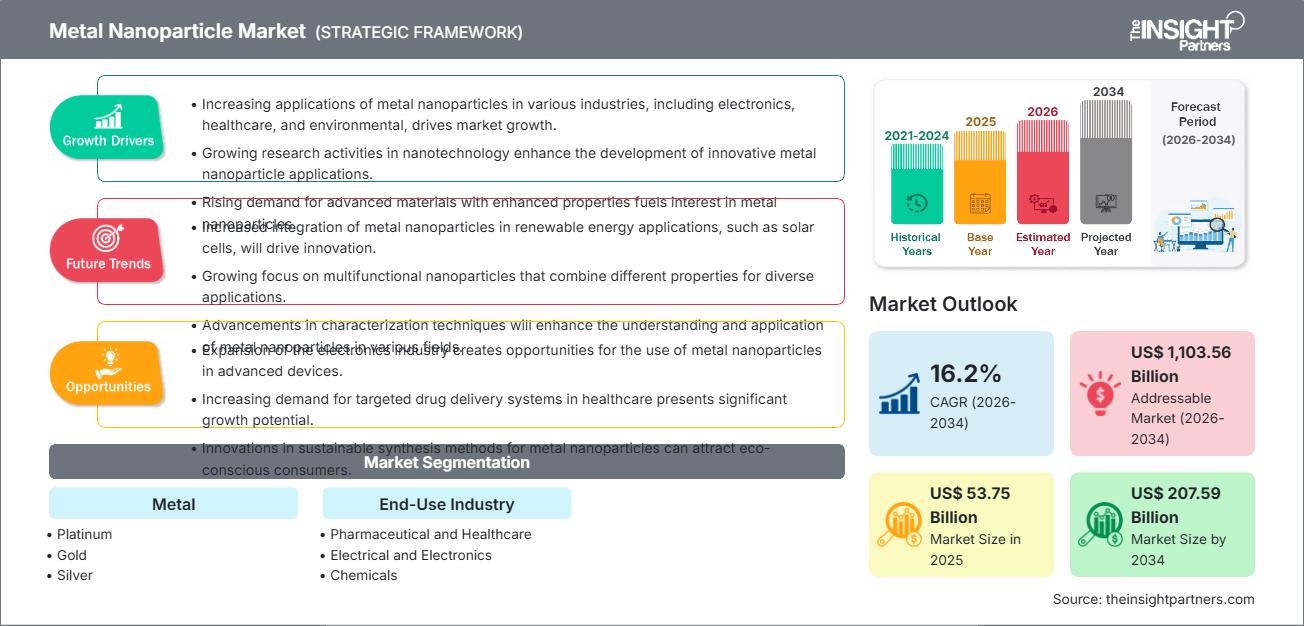
The global Metal Nanoparticle market size is projected to reach US$ 207.59 billion by 2034 from US$ 53.75 billion in 2025. The market is anticipated to register a CAGR of 16.2% during the forecast period 2026–2034. Key market dynamics include the intensifying integration of nanotechnology in medical diagnostics, the rapid miniaturization of electronic components, and the rising demand for high-efficiency catalysts in the chemical industry. Additionally, the market is expected to benefit from the expansion of the renewable energy sector, where metal nanoparticles enhance the efficiency of photovoltaic cells and hydrogen fuel production, alongside increasing investments in sustainable and green synthesis manufacturing methods.
Metal Nanoparticle Market Analysis
The metal nanoparticle market analysis indicates a strategic pivot toward high-purity, application-specific materials as industries demand greater precision and performance. Procurement trends reveal a growing preference for "green" nanoparticles synthesized via biological routes to mitigate environmental impact and regulatory hurdles. Strategic opportunities are emerging in the bio-medical field, specifically in targeted drug delivery systems and photothermal therapies, where the unique surface-plasmon resonance of noble metals provides a distinct therapeutic advantage. The analysis further highlights that market success is increasingly dependent on the ability to scale up production while maintaining uniform particle size and morphology. Competitive differentiation now hinges on R&D capabilities that allow for the customization of surface coatings and functionalization, enabling seamless integration into complex polymer matrices and pharmaceutical formulations.
Metal Nanoparticle Market Overview
Metal nanoparticles are evolving from a specialized laboratory curiosity into a cornerstone of modern industrial manufacturing. While historically utilized for aesthetic purposes or basic catalysis, these materials are now essential in high-tech applications ranging from conductive inks and sensors to advanced antimicrobial coatings. Metal nanoparticles comprise a mix of large-scale chemical conglomerates and agile biotechnology startups, all leveraging the unique physical and chemical properties exhibited by metals at the nanoscale. As global industries seek to improve resource efficiency and product performance, metal nanoparticles have gained traction as enabling materials in the Asia-Pacific and North American regions. For instance, the market in the US is characterized by a robust research ecosystem and a high concentration of advanced technology firms. Strong domestic demand is driven by the aerospace, defense, and healthcare sectors, where innovation in conductive coatings and diagnostic imaging is a primary focus for both private and public investments.
Market Assessment and Insights
- Global market for Metal Nanoparticle was valued at US$ 53.75 Billion in 2025
- Annual market size is expected to reach US$ 207.59 Billion by 2034
- Total addressable market (TAM) during 2026-2034 is projected to reach approximately US$ 1,103.56 Billion
- Market is anticipated to register a CAGR of 16.2% during the forecast period
- The United States represents a key market, supported by Increasing applications of metal nanoparticles in various industries, including electronics, healthcare, and environmental, drives market growth., Growing research activities in nanotechnology enhance the development of innovative metal nanoparticle applications., Rising demand for advanced materials with enhanced properties fuels interest in metal nanoparticles., as well as evolving industry dynamics
- Market analysis covers North America, Europe, Asia-Pacific, South and Central America, Middle East and Africa, with growth evaluated across the forecast period
- Market opportunities such as Expansion of the electronics industry creates opportunities for the use of metal nanoparticles in advanced devices., Increasing demand for targeted drug delivery systems in healthcare presents significant growth potential., Innovations in sustainable synthesis methods for metal nanoparticles can attract eco-conscious consumers. are expected to influence market dynamics and addressable market
- Report profiles industry participants, including American Elements, BBI Group, EPRUI Biotech Co., Ltd., Meliorum Technologies, Inc., Nanocomposix, Nanosc, Inc., Nanostructured and Amorphous Materials, Inc., Nanoshel LLC., TANAKA HOLDINGS Co., Ltd., while analyzing competitive strategies and innovation developments
-
Source: The Insight Partners' analysis based on proprietary research, government publications, company annual reports, investor presentations, industry databases, and expert interviews.
● REPORT CUSTOMIZATION
Tailor This Report To Align With Your Specific Business Requirements
This report can be customized to align precisely with your business objectives, scope, and target markets. Customization options include tailored segmentation, geography, competitive analysis, and strategic insights to support informed decision-making.
Customize This Report →WHAT YOU CAN ADJUST
- ● Segmentations
- ● Geography
- ● Competitive Analysis
- ● Language Preferences
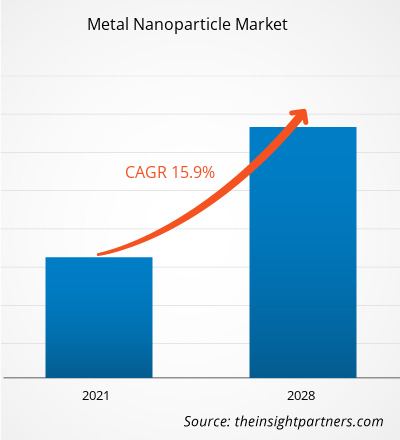
Metal Nanoparticle Market: Strategic Insights
-
Get Top Key Market Trends of this report.This FREE sample will include data analysis, ranging from market trends to estimates and forecasts.
Metal Nanoparticle Market Drivers and Opportunities
Market Drivers:
- Advancements in Healthcare and Targeted Therapeutics: The unique ability of metal nanoparticles to interact with biological markers is revolutionizing diagnostics and oncology treatments. This clinical utility, combined with the rising prevalence of chronic diseases, is a primary driver for market growth.
- Demand for Miniaturized Electronic Devices: As consumer electronics become smaller and more powerful, the need for nano-sized conductive materials in semiconductors and printed circuit boards has surged. Metal nanoparticles provide the necessary conductivity and thermal stability for next-generation hardware.
- Increased Utilization in Environmental Remediation: Metal nanoparticles, particularly iron and titanium, are increasingly used to break down pollutants in water and soil. Their high surface-area-to-volume ratio makes them exceptionally efficient catalysts for large-scale environmental cleanup projects.
Market Opportunities:
- Development of Smart Food Packaging: Incorporating antimicrobial metal nanoparticles, such as silver, into food packaging offers significant opportunities to extend shelf life and enhance food safety for global supply chains.
- Expansion in the Renewable Energy Sector: Opportunities exist in optimizing the performance of solar panels and energy storage systems through the use of metal-based nano-coatings that improve light absorption and charge transfer.
- Growth in the Sustainable Cosmetics Segment: Formulating UV-protection and anti-aging products using non-toxic, bio-compatible metal nanoparticles allows brands to target the premium, health-conscious personal care market.
Metal Nanoparticle Market Report Segmentation Analysis
The Metal Nanoparticle Market share is analyzed across various segments to provide a clearer understanding of its structure, growth potential, and emerging trends. Below is the standard segmentation approach used in most industry reports:
By Metal:
- Platinum, Gold, and Silver: These noble metals are highly valued for their stability and conductivity, predominantly serving the electronics, healthcare, and high-end jewelry or luxury goods industries.
- Iron and Titanium: Widely utilized in industrial applications, including environmental remediation, pigments, and high-strength coatings due to their magnetic properties and photo-catalytic activity.
- Others: Includes copper, nickel, and aluminum nanoparticles used in specific metallurgical, aerospace, and energy storage applications.
By End-Use Industry:
- Pharmaceutical and Healthcare: A primary segment focusing on drug delivery, diagnostic imaging, and antimicrobial medical devices.
- Electrical and Electronics: Utilizing nanoparticles for conductive inks, semiconductors, and high-density data storage solutions.
- Chemicals: Serving as high-efficiency catalysts to speed up reactions and reduce energy consumption in industrial manufacturing.
- Personal Care and Cosmetics: Integrated into sunscreens and skincare products for enhanced UV protection and active ingredient delivery.
- Others: Encompasses applications in the aerospace, defense, and textile industries.
By Geography:
- North America
- Europe
- Asia Pacific
- South & Central America
- Middle East & Africa
Metal Nanoparticle Market Report Scope
| Report Attribute | Details |
|---|---|
| Market size in 2025 | US$ 53.75 Billion |
| Market Size by 2034 | US$ 207.59 Billion |
| Global CAGR (2026 - 2034) | 16.2% |
| Historical Data | 2021-2024 |
| Forecast period | 2026-2034 |
| Segments Covered |
By Metal
|
| Regions and Countries Covered |
North America
|
| Market leaders and key company profiles |
|
Metal Nanoparticle Market Players Density: Understanding Its Impact on Business Dynamics
The Metal Nanoparticle Market is growing rapidly, driven by increasing end-user demand due to factors such as evolving consumer preferences, technological advancements, and greater awareness of the product's benefits. As demand rises, businesses are expanding their offerings, innovating to meet consumer needs, and capitalizing on emerging trends, which further fuels market growth.
Metal Nanoparticle Market Share Analysis by Geography
Asia-Pacific is expected to grow fastest in the coming years. Emerging markets in South & Central America, the Middle East, and Africa also have many untapped opportunities for industrial chemical producers and electronics manufacturers to expand.
The metal nanoparticle market is undergoing a significant transformation, moving from traditional chemical applications to high-tech functional materials. Growth is driven by the miniaturization of electronics, a surge in nanomedicine research, and the expansion of the green energy sector. Below is a summary of market share and trends by region:
North America
- Market Share: Holds the largest share globally, anchored by an advanced research ecosystem and the presence of leading biotechnology and aerospace firms.
- Key Drivers:
- Extensive government funding through initiatives like the National Nanotechnology Initiative (NNI).
- High demand for gold and silver nanoparticles in precision cancer diagnostics and targeted drug delivery.
- Robust domestic electronics sector focusing on nano-enhanced semiconductors and high-density storage.
- Trends: Strategic emphasis on digitalized quality detection and AI-integrated synthesis to ensure long-term market leadership and manufacturing consistency.
Europe
- Market Share: A significant global contributor, characterized by a mature automotive industry and stringent environmental standards.
- Key Drivers:
- Massive consumption of platinum group metal (PGM) nanoparticles for automotive catalytic converters to meet Euro 7 emission standards.
- Well-established pharmaceutical manufacturing hubs in Germany, Switzerland, and the UK.
- Collaborative EU projects focused on replacing critical raw materials with cost-efficient transition metal nanoparticles.
- Trends: A rapid shift toward "Green Synthesis" as a procurement requirement to comply with strict REACH chemical regulations and eco-design mandates.
Asia-Pacific
- Market Share: The fastest-growing region, increasingly dominating the production of base metal and conductive nanoparticles for global supply chains.
- Key Drivers:
- Massive manufacturing base in China, Japan, and South Korea for consumer electronics and flexible displays.
- Rising healthcare investments in India and Southeast Asia, fueling the demand for antimicrobial medical coatings.
- Government-supported agricultural initiatives utilizing nano-fertilizers and smart sensors for food security.
- Trends: Heavy focus on vertically integrated supply chains and the scaling of biological synthesis methods to reduce production costs and energy consumption.
South and Central America
- Market Share: Emerging market with a growing industrial and environmental remediation sector in countries like Brazil, Argentina, and Chile.
- Key Drivers:
- Increasing adoption of metal nanoparticles in the mining industry for more efficient mineral recovery and tailings management.
- Urgent need for advanced water treatment solutions to remove heavy metals from wastewater streams.
- Expansion of the regional pharmaceutical industry seeking domestic production of diagnostic reagents.
- Trends: Growth of clean-mining technology partnerships and the implementation of nano-adsorbents to maintain the safety and quality of regional drinking water supplies.
Middle East and Africa
- Market Share: Developing market with deep strategic interests in energy transition and resource management.
- Key Drivers:
- High demand for metal nanoparticles in solar energy harvesting and high-efficiency water desalination membranes.
- Strategic investments in Smart Agriculture to improve crop yields in arid climates through nano-encapsulated nutrients.
- Modernization of the oil and gas sector via nano-enhanced catalysts for more efficient petroleum refining.
- Trends: Transitioning toward localized commercial production of high-nutrient agricultural additives and the implementation of modern refrigeration tech using nano-coolants to stabilize supply chains.
High Market Density and Competition
Competition is intensifying due to the presence of established leaders such as American Elements, BBI Group, EPRUI Biotech Co., Ltd., Meliorum Technologies, Inc., Nanocomposix, Nanosc, Inc., Nanostructured and Amorphous Materials, Inc., Nanoshel LLC., and TANAKA HOLDINGS Co., Ltd., which also contribute to a diverse and rapidly expanding market landscape.
This competitive environment pushes vendors to differentiate through:
- Precision Functionalization and Customization: Positioning nanoparticles as high-value, application-specific solutions rather than raw commodities. Companies are tailoring surface ligands and coatings to meet the exact molecular requirements of pharmaceutical drug delivery systems and high-end electronic sensors.
- Investment in AI-Integrated Synthesis and R&D: Leading firms are utilizing artificial intelligence and automated "self-driving" laboratories to accelerate the discovery of new particle morphologies. This approach ensures greater batch-to-batch reproducibility and consistency, which is critical for industrial-scale integration.
- Adoption of Green and Bio-Based Synthesis: Producers are increasingly managing their environmental footprint by transitioning toward biological synthesis routes. Utilizing plant extracts or microbial processes helps companies meet strict global regulatory standards and appeals to the growing demand for sustainable manufacturing.
- Strategic Vertical Integration and CDMO Partnerships: Market players are expanding their capabilities by offering end-to-end services, from custom nanoparticle design to large-scale contract manufacturing (CDMO). This ensures quality control across the entire supply chain and accelerates the time-to-market for innovative nano-enabled products.
Opportunities and Strategic Moves
- Partner with specialized CDMOs and pharmaceutical giants to capitalize on the surging demand for metal nanoparticle-based targeted therapies and point-of-care diagnostic kits in the North American and European healthcare markets.
- Invest in the development of high-conductivity, low-cost metal inks to tap into the rapid expansion of flexible electronics and 5G infrastructure, particularly in the high-growth Asia-Pacific corridor.
- Expand into the renewable energy sector by engineering metal nanoparticles for use in high-efficiency solar cells and hydrogen fuel electrolysis, aligning with global shifts toward decarbonization and green technology.
Major Companies operating in the Metal Nanoparticle Market are:
- American Elements
- BBI Group
- EPRUI Biotech Co., Ltd.
- Meliorum Technologies, Inc.
- Nanocomposix
- Nanosc, Inc.
- Nanostructured and Amorphous Materials, Inc.
- Nanoshel LLC.
- TANAKA HOLDINGS Co., Ltd.
Disclaimer: The companies listed above are not ranked in any particular order.
Metal Nanoparticle Market News and Recent Developments
- In July 2025, Merck announced that it had closed the acquisition of SpringWorks Therapeutics, Inc., for an enterprise value of $3.4 billion (approximately €3 billion), following regulatory clearances and the fulfillment of other customary closing conditions. This acquisition strengthened Merck's position in the oncology sector, specifically enhancing its capabilities to develop therapies that leverage metal nanoparticle technology for targeted drug delivery and precision medicine.
- In April 2025, Fortis Life Sciences partnered with Avantor, Inc., a leading global provider of mission-critical products and services, to expand the availability of its reagents across North America. This collaboration significantly broadened the distribution of high-performance metal nanoparticle solutions from Fortis's brand, nanoComposix, facilitating greater access to specialized gold and silver particles for researchers in the diagnostic and pharmaceutical sectors.
Metal Nanoparticle Market Report Coverage and Deliverables
The Metal Nanoparticle Market Size and Forecast (2021–2034) report provides a detailed analysis of the market covering below areas:
- Metal Nanoparticle Market size and forecast at global, regional, and country levels for all the key market segments covered under the scope
- Metal Nanoparticle Market trends, as well as market dynamics such as drivers, restraints, and key opportunities
- Detailed PEST and SWOT analysis
- Metal Nanoparticle Market analysis covering key market trends, global and regional framework, major players, regulations, and recent market developments
- Industry landscape and competition analysis covering market concentration, heat map analysis, prominent players, and recent developments in the Metal Nanoparticle Market.
- Detailed company profiles
Frequently Asked Questions

- Comprehensive Market Sizing and Forecast Analysis
- Detailed Segmentation Analysis
- In-Depth Market Dynamics Assessment
- Regional and Country-Level Insights
- Competitive Landscape and Company Benchmarking
- Strategic Business Intelligence
Recent Reports
Testimonials

The Insight Partners' SCADA System Market report is comprehensive, with valuable insights on current trends and future forecasts. The team was highly professional, responsive, and supportive throughout. We are very satisfied and highly recommend their services.
RAN KEDEM Partner, Reali Technologies LTDs
I requested a report on a very specific software market and the team produced the report in a few days. The information was very relevant and well presented. I then requested some changes and additions to the report. The team was again very responsive and I got the final report in less than a week.
JEAN-HERVE JENN Chairman, Future Analytica
We worked with The Insight Partners for an important market study and forecast. They gave us clear insights into opportunities and risks, which helped shape our plans. Their research was easy to use and based on solid data. It helped us make smart, confident decisions. We highly recommend them.
PIYUSH NAGPAL Sr. Vice President, High Beam Global
The Insight Partners delivered insightful, well-structured market research with strong domain expertise. Their team was professional and responsive throughout. The user-friendly website made accessing industry reports seamless. We highly recommend them for reliable, high-quality research services
YUKIHIKO ADACHI CEO, Deep Blue, LLC.
This is the first time I have purchased a market report from The Insight Partners.While I was unsure at first, I visited their web site and felt more comfortable to take the risk and purchase a market report.I am completely satisfied with the quality of the report and customer service. I had several questions and comments with the initial report, but after a couple of dialogs over email with their analyst I believe I have a report that I can use as input to our strategic planning process.Thank you so much for taking the extra time and making this a positive experience.I will definitely recommend your service to others and you will be my first call when we need further market data.
JOHN SUZUKI President and Chief Executive Officer, Board Director, BK Technologies
I wish to appreciate your support and the professionalism you displayed in the course of attending to my request for information regarding to infectious disease IVD market in Nigeria. I appreciate your patience, your guidance, and the fact that you were willing to offer a discount, which eventually made it possible for us to close a deal. I look forward to engaging The Insight Partners in the future, all thanks to the impression you have created in me as a result of this first encounter.
DR CHIJIOKE ONYIA MANAGING DIRECTOR, PineCrest Healthcare Ltd.Reason to Buy
- Informed Decision-Making
- Understanding Market Dynamics
- Competitive Analysis
- Identifying Emerging Markets
- Customer Insights
- Market Forecasts
- Risk Mitigation
- Boosting Operational Efficiency
- Strategic Planning
- Investment Justification
- Tracking Industry Innovations
- Aligning with Regulatory Trends





 Get Free Sample for