
オル-気象着陸システム市場:規模・成長・予測 2034
全天候型着陸システム市場規模と予測(2021~2034年)、世界および地域別シェア、トレンド、成長機会分析レポートの対象範囲:タイプ別(ILS(計器着陸システム)、GBAS(地上支援システム)、MLS(マイクロ波着陸システム))、用途別(軍用機、民間機、商用機)、地域別(北米、欧州、アジア太平洋、南米および中米)
- ステータス : 公開されたデータ
- レポートコード : TIPRE00019760
- カテゴリー : 航空宇宙および防衛
- ページ数 : 150
- 利用可能なレポート形式 :


- 最終更新日 : November 03, 2026


2025 Market Size
US$ 2.11 Bn
Base year value
2034 Forecast
US$ 3.94 Bn
Projected by 2034
CAGR 2026-2034
7.17 %
Growth rate
Addressable Market
US$ 27.28 Bn
(2026-2034)
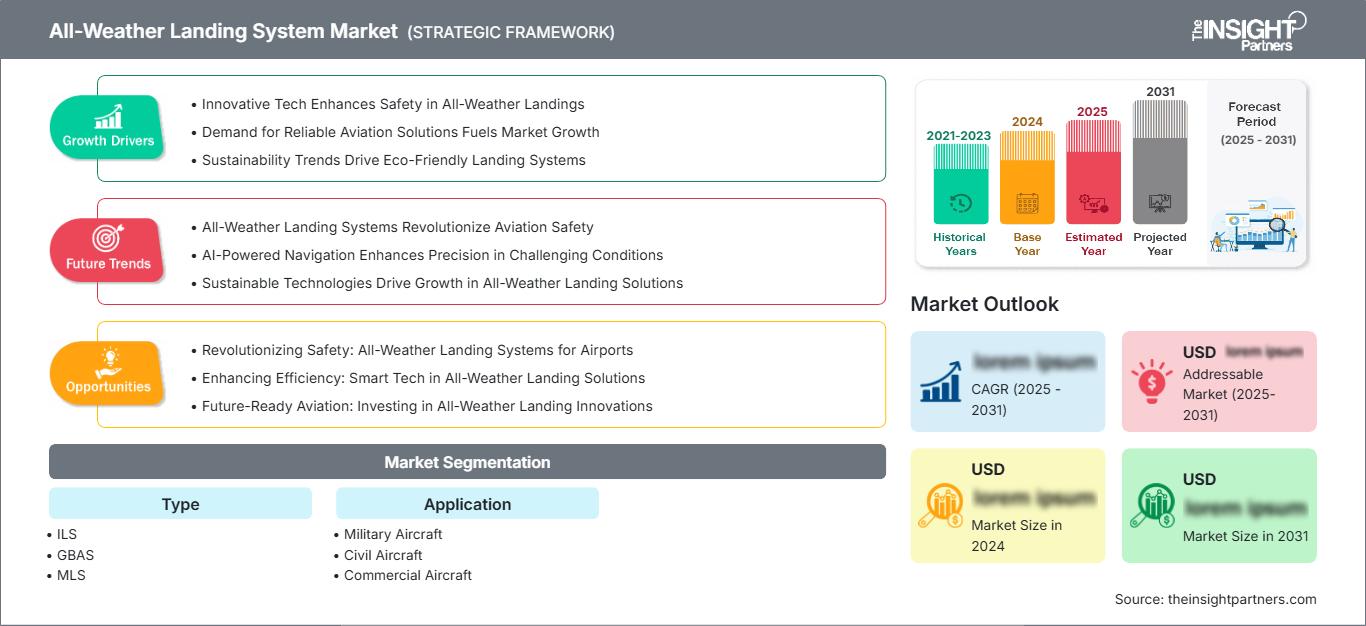
The all-weather landing system market was valued at US$ 2.11 Billion in 2025 and is projected to reach US$ 3.94 Billion by 2034, registering a CAGR of 7.17% from 2026 to 2034. Growth is supported by modernization of airport navigation infrastructure, increasing requirements for reliable low-visibility operations, aircraft fleet expansion, and the transition toward satellite-enabled precision approaches. ILS remains central to precision landing infrastructure, while GBAS adoption is expanding as airports seek flexible approach paths and more efficient use of runway infrastructure.
North America remains a significant demand center in the All-Weather Landing System Market share as airlines, airports, and defense organizations continue investing in navigation modernization and operational resilience. The region is projected to register a CAGR of ~6% through 2034, supported by established airport infrastructure, continued deployment of advanced navigation technologies, and regulatory emphasis on safe operations in constrained and low-visibility environments. The region also benefits from an established installed base of precision approach equipment, creating recurring replacement, upgrade, calibration, and integration requirements.
All-Weather Landing System Market Assessment and Insights
Regional Outlook
- North America: ~36% of the global market in 2025 | ~6% CAGR through 2034. Market position: North America holds the largest regional position, supported by extensive airport infrastructure, mature precision-approach deployment, military aviation requirements, and continued modernization of navigation systems across major commercial and defense aviation facilities.
- US: ~78% of North American market revenue in 2025 | ~6% CAGR through 2034. Market position: The US dominates North American demand because of its large commercial aviation network, extensive military airfield infrastructure, established ILS base, and continued integration of satellite-enabled navigation and landing technologies into the national airspace system.
- Europe: ~27% of the global market in 2025 | ~6% CAGR through 2034. Market position: Europe represents a mature precision-landing market led by Germany, the UK, France, Italy, and Spain, where stringent low-visibility operating requirements and airport modernization sustain demand for reliable ILS, GBAS, and associated navigation infrastructure.
- Asia Pacific: ~25% of the global market in 2025 | ~9% CAGR through 2034. Market position: Asia Pacific is the fastest-growing region, driven by airport expansion, rising aircraft movements, navigation modernization, and investment in satellite-based landing infrastructure. China, Japan, South Korea, India, and Australia provide diverse growth opportunities across commercial and government aviation.
Segment Outlook
- ILS: ~68% Share in 2025 | ~6% CAGR through 2034. Market position: ILS leads because it has a broad installed base and established certification, operational procedures, aircraft compatibility, and maintenance ecosystem. Airports continue replacing aging equipment while retaining ILS as a dependable precision approach solution.
- GBAS: ~18% Share in 2025 | ~10% CAGR through 2034. Market position: GBAS has the strongest growth outlook because one ground installation can support multiple runway ends and approach paths. Its digital architecture supports flexible procedures, infrastructure optimization, and improved operational efficiency at high-traffic airports.
Competitive Coverage
Raytheon Technologies Corporation, Honeywell International Inc., Indra Sistemas, S.A., Leonardo S.p.A., MOPIENS, INC., NEC Corporation, Saab AB, Systems Interface Limited, Thales Group, Universal Avionics Systems Corporation
Methodology
The Insight Partners follows Data Collection & Secondary Research, Primary Research, Data Analysis, and Data Triangulation & Final Review to validate market estimates and insights.
Source: The Insight Partners' analysis based on proprietary research, government publications, company annual reports, investor presentations, industry databases, and expert interviews.
The all-weather landing system market has evolved from conventional radio-based precision approach infrastructure toward increasingly integrated navigation architectures. ILS remains deeply embedded because airports and aircraft operators depend on established procedures, certification frameworks, and installed equipment. At the same time, GBAS introduces satellite-derived correction and integrity information that can support multiple approaches from one ground facility. FAA guidance recognizes GBAS as a satellite-based alternative to ILS, while European low-visibility rules continue to define stringent equipment and operational requirements for CAT II and CAT III approaches.
Looking ahead, the all-weather landing system market is expected to benefit from airport development in emerging aviation centers, modernization of existing navigation assets, and greater emphasis on resilient operations. Asia Pacific is particularly positioned for expansion as new airport capacity is combined with navigation upgrades. Japan’s operationalization of GBAS at Haneda in January 2025 demonstrates the progression of satellite-based precision landing infrastructure in the region. Investment will increasingly focus on interoperable equipment, system integration, lifecycle services, and technologies capable of supporting increasingly complex low-visibility and high-throughput operations.
All-Weather Landing System Market Report Scope
| Report Attribute | Details |
|---|---|
| Market size in 2025 | US$ 2.11 Billion |
| Market Size by 2034 | US$ 3.94 Billion |
| Global CAGR (2026 - 2034) | 7.17% |
| Historical Data | 2021-2024 |
| Forecast period | 2026-2034 |
All-Weather Landing System Market Analysis
Demand in the All-Weather Landing System Market report is anchored by the operational requirement to maintain safe approach and landing capability when visual conditions deteriorate. ILS remains valuable because it is supported by mature aircraft equipment, established procedures, and extensive airport experience. The value chain extends from navigation-system developers and precision receivers to airport authorities, air navigation service providers, aircraft integrators, calibration organizations, and maintenance specialists. Demand therefore includes new installations as well as modernization, replacement, calibration, software updates, and integration with broader airport navigation infrastructure.
Supply dynamics in the All-Weather Landing System Market trends are shaped by certification requirements, safety-critical engineering, specialized radio-frequency components, software assurance, and long procurement cycles. GBAS changes the infrastructure equation by allowing a single ground facility to support multiple runway ends, potentially reducing the number of dedicated precision-approach installations required at an airport. Suppliers with established regulatory knowledge and installed-base relationships have an advantage because airport operators prioritize continuity, interoperability, lifecycle support, and proven operational performance when procuring mission-critical landing systems.
The competitive landscape in the All-Weather Landing System Market forecast combines large aerospace and defense companies with specialized navigation and airport-system providers. Honeywell maintains a strong position in satellite-based precision landing through SmartPath, while Indra supplies ILS and associated navigation systems to major airports. NEC has strengthened its GBAS position through its Haneda deployment, and Systems Interface provides turnkey ILS integration across civil and military airports. Leonardo, Saab, Thales, Universal Avionics Systems Corporation, MOPIENS, and Raytheon Technologies Corporation broaden the competitive field through navigation, avionics, defense, and airport technology capabilities.
Investment priorities are shifting toward modernization rather than simple capacity replacement. Vendors are positioning around lower lifecycle costs, digital interfaces, flexible approach procedures, resilient navigation, and integration with wider airport management systems. The all-weather landing system market therefore rewards suppliers that can combine equipment with certification support, installation, flight inspection, maintenance, and software capabilities. Competitive differentiation increasingly depends on the ability to support mixed legacy and next-generation infrastructure without disrupting airport operations.
● REPORT CUSTOMIZATION
Tailor This Report To Align With Your Specific Business Requirements
This report can be customized to align precisely with your business objectives, scope, and target markets. Customization options include tailored segmentation, geography, competitive analysis, and strategic insights to support informed decision-making.
Customize This Report →WHAT YOU CAN ADJUST
- ● Segmentations
- ● Geography
- ● Competitive Analysis
- ● Language Preferences
All-Weather Landing System Market:
要件に合わせてレポートをカスタマイズ
レポートの一部、国レベルの分析、Excelデータパックなどを含め、スタートアップ&大学向けに特別オファーや割引もご利用いただけます(無償)
全天候型着陸システム市場: 戦略的洞察
-
このレポートの主要な市場動向を入手してください。この無料サンプルには、市場動向から見積もりや予測に至るまでのデータ分析が含まれます。
Regional Insights
North America all-weather landing system market
North America held an estimated ~36% of the global all-weather landing system market in 2025 and is expected to expand at ~6% CAGR through 2034. The region benefits from a large installed base of precision approach infrastructure and a substantial concentration of commercial airports, military airfields, business aviation facilities, and aviation technology suppliers. The US accounts for the majority of regional revenue, supported by extensive airport activity and continuous modernization of national airspace infrastructure.
The regional opportunity increasingly involves coexistence between conventional ILS and satellite-enabled landing technologies. FAA documentation identifies GBAS as a satellite-based alternative to ILS and notes that one GBAS installation can support multiple runway ends. This creates a pathway for selective adoption at airports where runway complexity, traffic density, and lifecycle economics justify modernization. Canada also contributes through airport and aviation infrastructure renewal, although the US remains the principal demand center because of its larger aviation ecosystem and defense requirements.
U.S. all-weather landing system market
The US represented ~78% of North American all-weather landing system market revenue in 2025 and is expected to grow at ~6% CAGR through 2034. It is dependent upon the size of the commercial airport network, military aviation facilities, and the established regulations for precision approach. It comprises replacement demand for existing systems as well as the demand for new satellite-based approach systems which are economically and technically feasible to be installed in airports.
US competitive landscape consists of Honeywell, Raytheon Technologies Corporation, Universal Avionics Systems Corporation, among others. Programs of the FAA have increasingly incorporated satellite-based navigation systems and air traffic management systems, while installation of GBAS at Newark, Houston, and San Francisco airports shows the operational feasibility of the technology. Commercial aviation is one of the important applications of this technology, whereas military needs provide additional demand for precision navigation and landing systems.
Europe all-weather landing system market
Europe accounted for ~27% of the global all-weather landing system market in 2025 and is projected to register a ~6% CAGR through 2034. There is well-established infrastructure with strict low visibility requirements that ensures regular demand for precision approach system installation and modernization. Germany remains the leading market in Europe due to its high density of aviation infrastructure and well-established airport infrastructure. The UK and France also ensure significant demand due to large international airports and defense aviation systems.
Germany focuses on the reliability of the systems, whereas the UK combines civil airport modernization with military applications. The French market enjoys the advantage of major international aviation centers and aerospace industry. There are also potential markets such as Italy and Spain that enjoy airport infrastructure modernization and increasing passengers' traffic. European legislation includes the issues of ILS and GLS/GBAS classification under low visibility requirements and CAT II and CAT III approaches.
Thus, the European market features a combination of the need for preserving existing ILS facilities and assessing new navigation technologies. The vendors should deal with the issues of certification, safety evaluation, flight checking, equipment reliability, and integration into airport operations. The demand is driven also by the necessity of sustaining the uninterrupted operations during equipment upgrades and favors phased equipment replacements.
APAC all-weather landing system market
Asia Pacific represented ~25% of the global all-weather landing system market in 2025 and is projected to expand at ~9% CAGR through 2034, making it the fastest-growing regional market. China remains the most prominent in Asia Pacific because of its huge investments in building airports, commercial aviation, and navigation infrastructure development. The other contributors to development in this regard are Japan, South Korea, India, and Australia.
The GBAS introduction into Haneda Airport by Japan was the first in the history of Asia in January 2025, showing that the region is going to develop towards satellite-based precision landing. South Korea also develops its navigation airport infrastructure, and India keeps developing its airport capacities and precision landing technologies. Australia already has an aviation infrastructure which will also serve as a platform for landing technologies development in the region.
Middle East & Africa all-weather landing system market
The Middle East and Africa market is projected to grow at ~7% CAGR through 2034. Among all the countries in the region, Saudi Arabia appears to be the most developed nation in terms of airport infrastructure development and investments in aircraft navigation equipment. The UAE is yet another significant market, as large-scale international airports need highly reliable operations and effective navigation facilities.
South Africa is the primary existing base for aviation in the region, while the Rest of Middle East & Africa offers further opportunities through airport development, air connectivity programs and navigation equipment modernization projects. GBAS equipment suppliers may discover new business opportunities in cases when airports have a number of runway ends and are interested in flexible approaches. Specifically, NEC has identified Southeast Asia and the Middle East as potential regions for further GBAS development.
Segmentation Analysis
Type
Type represents the technology architecture through which precision approach and landing guidance is delivered in the All-Weather Landing System Market. ILS remains the largest technology base because of its installed infrastructure, certification maturity, aircraft compatibility, and extensive operational experience, while newer architectures are gaining attention as airports evaluate infrastructure efficiency. Within this category, ILS is estimated to expand at ~6% CAGR through 2034. Procurement decisions increasingly balance established reliability against the operational flexibility and infrastructure efficiencies offered by satellite-enabled alternatives.
- ILS: Provides established lateral and vertical guidance for precision approaches and remains fundamental to low-visibility airport operations. Its broad installed base, standardized operating procedures, and compatibility with commercial and military aviation sustain replacement and modernization demand.
- GBAS: Uses satellite navigation corrections and integrity monitoring to provide precision approach guidance. Its ability to support multiple runway ends from a single ground facility improves infrastructure flexibility and creates a pathway for modernization at high-traffic airports.
- MLS: Uses microwave-based guidance to provide precise approach information and offers flexibility in approach geometry. Its role is more specialized than ILS, with adoption shaped by specific operational requirements and the availability of alternative navigation technologies.
Application
Application determines the operational environment and buyer requirements for landing infrastructure in the All-Weather Landing System Market. The segment benefits from demand across commercial aviation, civil airport operations, and military fleets, with procurement influenced by runway utilization, weather exposure, safety requirements, and mission profiles. Commercial Aircraft is expected to record a CAGR of ~7% through 2034 as expanding airline fleets and higher airport utilization increase the need for dependable precision approach capability across major operating hubs.
- Military Aircraft: Military users require landing capability that supports operations from established airbases and demanding environments. Procurement emphasizes resilience, interoperability, mission availability, and compatibility with broader military navigation and avionics architectures.
- Civil Aircraft: Civil aviation applications encompass scheduled and nonscheduled operations where reliable approach guidance supports airport accessibility and safety. Demand is closely linked to airport modernization, regulatory requirements, and the need to sustain operations during adverse weather.
- Commercial Aircraft: Commercial fleets generate recurring demand because high aircraft utilization increases the importance of dependable approach and landing systems. Major airlines and hub airports also benefit from technologies that support capacity, predictable operations, and efficient runway utilization.
Opportunity Snapshot
|
Application |
Revenue Contribution |
Trend Tag |
Adoption Stage |
|---|---|---|---|
|
Military Aircraft |
Medium |
Mission Resilience |
Mature |
|
Civil Aircraft |
Medium |
Airport Modernization |
Scaling |
|
Commercial Aircraft |
High |
Hub Optimization |
Mature |
All-Weather Landing System Market Growth Drivers and Impact Analysis
Airport Modernization and Runway Capacity Requirements
Airport modernization is a primary demand driver because landing infrastructure must evolve alongside runway expansion, higher aircraft movements, and tighter requirements for operational continuity. Major airports increasingly need navigation systems that maintain reliable approaches while supporting efficient use of available runway capacity. GBAS can contribute to this objective because a single ground installation can support multiple runway ends, reducing the infrastructure duplication associated with separate ILS installations. The impact is strongest at airports where multiple runways, high traffic density, and constrained operating windows create a clear economic case for infrastructure optimization. This mechanism expands demand beyond simple replacement and encourages investment in integrated navigation modernization, system engineering, installation, certification, and lifecycle maintenance services.
Stricter Low-Visibility Operational Requirements
Regulatory requirements for low-visibility operations directly support demand for reliable precision approach infrastructure. EASA rules require specific approvals for low-visibility approaches and define equipment and operational conditions for CAT II and CAT III operations. Such requirements increase the importance of certified landing systems, runway procedures, equipment redundancy, flight inspection, and maintenance. The commercial impact extends across both airport operators and aircraft operators because low-visibility capability affects whether flights can continue under deteriorating weather conditions. As airports seek higher operational resilience, investments in landing infrastructure become connected to broader safety and capacity objectives rather than being treated solely as navigation-equipment purchases.
Growth of Commercial and Defense Aviation Infrastructure
Expansion of aviation infrastructure across commercial and defense applications broadens the addressable demand base. New airports and runway projects require precision approach capabilities from the initial design stage, while existing facilities require equipment replacement as navigation assets age or operational requirements change. Defense organizations similarly require dependable landing capability for fixed-wing fleets operating from dispersed airfields. The combined effect creates a diversified procurement environment in which suppliers can address new installations, modernization, upgrades, integration, and lifecycle support. Growth is particularly relevant in Asia Pacific and the Middle East, where airport development and aviation connectivity initiatives create opportunities for suppliers with established certification capabilities and the ability to deliver complete navigation infrastructure.
All-Weather Landing System Market Future Trends
Migration Toward Multi-Runway Satellite Precision Approaches
The next phase of the all-weather landing system market is likely to feature greater evaluation of GBAS at airports where multiple runway ends make conventional infrastructure-intensive approaches less efficient. GBAS can provide correction and integrity information to aircraft while supporting several approach paths from one airport installation. This capability changes procurement economics by shifting attention from individual runway equipment toward airport-wide precision approach architecture. Adoption will depend on compatible airborne equipment, certification, procedure development, local spectrum considerations, and airport traffic patterns. As more operational references emerge, buyers are likely to assess GBAS alongside ILS rather than treating the technologies as mutually exclusive, resulting in hybrid infrastructure strategies.
Integration of Landing Guidance with Digital Aviation Systems
Landing infrastructure is expected to become increasingly connected with digital flight-deck, navigation, surveillance, and airport management systems. Modernization initiatives are already moving aviation infrastructure toward more integrated information exchange, while advanced navigation systems increasingly use digital data to support approach and landing. Over time, this integration can improve monitoring, maintenance planning, situational awareness, and operational coordination. Suppliers will therefore compete not only on radio-navigation performance but also on software architecture, data interfaces, cybersecurity, diagnostics, and lifecycle support. The trend can create new value for providers capable of integrating landing systems into broader airport and air traffic management environments while maintaining the certification and reliability required for safety-critical operations.
All-Weather Landing System Market Opportunities
Modernization Programs for Aging ILS Infrastructure
A substantial opportunity lies in replacing or upgrading aging ILS infrastructure while preserving operational continuity. Airports with long-established precision approach networks require equipment renewal, calibration, monitoring upgrades, spare parts, and technical support even when they are not ready for complete migration to GBAS. Suppliers can therefore develop phased modernization offerings that combine new transmitters, receivers, monitoring systems, remote diagnostics, and integration services. The commercial opportunity is particularly relevant in mature aviation regions where installed-base density is high. Companies that can reduce installation downtime, reuse existing site infrastructure, and provide certification and flight-calibration support can improve procurement attractiveness while helping airport operators manage capital expenditure across multiple budget cycles.
GBAS Deployment in Emerging Airport Hubs
Emerging airport hubs provide an opportunity for GBAS suppliers because new infrastructure can be designed around satellite-enabled precision landing rather than requiring a direct replication of legacy runway-by-runway equipment. NEC's operational deployment at Haneda and its stated interest in Southeast Asian and Middle Eastern markets demonstrate how technology suppliers are positioning GBAS for wider international deployment. Opportunity is strongest where airports have several runway ends, rising traffic volumes, and a requirement to improve approach flexibility. Vendors can capture value through complete packages covering ground stations, aircraft compatibility, procedure development, installation, certification support, training, and long-term maintenance.
Frequently Asked Questions

Naveenは、カスタム、シンジケート、コンサルティングの各プロジェクトにおいて9年以上の実績を持つ、経験豊富な市場調査およびコンサルティングのプロフェッショナルです。現在はアソシエイトバイスプレジデントを務め、プロジェクトバリューチェーン全体にわたるステークホルダー管理を成功させ、100件以上の調査レポートと30件以上のコンサルティング案件を執筆しています。産業および政府機関のプロジェクトに幅広く携わり、クライアントの成功とデータに基づく意思決定に大きく貢献しています。
Naveenは、カルナータカ州VTUで電子通信工学の学位を取得し、マニパル大学でマーケティング&オペレーションズのMBAを取得しています。IEEEの会員として9年間活動し、会議や技術シンポジウムへの参加、セクションレベルおよび地域レベルでのボランティア活動に積極的に取り組んでいます。現職以前は、IndustryARCでアソシエイト戦略コンサルタント、Hewlett Packard(HP Global)で産業用サーバーコンサルタントを務めていました。
- 包括的な市場規模および予測分析
- 詳細なセグメンテーション分析
- 市場動向(ダイナミクス)の徹底的な評価
- 地域および国別のインサイト
- 競争環境および企業ベンチマーク
- 戦略的ビジネスインテリジェンス
お客様の声

The Insight Partnersは、当社のグローバルな市場参入戦略を支える有益な市場インテリジェンスを提供してくれました。同社のチームはプロフェッショナルかつ迅速に対応し、こちらのフィードバックにも丁寧に耳を傾け、プロジェクト全体を通じて、思慮深い分析や手法に関する有益な説明を行ってくれました。
Junmo Kim 最高財務責任者(CFO), エナテック株式会社
Insight PartnersのSCADAシステム市場レポートは包括的で、現在のトレンドと将来の予測に関する貴重な洞察が含まれています。チームは終始、非常にプロフェッショナルで、対応が早く、サポートも充実していました。私たちは彼らのサービスに非常に満足しており、強くお勧めします。
ラン・ケデム パートナー, レアリテクノロジーズ株式会社
非常に特殊なソフトウェア市場に関するレポートを依頼したところ、チームは数日でレポートを作成してくれました。情報は非常に関連性が高く、分かりやすくまとめられていました。その後、レポートにいくつか修正と追加を依頼しましたが、チームは非常に迅速に対応し、1週間も経たないうちに最終レポートを受け取ることができました。
ジャン=エルヴェ・ジェン 会長, フューチャー・アナリティカ
重要な市場調査と予測のために、The Insight Partnersと協力しました。彼らは機会とリスクに関する明確な洞察を提供し、私たちの計画策定に役立ちました。彼らの調査は使いやすく、確かなデータに基づいており、賢明で自信に満ちた意思決定に役立ちました。彼らを強くお勧めします。
ピユーシュ・ナグパル 上級副社長, ハイビームグローバル
Insight Partnersは、深い専門知識に基づき、洞察力に富み、構造化された市場調査を提供しました。チームは終始プロフェッショナルで、対応力も抜群でした。ユーザーフレンドリーなウェブサイトにより、業界レポートへのアクセスもスムーズでした。信頼性の高い高品質な調査サービスをお探しなら、Insight Partnersを強くお勧めします。
安達幸彦 最高経営責任者(CEO), ディープブルーLLC。
The Insight Partnersから市場レポートを購入するのは今回が初めてです。最初は不安でしたが、ウェブサイトを見て、リスクを負ってでも購入してみようという気持ちになりました。レポートの品質とカスタマーサービスには大変満足しています。最初のレポートにはいくつか質問やコメントがありましたが、アナリストとメールで何度かやり取りした結果、戦略策定プロセスへのインプットとして活用できるレポートが完成しました。貴重なお時間を割いていただき、貴重な体験をさせていただき、誠にありがとうございました。他の方にもぜひお勧めしたいですし、今後さらに市場データが必要になった際には、まずThe Insight Partnersにご連絡させていただきます。
ジョン・スズキ 社長兼最高経営責任者、取締役, BKテクノロジーズ
ナイジェリアの感染症IVD市場に関する情報提供依頼に対し、ご対応いただいた際、ご尽力とプロフェッショナルな姿勢に深く感謝申し上げます。忍耐強く、的確なアドバイスをいただき、また、最終的に取引成立に至った割引のご提供にも深く感謝申し上げます。今回の最初の出会いで得た強い印象のおかげで、今後もThe Insight Partnersとの連携を心待ちにしております。
チジオケ博士 オニア マネージングディレクター, パインクレストヘルスケア株式会社購入理由
- 情報に基づいた意思決定
- 市場動向の理解
- 競合分析
- 顧客インサイト
- 市場予測
- リスク軽減
- 戦略計画
- 投資の正当性
- 新興市場の特定
- マーケティング戦略の強化
- 業務効率の向上
- 規制動向への対応




















 無料サンプルを入手 -