
3D Scanning Market Size, Share & Growth by 2034
Coverage: By Type (Laser Scanner, Optical Scanner, Structured Light Scanners, Others); Range (Short Range, Medium Range, Long Range); Services (Reverse Engineering, Quality Inspection, Rapid Prototyping, Face Body Scanning); End User (Aerospace and Defense, Healthcare, Entertainment and Media, Industrial Manufacturing, Others) , and Geography (North America, Europe, Asia Pacific, and South and Central America)
- Status : Data Released
- Report Code : TIPRE00003275
- Category : Electronics and Semiconductor
- No. of Pages : 150
- Available Report Formats :


- Last update date : July 15, 2026


2025 Market Size
US$ 5.23 Bn
Base year value
2034 Forecast
US$ 10.3 Bn
Projected by 2034
CAGR 2026-2034
7.82 %
Growth rate
Addressable Market
US$ 69.89 Bn
(2026-2034)
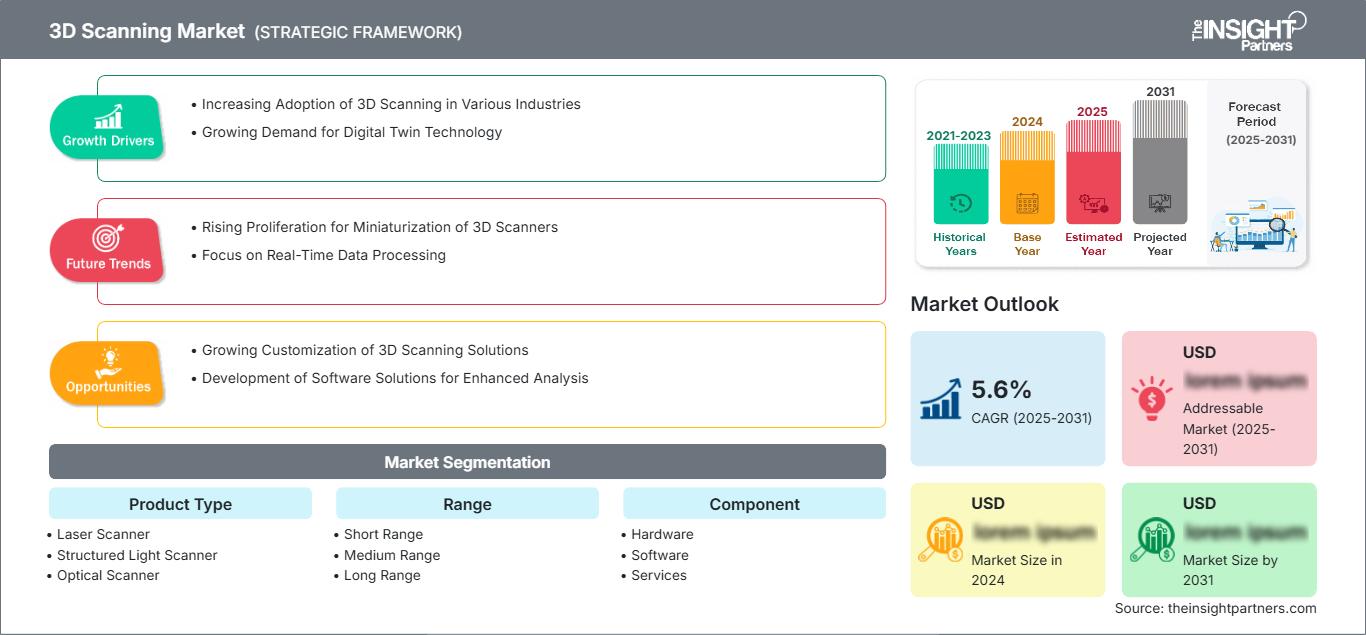
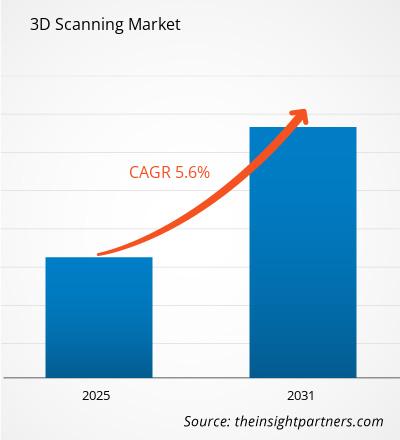
The 3D Scanning Market was valued at US$ 5.23 Billion in 2025 and is projected to reach US$ 10.3 Billion by 2034, expanding at a CAGR of 7.82% during 2026–2034. Adoption is driven by wider use of 3D capture in industrial inspection, reverse engineering, digital manufacturing, healthcare modeling, and construction documentation across precision-led workflows.
North America is expected to grow at a CAGR range of 7.2–7.6% through 2034 as aerospace inspection, automotive tooling, and healthcare customization expand scanner deployment. The region benefits from advanced metrology adoption, strong software ecosystems, and quality-control mandates that favor traceable, repeatable dimensional data across manufacturing, public safety, and architecture workflows.
3D Scanning Market Assessment and Insights
- North America: The region held 33–36% share in 2025 and is growing at a CAGR of 7.2–7.6% during 2026–2034, supported by aerospace metrology, healthcare digitization, and construction scanning.
- US: The country represented 78–82% of North America in 2025 and is growing at a CAGR of 7.3–7.7%, led by industrial inspection and defense-linked applications.
- Europe: Europe held 24–27% share in 2025 and is growing at a CAGR of 6.9–7.3%; Germany, the UK, and France lead adoption in automotive, aerospace, and heritage documentation.
- Asia Pacific: Asia Pacific held 28–31% share in 2025 and is growing at a CAGR of 8.4–8.8%; China, Japan, South Korea, and India lead manufacturing, electronics, and infrastructure demand.
- Largest Segment: Hardware held 57–61% market share in 2025 and is growing at a CAGR of 7.0–7.4%, reflecting continued demand for scanners, sensors, and metrology systems.
- High Growth Segment: Services held 16–19% market share in 2025 and is growing at a CAGR of 8.7–9.1%, driven by outsourced inspection, scan-to-BIM, calibration, and reverse engineering support.
- Key companies analyzed in detail: Artec 3D, Autodesk, Inc., AMETEK, Inc., FARO Technologies, Inc., Hexagon AB, Nikon Metrology NV, 3D Systems Corporation, Trimble Inc., Topcon Corporation, Carl Zeiss AG, SHINING 3D Tech Co., Ltd., RIEGL Laser Measurement Systems GmbH
Source: The Insight Partners' analysis based on proprietary research, government publications, company annual reports, investor presentations, industry databases, and expert interviews.
The 3D scanning market report has shifted from stationary metrology rooms toward portable, automated, and software-led scanning ecosystems. Laser, structured light, and optical scanners now feed CAD, inspection, simulation, and digital twin workflows with faster point-cloud processing. Production dynamics are increasingly shaped by sensor miniaturization, calibration quality, AI-enabled reconstruction, and integration with additive manufacturing, robotics, and building information modeling platforms.
Future demand will rise in Asia Pacific, the Middle East, and Latin America, with manufacturing localization, infrastructure monitoring, and medical personalization expanding the scope of the 3D Scanning Market. Quality traceability, aircraft maintenance documentation, patient-specific devices, and safer construction verification regulations will drive investments in scanners, software, and specialized services through the end of the forecast period.
3D Scanning Market Report Scope
| Report Attribute | Details |
|---|---|
| Market size in 2025 | US$ 5.23 Billion |
| Market Size by 2034 | US$ 10.3 Billion |
| Global CAGR (2026 - 2034) | 7.82% |
| Historical Data | 2021-2024 |
| Forecast period | 2026-2034 |
3D Scanning Market Analysis
The demand driver stems from the need to capture complex geometries efficiently and convert them into inspection-ready or design-ready digital models. The automotive and aerospace industries depend on scanning technology to save time in developing their products, while the healthcare sector uses body and anatomical scanning technology to develop customized products for their clients.
The value chain consists of optics, lasers, cameras, positioning systems, software algorithms, calibration services, and application engineering. The competitive positioning is influenced by accuracy, portability, speed, software integration, and service availability. Some of the major competitors in this industry include Artec 3D, Hexagon AB, AMETEK, Inc., FARO Technologies, Inc., Nikon Metrology NV, Autodesk, Inc., Trimble Inc., and Carl Zeiss AG.
● REPORT CUSTOMIZATION
Tailor This Report To Align With Your Specific Business Requirements
This report can be customized to align precisely with your business objectives, scope, and target markets. Customization options include tailored segmentation, geography, competitive analysis, and strategic insights to support informed decision-making.
Customize This Report →WHAT YOU CAN ADJUST
- ● Segmentations
- ● Geography
- ● Competitive Analysis
- ● Language Preferences
3D Scanning Market: Strategic Insights
Regional Insights
North America 3D Scanning Market
North America accounted for 33–36% share in 2025 and is projected to grow at a CAGR of 7.2–7.6% during 2026–2034. The region’s 3D Scanning Market share is supported by aerospace inspection, automotive validation, medical device customization, and public safety documentation.
Manufacturing companies focus on inspecting traceable data, while architects and construction firms employ mobile laser scanning to ensure on-site project progress. Software adoption is vital for improving analysis of the 3D scanning market, as it will enable the linking of point cloud data to CAD, PLM, and BIM. Supplier presence and trained service networks further support regional deployment.
U.S. 3D Scanning Market
The U.S. accounted for 78-82% of North American demand in 2025 and is projected to grow at a CAGR of 7.3-7.7%. Applications are focused on aerospace inspection systems, automotive reverse engineering, medical orthotics, construction monitoring, and safety mapping.
Hardware, software, and service capabilities of Autodesk, Inc., AMETEK, Inc., FARO Technologies, Inc., 3D Systems Corporation, and Trimble Inc. improve domestic availability. Trends include the use of portable scanning systems, automated inspection systems, and cloud-based data processing for faster inspections and proper documentation.
Europe 3D Scanning Market
Europe held 24–27% share in 2025 and is expected to grow at a CAGR of 6.9–7.3%. Germany leads regional demand through automotive tooling, industrial metrology, aerospace components, and machinery inspection, supported by precision manufacturing standards and strong engineering services.
Aerospace maintenance, construction digitization, and historical preservation are beneficial for the UK market. In France, continuous use occurs in aerospace, rail, medical, and cultural preservation, where the creation of digital documents helps avoid physical contact with objects and provides lifecycle documentation.
In Italy and Spain, their contributions to the industry are evident in automotive design, machinery, architecture, and restoration. European 3D Scanning Market trends include the need for portable metrology devices, software compatibility, and validation-ready documentation, despite the lengthy procurement process.
APAC 3D Scanning Market
Asia Pacific held 28–31% share in 2025 and is projected to grow at a CAGR of 8.4–8.8%. China leads regional demand through electronics, automotive, infrastructure, and industrial automation investment.
Both Japan and South Korea are focusing on precise manufacturing, semiconductor tooling, and robotic inspections. India is seeing increased usage in aerospace, automobiles, medical prosthetics, and infrastructure surveying, whereas Australia is focusing on mining, construction, and asset management applications.
Advancements in policies for high-end manufacturing, local electronics manufacturing, and intelligent infrastructure can contribute to increased adoption. The region is crucial for 3D Scanning Market growth, owing to cost-efficient technology, regional services, and the expansion of digital factory investments, which addressable demand.
Middle East & Africa 3D Scanning Market
The Middle East & Africa market is forecast to grow at a CAGR of 6.6–7.0%. Saudi Arabia leads demand through infrastructure megaprojects, energy asset documentation, industrial maintenance, and construction quality verification.
The UAE has applications for scanning in smart buildings, airplane maintenance, cultural heritage, and security. South Africa offers mining, manufacturing, and engineering services; the rest of MEA is project-driven.
Infrastructure, logistics, and construction management form concrete use cases. Limited metrology skills in the region hinder adoption, but service-led scanning is growing for owners who need asset data without buying full machine fleets.
Segmentation Analysis
Product Type
The product type segment is expected to grow at a CAGR of 7.6–8.0% during 2026–2034. Demand differs by accuracy, speed, surface compatibility, operating environment, and integration needs. Laser scanners serve long-range and industrial uses, structured light supports high-detail capture, and optical scanners remain relevant where portability and texture capture matter.
- Laser Scanner: Laser scanners hold strong demand in industrial metrology, construction, aerospace, and infrastructure documentation where range, dimensional accuracy, and reliable point-cloud density support inspection and as-built workflows.
- Structured Light Scanner: Structured light scanners are valued for high-resolution surface capture, especially in healthcare, product design, dental modeling, and reverse engineering, where fine geometry and fast acquisition improve workflow quality.
- Optical Scanner: Optical scanners support portable, non-contact capture for design, media, inspection, and cultural documentation, providing useful texture and shape data when speed and field usability are important.
Range
The range segment is projected to grow at a CAGR of 7.5–7.9% during 2026–2034. Short-range systems dominate detailed part capture and body scanning, medium-range systems support shop-floor and equipment inspection, and long-range scanners are essential for construction, infrastructure, mining, and large asset documentation where spatial coverage is critical.
- Short Range: Short-range systems are widely used for components, medical devices, product design, and small assemblies where high detail, controlled lighting, and operator proximity improve scan quality.
- Medium Range: Medium-range scanners serve machinery, vehicles, rooms, and production cells, balancing accuracy and coverage for maintenance, reverse engineering, and manufacturing validation.
- Long Range: Long-range scanners are strategically important for buildings, plants, bridges, mines, and transportation assets where rapid capture of large spaces supports safer surveys and digital documentation.
Component
The component segment is expected to grow at a CAGR of 7.7–8.1% during 2026–2034. Hardware remains the largest revenue contributor, software is becoming more valuable through automation and analytics, and services are expanding as companies outsource scanning, modeling, calibration, training, and project-specific data processing.
- Hardware: Hardware demand is led by scanners, sensors, cameras, probes, and positioning devices required for industrial inspection, healthcare capture, construction mapping, and field-based digitization.
- Software: Software is increasingly strategic because point-cloud processing, automated inspection, CAD conversion, mesh repair, and BIM integration determine how quickly scanned data becomes usable.
- Services: Services are gaining importance as customers seek outsourced scanning, reverse engineering, training, calibration, scan-to-BIM modeling, and inspection reporting without maintaining full in-house capability.
End User
The end user segment is projected to grow at a CAGR of 7.8–8.2% during 2026–2034. Automotive, aerospace and defense, healthcare, and architecture and construction apply scanning differently, but each uses accurate capture to reduce rework, support customization, document assets, and improve quality assurance.
- Automotive: Automotive users apply scanning to clay models, tooling, body panels, fixtures, and reverse engineering, supporting faster design validation, supplier quality checks, and repair documentation.
- Aerospace and Defense: Aerospace and defense adoption centers on complex components, maintenance inspection, airframe documentation, and high-precision metrology where compliance, repeatability, and traceability are essential.
- Healthcare: Healthcare demand includes prosthetics, orthotics, dental applications, surgical planning, and anatomical modeling, where contactless capture improves personalization and reduces manual measurement variability.
- Architecture and Construction: Architecture and construction users deploy scanning for as-built models, progress verification, clash detection, renovation planning, and facility documentation, reducing site uncertainty and rework.
Opportunity Snapshot
| End User | Revenue Contribution | Trend Tag | Adoption Stage |
| Automotive | High | Digital Twins | Mature |
| Aerospace and Defense | High | Precision QA | Mature |
| Healthcare | Medium | Custom Devices | Scaling |
| Architecture and Construction | Medium | Scan BIM | Scaling |
| Others | Low | Creative Capture | Emerging |
3D Scanning Market Growth Drivers and Impact Analysis
Industrial Quality Control and Digital Manufacturing
Manufacturers are shifting from manual measurement to non-contact scanning due to the need for speed as parts become more complex, tolerances tighten, and production times shorten. The 3D Scanning Market sees a boost in this respect, as scanners enable the integration of inspection, CAD comparison, additive manufacturing, and supplier quality control. Measurable value is provided to the automotive and aerospace industries through early error detection, reduced rework, and the creation of inspection reports as traceable digital information. This driver also supports software and services because raw point clouds must be converted into actionable deviation maps, meshes, and quality documentation.
Healthcare Personalization and Anatomical Modeling
Healthcare technology is seeing increasing adoption due to contactless scanning, which helps capture patients' body geometry for use in prosthetics, orthotics, dental appliances, surgical models, and rehabilitative devices. It reduces reliance on manual casting, increases patient comfort, and enables quick design iterations. WHO-aligned health systems priorities regarding access, rehabilitation, and aging populations mean there is an increased need for personalized devices. Market impact is most pronounced where clinical practices, dental laboratories, and medical device companies integrate scanning with CAD and additive manufacturing to deliver customized products at lower turnaround times.
Construction Digitization and Asset Documentation
Architects and building contractors are using scanning to map existing structures, confirm construction progress, identify conflicts, and produce as-built designs. The impact is practical because site errors often become expensive when discovered late. With long-range scanners and mobile mapping solutions, it is easier to record buildings, factories, bridges, and power assets with minimal need for physical surveying. As more infrastructure owners request better lifecycle management documents, the 3D Scanning Market size will be driven by recurring projects, software, and hardware.
3D Scanning Market Future Trends
AI-Assisted Point-Cloud Processing
Future scanning workflows will rely more heavily on AI-assisted alignment, noise removal, feature recognition, and automated deviation analysis. This shift will reduce operator dependence and shorten the time between capture and decision-making. Software vendors that connect scanning outputs with CAD, BIM, PLM, and quality systems will become more strategically important. The trend also expands the discussion of 3D Scanning Market trends beyond hardware accuracy, as customers increasingly judge value by how quickly scan data becomes usable for engineering, inspection, or asset management.
Portable and Wireless Field Scanning
Wireless and battery-powered scanners will increase usage, as users will conduct measurements from the perspective of the part, patient, construction site, or asset. Reduced setup times will improve productivity by providing faster turnaround for the inspection team or service provider, particularly when measurements need to take place within the manufacturing facility or in confined areas. Improvements in embedded computation, calibration performance, and user interface will expand usability to nonspecialist operators. This trend supports broader deployment in SMEs, field engineering, and maintenance workflows where fixed metrology rooms are impractical.
3D Scanning Market Opportunities
Scan-to-BIM and Infrastructure Lifecycle Services
Service providers can grow by offering services such as scan-to-BIM models, digital asset registers, renovation surveying, plant documentation, and progress verification for infrastructure owners. There is high demand for such outsourcing services among contractors who require high-quality information but cannot justify the cost of investing in equipment. Growth in this area is particularly applicable to city redevelopment, energy plants, hospitals, airports, and industrial plants, since existing-condition information reduces the risks associated with these projects.
Healthcare Device Customization Workflows
Healthcare offers a tangible opportunity for scanner manufacturers, software companies, and service agencies to streamline the process of capturing and designing for each patient. Prosthetics, orthotics, dental devices, helmets, rehabilitation devices, and surgical planning models require precise geometry; however, clinical practice prefers user-friendly applications over sophisticated metrology solutions. Integrated solutions, including portable scanners, guided software, secure data transfer, and additive manufacturing integration, can expand the range of applications. The 3D scanning market forecast looks most promising, with healthcare facilities seeking customizable products, fewer patient visits, and timely deliveries.
Recent Developments
- June 2026: Orbbec and Creality announced a deepened strategic partnership, including the establishment of a “3D Scanner Digital Joint Innovation Center” and the joint development of a next-generation “3D Printing AI Vision Intelligent Platform”. Built upon technological innovation and ecosystem collaboration, the partnership aims to accelerate the high-quality development of the 3D printing industry, empowering creators and digital manufacturing enterprises worldwide.
- February 2025: InnovMetric announced that it has recently signed a global partnership agreement with SHINING 3D. Under the terms of this agreement, SHINING 3D becomes a bundled reseller who will offer PolyWorks® software solutions for dimensional analysis and quality control plus reverse engineering coupled with its portfolio of high-accuracy 3D scanning technologies.
- February 2025: Shining 3D Metrology, a leading developer of 3D scanning technology, has released two new industrial 3D scanner models: the OptimScan Q9 and FreeScan Omni Lite. Coming close on the back of the launch of its FreeScan Omni Series platform, the expansion of the company’s metrology hardware line continues a busy period of innovation and growth.
Frequently Asked Questions

- Comprehensive Market Sizing and Forecast Analysis
- Detailed Segmentation Analysis
- In-Depth Market Dynamics Assessment
- Regional and Country-Level Insights
- Competitive Landscape and Company Benchmarking
- Strategic Business Intelligence
Recent Reports
Testimonials

The Insight Partners' SCADA System Market report is comprehensive, with valuable insights on current trends and future forecasts. The team was highly professional, responsive, and supportive throughout. We are very satisfied and highly recommend their services.
RAN KEDEM Partner, Reali Technologies LTDs
I requested a report on a very specific software market and the team produced the report in a few days. The information was very relevant and well presented. I then requested some changes and additions to the report. The team was again very responsive and I got the final report in less than a week.
JEAN-HERVE JENN Chairman, Future Analytica
We worked with The Insight Partners for an important market study and forecast. They gave us clear insights into opportunities and risks, which helped shape our plans. Their research was easy to use and based on solid data. It helped us make smart, confident decisions. We highly recommend them.
PIYUSH NAGPAL Sr. Vice President, High Beam Global
The Insight Partners delivered insightful, well-structured market research with strong domain expertise. Their team was professional and responsive throughout. The user-friendly website made accessing industry reports seamless. We highly recommend them for reliable, high-quality research services
YUKIHIKO ADACHI CEO, Deep Blue, LLC.
This is the first time I have purchased a market report from The Insight Partners.While I was unsure at first, I visited their web site and felt more comfortable to take the risk and purchase a market report.I am completely satisfied with the quality of the report and customer service. I had several questions and comments with the initial report, but after a couple of dialogs over email with their analyst I believe I have a report that I can use as input to our strategic planning process.Thank you so much for taking the extra time and making this a positive experience.I will definitely recommend your service to others and you will be my first call when we need further market data.
JOHN SUZUKI President and Chief Executive Officer, Board Director, BK Technologies
I wish to appreciate your support and the professionalism you displayed in the course of attending to my request for information regarding to infectious disease IVD market in Nigeria. I appreciate your patience, your guidance, and the fact that you were willing to offer a discount, which eventually made it possible for us to close a deal. I look forward to engaging The Insight Partners in the future, all thanks to the impression you have created in me as a result of this first encounter.
DR CHIJIOKE ONYIA MANAGING DIRECTOR, PineCrest Healthcare Ltd.Reason to Buy
- Informed Decision-Making
- Understanding Market Dynamics
- Competitive Analysis
- Identifying Emerging Markets
- Customer Insights
- Market Forecasts
- Risk Mitigation
- Boosting Operational Efficiency
- Strategic Planning
- Investment Justification
- Tracking Industry Innovations
- Aligning with Regulatory Trends





 Get Free Sample for