
3D Ultrasound Market Trends, Demand & Growth by 2034
Coverage: By Application (Cardiovascular Imaging, Musculoskeletal Imaging, Breast Imaging, Obstetrics and Gynecology Imaging, Other Application); Type (Portable, Stationary); End User (Hospitals, Diagnostic Centers, Others), and Geography (North America, Europe, Asia Pacific, and South and Central America)
- Status : Data Released
- Report Code : TIPRE00016675
- Category : Life Sciences
- No. of Pages : 150
- Available Report Formats :


- Last update date : July 28, 2026


2025 Market Size
US$ 4.22 Bn
Base year value
2034 Forecast
US$ 7.99 Bn
Projected by 2034
CAGR 2026-2034
7.35 %
Growth rate
Addressable Market
US$ 55.06 Bn
(2026-2034)
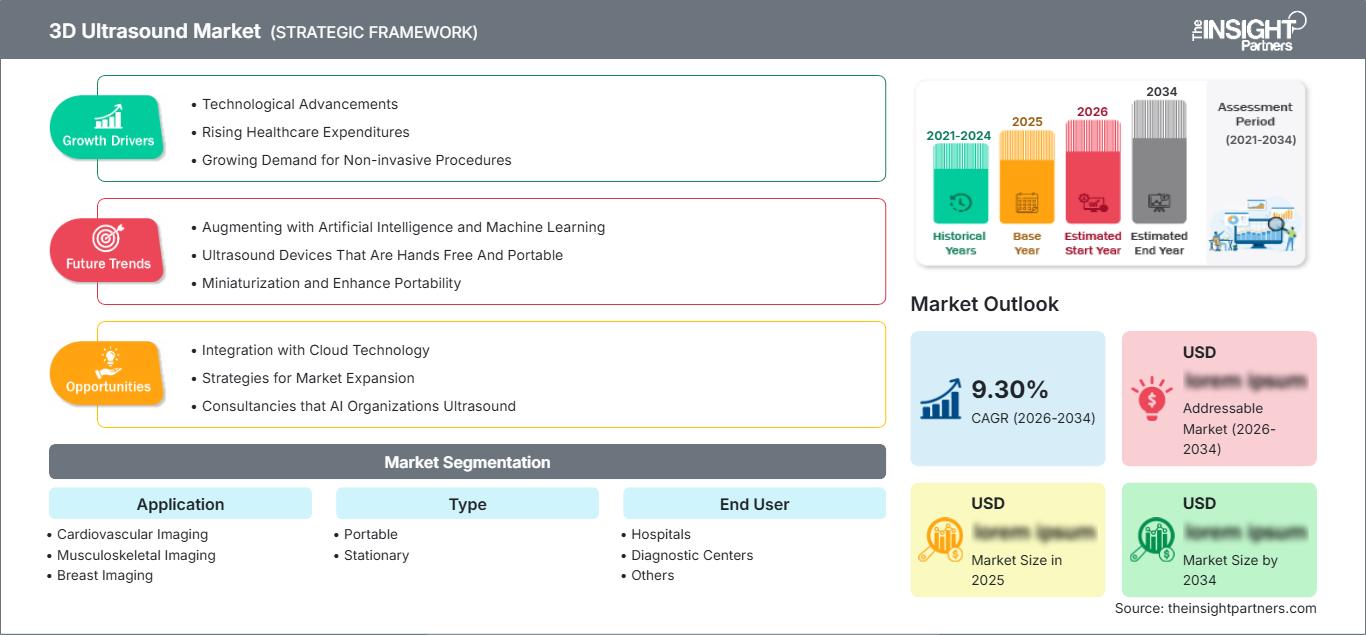
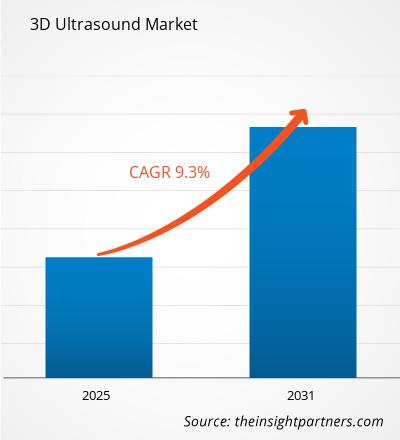
The 3d ultrasound market size stood at US$ 4.22 Billion in 2025, and is forecast to grow to US$ 7.99 Billion by 2034, exhibiting a CAGR of 7.35% from 2026 to 2034. Market growth will be driven by the increasing usage of 3D ultrasound technology in cardiovascular diagnostics, obstetrics and gynecology, breast examination, musculoskeletal diagnosis, and point-of-care portable applications.
In North America, the use of 3d ultrasounds is anticipated to grow at a CAGR of 6.8–7.8% until 2034, driven by the advanced imaging infrastructure, dense specialization network, and demand for AI-enabled ultrasound devices. The factors driving the growth of the 3d ultrasound market include the growing prevalence of cardiac disease screening, maternal imaging, dense breasts, and increased usage of portable ultrasound devices.
3D Ultrasound Market Assessment and Insights
- North America held 36–39% 3d ultrasound market share in 2025 and is projected to grow at a CAGR between 6.8–7.8% during 2026–2034, driven by ultrasound fleet upgrades, cardiovascular imaging demand, and mature hospital purchasing.
- US accounted for 82–86% of North America in 2025 and is forecast to grow at a CAGR between 6.9–7.9% during 2026–2034, led by cardiology and women’s health imaging.
- Europe represented 27–30% share in 2025 and is projected to grow at a CAGR between 6.3–7.3% during 2026–2034, with Germany, the UK, France, Italy, and Spain leading adoption.
- Asia Pacific captured 22–25% share in 2025 and is expected to grow at a CAGR between 8.2–9.2% during 2026–2034, led by China, Japan, India, South Korea, and Australia.
- Largest Segment Obstetrics and Gynecology Imaging held 30–33% market share in 2025 and is projected to grow at a CAGR between 7.1–8.1% during 2026–2034.
- High Growth Segment Portable held 34–37% market share in 2025 and is projected to grow at a CAGR between 8.5–9.5% during 2026–2034.
- Key companies analyzed in detail: GE HealthCare Technologies Inc., Esaote S.p.A., QT Ultrasound LLC, Samsung Medison Co., Ltd., Hitachi, Ltd., Siemens Healthineers AG, Wuhan Zoncare Bio-Medical Electronics Co., Ltd., Koninklijke Philips N.V., Shenzhen Mindray Bio-Medical Electronics Co., Ltd., Shantou Institute of Ultrasonic Instruments Co., Ltd.
Source: The Insight Partners' analysis based on proprietary research, government publications, company annual reports, investor presentations, industry databases, and expert interviews.
Volumetric ultrasound is progressing from specialist to wider diagnostic workflow applications due to advances in probe development, image processing, automation, and workflow software. Previous uses were focused on obstetric imaging, whereas present-day needs include cardiac 4D imaging, breast scanning, musculoskeletal evaluation, and portable clinical applications. Manufacturing is changing to platform renewal, software upgrades, proprietary probes, and service-based agreements, extending application beyond departmental boundaries.
Future development will be influenced by the rise of Asian healthcare capacity, AI-enabled data acquisition, cost reimbursement considerations, and limited radiologist staffing. Future investment trends include small size scanners, tele-radiology capabilities, measurement automation, and fleet management using the cloud. The market for 3D ultrasound is also being affected by increased demand for non-ionizing imaging, including repeated follow-up in obstetrics, cardiology, breast examination, and pediatrics.
3D Ultrasound Market Report Scope
| Report Attribute | Details |
|---|---|
| Market size in 2025 | US$ 4.22 Billion |
| Market Size by 2034 | US$ 7.99 Billion |
| Global CAGR (2026 - 2034) | 7.35% |
| Historical Data | 2021-2024 |
| Forecast period | 2026-2034 |
3D Ultrasound Market Analysis
Increasing demand comes from the increased chronic illness burden, higher rates of monitoring pregnancies, and the requirement for repeat imaging to be done more safely. Growth in 3D Ultrasound is driven by the burden of cardiovascular diseases as per WHO, maternal care requirements, and reducing the time taken in diagnosis because of limited availability of CT or MRI.
The market consists of players involved in transducers, system manufacturers, software developers, hospitals, diagnostic centers, specialists, and service providers. Dynamics in the supply side are improving with increasing offerings of AI presets, advanced beamforming, remote assistance, and automated quantification. Purchasing decisions have started taking into account total cost of ownership, efficiency, security, availability, and radiology information systems compatibility.
The competitive landscape is marked by high-quality imaging, workflow capabilities, and clinical scope. The 3d ultrasound market report reveals that GE HealthCare Technologies Inc., Koninklijke Philips N.V., Siemens Healthineers AG, Samsung Medison Co., Ltd., and Shenzhen Mindray Bio-Medical Electronics Co., Ltd. compete by means of state-of-the-art solutions, AI software, and wide care areas coverage.
Experts like Esaote S.p.A., QT Ultrasound LLC, Wuhan Zoncare Bio-Medical Electronics Co., Ltd., and Shantou Institute of Ultrasonic Instruments Co., Ltd. enhance the selection in musculoskeletal, breast, portable, and cost-effective markets. Positioning becomes increasingly associated with software updates, remote upgrades, clinical evidence, and local service networks rather than technical capabilities alone.
● REPORT CUSTOMIZATION
Tailor This Report To Align With Your Specific Business Requirements
This report can be customized to align precisely with your business objectives, scope, and target markets. Customization options include tailored segmentation, geography, competitive analysis, and strategic insights to support informed decision-making.
Customize This Report →WHAT YOU CAN ADJUST
- ● Segmentations
- ● Geography
- ● Competitive Analysis
- ● Language Preferences
3D Ultrasound Market: Strategic Insights
Regional Insights
North America 3d ultrasound market
North America held 36–39% share in 2025 and is forecast to grow at a CAGR between 6.8–7.8% during 2026–2034. The region benefits from high ultrasound utilization, strong cardiology and obstetrics networks, and continuous replacement of installed imaging systems. The 3d ultrasound market share is strongest in hospitals, maternal-fetal medicine, cardiology, and dense breast imaging pathways. Adoption is supported by physician preference for real-time imaging, non-ionizing diagnostics, and AI-assisted workflow tools that address sonographer shortages. Hospital systems are also standardizing ultrasound fleets to improve training, uptime, cybersecurity, and data integration. Demand remains strongest where volumetric imaging adds procedural confidence, improves anatomical visualization, or supports repeat follow-up without radiation exposure.
U.S. 3d ultrasound Market
North America comprised 82–86% of the total U.S. market share in 2025, and it is estimated to expand with a compound annual growth rate (CAGR) of 6.9–7.9% between 2026 and 2034. Market penetration is due to increased procedure volumes, superior cardiology programs, obstetric programs, outpatient imaging chains, and higher installed base of premium ultrasound machines. Trends in application of ultrasound include fetal imaging, echocardiography, musculoskeletal imaging, breast ultrasound for dense breast imaging, and point-of-care ultrasound in emergency and critical care departments. The key players in the industry include GE HealthCare Technologies Inc., Koninklijke Philips N.V., Siemens Healthineers AG, QT Ultrasound LLC, and Samsung Medison Co., Ltd.
Europe 3d ultrasound Market
The Europe region accounted for a market share of 27-30% in 2025 and is anticipated to witness growth with a CAGR of 6.3-7.3% over 2026-2034. Expansion is seen in the use of ultrasound devices in the UK in cardiology, obstetrics, breast care, and community diagnosis due to a need for rapid access out of the acute care hospital setting. Germany continues to lead in the region due to specialist imaging capability, network of private practitioners, and capital equipment adoption. France, Italy, and Spain are increasing usage in the field of women's health, musculoskeletal assessment, and out-patient diagnostics. The buyers in Europe prefer systems that ensure diagnostic confidence, ergonomics, cybersecurity, and remote service.
APAC 3d ultrasound Market
APAC captured 22–25% share in 2025 and is forecast to grow at a CAGR between 8.2–9.2% during 2026–2034. China is the leading country, followed by Japan, India, South Korea, and Australia, supported by hospital expansion, domestic manufacturing, and maternal care demand. Industrial policy, local production, and public healthcare investment are widening access to advanced imaging. Japan and South Korea emphasize premium cardiac and women’s health systems, while India’s growth is shaped by diagnostic center expansion and increasing portable ultrasound adoption.
Middle East & Africa 3d ultrasound Market
Middle East & Africa is projected to grow at a CAGR between 5.8–6.8% during 2026–2034. The UAE leads regional adoption through advanced private hospitals, medical tourism, and imaging modernization, while Saudi Arabia is investing in tertiary hospitals and national healthcare infrastructure. South Africa remains the most developed African market, supported by specialist imaging capacity and private healthcare networks. Rest of MEA adoption is gradual due to workforce, financing, and maintenance constraints, but portable systems support maternal, emergency, and community diagnostics.
Segmentation Analysis
Application
Application is projected to grow at a CAGR between 7.0–8.0% during 2026–2034. Application demand reflects the clinical value of volumetric imaging across anatomy, physiology, and procedural planning. The 3d ultrasound market scope is widening as departments use advanced visualization to improve diagnostic confidence, support repeat monitoring, and reduce dependence on higher-cost imaging where ultrasound provides sufficient insight.
- Cardiovascular Imaging remains strategically important because 3D and 4D echocardiography improve valve assessment, chamber quantification, structural heart planning, and follow-up in complex cardiac care.
- Musculoskeletal Imaging benefits from dynamic visualization, guided injections, tendon assessment, and sports medicine demand, especially where ultrasound offers faster examination and lower operating cost than MRI.
- Breast Imaging is gaining relevance in dense breast assessment, supplemental screening, and lesion characterization, supported by automated breast ultrasound and improved volumetric review tools.
- Obstetrics and Gynecology Imaging lead adoption because fetal anatomy, uterine assessment, reproductive medicine, and maternal-fetal monitoring benefit from clearer spatial visualization and patient communication.
Type
Type is expected to grow at a CAGR between 7.2–8.2% during 2026–2034. System selection depends on department workflow, throughput, image quality, portability, and service strategy. Stationary platforms remain central in high-volume hospitals and specialist practices, while portable systems are expanding in emergency care, outpatient centers, community screening, and bedside assessment.
- Portable systems are gaining importance as clinicians seek bedside imaging, faster triage, and wider access in outpatient, emergency, obstetric, and musculoskeletal settings without moving patients to imaging suites.
- Stationary systems remain essential for premium imaging, advanced probes, cardiac and obstetric workflows, and departments requiring high throughput, integrated reporting, and robust service contracts.
End User
End User is projected to grow at a CAGR between 6.9–7.9% during 2026–2034. Adoption varies by care setting, capital budgets, clinical specialization, and operator availability. Hospitals prioritize advanced capabilities and enterprise connectivity, diagnostic centers focus on throughput and utilization, while smaller facilities evaluate portable systems for access, triage, and focused imaging needs.
- Hospitals account for substantial demand because tertiary and secondary facilities require multipurpose ultrasound platforms for cardiology, obstetrics, emergency medicine, breast imaging, and procedural support.
- Diagnostic Centers invest in systems that improve exam efficiency, image consistency, remote review, and patient throughput across women’s health, cardiac, abdominal, and musculoskeletal imaging services.
Opportunity Snapshot
| Segment Name | Revenue Contribution | Trend Tag | Adoption Stage |
|---|---|---|---|
| Cardiovascular Imaging | High | 4D Echo | Scaling |
| Musculoskeletal Imaging | Medium | Guided MSK | Scaling |
| Breast Imaging | Medium | Dense Breast | Emerging |
| Obstetrics and Gynecology Imaging | High | Fetal View | Mature |
| Other Application | Low | General Scan | Mature |
3D Ultrasound Market Growth Drivers and Impact Analysis
Rising Need for Non-Ionizing Repeat Diagnostics
The increasing requirements for non-ionizing imaging have resulted from clinical challenges associated with pregnancy, cardiac disease, mammography, pediatrics, and chronic musculoskeletal problems where serial imaging and repeat imaging are required. Ultrasound offers real-time imaging without the use of any radiation. It can be applied in situations where patients require serial imaging and point-of-care imaging. The practical effect will be the increased use of ultrasound imaging in obstetrics, echocardiography, mammography of dense breasts, emergency medicine, and outpatient specialty imaging. Hospitals will be able to avoid the use of CT or MRI for specific patients, thereby increasing the flexibility in scheduling and reducing the workload on the systems.
AI-Assisted Workflow Addresses Workforce Constraints
A lack of skilled sonographers and increased patient volumes have made vendors focus on solutions that are related to AI-based acquisitions, automated measurements, and workflow standardizations. They will allow reducing manual actions, providing more consistent results, and enabling less skilled operators to produce diagnostic-quality images. This issue is crucial for such fields as cardiology, obstetrics, abdominal imaging, and mammography since the consistency of measurements is critical for making decisions. Integration of AI technologies into existing premium equipment and portable devices of vendors can support sales of upgrades, whereas users get increased efficiency without hiring more specialists.
Portable Platforms Expand Access Beyond Imaging Suites
The usage of portable ultrasound is extending the addressable market by making volumetric imaging more readily available near emergency rooms, operating rooms, out-patient clinics, rural settings, and point-of-care services. It helps in decreasing the movements of the patients, quickens the initial diagnosis process, and increases accessibility in the places where radiological services may not be available. The business implications will be the extended base of customers from the traditional imaging centers to include anesthesia, emergency room, orthopedics, women’s health, and rural diagnostic services. The portability will also help in developing hub and spoke model of healthcare.
3D Ultrasound Market Future Trends
AI-Led Volumetric Quantification
The next phase of 3d ultrasound market trends will be defined by AI-led volumetric quantification that turns complex image data into reproducible clinical measurements. Cardiology tools will increasingly automate ejection fraction, valve analysis, and chamber volumes, while obstetric and breast workflows will use automated segmentation and lesion tracking. Future systems will combine operator guidance, quality scoring, and structured reporting to reduce variability. As payers and hospitals demand evidence-based productivity gains, vendors that connect AI outputs with reporting systems and clinical audit trails will gain advantage across premium and portable ultrasound segments.
Remote Collaboration and Fleet Intelligence
Remote collaboration will become more important as health systems manage distributed imaging sites, workforce gaps, and equipment uptime. Ultrasound platforms are expected to include live expert support, remote troubleshooting, software upgrades, and analytics that identify utilization patterns across fleets. This trend will help hospitals standardize imaging protocols, support community clinics, and reduce service disruptions. For vendors, recurring software and service revenue will become more important than one-time system sales. Buyers will increasingly evaluate platforms based on cybersecurity, interoperability, remote access controls, and service response quality alongside image performance.
3D Ultrasound Market Opportunities
Women’s Health Imaging Modernization
Women’s health presents a strong investment opportunity because obstetrics, gynecology, and dense breast assessment require reliable, repeatable, and patient-friendly imaging. The 3d ultrasound market Forecasts indicate that demand will remain resilient where volumetric visualization improves fetal assessment, reproductive care, lesion characterization, and clinical communication. Vendors can capture value through premium probes, automated breast ultrasound, AI-assisted workflows, and ergonomic systems designed for high-volume practices. Health systems should prioritize platforms that integrate with reporting software, support remote review, and standardize image acquisition. Growth will be strongest where screening programs, private diagnostics, and maternal-fetal medicine networks are expanding together.
Portable Ultrasound for Distributed Care Models
Distributed care creates an opportunity for portable systems that support triage, follow-up, and focused imaging outside central radiology departments. Hospitals, urgent care networks, rural clinics, and ambulatory centers can use compact platforms to improve access and reduce delays. Investment should target systems with advanced probes, reliable battery life, wireless connectivity, remote expert support, and AI guidance that helps non-specialist users. The opportunity is particularly relevant in APAC, MEA, and underserved North American regions where imaging capacity is uneven. Sustainable business models will combine equipment, training, service, and tele-ultrasound support rather than hardware sales alone.
Recent Developments
- August 2025: GE HealthCare Technologies Inc. unveiled Vivid Pioneer, an AI-powered cardiovascular ultrasound system designed for advanced 2D, 4D, and color flow imaging. The company stated that the platform received CE Mark and U.S. FDA 510(k) clearance and includes next-generation cSound Pioneer architecture, enhanced probes, and automated measurement tools for complex cardiac assessment.
- August 2025: Koninklijke Philips N.V. launched Transcend Plus for EPIQ CVx and Affiniti CVx cardiovascular ultrasound systems. The release added FDA-cleared 2D and 3D image quality enhancements, AI-enabled clinical applications, and automation features intended to improve cardiac imaging confidence, workflow speed, and reproducibility in echocardiography departments.
- January 2025: Siemens Healthineers AG showcased Acuson Maple and Acuson Sequoia ultrasound solutions at AOCR 2025 in Chennai. The company highlighted Acuson Maple as a portable AI-powered ultrasound system and Acuson Sequoia for liver and musculoskeletal imaging, aligning its portfolio with diversified diagnostic imaging needs across Asian healthcare settings.
Frequently Asked Questions

- Comprehensive Market Sizing and Forecast Analysis
- Detailed Segmentation Analysis
- In-Depth Market Dynamics Assessment
- Regional and Country-Level Insights
- Competitive Landscape and Company Benchmarking
- Strategic Business Intelligence
Recent Reports
Testimonials

The Insight Partners' SCADA System Market report is comprehensive, with valuable insights on current trends and future forecasts. The team was highly professional, responsive, and supportive throughout. We are very satisfied and highly recommend their services.
RAN KEDEM Partner, Reali Technologies LTDs
I requested a report on a very specific software market and the team produced the report in a few days. The information was very relevant and well presented. I then requested some changes and additions to the report. The team was again very responsive and I got the final report in less than a week.
JEAN-HERVE JENN Chairman, Future Analytica
We worked with The Insight Partners for an important market study and forecast. They gave us clear insights into opportunities and risks, which helped shape our plans. Their research was easy to use and based on solid data. It helped us make smart, confident decisions. We highly recommend them.
PIYUSH NAGPAL Sr. Vice President, High Beam Global
The Insight Partners delivered insightful, well-structured market research with strong domain expertise. Their team was professional and responsive throughout. The user-friendly website made accessing industry reports seamless. We highly recommend them for reliable, high-quality research services
YUKIHIKO ADACHI CEO, Deep Blue, LLC.
This is the first time I have purchased a market report from The Insight Partners.While I was unsure at first, I visited their web site and felt more comfortable to take the risk and purchase a market report.I am completely satisfied with the quality of the report and customer service. I had several questions and comments with the initial report, but after a couple of dialogs over email with their analyst I believe I have a report that I can use as input to our strategic planning process.Thank you so much for taking the extra time and making this a positive experience.I will definitely recommend your service to others and you will be my first call when we need further market data.
JOHN SUZUKI President and Chief Executive Officer, Board Director, BK Technologies
I wish to appreciate your support and the professionalism you displayed in the course of attending to my request for information regarding to infectious disease IVD market in Nigeria. I appreciate your patience, your guidance, and the fact that you were willing to offer a discount, which eventually made it possible for us to close a deal. I look forward to engaging The Insight Partners in the future, all thanks to the impression you have created in me as a result of this first encounter.
DR CHIJIOKE ONYIA MANAGING DIRECTOR, PineCrest Healthcare Ltd.Reason to Buy
- Informed Decision-Making
- Understanding Market Dynamics
- Competitive Analysis
- Identifying Emerging Markets
- Customer Insights
- Market Forecasts
- Risk Mitigation
- Boosting Operational Efficiency
- Strategic Planning
- Investment Justification
- Tracking Industry Innovations
- Aligning with Regulatory Trends





 Get Free Sample for